Modern networks operate in an environment where data constantly moves across shared and often untrusted infrastructure. Whether organizations are connecting branch offices, supporting remote employees, or enabling cloud-based services, the need to protect data in transit has become critical. This is where secure networking technologies such as Virtual Private Networks come into play.
A Virtual Private Network creates a protected communication path over an existing network, most commonly the internet. It ensures that data remains confidential, maintains its integrity, and is exchanged only between verified parties. Without such protections, sensitive information like credentials, business data, and personal communications would be exposed to interception and misuse.
The concept of secure networking is not new. However, the scale and complexity of modern networks have made it more important than ever to understand how these protections work. Among the various technologies used to secure communications, IPsec stands out as one of the most widely adopted and robust solutions.
What Is a Virtual Private Network
A Virtual Private Network, or VPN, is a method of extending a private network across a public or shared infrastructure. It allows devices to send and receive data as if they were directly connected to a private network, even when they are physically located elsewhere.
The primary function of a VPN is encryption. When data is sent through a VPN, it is encrypted before transmission and decrypted upon arrival. This process ensures that even if the data is intercepted, it cannot be understood without the appropriate decryption key.
VPNs also provide authentication, which verifies the identity of the communicating parties. This prevents unauthorized access and ensures that only trusted devices can participate in the communication.
Another important feature is data integrity. VPNs use cryptographic techniques to ensure that data is not altered during transmission. If any modification occurs, it can be detected immediately.
While VPNs are often associated with secure internet browsing, they are also used in enterprise environments to connect remote offices, enable secure remote access, and protect communication across private circuits.
The Role of Encryption in VPNs
Encryption is the foundation of any VPN. It transforms readable data into an unreadable format using mathematical algorithms and encryption keys. Only those with the correct key can reverse the process and access the original data.
There are different types of encryption used in VPNs, ranging from symmetric encryption, where the same key is used for encryption and decryption, to asymmetric encryption, which uses a pair of keys. These methods are often combined to provide both security and efficiency.
Encryption ensures confidentiality, but it also plays a role in maintaining trust. In a world where cyber threats are constantly evolving, strong encryption provides a reliable defense against unauthorized access.
However, encryption alone is not enough. It must be integrated into a broader framework that includes authentication, key management, and secure data handling. This is where protocols like IPsec come into the picture.
Introduction to IPsec
Internet Protocol Security, commonly referred to as IPsec, is a suite of protocols designed to secure IP communications. It operates at the network layer, which allows it to protect nearly all types of traffic without requiring changes to individual applications.
IPsec was developed in the 1990s as a response to growing concerns about the security of internet communications. Over time, it has been refined and standardized, making it a reliable and widely supported solution for secure networking.
One of the key strengths of IPsec is its flexibility. It can be used in a variety of scenarios, including site-to-site connections, remote access VPNs, and secure communication between individual devices.
IPsec achieves security through a combination of encryption, authentication, and integrity checks. It ensures that data remains confidential, that it comes from a trusted source, and that it has not been tampered with during transmission.
Core Components of IPsec
IPsec relies on several key components to provide its functionality. Two of the most important are the Authentication Header and the Encapsulating Security Payload.
The Authentication Header focuses on ensuring data integrity and authenticity. It verifies that the data has not been altered and that it originates from a legitimate source. However, it does not provide encryption.
The Encapsulating Security Payload, on the other hand, offers both encryption and integrity. It protects the data by encrypting it and also includes mechanisms to verify its authenticity. Because of its comprehensive capabilities, it is more commonly used in modern implementations.
Another important aspect of IPsec is the concept of Security Associations. These define the parameters for secure communication, including encryption algorithms, keys, and protocols. Each communication session is governed by a Security Association, ensuring consistent and secure handling of data.
Understanding IPsec Modes
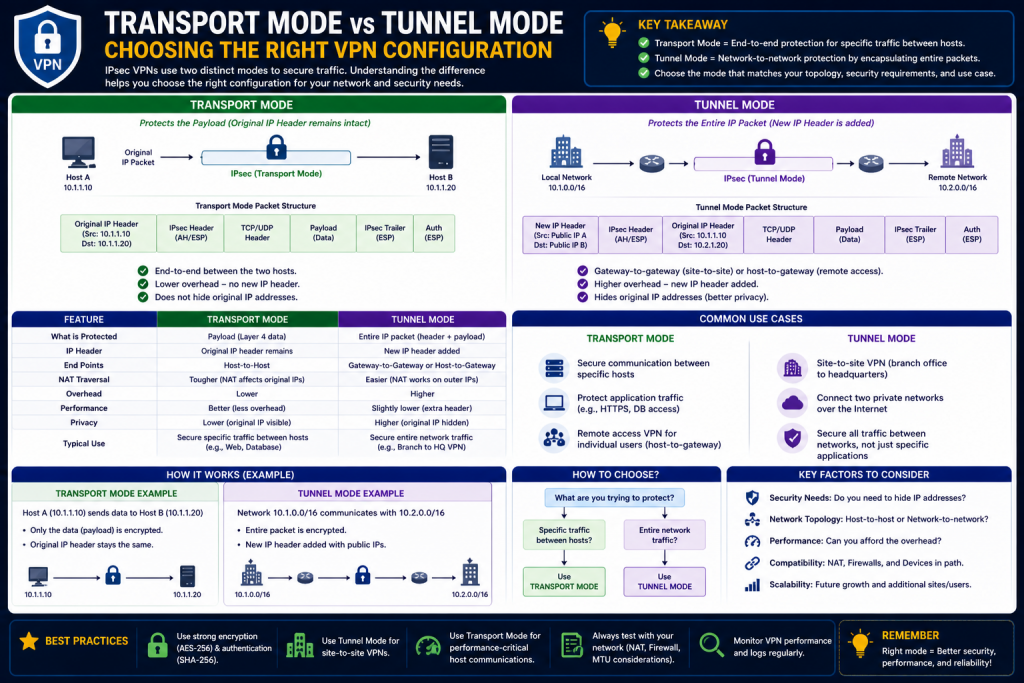
IPsec operates in two primary modes: transport mode and tunnel mode. These modes determine how data packets are processed and transmitted.
The choice between these modes affects the level of security, the type of communication, and the overall network design. While both modes use the same underlying protocols, they differ significantly in how they handle data.
Transport mode focuses on encrypting the data within a packet, while tunnel mode encapsulates and encrypts the entire packet. This distinction has important implications for both security and functionality.
In this part, the focus is on transport mode, which represents a more targeted approach to securing communications.
What Is Transport Mode
Transport mode is a method of securing communication where only the payload of an IP packet is encrypted. The payload is the portion of the packet that contains the actual data being transmitted.
In this mode, the original IP header remains unchanged and unencrypted. This means that information such as the source and destination IP addresses is visible to anyone who can intercept the packet.
Transport mode is typically used for direct communication between two endpoints. These endpoints could be individual devices, servers, or network nodes that require secure data exchange.
Because it does not encapsulate the entire packet, transport mode is more efficient in terms of processing and bandwidth usage. However, it provides less privacy compared to tunnel mode.
Structure of an IP Packet in Transport Mode
To understand how transport mode works, it is important to examine the structure of an IP packet.
An IP packet consists of two main parts: the header and the payload. The header contains information needed for routing, such as the source and destination addresses. The payload contains the actual data being transmitted.
In transport mode, IPsec encrypts only the payload. The header remains in its original form, allowing routers to read it and forward the packet to its destination.
This approach ensures compatibility with existing network infrastructure. Since routers rely on the header to make routing decisions, leaving it unencrypted simplifies the process.
However, this also means that certain information about the communication is exposed. While the data itself is protected, the metadata remains visible.
How Transport Mode Works
When a device sends data using transport mode, the process begins with the creation of a standard IP packet. IPsec then encrypts the payload using the selected encryption algorithm.
After encryption, the packet is transmitted across the network. Intermediate devices, such as routers, use the unencrypted header to determine the path of the packet.
Upon reaching the destination, the receiving device uses the appropriate keys to decrypt the payload. The data is then processed as usual.
This process ensures that the data remains secure while allowing normal network operations to continue without disruption.
Historical Context of Transport Mode
Transport mode was developed during a time when network security was less advanced than it is today. In the early days of the internet, many protocols transmitted data in plain text, making them vulnerable to interception.
At the same time, tunneling protocols such as Layer Two Tunneling Protocol and Generic Routing Encapsulation were used to connect networks. These protocols provided a way to create virtual connections but did not offer strong encryption.
Transport mode allowed organizations to add encryption to these existing tunnels without replacing them. By securing the payload, it enhanced the overall security of the network while preserving the existing infrastructure.
This approach was particularly valuable during the transition to more secure networking practices.
Securing Existing Tunnels
One of the most common uses of transport mode is to secure traffic within existing tunneling protocols. For example, an organization using a tunneling protocol to connect two sites can apply transport mode to encrypt the data flowing through that tunnel.
In this scenario, the tunneling protocol handles the encapsulation, while transport mode provides encryption. This combination allows for secure communication without the need for significant changes to the network design.
It also simplifies troubleshooting, as engineers can continue using familiar tools and methods associated with the tunneling protocol.
Direct Endpoint Communication
Transport mode is well suited for scenarios where two endpoints need to communicate securely over a network. This could involve servers exchanging sensitive information or devices communicating in a controlled environment.
In such cases, there is no need to encrypt traffic for an entire network. Instead, the focus is on securing a specific connection between two devices.
This makes transport mode a lightweight and efficient solution. It provides the necessary security without introducing additional complexity.
However, because the header remains visible, it may not be suitable for situations where complete privacy is required.
Client-Based Connections
In some cases, transport mode has been used in client-based VPN connections. A client device establishes a secure connection with a central server, encrypting the data exchanged between them.
While this approach is less common today, it demonstrates the flexibility of transport mode. It can be adapted to different scenarios depending on the requirements of the network.
Modern implementations often favor other methods, but transport mode remains a viable option in certain environments.
Comparison with Application-Level Security
Transport mode shares similarities with application-level security mechanisms. For example, when using secure web connections, the data transmitted between a browser and a server is encrypted, but the IP addresses remain visible.
This highlights the role of transport mode as a targeted security measure. It protects the data itself while allowing the network to function normally.
Such an approach can be sufficient in many cases, particularly when combined with other security measures.
Advantages of Transport Mode
Transport mode offers several benefits that make it useful in specific scenarios.
It is efficient because it does not require additional encapsulation. This reduces overhead and improves performance.
It is compatible with existing network infrastructure, allowing for seamless integration.
It is suitable for direct communication between endpoints, providing a straightforward solution for securing specific connections.
It also allows organizations to enhance the security of existing tunneling protocols without significant changes.
Limitations of Transport Mode
Despite its advantages, transport mode has certain limitations that must be considered.
The lack of full packet encryption means that sensitive information in the header is exposed. This can reveal details about the communication, such as the endpoints involved.
It is not ideal for site-to-site communication, where entire networks need to be secured.
It provides less privacy compared to other methods, making it less suitable for environments with strict security requirements.
It may also require additional protocols to achieve full tunneling functionality.
The Shift Toward More Comprehensive Security
As network security requirements have evolved, there has been a shift toward more comprehensive solutions. Organizations now require not only encryption but also greater privacy and flexibility.
This has led to the widespread adoption of alternative approaches that address the limitations of transport mode. While transport mode remains relevant, it is often used in specialized scenarios rather than as a default choice.
Understanding its role and capabilities is still important, as it provides valuable insight into the evolution of secure networking.
Preparing for Deeper Exploration
Having established a solid understanding of VPNs, IPsec, and transport mode, the next step is to explore how tunnel mode builds upon these concepts.
Tunnel mode introduces a different approach to securing data, one that encapsulates and encrypts entire packets. This provides a higher level of security and is widely used in modern networking environments.
The following section will examine tunnel mode in detail, highlighting its structure, use cases, and advantages over transport mode.
Introduction to Tunnel Mode
As network security requirements evolved, organizations needed more than just payload encryption. They required a method that could fully protect communications, hide internal network structures, and simplify secure connectivity between entire networks. This demand led to the widespread adoption of tunnel mode within IPsec.
Tunnel mode represents a more comprehensive approach to securing data in transit. Unlike transport mode, which encrypts only the payload, tunnel mode encapsulates the entire original packet and then encrypts it. This additional layer of protection makes it significantly more secure and versatile.
Today, tunnel mode is the default choice in most enterprise VPN deployments. It is used in site-to-site connections, remote access solutions, and even cloud networking environments. Understanding how tunnel mode works is essential for anyone involved in network design, security, or troubleshooting.
How Tunnel Mode Works
In tunnel mode, the original IP packet is completely encapsulated within a new packet. This process involves taking the entire original packet—including its header and payload—and wrapping it inside another IP packet.
Once encapsulated, the entire inner packet is encrypted. A new outer header is then added, which contains the source and destination addresses of the VPN endpoints, such as firewalls or VPN gateways.
This means that anyone intercepting the packet can only see the outer header. The original source, destination, and data remain hidden inside the encrypted portion.
When the packet reaches the destination VPN endpoint, the outer header is removed, the inner packet is decrypted, and the original data is forwarded to its intended destination.
This process provides both confidentiality and a level of anonymity, as the internal structure of the network is completely obscured.
Structure of a Packet in Tunnel Mode
To better understand tunnel mode, it is helpful to break down the packet structure.
A standard IP packet consists of a header and a payload. In tunnel mode, this entire packet becomes the payload of a new packet. The steps can be described as follows:
The original packet is created as usual, containing its header and payload.
IPsec then encrypts the entire packet.
A new IP header is added to the encrypted data. This header contains the addresses of the VPN endpoints rather than the original sender and receiver.
The result is a packet that appears to be traveling between two VPN devices, even though it actually contains data intended for internal systems.
This layered structure is what gives tunnel mode its strength. It separates the external routing information from the internal communication details.
Key Differences from Transport Mode
The most significant difference between tunnel mode and transport mode lies in what is encrypted.
In transport mode, only the payload is encrypted, leaving the original header exposed.
In tunnel mode, the entire original packet is encrypted and hidden inside a new packet.
This difference has several important implications.
Tunnel mode provides better privacy because it conceals the identities of the communicating endpoints.
It supports network-to-network communication, making it ideal for connecting entire sites.
It introduces additional overhead due to encapsulation, but this is generally acceptable given the increased security.
These differences explain why tunnel mode has become the preferred choice in most modern environments.
Site-to-Site VPNs and Tunnel Mode
One of the most common uses of tunnel mode is in site-to-site VPNs. In this scenario, two or more networks are connected securely over the internet.
Each site typically has a VPN gateway, such as a firewall or router, that handles encryption and decryption. When a device on one network sends data to a device on another network, the gateway encapsulates the packet using tunnel mode.
The packet is then transmitted over the internet to the remote gateway. Upon arrival, it is decrypted and forwarded to the destination device.
From the perspective of users, this process is seamless. It appears as though the networks are directly connected, even though the communication is taking place over a public infrastructure.
Tunnel mode makes this possible by securely transporting entire packets between gateways.
Benefits for Enterprise Networking
Tunnel mode offers several advantages that make it ideal for enterprise environments.
It provides complete encryption of data, ensuring that sensitive information remains protected.
It hides internal IP addresses, reducing the risk of exposure and potential attacks.
It simplifies network design by combining tunneling and encryption into a single solution.
It supports interoperability between different vendors, as IPsec is a standardized protocol.
These benefits have contributed to its widespread adoption across industries.
Remote Access VPNs and Tunnel Mode
Tunnel mode is also widely used in remote access VPNs. In this setup, an individual user connects to a corporate network from a remote location.
The user’s device establishes a secure tunnel with a VPN gateway, often using specialized client software. Once connected, all traffic between the device and the network is encrypted using tunnel mode.
This allows remote users to access internal resources as if they were physically present within the organization’s network.
Tunnel mode ensures that not only the data but also the internal addressing information is protected. This is particularly important when accessing sensitive systems or data.
Full Network Access vs Restricted Access
While tunnel mode is capable of providing access to entire networks, it does not mean that all resources must be exposed.
Organizations often implement access control mechanisms such as firewall rules and access control lists. These controls determine which resources a user or system can access within the network.
This combination of secure tunneling and granular access control provides both flexibility and security.
Tunnel mode handles the secure transport of data, while additional controls enforce security policies within the network.
Security Advantages of Tunnel Mode
One of the most significant advantages of tunnel mode is its ability to provide comprehensive security.
By encrypting the entire packet, it ensures that no part of the original communication is exposed.
This includes not only the data but also the source and destination addresses.
This level of protection makes it difficult for attackers to analyze traffic patterns or identify communication endpoints.
It also helps protect against certain types of attacks, such as packet sniffing and traffic analysis.
In addition, tunnel mode supports strong encryption algorithms and authentication methods, further enhancing security.
Overhead and Performance Considerations
While tunnel mode provides enhanced security, it also introduces additional overhead.
Encapsulation increases the size of each packet, which can impact bandwidth usage.
Encryption and decryption require processing power, which can affect performance, especially on devices with limited resources.
However, modern hardware and optimized algorithms have significantly reduced these impacts.
In most cases, the benefits of tunnel mode far outweigh the performance costs.
Network designers must still consider these factors when planning large-scale deployments.
NAT and Addressing Challenges
One challenge that can arise with tunnel mode is overlapping IP address spaces.
When two networks use the same internal IP ranges, routing conflicts can occur.
To address this, techniques such as Network Address Translation can be used to remap addresses.
This allows the networks to communicate without conflicts, even if their internal addressing schemes overlap.
While this adds complexity, it is a common and manageable aspect of tunnel mode deployments.
Evolution of Tunnel Mode Adoption
In the early days of IPsec, there was some hesitation in adopting tunnel mode. Many organizations were already using existing tunneling protocols and were reluctant to change.
Over time, as IPsec matured and standards became more stable, tunnel mode gained widespread acceptance.
Its ability to combine tunneling and encryption into a single solution made it an attractive choice.
Today, it is supported by virtually all networking vendors and is considered a standard approach to secure communication.
Integration with Modern Technologies
Tunnel mode continues to play a vital role in modern networking.
It is widely used in software-defined wide area networks, where it enables secure connectivity between distributed sites.
It is also a key component in cloud networking, allowing organizations to connect on-premises environments with cloud infrastructure securely.
In addition, it supports hybrid and multi-cloud architectures, providing a consistent security model across different environments.
This adaptability ensures that tunnel mode remains relevant in an ever-changing technological landscape.
Practical Deployment Considerations
When deploying tunnel mode, several factors must be considered.
Proper configuration of encryption algorithms and key management is essential for security.
Network topology must be designed to ensure efficient routing and minimal latency.
Redundancy and failover mechanisms should be implemented to maintain availability.
Monitoring and logging are important for detecting and responding to potential issues.
By carefully planning these aspects, organizations can maximize the benefits of tunnel mode.
When Tunnel Mode May Not Be Ideal
Although tunnel mode is highly versatile, there are scenarios where it may not be the best choice.
In environments with strict performance requirements, the additional overhead may be a concern.
In cases where only specific endpoints need to communicate securely, transport mode may be more efficient.
Addressing conflicts and NAT requirements can also add complexity.
These considerations highlight the importance of understanding both modes and selecting the appropriate one based on specific needs.
The Dominance of Tunnel Mode
Despite its limitations, tunnel mode has become the dominant mode in IPsec deployments.
Its ability to provide comprehensive security, support diverse use cases, and integrate with modern technologies makes it the preferred option.
Most network engineers assume tunnel mode by default when working with IPsec.
Transport mode is typically reserved for specialized scenarios.
This trend reflects the broader shift toward more secure and flexible networking solutions.
Preparing for Final Comparison
With a clear understanding of both transport mode and tunnel mode, the next step is to compare them directly.
This comparison will highlight their strengths, weaknesses, and ideal use cases.
It will also provide guidance on choosing the right mode for different scenarios.
The final section will bring these concepts together, offering practical recommendations and a clear answer to the question of which mode to use.
Bringing the Two Modes Together
After exploring both transport mode and tunnel mode in depth, it becomes clear that each serves a distinct purpose within IPsec-based VPN implementations. While they share the same foundational protocols and security mechanisms, their design philosophies differ significantly. Transport mode focuses on efficiency and direct communication, whereas tunnel mode emphasizes comprehensive protection and scalability.
Understanding these differences is essential for making informed decisions in real-world networking scenarios. The choice between the two modes is not simply about preference but about aligning the solution with the specific requirements of the environment.
In modern networks, where security threats are increasingly sophisticated and infrastructures are more complex, selecting the appropriate mode can have a significant impact on performance, security, and manageability.
Core Functional Differences
At the most fundamental level, the distinction between transport mode and tunnel mode lies in how they handle IP packets.
Transport mode encrypts only the payload of the packet. The original header remains visible, allowing routers to process and forward the packet without modification. This makes transport mode efficient and straightforward but limits its ability to conceal communication details.
Tunnel mode, in contrast, encapsulates the entire original packet and encrypts it. A new header is added, which represents the communication between VPN endpoints rather than the original sender and receiver. This approach provides a higher level of privacy and security.
These differences influence how each mode is used and the types of scenarios in which they are most effective.
Security Comparison
Security is often the primary factor when choosing between transport mode and tunnel mode.
Transport mode provides strong encryption for the data itself. The payload is protected from interception, ensuring that sensitive information cannot be easily accessed. However, because the header is not encrypted, certain metadata remains exposed. This includes the source and destination IP addresses, which can reveal communication patterns.
Tunnel mode offers a more comprehensive level of security. By encrypting the entire packet, it hides both the data and the metadata. This makes it much more difficult for attackers to analyze traffic or identify communication endpoints.
In environments where privacy and confidentiality are critical, tunnel mode is generally the better choice. It reduces the attack surface and provides an additional layer of protection against traffic analysis.
Performance and Efficiency
Performance is another important consideration.
Transport mode is more efficient because it does not require encapsulation. The absence of an additional header means that packet sizes remain smaller, and less processing power is required for encryption and decryption.
Tunnel mode introduces additional overhead due to encapsulation. Each packet becomes larger, which can increase bandwidth usage. The encryption of the entire packet also requires more computational resources.
However, advances in hardware and optimization techniques have minimized these performance differences. Modern networking devices are capable of handling tunnel mode efficiently, even in high-throughput environments.
In most cases, the performance impact of tunnel mode is outweighed by its security benefits. Nevertheless, in scenarios where resources are limited or latency is critical, transport mode may still be a viable option.
Use Case Comparison
The practical use of each mode depends heavily on the scenario.
Transport mode is best suited for direct communication between two endpoints. This could involve server-to-server communication, device-to-device interactions, or securing specific applications. It is also useful when combined with other tunneling protocols, where it adds encryption without altering the existing structure.
Tunnel mode is ideal for connecting entire networks. It is commonly used in site-to-site VPNs, where multiple devices on each network need to communicate securely. It is also widely used in remote access VPNs, enabling users to connect to a corporate network from anywhere in the world.
The broader scope of tunnel mode makes it more versatile and suitable for modern networking needs.
Real-World Deployment Scenarios
In enterprise environments, tunnel mode is the dominant choice. Organizations often need to connect multiple offices, support remote workers, and integrate with cloud services. Tunnel mode provides the flexibility and security required for these tasks.
For example, a company with offices in different cities can use tunnel mode to create secure connections between them. Employees can access shared resources as if they were on the same network, while all communication remains encrypted.
Remote workers can also use tunnel mode to connect to the corporate network. This ensures that their data is protected, even when using public internet connections.
Transport mode, while less common, still has its place. It may be used in specialized scenarios where only specific endpoints need secure communication. It can also be useful in environments where performance is a primary concern.
Interaction with Other Technologies
Modern networks often involve a combination of technologies, and the choice of IPsec mode can affect how these technologies interact.
Tunnel mode integrates well with software-defined networking and cloud platforms. It provides a consistent security model that can be applied across different environments.
It also works seamlessly with network segmentation strategies, allowing organizations to isolate and protect different parts of their infrastructure.
Transport mode, on the other hand, is more focused on specific connections. It can be used alongside application-level encryption or other security mechanisms to provide layered protection.
Understanding how each mode fits into the broader network architecture is essential for effective design and implementation.
Addressing and Routing Considerations
Routing and addressing play a significant role in determining which mode to use.
Transport mode relies on the original IP header for routing. This simplifies the process but limits flexibility. It is not well suited for scenarios where internal addressing needs to be hidden or modified.
Tunnel mode introduces a new header, which allows for greater flexibility in routing. It enables the use of private IP addresses within the tunnel, even when communicating over public networks.
However, tunnel mode can also introduce challenges, such as overlapping IP address spaces. These issues can be resolved باستخدام techniques like network address translation, but they require careful planning.
Overall, tunnel mode provides more options for complex network designs.
Troubleshooting Differences
Troubleshooting VPN issues can vary depending on the mode being used.
Transport mode is generally easier to troubleshoot because the original packet structure is preserved. Network engineers can analyze traffic more directly and identify issues without dealing with additional layers of encapsulation.
Tunnel mode can be more complex due to the encapsulation process. Engineers must consider both the outer and inner packets when diagnosing problems. Tools and techniques must be adapted to account for this layered structure.
Despite this complexity, modern diagnostic tools and monitoring systems have made it easier to manage tunnel mode environments.
Legacy Systems and Compatibility
Legacy systems can influence the choice between transport mode and tunnel mode.
Older networks may rely on protocols that were designed before IPsec became widely adopted. In such cases, transport mode can be used to add encryption without disrupting existing configurations.
Tunnel mode, while more modern, may require changes to network design or infrastructure. However, its compatibility with a wide range of vendors and systems has made it a standard choice in most environments.
As organizations modernize their networks, they often transition from transport mode or legacy solutions to tunnel mode for improved security and scalability.
Decision-Making Framework
Choosing between transport mode and tunnel mode requires a clear understanding of the requirements and constraints of the network.
If the goal is to secure communication between specific endpoints with minimal overhead, transport mode may be appropriate.
If the objective is to connect entire networks, support remote access, or provide comprehensive security, tunnel mode is the better choice.
Other factors to consider include performance requirements, existing infrastructure, scalability, and security policies.
By evaluating these factors, network engineers can make informed decisions that align with organizational goals.
Common Misconceptions
There are several misconceptions about transport mode and tunnel mode that can lead to confusion.
One common misconception is that transport mode is outdated or irrelevant. While it is less commonly used, it still serves important purposes in certain scenarios.
Another misconception is that tunnel mode is always the best choice. While it is highly versatile, it may not be necessary for every situation.
Understanding the strengths and limitations of each mode helps avoid these misconceptions and ensures that the chosen solution is appropriate.
Future Trends in VPN Technology
As networking continues to evolve, VPN technologies are also changing.
New approaches such as zero trust networking and software-defined perimeters are gaining popularity. These models focus on securing individual connections rather than entire networks.
Despite these changes, IPsec and its modes remain relevant. Tunnel mode continues to be a key component in many modern architectures, particularly in hybrid and multi-cloud environments.
Transport mode may see continued use in specialized scenarios, particularly যেখানে efficiency and simplicity are important.
The ability to adapt these modes to new technologies ensures their ongoing relevance.
Practical Recommendations
For most modern deployments, tunnel mode should be considered the default choice. It provides comprehensive security, supports a wide range of use cases, and integrates well with current technologies.
Transport mode should be used when there is a clear need for its specific advantages. This includes scenarios involving direct endpoint communication or the integration of existing tunneling protocols.
Organizations should also consider future scalability when making their decision. Choosing a mode that supports growth and evolving requirements can save time and resources in the long term.
Proper planning, testing, and monitoring are essential for successful implementation, regardless of the mode chosen.
Conclusion
Transport mode and tunnel mode are both integral parts of the IPsec framework, each offering unique advantages and serving different purposes. Transport mode provides a lightweight and efficient way to secure direct communications by encrypting only the payload. It is best suited for specific, targeted use cases যেখানে simplicity and performance are priorities.
Tunnel mode, on the other hand, delivers a more comprehensive solution by encapsulating and encrypting entire packets. This approach ensures greater privacy, supports network-to-network communication, and aligns with the demands of modern enterprise environments.
In today’s networking landscape, tunnel mode has become the standard due to its versatility and robust security features. It is widely used for site-to-site connections, remote access VPNs, and cloud integration.
However, transport mode still holds value in specialized scenarios and should not be overlooked. The key is to understand the requirements of the network and choose the mode that best fits those needs.
By mastering both transport mode and tunnel mode, network professionals can design secure, efficient, and scalable systems that meet the challenges of today and adapt to the demands of the future.
Continue exploring the technologies and certification concepts that matter most to you.