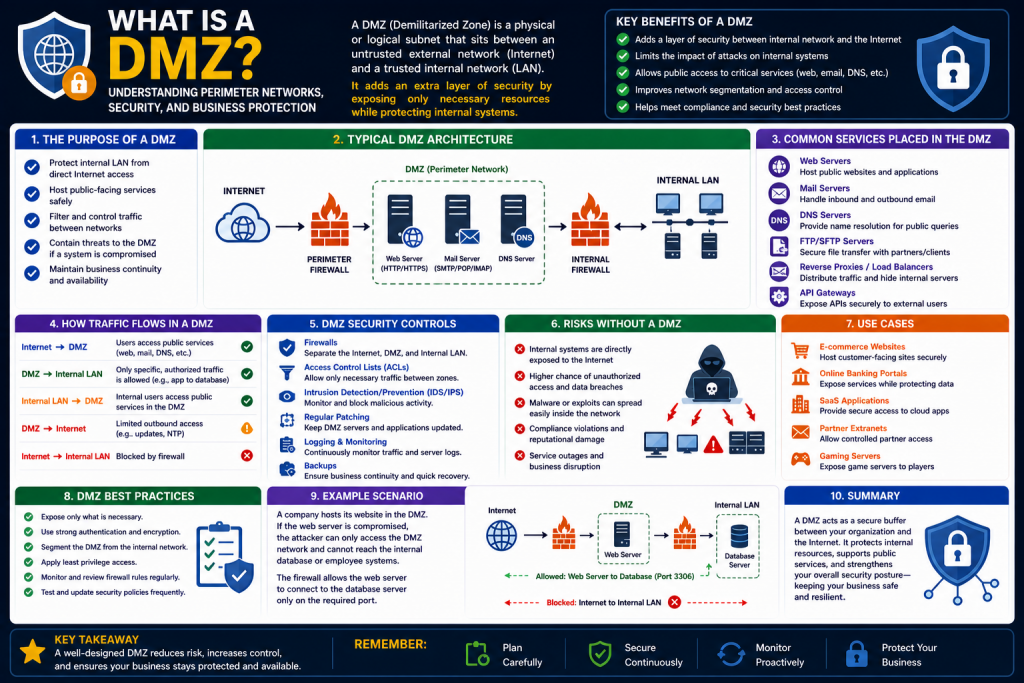
In today’s interconnected digital environment, the concept of a network boundary has evolved significantly. Organizations are no longer operating within isolated systems. Instead, they rely heavily on internet connectivity, cloud services, and remote access solutions. This evolution has made it essential to rethink how networks are structured and protected. One of the most important architectural components that emerged from this need is the perimeter network, commonly known as a Demilitarized Zone or DMZ.
A perimeter network serves as a buffer between trusted internal systems and untrusted external environments. Rather than exposing internal infrastructure directly to the internet, organizations use this intermediate layer to manage and control access. This design reduces the risk of unauthorized access while still allowing necessary communication with external users and systems.
The increasing sophistication of cyber threats has made such layered approaches to security not just beneficial but necessary. Attackers often look for the weakest entry point, and without proper segmentation, a single vulnerability can compromise an entire network. The DMZ helps prevent this by introducing controlled separation.
Defining the DMZ in Networking
The term Demilitarized Zone originates from military terminology, where it refers to a neutral area between opposing forces. In networking, the concept is similar. A DMZ is a distinct segment that separates two environments with different levels of trust.
In practical terms, the DMZ is positioned between the internal network and external networks such as the internet. Systems placed within this zone are accessible from outside but are isolated from sensitive internal resources. This isolation is achieved through strict security controls, including firewalls, access control lists, and routing policies.
The DMZ is neither fully trusted nor completely untrusted. Instead, it operates as a controlled environment where interactions can take place under carefully defined conditions. This dual role makes it a critical component in network security architecture.
Purpose of a Perimeter Network
The primary purpose of a perimeter network is to provide a secure area for hosting services that must be accessible from outside the organization. These services might include web servers, email gateways, remote access portals, or file-sharing systems.
Without a DMZ, these services would need to reside within the internal network, exposing critical systems to potential threats. By placing them in a separate zone, organizations can limit the impact of attacks. Even if a service in the DMZ is compromised, the attacker does not gain direct access to the internal network.
Another important purpose of the DMZ is traffic regulation. It allows organizations to define exactly how data flows between external users and internal systems. This level of control is essential for maintaining both security and performance.
Evolution of Network Security Design
In the early days of networking, security was often perimeter-based in a very literal sense. Organizations relied heavily on a single firewall at the network edge. Once traffic passed through this firewall, it was generally trusted.
However, this model proved insufficient as threats became more advanced. Attackers found ways to bypass perimeter defenses or exploit vulnerabilities within the network. As a result, the concept of layered security, also known as defense in depth, became more widely adopted.
The DMZ is a key element of this layered approach. Instead of relying on a single line of defense, organizations create multiple barriers that an attacker must overcome. Each layer adds complexity and reduces the likelihood of a successful breach.
Logical Placement of the DMZ
One important aspect of understanding the DMZ is recognizing that it is primarily a logical construct. While it may involve physical hardware, its defining characteristics are based on how it is configured within the network.
Logically, the DMZ sits between the internal network and the external environment. This placement is determined by routing rules, firewall configurations, and network segmentation techniques. Traffic is directed through specific paths that enforce security policies.
For example, incoming internet traffic might first pass through an external firewall before reaching the DMZ. From there, any communication with the internal network must pass through additional security controls. This layered routing ensures that no direct path exists between the outside world and sensitive internal systems.
Physical vs Virtual Implementations
Although the DMZ is primarily a logical concept, it can also have physical components. In high-security environments, organizations may use separate hardware devices, dedicated network interfaces, or even entirely distinct physical networks to implement the DMZ.
In modern environments, virtualization has become a common approach. Technologies such as virtual local area networks and software-defined networking allow administrators to create isolated segments without requiring separate physical infrastructure. This makes it easier to deploy and manage DMZs in complex or scalable environments.
Regardless of whether the implementation is physical or virtual, the goal remains the same: enforce strict separation and control over how systems interact.
Characteristics of DMZ Systems
Systems placed within the DMZ are typically configured with specific characteristics that differentiate them from internal systems. One of the most important characteristics is limited functionality. These systems are designed to perform only the tasks necessary for their role.
For instance, a web server in the DMZ might handle incoming requests and serve content, but it would not store sensitive data locally. Instead, it might retrieve necessary information from internal systems through controlled channels.
Another characteristic is hardened security. DMZ systems are often configured with additional protections, such as minimal services, regular patching, and strict access controls. Because they are exposed to external threats, they must be more resilient than typical internal systems.
Monitoring is also a key feature. Traffic to and from DMZ systems is closely observed to detect suspicious activity. This helps organizations respond quickly to potential threats.
Controlled Interaction Between Networks
One of the defining principles of a DMZ is controlled interaction. Unlike internal networks, where communication may be relatively unrestricted, the DMZ operates under strict rules.
External users can access certain services in the DMZ, but only through predefined protocols and ports. Similarly, systems in the DMZ can communicate with the internal network only when explicitly allowed.
This controlled interaction reduces the attack surface and limits the potential damage of a breach. It ensures that even if an attacker gains access to a DMZ system, their ability to move further into the network is restricted.
Real-World Use Cases
Perimeter networks are used in a wide range of scenarios. One common use case is hosting public websites. By placing web servers in the DMZ, organizations can allow users to access their sites without exposing internal infrastructure.
Another example is remote access. Many organizations provide employees with access to internal resources from outside the office. Instead of connecting directly to the internal network, users connect to systems in the DMZ, which then manage and secure the connection.
Email systems are also frequently placed in the DMZ. This allows organizations to receive and send messages over the internet while protecting internal mail servers from direct exposure.
These use cases demonstrate the versatility of the DMZ and its importance in modern network design.
Security Implications of the DMZ
The implementation of a DMZ has significant security implications. On one hand, it enhances security by isolating external-facing services. On the other hand, it introduces additional complexity that must be managed carefully.
Misconfigurations can create vulnerabilities. For example, overly permissive firewall rules might allow unauthorized access. Similarly, insufficient monitoring could allow an attacker to remain undetected.
Therefore, proper planning and management are essential. Organizations must carefully design their DMZ architecture, define clear policies, and regularly review their configurations.
Relationship to Defense in Depth
The concept of defense in depth is central to modern cybersecurity. It involves using multiple layers of protection to safeguard systems and data. The DMZ is a key component of this strategy.
By adding an intermediate layer between the internal network and external environments, the DMZ increases the number of barriers an attacker must overcome. This not only reduces the likelihood of a successful attack but also provides more opportunities to detect and respond to threats.
Each layer in a defense-in-depth strategy serves a specific purpose. The DMZ focuses on managing external access and isolating public-facing services. Combined with other layers, such as internal firewalls and endpoint security, it contributes to a comprehensive security posture.
Balancing Functionality and Protection
One of the ongoing challenges in network design is balancing functionality with protection. Users need access to resources, and organizations need to provide services to customers and partners. At the same time, security must be maintained.
The DMZ helps achieve this balance by providing a controlled environment for external interactions. It allows organizations to offer services without exposing their entire network. This approach supports both operational needs and security requirements.
However, achieving this balance requires careful planning. Decisions about which services to place in the DMZ and how to configure access controls must be made thoughtfully.
Importance in Contemporary IT Environments
As technology continues to evolve, the importance of the DMZ remains strong. Even with the rise of cloud computing and zero-trust architectures, the need for controlled boundaries has not disappeared.
In fact, the principles behind the DMZ are often incorporated into modern security models. For example, micro-segmentation and zero-trust approaches build on the idea of limiting access and isolating systems.
The DMZ represents a foundational concept that continues to influence how networks are designed and secured. Understanding its role is essential for anyone involved in IT or cybersecurity.
Preparing for Advanced Concepts
This foundational understanding of the DMZ sets the stage for deeper exploration. The next areas to consider include how DMZs are constructed, how they integrate with firewalls and other security devices, and how they are managed in real-world environments.
By building on these core concepts, it becomes possible to design and implement effective perimeter networks that meet the demands of modern organizations while maintaining strong security controls.
Introduction to DMZ Construction
After understanding the foundational purpose of a perimeter network, the next step is exploring how it is actually built. A DMZ is not a single device or a simple configuration. It is a carefully designed segment of a network that relies on multiple technologies working together to enforce separation, control access, and protect internal systems.
Constructing a DMZ requires thoughtful planning. Decisions must be made about where to place it within the network, how traffic will flow through it, and what security controls will be applied. These decisions directly impact both the effectiveness of the security posture and the usability of the network.
A well-designed DMZ acts as a controlled gateway. It allows necessary communication while blocking unnecessary or potentially harmful traffic. Achieving this balance involves combining routing strategies, firewall rules, segmentation techniques, and access control mechanisms.
Basic DMZ Network Architecture
At its simplest, a DMZ can be created using a single firewall with three network interfaces. One interface connects to the external network, typically the internet. Another connects to the internal network. The third interface is dedicated to the DMZ.
In this configuration, the firewall acts as a central control point. It enforces rules that govern how traffic moves between the three zones. External users can access services in the DMZ, but they cannot directly reach the internal network. Similarly, internal systems can communicate with the DMZ under controlled conditions.
This basic architecture is often referred to as a three-legged firewall design. It is relatively straightforward to implement and provides a clear separation between network segments.
Dual Firewall Architecture
In more advanced environments, organizations may use a dual firewall architecture. This approach involves placing the DMZ between two separate firewalls. One firewall sits between the external network and the DMZ, while the other sits between the DMZ and the internal network.
This design provides an additional layer of security. Even if one firewall is compromised, the second firewall continues to protect the internal network. It also allows for more granular control, as each firewall can enforce different policies.
For example, the external firewall might focus on filtering incoming traffic from the internet, while the internal firewall enforces strict rules on what the DMZ can access internally. This layered approach aligns with the principle of defense in depth.
Role of Firewalls in the DMZ
Firewalls are the backbone of any DMZ implementation. They define the boundaries of the network and control how traffic flows between different zones.
In a DMZ setup, firewalls are configured with specific rules that allow only necessary traffic. These rules are typically based on factors such as source and destination addresses, ports, and protocols.
For instance, a web server in the DMZ might be configured to accept traffic on port 80 or 443 from the internet. However, it would not accept connections on other ports unless explicitly required. Similarly, any communication from the DMZ to the internal network would be tightly restricted.
Firewalls also provide logging and monitoring capabilities. This allows administrators to track traffic patterns, detect anomalies, and respond to potential threats.
Network Segmentation and Isolation
Segmentation is a critical aspect of DMZ design. It involves dividing the network into smaller, isolated segments that can be managed independently. The DMZ itself is a form of segmentation, but further segmentation within the DMZ is often necessary.
For example, different types of services can be placed on separate subnets. Public-facing web servers might reside on one subnet, while internal-facing services accessible through the DMZ might reside on another. This separation reduces the risk of lateral movement if one system is compromised.
Segmentation can be achieved using technologies such as subnets and virtual local area networks. These tools allow administrators to create logical boundaries within the network, even when using shared physical infrastructure.
VLANs in DMZ Design
Virtual local area networks play a significant role in modern DMZ implementations. A VLAN allows multiple logical networks to exist on the same physical hardware while remaining isolated from each other.
In a DMZ, VLANs can be used to group systems based on their roles or security requirements. For example, one VLAN might be dedicated to application servers, while another is used for management systems.
This approach simplifies network management and enhances security. Devices on different VLANs cannot communicate directly unless routing rules allow it. This adds another layer of control beyond firewall policies.
VLANs also make it easier to scale the network. New systems can be added to the appropriate VLAN without requiring major changes to the physical infrastructure.
Traffic Flow Through the DMZ
Understanding how traffic flows through the DMZ is essential for effective design. Traffic can move in several directions: from the internet to the DMZ, from the DMZ to the internal network, and from the internal network to the DMZ.
Each of these paths must be carefully controlled. Incoming traffic from the internet is typically allowed only to specific services in the DMZ. This ensures that external users can access necessary resources without exposing the entire network.
Traffic from the DMZ to the internal network is usually the most restricted. Only essential communication is permitted, and it is often limited to specific protocols and destinations. This prevents compromised DMZ systems from being used as a gateway to internal resources.
Outgoing traffic from the internal network to the DMZ is also controlled, though it may be less restrictive depending on the organization’s needs.
Role-Based Access Control in the DMZ
Role-based access control is often applied to systems within the DMZ. This approach ensures that users and devices have only the permissions necessary for their roles.
For example, a system administrator might have full access to manage DMZ servers, while a regular user might only have access to specific services. Similarly, applications running in the DMZ are granted only the permissions they need to function.
This principle of least privilege reduces the risk of unauthorized access and limits the potential impact of compromised accounts or systems.
Hosting Services in the DMZ
The DMZ is commonly used to host services that need to be accessible from outside the organization. These services are carefully selected based on their purpose and risk level.
Web servers are among the most common services placed in the DMZ. They handle requests from users on the internet and deliver content. Because they are exposed to external traffic, they are configured with strong security measures.
Email gateways are another common component. They manage incoming and outgoing email traffic, filtering out spam and malicious content before it reaches internal systems.
File transfer services, remote access portals, and application gateways may also be hosted in the DMZ. Each of these services is configured to operate within strict boundaries.
Handling Remote Access
Remote access is a major driver for DMZ implementation. As more employees work from outside the office, organizations need secure ways to provide access to internal resources.
Instead of allowing direct connections to the internal network, remote users connect to systems in the DMZ. These systems authenticate users and manage their access.
This approach reduces risk by ensuring that external connections are terminated in a controlled environment. Additional security measures, such as multi-factor authentication and encryption, can be applied at this point.
Once authenticated, users may be granted limited access to internal resources based on their roles and permissions.
Monitoring and Logging
Effective monitoring is essential for maintaining the security of a DMZ. Because this zone is exposed to external threats, it is a common target for attacks.
Monitoring tools track traffic patterns, system activity, and potential anomalies. Logs are generated for all significant events, such as connection attempts, authentication failures, and configuration changes.
These logs are analyzed to identify suspicious behavior. For example, repeated failed login attempts might indicate a brute-force attack. Unusual traffic patterns could signal a compromised system.
By monitoring the DMZ closely, organizations can detect and respond to threats before they escalate.
Hardening DMZ Systems
Systems in the DMZ must be hardened to withstand potential attacks. Hardening involves reducing the attack surface by disabling unnecessary services, applying security patches, and configuring systems securely.
For example, a server might be configured to run only the services required for its role. Unused ports and protocols are disabled. Strong authentication mechanisms are enforced.
Regular updates are applied to address known vulnerabilities. Security configurations are reviewed periodically to ensure they remain effective.
This proactive approach helps protect DMZ systems from being compromised.
Integration with Other Security Controls
The DMZ does not operate in isolation. It is part of a broader security architecture that includes multiple layers of protection.
Intrusion detection and prevention systems may be deployed to monitor traffic and block malicious activity. Load balancers can distribute traffic across multiple servers, improving performance and resilience.
Encryption technologies ensure that data transmitted through the DMZ is protected from interception. Identity and access management systems control who can access resources.
By integrating these controls, organizations create a comprehensive security framework that enhances the effectiveness of the DMZ.
Challenges in DMZ Implementation
While the DMZ provides significant security benefits, it also introduces challenges. Designing and maintaining a DMZ requires expertise and careful planning.
Misconfigurations can create vulnerabilities. For example, overly permissive firewall rules might allow unauthorized access. Poor segmentation could enable attackers to move between systems.
Performance considerations must also be addressed. Traffic passing through multiple layers of security controls can introduce latency. Balancing security and performance is an ongoing challenge.
Additionally, managing a DMZ requires continuous monitoring and updates. As threats evolve, configurations must be adjusted to maintain effectiveness.
Preparing for Operational Management
Building a DMZ is only part of the process. Once it is in place, it must be managed effectively. This includes monitoring, updating configurations, responding to incidents, and ensuring compliance with security policies.
The next stage involves understanding how to operate and maintain the DMZ in real-world environments. This includes advanced topics such as policy management, incident response, and adapting to new technologies.
By combining strong architecture with effective management, organizations can ensure that their perimeter network continues to provide robust protection while supporting essential services.
Introduction to DMZ Operations
Once a perimeter network has been designed and deployed, the real challenge begins with its ongoing operation. A DMZ is not a static component that can be configured once and ignored. It is a dynamic environment that must adapt continuously to new threats, changing business requirements, and evolving technologies.
Operational management of a DMZ involves monitoring, maintenance, policy enforcement, and incident response. Each of these areas plays a crucial role in ensuring that the DMZ continues to function as an effective security barrier while still supporting necessary services.
Organizations that treat the DMZ as a living part of their infrastructure are far more likely to maintain a strong security posture. Those that neglect it risk creating vulnerabilities that attackers can exploit.
Continuous Monitoring and Visibility
One of the most important aspects of DMZ management is maintaining visibility into what is happening within the network. Because the DMZ is exposed to external traffic, it is often the first point of contact for potential attackers.
Continuous monitoring allows administrators to observe traffic patterns, identify anomalies, and detect suspicious behavior. This includes tracking connection attempts, monitoring bandwidth usage, and analyzing logs from servers and security devices.
Visibility is not just about collecting data. It also involves making sense of that data. Security information and event management systems are often used to aggregate and analyze logs from multiple sources. These systems can identify patterns that might indicate an attack, such as repeated failed login attempts or unusual data transfers.
Without proper visibility, threats can go undetected until they cause significant damage.
Incident Detection and Response
Even with strong preventive measures, no system is completely immune to attack. This makes incident detection and response a critical component of DMZ operations.
When a potential threat is identified, a response plan must be in place. This plan outlines the steps to contain the threat, investigate its source, and restore normal operations. In a DMZ environment, rapid response is especially important because of its exposure to external networks.
For example, if a web server in the DMZ is compromised, it may need to be isolated immediately to prevent further damage. Logs must be analyzed to understand how the breach occurred, and vulnerabilities must be addressed before the system is brought back online.
Effective incident response requires preparation, training, and regular testing. Organizations often conduct simulations to ensure that their teams are ready to handle real-world scenarios.
Policy Management and Enforcement
Security policies define how the DMZ should operate. These policies cover areas such as access control, acceptable use, data handling, and system configuration.
Managing these policies is an ongoing process. As business needs change, policies must be updated to reflect new requirements. For example, adding a new service to the DMZ may require changes to firewall rules and access controls.
Enforcement is equally important. Policies are only effective if they are consistently applied. Automated tools can help ensure that configurations remain aligned with defined policies. Regular audits can identify deviations and ensure compliance.
Clear and well-defined policies provide a framework for maintaining security while supporting operational needs.
Managing Access and Authentication
Access management is a key aspect of DMZ security. Systems in the DMZ often serve as gateways for users and applications, making it essential to control who can access them and how.
Strong authentication mechanisms are critical. This may include multi-factor authentication, which requires users to provide multiple forms of verification. Encryption is also important to protect credentials and data during transmission.
Access should be granted based on the principle of least privilege. Users and systems should have only the permissions necessary to perform their functions. This reduces the risk of unauthorized access and limits the potential impact of compromised accounts.
Regular reviews of access permissions help ensure that they remain appropriate over time.
Patch Management and System Updates
Keeping systems up to date is one of the most effective ways to prevent attacks. Many security breaches exploit known vulnerabilities that could have been patched.
In a DMZ environment, patch management is particularly important. Systems in this zone are exposed to external threats and are therefore more likely to be targeted.
Updates must be applied regularly to operating systems, applications, and security tools. This includes not only security patches but also updates that improve stability and performance.
However, updates must be managed carefully. Applying changes without proper testing can introduce new issues. Organizations often use staging environments to test updates before deploying them to production systems.
A structured approach to patch management helps maintain security without disrupting operations.
Handling Common Threat Vectors
The DMZ is a frequent target for a variety of attack vectors. Understanding these threats is essential for effective defense.
One common threat is exploitation of vulnerabilities in public-facing applications. Attackers may use techniques such as injection attacks, cross-site scripting, or buffer overflows to gain access to systems.
Another threat involves denial-of-service attacks, which aim to overwhelm services and make them unavailable. These attacks can disrupt operations and damage an organization’s reputation.
Malware and unauthorized access attempts are also common. Attackers may try to install malicious software or gain access through weak credentials.
Defending against these threats requires a combination of secure coding practices, robust configurations, and active monitoring.
Limiting Lateral Movement
One of the key goals of DMZ design is to prevent lateral movement within the network. Lateral movement occurs when an attacker gains access to one system and then uses it to move to other systems.
In a well-designed DMZ, this movement is restricted. Systems are isolated from each other, and communication is tightly controlled. Even if one system is compromised, the attacker cannot easily access others.
Techniques such as network segmentation, strict firewall rules, and access controls help enforce this isolation. Monitoring tools can also detect attempts at lateral movement and trigger alerts.
Limiting lateral movement is critical for containing breaches and reducing their impact.
Integration with Advanced Security Models
As cybersecurity evolves, new models and approaches are being adopted. The DMZ continues to play a role, but it is often integrated with more advanced concepts.
One such concept is zero trust, which assumes that no part of the network is inherently trusted. Instead, every request is verified based on identity, context, and policy. The principles of the DMZ align with this approach, particularly in terms of limiting access and enforcing strict controls.
Micro-segmentation is another related concept. It involves dividing the network into even smaller segments, each with its own security policies. This approach builds on the idea of isolation found in the DMZ.
By integrating with these models, the DMZ remains relevant in modern security architectures.
Balancing Performance and Security
Security measures can impact network performance. Firewalls, encryption, and monitoring tools all introduce some level of overhead. In a DMZ, where traffic often passes through multiple layers of control, this impact can be significant.
Balancing performance and security is an ongoing challenge. Organizations must ensure that security measures do not degrade user experience or disrupt services.
Techniques such as load balancing, traffic optimization, and hardware acceleration can help mitigate performance issues. Regular testing and monitoring are also important to identify and address bottlenecks.
Achieving the right balance requires careful planning and continuous adjustment.
Compliance and Regulatory Considerations
Many organizations operate under regulatory requirements that dictate how data must be protected. The DMZ can play a role in meeting these requirements by providing controlled access and strong security measures.
Compliance frameworks often require segmentation of sensitive data, monitoring of access, and regular audits. A well-managed DMZ can help meet these criteria.
However, compliance is not just about meeting minimum requirements. It should be viewed as part of a broader effort to maintain strong security practices.
Documentation, reporting, and regular reviews are essential for demonstrating compliance and ensuring that controls remain effective.
Adapting to Cloud and Hybrid Environments
The rise of cloud computing has changed how networks are designed. Many organizations now operate in hybrid environments that combine on-premises infrastructure with cloud services.
In these environments, the concept of the DMZ still applies, but it may be implemented differently. Cloud providers offer tools and services that allow organizations to create isolated network segments and control access.
For example, virtual networks, security groups, and application gateways can be used to replicate the functions of a traditional DMZ. These tools provide flexibility and scalability while maintaining security.
Adapting DMZ principles to the cloud requires an understanding of both traditional networking and cloud-specific technologies.
Future Trends in Perimeter Security
As technology continues to evolve, so too will the concept of the network perimeter. The traditional idea of a fixed boundary is becoming less relevant as networks become more distributed.
However, the need for controlled access and isolation remains. The principles behind the DMZ will continue to influence how networks are designed and secured.
Emerging technologies such as artificial intelligence and machine learning are being used to enhance threat detection and response. Automation is also playing a larger role in managing security configurations.
These trends will shape the future of perimeter security, making it more adaptive and responsive to changing threats.
Operational Best Practices
Maintaining an effective DMZ requires adherence to best practices. These include regular audits, continuous monitoring, timely updates, and clear documentation.
Training is also important. Staff must understand how the DMZ operates and how to respond to potential issues. Regular drills and simulations can help prepare teams for real-world scenarios.
Collaboration between different teams, such as network administrators and security professionals, is essential. A coordinated approach ensures that all aspects of the DMZ are managed effectively.
By following best practices, organizations can maximize the benefits of their perimeter network while minimizing risks.
Conclusion
The perimeter network, or DMZ, is a foundational element of modern cybersecurity. It provides a controlled environment where external interactions can occur without exposing critical internal systems. Through careful design, implementation, and management, it serves as a powerful tool for reducing risk and enhancing security.
Understanding the DMZ requires more than just knowing its definition. It involves recognizing its role within a broader security strategy, appreciating the complexity of its construction, and committing to its ongoing management.
As networks continue to evolve, the principles behind the DMZ remain highly relevant. Whether implemented in traditional data centers or modern cloud environments, the concept of a controlled boundary is essential for protecting digital assets.
Ultimately, the effectiveness of a DMZ depends on how well it is integrated into an organization’s overall security posture. When combined with other layers of defense and supported by strong operational practices, it becomes a critical component in safeguarding systems, data, and users in an increasingly connected world.
Continue exploring the technologies and certification concepts that matter most to you.