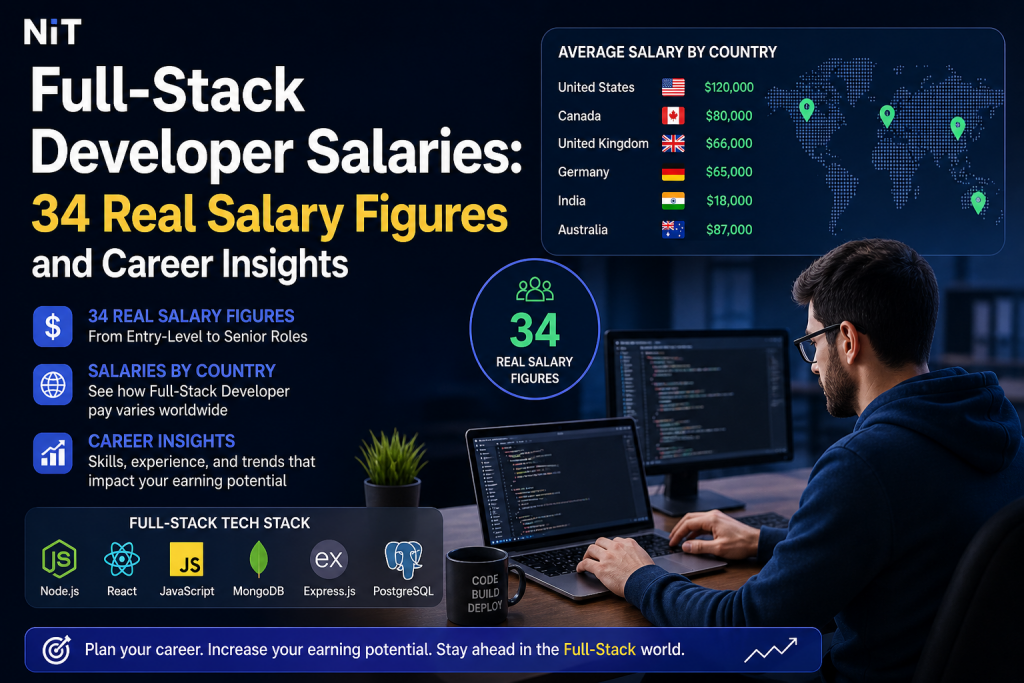
The field of software development has expanded rapidly over the past decade, creating a wide range of specialized roles. Among these, full-stack development stands out as one of the most versatile and in-demand career paths. While many developers focus exclusively on either front-end or back-end technologies, full-stack developers are skilled in both areas, allowing them to build complete applications from start to finish.
This flexibility has made full-stack developers highly valuable in modern tech environments. Companies are increasingly looking for professionals who can handle multiple aspects of development, reduce dependency between teams, and accelerate product delivery. As a result, full-stack developers often enjoy strong job prospects, diverse career opportunities, and competitive salaries.
However, understanding how much full-stack developers earn and what influences their salaries can be complex. Compensation varies widely depending on factors such as location, experience, technical skills, and industry demand. To make informed career decisions, it is important to explore not only salary ranges but also the responsibilities and expectations associated with this role.
This guide provides a detailed look at full-stack development as a career, including what these professionals do, the tools they use, and how their salaries are structured across different markets.
What is a Full-Stack Developer
A full-stack developer is a software engineer who is capable of working on both the front end and back end of a web application or software system. Instead of focusing on a single layer of development, they are responsible for managing the entire technology stack, ensuring that all components work together seamlessly.
On the front end, full-stack developers create user interfaces that are visually appealing, responsive, and easy to use. This involves working with technologies such as HTML, CSS, and JavaScript, along with frameworks and libraries that enhance the user experience.
On the back end, they handle server-side logic, database interactions, authentication processes, and application performance. This includes writing code that processes user requests, retrieves and stores data, and ensures that the application runs efficiently.
What sets full-stack developers apart is their ability to move between these layers without difficulty. They understand how the front end communicates with the back end and how data flows through the system. This holistic perspective allows them to identify issues more quickly and design solutions that are both efficient and scalable.
In many organizations, full-stack developers play a key role in bridging communication gaps between different teams. Because they understand both user-facing and server-side components, they can collaborate effectively with designers, backend engineers, and DevOps teams.
Core Responsibilities of Full-Stack Developers
The responsibilities of a full-stack developer can vary depending on the size and structure of the organization. In smaller companies or startups, they may be responsible for nearly every aspect of development. In larger organizations, their role may be more focused but still span multiple areas.
One of the primary responsibilities is developing and maintaining both client-side and server-side code. This includes building user interfaces, implementing application logic, and ensuring that all components function correctly together.
Another important responsibility is database management. Full-stack developers design database structures, write queries, and optimize performance to ensure that data is stored and retrieved efficiently. They must understand how to work with both relational and non-relational databases.
API development and integration is also a key part of the role. Developers create APIs that allow different parts of an application to communicate, as well as integrate external services such as payment systems or third-party data providers.
Testing and debugging are ongoing responsibilities. Full-stack developers must identify and resolve issues across the entire application, from front-end bugs to server-side errors and database inefficiencies.
Deployment and infrastructure management are increasingly important aspects of the role. Many full-stack developers are involved in deploying applications to cloud platforms, configuring servers, and maintaining production environments. This requires a basic understanding of DevOps practices and tools.
In addition to technical tasks, full-stack developers often participate in planning and decision-making processes. They may contribute to architectural design, help define project requirements, and collaborate with cross-functional teams to deliver high-quality products.
Technologies Used in Full-Stack Development
To perform their duties effectively, full-stack developers must be proficient in a wide range of technologies. These tools can be broadly categorized into front-end, back-end, database, and infrastructure technologies.
On the front end, developers typically use HTML, CSS, and JavaScript as foundational technologies. They also work with modern frameworks and libraries such as React or Vue, which simplify the process of building dynamic and interactive user interfaces.
Back-end development involves programming languages and frameworks that handle server-side logic. Popular choices include Node.js, Python with frameworks like Django or Flask, and Ruby on Rails. These tools allow developers to build scalable and secure applications.
Database technologies are another essential component. Full-stack developers work with relational databases such as PostgreSQL and MySQL, as well as NoSQL databases like MongoDB. Understanding how to model data and write efficient queries is crucial for application performance.
Version control systems, particularly Git, are used to manage code changes and collaborate with other developers. Platforms like GitHub enable teams to track progress, review code, and maintain a history of updates.
Cloud computing platforms have become a standard part of modern development. Services such as AWS, Azure, and Google Cloud provide infrastructure for hosting applications, storing data, and scaling resources. Full-stack developers who are familiar with these platforms are better equipped to handle end-to-end development.
DevOps tools and practices are also increasingly important. Technologies like Docker, Jenkins, and CI/CD pipelines help automate testing, deployment, and monitoring processes. This allows developers to deliver updates more quickly and reliably.
Common Job Titles in Full-Stack Development
While the title full-stack developer is widely recognized, it is not the only designation used for this type of role. Companies often use different titles depending on their internal structure and the specific responsibilities of the position.
Some organizations use the term software engineer to describe developers who work across the stack. Others may use titles such as web application developer or application engineer.
In certain cases, developers may be hired as front-end or back-end specialists but are expected to handle tasks across both areas. This effectively makes them full-stack developers, even if the title does not explicitly reflect it.
There are also roles defined by specific technology stacks. For example, developers who work with a combination of MongoDB, Express, React, and Node.js are often referred to as MERN stack developers. Similarly, those who use Angular instead of React may be called MEAN stack developers.
Seniority levels further differentiate job titles. Entry-level professionals are often labeled as junior developers, while experienced individuals may hold titles such as senior full-stack engineer, lead developer, or technical architect.
Understanding these variations is important when exploring job opportunities, as similar roles may be listed under different names.
Overview of Full-Stack Developer Salaries
Full-stack developers are generally well-compensated due to their broad skill set and ability to handle multiple aspects of development. However, salaries can vary significantly based on several factors.
At a basic level, full-stack developer salaries are typically divided into three categories: entry-level, mid-level, and senior-level. Each category reflects a different level of experience, responsibility, and expertise.
Entry-level developers usually earn lower salaries as they are still building their skills and gaining practical experience. Mid-level developers earn higher salaries as they take on more complex tasks and contribute more independently. Senior developers command the highest salaries due to their experience, leadership abilities, and specialized knowledge.
In addition to experience, location plays a major role in determining salary levels. Developers in major technology hubs tend to earn higher salaries, while those in smaller markets may earn less.
Industry also has an impact on compensation. Developers working in high-demand sectors such as finance, enterprise software, or technology startups often earn more than those in less competitive industries.
Impact of Location on Salaries
Geographic location is one of the most significant factors influencing full-stack developer salaries. Cities with strong technology ecosystems and a high concentration of tech companies tend to offer higher salaries.
These regions attract top talent and foster innovation, leading to increased competition among employers. As a result, companies are willing to offer higher compensation packages to attract and retain skilled developers.
However, higher salaries in these areas are often accompanied by a higher cost of living. Expenses such as housing, transportation, and daily necessities can significantly reduce the purchasing power of a higher income.
In contrast, smaller cities and regions with lower living costs may offer lower salaries, but the overall financial situation can still be favorable. Developers in these areas may enjoy a better work-life balance and lower expenses.
The rise of remote work has begun to change the importance of location. Many companies now hire developers from different regions, allowing professionals to access higher-paying opportunities without relocating. This has opened up new possibilities for developers in emerging markets.
Salary Ranges and Market Variations
Full-stack developer salaries are typically presented as ranges that reflect different levels of experience and expertise. These ranges can vary significantly depending on the market.
Lower-end salaries are usually associated with entry-level roles or junior developers. These positions often involve assisting with tasks, fixing bugs, and learning the fundamentals of development.
Average salaries represent mid-level developers who have gained experience and can handle more complex responsibilities. These professionals are capable of working independently and contributing to larger projects.
Higher-end salaries are reserved for senior developers who have extensive experience and specialized skills. These individuals often lead projects, design system architecture, and mentor other team members.
In larger cities, salary ranges tend to be wider due to the diversity of opportunities. Developers may find roles ranging from startup positions to high-paying jobs in large corporations.
In smaller markets, salary ranges may be narrower, but compensation can still be competitive relative to the local cost of living.
Trends in Full-Stack Developer Compensation
The demand for full-stack developers continues to grow as companies seek professionals who can handle multiple aspects of development. This demand has contributed to rising salaries and increased job opportunities.
One notable trend is the growing importance of specialized skills. Developers who are proficient in modern frameworks, cloud platforms, and scalable architecture often earn higher salaries. Employers are willing to pay a premium for professionals who can deliver high-quality solutions efficiently.
Another trend is the expansion of remote work opportunities. Companies are increasingly hiring developers from different regions, allowing them to access a broader talent pool. This has led to more competitive salaries and greater flexibility for developers.
The range of salaries is also expanding as the industry evolves. Entry-level salaries remain strong, while senior developers continue to see significant increases in compensation. This reflects the growing complexity of software development and the value of experienced professionals.
Overall, full-stack development remains one of the most promising career paths in the technology industry. With the right skills and experience, developers can achieve strong earning potential and long-term career growth.
Key Factors That Shape Full-Stack Developer Salaries
While location and experience are two of the most obvious influences on salary, they are far from the only factors that determine how much a full-stack developer earns. In reality, compensation is shaped by a combination of technical ability, business value, and market demand. Employers evaluate not just what a developer knows, but how effectively they can apply that knowledge to solve real problems.
One of the most important factors is versatility. Full-stack developers who can confidently move between front-end and back-end tasks tend to be more valuable than those who lean heavily toward one side. The ability to understand the entire lifecycle of an application, from user interface design to server performance, allows these developers to contribute more meaningfully to projects.
Another factor is the ability to deliver complete solutions. Employers often look for developers who can take ownership of features or even entire applications. This includes planning, building, testing, and deploying software. Developers who can manage this full process are often rewarded with higher salaries because they reduce the need for additional team members.
Problem-solving ability also plays a significant role. Developers who can quickly identify issues, optimize performance, and implement efficient solutions are highly sought after. These skills go beyond basic coding and demonstrate a deeper understanding of software engineering principles.
Communication skills should not be overlooked. Full-stack developers frequently work with designers, product managers, and other stakeholders. The ability to explain technical concepts clearly and collaborate effectively can significantly impact career growth and earning potential.
Depth and Breadth of Technical Skills
The depth of knowledge across the technology stack is a major determinant of salary. It is not enough to have a basic understanding of multiple technologies; employers value developers who have strong, practical expertise in both front-end and back-end systems.
On the front end, this means being proficient in building responsive, accessible, and high-performance user interfaces. Developers who understand how to optimize rendering, manage state efficiently, and create seamless user experiences are often in higher demand.
On the back end, depth of knowledge includes writing efficient server-side code, designing scalable systems, and ensuring application security. Developers who can handle complex logic, manage large datasets, and maintain system reliability are particularly valuable.
The combination of breadth and depth is what sets top full-stack developers apart. They are not just generalists; they are well-rounded engineers who can dive deep into specific areas when needed.
Continuous learning is essential in this field. Technologies evolve rapidly, and developers who stay updated with the latest tools and practices are more likely to command higher salaries. Those who fail to keep up may find their skills becoming outdated, which can limit their earning potential.
Importance of Cloud and Infrastructure Knowledge
Cloud computing has become a central part of modern software development. As a result, full-stack developers who understand cloud platforms and infrastructure are often paid more than those who do not.
Knowledge of cloud services allows developers to deploy applications, manage resources, and scale systems efficiently. This reduces the need for separate DevOps teams and enables faster development cycles. Employers value developers who can handle both coding and deployment, as it streamlines the entire development process.
Understanding infrastructure also includes knowledge of containers, orchestration tools, and monitoring systems. Developers who can ensure that applications run smoothly in production environments are seen as highly valuable assets.
Another important aspect is cost optimization. Cloud resources can be expensive if not managed properly. Developers who know how to design cost-efficient systems can save companies significant amounts of money, which further increases their value.
Security is also a key concern in cloud environments. Full-stack developers who understand how to secure applications, manage authentication, and protect data are often in higher demand and can negotiate better salaries.
Framework Expertise and Modern Development Practices
Experience with modern frameworks and development practices can significantly impact a developer’s salary. Frameworks are designed to simplify development and improve performance, making them essential tools in many projects.
On the front end, frameworks like React and Vue are widely used for building dynamic user interfaces. Developers who are skilled in these frameworks can create efficient and maintainable code, which is highly valued by employers.
On the back end, frameworks such as Express, Django, and Laravel provide structure and functionality for building robust applications. Developers who understand how to use these frameworks effectively can deliver projects more quickly and with fewer errors.
In addition to frameworks, modern development practices such as test-driven development, continuous integration, and agile methodologies are increasingly important. Developers who are familiar with these practices can work more efficiently in team environments and contribute to higher-quality products.
Another emerging trend is the use of serverless architectures. Developers who understand how to build and deploy serverless applications can take advantage of scalability and cost benefits, making them more attractive to employers.
Industry and Type of Product
The industry in which a developer works can have a significant impact on salary. Some industries have higher budgets and greater demand for skilled developers, leading to higher compensation.
For example, companies in the financial technology sector often pay higher salaries due to the complexity and importance of their systems. These applications require high levels of security, reliability, and performance, which increases the demand for experienced developers.
Similarly, enterprise software companies tend to offer competitive salaries because their products are used by large organizations and require ongoing maintenance and support.
On the other hand, industries such as education, nonprofit organizations, or small local businesses may offer lower salaries due to budget constraints. While these roles can still provide valuable experience, they may not offer the same financial rewards as positions in high-demand sectors.
The type of product being developed also matters. Applications that handle large amounts of data, require real-time processing, or support millions of users are more complex and often come with higher salaries.
Certifications and Demonstrated Skills
Certifications can play a role in increasing a full-stack developer’s salary, particularly for those who are early in their careers or transitioning from another field. While not always required, certifications provide proof of knowledge and commitment to professional development.
Cloud certifications are especially valuable. They demonstrate that a developer can work with modern infrastructure and deploy applications effectively. Employers often view these certifications as an indicator of practical skills.
In addition to formal certifications, a strong portfolio can have an even greater impact. Developers who can showcase real-world projects, contributions to open-source software, or innovative applications are more likely to stand out in the job market.
Practical experience often carries more weight than theoretical knowledge. Employers want to see what a developer can actually build and how they approach problem-solving. A well-documented portfolio can significantly enhance earning potential.
Continuous learning through online courses, workshops, and self-study also contributes to career growth. Developers who invest in their skills are more likely to advance and secure higher-paying roles.
How Experience Impacts Salary Growth
Experience is one of the most consistent predictors of salary in full-stack development. As developers gain more experience, they take on greater responsibilities and contribute more to their organizations.
At the entry level, developers are primarily focused on learning and gaining practical experience. They may work on smaller tasks, assist senior developers, and gradually build their skills. Salaries at this stage are lower but still competitive compared to many other professions.
As developers move into mid-level roles, they become more independent and take on larger projects. They are expected to handle full features, from front-end design to back-end implementation. At this stage, salaries increase significantly as developers demonstrate their ability to deliver results.
Senior developers have extensive experience and often take on leadership roles. They are responsible for designing system architecture, making technical decisions, and guiding other team members. Their salaries reflect their expertise and the value they bring to the organization.
Experience also includes the ability to adapt to new technologies and solve complex problems. Developers who continuously improve their skills and take on challenging projects are more likely to advance quickly and earn higher salaries.
Entry-Level Full-Stack Developers
Entry-level full-stack developers typically have between zero and two years of experience. At this stage, they are still building their foundation and learning how to apply their knowledge in real-world scenarios.
Their responsibilities often include assisting with front-end development, fixing bugs, and working on simple back-end tasks. They may also spend time learning best practices and improving their coding skills.
While salaries at this level are lower compared to more experienced roles, they are still attractive compared to many other entry-level positions. The potential for growth is one of the main advantages of pursuing a career in full-stack development.
Developers at this stage should focus on building a strong foundation, learning new technologies, and gaining practical experience. This will set the stage for future career growth and higher earnings.
Mid-Level Full-Stack Developers
Mid-level developers typically have three to five years of experience. By this stage, they have developed a solid understanding of both front-end and back-end technologies and can work independently on complex tasks.
They are often responsible for building complete features, integrating APIs, and managing databases. They may also be involved in code reviews, mentoring junior developers, and contributing to architectural decisions.
Salaries at this level are significantly higher than entry-level positions, reflecting the increased responsibility and expertise. Developers who continue to expand their skills and take on leadership roles can further increase their earning potential.
Mid-level developers are often at a critical point in their careers. By focusing on specialization, leadership, or advanced technologies, they can position themselves for senior roles and higher salaries.
Senior Full-Stack Developers
Senior full-stack developers typically have six or more years of experience. They are highly skilled professionals who take on leadership roles within their teams.
Their responsibilities include designing system architecture, optimizing performance, ensuring security, and making critical technical decisions. They often lead projects, mentor junior developers, and collaborate with stakeholders to align technical solutions with business goals.
Salaries at this level are among the highest in the industry, reflecting the value of experience and expertise. Senior developers are expected to deliver high-quality results and drive innovation within their organizations.
In addition to technical skills, leadership and communication abilities become increasingly important at this stage. Developers who can effectively manage teams and contribute to strategic planning are especially valuable.
The Role of Continuous Learning in Salary Growth
The technology landscape is constantly evolving, and full-stack developers must keep up with new tools, frameworks, and best practices. Continuous learning is essential for maintaining and increasing earning potential.
Developers who invest in learning new technologies are more likely to stay competitive in the job market. This includes exploring emerging trends, such as serverless computing, artificial intelligence integration, and advanced cloud architectures.
Learning can take many forms, including online courses, certifications, workshops, and self-directed projects. The key is to remain curious and proactive in developing new skills.
Employers value developers who are adaptable and willing to learn. This mindset not only leads to higher salaries but also opens up new career opportunities.
Essential Programming Languages for Full-Stack Developers
At the core of full-stack development lies a strong command of programming languages that power both the front end and back end of applications. These languages form the foundation upon which all other tools and frameworks are built.
JavaScript is one of the most critical languages for full-stack developers. It is used extensively on the front end to create interactive and dynamic user interfaces. With the rise of server-side environments, JavaScript is also widely used on the back end, making it one of the few languages that can truly span the entire stack.
HTML and CSS are equally important, as they define the structure and styling of web applications. While they may seem basic compared to other technologies, mastery of these tools is essential for creating responsive and accessible user interfaces.
On the back end, languages such as Python, Ruby, and Java are commonly used. Python is known for its simplicity and versatility, while Ruby offers a developer-friendly approach to building web applications. Java, on the other hand, is often used in large-scale enterprise systems where performance and stability are critical.
A full-stack developer does not need to master every language, but having a solid understanding of at least one front-end and one back-end language is essential. The ability to adapt and learn new languages as needed is equally important.
Front-End Frameworks and Libraries
Modern web development relies heavily on frameworks and libraries that simplify the process of building user interfaces. These tools provide structure, reusable components, and efficient ways to manage application state.
React has become one of the most popular front-end libraries due to its flexibility and performance. It allows developers to build complex interfaces using reusable components, making development faster and more maintainable.
Vue is another widely used framework that offers a more approachable learning curve. It combines ease of use with powerful features, making it a popular choice for both beginners and experienced developers.
Angular provides a comprehensive framework with built-in tools for routing, state management, and form handling. It is often used in large-scale applications where a structured approach is required.
Understanding how to work with these frameworks can significantly increase a developer’s value. Employers often look for candidates who can quickly build and maintain modern user interfaces using industry-standard tools.
Back-End Technologies and Frameworks
Back-end development is responsible for handling the logic and data processing that powers applications. Full-stack developers must be comfortable working with server-side technologies and frameworks.
Node.js is a popular choice because it allows developers to use JavaScript on the server side. This creates a consistent development environment and simplifies the learning process.
Python frameworks such as Django and Flask are known for their simplicity and efficiency. Django provides a full-featured framework with built-in tools, while Flask offers a more lightweight and flexible approach.
Ruby on Rails emphasizes convention over configuration, allowing developers to build applications and with less boilerplate code. It is particularly popular among startups and small teams.
Other technologies, such as Java with Spring or PHP with Laravel, are also widely used in different industries. The choice of framework often depends on the project requirements and the company’s technology stack.
Developers who are proficient in multiple back-end frameworks have a significant advantage in the job market. This versatility allows them to adapt to different environments and contribute more effectively to projects.
Databases and Data Management
Data is a critical component of any application, and full-stack developers must understand how to manage it effectively. This includes designing database schemas, writing queries, and optimizing performance.
Relational databases, such as PostgreSQL and MySQL, are commonly used for structured data. They rely on tables and predefined schemas, making them suitable for applications that require consistency and accuracy.
NoSQL databases, such as MongoDB, offer more flexibility by allowing unstructured or semi-structured data. They are often used in applications that require scalability and rapid development.
Understanding when to use each type of database is an important skill. Developers must also know how to write efficient queries, index data properly, and handle large datasets without compromising performance.
Data security is another critical aspect. Full-stack developers must ensure that sensitive information is protected and that applications comply with relevant regulations.
Version Control and Collaboration Tools
Collaboration is a key part of modern software development, and version control systems play a central role in managing code changes. Git is the most widely used version control system, allowing developers to track changes, create branches, and collaborate with others.
Platforms like GitHub and similar tools provide a centralized location for code repositories. They also offer features such as pull requests, code reviews, and issue tracking, which help teams maintain high-quality code.
In addition to version control, project management tools are essential for coordinating tasks and tracking progress. These tools help teams stay organized and ensure that projects are completed on time.
Full-stack developers who are comfortable with these tools can work more effectively in team environments. This not only improves productivity but also enhances their reputation as reliable contributors.
DevOps Practices and Continuous Integration
DevOps practices have become an integral part of software development, bridging the gap between development and operations. Full-stack developers who understand these practices can deliver applications more efficiently and reliably.
Continuous integration and continuous deployment pipelines automate the process of testing and deploying code. This reduces the risk of errors and ensures that updates can be released quickly.
Tools like Docker allow developers to create consistent environments for development and production. This eliminates issues caused by differences in system configurations.
Automation tools help streamline repetitive tasks, allowing developers to focus on more complex work. Understanding how to use these tools can significantly improve productivity and reduce development time.
Employers value developers who can contribute to DevOps processes because it leads to faster delivery and more stable applications. This often translates into higher salaries and better career opportunities.
Cloud Platforms and Deployment Skills
Cloud computing has transformed the way applications are built and deployed. Full-stack developers who are familiar with cloud platforms have a significant advantage in the job market.
Cloud services provide infrastructure for hosting applications, storing data, and scaling resources as needed. This eliminates the need for physical servers and allows developers to focus on building applications.
Developers must understand how to deploy applications, configure services, and monitor performance in cloud environments. This includes setting up databases, managing storage, and ensuring security.
Scalability is one of the key benefits of cloud computing. Developers must design applications that can handle increased traffic and adapt to changing demands.
Knowledge of cloud platforms is often a requirement for modern development roles. Developers who can manage both code and deployment are highly valued and often earn higher salaries.
Certifications That Can Boost Career Growth
Certifications can play an important role in advancing a full-stack developer’s career. While they are not always required, they provide a way to demonstrate expertise and commitment to professional development.
Cloud certifications are among the most valuable. They validate a developer’s ability to work with modern infrastructure and deploy applications effectively. These certifications are often recognized by employers and can lead to better job opportunities.
Other certifications focus on specific programming languages, frameworks, or development practices. These can help developers deepen their knowledge and stand out in competitive job markets.
Course-based certificates from online learning platforms can also be useful, especially for beginners. They provide structured learning paths and help build foundational skills.
While certifications can enhance a resume, they are most effective when combined with practical experience. Employers often look for a balance between formal training and real-world skills.
Building a Strong Portfolio
A strong portfolio is one of the most effective ways to showcase skills as a full-stack developer. It provides tangible evidence of what a developer can build and how they approach problem-solving.
Projects should demonstrate a range of skills, including front-end design, back-end development, and database management. Including real-world applications or contributions to open-source projects can make a portfolio more impressive.
Documentation is also important. Developers should explain the purpose of each project, the technologies used, and any challenges they overcame. This helps potential employers understand their thought process and capabilities.
A well-organized portfolio can set a developer apart from other candidates. It shows initiative, creativity, and a commitment to continuous learning.
Strategies to Increase Salary as a Full-Stack Developer
Increasing salary requires more than just technical skills. Developers must take a proactive approach to career growth and continuously look for ways to add value.
One effective strategy is to specialize in high-demand areas, such as cloud computing, scalable architecture, or performance optimization. These skills are often in short supply and command higher salaries.
Taking on leadership roles can also lead to higher earnings. Developers who mentor others, lead projects, or contribute to strategic decisions are often rewarded with promotions and salary increases.
Networking is another important factor. Building relationships within the industry can lead to new opportunities and provide insights into salary trends.
Negotiation skills should not be overlooked. Developers should research market rates and be prepared to discuss their value during job offers or performance reviews.
Changing jobs can sometimes result in significant salary increases. While staying with one company can provide stability, exploring new opportunities can lead to better compensation and career growth.
Transitioning to Advanced Roles
As full-stack developers gain experience, they often have the opportunity to move into more advanced roles. These positions typically come with higher salaries and greater responsibilities.
One common path is transitioning into a lead developer role. This involves overseeing projects, guiding team members, and ensuring that development processes run smoothly.
Another option is becoming a software architect. This role focuses on designing complex systems and making high-level technical decisions. It requires a deep understanding of both technology and business requirements.
Developers may also move into specialized roles, such as DevOps engineer or cloud architect. These positions focus on specific areas of development and often offer higher salaries due to their specialized nature.
Career progression depends on individual interests and goals. Developers should choose paths that align with their strengths and long-term aspirations.
The Future of Full-Stack Development
The demand for full-stack developers is expected to remain strong as technology continues to evolve. Businesses are increasingly relying on digital solutions, creating a need for skilled professionals who can build and maintain applications.
Emerging technologies, such as artificial intelligence, machine learning, and advanced cloud services, are shaping the future of development. Full-stack developers who adapt to these trends will have a competitive advantage.
Automation and low-code platforms are also changing the landscape, but they are unlikely to replace skilled developers. Instead, they will create new opportunities for developers to focus on more complex and creative tasks.
Continuous learning and adaptability will remain key factors in long-term success. Developers who embrace change and invest in their skills will continue to thrive in this dynamic field.
Conclusion
Full-stack development offers a unique combination of versatility, creativity, and strong earning potential. Developers in this field have the ability to work across multiple layers of technology, making them valuable assets in a wide range of industries.
Salaries are influenced by many factors, including technical skills, experience, location, and industry demand. While entry-level positions provide a solid starting point, significant growth is possible as developers gain experience and expand their expertise.
Mastering essential tools, frameworks, and cloud platforms can greatly enhance career prospects. Certifications and a strong portfolio further strengthen a developer’s position in the job market.
Ultimately, success as a full-stack developer depends on continuous learning, adaptability, and a willingness to take on new challenges. Those who invest in their skills and stay current with industry trends can achieve long-term career growth and financial success.
Continue exploring the technologies and certification concepts that matter most to you.