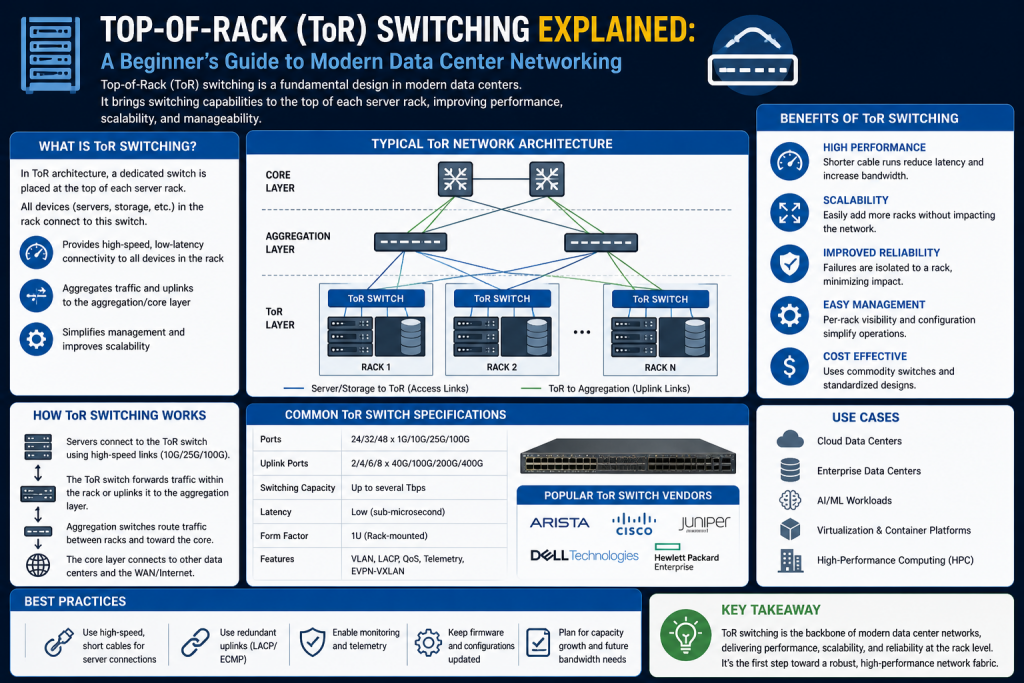
Top-of-Rack (ToR) switching is a modern data center networking design that places network switches directly at the top of each server rack. This approach allows servers within the same rack to connect to a dedicated switch, creating a localized and efficient communication environment. Instead of relying on distant, centralized switches, ToR switching brings connectivity closer to where computing actually happens.
The concept is simple but powerful. Each rack operates almost like its own mini network, with the ToR switch acting as the primary gateway for all servers in that rack. These switches then connect upward to aggregation or core layers, forming a structured and scalable hierarchy.
As data centers have grown larger and more complex, traditional networking approaches have struggled to keep up. Increased demand for faster processing, cloud services, and virtualization has pushed organizations to adopt architectures that can handle high volumes of data with minimal delay. ToR switching has emerged as one of the most effective solutions to these challenges.
The Role of ToR Switching in Data Centers
In modern data centers, efficiency and speed are critical. Applications often require real-time processing, and even small delays can impact performance. ToR switching plays a crucial role in meeting these demands by reducing the distance data must travel between servers and network devices.
By placing switches within each rack, ToR switching enables direct communication between servers and their local switch. This reduces dependency on centralized infrastructure and allows for faster data exchange. It also helps isolate traffic within racks, preventing unnecessary congestion across the entire network.
This localized design is especially beneficial in environments that rely heavily on east-west traffic. East-west traffic refers to communication between servers within the data center, as opposed to north-south traffic, which involves communication with external networks. ToR switching optimizes this internal communication, making it ideal for modern workloads such as distributed computing and virtualization.
Traditional Network Architectures and Their Limitations
Before the adoption of ToR switching, data centers typically used centralized switching models such as end-of-row (EoR) or middle-of-row (MoR) designs. In these architectures, switches were placed in shared locations, and servers from multiple racks were connected to them using long cables.
While these models were effective in smaller or less demanding environments, they introduced several challenges as data centers expanded. One of the biggest issues was cable management. Long cables running between racks and centralized switches often resulted in cluttered and disorganized setups. This made installation, maintenance, and troubleshooting more difficult.
Another limitation was latency. Because data had to travel longer distances to reach centralized switches, delays were more common. This became a significant problem for applications that required high-speed communication.
Scalability was also a concern. Adding new servers or racks often required reconfiguring the network and running additional cables to centralized switches. This process was time-consuming and increased the risk of errors.
ToR switching was developed to address these limitations by decentralizing the switching layer and bringing connectivity closer to the servers.
Core Principles Behind ToR Switching
The effectiveness of ToR switching is based on a few key principles. One of the most important is localization. By keeping most connections within a single rack, the architecture reduces complexity and improves performance.
Another principle is modularity. Each rack functions as an independent unit with its own switch. This makes it easier to add or remove racks without affecting the rest of the network. The modular design also simplifies troubleshooting, as issues can often be isolated to a specific rack.
Efficiency is another core concept. ToR switching minimizes the number of hops data must take to reach its destination. Fewer hops mean lower latency and better overall performance.
Finally, the architecture emphasizes scalability. As data centers grow, ToR switching allows for seamless expansion by adding more racks and switches without requiring a complete redesign of the network.
Key Components of ToR Switching
ToR switching relies on several essential components that work together to create a functional and efficient network. Understanding these components provides insight into how the architecture operates.
ToR Switches
ToR switches are the central element of this architecture. These devices are specifically designed to be installed within server racks, usually at the top position. They are compact yet powerful, offering a high number of ports to accommodate multiple server connections.
These switches support high-speed Ethernet standards, enabling fast data transfer between servers and other parts of the network. Their primary responsibilities include aggregating traffic from connected servers and forwarding it to the appropriate destination.
Aggregation involves collecting data from multiple servers and combining it into a single stream for transmission to higher-level switches. This reduces the number of connections required at the aggregation layer and simplifies the overall network design.
Forwarding is the process of directing data to its destination. The switch uses routing and switching logic to determine the most efficient path for each packet, ensuring optimal performance.
Modern ToR switches often include advanced features such as traffic prioritization, automation capabilities, and support for virtualization. These features enable them to handle complex workloads and adapt to changing network conditions.
Server-to-Switch Connections
The connections between servers and the ToR switch are another critical component. These links are typically made using short Ethernet cables, which are confined within the rack.
Shorter cables offer several advantages. They reduce latency, improve signal quality, and are easier to manage. Because the connections are localized, they also contribute to a cleaner and more organized physical layout.
These direct links enable fast communication between servers and the ToR switch. In many cases, servers within the same rack can communicate with each other through the switch without needing to access higher layers of the network.
This capability is particularly important for applications that require frequent data exchange between servers, such as clustered computing and distributed storage systems.
Benefits of Localized Networking
One of the defining characteristics of ToR switching is its focus on localized networking. By keeping most traffic within the rack, the architecture reduces the burden on the broader network.
Localized networking improves performance by minimizing latency. Data does not need to travel long distances or pass through multiple devices, resulting in faster response times.
It also enhances reliability. Because each rack operates independently, issues in one rack are less likely to affect others. This isolation helps maintain overall network stability.
Another benefit is improved resource utilization. By handling traffic locally, ToR switches reduce the load on aggregation and core switches. This allows those higher-level devices to focus on inter-rack and external communication.
Impact on Data Center Design
The adoption of ToR switching has had a significant impact on how data centers are designed and operated. It has influenced everything from physical layout to network topology.
From a physical perspective, ToR switching simplifies cabling and improves organization. Shorter cables and localized connections result in a cleaner and more efficient setup. This not only makes maintenance easier but also improves airflow and cooling.
From a network perspective, the architecture supports a more hierarchical and scalable design. Each rack connects to aggregation switches, which in turn connect to the core network. This structure provides a clear and efficient path for data flow.
The modular nature of ToR switching also makes it easier to plan and implement expansions. New racks can be added without disrupting existing infrastructure, allowing data centers to grow in a controlled and predictable manner.
Supporting High-Performance Applications
Modern applications place significant demands on data center networks. They require high bandwidth, low latency, and the ability to scale quickly. ToR switching is well-suited to meet these requirements.
Applications such as big data analytics, artificial intelligence, and cloud computing often involve large volumes of data moving between servers. ToR switching enables fast and efficient communication within racks, reducing delays and improving performance.
The architecture also supports dynamic environments where workloads can change rapidly. Virtual machines and containers may be created, moved, or scaled on demand. ToR switches provide the consistent connectivity needed to support these operations.
This adaptability makes ToR switching a key component of modern data center infrastructure. It ensures that networks can keep up with the evolving needs of applications and users.
Preparing for Future Growth
As technology continues to advance, data centers must be able to adapt to new challenges and opportunities. ToR switching provides a foundation for future growth by offering flexibility and scalability.
The modular design allows organizations to expand their infrastructure incrementally. Instead of making large, disruptive changes, they can add new racks and switches as needed.
This approach reduces costs and minimizes downtime, making it easier to respond to changing demands. It also ensures that performance remains consistent as the data center grows.
In addition, ToR switching supports integration with emerging technologies such as automation and software-defined networking. These capabilities enable more efficient management and greater control over network resources.
By providing a scalable and adaptable framework, ToR switching helps ensure that data centers remain efficient and effective in the face of ongoing technological change.
Advantages of Top-of-Rack Switching in Modern Data Centers
Top-of-Rack switching offers a range of benefits that directly address the challenges faced by modern data centers. As computing environments continue to expand and workloads become more demanding, network architectures must evolve to keep up. ToR switching provides a flexible and efficient solution by localizing connectivity and simplifying infrastructure.
One of the most notable advantages is the ability to reduce complexity. By placing switches within each rack, the network becomes more structured and easier to manage. Instead of relying on a few centralized switches to handle all traffic, responsibilities are distributed across multiple ToR switches. This distribution improves resilience and ensures that no single device becomes a bottleneck.
Another key advantage is performance improvement. Because servers connect directly to a nearby switch, the time it takes for data to travel is significantly reduced. This results in lower latency and faster communication, which is critical for applications that rely on real-time processing.
ToR switching also enhances flexibility. Data centers can be designed in a modular way, allowing administrators to scale resources up or down based on demand. This adaptability is essential in environments where workloads can change rapidly.
Streamlined Cabling and Infrastructure Organization
One of the most visible improvements introduced by ToR switching is the simplification of cabling. In traditional architectures, cables often run long distances between servers and centralized switches. This creates a dense and sometimes chaotic network of wires that can be difficult to manage.
With ToR switching, most connections are contained within the rack. Servers are connected to the ToR switch using short cables, which reduces clutter and improves organization. This cleaner layout makes it easier to identify and trace connections, reducing the time required for maintenance and troubleshooting.
The reduction in cable length also has technical benefits. Shorter cables experience less signal loss and interference, resulting in more reliable data transmission. Additionally, the improved organization contributes to better airflow within the racks, which helps maintain optimal operating temperatures.
From an operational perspective, simplified cabling reduces the likelihood of errors during installation and maintenance. It also allows for faster deployment of new equipment, as technicians can quickly connect servers to the local switch without needing to route cables across the data center.
Improved Network Performance and Reduced Latency
Performance is a critical factor in any data center, and ToR switching is designed to optimize it. By minimizing the distance between servers and switches, this architecture reduces latency and improves overall efficiency.
Latency refers to the time it takes for data to travel from one point to another. In traditional setups, data may need to pass through multiple switches before reaching its destination. Each additional hop introduces delay, which can accumulate and impact performance.
ToR switching addresses this issue by handling much of the traffic locally. Communication between servers in the same rack can occur directly through the ToR switch, without involving higher layers of the network. This significantly reduces the number of hops and speeds up data transfer.
Even when data needs to travel between racks, the streamlined structure ensures that it follows an efficient path. The combination of localized processing and optimized routing results in faster response times and improved application performance.
This is particularly important for workloads that require rapid data exchange, such as high-frequency trading platforms, real-time analytics, and large-scale simulations.
Scalability and Modular Growth
Scalability is one of the defining strengths of ToR switching. As organizations grow and their computing needs increase, they must be able to expand their infrastructure without disrupting existing operations.
ToR switching supports this by enabling a modular approach to data center design. Each rack operates as an independent unit with its own switch, making it easy to add new racks as needed. This eliminates the need for extensive reconfiguration and allows for incremental growth.
When a new rack is added, it can be integrated into the network by connecting its ToR switch to the aggregation layer. This process is straightforward and does not require changes to existing racks or switches.
The modular design also simplifies capacity planning. Administrators can scale resources based on demand, adding or removing racks to match workload requirements. This flexibility helps optimize resource utilization and reduces unnecessary costs.
In addition, the consistent structure of ToR switching ensures that performance remains predictable as the data center grows. Each rack follows the same design principles, making it easier to maintain uniform performance across the entire environment.
Enhanced Fault Isolation and Reliability
Reliability is a critical concern in data center operations. Any network failure can disrupt services and lead to significant downtime. ToR switching improves reliability by isolating potential issues and preventing them from affecting the entire network.
Because each rack has its own switch, problems are often contained within that rack. For example, if a ToR switch fails, only the servers connected to that switch are affected. The rest of the data center continues to operate normally.
This level of isolation makes it easier to identify and resolve issues. Technicians can focus on a specific rack rather than troubleshooting the entire network. This reduces downtime and improves overall efficiency.
To further enhance reliability, many data centers implement redundancy at the ToR level. This may involve using multiple switches per rack or connecting servers to more than one switch. If one switch fails, the other can take over, ensuring continuous operation.
Load balancing is another important aspect of reliability. By distributing traffic evenly across multiple switches and connections, ToR switching helps prevent congestion and ensures consistent performance.
Operational Efficiency and Simplified Management
Managing a large data center can be a complex task, but ToR switching helps simplify operations. The structured and modular design makes it easier to monitor and control the network.
Each ToR switch can be configured using standardized settings, ensuring consistency across all racks. This uniformity reduces the likelihood of configuration errors and makes it easier to apply updates or changes.
Centralized management tools can be used to oversee multiple ToR switches from a single interface. These tools allow administrators to monitor performance, detect issues, and implement changes quickly and efficiently.
Automation is another key factor in operational efficiency. Many modern ToR switches support automated configuration and provisioning, which reduces the need for manual intervention. This not only saves time but also minimizes the risk of human error.
By streamlining management processes, ToR switching allows data center teams to focus on strategic tasks rather than routine maintenance.
Cost Considerations and Resource Optimization
While ToR switching requires an investment in additional switches, it can lead to cost savings in other areas. The reduction in cabling, improved efficiency, and simplified management all contribute to lower operational costs over time.
Shorter cables are less expensive and easier to install than long ones. The improved organization also reduces the time and effort required for maintenance, which can result in significant labor savings.
In addition, the modular design allows organizations to invest in infrastructure gradually. Instead of making large upfront investments, they can expand their data center as needed, aligning costs with growth.
Resource optimization is another important benefit. By localizing traffic and reducing congestion, ToR switching ensures that network resources are used more efficiently. This can lead to better performance without the need for additional hardware.
Supporting High-Density and High-Speed Environments
Modern data centers often operate in high-density environments, with large numbers of servers packed into each rack. These environments require high-speed connectivity to handle the increased volume of data.
ToR switches are designed to meet these demands. They offer a high density of ports and support advanced Ethernet standards, enabling fast and reliable communication.
This capability is essential for workloads that generate large amounts of data, such as video streaming, cloud computing, and big data analytics. ToR switching ensures that these workloads can operate efficiently without being limited by network performance.
The architecture also supports future upgrades. As new technologies emerge, ToR switches can be replaced or upgraded to support higher speeds and additional features, ensuring that the data center remains competitive.
Alignment with Modern IT Strategies
ToR switching aligns well with modern IT strategies that emphasize flexibility, scalability, and efficiency. As organizations move toward cloud-based and virtualized environments, their networking infrastructure must be able to support these changes.
The localized and modular nature of ToR switching makes it ideal for dynamic environments. It allows for rapid deployment of new resources and supports the movement of workloads across the data center.
This alignment with modern practices ensures that ToR switching remains relevant as technology continues to evolve. It provides a strong foundation for building agile and responsive data center networks that can adapt to changing business needs.
Challenges in Implementing Top-of-Rack Switching
While Top-of-Rack switching provides many benefits, it also introduces a set of challenges that organizations must address to fully realize its potential. As with any distributed architecture, increasing the number of devices within a network can add complexity if not managed properly.
One of the primary challenges is the increase in the number of switches. Instead of a few centralized switches, a data center using ToR architecture may have dozens or even hundreds of switches. Each of these devices requires configuration, monitoring, and maintenance. Without proper planning, this can lead to inconsistencies and operational inefficiencies.
Another challenge is ensuring interoperability between devices. In environments where different switch models or vendors are used, compatibility issues may arise. This can complicate configuration and troubleshooting processes, making it more difficult to maintain a stable and predictable network.
Power and space considerations also come into play. Each ToR switch consumes power and generates heat, which must be accounted for in the overall design of the data center. Proper cooling and power distribution strategies are essential to prevent performance degradation and hardware failures.
Despite these challenges, they can be effectively managed through careful planning, standardized configurations, and the use of modern management tools.
Managing Multiple ToR Switches Effectively
As the number of ToR switches grows, centralized management becomes increasingly important. Without a unified approach, maintaining consistency across all switches can become a difficult task.
In large-scale data centers, even small configuration differences between switches can lead to performance issues, security gaps, or troubleshooting challenges. A centralized system helps eliminate these inconsistencies by enforcing standardized configurations across all devices.
With centralized management, administrators can control multiple ToR switches from a single interface, making it easier to deploy updates, apply policies, and monitor network health. This approach significantly reduces the time and effort required to manage the network, especially in environments with hundreds of racks. It also improves accuracy, as configurations can be automated and replicated without manual intervention.
Automation tools further enhance centralized management by enabling zero-touch provisioning. New switches can be added to the network and automatically configured based on predefined templates. This not only speeds up deployment but also ensures that all devices follow the same standards from the start.
Additionally, centralized monitoring provides real-time visibility into performance metrics, traffic patterns, and potential issues. This allows administrators to quickly identify and resolve problems, ensuring the network remains stable, efficient, and easy to manage at scale.
Centralized management platforms allow administrators to configure, monitor, and update multiple switches from a single interface. This ensures that all devices follow the same policies and reduces the risk of configuration drift.
Automation plays a key role in managing large-scale ToR deployments. Automated provisioning tools can quickly deploy new switches with predefined configurations, saving time and reducing the likelihood of human error. These tools can also be used to apply updates and patches across the network, ensuring that all devices remain secure and up to date.
Monitoring is another critical aspect of management. Real-time visibility into network performance allows administrators to identify and address issues before they impact operations. Metrics such as traffic patterns, latency, and error rates provide valuable insights into the health of the network.
By combining centralized management with automation and monitoring, organizations can effectively handle the complexity of large ToR environments.
Load Balancing and Redundancy Strategies
To ensure consistent performance and high availability, ToR switching environments must incorporate load balancing and redundancy mechanisms. These strategies help distribute traffic evenly and provide backup options in case of failures.
Load balancing ensures that no single switch or connection becomes overwhelmed with traffic. By distributing workloads across multiple paths, it improves efficiency and prevents bottlenecks. This is especially important in high-traffic environments where uneven distribution can lead to performance degradation.
Redundancy involves having backup components that can take over if a primary component fails. In a ToR setup, this may include deploying multiple switches per rack or connecting servers to more than one switch. If one switch becomes unavailable, the other can continue to handle traffic, minimizing downtime.
Network protocols and technologies are often used to support these strategies. These tools enable automatic failover and dynamic traffic distribution, ensuring that the network remains operational even in the face of hardware failures.
Implementing effective load balancing and redundancy requires careful design and planning. However, the benefits in terms of reliability and performance make it a worthwhile investment.
Maintaining Uniformity and Compatibility
Consistency is a key factor in managing large data center networks. Using standardized hardware and configurations across all ToR switches simplifies operations and reduces the risk of errors.
When all switches follow the same configuration templates, it becomes easier to deploy new devices and troubleshoot issues. Administrators can apply the same procedures across the entire network, leading to more predictable outcomes.
Compatibility is also important when integrating different components. Ensuring that all devices support the same protocols and features helps prevent conflicts and ensures smooth operation.
Organizations often establish best practices and guidelines for hardware selection and configuration. These standards help maintain uniformity and ensure that the network operates efficiently.
Regular audits and testing can also be used to verify that all devices remain compliant with established standards. This proactive approach helps identify potential issues before they become serious problems.
Security Considerations in ToR Switching
Security is a critical aspect of any network architecture, and ToR switching is no exception. The distributed nature of this design introduces additional points of access that must be protected.
Each ToR switch represents a potential entry point into the network, which means that a strong and layered security approach is essential to safeguard data and infrastructure.
One important consideration is securing management access to these switches. Administrators should use secure protocols, enforce strong authentication methods, and restrict access to trusted users and systems only. This helps prevent unauthorized configuration changes that could disrupt operations or expose vulnerabilities. Regular firmware and software updates are also necessary to address known security issues and keep devices protected against emerging threats.
Another key area is traffic security. Data moving between servers and switches should be monitored and, where appropriate, encrypted to prevent interception or tampering. Network segmentation can further enhance protection by isolating sensitive workloads and limiting the spread of potential attacks within the data center.
Continuous monitoring and logging are equally important. By tracking activity across all ToR switches, administrators can quickly detect unusual behavior and respond to potential threats before they escalate. Together, these practices create a robust defense strategy that strengthens the overall security posture of a ToR-based network.
One of the most important steps in securing ToR switches is keeping their software up to date. Regular updates and patches help protect against known vulnerabilities and ensure that devices remain secure.
Access control is another essential measure. Limiting who can access and configure switches helps prevent unauthorized changes. Strong authentication methods and role-based access controls can be used to enforce these restrictions.
Network segmentation is also an effective security strategy. By dividing the network into smaller, isolated segments, organizations can limit the spread of potential threats. This approach adds an extra layer of protection and makes it more difficult for attackers to move within the network.
Monitoring and logging are crucial for detecting and responding to security incidents. By keeping track of network activity, administrators can identify unusual behavior and take action before it escalates.
Implementing a comprehensive security strategy ensures that ToR switching environments remain protected against evolving threats.
Integration with Network Virtualization
As data centers evolve, network virtualization has become an essential technology. It allows organizations to create multiple virtual networks on top of a single physical infrastructure, providing greater flexibility and efficiency.
ToR switches play a key role in supporting network virtualization. They provide the physical connectivity required to transport data between virtual machines and other resources.
Virtualization technologies rely on the ability to create isolated environments for different applications or tenants. ToR switches facilitate this by supporting features such as VLANs and overlay networks.
This integration enables organizations to deploy and manage virtual networks quickly and efficiently. It also allows for better utilization of physical resources, reducing costs and improving performance.
By supporting network virtualization, ToR switching helps data centers adapt to modern computing requirements and deliver more flexible services.
Role of Software-Defined Networking in ToR Environments
Software-defined networking (SDN) is another important development in data center networking. It separates the control plane from the data plane, allowing for centralized management and dynamic configuration.
This architectural shift changes how networks are designed, operated, and scaled, making them far more flexible than traditional approaches.
In a conventional network, each device makes its own forwarding decisions based on locally configured rules. With SDN, those decisions are controlled by a centralized controller that has a global view of the entire network. This enables administrators to define policies once and apply them consistently across all devices, reducing complexity and minimizing configuration errors.
SDN also enhances network programmability. Administrators can use software-based interfaces and APIs to automate tasks such as provisioning, traffic engineering, and security enforcement. This reduces the need for manual configuration and allows the network to respond quickly to changing conditions.
Another key benefit is improved visibility. Because the SDN controller monitors the entire network, it can provide detailed insights into traffic patterns, performance metrics, and potential bottlenecks. This information can be used to optimize resource utilization and improve overall efficiency.
By enabling centralized control, automation, and real-time adaptability, SDN plays a crucial role in building agile and scalable data center networks.
ToR switches are well-suited for SDN environments. They act as programmable devices that can be controlled by a central SDN controller. This allows administrators to define network behavior through software rather than manual configuration.
SDN enables automation and improves efficiency by allowing changes to be implemented quickly across the entire network. For example, traffic patterns can be adjusted in real time to optimize performance or respond to changing conditions.
This level of control is particularly valuable in large-scale environments where manual configuration would be impractical. By integrating with SDN, ToR switches become part of a more intelligent and responsive network.
Agility and Programmability in Modern Data Centers
Modern data centers require a high degree of agility to keep up with changing demands. Applications may need to scale quickly, and resources must be allocated dynamically.
This need for flexibility is driven by the rapid growth of cloud computing, real-time applications, and user expectations for uninterrupted service. As workloads fluctuate throughout the day, the underlying infrastructure must be capable of responding instantly without manual intervention.
Agility in this context means more than just adding new servers; it involves the ability to reconfigure networks, redistribute workloads, and optimize performance on demand.
Technologies such as virtualization and containerization play a key role by allowing applications to be deployed, scaled, or migrated across servers with minimal disruption. To support this, the network must provide consistent connectivity and low latency regardless of where workloads are running.
Automation further enhances agility by enabling predefined policies to manage how resources are allocated. For example, when demand spikes, additional compute and network resources can be provisioned automatically to maintain performance levels. Similarly, when demand decreases, resources can be scaled back to improve efficiency and reduce costs.
This dynamic approach ensures that modern data centers remain responsive, efficient, and capable of supporting a wide range of applications in an ever-changing technological landscape.
ToR switching supports this agility by providing a flexible and programmable infrastructure. With the help of automation and SDN, network configurations can be adjusted on the fly to meet evolving requirements.
Programmability allows administrators to define policies and workflows that automate routine tasks. This reduces the need for manual intervention and ensures consistent results.
For example, when a new application is deployed, the network can automatically configure the necessary connections and security settings. This speeds up deployment and reduces the risk of errors.
Agility and programmability are essential for supporting modern workloads, and ToR switching provides the foundation needed to achieve these capabilities.
Future Trends in ToR Switching
As technology continues to advance, ToR switching is expected to evolve alongside it. New developments in hardware and software will further enhance its capabilities and expand its role in data center networking.
hardware and software will further enhance its capabilities and expand its role in data center networking.
In the coming years, ToR switches will increasingly incorporate intelligent features powered by automation and artificial intelligence. These capabilities will allow switches to analyze traffic patterns in real time, predict congestion before it occurs, and automatically adjust routing decisions to maintain optimal performance. This shift from reactive to proactive network management will significantly improve efficiency and reduce downtime.
Hardware innovations will also play a major role in this evolution. Next-generation ToR switches are likely to support even higher port densities and faster interface speeds, enabling them to handle the growing demands of data-intensive applications such as artificial intelligence, machine learning, and large-scale analytics. At the same time, improvements in energy efficiency will help data centers reduce power consumption while maintaining high performance.
On the software side, tighter integration with cloud platforms and orchestration tools will make ToR switches more adaptable to dynamic environments. They will seamlessly align with containerized workloads and microservices architectures, ensuring consistent connectivity as applications scale or move. These advancements will reinforce ToR switching as a critical foundation for future-ready, high-performance data centers.
One trend is the adoption of higher-speed networking standards. As data volumes increase, the need for faster connections will continue to grow. ToR switches will play a key role in supporting these higher speeds.
Another trend is increased integration with automation and artificial intelligence. These technologies can be used to optimize network performance, predict potential issues, and automate complex tasks.
Edge computing is also influencing the evolution of ToR switching. As computing resources move closer to end users, smaller data centers and edge locations will require efficient networking solutions. ToR switching can be adapted to meet these needs, providing localized connectivity in distributed environments.
These trends highlight the ongoing importance of ToR switching in the future of data center networking.
Conclusion
Top-of-Rack switching has become a fundamental component of modern data center design. By bringing network connectivity closer to servers, it simplifies infrastructure, reduces latency, and enhances overall performance.
Throughout this discussion, it is clear that ToR switching offers significant advantages in terms of scalability, efficiency, and flexibility. Its modular design allows data centers to grow incrementally, while its localized approach improves communication and reduces complexity.
At the same time, successful implementation requires careful attention to challenges such as management, security, and compatibility. By using centralized tools, automation, and best practices, organizations can overcome these challenges and fully leverage the benefits of ToR switching.
The integration of ToR switching with technologies such as network virtualization and software-defined networking further enhances its value. These capabilities enable data centers to become more agile, programmable, and responsive to changing demands.
As the digital landscape continues to evolve, ToR switching will remain a key enabler of efficient and scalable network infrastructure. Its ability to adapt to new technologies and support modern workloads ensures that it will continue to play a vital role in the future of data centers.
Continue exploring the technologies and certification concepts that matter most to you.