Computer networks exist to allow devices to communicate, share resources, and exchange data efficiently. At the core of this communication lies a fundamental challenge: multiple devices often rely on the same transmission medium. Whether it is a copper Ethernet cable or a wireless signal, the medium is typically shared among many nodes. This shared nature introduces the possibility of interference, especially when devices attempt to send data at the same time.
In early networking environments, this issue was particularly pronounced. Networks were simpler but far less efficient. Devices were connected in ways that forced them to compete directly for access to the network. When two devices transmitted simultaneously, their signals overlapped, leading to corruption of data. This phenomenon is known as a collision, and it played a major role in shaping how modern networks evolved.
Understanding collision domains is essential because they represent the boundaries within which these transmission conflicts can occur. By learning how collisions happen and how they are controlled, network designers can build systems that are faster, more reliable, and more scalable.
What is a Collision in Networking
A collision occurs when two or more devices attempt to transmit data over the same network segment at exactly the same time. Because the signals interfere with each other, the transmitted data becomes unusable. The devices involved must then stop transmitting, wait for a short random period, and attempt to resend the data.
This process introduces delays and reduces overall network efficiency. In environments where collisions are frequent, network performance can degrade significantly. Users may experience slow data transfers, interruptions, or inconsistent connectivity.
Collisions were a normal part of early Ethernet networks, especially those operating in half-duplex mode. In half-duplex communication, devices cannot send and receive data simultaneously. Instead, they must take turns using the network medium. This increases the likelihood that two devices will try to transmit at the same time, resulting in a collision.
To manage this, networks relied on a mechanism that allowed devices to detect collisions and recover from them. While effective, this approach was not ideal for high-performance networking, as it introduced overhead and inefficiency.
The Concept of a Collision Domain
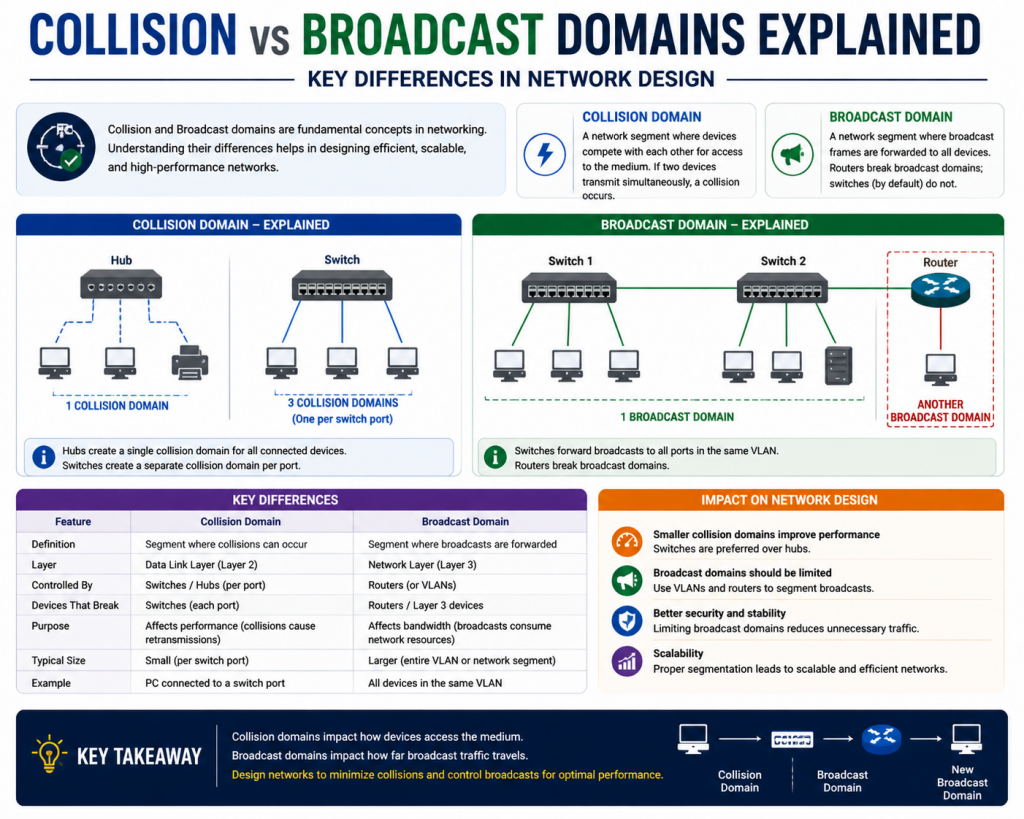
A collision domain is a section of a network where devices share the same transmission medium and therefore have the potential to collide with one another. If two devices are within the same collision domain, their transmissions can interfere. If they are in different collision domains, they cannot directly cause collisions with each other.
In simple terms, a collision domain defines the scope of where collisions can happen. The larger the collision domain, the more devices are competing for the same bandwidth, and the higher the likelihood of collisions. Conversely, smaller collision domains reduce competition and improve performance.
In early network designs, entire networks often existed as a single collision domain. This meant that every device connected to the network had to share the same communication channel. As more devices were added, the probability of collisions increased dramatically, leading to congestion and inefficiency.
Early Ethernet and the Role of Hubs
In the early days of Ethernet networking, hubs were commonly used to connect devices. A hub is a simple device that receives incoming data and broadcasts it to all connected ports. It does not have the ability to distinguish between intended recipients, so every device receives every transmission.
Because hubs operate in this way, all connected devices are part of the same collision domain. If two devices transmit at the same time, a collision occurs, and all devices must wait while the affected nodes retransmit their data.
This design was simple and inexpensive, but it did not scale well. As networks grew, the number of collisions increased, leading to slower performance and reduced reliability. Hubs eventually became obsolete as more advanced networking devices were introduced.
Carrier Sense Multiple Access with Collision Detection
To handle collisions in early Ethernet networks, a protocol known as Carrier Sense Multiple Access with Collision Detection was developed. This protocol allowed devices to monitor the network before transmitting. If the network was already in use, the device would wait until it became idle.
When a device began transmitting, it continued to monitor the network for signs of a collision. If a collision was detected, the device would stop transmitting immediately and send a signal to notify other devices of the collision. Afterward, each device would wait for a random amount of time before attempting to retransmit.
This random delay was crucial in preventing repeated collisions between the same devices. While this protocol helped manage collisions, it did not eliminate them. Instead, it provided a way to recover from collisions when they occurred.
As network speeds increased and the number of connected devices grew, the limitations of this approach became more apparent. The need for a more efficient solution led to the development of modern switching technologies.
Transition to Switch-Based Networking
The introduction of network switches marked a significant advancement in the way collision domains were managed. Unlike hubs, switches are intelligent devices that can identify the destination of incoming data and forward it only to the appropriate port.
Each port on a switch represents a separate collision domain. This means that devices connected to different ports do not compete for the same transmission medium. As a result, collisions are greatly reduced, and network performance improves.
Switches also support full-duplex communication, which allows devices to send and receive data simultaneously. In a full-duplex environment, collisions cannot occur because there is no shared transmission channel. Each device has a dedicated communication path, eliminating the possibility of interference.
This shift from shared media to dedicated connections transformed network design. It allowed networks to scale more effectively while maintaining high levels of performance.
Full-Duplex Communication and Its Impact
Full-duplex communication represents one of the most important developments in networking. In this mode, devices can transmit and receive data at the same time without interfering with each other. This eliminates the need for collision detection mechanisms and significantly improves efficiency.
In modern networks, full-duplex communication is the standard. Most network devices automatically negotiate full-duplex connections, ensuring optimal performance. Higher-speed Ethernet standards, such as Gigabit Ethernet and beyond, do not support half-duplex mode at all.
By removing the possibility of collisions, full-duplex communication allows networks to achieve higher throughput and lower latency. This is especially important for applications that require real-time data transmission, such as video conferencing, online gaming, and cloud services.
Causes of Collisions in Modern Environments
Although collisions are rare in modern networks, they can still occur under certain conditions. One common cause is a duplex mismatch, where one device operates in full-duplex mode while the other operates in half-duplex mode. This mismatch can lead to communication errors and retransmissions that resemble collisions.
Faulty network cables or connectors can also contribute to collision-like behavior. Poor signal quality may cause data corruption, requiring retransmission and reducing performance.
In some cases, outdated or misconfigured hardware may not support modern networking standards. This can force devices to operate in less efficient modes, increasing the likelihood of collisions.
Wireless networks present a different challenge. Because multiple devices share the same radio frequency spectrum, they must coordinate their transmissions carefully. While not identical to wired collisions, interference and overlapping transmissions can produce similar effects.
Strategies for Reducing Collision Domains
Network designers use several strategies to minimize collision domains and improve performance. One of the most effective methods is replacing hubs with switches. By creating separate collision domains for each port, switches reduce the number of devices competing for the same medium.
Ensuring that all devices operate in full-duplex mode is another critical step. This eliminates collisions entirely and allows for simultaneous data transmission.
Proper network configuration is also essential. Automatic negotiation settings should be enabled to ensure compatibility between devices. Regular maintenance, such as inspecting cables and replacing faulty hardware, helps prevent issues that could lead to collisions.
Segmenting networks into smaller sections can further reduce the impact of collisions. By limiting the number of devices within each collision domain, administrators can improve overall efficiency and reliability.
Wireless Networks and Collision Avoidance
Wireless networks handle collisions differently from wired networks. Instead of detecting collisions after they occur, wireless systems attempt to avoid them altogether. This is achieved through a protocol that requires devices to listen to the channel before transmitting.
If the channel is busy, the device waits for a random period before attempting to transmit. This reduces the likelihood of overlapping transmissions and improves overall efficiency.
However, wireless environments can still experience interference, especially in high-density areas. When many devices share the same channel, the chances of transmission conflicts increase. To address this, network administrators use multiple access points and distribute devices across different channels.
Using higher-frequency bands can also help reduce congestion and improve performance. Proper placement of access points and careful channel selection are essential for minimizing interference.
Importance of Collision Domain Management
Effective management of collision domains is critical for maintaining network performance. Even though modern technologies have largely eliminated collisions, understanding how they occur and how to prevent them remains important.
By minimizing collisions, networks can achieve faster data transmission, lower latency, and improved reliability. This is particularly important in environments that support critical applications and large numbers of users.
Network administrators must consider collision domains when designing and maintaining networks. This includes selecting appropriate hardware, configuring devices correctly, and monitoring performance to identify potential issues.
Real-World Implications of Collision Domains
In real-world scenarios, the impact of collision domains can be significant. In older networks that rely on outdated equipment, collisions can still cause performance issues. Upgrading to modern switching technology can dramatically improve efficiency and reliability.
In enterprise environments, proper network design ensures that collision domains are minimized, allowing for smooth operation even under heavy workloads. Data centers, for example, rely on advanced switching technologies to handle large volumes of traffic without interference.
Even in smaller networks, such as those found in homes or small offices, understanding collision domains can help improve performance. Using modern routers and switches ensures that devices have dedicated communication paths, reducing the likelihood of conflicts.
Looking Ahead in Network Evolution
As networking technology continues to evolve, the importance of collision domains has diminished, but the concept remains foundational. Modern networks are designed to avoid collisions altogether, focusing instead on optimizing data flow and minimizing latency.
Emerging technologies, such as software-defined networking and advanced automation tools, provide even greater control over network behavior. These innovations allow administrators to dynamically adjust configurations and optimize performance in real time.
Despite these advancements, the principles behind collision domains continue to influence network design. Understanding these concepts provides valuable insight into how networks operate and how they can be optimized for maximum efficiency.
Introduction to Broadcast Communication in Networks
In modern computer networks, communication is not always limited to one-to-one interactions between devices. There are many situations where a device needs to send information to every other device within a specific network segment. This type of communication is known as broadcasting, and it plays a fundamental role in how networks operate.
Broadcast communication allows devices to discover services, request configuration details, and maintain connectivity without prior knowledge of specific destinations. While this capability is extremely useful, it also introduces challenges. When broadcast traffic becomes excessive, it can consume bandwidth, overload devices, and reduce overall network efficiency.
To manage this effectively, networks are divided into broadcast domains. Understanding how broadcast domains function and how they can be controlled is essential for designing scalable and high-performing networks.
What is a Broadcast in Networking
A broadcast is a message that is sent from one device to all other devices within the same network segment. Unlike unicast communication, which targets a specific destination, a broadcast is intended for every node in the broadcast domain.
When a device sends a broadcast, all other devices in that domain receive and process the message. Even if the information is not relevant to them, they must still examine the packet to determine whether it should be acted upon or discarded. This behavior ensures that important network services can function correctly, but it also increases the workload on each device.
Broadcasts are typically used when the sender does not know the exact address of the intended recipient. For example, when a device first connects to a network, it may not have enough information to communicate directly with a server. In such cases, broadcasting provides a way to locate the necessary resources.
Understanding Broadcast Domains
A broadcast domain is a logical grouping of devices that receive broadcast messages from one another. All devices within the same broadcast domain will receive any broadcast sent by any other device in that domain.
Broadcast domains are defined by network boundaries. Devices within the same domain can communicate freely using broadcast messages, while devices outside the domain are isolated from this traffic. This separation is important for controlling the flow of broadcast traffic and preventing unnecessary congestion.
In simple networks, a broadcast domain may include all connected devices. However, as networks grow larger, this approach becomes inefficient. Dividing the network into smaller broadcast domains helps reduce the number of devices that must process each broadcast, improving performance.
Why Broadcasts Are Necessary
Broadcasts serve several critical functions in networking. Without them, many automated processes would require manual configuration, making network management more complex and less efficient.
One of the most common uses of broadcast communication is dynamic configuration. When a device connects to a network, it often needs to obtain an IP address and other configuration details. Since it does not yet know the location of the server providing this information, it sends a broadcast request to discover it.
Broadcasts are also used for device discovery. For example, a computer may send a broadcast to locate printers, file servers, or other shared resources on the network. This simplifies the process of connecting to these services, especially in environments where devices frequently join or leave the network.
In addition, certain network protocols rely on broadcast communication to maintain network stability. These protocols exchange information about network topology, device status, and routing paths, ensuring that data is delivered efficiently.
Common Protocols That Use Broadcasts
Several widely used network protocols depend on broadcast communication. One example is the protocol responsible for assigning IP addresses dynamically. When a device joins a network, it sends a broadcast request to locate a server that can assign it an address. The server responds, allowing the device to communicate with other nodes.
Another example involves protocols that map network addresses to physical hardware addresses. These protocols use broadcasts to request information from all devices, ensuring that the correct mapping is established.
Broadcasts are also used in certain routing and management protocols. These protocols rely on broadcast communication to exchange information between devices, helping maintain an accurate view of the network.
While these uses are essential, they also highlight the importance of controlling broadcast traffic to prevent excessive overhead.
The Impact of Broadcast Traffic on Network Performance
Although broadcasts are necessary, they can have a significant impact on network performance if not managed properly. Each broadcast message must be processed by every device in the broadcast domain. As the number of devices increases, so does the amount of processing required.
In small networks, this overhead is usually negligible. However, in large networks with hundreds or thousands of devices, broadcast traffic can become a major concern. Excessive broadcasts can consume bandwidth, slow down communication, and reduce the overall responsiveness of the network.
This issue becomes even more pronounced when broadcast traffic occurs in bursts. A sudden increase in broadcast messages can overwhelm devices, leading to delays and potential disruptions in service.
Broadcast Storms and Their Consequences
One of the most serious issues related to broadcast traffic is the broadcast storm. A broadcast storm occurs when a large number of broadcast messages are generated in a short period, overwhelming the network.
Broadcast storms can be caused by network loops, misconfigured devices, or faulty hardware. In such situations, broadcast messages may be continuously replicated and retransmitted, creating a cycle that rapidly consumes network resources.
The consequences of a broadcast storm can be severe. Network performance may degrade significantly, and in extreme cases, the network may become completely unusable. Devices may struggle to process the overwhelming volume of traffic, leading to dropped packets and communication failures.
Preventing broadcast storms requires careful network design and the use of mechanisms that can detect and mitigate abnormal traffic patterns.
Segmenting Networks to Control Broadcast Domains
One of the most effective ways to manage broadcast traffic is by dividing the network into smaller broadcast domains. This process is known as segmentation. By limiting the number of devices within each domain, segmentation reduces the impact of broadcast traffic.
Routers play a key role in this process. By default, routers do not forward broadcast messages between different network segments. This creates a boundary that confines broadcasts to a specific domain.
For example, a network can be divided into multiple subnets, each representing a separate broadcast domain. Devices within the same subnet can communicate using broadcasts, but those broadcasts do not extend beyond the subnet.
This approach improves efficiency by ensuring that broadcast traffic is limited to relevant devices. It also enhances security by isolating different parts of the network.
Virtual Segmentation and Its Advantages
In addition to physical segmentation, modern networks use virtual segmentation techniques to manage broadcast domains. This approach allows administrators to divide a network logically, without requiring separate physical infrastructure.
Virtual segmentation enables devices to be grouped based on function, location, or organizational requirements. For instance, computers in one department can be placed in one broadcast domain, while devices in another department are placed in a separate domain.
This flexibility makes it easier to manage large networks and adapt to changing requirements. Virtual segmentation also improves performance by reducing unnecessary broadcast traffic and enhances security by isolating sensitive systems.
Communication between different segments is handled through routing, ensuring that data is exchanged efficiently and securely.
Managing Broadcast Traffic with Intelligent Systems
Modern networking equipment includes features designed to manage broadcast traffic more effectively. These systems can analyze traffic patterns and make intelligent decisions about how broadcasts are handled.
One common technique involves limiting the rate of broadcast traffic. By setting thresholds, administrators can prevent excessive broadcasts from overwhelming the network. If the threshold is exceeded, additional broadcast traffic may be temporarily restricted.
Another approach involves redirecting broadcast traffic to specific destinations. For example, certain types of broadcast requests can be intercepted and forwarded directly to the appropriate server, reducing the need to send the message to all devices.
These techniques help maintain a balance between functionality and efficiency, ensuring that broadcasts serve their intended purpose without causing unnecessary overhead.
The Role of Multicast in Reducing Broadcast Traffic
Multicast communication provides an alternative to broadcasting in certain scenarios. Instead of sending data to all devices, multicast allows data to be delivered only to devices that have expressed interest in receiving it.
This approach is particularly useful for applications that involve sending the same data to multiple recipients, such as video streaming or real-time updates. By targeting only interested devices, multicast reduces unnecessary traffic and improves efficiency.
While multicast is more efficient than broadcasting, it requires proper configuration and support from network devices. When implemented correctly, it can significantly reduce the burden of broadcast traffic on the network.
Designing Networks for Optimal Broadcast Management
Effective broadcast management requires careful planning and design. Network administrators must consider factors such as the number of devices, the types of applications in use, and the overall network architecture.
Segmenting the network into appropriate broadcast domains is a key step. Each domain should be sized to balance efficiency and functionality. Too few domains can lead to excessive broadcast traffic, while too many can complicate management.
Monitoring network performance is also essential. By analyzing traffic patterns, administrators can identify potential issues and make adjustments as needed. This proactive approach helps prevent problems before they impact users.
In addition, implementing redundancy and failover mechanisms can improve reliability. These measures ensure that the network continues to function even in the event of hardware failures or unexpected traffic spikes.
Real-World Applications of Broadcast Domain Management
Broadcast domain management is applied in a wide range of environments. In enterprise networks, segmentation is used to separate different departments, reducing unnecessary communication and improving performance.
In data centers, broadcast domains are carefully controlled to handle large volumes of traffic efficiently. Advanced networking technologies are used to ensure that broadcasts do not interfere with critical operations.
Even in smaller networks, such as those in homes or small offices, managing broadcast traffic is important. Modern networking devices often include built-in features that automatically optimize broadcast behavior, providing reliable performance with minimal configuration.
Challenges in Modern Network Environments
As networks continue to grow and evolve, managing broadcast domains becomes increasingly complex. The rise of cloud computing, mobile devices, and Internet of Things technologies has introduced new challenges.
These environments often involve large numbers of devices with varying communication needs. Ensuring that broadcast traffic is handled efficiently requires advanced tools and strategies.
Security is another important consideration. Broadcast traffic can potentially expose sensitive information if not properly controlled. Segmentation and filtering techniques help mitigate these risks by limiting the scope of broadcasts.
Future Trends in Broadcast Management
The future of networking will likely bring new approaches to managing broadcast traffic. Automation and software-defined networking are already playing a significant role in this area.
These technologies allow networks to adapt dynamically to changing conditions. For example, broadcast domains can be adjusted automatically based on traffic patterns, ensuring optimal performance at all times.
Artificial intelligence and machine learning may also contribute to more efficient broadcast management. By analyzing network behavior, these systems can identify patterns and optimize configurations in real time.
As networks become more complex, these advanced techniques will be essential for maintaining performance and reliability.
Introduction to the Relationship Between Collision and Broadcast Domains
Collision domains and broadcast domains are two foundational concepts in networking that influence how data flows across a network. While they address different aspects of communication, they are closely related in how they affect performance, scalability, and efficiency.
A collision domain focuses on how devices share a communication medium and whether their transmissions can interfere with one another. A broadcast domain, on the other hand, determines how far broadcast messages can travel within a network. Understanding the relationship between these two domains is essential for designing networks that are both efficient and reliable.
Modern networking technologies have largely eliminated collisions, but broadcast traffic remains an important factor. By comparing these two domains and examining how they are managed, it becomes easier to understand the principles behind effective network design.
Key Differences Between Collision and Broadcast Domains
The primary difference between collision and broadcast domains lies in their purpose and impact on network communication. Collision domains deal with data transmission conflicts, while broadcast domains deal with data distribution.
In a collision domain, the main concern is whether two devices can transmit at the same time without interfering with each other. If they cannot, a collision occurs, resulting in retransmissions and delays. Reducing the size of collision domains minimizes these issues and improves performance.
In a broadcast domain, the focus shifts to how messages are shared among devices. Broadcast messages are sent to all devices within the domain, regardless of whether they are the intended recipients. This can be useful for discovery and configuration, but it also introduces overhead.
Another key difference is how these domains are controlled. Collision domains are primarily managed by switches and duplex settings, while broadcast domains are controlled through network segmentation techniques such as routing and logical grouping.
Understanding these differences helps network administrators make informed decisions about how to structure their networks for optimal performance.
How Modern Networks Handle Collision Domains
In modern networks, collision domains have been significantly reduced or eliminated. This is largely due to the widespread use of switches and full-duplex communication.
Each port on a switch represents a separate collision domain. This means that devices connected to different ports do not compete for the same transmission medium. As a result, collisions are no longer a common occurrence in wired networks.
Full-duplex communication further enhances this by allowing devices to send and receive data simultaneously. Since there is no shared transmission channel, collisions cannot occur.
These advancements have made networks more efficient and reliable. However, understanding collision domains is still important, especially when troubleshooting issues related to performance or hardware compatibility.
How Broadcast Domains Continue to Affect Networks
Unlike collision domains, broadcast domains remain highly relevant in modern networks. Broadcast traffic is still widely used for various networking functions, including device discovery and configuration.
As networks grow larger, managing broadcast domains becomes increasingly important. Without proper segmentation, broadcast traffic can spread across large portions of the network, consuming bandwidth and processing resources.
By dividing networks into smaller broadcast domains, administrators can limit the scope of broadcast traffic. This improves efficiency and ensures that devices only receive relevant messages.
Broadcast domain management is especially important in large organizations, where thousands of devices may be connected to the network. Proper segmentation helps maintain performance and prevents unnecessary congestion.
The Role of Switches and Routers in Domain Management
Switches and routers play a crucial role in managing both collision and broadcast domains. Switches are primarily responsible for reducing collision domains, while routers are used to segment broadcast domains.
Switches create separate collision domains for each port, allowing multiple devices to communicate simultaneously without interference. They also support features that help manage broadcast traffic within a local network.
Routers act as boundaries between different broadcast domains. By default, they do not forward broadcast messages from one network segment to another. This helps contain broadcast traffic and prevents it from spreading unnecessarily.
In modern networks, Layer 3 switches combine the functionality of switches and routers. They can perform routing functions while maintaining high-speed switching capabilities, providing an efficient solution for managing both types of domains.
Network Segmentation and Its Importance
Network segmentation is the process of dividing a network into smaller, more manageable sections. This technique is essential for controlling broadcast domains and improving overall performance.
By creating multiple segments, administrators can limit the number of devices within each broadcast domain. This reduces the amount of broadcast traffic that each device must process, improving efficiency.
Segmentation also enhances security by isolating different parts of the network. Sensitive systems can be placed in separate segments, reducing the risk of unauthorized access.
In addition, segmentation makes it easier to manage and troubleshoot networks. Problems can be isolated to specific segments, simplifying the process of identifying and resolving issues.
Virtual Segmentation in Modern Networking
Virtual segmentation has become a key component of modern network design. This approach allows networks to be divided logically rather than physically, providing greater flexibility and scalability.
Through virtual segmentation, devices can be grouped based on their roles or requirements. For example, servers, workstations, and printers can each be placed in separate broadcast domains.
This logical separation improves performance by reducing unnecessary broadcast traffic. It also enhances security by restricting communication between different groups of devices.
Virtual segmentation is widely used in enterprise environments, where networks must support a diverse range of applications and users. It allows administrators to adapt quickly to changing needs without requiring significant changes to the physical infrastructure.
Impact on Network Performance and Efficiency
Both collision and broadcast domains have a direct impact on network performance. Reducing collision domains leads to fewer transmission conflicts and faster data transfer.
Managing broadcast domains helps prevent excessive traffic and ensures that network resources are used efficiently. By limiting the scope of broadcasts, networks can operate more smoothly and handle larger volumes of data.
Balancing these two factors is essential for achieving optimal performance. While collisions should be minimized as much as possible, broadcasts must be carefully controlled rather than eliminated entirely.
Modern networks achieve this balance through the use of advanced technologies and thoughtful design practices.
Real-World Network Design Considerations
In real-world environments, network design must account for a variety of factors, including the number of devices, the types of applications in use, and the expected level of traffic.
Enterprise networks often use a hierarchical design, with core, distribution, and access layers. Each layer plays a specific role in managing traffic and maintaining performance.
Collision domains are minimized at the access layer through the use of switches and full-duplex communication. Broadcast domains are controlled at the distribution layer through segmentation and routing.
Data centers require even more advanced design strategies. High-performance switching and routing technologies are used to handle large volumes of traffic while maintaining low latency.
In smaller networks, such as those found in homes or small businesses, modern routers and switches automatically manage collision and broadcast domains. This simplifies network setup and ensures reliable performance.
Troubleshooting Issues Related to Domains
Understanding collision and broadcast domains is essential for troubleshooting network issues. Problems related to collisions are often caused by duplex mismatches, faulty cables, or outdated hardware.
Symptoms may include slow performance, high error rates, or frequent retransmissions. Resolving these issues typically involves checking device configurations and ensuring that all connections support full-duplex communication.
Broadcast-related issues can be more complex. Excessive broadcast traffic may indicate a misconfiguration, network loop, or faulty device. Identifying the source of the problem requires careful monitoring and analysis.
Tools such as network analyzers can help administrators identify patterns and pinpoint the cause of issues. By addressing these problems promptly, network performance can be restored.
Security Implications of Broadcast Domains
Broadcast domains also have important security implications. Because broadcast messages are sent to all devices within a domain, sensitive information may be exposed if not properly controlled.
Segmenting the network helps mitigate this risk by limiting the scope of broadcast traffic. Devices in one segment cannot directly access broadcasts from another segment, providing an additional layer of protection.
Access control mechanisms can also be used to restrict communication between different segments. This ensures that only authorized devices can exchange data.
In modern networks, security is a top priority, and managing broadcast domains plays a key role in protecting sensitive information.
Future Trends in Network Domain Management
As networking technology continues to evolve, new approaches to managing collision and broadcast domains are emerging. Software-defined networking allows administrators to control network behavior through centralized software, providing greater flexibility and efficiency.
Automation tools can monitor network conditions and adjust configurations dynamically. This ensures that collision and broadcast domains are optimized for current traffic patterns.
Artificial intelligence and machine learning are also being integrated into network management systems. These technologies can analyze large amounts of data and identify patterns that may not be immediately apparent to human administrators.
These advancements will continue to improve network performance and make it easier to manage complex environments.
The Balance Between Control and Flexibility
Effective network design requires a balance between control and flexibility. While it is important to minimize collisions and manage broadcast traffic, networks must also remain adaptable to changing needs.
Over-segmentation can make networks difficult to manage, while under-segmentation can lead to performance issues. Finding the right balance requires careful planning and ongoing monitoring.
By understanding the principles of collision and broadcast domains, administrators can make informed decisions that support both efficiency and scalability.
Conclusion
Collision and broadcast domains are essential concepts that shape how networks operate. While collisions have largely been eliminated in modern networks through the use of switches and full-duplex communication, broadcast domains remain a critical factor in network design.
By understanding the differences between these domains and how they impact performance, network administrators can build systems that are efficient, scalable, and secure. Reducing collision domains improves data transmission, while managing broadcast domains ensures that network resources are used effectively.
Modern technologies provide powerful tools for controlling both types of domains, but the underlying principles remain the same. Careful planning, proper configuration, and continuous monitoring are key to maintaining optimal network performance.
As networks continue to evolve, the importance of these concepts will remain. They form the foundation of effective network design and provide the knowledge needed to adapt to future challenges.
Continue exploring the technologies and certification concepts that matter most to you.