In modern computer networks, efficient communication is essential for delivering data quickly and reliably. Networks support different communication models that define how data is transmitted between devices. The three primary models are unicast, broadcast, and multicast. Each of these plays a distinct role in how information flows across a network.
Unicast communication involves a one-to-one relationship where a single sender transmits data to a single receiver. This model is widely used in everyday applications such as web browsing, email communication, and file transfers. While unicast is straightforward and reliable, it becomes inefficient when the same data must be sent to multiple recipients simultaneously.
Broadcast communication, on the other hand, involves sending data from one device to all devices within a network segment. While this ensures that every device receives the message, it can lead to unnecessary traffic and congestion, especially in large networks. Broadcast traffic is often limited to essential network operations to avoid overwhelming the network.
Multicast communication provides a balance between unicast and broadcast. It allows a single sender to transmit data to a group of interested receivers. Devices that wish to receive multicast traffic join a multicast group, and only those devices receive the data. This approach significantly improves efficiency, especially in applications such as video streaming, online gaming, and live broadcasts.
Understanding these communication models is crucial for appreciating the importance of IGMP snooping. Multicast, while efficient in theory, requires proper management to function effectively in real-world networks.
The Growing Importance of Multicast in Modern Networks
As digital services continue to expand, the demand for efficient data distribution has increased significantly. Applications such as video conferencing, IPTV, online education platforms, and real-time data feeds rely heavily on multicast technology. These applications often require the same data to be delivered to multiple users simultaneously, making multicast an ideal solution.
In enterprise environments, multicast is commonly used for software updates, financial data distribution, and internal communication systems. Educational institutions use multicast to deliver lectures and training sessions to large audiences. Similarly, media companies rely on multicast for live streaming and broadcasting.
Despite its advantages, multicast introduces challenges, particularly at the data link layer. Switches operating at this layer are not inherently aware of multicast group memberships. As a result, they may treat multicast traffic as broadcast traffic, forwarding it to all connected devices. This behavior can negate the efficiency benefits of multicast and lead to network congestion.
To address these challenges, additional mechanisms are required to ensure that multicast traffic is delivered only to devices that need it. This is where IGMP snooping becomes a critical component of network design.
Understanding Internet Group Management Protocol
The Internet Group Management Protocol, commonly referred to as IGMP, is a protocol used by devices to manage their membership in multicast groups. It operates at the network layer and enables communication between hosts and multicast routers.
When a device wants to receive multicast traffic, it sends an IGMP join message to indicate its interest in a specific multicast group. This message informs the network that the device should receive traffic associated with that group. When the device no longer needs the data, it sends an IGMP leave message to exit the group.
Routers use IGMP messages to determine which multicast traffic should be forwarded to specific network segments. By maintaining a record of group memberships, routers can ensure that multicast data is delivered efficiently across the network.
There are multiple versions of IGMP, each introducing improvements in performance and functionality. These enhancements include faster group membership updates, better handling of leave messages, and more efficient use of network resources.
While IGMP is essential for managing multicast traffic at the network layer, it does not directly control how switches handle multicast frames at the data link layer. This limitation creates the need for IGMP snooping.
What is IGMP Snooping and Why It Matters
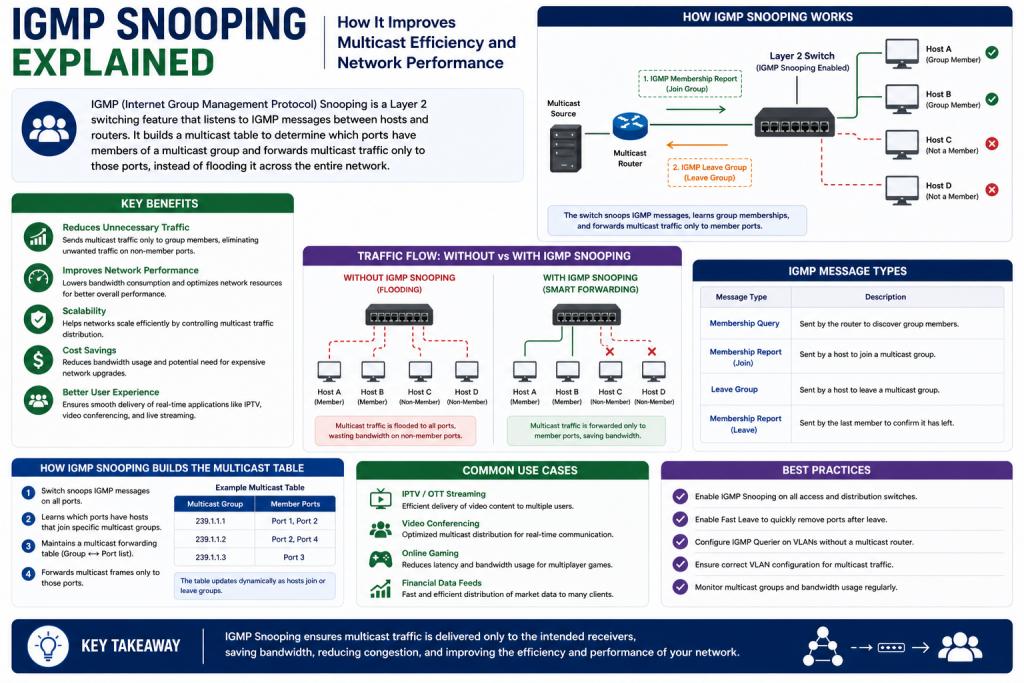
IGMP snooping is a feature implemented on network switches that allows them to monitor IGMP messages exchanged between devices and routers. By analyzing these messages, switches can identify which devices belong to specific multicast groups.
Instead of forwarding multicast traffic to all ports, a switch with IGMP snooping enabled creates a mapping between multicast groups and the ports where interested devices are connected. This mapping allows the switch to forward multicast traffic only to the relevant ports.
This selective forwarding significantly reduces unnecessary traffic and improves overall network efficiency. It also helps prevent network congestion and ensures that bandwidth is used effectively.
IGMP snooping operates passively, meaning it does not generate its own control messages. Instead, it listens to existing IGMP communications and uses that information to make forwarding decisions. This design makes it easy to integrate into existing networks without requiring major changes.
The importance of IGMP snooping becomes particularly evident in networks with high volumes of multicast traffic. Without it, the benefits of multicast can be overshadowed by inefficiencies and performance issues.
Challenges of Multicast Without IGMP Snooping
In networks where IGMP snooping is not enabled, switches lack the ability to differentiate between devices that need multicast traffic and those that do not. As a result, multicast traffic is treated similarly to broadcast traffic and is forwarded to all ports within a VLAN.
This behavior leads to several challenges. First, it increases bandwidth consumption by sending unnecessary data to devices that are not interested in the multicast stream. This can reduce the available bandwidth for other critical applications.
Second, it places additional processing load on devices that receive unwanted traffic. These devices must process and discard the data, which can impact their performance.
Third, it introduces potential security risks. Multicast traffic may contain sensitive information, and broadcasting it to all devices increases the likelihood of unauthorized access.
In large networks, these issues can become more pronounced. High volumes of unnecessary traffic can lead to congestion, increased latency, and reduced overall network performance. This highlights the need for mechanisms like IGMP snooping to optimize multicast traffic.
How IGMP Snooping Enhances Network Efficiency
When IGMP snooping is enabled, switches begin to monitor IGMP messages such as join and leave requests. By tracking these messages, the switch builds a table that associates multicast groups with specific ports.
This table allows the switch to make intelligent forwarding decisions. When a multicast packet arrives, the switch checks the table and forwards the packet only to the ports where devices have expressed interest in the corresponding multicast group.
This targeted approach reduces unnecessary traffic and ensures that bandwidth is used efficiently. It also improves the performance of multicast applications by minimizing delays and packet loss.
In addition to improving efficiency, IGMP snooping helps maintain a cleaner and more organized network. By preventing unnecessary traffic from spreading across the network, it reduces the likelihood of congestion and improves overall reliability.
The Relationship Between IGMP Snooping and VLANs
Virtual Local Area Networks, or VLANs, play a significant role in how IGMP snooping operates. Multicast traffic is typically confined within a VLAN, and IGMP snooping tables are maintained separately for each VLAN.
This means that each VLAN has its own set of multicast group memberships and forwarding rules. By isolating multicast traffic within VLANs, networks can achieve better segmentation and control.
For example, different departments within an organization may be assigned to separate VLANs. With IGMP snooping enabled, multicast traffic intended for one department will not be forwarded to another. This improves both efficiency and security.
Proper VLAN configuration is essential for effective IGMP snooping. Incorrect configurations can lead to improper forwarding behavior and reduce the effectiveness of the feature.
The Role of the IGMP Querier
An important component of multicast networks is the IGMP querier. The querier is responsible for sending periodic queries to determine which devices are still interested in receiving multicast traffic.
These queries help maintain accurate group membership information by prompting devices to respond with their current status. If a device does not respond within a specified time, it is assumed to have left the group, and the switch updates its forwarding table accordingly.
In networks with a multicast router, the router typically acts as the IGMP querier. However, in the absence of a router, a switch can be configured to perform this role. This ensures that IGMP snooping continues to function correctly even in simpler network environments.
The presence of a querier is essential for maintaining accurate and up-to-date multicast group information. Without it, switches may continue to forward traffic to devices that are no longer interested, reducing efficiency.
Security Advantages of IGMP Snooping
IGMP snooping not only improves performance but also enhances network security. By restricting multicast traffic to only the devices that have joined a specific group, it reduces the risk of sensitive information being exposed to unauthorized users.
In networks without IGMP snooping, multicast traffic is visible to all devices within a VLAN. This can create opportunities for data interception and unauthorized access. With IGMP snooping, access to multicast streams is effectively controlled based on group membership.
This selective delivery acts as an additional layer of protection, particularly in environments where multicast traffic contains confidential data. While IGMP snooping is not a substitute for comprehensive security measures, it contributes to a more secure network environment.
Deep Dive into How IGMP Snooping Works Internally
To fully understand the value of IGMP snooping, it is important to explore how it operates inside a network switch. At its core, IGMP snooping is a process of inspection and learning. The switch listens to IGMP control messages exchanged between hosts and routers and uses that information to build a logical understanding of multicast group membership.
When a host wants to receive multicast traffic, it sends an IGMP membership report, often referred to as a join message. This message is forwarded through the network and can be observed by switches along the path. A switch with IGMP snooping enabled captures this message and records the port on which it was received along with the multicast group address.
Over time, the switch builds a multicast forwarding table. This table is similar in concept to a MAC address table but is specific to multicast groups. Each entry maps a multicast group to one or more switch ports that have interested receivers.
When multicast traffic arrives at the switch, the forwarding decision is no longer based on flooding. Instead, the switch consults its multicast table and sends the traffic only to the relevant ports. This behavior is what makes IGMP snooping highly efficient compared to traditional Layer 2 multicast handling.
The Lifecycle of Multicast Group Membership
Multicast group membership is not static. Devices can join and leave multicast groups dynamically based on application requirements. IGMP snooping must continuously track these changes to maintain accurate forwarding behavior.
When a host joins a multicast group, the switch updates its table to include the port associated with that host. When a host leaves the group, the switch must remove the corresponding entry. However, detecting when a host leaves is not always straightforward.
In many cases, devices do not explicitly send leave messages, especially in older IGMP versions. To handle this, the network relies on periodic queries from an IGMP querier. These queries prompt devices to confirm their membership in multicast groups.
If a device does not respond to a query within a certain time frame, the switch assumes that the device is no longer interested in the multicast traffic. The corresponding entry is then removed from the table. This process ensures that multicast forwarding remains accurate and efficient.
The continuous updating of group membership is essential for preventing stale entries and ensuring that multicast traffic is delivered only where it is needed.
IGMP Snooping Tables and Forwarding Logic
The multicast forwarding table maintained by a switch is the heart of IGMP snooping. This table contains entries that associate multicast group addresses with specific switch ports. Some implementations may also include additional information such as VLAN identifiers and timers.
Each time a join message is observed, the switch adds or updates an entry in the table. When multicast traffic arrives, the switch checks the destination address against this table. If a match is found, the traffic is forwarded only to the listed ports.
If no entry exists for a particular multicast group, the switch may either flood the traffic or drop it, depending on its configuration. Flooding is typically used as a fallback mechanism to ensure that multicast traffic is not lost.
Timers play an important role in maintaining the accuracy of the table. Each entry has an associated timeout value. If no IGMP messages are received for a group within this time period, the entry is removed. This prevents outdated information from affecting forwarding decisions.
The efficiency of IGMP snooping depends on the accuracy and timeliness of this table. Proper configuration and monitoring are essential to ensure that it functions correctly.
Understanding IGMP Versions and Their Impact
Different versions of IGMP introduce varying levels of functionality and efficiency. Understanding these versions helps in optimizing IGMP snooping behavior.
IGMP version 1 is the earliest implementation and provides basic group membership management. However, it lacks mechanisms for explicit leave notifications, which can result in slower updates to group membership.
IGMP version 2 introduces the ability for hosts to send leave messages. This allows switches and routers to update their tables more quickly when devices leave a multicast group. It also introduces group-specific queries, improving efficiency.
IGMP version 3 adds support for source-specific multicast. This allows devices to specify not only the multicast group they want to join but also the source from which they want to receive traffic. This provides greater control and enhances security.
Switches with IGMP snooping must be compatible with the IGMP version used in the network. In mixed environments, they must be able to interpret messages from different versions and maintain accurate forwarding tables.
The Role of the IGMP Querier in Detail
The IGMP querier is a critical component in maintaining multicast group membership. Its primary function is to send periodic query messages to all devices in the network.
These queries serve as a mechanism to verify which devices are still interested in receiving multicast traffic. When a device receives a query, it responds with a membership report if it is still part of a multicast group.
In networks with a multicast router, the router typically acts as the querier. However, in networks without a router, a switch can be configured to take on this role. This is known as an IGMP snooping querier.
The election of a querier is based on factors such as IP address. The device with the lowest IP address is usually selected as the querier. This ensures that only one device performs this function, preventing conflicts.
Without a querier, multicast group membership information can become outdated. This can lead to inefficient forwarding and unnecessary traffic. Therefore, ensuring the presence of a querier is essential for proper IGMP snooping operation.
Handling Multicast Traffic Across VLANs
In complex networks, multiple VLANs are used to segment traffic and improve organization. IGMP snooping must operate within this segmented environment to ensure efficient multicast delivery.
Each VLAN maintains its own multicast forwarding table. This means that multicast group memberships are tracked separately for each VLAN. Traffic is only forwarded within the VLAN where the group exists.
When multicast traffic needs to cross VLAN boundaries, a multicast router is required. The router handles the forwarding of multicast traffic between VLANs while maintaining group membership information.
Switches with IGMP snooping must correctly associate multicast traffic with the appropriate VLAN. Misconfiguration can lead to traffic being forwarded incorrectly or not at all.
Proper VLAN design and configuration are essential for ensuring that IGMP snooping functions effectively in multi-VLAN environments.
Interaction Between IGMP Snooping and Network Hardware
IGMP snooping relies heavily on the capabilities of network hardware. Modern switches are designed with dedicated resources for handling multicast traffic efficiently.
Hardware-based IGMP snooping allows switches to process multicast traffic at line speed without impacting overall performance. This is particularly important in high-bandwidth environments where large volumes of multicast traffic are present.
Some switches also support advanced features such as multicast filtering, rate limiting, and prioritization. These features build upon the foundation provided by IGMP snooping and allow for more granular control of multicast traffic.
However, not all switches are created equal. Lower-end devices may have limited support for IGMP snooping or may rely on software-based processing, which can impact performance.
When designing a network, it is important to consider the capabilities of the hardware and ensure that it supports the required multicast features.
Common Issues in IGMP Snooping Environments
While IGMP snooping provides significant benefits, it can also introduce challenges if not configured correctly. One common issue is the absence of an IGMP querier. Without a querier, switches may not receive periodic updates, leading to stale entries in the multicast table.
When entries become stale, the switch may continue forwarding multicast traffic to ports where no active receivers exist. This results in unnecessary bandwidth consumption and can reduce overall network efficiency. In some cases, it may also prevent new devices from properly joining multicast groups because the table is not being refreshed with accurate membership information.
Another challenge arises when multiple queriers exist in the same VLAN without proper election mechanisms. This can cause inconsistent query intervals and unpredictable behavior in group membership tracking. Ensuring that only one active querier is present, or that querier election is functioning correctly, is essential for stable operation.
Timer settings also play a role in these issues. If query intervals and timeout values are not properly configured, switches may either remove active members too quickly or retain inactive ones for too long. Both scenarios can negatively impact multicast performance.
Additionally, network topology changes such as link failures or device reboots can disrupt IGMP snooping tables. Without proper re-convergence, multicast traffic may be misdirected. Regular monitoring and validation help ensure that IGMP snooping continues to operate accurately in dynamic network environments.
Another issue is incorrect VLAN configuration. If devices are placed in the wrong VLAN or if multicast traffic is not properly associated with a VLAN, IGMP snooping may not function as expected.
In some cases, security features such as firewalls or access control lists may block IGMP messages. This can prevent switches from learning group membership and result in multicast traffic being flooded.
Firmware bugs and hardware limitations can also impact IGMP snooping performance. Keeping network devices updated with the latest firmware is essential for avoiding such issues.
Proper monitoring and troubleshooting practices are necessary to identify and resolve these challenges.
Optimizing Multicast Performance with IGMP Snooping
To achieve the best performance from IGMP snooping, several optimization techniques can be applied. One important practice is enabling IGMP snooping only on VLANs where multicast traffic is present. This reduces unnecessary processing and improves efficiency.
Configuring an IGMP querier ensures that group membership information is kept up to date. This is especially important in networks without a multicast router.
Adjusting timer values can also improve performance. Shorter timers allow for quicker updates to group membership but may increase control traffic. Finding the right balance is key.
In environments with high multicast traffic, using switches with hardware-based IGMP snooping is recommended. This ensures that traffic is processed efficiently without impacting overall performance.
Regular testing and validation of multicast applications help ensure that IGMP snooping is functioning as expected.
Configuring IGMP Snooping in Real-World Networks
Implementing IGMP snooping in a production environment requires a structured and careful approach. While the concept itself is straightforward, configuration details can vary depending on the network vendor, operating system, and topology. Despite these variations, the core principles remain consistent across most platforms.
The first step in configuration is enabling IGMP snooping globally on the switch. This ensures that the device begins listening to IGMP messages across all relevant interfaces. In many enterprise-grade switches, this feature may already be enabled by default, but it is always important to verify the current status before proceeding.
Once global snooping is enabled, the next step is to activate it on specific VLANs. Since multicast traffic is typically scoped within VLAN boundaries, enabling IGMP snooping at the VLAN level ensures precise control. Administrators should carefully select which VLANs require multicast optimization to avoid unnecessary processing overhead.
Another important configuration aspect involves defining the multicast forwarding mode. Some switches allow administrators to choose between IP-based and MAC-based forwarding. IP-based forwarding provides more granular control, while MAC-based forwarding is simpler but less flexible. The choice depends on the complexity of the network and the level of control required.
Finally, administrators should verify that multicast routing devices or queriers are present and properly configured. Without a querier, IGMP snooping tables may not update correctly, leading to inefficient traffic handling.
Step-by-Step Deployment Strategy
Deploying IGMP snooping successfully requires more than just enabling a feature. It involves planning, testing, and gradual rollout to ensure minimal disruption to network operations.
The deployment process typically begins with an assessment phase. During this phase, administrators identify multicast applications, analyze traffic patterns, and determine which parts of the network will benefit most from IGMP snooping. This helps in creating a targeted deployment plan.
The next phase involves testing in a controlled environment. A lab setup or a small segment of the network can be used to validate the configuration. This allows administrators to observe how multicast traffic behaves with IGMP snooping enabled and identify any potential issues.
Once testing is complete, the feature can be gradually rolled out across the network. Starting with less critical segments minimizes the impact of any unexpected issues. Monitoring tools should be used during this phase to track performance and ensure that multicast traffic is being handled correctly.
After full deployment, continuous monitoring and periodic reviews are essential. Networks evolve over time, and configurations may need to be adjusted to accommodate new applications or changes in traffic patterns.
Troubleshooting IGMP Snooping Issues
Even with careful configuration, issues can arise in IGMP snooping environments. Effective troubleshooting requires a systematic approach to identify and resolve problems.
One of the first steps in troubleshooting is verifying that IGMP snooping is enabled both globally and on the relevant VLANs. Misconfigurations at this level can prevent the feature from functioning entirely.
Next, administrators should examine the multicast forwarding table. This table provides insight into which ports are associated with specific multicast groups. If entries are missing or incorrect, it may indicate that IGMP messages are not being properly received or processed.
Checking the status of the IGMP querier is also critical. Without an active querier, switches may not receive periodic updates, leading to stale entries in the forwarding table. Ensuring that a querier is present and functioning correctly can resolve many issues.
Network devices such as firewalls and access control systems should also be reviewed. These devices may block IGMP messages, preventing switches from learning group memberships. Adjusting security policies to allow IGMP traffic is often necessary.
Finally, analyzing packet captures can provide detailed insights into multicast behavior. By examining IGMP messages and multicast traffic flows, administrators can pinpoint the root cause of issues and implement appropriate solutions.
Best Practices for IGMP Snooping Implementation
To maximize the benefits of IGMP snooping, it is important to follow established best practices. These guidelines help ensure optimal performance, reliability, and scalability.
One of the most important practices is enabling IGMP snooping only where it is needed. Applying it to VLANs that do not use multicast traffic can introduce unnecessary complexity without providing any benefits.
Ensuring the presence of an IGMP querier is another critical step. In networks without multicast routers, configuring a switch to act as a querier prevents issues related to stale group membership information.
Keeping firmware and software up to date is also essential. Vendors frequently release updates that improve multicast handling and fix bugs related to IGMP snooping. Regular updates help maintain a stable and secure network environment.
Proper documentation is often overlooked but plays a vital role in network management. Recording configurations, VLAN assignments, and multicast group details makes troubleshooting and future expansion much easier.
Testing multicast applications after configuration changes ensures that IGMP snooping is functioning as expected. Regular validation helps detect issues early and prevents disruptions to network services.
Security Considerations in Multicast Networks
While IGMP snooping improves efficiency, it also contributes to network security by controlling the distribution of multicast traffic. However, additional measures are required to fully secure multicast environments.
On its own, IGMP snooping primarily ensures that multicast traffic is forwarded only to devices that have explicitly joined a multicast group. This reduces unnecessary exposure, but it does not verify whether those devices are authorized to receive the data. To strengthen security, network administrators should implement access control mechanisms that restrict which hosts are allowed to join specific multicast groups. This can be achieved through port-based security policies or authentication frameworks that validate devices before granting access.
Another important measure is the use of filtering techniques such as access control lists. These can be applied to block unauthorized IGMP messages or limit multicast traffic to approved sources and destinations. Without such controls, malicious users could attempt to join multicast groups and gain access to sensitive information.
Network segmentation also plays a critical role. By isolating multicast traffic within dedicated VLANs, organizations can minimize the risk of data leakage across different departments or user groups. Monitoring tools further enhance security by providing visibility into multicast activity, allowing administrators to detect unusual patterns or unauthorized group memberships.
Encryption adds an additional layer of protection, ensuring that even if multicast traffic is intercepted, the data remains unreadable. By combining IGMP snooping with these complementary security strategies, organizations can create a more secure and controlled multicast environment.
Access control mechanisms can be used to restrict which devices are allowed to join specific multicast groups. This prevents unauthorized users from accessing sensitive data streams.
Network segmentation through VLANs further enhances security by isolating multicast traffic within defined boundaries. Combined with IGMP snooping, this ensures that traffic is delivered only to intended recipients.
Monitoring tools can be used to detect unusual multicast activity. Sudden spikes in multicast traffic or unexpected group memberships may indicate security threats or misconfigurations.
Encryption is another important consideration, especially for multicast applications that transmit sensitive information. While IGMP snooping controls traffic distribution, encryption ensures that the data itself remains protected.
By combining IGMP snooping with other security measures, organizations can create a robust and secure multicast environment.
Scaling IGMP Snooping in Large Networks
As networks grow, managing multicast traffic becomes increasingly complex. IGMP snooping plays a key role in ensuring scalability, but additional considerations are required in large environments.
Hierarchical network design is often used to manage scalability. By organizing switches into layers, administrators can control how multicast traffic flows through the network. IGMP snooping operates at each layer, ensuring efficient delivery within segments.
Load balancing techniques can be applied to distribute multicast traffic evenly across network resources. This prevents bottlenecks and ensures consistent performance.
In very large networks, multiple queries may be configured for redundancy. While only one querier is active at a time, backup queries ensure continuity in case of failure.
Monitoring and analytics tools become increasingly important as networks scale. These tools provide visibility into multicast traffic patterns and help identify potential issues before they impact performance.
Planning for scalability from the beginning ensures that IGMP snooping continues to deliver benefits as the network grows.
Integration with Advanced Network Technologies
IGMP snooping does not operate in isolation. It is often integrated with other advanced networking technologies to provide comprehensive traffic management.
In modern network environments, traffic flows are rarely simple or uniform. Different types of applications generate different kinds of data, each with unique performance and delivery requirements. IGMP snooping works alongside other technologies to ensure that multicast traffic is handled efficiently without disrupting the overall balance of the network. For example, when combined with traffic shaping and bandwidth management tools, multicast streams can be regulated to prevent them from overwhelming other critical services.
Integration with redundancy protocols also enhances reliability. Technologies such as link aggregation and failover mechanisms ensure that multicast traffic continues to flow even if a network link or device fails. IGMP snooping adapts to these changes by updating its forwarding tables based on the new topology, maintaining consistent delivery to active group members.
Additionally, in virtualized and cloud-based infrastructures, multicast traffic may traverse both physical and virtual switches. IGMP snooping extends into these environments, ensuring that multicast efficiency is preserved even when workloads move dynamically between servers or data centers.
By cooperating with these advanced systems, IGMP snooping becomes more than just a Layer 2 feature. It evolves into a critical component of a broader traffic management strategy, helping networks remain efficient, resilient, and adaptable to changing demands.
Software-defined networking introduces centralized control over network behavior. In such environments, IGMP snooping can be managed through centralized controllers, allowing for dynamic adjustments based on real-time conditions.
Quality of service mechanisms can be combined with IGMP snooping to prioritize critical multicast traffic. This ensures that applications such as video conferencing receive the necessary bandwidth and low latency.
Network automation tools can simplify the configuration and management of IGMP snooping. Automated scripts and policies reduce the risk of human error and improve consistency across the network.
Cloud-based networking environments also benefit from IGMP snooping, particularly in hybrid deployments where multicast traffic must be managed across both on-premises and cloud infrastructures.
These integrations enhance the overall effectiveness of IGMP snooping and enable more sophisticated network management strategies.
Future Trends in Multicast and IGMP Snooping
As technology continues to evolve, the role of multicast networking and IGMP snooping is also changing. Emerging applications such as virtual reality, augmented reality, and large-scale live streaming are driving the need for more efficient multicast solutions.
Advancements in hardware are enabling faster and more efficient processing of multicast traffic. Modern switches are equipped with specialized components that handle IGMP snooping at high speeds, reducing latency and improving performance.
New protocols and enhancements to existing ones are being developed to address the limitations of traditional multicast networking. These innovations aim to provide better scalability, security, and flexibility.
The increasing adoption of cloud and edge computing is also influencing multicast strategies. As data is distributed across multiple locations, efficient multicast delivery becomes even more critical.
Despite these changes, the fundamental principles of IGMP snooping remain relevant. By enabling efficient and controlled delivery of multicast traffic, it continues to play a vital role in modern network design.
Conclusion
IGMP snooping is an essential feature for optimizing multicast traffic in modern networks. By allowing switches to monitor IGMP messages and make intelligent forwarding decisions, it eliminates unnecessary traffic and improves overall network efficiency.
Proper configuration, careful deployment, and adherence to best practices are key to maximizing the benefits of IGMP snooping. From enabling the feature on appropriate VLANs to ensuring the presence of a querier, each step plays a crucial role in achieving optimal performance.
Troubleshooting and ongoing monitoring are equally important. Networks are dynamic environments, and maintaining efficient multicast delivery requires continuous attention and adjustment.
In addition to performance improvements, IGMP snooping enhances security by limiting multicast traffic to intended recipients. When combined with other security measures, it contributes to a robust and reliable network infrastructure.
As networks continue to evolve and new applications emerge, the importance of efficient multicast management will only grow. IGMP snooping provides the foundation for this efficiency, making it an indispensable tool for network professionals aiming to build scalable, high-performance, and secure networks.
Continue exploring the technologies and certification concepts that matter most to you.