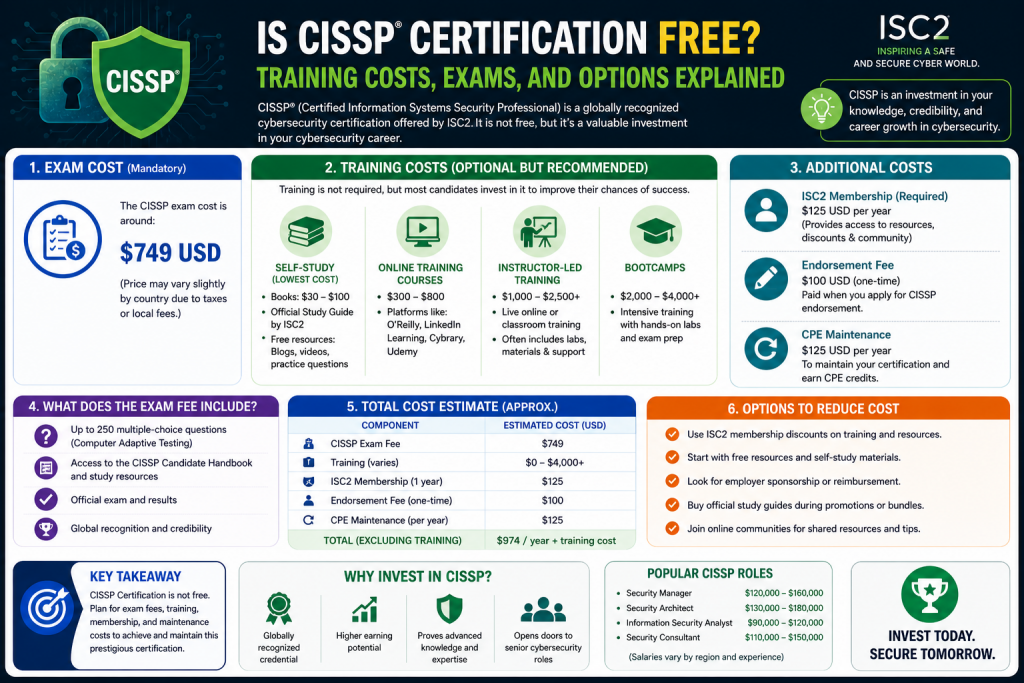
The Certified Information Systems Security Professional certification is one of the most respected and globally recognized credentials in the field of cybersecurity. It is designed for experienced professionals who want to demonstrate their ability to design, implement, and manage a comprehensive cybersecurity program. As organizations continue to face increasingly complex cyber threats, the demand for certified professionals continues to grow, making this certification highly valuable for career advancement.
Many individuals who are interested in cybersecurity or are already working in the field often wonder whether they can obtain CISSP training and certification without spending a significant amount of money. This question is especially relevant for students, entry level professionals, and individuals transitioning into cybersecurity from other careers. While the certification itself comes with a cost, there are many ways to access training and preparation resources for free or at a reduced cost.
Understanding how to navigate these options can make a major difference in your certification journey. It is not just about finding free materials, but also about choosing the right combination of resources that align with your learning style and goals.
Understanding the Real Cost of CISSP
Before exploring free options, it is important to understand the actual costs associated with earning the CISSP certification. The exam fee is one of the primary expenses. This fee varies by region, but it is generally considered expensive compared to many other IT certifications. Paying this fee gives you one attempt at the exam, which means proper preparation is essential to avoid additional costs from retakes.
In addition to the exam fee, there is also an annual maintenance fee required to keep the certification active. This fee ensures that certified professionals stay current with industry developments and continue to meet professional standards. Over time, this ongoing cost becomes part of the overall investment in maintaining the certification.
Training costs can add another layer of expense. Official training programs, especially those offered by recognized providers, are often priced at a premium. These programs are designed to cover all domains of the CISSP Common Body of Knowledge, providing structured learning and expert guidance.
Despite these costs, it is important to remember that not all preparation methods require payment. Many candidates successfully prepare for the exam using free resources combined with disciplined self study.
Why CISSP Is Worth the Investment
Although the CISSP certification is not free, it is often considered a worthwhile investment for cybersecurity professionals. One of the main reasons is its global recognition. Employers across industries trust this certification as a benchmark for advanced security knowledge and skills.
Holding a CISSP certification can open doors to higher level roles such as security analyst, security architect, and information security manager. These roles often come with increased responsibilities and higher salaries, making the certification financially rewarding in the long term.
Another important benefit is professional credibility. The certification demonstrates that you have a deep understanding of cybersecurity principles and the ability to apply them in real world scenarios. It also shows commitment to the field, which can make you stand out in a competitive job market.
In addition to career growth, CISSP certification provides access to a professional network of certified individuals. This network can be valuable for knowledge sharing, mentorship, and career opportunities.
Can You Get CISSP Training for Free
While the certification exam itself requires payment, training does not always have to be expensive. There are many free resources available online that can help you prepare effectively for the CISSP exam. The key is knowing where to find these resources and how to use them efficiently.
Free training options include online videos, mentorship programs, practice exams, and community discussions. Each of these resources offers unique advantages and can contribute to a well rounded study plan.
However, not all free resources are equal in quality. Some may be outdated or incomplete, which can lead to gaps in your knowledge. It is important to evaluate the credibility of each resource and ensure that it aligns with the latest CISSP exam objectives.
By combining multiple free resources, you can create a comprehensive study strategy that covers all domains of the exam without requiring a large financial investment.
Free Mentorship Programs for CISSP Preparation
Mentorship programs are among the most valuable free resources available for CISSP candidates. These programs are often led by experienced cybersecurity professionals who volunteer their time to help others succeed.
A typical mentorship program includes structured sessions, study guidance, and opportunities to ask questions. Mentors often share their own experiences, providing insights into the exam format and effective preparation strategies.
One of the biggest advantages of mentorship is personalized support. Unlike self study materials, mentorship allows you to interact with someone who can clarify doubts and provide tailored advice. This can significantly improve your understanding of complex topics.
Mentorship programs also help you stay motivated and accountable. Having a mentor and a community of learners can make the preparation process more engaging and less overwhelming.
Learning Through Free Online Videos
Online video platforms offer a wide range of free CISSP training content. These videos cover everything from basic concepts to advanced topics within the CISSP curriculum. Many instructors provide detailed explanations, making it easier to understand complex subjects.
One of the main benefits of video learning is flexibility. You can watch videos at your own pace, pause and rewind as needed, and revisit topics whenever necessary. This makes it a convenient option for individuals with busy schedules.
However, it is important to be selective when choosing video content. Not all videos are up to date or aligned with the current exam format. Some may lack depth, while others may focus too much on theory without practical application.
To get the most out of video learning, look for content created by reputable instructors and ensure that it is based on the latest CISSP exam objectives. Combining videos from different sources can also provide a more comprehensive understanding of the material.
Using Free Trial Training Platforms
Many online learning platforms offer free trial periods that allow you to access premium CISSP training content without paying initially. These trials typically last for a limited time, such as a week, but they provide access to high quality courses, practice exams, and study tools.
During the trial period, you can explore structured lessons, watch expert led videos, and test your knowledge with quizzes. These resources are often designed to align closely with the CISSP exam, making them highly effective for preparation.
To maximize the value of a free trial, it is important to plan your study schedule in advance. Focus on completing key modules and practicing important topics within the trial period. This approach allows you to gain maximum benefit without incurring any cost.
Even though the trial is temporary, it can provide a strong foundation and complement other free resources.
Importance of Practice Exams and Quizzes
Practice exams play a crucial role in CISSP preparation. They help you assess your understanding of the material and identify areas that need improvement. While many full length practice exams are paid, there are also free options available.
Free practice quizzes may be limited in the number of questions, but they still provide valuable insights into the exam format and question style. They can help you become familiar with the types of scenarios and concepts that are commonly tested.
Regular practice is essential for building confidence and improving performance. By consistently testing your knowledge, you can track your progress and focus on weak areas.
It is important to review your answers carefully and understand the reasoning behind each question. This process helps reinforce learning and ensures that you are fully prepared for the exam.
Entry Level Cybersecurity Learning Opportunities
For individuals who are new to cybersecurity, starting with entry level training can be a smart approach. Many organizations offer free introductory courses that cover basic security concepts and principles.
These programs are designed to build a strong foundation, making it easier to progress to advanced certifications like CISSP. They often include topics such as risk management, threat awareness, and basic network security.
Taking advantage of these free opportunities can help you develop essential skills and gain confidence before tackling the more complex CISSP material. It also allows you to explore the field and determine whether cybersecurity is the right career path for you.
The Role of Self Study in Free CISSP Preparation
Self study is one of the most effective ways to prepare for the CISSP exam without spending a lot of money. With the right approach, it is possible to cover all exam domains using free or low cost resources.
A successful self study plan involves setting clear goals, creating a study schedule, and using a variety of resources. This may include online videos, practice questions, and community discussions.
One of the main advantages of self study is flexibility. You can learn at your own pace and focus on areas where you need the most improvement. This personalized approach can lead to better understanding and retention of information.
However, self study also requires discipline and consistency. Without structured guidance, it can be easy to lose focus or miss important topics. To overcome this challenge, many candidates combine self study with mentorship programs or online communities.
Challenges of Free CISSP Training
While free resources can be highly effective, they also come with certain challenges. One of the main issues is the lack of structure. Unlike paid courses, free materials are often scattered across different platforms, making it difficult to create a cohesive study plan.
Another challenge is quality control. Not all free resources are accurate or up to date. Relying on outdated information can negatively impact your exam performance.
Additionally, free resources may not provide the same level of depth as paid training programs. This can make it harder to fully understand complex topics.
To overcome these challenges, it is important to carefully चयन and combine multiple resources. Cross referencing information and staying updated with the latest exam objectives can help ensure effective preparation.
Building an Effective Free Study Strategy
Creating a successful study strategy using free resources requires careful planning. Start by understanding the CISSP exam domains and identifying the topics you need to cover. This will help you organize your study materials and stay focused.
Next, gather a variety of free resources, including videos, articles, and practice questions. Using multiple sources can provide a more comprehensive understanding of the material.
Set a realistic study schedule that fits your daily routine. Consistency is key, so aim to study regularly and track your progress. Break down complex topics into smaller sections to make them easier to manage.
Engage with online communities and discussion forums to share knowledge and ask questions. Learning from others can provide new insights and help clarify difficult concepts.
Finally, regularly test your knowledge using practice quizzes. This will help you identify weak areas and adjust your study plan accordingly.
Exploring Scholarships and Financial Assistance for CISSP
For many aspiring cybersecurity professionals, the cost of CISSP certification can feel like a major barrier. However, there are several scholarship and financial assistance opportunities that can significantly reduce or even eliminate some of the expenses associated with training and certification. These programs are often designed to support individuals who demonstrate potential in cybersecurity but may lack the financial resources to pursue advanced certifications.
Scholarships are typically offered by nonprofit organizations, educational institutions, and industry groups that are committed to addressing the global shortage of skilled cybersecurity professionals. These programs aim to make high level training more accessible and encourage diversity within the field.
Some scholarships specifically cover training costs, while others may include exam vouchers or additional support such as mentorship and career guidance. Although not all scholarships are exclusively focused on CISSP, many can still be used to support your journey toward earning the certification.
Applying for scholarships requires effort and preparation. You may need to submit an application, provide proof of experience or education, and explain your career goals. While the process can be competitive, the potential benefits make it worth pursuing.
Diversity Focused Cybersecurity Programs
One of the most impactful types of financial support comes from diversity focused cybersecurity programs. These initiatives are designed to increase representation in the cybersecurity industry by providing resources and opportunities to underrepresented groups.
Such programs often include scholarships for training, access to free or discounted courses, and networking opportunities. They may also provide mentorship and career development support, helping participants build the skills and confidence needed to succeed in the field.
These initiatives recognize that diverse perspectives are essential for effective cybersecurity. By supporting individuals from different backgrounds, they contribute to a more inclusive and innovative workforce.
Even if you do not qualify for a specific diversity program, it is worth exploring similar initiatives that focus on education and workforce development. Many organizations offer support based on merit, financial need, or career aspirations.
Educational Institutions and Community Support
Educational institutions, including community colleges and training centers, can also play a significant role in reducing the cost of CISSP preparation. Some institutions offer cybersecurity programs that include certification training as part of their curriculum.
In certain cases, these programs are subsidized or funded by government initiatives, making them more affordable or even free for eligible participants. Community colleges, in particular, often provide accessible education options that can help you build foundational knowledge and prepare for advanced certifications.
Local training programs may also partner with industry organizations to offer discounted or sponsored certification opportunities. These partnerships can provide access to high quality training without the high price tag typically associated with commercial courses.
In addition to formal education, community based organizations and nonprofits may offer workshops, study groups, and other learning opportunities. These resources can complement your self study efforts and provide additional support.
Government Programs and Cybersecurity Initiatives
Government funded programs are another valuable resource for individuals seeking to reduce the cost of CISSP certification. Many governments recognize the importance of cybersecurity and invest in training programs to develop a skilled workforce.
These initiatives may include scholarships, grants, or fully funded training programs that cover certification costs. Some programs are targeted at students, while others are designed for working professionals or individuals transitioning into cybersecurity careers.
Participation in government programs often comes with certain requirements, such as completing training within a specified timeframe or committing to work in a related field after certification. While these conditions may vary, they can provide a pathway to achieving your certification goals without significant financial burden.
Exploring available programs in your region can help you identify opportunities that align with your career objectives. Staying informed about new initiatives is also important, as funding and program availability can change over time.
Employer Sponsorship and Reimbursement Opportunities
One of the most effective ways to obtain CISSP training and certification at little or no cost is through employer sponsorship. Many organizations recognize the value of having certified cybersecurity professionals on their teams and are willing to invest in employee development.
Employer sponsorship programs may cover the cost of training, exam fees, and even study materials. In some cases, employers may also provide paid time off for exam preparation or offer bonuses upon successful certification.
If your organization does not have a formal sponsorship program, it is still possible to request support. Many employers are open to funding professional development if you can demonstrate how it will benefit the organization.
When approaching your employer, it is important to present a clear and well thought out proposal. This should include the costs involved, your study plan, and the expected benefits of obtaining the certification.
Building a Strong Case for Employer Support
Convincing your employer to sponsor your CISSP certification requires careful preparation. Start by highlighting the value that the certification brings to the organization. Emphasize how your enhanced skills can improve security practices, reduce risks, and support business objectives.
It is also important to align your request with organizational goals. For example, if your company is focused on strengthening its cybersecurity posture or meeting compliance requirements, explain how CISSP certification can contribute to these efforts.
Providing a detailed plan can strengthen your case. Outline the training resources you intend to use, the timeline for your preparation, and the expected costs. This demonstrates that you are committed and organized.
In addition, consider proposing a return on investment. This could include applying your new knowledge to specific projects, sharing insights with your team, or contributing to security improvements within the organization.
Benefits of Employer Sponsored Certification
Employer sponsorship offers several advantages beyond financial support. It often includes access to high quality training resources and structured learning programs. This can make the preparation process more efficient and effective.
Another benefit is the opportunity to apply your learning in a real world context. As you study for the CISSP exam, you can relate concepts to your work environment, reinforcing your understanding and improving retention.
Employer support can also enhance your professional growth. It demonstrates that your organization values your development and is willing to invest in your future. This can lead to increased job satisfaction and career advancement opportunities.
In some cases, employer sponsored certification may also include mentorship or guidance from experienced colleagues. This additional support can further improve your chances of success.
Combining Free Resources with Sponsored Opportunities
Even if you receive financial support from your employer or a scholarship program, combining these opportunities with free resources can enhance your preparation. Free materials can supplement formal training and provide additional perspectives on complex topics.
For example, you can use free videos to reinforce concepts learned in structured courses or participate in online discussions to gain insights from other candidates. Practice exams and quizzes can help you assess your progress and identify areas for improvement.
This blended approach allows you to maximize the value of both free and sponsored resources. It also provides a more comprehensive learning experience, increasing your chances of passing the exam on your first attempt.
Leveraging Online Communities and Study Groups
Online communities and study groups are valuable resources for CISSP candidates. These platforms allow you to connect with other learners, share knowledge, and seek advice from experienced professionals.
Participating in a study group can provide structure and accountability. Regular discussions and collaborative learning can help you stay motivated and focused on your goals.
Online forums often include detailed discussions on specific topics, exam strategies, and study techniques. Engaging with these communities can provide insights that are not always available in formal training materials.
In addition, study groups can help you clarify difficult concepts and gain different perspectives. Explaining topics to others can also reinforce your own understanding.
Balancing Work, Study, and Financial Planning
Preparing for the CISSP exam requires a significant investment of time and effort. Balancing work responsibilities, study commitments, and financial planning can be challenging.
Creating a realistic schedule is essential for managing these demands. Allocate dedicated time for study and ensure that you maintain consistency. Setting achievable goals can help you stay on track and avoid burnout.
Financial planning is also important. Even if you are using free resources, you may still need to budget for the exam fee and other expenses. Exploring all available options for financial assistance can help reduce this burden.
Maintaining a balance between work and study is crucial for long term success. Taking regular breaks and managing stress can improve productivity and overall well being.
Avoiding Common Financial Mistakes
When pursuing CISSP certification, it is important to avoid common financial mistakes that can increase costs unnecessarily. One of the most common mistakes is relying solely on expensive training programs without exploring free or low cost alternatives.
Another mistake is not preparing adequately for the exam. Failing the exam can result in additional fees for retakes, making the certification more expensive overall. Investing time in thorough preparation can help you avoid this scenario.
It is also important to verify the quality of training resources before investing in them. Not all paid courses provide the same level of value, so careful research is essential.
By making informed decisions and using available resources wisely, you can minimize costs and maximize your chances of success.
Long Term Value of Cost Saving Strategies
Reducing the cost of CISSP certification is not just about saving money in the short term. It also contributes to long term career growth and financial stability. By minimizing upfront expenses, you can focus on gaining experience and building your career.
Cost saving strategies also encourage resourcefulness and self discipline. These skills are valuable in cybersecurity, where continuous learning and problem solving are essential.
In addition, successfully navigating the certification process with limited resources can boost your confidence. It demonstrates your ability to achieve challenging goals despite constraints.
Ultimately, the value of CISSP certification extends beyond the initial investment. It provides opportunities for career advancement, higher earning potential, and professional recognition
Creating a Long Term Study Plan for CISSP Success
Preparing for the CISSP exam without spending heavily on training requires a well structured and realistic study plan. A long term approach allows you to absorb complex topics gradually rather than rushing through them. Since the CISSP covers a wide range of domains, spreading your study over several months can improve retention and reduce stress.
Start by understanding the eight domains of the CISSP Common Body of Knowledge. Break these domains into manageable sections and assign each section to a specific time period. This helps you stay organized and ensures that no topic is overlooked. A balanced plan should include reading, watching training content, practicing questions, and revising previously covered material.
Consistency is more important than intensity. Studying for a few hours every day is often more effective than long but irregular sessions. Establishing a routine also makes it easier to stay committed to your goal. Over time, this discipline becomes one of your strongest assets.
Tracking your progress is equally important. Keeping a study journal or checklist allows you to monitor what you have completed and identify areas that need more attention. This structured approach is especially useful when relying on free resources, as it helps you stay focused despite the lack of a formal curriculum.
Mastering the CISSP Domains Through Free Resources
Each CISSP domain represents a critical area of cybersecurity knowledge. To succeed in the exam, you need to develop both conceptual understanding and practical insight across all domains. Free resources can support this process effectively if used strategically.
For security and risk management, focus on understanding principles such as confidentiality, integrity, and availability. Free articles, videos, and case studies can help you see how these concepts apply in real world scenarios. For asset security, explore how data is classified, handled, and protected throughout its lifecycle.
Security architecture and engineering require a deeper technical understanding. Free online content can help you learn about system design, cryptography, and secure architectures. For communication and network security, explore topics such as network protocols, secure communication methods, and threat mitigation techniques.
Identity and access management is another important domain. Free tutorials and guides can help you understand authentication methods, authorization models, and identity governance. Security assessment and testing involve evaluating systems and identifying vulnerabilities, which can be practiced using sample questions and simulated scenarios.
Security operations focus on incident response, disaster recovery, and monitoring. Free resources often include practical examples that demonstrate how organizations handle security incidents. Finally, software development security covers secure coding practices and application security, which can be learned through tutorials and case studies.
By combining multiple types of free resources, you can build a comprehensive understanding of each domain without relying on expensive training programs.
Developing Strong Exam Strategies
Passing the CISSP exam is not just about knowledge; it also requires effective exam strategies. The exam is known for its complex and scenario based questions, which test your ability to apply concepts rather than simply recall information.
One important strategy is to think like a manager rather than a technician. Many questions are designed to assess decision making and risk management skills. Understanding the broader context of security practices can help you choose the best answer.
Time management is another critical factor. Practice answering questions within a set time limit to improve your speed and accuracy. Free practice quizzes can help you simulate exam conditions and build confidence.
Reading questions carefully is essential. Pay attention to keywords and identify what the question is really asking. Eliminating incorrect options can increase your chances of selecting the correct answer.
Developing these strategies through consistent practice can significantly improve your performance on the exam.
Using Practice Questions to Strengthen Knowledge
Practice questions are one of the most effective tools for CISSP preparation. They help reinforce your understanding and highlight areas where you need improvement. While many comprehensive practice exams are paid, free options can still provide valuable benefits.
Start by using short quizzes to test your knowledge after completing each domain. This helps you identify weak areas early and focus your efforts accordingly. Reviewing explanations for both correct and incorrect answers is crucial for learning.
As you progress, try to simulate full exam conditions using available free resources. This includes setting time limits and avoiding distractions. Practicing under realistic conditions can help you build confidence and reduce anxiety.
Repeated exposure to different types of questions improves your ability to analyze scenarios and apply concepts. Over time, this practice becomes a key factor in your success.
Maintaining Motivation Throughout the Journey
Preparing for the CISSP exam can be a long and challenging process, especially when you are balancing it with work and personal responsibilities. Maintaining motivation is essential for staying on track.
Setting clear goals can help you stay focused. Break your preparation into smaller milestones and celebrate your progress along the way. This creates a sense of achievement and keeps you motivated.
Joining study groups or online communities can also provide encouragement. Interacting with others who share your goals can make the process more engaging and less isolating. Sharing experiences and challenges can help you stay committed.
It is also important to remind yourself why you started. Whether it is career advancement, personal growth, or financial benefits, keeping your goals in mind can help you overcome obstacles.
Taking breaks and maintaining a healthy balance is equally important. Avoid burnout by giving yourself time to rest and recharge. A well balanced approach improves both productivity and well being.
Leveraging Real World Experience
One of the unique aspects of the CISSP certification is its emphasis on real world experience. The exam is designed for professionals who have practical knowledge of cybersecurity practices.
If you are currently working in IT or cybersecurity, try to relate your daily tasks to the CISSP domains. Applying theoretical concepts in a practical context can deepen your understanding and improve retention.
For those who are not yet working in the field, consider gaining experience through internships, volunteer work, or personal projects. Even small projects can provide valuable insights into security practices.
Real world experience not only helps with exam preparation but also enhances your overall skill set. It prepares you for the responsibilities that come with CISSP certified roles.
Avoiding Common Study Mistakes
While preparing for the CISSP exam, it is important to avoid common mistakes that can hinder your progress. One of the most common issues is relying on a single resource. This can limit your understanding and leave gaps in your knowledge.
Another mistake is focusing too much on memorization. The CISSP exam requires conceptual understanding and the ability to apply knowledge in different scenarios. Simply memorizing facts is not enough.
Skipping practice questions is another common error. Practice is essential for testing your knowledge and improving your exam skills. Without it, you may struggle to perform under exam conditions.
Procrastination can also be a major obstacle. Delaying your study sessions can lead to last minute stress and incomplete preparation. Staying consistent and disciplined is key to success.
By recognizing and avoiding these mistakes, you can improve your efficiency and increase your chances of passing the exam.
Evaluating Your Readiness for the Exam
Before scheduling your CISSP exam, it is important to evaluate your readiness. This involves assessing your knowledge, confidence, and ability to perform under exam conditions.
Start by reviewing all domains and identifying any weak areas. Use practice questions to test your understanding and measure your performance. Consistently achieving high scores on practice quizzes is a good indicator of readiness.
Confidence is another important factor. You should feel comfortable analyzing complex scenarios and making informed decisions. If you still feel uncertain, consider revisiting challenging topics and practicing more questions.
It is also helpful to simulate the exam experience. Practice sitting for extended periods and answering questions without interruptions. This prepares you for the mental and physical demands of the actual exam.
Taking the time to evaluate your readiness can help you avoid unnecessary retakes and additional costs.
Planning for Certification Maintenance
Earning the CISSP certification is not the end of the journey. Maintaining the certification requires ongoing effort and commitment. This includes paying an annual maintenance fee and earning continuing professional education credits.
Continuing education ensures that you stay updated with the latest developments in cybersecurity. Many free resources can help you earn these credits, including webinars, online courses, and industry events.
Planning for maintenance from the beginning can help you manage costs and stay organized. Keeping track of your learning activities and documenting your progress is essential.
Maintaining your certification demonstrates your commitment to professional growth and keeps your skills relevant in a rapidly evolving field.
Long Term Career Benefits of CISSP
The CISSP certification offers significant long term benefits for your career. It can open doors to advanced roles, increase your earning potential, and enhance your professional reputation.
Certified professionals are often considered for leadership positions and strategic roles within organizations. The certification demonstrates not only technical expertise but also the ability to manage and oversee security programs.
In addition to career advancement, CISSP certification provides access to a global network of professionals. This network can be a valuable resource for knowledge sharing, collaboration, and career opportunities.
The skills and knowledge gained during CISSP preparation also contribute to your overall professional development. They enable you to address complex security challenges and make informed decisions.
Conclusion
While the CISSP certification itself is not free, achieving it without spending heavily on training is entirely possible. By using free resources, applying for scholarships, seeking employer support, and following a disciplined study plan, you can significantly reduce the financial burden.
Success in the CISSP journey requires dedication, consistency, and a strategic approach. Free resources can provide a strong foundation, but it is your commitment and effort that ultimately determine the outcome.
By combining knowledge, practical experience, and effective exam strategies, you can achieve your goal of becoming CISSP certified. The journey may be challenging, but the rewards in terms of career growth, professional recognition, and personal achievement make it worthwhile.
Continue exploring the technologies and certification concepts that matter most to you.