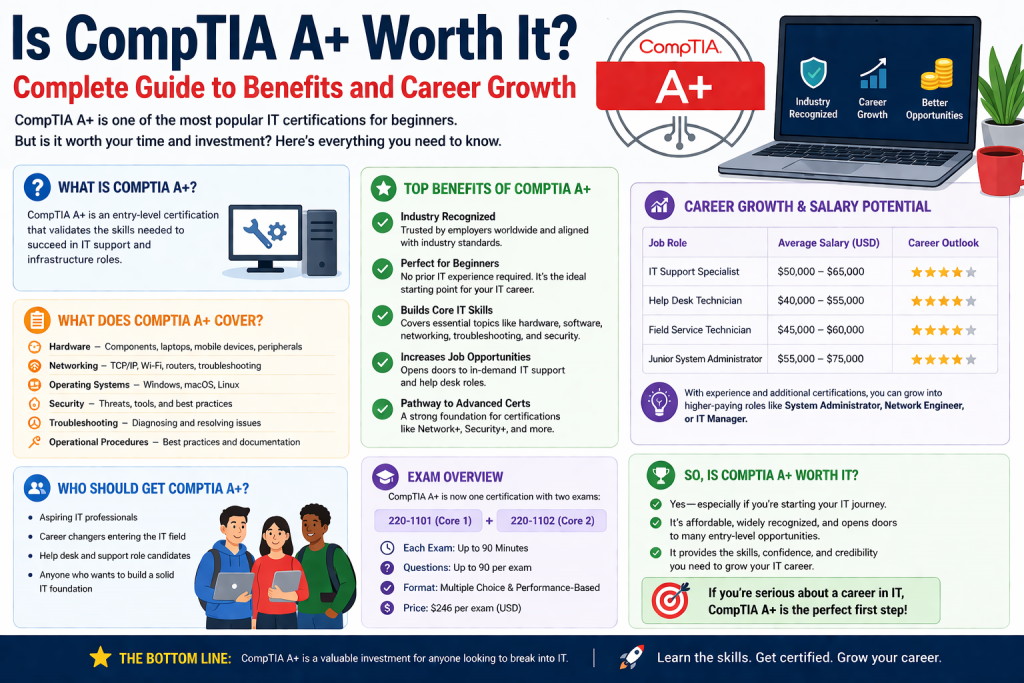
The CompTIA A+ certification has long been considered one of the most recognized entry points into the world of information technology. For decades, it has helped aspiring IT professionals build foundational knowledge and gain credibility in a competitive job market. If you are new to IT or considering a career change, understanding what this certification offers is essential.
At its core, the A+ certification is designed to validate your ability to perform common IT support tasks. These include troubleshooting hardware and software issues, configuring operating systems, and understanding basic networking concepts. Unlike specialized certifications, A+ takes a broad approach, ensuring that candidates gain exposure to multiple areas of IT before choosing a specific path.
One of the reasons the A+ certification has remained relevant for so long is its adaptability. As technology evolves, so do the exam objectives. This ensures that candidates are learning skills that are aligned with current industry standards. From traditional desktop support to modern cloud-based systems, A+ continues to reflect the realities of today’s IT environments.
Understanding the Structure of the A+ Certification
The A+ certification is not a single exam but a combination of two separate tests. These exams are commonly referred to as Core 1 and Core 2. To earn the certification, candidates must pass both exams, each focusing on different aspects of IT knowledge.
Core 1 primarily covers hardware, networking, mobile devices, and troubleshooting. It focuses on the physical components of computers and how they interact with each other. Candidates learn about processors, memory, storage devices, and peripheral components, along with how to diagnose and fix common hardware issues.
Core 2, on the other hand, dives deeper into software-related topics. This includes operating systems, security practices, and software troubleshooting. Candidates are introduced to multiple operating systems, including Windows, macOS, and Linux, and learn how to manage them effectively.
The two-exam structure ensures that candidates develop a balanced understanding of both hardware and software. This dual focus is particularly important for entry-level IT roles, where professionals are often expected to handle a wide range of technical issues.
What Makes A+ Vendor-Neutral
One of the defining features of the A+ certification is its vendor-neutral approach. Unlike certifications offered by specific companies, such as Microsoft or Cisco, A+ does not focus on a single brand or technology stack.
This neutrality allows candidates to learn universal IT principles that can be applied across different environments. For example, understanding how operating systems work is valuable regardless of whether you are using Windows, Linux, or macOS. Similarly, networking fundamentals remain consistent across different hardware vendors.
The benefit of this approach is flexibility. As an A+ certified professional, you are not tied to a specific ecosystem. This makes it easier to adapt to new technologies and work in diverse environments. For beginners, this flexibility is particularly valuable, as it allows them to explore different areas of IT before committing to a specialization.
Key Skills You Gain from the A+ Certification
The A+ certification equips candidates with a wide range of practical skills that are directly applicable to real-world IT roles. These skills form the foundation of a successful career in technology.
One of the most important skills is troubleshooting. IT professionals are often tasked with diagnosing and resolving issues quickly and efficiently. The A+ certification teaches a structured approach to problem-solving, helping candidates identify root causes and implement effective solutions.
Another key skill is hardware knowledge. Understanding how computer components work together is essential for tasks such as assembling systems, upgrading hardware, and repairing devices. This knowledge is particularly useful for roles that involve hands-on work with computers and peripherals.
Software management is also a major focus. Candidates learn how to install, configure, and maintain operating systems, as well as how to manage applications and user settings. This includes tasks such as updating software, managing permissions, and ensuring system stability.
Networking basics are another critical component. While A+ does not go as deep as specialized networking certifications, it provides a solid introduction to concepts such as IP addressing, network configurations, and connectivity troubleshooting.
Finally, the certification emphasizes security awareness. In today’s digital landscape, understanding basic security principles is essential. Candidates learn about common threats, such as malware and phishing attacks, and how to protect systems from these risks.
Why A+ Is Considered a Beginner-Friendly Certification
The A+ certification is specifically designed for individuals who are new to IT. Unlike advanced certifications that require prior experience, A+ assumes little to no background knowledge. This makes it an ideal starting point for beginners.
One of the reasons it is beginner-friendly is its comprehensive curriculum. Instead of focusing on a single area, A+ covers multiple aspects of IT, providing a well-rounded introduction to the field. This helps candidates build confidence and develop a broad understanding of technology.
Another factor is the availability of learning resources. There are numerous study guides, online courses, and practice exams available for A+ candidates. These resources cater to different learning styles, making it easier for individuals to prepare for the exams.
The certification also includes performance-based questions, which simulate real-world scenarios. While these questions can be challenging, they provide valuable hands-on experience that prepares candidates for actual job tasks.
The Role of A+ in Entry-Level IT Jobs
The A+ certification is often associated with entry-level IT roles, and for good reason. It provides the foundational skills needed to perform tasks commonly required in these positions.
Help desk roles are one of the most common entry points for A+ certified professionals. In these roles, individuals are responsible for assisting users with technical issues, ranging from software errors to hardware malfunctions. The troubleshooting skills learned in A+ are directly applicable to these tasks.
Technical support positions also benefit from A+ knowledge. These roles often involve diagnosing and resolving issues remotely, requiring a strong understanding of both hardware and software systems. The certification prepares candidates to handle these challenges effectively.
Field service technicians, who work on-site with equipment, also rely on the skills gained from A+. Their responsibilities include repairing hardware, installing systems, and ensuring that devices are functioning properly. The hands-on knowledge provided by A+ is particularly valuable in these roles.
Even junior system administrator positions may require or prefer A+ certification. While these roles involve more advanced responsibilities, having a strong foundation in IT fundamentals is essential.
Exam Versions and Updates in 2025
The A+ certification is regularly updated to reflect changes in technology and industry practices. The latest version, introduced in 2025, includes updated exam objectives that align with modern IT environments.
One of the key updates is the increased focus on cloud computing. As more organizations move their operations to the cloud, understanding cloud concepts has become essential. The updated A+ exams introduce candidates to these concepts, preparing them for modern IT roles.
Another significant update is the emphasis on remote work technologies. With the rise of hybrid work environments, IT professionals must be able to support users who are working from different locations. The certification now includes topics related to remote access, virtual collaboration tools, and secure connections.
Security content has also been expanded. As cyber threats continue to evolve, IT professionals must stay informed about the latest risks and mitigation strategies. The updated exams cover topics such as data protection, secure configurations, and threat detection.
These updates ensure that the A+ certification remains relevant and valuable in today’s fast-changing technology landscape.
The Cost of Getting A+ Certified
One of the most important considerations for prospective candidates is the cost of the A+ certification. Each exam requires a separate fee, and the total cost can add up.
While the initial investment may seem high, it is important to consider the potential return on investment. Earning the certification can increase your chances of landing an entry-level IT job, which can lead to higher earning potential over time.
In addition to exam fees, candidates may also need to invest in study materials. These can include textbooks, online courses, and practice exams. While these resources add to the overall cost, they can significantly improve your chances of passing the exams on the first attempt.
It is also worth noting that some employers offer reimbursement for certification costs. If you are already working in IT or planning to join a company that supports professional development, this can help offset the expenses.
Do You Need Experience Before Taking A+?
While having prior experience can be helpful, it is not a requirement for taking the A+ exams. Many candidates successfully earn the certification without any formal IT background.
However, some level of familiarity with computers is recommended. This includes basic tasks such as using an operating system, managing files, and installing software. These skills provide a foundation that makes it easier to understand the concepts covered in the certification.
For those without experience, hands-on practice is essential. Setting up a home lab or using virtual environments can help you gain practical experience. This not only prepares you for the exams but also builds confidence in your abilities.
Deep Dive into CompTIA A+ Exam Objectives
The CompTIA A+ certification is structured to ensure candidates develop a strong and practical understanding of IT fundamentals. To truly evaluate its worth, it is important to explore the exam objectives in depth. These objectives are carefully designed to reflect real-world responsibilities in entry-level IT roles.
Core 1 focuses heavily on hardware and networking. Candidates are expected to understand internal computer components such as CPUs, RAM, motherboards, storage devices, and power supplies. Beyond identification, the exam tests how these components interact and how to troubleshoot when something goes wrong. For example, you might be asked to diagnose why a system fails to boot or identify faulty hardware based on symptoms.
Networking is another major component of Core 1. This includes understanding IP addressing, DNS, DHCP, and basic network configurations. While the coverage is introductory, it lays the groundwork for more advanced networking knowledge. Candidates also learn how to troubleshoot connectivity issues, which is a common task in many IT roles.
Mobile devices are also included, reflecting the growing importance of smartphones and tablets in the workplace. You’ll learn how to configure devices, manage connections, and resolve common issues. This is particularly relevant in modern environments where employees rely heavily on mobile technology.
Core 2 shifts the focus to software and operational procedures. Operating systems are a key area, with emphasis on installation, configuration, and maintenance. Candidates must understand how to work with different systems, including Windows, Linux, and macOS.
Security is another critical domain. The exam covers basic principles such as access control, encryption, and threat mitigation. While not as in-depth as dedicated security certifications, it provides a solid introduction to protecting systems and data.
Software troubleshooting is also heavily emphasized. Candidates must be able to identify and resolve issues related to applications, operating systems, and system performance. This includes understanding error messages, system logs, and recovery tools.
Operational procedures round out the exam objectives. These include best practices for documentation, change management, and professionalism in IT environments. While often overlooked, these skills are essential for working effectively in a team and maintaining organized systems.
The Importance of Hands-On Learning in A+
One of the defining characteristics of the A+ certification is its emphasis on hands-on learning. Unlike purely theoretical certifications, A+ requires candidates to apply their knowledge in practical scenarios. This approach ensures that certified professionals are job-ready from day one.
Performance-based questions are a key feature of the exams. These questions simulate real-world tasks, such as configuring a network, troubleshooting a system, or setting up a device. Instead of selecting an answer from a list, candidates must perform the task within a simulated environment.
This practical focus is particularly valuable for beginners who may not have prior work experience. By practicing these tasks during their studies, candidates gain confidence and familiarity with common IT procedures. This reduces the learning curve when they enter the workforce.
Setting up a home lab is one of the best ways to prepare for these practical components. A home lab can include a basic computer setup, virtual machines, and networking equipment. This allows candidates to experiment with different configurations and troubleshoot issues in a controlled environment.
Virtual labs and simulation tools are also widely available. These platforms provide guided exercises that mimic real-world scenarios, helping candidates build practical skills without needing physical hardware.
Hands-on learning not only improves exam performance but also enhances long-term retention. When you actively apply what you’ve learned, you are more likely to remember it and use it effectively in your career.
Study Strategies for Passing the A+ Exams
Preparing for the A+ certification requires a structured and disciplined approach. Given the breadth of topics covered, it is important to use effective study strategies to ensure success.
One of the most important steps is creating a study plan. This involves breaking down the exam objectives into manageable sections and allocating time for each topic. A well-structured plan helps you stay organized and ensures that you cover all necessary material.
Using multiple learning resources can also be beneficial. Textbooks provide detailed explanations, while video courses offer visual demonstrations. Practice exams are particularly useful for assessing your knowledge and identifying areas where you need improvement.
Flashcards are a great tool for memorizing key terms and concepts. They are especially helpful for topics such as networking protocols, hardware components, and security principles. Regular review of flashcards can reinforce your understanding and improve recall during the exam.
Practice is essential for mastering performance-based questions. This involves actively working through scenarios rather than passively reading about them. The more you practice, the more comfortable you will become with applying your knowledge.
Time management is another critical factor. Both exams have time limits, so it is important to practice answering questions within a set timeframe. This helps you develop the ability to work efficiently under pressure.
Finally, consistency is key. Regular study sessions are more effective than cramming, as they allow you to gradually build and reinforce your knowledge over time.
Common Challenges Faced by A+ Candidates
While the A+ certification is designed for beginners, it still presents several challenges. Understanding these challenges can help you prepare more effectively and avoid common pitfalls.
One of the biggest challenges is the sheer volume of information. The certification covers a wide range of topics, from hardware to software to networking. This can be overwhelming for candidates who are new to IT.
Another challenge is the technical nature of the material. Some topics, such as networking and security, may be difficult to grasp without prior experience. This requires additional effort and practice to fully understand.
Performance-based questions can also be challenging. These questions require you to apply your knowledge in practical scenarios, which can be difficult if you are not comfortable with hands-on tasks.
Time pressure is another factor. The exams are timed, and candidates must answer questions quickly and accurately. This can be stressful, especially for those who are not used to timed assessments.
Finally, the cost of retakes can be a concern. Failing an exam means paying the full fee again, which can add financial pressure. This makes thorough preparation even more important.
The Value of A+ in Real-World IT Scenarios
The true value of the A+ certification becomes evident when you apply its concepts in real-world scenarios. The skills you learn are directly applicable to everyday tasks in IT roles.
For example, troubleshooting is a core component of many IT jobs. Whether it’s diagnosing a hardware failure or resolving a software issue, the structured approach taught in A+ helps you identify problems efficiently.
Hardware knowledge is also highly practical. Tasks such as upgrading RAM, replacing storage drives, and configuring peripherals are common in many roles. The hands-on experience gained through A+ prepares you for these responsibilities.
Networking skills are equally important. Understanding how devices connect and communicate allows you to troubleshoot connectivity issues and maintain network performance. Even basic knowledge can make a significant difference in resolving problems quickly.
Security awareness is another critical aspect. In today’s environment, protecting systems from threats is a top priority. The A+ certification provides a foundation for implementing basic security measures and recognizing potential risks.
Customer interaction is also a key part of many IT roles. The certification emphasizes professionalism and communication, helping you build trust and effectively assist users.
How A+ Prepares You for Workplace Responsibilities
The transition from studying for A+ to working in an IT role can be surprisingly smooth. This is because the certification is designed to reflect real-world responsibilities.
In a typical help desk role, you might be responsible for resolving user issues, installing software, and maintaining systems. The knowledge gained from A+ directly supports these tasks, making it easier to perform your job effectively.
Documentation is another important aspect of IT work. Keeping records of issues and solutions helps maintain organized systems and improves efficiency. The A+ certification emphasizes the importance of documentation and teaches best practices.
Teamwork is also essential in IT environments. You may need to collaborate with other technicians, escalate issues, or coordinate with different departments. The operational procedures covered in A+ help you navigate these situations professionally.
Adaptability is another key skill. Technology is constantly changing, and IT professionals must be able to learn and adapt quickly. The broad knowledge base provided by A+ makes it easier to pick up new technologies and tools.
The Role of A+ in Building Confidence
For many beginners, one of the biggest barriers to entering IT is a lack of confidence. The A+ certification helps address this by providing a structured learning path and measurable achievement.
As you progress through the material, you begin to understand how different components and systems work together. This understanding builds confidence in your ability to handle technical tasks.
Passing the exams is a significant milestone. It validates your knowledge and demonstrates your capabilities to employers. This sense of accomplishment can boost your confidence and motivate you to pursue further learning.
Hands-on practice also plays a role in building confidence. By working through real-world scenarios, you become more comfortable with troubleshooting and problem-solving.
Confidence is not just about technical skills—it also affects how you interact with others. Being able to communicate effectively and present yourself professionally is an important part of IT roles, and A+ helps develop these skills.
Understanding the Learning Curve of A+
The learning curve for the A+ certification can vary depending on your background. For individuals with prior experience, some topics may be familiar, while others may require additional study.
For complete beginners, the learning curve may be steeper. However, the structured nature of the certification makes it manageable. By following a study plan and using the right resources, you can gradually build your knowledge.
It’s important to approach the learning process with patience. Some concepts may take time to fully understand, and that’s perfectly normal. Consistent effort and practice will eventually lead to mastery.
Breaking down complex topics into smaller sections can make them easier to understand. For example, instead of trying to learn all networking concepts at once, focus on one area at a time, such as IP addressing or DNS.
Seeking help from online communities or study groups can also be beneficial. Engaging with others allows you to share knowledge, ask questions, and gain different perspectives.
Ultimately, the learning curve is part of the journey. Overcoming challenges and mastering new concepts is what makes the certification process rewarding.
Advanced Career Paths After CompTIA A+
The CompTIA A+ certification is widely recognized as a starting point, but its real power becomes clear when you look at where it can take you next. Once you’ve gained foundational knowledge, a wide range of career paths begins to open up. These paths are not limited to a single direction, which makes A+ especially valuable for those still exploring their interests in IT.
One common progression is into networking. After gaining basic networking knowledge through A+, many professionals pursue deeper expertise in designing, managing, and troubleshooting networks. This can eventually lead to roles such as network administrator or network engineer. The fundamentals learned in A+—like IP addressing, connectivity troubleshooting, and device configuration—are directly applicable in these roles.
Another popular direction is cybersecurity. With cyber threats increasing globally, organizations are investing heavily in protecting their systems. A+ introduces basic security concepts such as malware prevention, secure configurations, and access control. These concepts form the groundwork for more advanced learning, making it easier to transition into security-focused roles later.
Cloud computing is also a rapidly growing field. Businesses are increasingly relying on cloud platforms to store data and run applications. The A+ certification now includes cloud-related topics, giving candidates an early introduction to this area. This makes it easier to pursue cloud certifications and roles in the future.
Systems administration is another logical next step. Many junior system administrators begin their careers with A+ before moving on to more specialized certifications. The operating system knowledge gained through A+ is particularly useful in managing servers, user accounts, and system configurations.
How A+ Supports Lifelong Learning in IT
One of the most important aspects of a successful IT career is continuous learning. Technology changes rapidly, and professionals must constantly update their skills to stay relevant. The A+ certification plays a key role in developing this mindset.
By covering a wide range of topics, A+ encourages curiosity and exploration. Instead of focusing on a single area, it exposes candidates to multiple aspects of IT. This helps individuals identify their interests and decide where they want to specialize.
The certification also introduces candidates to the concept of structured learning. Preparing for A+ requires planning, discipline, and consistent effort. These habits are essential for pursuing more advanced certifications and staying up to date with industry trends.
Another important factor is adaptability. Because A+ is vendor-neutral, it teaches principles that apply across different technologies. This makes it easier to learn new tools and systems as they emerge. In a field where change is constant, this adaptability is a major advantage.
Lifelong learning is not just about technical skills. It also involves developing soft skills such as communication, problem-solving, and teamwork. The A+ certification emphasizes these areas, helping candidates become well-rounded professionals.
The Financial Return on Investment
When considering whether the A+ certification is worth it, one of the most important factors is the return on investment. While the certification requires an upfront cost, it can lead to significant long-term benefits.
Entry-level IT roles often offer competitive salaries compared to other beginner positions. Even a modest increase in salary can quickly offset the cost of the certification. Over time, as you gain experience and pursue additional certifications, your earning potential can increase substantially.
The certification can also improve job stability. IT professionals are in high demand across various industries, from healthcare to finance to education. This demand provides a level of job security that is not always available in other fields.
Another financial benefit is career mobility. With A+, you can work in different environments, including corporate offices, government agencies, and remote positions. This flexibility allows you to explore opportunities that align with your interests and goals.
It’s also worth noting that some employers offer reimbursement for certification costs. This can significantly reduce the financial burden and make the investment even more worthwhile.
A+ in the Context of Global IT Demand
The demand for IT professionals is not limited to a specific region—it is a global phenomenon. As businesses continue to digitize their operations, the need for skilled technicians continues to grow. The A+ certification is recognized worldwide, making it a valuable credential for those seeking international opportunities.
In many countries, A+ is considered a standard qualification for entry-level IT roles. This recognition makes it easier to apply for jobs in different regions, whether you are looking to relocate or work remotely.
The global nature of IT also means that skills learned through A+ are universally applicable. Concepts such as troubleshooting, networking, and system management are relevant regardless of location. This makes the certification a versatile and portable credential.
Remote work has further expanded opportunities for IT professionals. Many companies now hire technicians to support systems and users from anywhere in the world. The skills gained from A+ are well-suited to this type of work, as they include remote troubleshooting and system management.
Combining A+ with Other Certifications
While the A+ certification is valuable on its own, its true potential is unlocked when combined with other certifications. Building a certification pathway allows you to deepen your expertise and advance your career.
A common progression is to follow A+ with networking and security certifications. This creates a well-rounded skill set that covers multiple aspects of IT. For example, networking knowledge complements the hardware and troubleshooting skills learned in A+.
Cloud certifications are another popular addition. As more organizations adopt cloud technologies, having both foundational IT knowledge and cloud expertise can make you a highly competitive candidate.
Vendor-specific certifications can also be beneficial. While A+ provides a broad understanding, vendor certifications allow you to specialize in specific technologies. This combination of breadth and depth is highly valued by employers.
The key is to align your certification path with your career goals. Whether you want to focus on networking, security, or cloud computing, A+ provides a strong starting point.
Real-World Success Stories and Career Outcomes
Many IT professionals credit the A+ certification as the starting point of their careers. While individual experiences vary, there are common themes in these success stories.
For some, A+ provides the confidence needed to apply for their first IT job. Without prior experience, breaking into the industry can be challenging. The certification serves as proof of knowledge and commitment, helping candidates stand out.
Others use A+ to transition from non-IT roles into technology careers. The certification provides a structured learning path, making it easier to acquire the necessary skills. This is particularly valuable for career changers who need a clear starting point.
There are also professionals who use A+ to validate their existing skills. Even with hands-on experience, having a recognized certification can improve job prospects and open up new opportunities.
In many cases, A+ serves as a stepping stone to higher-level roles. As individuals gain experience and pursue additional certifications, they move into more advanced positions with greater responsibilities and higher salaries.
The Role of Soft Skills in A+ Certification
While technical knowledge is the primary focus of the A+ certification, soft skills play an equally important role in IT careers. The certification includes topics related to communication, professionalism, and customer service, which are essential for success in many roles.
Help desk and support positions often require direct interaction with users. Being able to explain technical concepts in simple terms is a valuable skill. The A+ certification emphasizes clear communication and effective problem-solving, helping candidates develop these abilities.
Professionalism is another key aspect. This includes following best practices, maintaining documentation, and adhering to organizational policies. These skills contribute to a positive work environment and improve overall efficiency.
Time management and organization are also important. IT professionals often handle multiple tasks simultaneously, from troubleshooting issues to maintaining systems. The ability to prioritize and manage time effectively is crucial.
By combining technical knowledge with soft skills, the A+ certification helps create well-rounded professionals who can succeed in a variety of roles.
Common Misconceptions About A+
Despite its popularity, there are several misconceptions about the A+ certification. Understanding these misconceptions can help you make a more informed decision.
One common misunderstanding is that the CompTIA A+ certification is only useful for absolute beginners and loses its value quickly after you gain experience. In reality, the knowledge it provides continues to support your daily work, especially in troubleshooting and understanding system fundamentals. Even experienced professionals often rely on these basics when diagnosing complex issues.
Another misconception is that A+ is too easy to matter. While it is designed to be accessible, the certification still requires a solid grasp of multiple domains, including hardware, software, networking, and security. The inclusion of performance-based questions ensures that candidates can apply what they’ve learned rather than simply memorizing facts.
Some people also believe that employers no longer care about A+. However, many organizations still use it as a benchmark for entry-level candidates. It can help your resume stand out, particularly when competing against others with similar experience levels.
Finally, there is a belief that A+ alone is enough for long-term success. While it is a strong starting point, it should be viewed as the first step in a broader learning journey rather than the final destination.
One common belief is that A+ guarantees a job. While the certification can improve your chances, it is not a guarantee. Employers also consider factors such as experience, skills, and attitude.
Another misconception is that A+ is only for beginners and has no value beyond entry-level roles. While it is designed for beginners, the foundational knowledge it provides is useful throughout your career.
Some people also believe that A+ is outdated. In reality, the certification is regularly updated to reflect current technologies and industry practices. This ensures that it remains relevant in a rapidly changing field.
Finally, there is a misconception that certifications are more important than experience. In truth, both are important. The A+ certification provides a foundation, but hands-on experience is essential for long-term success.
Is A+ the Right Choice for You?
Deciding whether to pursue the A+ certification depends on your goals and circumstances. For beginners with little or no IT experience, it is often an excellent choice. It provides a structured introduction to the field and helps build essential skills.
In addition to offering a clear starting point, the CompTIA A+ certification helps you develop confidence as you learn. Many beginners feel overwhelmed by the vastness of the IT industry, but A+ breaks complex topics into manageable sections, making it easier to understand how different technologies connect and function together. This step-by-step learning approach reduces confusion and creates a solid base for further growth.
Another important benefit is that it exposes you to real-world scenarios early on. Through hands-on labs and practical exercises, you begin to understand how IT systems operate in everyday environments. This kind of exposure is valuable because it prepares you for the types of problems you will encounter in entry-level roles. Instead of relying only on theory, you gain experience that can be directly applied in the workplace.
Additionally, pursuing A+ demonstrates commitment and initiative to potential employers. Even without prior experience, having this certification on your resume signals that you are serious about entering the IT field and willing to invest time and effort into learning.
For those with some experience, the decision may depend on whether you need formal validation of your skills. If you are struggling to get interviews or want to strengthen your resume, A+ can be a valuable addition.
However, if you already have advanced knowledge or a clear specialization, you might consider skipping A+ and pursuing more targeted certifications. The key is to align your learning path with your career objectives.
It’s also important to consider your learning style. If you prefer hands-on, practical learning, A+ is a good fit. The certification’s focus on real-world scenarios makes it engaging and relevant.
Ultimately, the decision should be based on your individual needs and goals. There is no one-size-fits-all answer, but A+ remains a strong option for many aspiring IT professionals.
Conclusion
The CompTIA A+ certification continues to hold significant value as a foundational credential in the IT industry. It provides a comprehensive introduction to essential concepts, practical skills, and real-world scenarios that prepare candidates for entry-level roles.
Beyond its immediate benefits, A+ serves as a gateway to long-term career growth. It supports lifelong learning, opens doors to various career paths, and lays the groundwork for advanced certifications. Whether you are just starting out or looking to validate your skills, the certification offers a solid return on investment.
While it is not without its challenges and limitations, the advantages of gaining a recognized credential, building confidence, and developing practical skills make it a worthwhile pursuit for many individuals.
In a world where technology continues to evolve, having a strong foundation is more important than ever. The A+ certification provides that foundation, helping you take the first step toward a successful and rewarding career in IT.
Continue exploring the technologies and certification concepts that matter most to you.