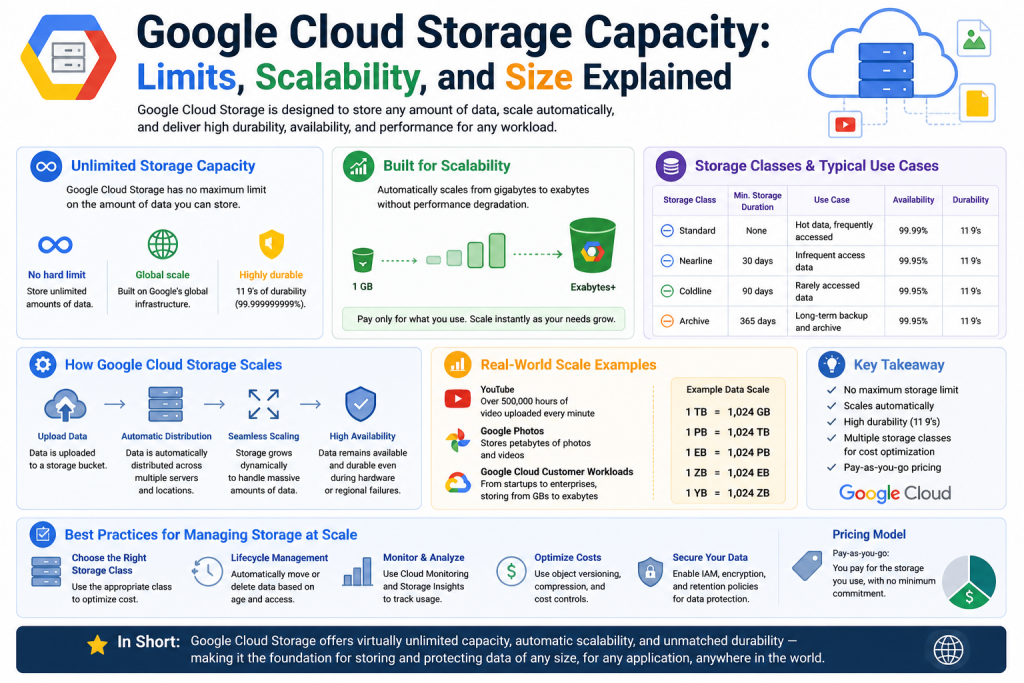
The question of how much data is stored in Google Cloud is one that sparks curiosity for both everyday users and IT professionals. With billions of people relying on cloud-based services for communication, storage, and productivity, it becomes natural to wonder where all that data goes and how it is managed. While there is no exact public figure available, understanding the structure and functionality of Google’s storage ecosystem provides valuable insight into its enormous scale.
At the core of this system is Google Cloud Storage, which serves as a flexible and scalable solution for storing digital information. This service allows users to upload, manage, and retrieve data from virtually anywhere in the world. It is designed to handle everything from small personal files to massive enterprise-level datasets.
Google Cloud Storage is not just a single tool but a foundational component that supports a wide range of services. Whenever someone saves a document, uploads a photo, or sends an email, that data is stored within Google’s infrastructure. This interconnected system is what makes cloud computing so powerful and accessible.
What Is Google Cloud Storage?
To understand how much data Google stores, it is important to first define what Google Cloud Storage actually is. In simple terms, it is an object storage system that allows data to be stored as individual units called objects. Each object contains the data itself, along with metadata that describes it.
Unlike traditional file storage systems that rely on hierarchical folder structures, object storage is designed for flexibility and massive scalability. In Google Cloud Storage, objects are stored in containers known as buckets. These buckets act as logical groupings rather than physical locations, meaning data can be distributed across multiple servers and data centers without the user needing to manage that complexity.
Each object within a bucket is assigned a unique identifier, which allows it to be retrieved quickly through APIs or web interfaces. The metadata associated with each object can include details such as file type, size, creation date, access permissions, and custom tags. This metadata plays a crucial role in organizing and managing large datasets, especially when dealing with billions of files.
Another important aspect of object storage is durability. Google Cloud Storage is designed to provide extremely high durability by replicating data across multiple locations. This ensures that even in the event of hardware failure, natural disasters, or network issues, the data remains safe and accessible. Users do not need to manually create backups, as the system automatically handles redundancy.
Performance is also optimized through distributed architecture. Data can be accessed from different geographic regions with minimal latency, which is especially important for global applications and services. This capability is part of the broader infrastructure of Google Cloud Platform, which integrates storage with computing and networking resources.
Overall, this approach allows Google Cloud Storage to handle enormous volumes of unstructured data efficiently, making it a foundational technology behind many modern digital services.
Unlike traditional file systems that organize data into folders and directories, object storage systems are designed for scalability. This makes them ideal for handling large volumes of unstructured data, such as images, videos, and backups.
Google Cloud Storage operates on a global scale, with data centers distributed across multiple regions. These data centers are interconnected, allowing data to be replicated and accessed quickly regardless of location. This ensures both high availability and durability.
The service is part of the broader Google Cloud Platform, which includes a wide range of tools for computing, networking, and data analysis. Together, these services form a comprehensive ecosystem that supports modern digital applications.
How Google Cloud Storage Supports Everyday Services
One of the most important aspects of Google Cloud Storage is how it integrates with everyday applications. Many users may not even realize they are interacting with it on a daily basis.
This seamless integration is what makes cloud storage feel almost invisible, yet incredibly powerful in supporting modern digital life.
For instance, when someone sends or receives emails through Gmail, every message and attachment is automatically stored in the cloud without requiring any manual action. Similarly, documents created in Google Docs are saved in real time, eliminating the need to click a save button or worry about losing progress. This continuous synchronization ensures that users always have access to the most up-to-date version of their files.
Applications like Google Photos further demonstrate this integration by automatically backing up images and videos from mobile devices. Users can take a photo on their phone and instantly access it on a laptop or tablet. Behind the scenes, Google Drive acts as a central hub, organizing and managing these files in a way that feels intuitive and accessible.
This level of integration not only improves convenience but also enhances productivity. By removing the need for manual file transfers or storage management, Google Cloud Storage allows users to focus on their tasks while the system quietly handles data storage and synchronization in the background.
For example, when you use Gmail, all your emails and attachments are stored in Google’s cloud infrastructure. Similarly, files created or uploaded in Google Docs and Google Drive are saved in the same system.
Photos and videos uploaded to Google Photos are also stored in Google Cloud Storage. These files can be accessed from multiple devices, shared with others, and even enhanced using AI-powered features.
This seamless integration is one of the key reasons why cloud storage has become so popular. Users do not need to think about where their data is stored or how it is managed. Instead, they can focus on using the services, while Google handles the underlying infrastructure.
The Evolution of Google’s Storage Ecosystem
Google’s approach to storage has evolved significantly over the years. In the early days, different services had separate storage limits and pricing structures. This often led to confusion among users who had to manage multiple storage quotas.
To address this issue, Google introduced Google One, which unified storage across various services into a single plan. This made it easier for users to understand how much storage they had and how it was being used.
Under this model, storage is shared across Gmail, Google Drive, and Google Photos. This means that users can allocate their storage space according to their needs, whether that involves storing emails, documents, or media files.
This shift also reflects a broader trend in cloud computing, where services are becoming more integrated and user-friendly. By simplifying the storage experience, Google has made it easier for people to adopt and rely on cloud-based solutions.
How Data Is Stored Behind the Scenes
While the user experience of cloud storage is simple, the underlying technology is highly complex. Google’s data centers are designed to store and manage vast amounts of information efficiently.
These facilities are built with advanced engineering principles that prioritize performance, reliability, and scalability, allowing services like Google Cloud Storage to operate seamlessly for billions of users.
Inside these data centers, thousands of servers work together in coordinated clusters. Each server contributes storage capacity and processing power, forming a distributed system that can handle enormous workloads. Data is not stored in a single location but spread across multiple machines and even different geographic regions. This distribution ensures that if one component fails, the system continues to function without interruption.
Another critical element is automation. Google relies heavily on software-driven management systems to monitor hardware health, balance workloads, and optimize storage usage. These systems can detect potential issues and respond in real time, often before users notice any disruption. Integration with Google Cloud Platform allows storage to work alongside computing and networking resources, creating a unified infrastructure.
Energy efficiency and cooling technologies also play a significant role. Google designs its data centers to minimize power consumption while maintaining high performance, ensuring sustainable operation at massive scale.
These data centers consist of thousands of servers, each equipped with high-capacity storage drives. Data is distributed across multiple servers and locations to ensure redundancy. This means that even if one server fails, the data can still be accessed from another.
Google also uses advanced techniques such as data replication and error correction to enhance reliability. Data is typically stored in multiple copies across different locations, reducing the risk of data loss.
In addition, Google employs sophisticated algorithms to optimize storage usage. These algorithms can compress data, eliminate duplicates, and prioritize frequently accessed files. This helps maximize efficiency and reduce costs.
The Scale of Global Data Storage
To truly appreciate how much data Google Cloud can store, it is helpful to consider the broader context of global data growth. The amount of digital data generated each year is increasing at an exponential rate.
This rapid expansion is driven by the widespread use of smartphones, social media platforms, streaming services, and connected devices that constantly create and share information.
Every day, users upload photos and videos, send emails, participate in video calls, and generate documents, all of which contribute to the growing of global data. Services powered by Google, such as YouTube and Gmail, handle enormous volumes of content every second. High-definition and 4K video content, in particular, requires significantly more storage space than older formats, accelerating data growth even further.
In addition to consumer activity, businesses are producing vast amounts of data through analytics, transactions, and digital operations. The rise of cloud computing, supported by platforms like Google Cloud Platform, has made it easier for organizations to store and process this information at scale.
Emerging technologies such as artificial intelligence and the Internet of Things also play a major role. These systems generate continuous streams of data that must be stored, analyzed, and retained, further increasing the demand for large-scale cloud storage solutions.
Every day, billions of people create and share content online. This includes social media posts, emails, videos, and more. Businesses also generate large volumes of data through transactions, analytics, and operations.
Google plays a central role in this ecosystem, providing storage solutions for both individuals and organizations. As more people rely on digital services, the demand for cloud storage continues to grow.
This growth is further accelerated by emerging technologies such as artificial intelligence and the Internet of Things. These technologies generate massive amounts of data that need to be stored and processed.
Why Cloud Storage Feels Unlimited
One of the most interesting aspects of Google Cloud Storage is how it appears virtually unlimited to users. While there are technical limits based on subscription plans, the underlying infrastructure is designed to scale continuously.
Google achieves this by expanding its data centers and improving storage efficiency. New technologies are constantly being developed to increase storage capacity and reduce costs.
For users, this means they rarely encounter the limitations of traditional storage systems. Instead of worrying about running out of space on a device, they can simply upgrade their storage plan or manage their data more effectively.
This sense of unlimited storage is one of the key advantages of cloud computing. It allows users to focus on their tasks without being constrained by physical hardware limitations.
The Role of Data Centers
Data centers are the backbone of Google Cloud Storage. These facilities house the servers and infrastructure needed to store and process data.
Google’s data centers are located in various regions around the world. This global distribution ensures that data can be accessed quickly and reliably from different locations.
Each data center is designed with efficiency and sustainability in mind. Google has invested heavily in renewable energy and advanced cooling systems to reduce its environmental impact.
Security is also a top priority. Data centers are equipped with multiple layers of protection, including physical security measures and advanced encryption technologies. This ensures that user data is kept safe from unauthorized access.
Types of Data Stored in Google Cloud
The diversity of data stored in Google Cloud is vast. It includes personal, professional, and technical data from a wide range of sources.
Personal data includes photos, videos, emails, and documents created by individual users. Professional data includes files and communications from businesses using Google Workspace.
Technical data includes application data, logs, and analytics generated by developers using Google Cloud Platform. This data is often used to build and optimize applications.
In addition, Google stores large datasets for machine learning and artificial intelligence. These datasets are used to train models that power features such as search, recommendations, and image recognition.
Setting the Foundation for Understanding Scale
Before attempting to estimate how much data is stored in Google Cloud, it is important to understand the foundational elements of the system. Google Cloud Storage is not just a storage service but a complex and highly scalable infrastructure that supports a wide range of applications.
From individual users storing personal files to large enterprises managing critical operations, all of this data contributes to the overall volume stored in Google’s cloud.
As we move forward, it becomes clear that the question is not just about how much data is stored but how Google manages to handle such an enormous of information efficiently and reliably.
Understanding Storage Capacity in Google Cloud
After exploring the foundations of Google Cloud Storage, the next step is to understand how much data users can actually store within this ecosystem. While the infrastructure behind Google Cloud Storage is designed to scale almost indefinitely, the amount of storage available to individual users and organizations depends on subscription plans and service tiers.
From a user perspective, storage is not measured by physical hardware but by allocated quotas. These quotas define how much data you can store across various services such as Gmail, Google Drive, and Google Photos. The actual infrastructure behind the scenes is far larger, but users interact with it through these defined limits.
Understanding these storage plans helps provide insight into how Google distributes its resources and how the total of stored data grows over time.
Consumer Storage Through Google One
For individual users, Google has simplified its storage offerings through Google One. This subscription model combines storage across multiple services into a single shared pool, making it easier to manage files, emails, and media.
Every Google account begins with a free allocation of 15 GB of storage. This space is shared across Gmail, Google Drive, and Google Photos. While 15 GB may be sufficient for light users, it can quickly fill up for those who frequently store high-resolution photos, videos, or large attachments.
To address this, Google One offers several paid tiers that increase storage capacity. These plans are designed to cater to different types of users, from casual individuals to heavy data consumers.
The entry-level plan typically provides 100 GB of storage, which is suitable for users who need extra space for photos and documents. The next tier offers 200 GB, providing more flexibility for growing storage needs. At a higher level, users can access 2 TB of storage, which is ideal for storing large collections of media or backups.
In addition to storage, Google One includes extra features such as enhanced support, family sharing options, and additional security tools. Some higher-tier plans also include access to advanced features like VPN services and AI-powered tools.
This subscription model plays a significant role in increasing the overall amount of data stored in Google Cloud. As more users upgrade their plans, the حجم of stored data expands accordingly.
Storage Allocation and User Behavior
While storage limits define how much data users can store, actual usage patterns vary widely. Not every user utilizes their full storage capacity. Some may use only a fraction of their allocated space, while others may consistently reach or exceed their limits.
User behavior is a key factor in determining how much data is actually stored in Google Cloud. For example, a user who primarily uses Gmail for text-based communication may consume very little storage. On the other hand, a user who frequently uploads high-resolution videos to Google Photos may use several gigabytes or even terabytes of storage.
Another factor to consider is data retention. Many users keep files and emails for years without deleting them. Over time, this leads to a steady accumulation of data across the platform.
The rise of smartphones and digital media has also contributed to increased storage usage. With high-quality cameras and video recording capabilities, users generate larger files than ever before. These files are often backed up automatically to the cloud, further increasing storage demand.
Business Storage with Google Workspace
In addition to consumer storage, Google offers business-oriented solutions through Google Workspace. This platform provides tools for communication, collaboration, and data storage, similar to other enterprise productivity suites.
Google Workspace includes several subscription tiers, each offering different levels of storage and features. These tiers are designed to meet the needs of organizations of various sizes, from small businesses to large enterprises.
The entry-level tier typically provides a modest amount of storage per user, which is sufficient for basic operations. Higher tiers offer significantly more storage, often reaching multiple terabytes per user.
For example, mid-level plans may include around 2 TB of storage per user, while higher-tier plans can provide up to 5 TB or more. Enterprise plans may offer even greater flexibility, with storage limits that can be adjusted based on organizational needs.
Unlike individual users, businesses often generate large volumes of data through daily operations. This includes documents, spreadsheets, presentations, emails, and collaborative projects. In some cases, organizations may rely entirely on Google Workspace for their data storage needs.
This makes business users a major contributor to the total amount of data stored in Google Cloud. As more organizations adopt cloud-based solutions, the overall حجم of stored data continues to grow.
The Impact of Collaboration and Shared Storage
One of the defining features of Google Workspace is real-time collaboration. Multiple users can work on the same document simultaneously, making it easier to share information and coordinate tasks.
This collaborative approach affects how data is stored and managed. Instead of creating multiple copies of the same file, Google often stores a single version that can be accessed by multiple users. This helps reduce redundancy and optimize storage usage.
However, collaboration also leads to increased data creation. Teams may generate numerous documents, revisions, and backups as they work on projects. Over time, this can result in a substantial accumulation of data.
Shared drives and team storage spaces further contribute to this growth. These shared environments allow organizations to centralize their data, making it easier to manage and access. At the same time, they increase the overall amount of stored data within Google Cloud.
Comparing Consumer and Business Storage
While both consumer and business storage contribute to Google Cloud, there are important differences between the two.
. Consumer storage, typically accessed through services like Google One and Google Drive, is designed for individual use. It focuses on simplicity, ease of access, and integration with everyday applications such as email, photos, and personal documents. Users generally manage their own files, and storage usage depends on personal habits like media uploads, backups, and communication.
Business storage, on the other hand, operates at a much larger and more structured scale. Through platforms like Google Workspace, organizations store not only files but also collaborative data, shared drives, project assets, and long-term records. Businesses often require centralized control, user permissions, compliance policies, and security management, which adds complexity to how storage is used and maintained.
Another key difference lies in scalability and predictability. Individual users may upgrade storage occasionally, but businesses often plan storage growth strategically, anticipating future data needs. They may also integrate storage with applications hosted on Google Cloud Platform, enabling automation and large-scale data processing.
Overall, while consumer storage emphasizes convenience and flexibility, business storage prioritizes structure, governance, and scalability, making it a major driver of large-scale data growth in the cloud.
Consumer storage is typically driven by personal usage, such as storing photos, emails, and documents. The data is influenced by individual habits and preferences.
Business storage, on the other hand, is driven by organizational needs. Companies often generate and store large amounts of data as part of their operations. This includes not only files and communications but also backups, logs, and application data.
In many cases, business users consume significantly more storage than individual users. This makes them a key factor in estimating the total amount of data stored in Google Cloud.
Additional Storage Through Google Cloud Platform
Beyond consumer and business subscriptions, Google Cloud Storage is also used extensively within Google Cloud Platform. This platform provides infrastructure and services for developers and organizations to build and run applications.
Storage in this context is often used for purposes such as:
Application data storage
Database backups
Big data analytics
Machine learning datasets
Content delivery
Unlike consumer and business plans, storage in Google Cloud Platform is typically billed based on usage rather than fixed quotas. This allows organizations to scale their storage dynamically based on their needs.
For example, a company running a large-scale application may store terabytes or even petabytes of data in Google Cloud Storage. Similarly, organizations working with big data or artificial intelligence may require massive datasets for training and analysis.
This type of usage significantly contributes to the overall حجم of data stored in Google Cloud. In many cases, it exceeds the storage used by individual and business users combined.
The Role of Data Growth Trends
The amount of data stored in Google Cloud is not static. It is constantly increasing as more users and organizations adopt cloud-based solutions.
Several trends are driving this growth. One of the most significant is the rise of digital content. High-resolution images, 4K videos, and other media files require large amounts of storage.
Another factor is the increasing reliance on cloud-based applications. As more services move to the cloud, the need for scalable storage continues to grow.
Artificial intelligence and machine learning are also contributing to this trend. These technologies require large datasets for training and operation, further increasing storage demand.
In addition, regulatory requirements and data retention policies often require organizations to store data for extended periods. This leads to long-term accumulation of data within cloud systems.
Estimating Total Storage Based on User Numbers
While Google does not publish exact figures, it is possible to estimate the scale of storage based on user numbers and storage allocations.
For example, if billions of users each have access to at least 15 GB of storage, the total potential storage capacity is already enormous. When you factor in users with higher-tier subscriptions, the numbers grow even larger.
Business users and Google Cloud Platform customers add another layer of complexity. Their storage usage can vary widely, but it often involves large-scale data storage.
These estimates suggest that the total amount of data stored in Google Cloud is likely measured in petabytes or even exabytes. While these numbers are difficult to comprehend, they highlight the масштаб of modern cloud infrastructure.
Storage Efficiency and Optimization
Managing such a vast amount of data requires advanced optimization techniques. Google uses a variety of methods to ensure efficient storage and retrieval.
Data compression reduces the size of files, allowing more data to be stored in the same space. Deduplication eliminates duplicate data, further optimizing storage usage.
Tiered storage systems allow less frequently accessed data to be stored in lower-cost storage tiers. This helps balance performance and cost.
Caching and content delivery networks improve access speed by storing frequently accessed data closer to users. This enhances the overall user experience.
These optimization techniques play a crucial role in managing the ever-growing of data stored in Google Cloud.
Preparing for the Next Level of Scale
As cloud adoption continues to grow, the amount of data stored in Google Cloud will only increase. New technologies and applications will drive further demand for storage, pushing the limits of what is possible.
Understanding how storage plans, user behavior, and business usage contribute to this growth provides valuable context for estimating the overall scale of Google Cloud.
In the next section, we will explore deeper estimates and assumptions about total data حجم, including how factors like user growth and technological advancements influence the future of cloud storage.
Estimating the Total Data Stored in Google Cloud
After understanding how storage works across consumer plans, business solutions, and developer platforms, the next logical step is to estimate how much data is actually stored in Google Cloud. While Google does not publicly disclose exact figures, we can build a realistic picture by analyzing available data points, user numbers, and storage behavior.
One of the most useful starting points is the number of active users across Google services. Platforms like Gmail, Google Drive, and Google Photos collectively serve billions of people worldwide. Even a conservative estimate of user activity reveals a massive baseline for storage requirements.
If each user is allocated a minimum of 15 GB of free storage, the total potential storage capacity quickly reaches into the tens of billions of gigabytes. However, this is only a starting point. Actual usage often exceeds these baseline allocations due to paid subscriptions and business requirements.
From Gigabytes to Exabytes: Understanding the Scale
To grasp the magnitude of Google’s storage, it is essential to understand how data is measured at scale. Most individuals are familiar with gigabytes and terabytes, but cloud providers operate at much higher levels.
A terabyte equals 1,000 gigabytes. A petabyte equals 1,000 terabytes. An exabyte equals 1,000 petabytes. At this level, numbers become almost abstract.
To put this into perspective, a typical personal computer might store 1 terabyte of data. One petabyte would equal approximately 1,000 such computers. An exabyte would represent around one million of those devices.
When considering billions of users and countless organizations storing data simultaneously, it becomes clear that Google Cloud operates at the exabyte level or beyond. This is not a theoretical possibility but a practical necessity for supporting modern digital services.
Estimating Data Based on User Distribution
A useful way to estimate total storage is to analyze how different categories of users contribute to data growth.
First, consider free-tier users. Every Google account includes 15 GB of shared storage. If there are over a billion active users, the total allocated storage already reaches into the tens of billions of gigabytes.
Next, consider paid subscribers using Google One. Many users upgrade to plans offering 100 GB, 200 GB, or even 2 TB of storage. Even if only a fraction of users subscribe, the increase in storage allocation is significant.
For example, if 20 percent of users upgrade to a 100 GB plan, the total storage allocation expands dramatically. This does not even account for users on higher-tier plans with terabytes of storage.
Then there are business users operating through Google Workspace. Organizations often store large volumes of data, including documents, communications, and operational records. In many cases, businesses rely entirely on cloud storage, making them major contributors to overall data.
Finally, there are developers and enterprises using Google Cloud Platform. These users may store massive datasets for applications, analytics, and artificial intelligence. Their storage needs can reach petabytes or more, further increasing the total حجم of stored data.
The Hidden Layer: Data Beyond User Files
When estimating how much data Google stores, it is important to consider more than just user-generated content. A significant portion of data exists behind the scenes.
This includes system logs, backups, metadata, and replicated data. For every file a user uploads, multiple copies may be stored across different locations to ensure reliability and availability.
Machine learning models also require large datasets for training and operation. These datasets often include billions of data points and can occupy vast amounts of storage space.
In addition, Google stores data to support its own services, such as search indexing, maps, and advertising systems. While this data is not directly visible to users, it contributes significantly to the total storage.
Why Exact Numbers Are Not Public
There are several reasons why Google does not disclose the exact amount of data stored in its cloud.
One reason is competitive advantage. Revealing detailed infrastructure metrics could provide insights to competitors about capacity and capabilities.
Another reason is the dynamic nature of cloud storage. The amount of data is constantly changing as users upload, modify, and delete content. Any published number would quickly become outdated.
Security considerations also play a role. Limiting the amount of publicly available information about infrastructure helps protect against potential threats.
Despite this lack of transparency, the available data allows us to make informed estimates about the scale of Google Cloud Storage.
Growth Trends and Future Projections
The amount of data stored in Google Cloud is not static. It is growing rapidly due to several key trends.
One of the most significant drivers is the increasing use of digital services. More people are relying on cloud-based tools for communication, work, and entertainment.
The rise of high-resolution media is another factor. Modern smartphones and cameras produce large files, which are often backed up automatically to the cloud.
Artificial intelligence is also accelerating data growth. Training AI models requires massive datasets, and these datasets continue to expand as models become more advanced.
Businesses are generating more data than ever before through analytics, transactions, and operations. Many organizations are transitioning to cloud-first strategies, further increasing storage demand.
As these trends continue, the total حجم of data stored in Google Cloud is expected to grow exponentially.
Will Google Cloud Storage Ever Fill Up?
A common question is whether Google Cloud Storage could ever run out of space. In practical terms, the answer is no.
Google’s infrastructure is designed to scale continuously. New data centers are built, and existing ones are expanded to accommodate growing demand.
Advancements in storage technology also play a role. New types of storage media and improved data management techniques allow for greater capacity and efficiency.
In addition, Google optimizes how data is stored. Techniques such as compression, deduplication, and tiered storage help maximize available space.
From a user perspective, this means that storage will continue to be available as long as there is demand and willingness to pay for it.
The Role of Efficiency in Managing Massive Data
Managing exabytes of data requires more than just physical storage. Efficiency is critical to ensuring that data can be stored, accessed, and processed effectively.
Google uses advanced algorithms to optimize storage usage. These algorithms determine how data is distributed, replicated, and accessed.
For example, frequently accessed data may be stored in high-performance storage systems, while less frequently accessed data is moved to lower-cost storage tiers.
Automation plays a key role in managing this process. Systems continuously monitor usage patterns and adjust storage strategies accordingly.
This level of efficiency allows Google to handle enormous volumes of data without compromising performance or reliability.
The Human Perspective on Massive Data
While the technical details of cloud storage are impressive, it is also important to consider the human perspective.
Every piece of data stored in Google Cloud represents a real-world activity. It could be a family photo, an important email, a business document, or a research dataset.
When combined, these individual pieces of data form a vast digital ecosystem that reflects how people live, work, and communicate in the modern world.
Understanding this perspective helps make the concept of large-scale storage more relatable. It is not just about numbers but about the collective digital footprint of billions of users.
The Future of Cloud Storage
Looking ahead, the role of cloud storage will continue to expand. New technologies and applications will drive further demand for scalable storage solutions.
Edge computing, for example, will require data to be processed closer to where it is generated. This will create new challenges and opportunities for storage systems.
Quantum computing and advanced AI may also influence how data is stored and managed in the future.
As these technologies evolve, companies like Google will continue to innovate and expand their storage capabilities.
Conclusion
The exact amount of data stored in Google Cloud remains unknown, but all evidence points to a scale measured in exabytes or more. By analyzing user numbers, subscription models, and enterprise usage, it becomes clear that Google manages one of the largest data storage systems in the world.
From free-tier users to large organizations and developers using Google Cloud Platform, every interaction contributes to the growing حجم of stored data. Behind the scenes, advanced infrastructure, optimization techniques, and continuous expansion ensure that this data is managed efficiently and securely.
Ultimately, the question is not just how much data Google stores, but how it successfully handles such an enormous and ever-growing volume. As digital transformation continues and new technologies emerge, the scale of cloud storage will only increase, reinforcing its role as a critical foundation of the modern digital world.
Continue exploring the technologies and certification concepts that matter most to you.