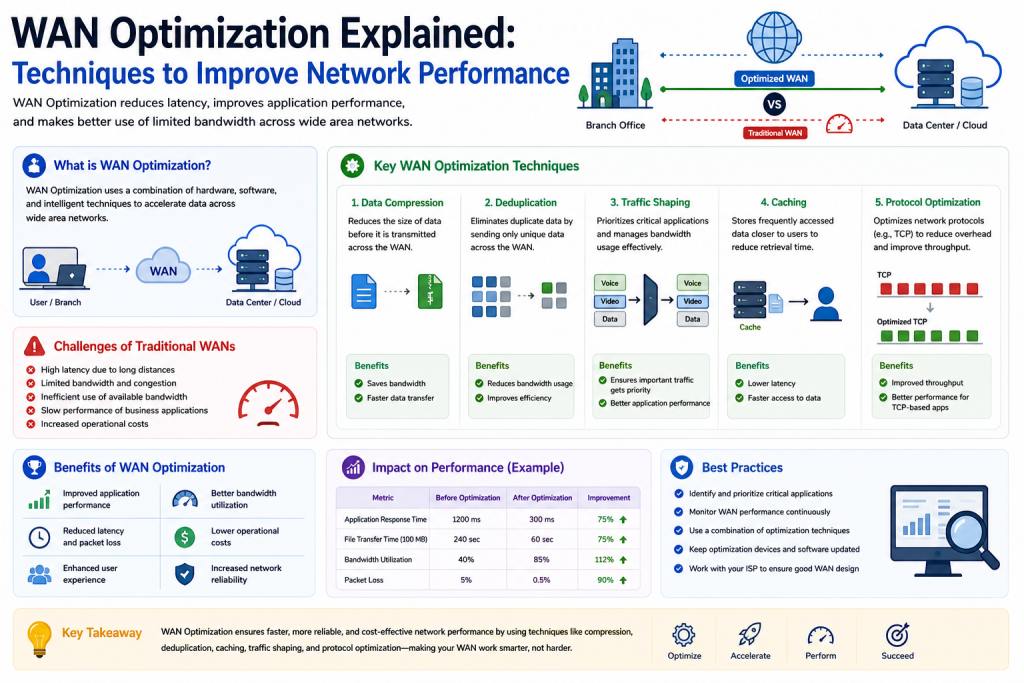
Wide-area networks, often referred to as WANs, play a critical role in connecting systems across cities, countries, and continents. They allow organizations to link branch offices, data centers, and cloud platforms into a unified infrastructure. In today’s highly connected environment, almost every digital interaction depends on the efficiency of WANs, from accessing cloud applications to transferring large files and supporting real-time communication.
As reliance on digital services continues to grow, the demand for faster, more reliable network performance has increased significantly. Users expect seamless connectivity, minimal delays, and uninterrupted access regardless of their physical location. However, WANs face several inherent challenges, including latency, bandwidth limitations, and packet loss, which can impact performance.
WAN optimization emerges as a solution to these challenges by improving the efficiency of data transmission across existing network infrastructure. Instead of upgrading hardware or increasing bandwidth, it focuses on making smarter use of available resources. By optimizing how data is processed and transmitted, WAN optimization helps organizations achieve better performance without incurring high costs.
Understanding the Concept of WAN Optimization
WAN optimization refers to a collection of techniques designed to enhance the performance of wide-area networks. Its primary objective is to reduce latency and maximize bandwidth utilization, ensuring that data travels efficiently from source to destination.
Unlike traditional approaches that rely on infrastructure upgrades, WAN optimization works by improving the way data flows through the network. It identifies inefficiencies, removes redundancies, and adjusts transmission methods to deliver faster and more reliable communication.
The concept revolves around intelligent data handling. For example, instead of repeatedly sending identical data across the network, optimization techniques can store and reuse previously transmitted information. Similarly, large files can be compressed to reduce their size before transmission, speeding up the process.
These methods collectively contribute to a smoother and more efficient network experience. Organizations benefit from faster application performance, reduced network congestion, and improved overall productivity.
The Growing Need for WAN Optimization
The importance of WAN optimization has increased significantly with the rise of cloud computing, remote work, and global business operations. Modern applications are often hosted in remote data centers or cloud platforms, requiring data to travel long distances between users and servers.
This shift has introduced new challenges for network performance. Applications that once operated within local networks now depend on WAN connectivity, making them more susceptible to latency and bandwidth constraints. As a result, even minor inefficiencies can lead to noticeable performance issues.
Remote work has further amplified the need for optimization. Employees accessing corporate resources from different locations rely heavily on WAN connections. Slow or unreliable networks can disrupt workflows, reduce productivity, and negatively impact user experience.
WAN optimization addresses these challenges by ensuring that networks operate efficiently under increasing demand. It enables organizations to support modern applications and distributed workforces without compromising performance.
Key Objectives of WAN Optimization
The primary goal of WAN optimization is to enhance network performance by improving efficiency. This involves several key objectives that work together to achieve optimal results.
One of the main objectives is reducing latency. Latency refers to the time it takes for data to travel from one point to another. High latency can cause delays in application response times, affecting user experience. WAN optimization minimizes these delays by streamlining data transmission processes.
Another important objective is optimizing bandwidth usage. Bandwidth is a limited resource, and inefficient use can lead to congestion and slower speeds. By reducing unnecessary data transmission, WAN optimization ensures that available bandwidth is used effectively.
Improving data reliability is also a key focus. Packet loss and transmission errors can disrupt communication and require data to be present. Optimization techniques help reduce these issues, ensuring smoother and more consistent data delivery.
Finally, WAN optimization aims to enhance overall user experience. Faster load times, smoother application performance, and reduced interruptions contribute to higher productivity and satisfaction.
How WAN Optimization Works
WAN optimization works by applying various techniques to improve data transmission across the network. These techniques are typically implemented through specialized hardware or software solutions that monitor and manage network traffic.
When data is sent across a WAN, it is analyzed by optimization systems that identify inefficiencies. These systems then apply appropriate techniques to enhance performance. For example, redundant data may be removed, files may be compressed, or frequently accessed content may be cached closer to the user.
The optimization process often involves both ends of the network. Devices or software deployed at different locations communicate with each other to ensure that optimization techniques are applied consistently. This coordinated approach helps achieve maximum efficiency.
Another important aspect of WAN optimization is protocol optimization. Communication protocols govern how data is transmitted, and some protocols introduce delays due to their design. Optimization techniques modify these protocols to reduce overhead and improve speed.
Overall, WAN optimization transforms the way data is handled, ensuring faster and more efficient communication across long distances.
Challenges in WAN Performance
To understand the value of WAN optimization, it is important to examine the challenges that affect WAN performance. These challenges arise from both physical limitations and network design.
Latency is one of the most significant challenges. As data travels across long distances, delays are inevitable. This can impact applications that require real-time interaction, such as video conferencing or online collaboration tools.
Bandwidth limitations also pose a challenge. Networks often have limited capacity, and as more users and applications share the same resources, congestion can occur. This leads to slower speeds and reduced performance.
Packet loss is another issue that affects reliability. When data packets are lost during transmission, they must be retransmitted, increasing delays and reducing efficiency.
Protocol inefficiencies further complicate the situation. Many communication protocols prioritize reliability over speed, introducing additional overhead that can slow down data transmission.
WAN optimization addresses these challenges by improving how data is transmitted and reducing inefficiencies in the network.
The Role of Data Efficiency in Network Performance
Efficient data transmission is at the core of WAN optimization. By reducing the amount of data that needs to be sent and improving how it is transmitted, networks can achieve better performance without increasing resources.
Data efficiency involves eliminating redundancies, compressing information, and prioritizing critical traffic. These measures ensure that only necessary data is transmitted, freeing up bandwidth for other operations.
Efficient data handling also reduces the strain on network infrastructure. When less data is transmitted, network devices experience lower loads, leading to improved performance and reliability.
In addition, data efficiency contributes to cost savings. Organizations can avoid expensive upgrades by making better use of existing resources. This makes WAN optimization a cost-effective solution for improving network performance.
WAN Optimization in Modern IT Environments
Modern IT environments are increasingly complex, with applications distributed across multiple locations and accessed by users worldwide. This complexity makes WAN optimization more important than ever.
Cloud computing has transformed how organizations store and access data. Instead of relying on local servers, many businesses use cloud platforms to host applications and data. This requires efficient WAN connectivity to ensure smooth access.
Global operations also rely heavily on WANs. Organizations with offices in different regions need reliable communication to coordinate activities and share information. WAN optimization ensures that these connections remain fast and efficient.
The rise of data-intensive applications has further increased the need for optimization. Applications such as video streaming, big data analytics, and real-time collaboration require high bandwidth and low latency. WAN optimization helps meet these requirements by improving network efficiency.
Benefits of WAN Optimization
WAN optimization offers numerous benefits that make it an essential component of modern networking strategies. These benefits extend beyond performance improvements to include cost savings and enhanced user experience.
One of the most notable benefits is faster data transfer. By reducing latency and optimizing bandwidth usage, WAN optimization ensures that data is delivered quickly and efficiently.
Another benefit is improved application performance. Applications that rely on WAN connectivity can operate more smoothly, providing better user experiences.
Reduced bandwidth consumption is also a significant advantage. By eliminating redundant data and compressing information, WAN optimization frees up bandwidth for other uses.
Cost savings are another important benefit. Organizations can achieve better performance without investing in additional infrastructure, making WAN optimization a cost-effective solution.
Improved reliability is also a key advantage. Optimization techniques help reduce packet loss and ensure consistent data delivery, even in challenging network conditions.
Finally, WAN optimization enhances productivity by enabling employees to work more efficiently. Faster access to data and applications allows users to complete tasks more quickly and effectively.
Preparing for WAN Optimization Techniques
Understanding the fundamentals of WAN optimization provides a solid foundation for exploring specific techniques. These techniques are the building blocks of optimization strategies and play a crucial role in improving network performance.
Each technique addresses a specific aspect of WAN performance, such as reducing latency, minimizing data transmission, or improving reliability. When combined, these techniques create a comprehensive approach to optimization.
In the next section, we will examine these techniques in detail, exploring how they work and how they contribute to overall network efficiency. By understanding these methods, organizations can make informed decisions about implementing WAN optimization solutions.
Introduction to WAN Optimization Techniques
After understanding the fundamentals of WAN optimization, the next step is to explore the specific techniques that make optimization possible. These techniques are designed to address the core challenges of wide-area networks, such as latency, bandwidth limitations, and inefficient data transmission.
Each technique focuses on a different aspect of network performance. Some aim to improve how data is transmitted, while others reduce the amount of data that needs to be sent. When combined, these strategies create a powerful system that enhances the overall efficiency of WAN connections.
Modern WAN optimization solutions often integrate multiple techniques into a unified platform. This allows organizations to benefit from a comprehensive approach rather than relying on a single method. Understanding these techniques in detail helps in selecting the right combination for specific network requirements.
TCP Optimization and Protocol Efficiency
Transmission Control Protocol, commonly known as TCP, is one of the most widely used protocols for data communication over networks. It ensures reliable delivery by establishing connections, tracking packets, and confirming receipt through acknowledgments.
While TCP provides reliability, it also introduces delays due to its design. Each packet sent across the network requires confirmation from the receiving end. This back-and-forth communication can significantly slow down performance, especially over long distances.
TCP optimization techniques are designed to reduce these delays while maintaining reliability. One common approach is window scaling. This technique increases the amount of data that can be sent before waiting for an acknowledgment, allowing more data to flow continuously.
Another important method is selective acknowledgment. Instead of retransmitting all packets when one is lost, selective acknowledgment allows the receiver to inform the sender exactly which packets are missing. This reduces unnecessary retransmissions and improves efficiency.
TCP optimization may also involve adjusting congestion control mechanisms. These adjustments help maintain steady data flow even in fluctuating network conditions, preventing sudden drops in performance.
By refining how TCP operates, these optimization techniques significantly enhance data transfer speeds across WANs.
Data Deduplication and Its Impact
Data deduplication is a powerful technique that eliminates redundant data from network transmissions. In many environments, the same data is sent repeatedly across the network, consuming valuable bandwidth.
Deduplication addresses this issue by identifying duplicate data patterns and ensuring that only unique data is transmitted. When repeated data is detected, the system sends a reference instead of the full data, reducing the amount of information that needs to be transferred.
This technique is particularly useful in environments with multiple users accessing the same files or applications. For example, in a corporate setting, employees in different branch offices may frequently access shared documents. Without deduplication, these files would be transmitted repeatedly across the WAN.
With deduplication, the system recognizes that the data has already been sent and avoids retransmitting it. This not only reduces bandwidth usage but also speeds up data access.
Deduplication systems often maintain a database of previously transmitted data patterns. This allows them to quickly identify duplicates and apply optimization in real time.
Compression Techniques in WAN Optimization
Compression is another essential technique used to improve WAN performance. It works by reducing the size of data before transmission, allowing more information to be sent within the same bandwidth.
When data is compressed, it is encoded using algorithms that eliminate unnecessary or repetitive elements. The compressed data is then transmitted across the network and decompressed at the receiving end.
This process reduces the amount of data that needs to travel across the WAN, resulting in faster transfer times and lower bandwidth consumption. Compression is particularly effective for large files, such as documents, images, and multimedia content.
Different types of compression algorithms are used depending on the nature of the data. Some algorithms prioritize speed, while others focus on achieving higher compression ratios.
One important consideration is the processing overhead associated with compression and decompression. While these processes improve transmission efficiency, they require computational resources. Modern systems are designed to handle this efficiently, ensuring that the benefits outweigh the costs.
Compression is often used in combination with deduplication to maximize data reduction and improve overall network performance.
Caching for Faster Data Access
Caching is a technique that involves storing frequently accessed data closer to the end user. Instead of retrieving data from a distant server each time it is requested, the system provides a locally stored copy.
This significantly reduces latency and improves response times. When users access cached data, the request is fulfilled almost instantly, as it does not need to travel across the WAN.
Caching is widely used in various applications, including web browsing, content delivery, and enterprise systems. For example, content delivery networks use caching to store copies of web content in multiple locations around the world.
When a user requests content, the system directs the request to the nearest cache location, ensuring faster delivery. This approach not only improves performance but also reduces the load on central servers.
In enterprise environments, caching can be implemented at branch offices to store frequently used files and applications. This reduces the need for repeated data transfers and enhances productivity.
Caching strategies must be carefully managed to ensure that stored data remains up to date. Systems often use policies to refresh or invalidate cached data when changes occur.
Forward Error Correction and Reliability
Forward Error Correction, often abbreviated as FEC, is a technique used to improve data reliability in WAN transmissions. It addresses the issue of packet loss, which can occur due to network congestion or poor connection quality.
In traditional data transmission, lost packets must be retransmitted, leading to delays. FEC reduces the need for retransmissions by adding redundant data to the original transmission.
This redundant data allows the receiving system to reconstruct lost packets without requesting retransmission. As a result, data can be delivered more quickly and efficiently.
FEC is particularly useful in environments where packet loss is common, such as long-distance or unstable network connections. By preventing delays caused by retransmissions, it helps maintain consistent performance.
However, FEC introduces additional overhead, as extra data must be transmitted along with the original packets. This trade-off must be carefully considered when implementing the technique.
Despite this, FEC remains a valuable tool for improving reliability and ensuring smooth data delivery in challenging network conditions.
Traffic Shaping and Prioritization
Traffic shaping is a technique used to control the flow of data across a network. It involves prioritizing certain types of traffic to ensure that critical applications receive the necessary bandwidth.
In a typical network, multiple applications compete for bandwidth. Without proper management, less important traffic can consume resources needed for critical operations.
Traffic shaping addresses this issue by classifying data and assigning priorities. For example, real-time applications such as voice and video communication may be given higher priority than file downloads.
This ensures that important applications perform smoothly, even during periods of high network usage. Traffic shaping can also prevent network congestion by regulating the rate at which data is transmitted.
Quality of Service policies are often used in conjunction with traffic shaping to define rules for prioritization. These policies help maintain consistent performance across different types of applications.
By managing how data flows through the network, traffic shaping enhances overall efficiency and user experience.
Application Acceleration Techniques
Application acceleration focuses on improving the performance of specific applications over WAN connections. Different applications have unique requirements, and optimization techniques can be tailored to meet these needs.
For example, some applications rely heavily on frequent data exchanges, while others involve large file transfers. Application acceleration techniques optimize these interactions to reduce delays and improve responsiveness.
This may involve protocol optimization, caching, or data reduction methods. By understanding how an application behaves, optimization systems can apply the most effective techniques.
Application acceleration is particularly important for cloud-based services, where performance depends on WAN connectivity. By enhancing data transmission, it ensures that applications operate smoothly regardless of location.
Encryption and Optimization Challenges
Security is a critical aspect of modern networks, and many organizations use encryption to protect data. However, encryption can present challenges for WAN optimization.
When data is encrypted, it becomes difficult for optimization systems to analyze and process it. Techniques such as deduplication and compression rely on inspecting data patterns, which is not possible with encrypted data.
To address this, some solutions use methods that allow optimization to occur before encryption or after decryption. This ensures that both security and performance are maintained.
Balancing security and optimization requires careful planning. Organizations must ensure that data remains protected while still benefiting from optimization techniques.
Integration of Multiple Techniques
One of the key strengths of WAN optimization is the ability to combine multiple techniques into a unified solution. Each technique addresses specific challenges, and their combined effect results in significant performance improvements.
For example, a single solution may use compression to reduce data size, deduplication to eliminate redundancy, caching to speed up access, and TCP optimization to improve transmission efficiency.
By integrating these techniques, organizations can achieve a comprehensive approach to WAN optimization. This ensures that all aspects of network performance are addressed.
Modern optimization platforms often provide centralized management, allowing administrators to configure and monitor different techniques بسهولة.
Introduction to WAN Optimization Solutions
After exploring the foundational concepts and core techniques of WAN optimization, the next step is understanding how these methods are implemented in real-world environments. Organizations rarely rely on a single technique in isolation. Instead, they deploy integrated solutions that combine multiple optimization strategies into cohesive systems.
WAN optimization solutions are designed to simplify the process of improving network performance. They provide centralized control, automated optimization, and scalability, allowing organizations to manage complex networks more effectively. These solutions may come in the form of hardware appliances, virtual machines, or cloud-based services.
As networks grow in size and complexity, having a structured solution becomes essential. It ensures that optimization techniques are applied consistently across all locations, delivering reliable performance improvements.
Types of WAN Optimization Solutions
WAN optimization solutions can be broadly categorized based on how they are deployed and managed. Each type offers unique advantages depending on the organization’s requirements.
Hardware-based solutions are physical devices installed at different points in the network, such as data centers and branch offices. These appliances are dedicated to handling optimization tasks and often provide high performance and reliability. They are commonly used in enterprise environments where consistent performance is critical.
Software-based solutions run on existing infrastructure, such as servers or virtual machines. These solutions offer flexibility and can be deployed without significant hardware investments. They are suitable for organizations that prefer scalable and cost-effective approaches.
Cloud-based solutions have gained popularity with the rise of cloud computing. These solutions operate from cloud platforms and provide optimization as a service. They are particularly useful for organizations with distributed workforces and cloud-hosted applications.
Each type of solution has its own strengths, and the choice depends on factors such as network architecture, budget, and performance requirements.
Overview of Leading WAN Optimization Platforms
Several vendors offer comprehensive WAN optimization platforms that integrate multiple techniques into a single solution. These platforms are designed to address a wide range of network challenges and provide end-to-end optimization.
Riverbed Technology provides its SteelHead platform, which is widely recognized for its data reduction and application acceleration capabilities. It combines techniques such as deduplication, compression, and protocol optimization to improve performance across WAN links.
Cisco Systems offers Wide Area Application Services, commonly known as WAAS. This solution integrates with networking infrastructure to optimize traffic and improve application delivery. It is particularly effective in environments that already use Cisco networking equipment.
Hewlett Packard Enterprise delivers WAN optimization through its Aruba platform, which evolved from Silver Peak technology. This solution focuses on cloud-based optimization and software-defined WAN capabilities, enabling organizations to manage networks more efficiently.
These platforms demonstrate how multiple optimization techniques can be combined into unified systems that deliver significant performance improvements.
Factors to Consider When Choosing a Solution
Selecting the right WAN optimization solution requires careful evaluation of several factors. Each organization has unique requirements, and the chosen solution must align with its specific needs.
Network topology is one of the most important considerations. Organizations with centralized data centers and multiple branch offices may benefit from solutions that emphasize data deduplication and caching. On the other hand, cloud-focused environments may require solutions that prioritize global accessibility and scalability.
Compatibility with existing infrastructure is another key factor. Some optimization techniques rely on features supported by specific network devices. Ensuring compatibility helps avoid additional costs and simplifies deployment.
Cost is always a critical consideration. Organizations must evaluate both initial investment and ongoing maintenance expenses. While some solutions may have higher upfront costs, they can provide long-term savings by reducing bandwidth usage and improving efficiency.
Scalability is also important. As organizations grow, their network requirements change. A scalable solution ensures that optimization capabilities can expand alongside the network.
Finally, ease of management should not be overlooked. Solutions with intuitive interfaces and centralized control simplify administration and reduce the burden on IT teams.
Implementing WAN Optimization in Real Environments
Implementing WAN optimization involves more than just deploying a solution. It requires careful planning, configuration, and ongoing management to achieve optimal results.
The first step is assessing the current network environment. This includes analyzing traffic patterns, identifying bottlenecks, and understanding application requirements. A thorough assessment provides the foundation for selecting appropriate optimization techniques.
Once a solution is chosen, it must be deployed across relevant network locations. This may involve installing hardware appliances, configuring software systems, or integrating cloud-based services.
Configuration is a critical phase. Optimization techniques must be tailored to the organization’s specific needs. For example, certain applications may require higher priority, while others can tolerate delays.
Testing is essential to ensure that the solution works as intended. Performance metrics such as latency, bandwidth usage, and application response times should be monitored to evaluate the effectiveness of optimization.
Ongoing management is also important. Networks are dynamic, and conditions can change over time. Regular monitoring and adjustments help maintain optimal performance.
Role of SD-WAN in Modern Optimization
Software-defined WAN, often referred to as SD-WAN, has become an important component of modern WAN optimization strategies. It provides a flexible and intelligent approach to managing network traffic.
SD-WAN separates the control plane from the data plane, allowing centralized management of network policies. This enables organizations to dynamically route traffic based on performance requirements.
One of the key advantages of SD-WAN is its ability to use multiple network connections simultaneously. Traffic can be routed through the most efficient path, reducing latency and improving reliability.
SD-WAN also integrates with optimization techniques such as traffic shaping and application prioritization. This combination enhances overall network performance and ensures that critical applications receive the necessary resources.
By incorporating SD-WAN into optimization strategies, organizations can achieve greater flexibility and efficiency in managing their networks.
Advantages of WAN Optimization
WAN optimization offers numerous advantages that make it an essential part of modern networking strategies. These benefits extend across performance, cost efficiency, and user experience.
One of the most impactful advantages is the ability to significantly improve application responsiveness, especially for cloud-based and latency-sensitive services. Users experience faster load times, smoother interactions, and fewer disruptions, which directly contributes to higher productivity.
Another key benefit is better utilization of existing network resources. Instead of investing heavily in additional bandwidth or infrastructure upgrades, organizations can maximize what they already have. This leads to measurable cost savings over time, particularly for businesses operating across multiple locations.
WAN optimization also helps reduce network congestion by eliminating redundant data and prioritizing critical traffic. This ensures that essential applications receive the bandwidth they need, even during peak usage periods. As a result, performance remains stable and predictable.
Scalability is another important advantage. As organizations grow and their network demands increase, WAN optimization solutions can adapt without requiring a complete overhaul of the infrastructure. This flexibility supports long-term growth.
Additionally, improved reliability and reduced downtime enhance business continuity, ensuring that operations run smoothly even under challenging network conditions.
Improved performance is one of the most significant advantages. Optimization techniques reduce latency, enhance data transfer speeds, and ensure smoother application operation. This leads to better overall network performance.
Cost savings are another important benefit. By optimizing bandwidth usage, organizations can avoid expensive upgrades and make better use of existing resources. This results in lower operational costs.
Enhanced user experience is also a key advantage. Faster access to applications and data improves productivity and satisfaction among users.
Reliability is another benefit. Techniques such as caching and error correction ensure consistent data delivery, even in challenging network conditions.
Scalability further adds to the value of WAN optimization. As organizations grow, optimization solutions can adapt to increased demands without compromising performance.
Challenges and Disadvantages
Despite its benefits, WAN optimization also presents certain challenges that organizations must consider.
One of the primary challenges is cost. Some solutions require significant investment in hardware, software, and implementation. Organizations must carefully evaluate whether the benefits justify the expense.
Complexity is another issue. Implementing and managing optimization solutions can be technically demanding. It requires skilled personnel and ongoing maintenance to ensure optimal performance.
Compatibility challenges may also arise. Not all optimization techniques work seamlessly with existing infrastructure. Ensuring compatibility is essential to avoid disruptions.
Security considerations are also important. Some optimization methods involve analyzing data, which can raise concerns about privacy and protection. Balancing optimization with security requires careful planning.
Finally, troubleshooting can become more complex. With multiple optimization techniques in place, identifying and resolving issues may require additional time and expertise.
Real-World Use Cases of WAN Optimization
WAN optimization is used across various industries to improve network performance and support critical operations.
In enterprise environments, organizations rely on it to connect branch offices with centralized data centers, ensuring that employees can access shared applications and files without delays. This is especially important for businesses with geographically dispersed teams that depend on consistent and reliable communication.
In the healthcare sector, WAN optimization plays a vital role in enabling fast and secure access to electronic medical records, imaging systems, and telemedicine platforms. Doctors and healthcare professionals need real-time data access to make informed decisions, and optimization helps ensure that critical information is delivered without interruption.
Educational institutions also benefit from WAN optimization by supporting online learning platforms, virtual classrooms, and digital resources. With students and faculty accessing content from different locations, optimized networks help maintain smooth and responsive learning experiences.
In the financial industry, where speed and accuracy are crucial, WAN optimization enhances transaction processing and supports real-time data exchange between systems. Even small delays can have significant consequences, making optimization essential.
Additionally, industries such as retail, manufacturing, and media use WAN optimization to manage supply chains, process large volumes of data, and deliver content efficiently, ensuring seamless operations and improved customer experiences.
In enterprise environments, organizations use optimization to connect branch offices with central data centers. This ensures fast and reliable access to shared resources.
In cloud computing, optimization enhances access to cloud-based applications. It reduces latency and improves performance for users located far from data centers.
Healthcare organizations use WAN optimization to support telemedicine and electronic health records. Reliable and fast data transmission is essential for patient care.
Educational institutions rely on optimization to deliver online learning platforms. It ensures smooth access to educational resources for students and faculty.
These use cases highlight the versatility of WAN optimization and its importance in different sectors.
Future Trends in WAN Optimization
The field of WAN optimization continues to evolve as technology advances and network demands increase. Several trends are shaping the future of optimization strategies.
. As organizations rely more heavily on cloud-based services, there is a growing need for optimization techniques that are specifically designed for cloud-native environments.
Traditional WAN optimization approaches are being adapted to support applications that operate across multiple cloud platforms, ensuring consistent performance regardless of where data is hosted.
Another important trend is the integration of artificial intelligence and machine learning into WAN optimization solutions. These technologies allow systems to analyze traffic patterns in real time and automatically adjust optimization techniques based on current network conditions. This level of automation reduces the need for manual intervention and improves overall efficiency.
The rise of edge computing is also influencing WAN optimization. By processing data closer to the source, edge environments reduce the distance data must travel, which in turn lowers latency. WAN optimization solutions are evolving to support these distributed architectures by enabling faster communication between edge devices and central systems.
Additionally, increased focus on security is shaping optimization strategies. As encrypted traffic becomes more common, solutions must balance performance improvements with data protection, ensuring secure and efficient transmission across modern networks.
Artificial intelligence and machine learning are being integrated into optimization solutions. These technologies enable systems to analyze network conditions and automatically adjust optimization techniques in real time.
Cloud-native optimization is becoming more prevalent. As organizations move to cloud environments, optimization solutions are adapting to support cloud-based architectures.
Edge computing is another emerging trend. By processing data closer to the source, edge computing reduces latency and enhances performance. WAN optimization plays a key role in supporting these distributed environments.
Automation is also gaining importance. Automated systems reduce the need for manual configuration and management, making optimization more efficient and accessible.
These trends indicate that WAN optimization will continue to play a vital role in modern networking.
Best Practices for Effective WAN Optimization
To achieve the best results, organizations should follow certain best practices when implementing WAN optimization.
Conducting a thorough network assessment is essential. Understanding current performance and identifying bottlenecks helps in selecting the right techniques.
Choosing the appropriate solution based on specific requirements ensures effective optimization. There is no one-size-fits-all approach.
Regular monitoring and analysis are important for maintaining performance. Continuous evaluation helps identify areas for improvement.
Training IT staff is also crucial. Skilled personnel can manage optimization solutions effectively and address issues promptly.
Finally, maintaining a balance between performance and security ensures that optimization does not compromise data protection.
Conclusion
WAN optimization is a critical component of modern networking, enabling organizations to improve performance without significant infrastructure investments. By combining various techniques and deploying comprehensive solutions, it addresses challenges such as latency, bandwidth limitations, and data inefficiencies.
Through careful planning, implementation, and management, organizations can achieve faster data transfer, better application performance, and enhanced user experiences. While there are challenges to consider, the benefits of WAN optimization often outweigh the drawbacks.
As technology continues to evolve, WAN optimization will remain essential for supporting growing network demands. By adopting best practices and leveraging advanced solutions, organizations can ensure that their networks remain efficient, reliable, and ready for the future.
Continue exploring the technologies and certification concepts that matter most to you.