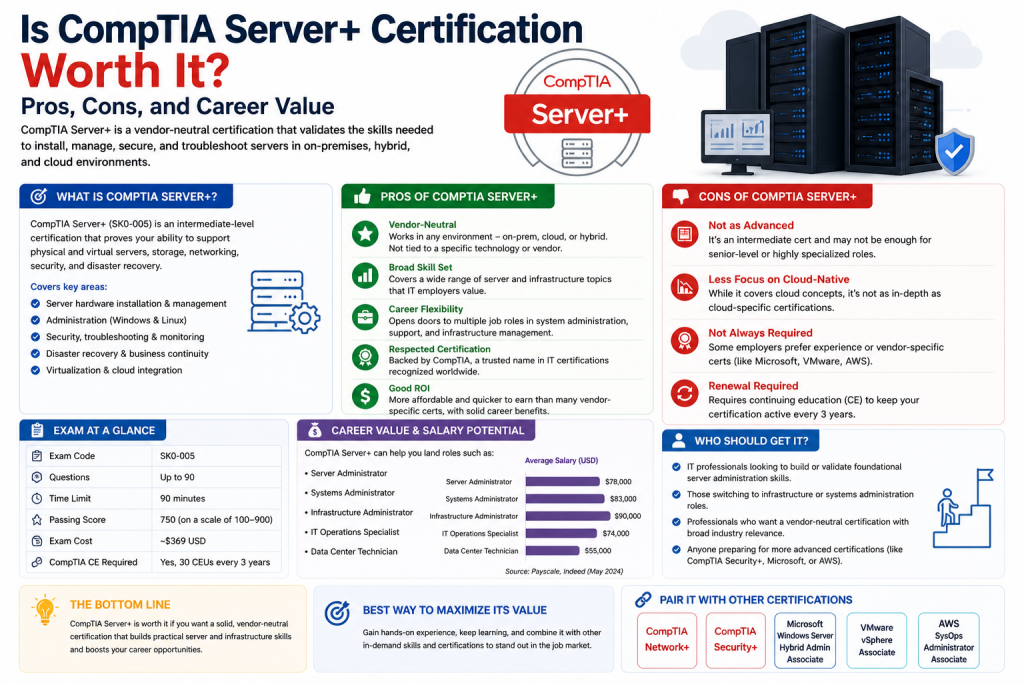
CompTIA Server+ is a certification that often flies under the radar when compared to more widely recognized credentials in the IT industry. However, its value should not be underestimated, especially for professionals who work directly with servers or are planning to move into infrastructure-related roles. This certification is designed to validate the foundational skills required to manage, maintain, and troubleshoot servers in a variety of environments.
Unlike many certifications that focus on a specific vendor’s ecosystem, CompTIA Server+ takes a vendor-neutral approach. This means it teaches universal principles that apply across multiple platforms and technologies. Whether an organization uses Microsoft, Linux, or a hybrid infrastructure, the knowledge gained through Server+ remains relevant. This flexibility makes it particularly appealing to professionals who want to keep their career options open.
The certification is intended for individuals who already have some experience in IT. It is not aimed at complete beginners, but rather those who have spent some time working with systems, networks, or support tasks. Typically, candidates have between two to four years of hands-on experience, although motivated learners with slightly less experience can still succeed.
Server+ plays an important role in bridging the gap between entry-level certifications and more advanced, specialized credentials. It provides a structured way to demonstrate your understanding of server technologies without diving too deeply into any one platform. This makes it a strong stepping stone for those who are still exploring their career paths within IT.
The Purpose and Value of a Vendor-Neutral Certification
One of the most important aspects of CompTIA Server+ is its vendor-neutral nature. In the IT world, many certifications are tied to specific companies or technologies. While these can be extremely valuable, they often limit your expertise to a particular ecosystem. Server+, on the other hand, focuses on the bigger picture.
A vendor-neutral certification teaches concepts that apply across different systems. For example, the principles of server hardware installation, storage management, and troubleshooting are largely the same regardless of the brand or platform being used. By learning these fundamentals, you gain a deeper understanding of how servers operate as a whole.
This approach is particularly beneficial in today’s diverse IT environments. Many organizations use a mix of technologies, combining on-premises servers with cloud-based solutions. In such scenarios, having a broad understanding of server concepts is often more valuable than being highly specialized in one area.
Another advantage of vendor neutrality is career flexibility. With a certification like Server+, you are not tied to a specific job role or company. You can move between different organizations and adapt to new technologies more easily. This can be especially useful early in your career when you are still exploring different paths.
The knowledge gained from Server+ also serves as a strong foundation for more advanced certifications. Once you understand the basics, it becomes easier to specialize in areas such as cloud computing, cybersecurity, or data center management. In this sense, Server+ acts as a building block for long-term career growth.
Who Should Consider CompTIA Server+
CompTIA Server+ is best suited for IT professionals who are in the early to منتصف stages of their careers. It is particularly valuable for those who already have some hands-on experience with servers or related technologies but want to formalize their knowledge with a recognized certification.
Server administrators are among the primary candidates for this certification. These professionals are responsible for managing and maintaining server infrastructure, ensuring that systems run smoothly and efficiently. For individuals in this role, Server+ provides a comprehensive overview of the skills needed to perform their duties effectively.
Server support technicians can also benefit significantly from this certification. These individuals often handle troubleshooting, maintenance, and day-to-day operations. The practical focus of Server+ aligns well with their responsibilities, making it a natural fit for career advancement.
General IT technicians are another group that can gain value from Server+. Even if their primary role does not involve servers, they often encounter server-related tasks in their daily work. Earning this certification can enhance their understanding and make them more versatile professionals.
The certification is also a good option for individuals who have already earned entry-level certifications and are looking to take the next step. It builds on foundational knowledge and introduces more advanced concepts without being overwhelming. This makes it an ideal progression for those who are serious about developing their skills.
However, Server+ may not be the best choice for everyone. Professionals who already have extensive experience or who hold advanced certifications may find that it does not add significant value to their resumes. In such cases, more specialized certifications might be a better investment.
The Evolution and Structure of the Certification
CompTIA Server+ was introduced to address the growing need for skilled server professionals. As organizations became increasingly reliant on digital infrastructure, the demand for individuals who could manage and maintain servers grew rapidly. This certification was created to provide a standardized way to measure those skills.
Over the years, the certification has evolved to keep pace with changes in technology. While it still focuses heavily on on-premises infrastructure, it has incorporated elements of virtualization and modern server management practices. This ensures that the content remains relevant in today’s IT landscape.
The current version of the certification reflects a balance between traditional and modern approaches. It acknowledges the importance of physical servers while also recognizing the role of virtual environments. This combination makes it well-suited for professionals working in hybrid infrastructures.
The structure of the certification is designed to test both knowledge and practical understanding. Rather than relying solely on theoretical questions, it emphasizes real-world scenarios. Candidates are expected to apply their knowledge to solve problems and make decisions, which mirrors the challenges they will face on the job.
This approach ensures that those who earn the certification are not just familiar with concepts but are also capable of using them in practice. It also makes the exam more engaging, as it requires critical thinking and problem-solving skills.
Key Areas of Knowledge Covered
CompTIA Server+ covers a wide range of topics related to server management. These include hardware installation, system configuration, security, and troubleshooting. The goal is to provide a comprehensive understanding of how servers function and how they are managed in real-world environments.
One of the primary areas of focus is server hardware. Candidates are expected to understand how to install, configure, and maintain physical components. This includes knowledge of storage systems, power supplies, and cooling mechanisms. These skills are essential for ensuring that servers operate reliably.
Another important area is server administration. This involves managing operating systems, configuring network services, and maintaining server functionality. Candidates must be familiar with common administrative tasks and understand how to keep systems running efficiently.
Security is also a major component of the certification. With the increasing importance of data protection, IT professionals must be able to secure servers against threats. This includes understanding access control, encryption, and risk mitigation strategies.
Disaster recovery and backup strategies are closely related to security. Candidates are expected to know how to protect data and ensure continuity in the event of a failure. This includes creating backup plans and understanding recovery processes.
Troubleshooting is another critical area. IT professionals must be able to identify and resolve issues quickly to minimize downtime. The certification tests the ability to diagnose problems and apply appropriate solutions in various scenarios.
Exam Format and Expectations
The CompTIA Server+ exam is designed to be both challenging and practical. It consists of multiple-choice questions that cover a wide range of topics. Candidates are given a limited amount of time to complete the exam, which requires careful time management.
The questions are structured to test both knowledge and application. Some questions focus on basic concepts, while others present scenarios that require problem-solving skills. This combination ensures that candidates have a well-rounded understanding of the material.
The exam is relatively fast-paced, with a large number of questions to answer in a short period. This can be challenging, especially for those who are not used to timed tests. However, with proper preparation, it is manageable.
The passing score is set at a level that reflects a solid understanding of the material. Candidates must demonstrate competence across all areas to succeed. This ensures that the certification maintains its credibility and value.
One of the unique aspects of Server+ is that it does not require renewal. Once you pass the exam, the certification is valid for life. This can be a significant advantage for professionals who want a long-term credential without ongoing maintenance requirements.
Why Server+ Still Matters in Modern IT
In an era dominated by cloud computing and virtualization, some may question the relevance of a certification focused on servers. However, the reality is that servers remain a critical component of IT infrastructure. Even cloud services rely on physical servers behind the scenes.
Many organizations continue to operate on-premises data centers or hybrid environments. In these settings, the skills validated by Server+ are highly relevant. Understanding how to manage physical hardware and troubleshoot issues is essential for maintaining reliable systems.
The certification also provides a strong foundation for understanding more advanced technologies. Concepts such as virtualization, storage management, and network configuration are fundamental to many areas of IT. By mastering these basics, professionals can more easily transition into specialized roles.
Another reason Server+ remains valuable is its focus on practical skills. While some certifications emphasize theory, Server+ prioritizes real-world application. This makes it particularly useful for those who want to develop hands-on expertise.
Employers often look for candidates who can demonstrate both knowledge and experience. Having a certification like Server+ can help validate your skills and set you apart from other applicants. It shows that you have taken the time to learn and understand the fundamentals of server management.
What the CompTIA Server+ Exam Covers in Detail
CompTIA Server+ is structured to ensure that candidates develop a well-rounded understanding of server environments. The exam is not limited to theoretical knowledge; instead, it focuses on practical skills that IT professionals use in their daily work. The content is divided into several key areas that reflect real-world responsibilities, ensuring that certified individuals can handle a variety of server-related tasks.
The certification emphasizes four major areas: server hardware installation and management, server administration, security and disaster recovery, and troubleshooting. Each of these areas represents a critical aspect of server operations. Together, they form a comprehensive framework that prepares candidates for real-world challenges.
The exam is designed to test both knowledge and application. Candidates are expected to analyze scenarios, make decisions, and apply best practices. This approach ensures that those who pass the exam are capable of working effectively in practical environments, not just recalling information.
Server Hardware Installation and Management
One of the foundational components of the Server+ certification is understanding server hardware. This area focuses on the physical aspects of servers, including installation, configuration, and maintenance. It is essential for IT professionals who work in environments where physical infrastructure plays a significant role.
Candidates are expected to know how to install server hardware correctly. This includes understanding different types of servers, such as rack-mounted, blade, and tower servers. Each type has its own use cases, advantages, and limitations. Knowing when and how to use each type is an important skill.
Storage management is another key topic within this domain. Servers rely on various storage technologies, including hard disk drives, solid-state drives, and network-attached storage. Candidates must understand how these technologies work and how to configure them effectively. This includes knowledge of RAID configurations, which are used to improve performance and provide redundancy.
Maintenance is also a critical aspect of server hardware management. IT professionals must be able to identify and replace faulty components, perform routine checks, and ensure that systems remain operational. This requires an understanding of hardware lifecycles and best practices for maintaining equipment.
Environmental factors play a significant role in server performance. Candidates must be aware of issues such as temperature control, power supply, and cooling systems. Proper management of these factors helps prevent hardware failures and ensures the longevity of equipment.
Another important concept is documentation. Keeping accurate records of hardware configurations, maintenance activities, and upgrades is essential for efficient management. This information helps teams troubleshoot issues and plan for future improvements.
Server Administration and System Management
Server administration is one of the largest and most important areas covered in the Server+ certification. It focuses on managing server operating systems, configuring services, and ensuring that systems run smoothly.
Candidates are expected to understand how to install and configure server operating systems. This includes both Windows and Linux environments. Knowing how to set up these systems, apply updates, and manage resources is a fundamental skill for any server administrator.
Network services are another key component of server administration. Servers often provide essential services such as file sharing, authentication, and application hosting. Candidates must understand how to configure and manage these services to meet organizational needs.
High availability is a critical concept in modern IT environments. Organizations rely on servers to be available at all times, and downtime can have serious consequences. The certification covers strategies for achieving high availability, such as clustering, load balancing, and redundancy.
Virtualization is also an important topic. It allows multiple virtual machines to run on a single physical server, improving efficiency and reducing costs. Candidates must understand how virtualization works and how it is used in server environments.
Scripting basics are included to help candidates automate routine tasks. While the certification does not require advanced programming skills, it emphasizes the importance of using scripts to improve efficiency and reduce manual work.
Asset management and documentation are essential for maintaining organized and efficient systems. Candidates must understand how to track hardware and software assets, manage licenses, and maintain accurate records. This helps ensure compliance and simplifies management.
Licensing concepts are another important area. IT professionals must understand different licensing models and ensure that their organizations remain compliant. This includes knowledge of software licenses, subscriptions, and usage rights.
Security an dDisaster Recovery Concepts
Security is a fundamental aspect of server management. With the increasing number of cyber threats, IT professionals must be able to protect systems and data from unauthorized access and attacks. The Server+ certification covers a wide range of security concepts to prepare candidates for this responsibility.
Data security is a primary focus. Candidates must understand how to protect sensitive information through encryption, access controls, and secure storage practices. This includes knowledge of best practices for handling data and preventing breaches.
Physical security is also . Servers are often housed in data centers or server rooms, and protecting these locations is essential. Candidates must understand measures such as access controls, surveillance, and environmental protections.
Identity and access management is another key topic. This involves controlling who can access systems and what actions they can perform. Proper implementation of these controls helps prevent unauthorized access and ensures that users have the appropriate permissions.
Risk management is an important part of security. Candidates must be able to identify potential threats, assess risks, and implement strategies to mitigate them. This includes understanding common vulnerabilities and how to address them.
Server hardening is a practical approach to improving security. It involves configuring systems to reduce their attack surface by disabling unnecessary services, applying updates, and enforcing security policies. Candidates must understand how to apply these techniques effectively.
Decommissioning servers is another aspect of security. When servers are retired, they must be properly wiped and disposed of to prevent data leaks. Candidates must understand the correct procedures for handling this process.
Backup and recovery strategies are essential for protecting data. Candidates must know how to create backups, test them, and restore systems when needed. This ensures that organizations can recover quickly from failures or attacks.
Disaster recovery planning goes beyond backups. It involves creating comprehensive plans to ensure business continuity in the event of major disruptions. Candidates must understand how to develop and implement these plans.
Troubleshooting and Problem-Solving Skills
Troubleshooting is one of the most practical and valuable skills covered in the Server+ certification. IT professionals are often called upon to resolve issues quickly, and the ability to diagnose and fix problems is essential.
The certification emphasizes a structured approach to troubleshooting. Candidates must understand the steps involved in identifying issues, analyzing symptoms, and implementing solutions. This systematic approach helps ensure that problems are resolved efficiently.
Hardware troubleshooting is a key area. Candidates must be able to identify issues with components such as memory, storage devices, and power supplies. This requires an understanding of how hardware works and how to test it.
Storage problems are also common in server environments. Candidates must know how to diagnose issues related to disk performance, data corruption, and RAID configurations. This includes understanding error messages and using diagnostic tools.
Operating system and software issues are another focus. Servers rely on complex software systems, and problems can arise from misconfigurations, bugs, or compatibility issues. Candidates must be able to identify and resolve these problems.
Network connectivity issues are frequently encountered in server environments. Candidates must understand how to troubleshoot problems related to network configurations, connectivity, and performance. This includes knowledge of common protocols and tools.
Security-related issues are also part of troubleshooting. Candidates must be able to identify signs of breaches, unauthorized access, or vulnerabilities. This requires an understanding of security principles and monitoring techniques.
The certification also emphasizes the importance of documentation during troubleshooting. Keeping detailed records of issues and solutions helps teams learn from past experiences and improves efficiency.
Exam Structure and Preparation Expectations
The Server+ exam is designed to test a candidate’s ability to apply knowledge in real-world scenarios. It includes a mix of questions that cover all the domains discussed above. The format is straightforward, but the content requires a solid understanding of server concepts.
Candidates can expect a large number of questions within a limited time frame. This makes time management an important factor. Being able to quickly analyze questions and select the correct answers is essential for success.
Preparation for the exam should focus on both theory and practice. Reading study materials is important, but hands-on experience is equally valuable. Working with servers, configuring systems, and troubleshooting issues can greatly improve understanding.
Practice exams are a useful tool for preparation. They help candidates become familiar with the format and identify areas where they need improvement. This can increase confidence and improve performance on the actual exam.
Consistency is key when preparing for Server+. Studying regularly and reviewing concepts helps reinforce knowledge. Candidates should focus on understanding concepts rather than memorizing information.
Real-World Application of Server+ Skills
The skills covered in Server+ are directly applicable to real-world IT environments. Professionals who earn this certification are better equipped to handle the challenges of managing and maintaining servers.
In many organizations, servers are the backbone of operations. They host applications, store data, and provide essential services. Having the skills to manage these systems is critical for ensuring business continuity.
Server+ also prepares candidates for working in diverse environments. Whether it is a small business with a single server or a large enterprise with a complex infrastructure, the principles remain the same. This versatility makes the certification valuable across different industries.
The troubleshooting skills gained from Server+ are particularly valuable. Being able to quickly identify and resolve issues can save time and prevent costly downtime. This makes certified professionals an asset to any organization.
The knowledge of security and disaster recovery is also highly relevant. As cyber threats continue to evolve, organizations need professionals who can protect their systems and respond to incidents effectively.
Building a Strong Foundation for Future Growth
CompTIA Server+ is not just about immediate job skills; it also provides a foundation for future growth. The concepts learned through this certification are applicable to many advanced areas of IT.
For example, understanding server hardware and administration is essential for roles in cloud computing. Even though cloud environments abstract some of the underlying infrastructure, the fundamental principles remain the same.
Similarly, the security concepts covered in Server+ are relevant to cybersecurity roles. Protecting servers is a critical part of securing an organization’s IT environment.
Virtualization knowledge is also valuable for modern IT roles. Many organizations rely on virtual environments, and understanding how they work is essential for managing them effectively.
By building a strong foundation, Server+ helps professionals prepare for more advanced certifications and career opportunities. It provides the knowledge and confidence needed to take the next step in their IT journey.
In the next part, we will explore the cost, career benefits, and overall value of CompTIA Server+, helping you decide whether it is the right certification for your goals.
Cost, Investment, and Overall Value of CompTIA Server+
When considering any certification, one of the first questions that comes to mind is whether the financial investment is justified. CompTIA Server+ sits in the mid-range of IT certification costs, making it neither the cheapest nor the most expensive option available. The exam voucher alone represents a significant expense, and additional resources such as training courses, study guides, and practice exams can increase the total cost.
For many candidates, the decision to invest in Server+ depends on their confidence level. Those who already have hands-on experience with servers may only need minimal preparation, reducing overall costs. On the other hand, individuals who are less familiar with the material may choose to invest in structured learning resources to improve their chances of passing on the first attempt.
Retake options and bundled packages are often available, allowing candidates to purchase multiple exam attempts at a slightly higher upfront cost. While this may seem unnecessary, it can provide peace of mind, especially for those who are unsure about their readiness. Failing an exam and paying for another attempt separately can be more expensive in the long run.
Beyond the direct financial cost, there is also a time investment to consider. Preparing for the Server+ exam requires consistent study and practice. Depending on your background, this preparation period can range from a few weeks to several months. Balancing study time with work and personal commitments is an important factor in determining whether the certification is worth pursuing.
Despite these costs, many professionals find that the benefits outweigh the investment. The knowledge gained during preparation can improve job performance, increase confidence, and open new opportunities. In this sense, the value of Server+ extends beyond the certification itself.
Career Impact and Salary Potential
One of the primary motivations for earning a certification is career advancement. CompTIA Server+ can play a meaningful role in this process, particularly for individuals in the early stages of their IT careers. While it may not guarantee a promotion or salary increase on its own, it can enhance your qualifications and make you a more competitive candidate.
Professionals with Server+ certification often work in roles such as server administrator, systems technician, or IT support specialist. These positions involve managing server infrastructure, troubleshooting issues, and ensuring that systems operate efficiently. The skills validated by Server+ align closely with the responsibilities of these roles.
Salary potential for individuals with server-related skills varies widely depending on experience, location, and employer. Entry-level professionals may start with modest salaries, but there is significant room for growth as they gain experience and develop specialized skills. The certification can serve as a stepping stone toward higher-paying roles.
Employers often view certifications as evidence of dedication and competence. Having Server+ on your resume signals that you have taken the initiative to learn and validate your skills. This can set you apart from other candidates, especially in competitive job markets.
It is important to note that certifications are just one piece of the puzzle. Experience, soft skills, and practical knowledge are equally important. Server+ should be seen as a complement to these factors rather than a replacement.
Comparing Server+ to Other Certifications
To fully understand the value of Server+, it is helpful to compare it with other certifications in the IT industry. Many professionals consider alternatives such as vendor-specific certifications or other vendor-neutral options when deciding how to invest their time and resources.
Server+ stands out because of its broad scope. While vendor-specific certifications focus on particular technologies, Server+ covers general principles that apply across different systems. This makes it a good choice for individuals who want a versatile foundation.
However, this broad approach can also be a limitation. In some cases, employers may prioritize certifications that demonstrate expertise in a specific technology. For example, roles that require deep knowledge of a particular platform may favor candidates with specialized credentials.
Another factor to consider is career stage. For beginners, Server+ provides a natural progression from entry-level certifications. For more experienced professionals, it may not offer the same level of value as advanced or specialized certifications.
Ultimately, the choice depends on your career goals. If you are looking for a well-rounded understanding of server technologies, Server+ is a strong option. If you have a clear specialization in mind, a more targeted certification may be a better fit.
Advantages of Earning CompTIA Server+
There are several advantages to earning the CompTIA Server+ certification, particularly for those who are building their careers in IT. One of the most significant benefits is its vendor-neutral nature. This allows you to apply your knowledge across different environments, making you more adaptable and versatile.
Another advantage is the focus on practical skills. The certification emphasizes real-world scenarios, ensuring that you are prepared to handle common challenges in server management. This practical approach can improve your performance on the job and increase your confidence.
The lifetime validity of Server+ is another appealing feature. Unlike many certifications that require renewal, Server+ remains valid indefinitely. This eliminates the need for ongoing maintenance and allows you to focus on other areas of professional development.
Server+ also provides a strong foundation for further learning. The concepts covered in the certification are relevant to many advanced areas of IT, including cloud computing, cybersecurity, and data center management. This makes it a valuable stepping stone for future growth.
Additionally, earning Server+ can enhance your resume and increase your visibility to employers. It demonstrates that you have a solid understanding of server technologies and are committed to your professional development.
Limitations and Potential Drawbacks
While Server+ offers many benefits, it is not without its limitations. One of the main drawbacks is its relatively low recognition compared to other certifications. Many employers are more familiar with widely known credentials, which can impact the perceived value of Server+.
Another limitation is its broad scope. While this can be an advantage, it also means that the certification does not provide deep expertise in any specific area. For professionals seeking specialized roles, this may not be sufficient.
The focus on on-premises infrastructure is another consideration. While many organizations still rely on physical servers, the industry is increasingly moving toward cloud-based solutions. Although Server+ includes some modern concepts, it may not fully address the latest trends.
For experienced professionals, the certification may offer limited value. Those who already have extensive knowledge and advanced certifications may find that Server+ does not significantly enhance their credentials.
Finally, the cost and time required for preparation can be a barrier for some individuals. While the investment is reasonable compared to other certifications, it is still a factor to consider.
Who Benefits the Most from Server+
CompTIA Server+ is most beneficial for early-career IT professionals who are looking to build a strong foundation. Individuals with some hands-on experience but no formal certification can use Server+ to validate their skills and improve their career prospects.
Server administrators in the early stages of their careers can gain valuable insights from the certification. It covers essential concepts that are directly applicable to their roles, helping them perform their duties more effectively.
Server support technicians can also benefit significantly. The troubleshooting and practical skills emphasized in Server+ align closely with their responsibilities, making it a valuable addition to their skill set.
General IT technicians who want to expand their knowledge can use Server+ as a stepping stone. It provides a broader understanding of server technologies, which can open up new opportunities.
On the other hand, professionals who are already established in their careers may find limited benefits. In such cases, more advanced or specialized certifications may be a better investment.
Long-Term Career Strategy and Certification Path
Earning CompTIA Server+ should be viewed as part of a broader career strategy. It is not an endpoint but rather a step in a continuous learning journey. The knowledge gained from Server+ can serve as a foundation for more advanced certifications and roles.
For example, professionals interested in cloud computing can build on their server knowledge to pursue cloud-related certifications. Understanding how servers operate provides valuable context for working with cloud infrastructure.
Similarly, those interested in cybersecurity can use Server+ as a starting point. Securing servers is a critical aspect of protecting an organization’s IT environment, and the concepts learned in Server+ are directly applicable.
Virtualization and data center management are other areas where Server+ knowledge is valuable. As organizations continue to adopt these technologies, professionals with a strong foundation will be well-positioned to take advantage of new opportunities.
Developing a long-term plan that includes a mix of certifications, experience, and continuous learning is essential for success in IT. Server+ can play an important role in this plan, especially in the early stages.
Real-World Relevance in a Changing IT Landscape
The IT industry is constantly evolving, with new technologies and trends emerging regularly. Despite these changes, the fundamental principles of server management remain relevant. Servers continue to play a critical role in supporting applications, storing data, and enabling communication.
Even in cloud environments, the underlying infrastructure relies on servers. Understanding how these systems work provides valuable insight into modern technologies. This makes Server+ relevant even as the industry shifts toward new models.
Hybrid environments, which combine on-premises and cloud infrastructure, are becoming increasingly common. In these settings, the skills validated by Server+ are particularly valuable. Professionals must be able to manage both physical and virtual systems effectively.
The emphasis on troubleshooting and problem-solving is another reason Server+ remains relevant. Regardless of the technology being used, issues will arise, and the ability to resolve them quickly is essential.
By focusing on foundational concepts, Server+ ensures that candidates are prepared for a wide range of scenarios. This adaptability is crucial in an industry that is constantly changing.
Conclusion
CompTIA Server+ is a practical and versatile certification that offers significant value for the right audience. It provides a comprehensive understanding of server technologies while maintaining a vendor-neutral approach, making it applicable across a wide range of environments.
For early-career IT professionals, Server+ serves as an excellent stepping stone. It builds on existing knowledge, validates practical skills, and enhances career prospects. The certification’s focus on real-world scenarios ensures that candidates are prepared to handle the challenges they will encounter in their roles.
While it may not be the best choice for highly experienced professionals or those seeking specialized expertise, it remains a strong option for individuals looking to establish a solid foundation. Its lifetime validity, practical focus, and broad applicability make it a worthwhile investment for many.
Ultimately, the decision to pursue CompTIA Server+ depends on your career goals, experience level, and interests. If you are looking for a certification that strengthens your understanding of servers and supports long-term growth, Server+ is certainly worth considering.
Continue exploring the technologies and certification concepts that matter most to you.