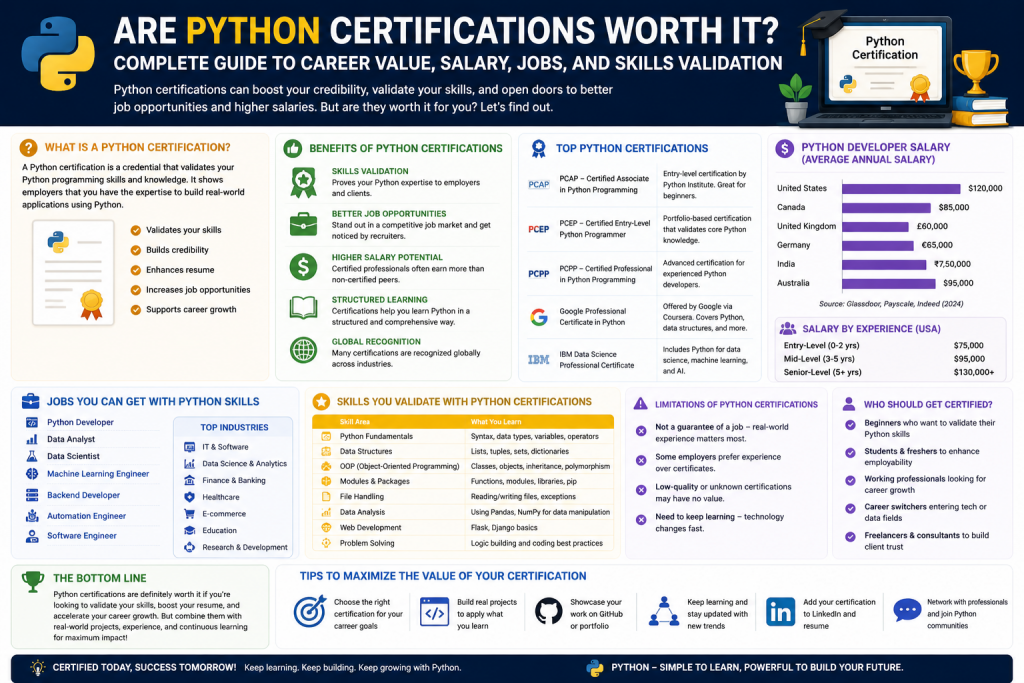
Python has become one of the most influential programming languages in modern technology. Its simplicity, flexibility, and broad range of applications have made it a foundational skill across software development, cybersecurity, cloud automation, data analytics, machine learning, and even business operations. Unlike many niche programming languages that primarily serve software engineers, Python has expanded into multiple industries, making it one of the few technical skills with nearly universal professional value.
As Python’s popularity continues to rise, professionals entering technology fields often ask an important question: Are Python certifications actually worth pursuing?
This question does not have a one-size-fits-all answer. Certifications in information technology have traditionally served as structured validation of technical ability. Networking professionals often pursue certifications to prove infrastructure expertise. Security specialists rely on certifications to demonstrate compliance and operational capability. Cloud engineers frequently earn vendor-specific credentials to confirm practical platform knowledge.
Programming, however, has always existed in a slightly different category.
Many employers prioritize practical coding ability over exam-based validation. Portfolios, Git repositories, project history, and problem-solving demonstrations often outweigh certificates in developer hiring decisions. Because of this, some professionals dismiss programming certifications entirely, believing real-world development is the only metric that matters.
Yet this perspective overlooks an important reality: certifications can provide structured proof of commitment, foundational knowledge, and progression—especially for beginners, career changers, and professionals who use Python outside traditional software engineering roles.
Python certifications can bridge the gap between interest and employability. They can provide a roadmap for learning, offer measurable milestones, and help candidates stand out in crowded job markets where resumes may otherwise look similar.
For newcomers without experience, certifications may act as an early credibility boost.
For IT administrators, cybersecurity specialists, and automation engineers, Python certification can prove practical scripting competence.
For analysts and technical specialists, Python credentials may signal proficiency in data manipulation, automation, and tool development.
The real value of Python certifications depends on who you are, where you are in your career, and how you plan to use Python.
Understanding this requires examining both the strengths and limitations of certification, as well as the certification paths available to Python learners.
Python certification is not merely about passing an exam—it is about understanding whether structured validation aligns with your professional goals.
This guide explores Python certification from a strategic perspective, beginning with why Python itself has become so important, why certification in programming remains controversial, and how foundational Python certifications can fit into a larger career plan.
Why Python Became One of the World’s Most Valuable Technical Skills
To understand whether Python certification matters, it is necessary to understand why Python itself carries such extraordinary weight in today’s digital economy.
Python’s rise did not happen because it is the fastest language, nor because it is the most powerful for every application. Instead, Python succeeded because it solved one of technology’s biggest barriers: accessibility.
Python is designed to be readable.
Its syntax often resembles human language more closely than many other programming languages. This makes Python easier to learn than lower-level languages while still remaining powerful enough for professional development.
For example, Python is widely used in:
Software development
Web development
Cybersecurity automation
Ethical hacking tools
Cloud scripting
Data science
Artificial intelligence
Machine learning
Scientific computing
Financial analysis
Network automation
System administration
DevOps workflows
This versatility means Python is not limited to a single career path.
A cybersecurity analyst may use Python to automate penetration testing.
A network engineer may use Python to configure routers.
A business analyst may use Python for data visualization.
A software developer may build full applications with Python frameworks.
Because Python crosses so many professional boundaries, proving Python proficiency can benefit a wider audience than certifications in many other programming languages.
This is one reason Python certifications are increasingly relevant—not because they replace experience, but because they can support diverse technical roles.
The Debate Around Programming Certifications
Unlike infrastructure certifications, programming certifications often face skepticism.
Why?
Because programming is fundamentally practical.
A network engineer can prove knowledge through standards and configurations. A security professional can demonstrate policy expertise. But programmers are often judged by whether they can actually build functional software.
This creates a perception that coding exams may not reflect real-world programming ability.
Critics of programming certifications argue:
Exams may test memorization more than problem-solving
Real coding projects better demonstrate ability
Employers often value portfolios more
Open-source contributions may carry greater weight
Some certifications lack industry recognition
These concerns are valid.
A certification alone does not make someone a strong Python developer.
Passing an exam does not automatically mean someone can architect applications, debug complex systems, or write production-ready code.
However, dismissing certifications entirely ignores their strategic advantages.
Supporters of Python certification emphasize:
Structured learning progression
Clear skill benchmarks
Resume differentiation for beginners
Motivation through defined goals
Proof of language-specific commitment
Accessibility for career changers
For someone with no professional coding background, certification can provide direction where self-study may feel overwhelming.
For someone transitioning from IT support into automation, Python certification can validate newly acquired scripting capability.
For employers reviewing entry-level candidates, certification may help identify applicants who invested in formal skill development.
Ultimately, Python certifications should not be viewed as replacements for projects or experience—but rather as supplements.
Who Benefits Most from Python Certification?
Python certifications tend to provide the greatest value for specific categories of learners.
Beginners Entering Technology
For individuals without prior professional experience, certification can act as evidence of structured learning. A beginner with a Python credential may stand out more than someone who simply lists “Python” on a resume without proof.
IT Professionals Expanding Into Automation
System administrators, network engineers, and cybersecurity specialists increasingly rely on Python for automation. Certification can formalize scripting competence without requiring a full software engineering background.
Career Changers
Professionals transitioning from non-technical or semi-technical roles into development, analytics, or automation may benefit from certification because it creates a measurable credential during the transition.
Students Building Credibility
Students often lack both work history and project depth. Certification may strengthen internship or junior-level applications.
Data and Analytics Beginners
As Python dominates data analysis, entry-level certifications focused on analytics can help non-programmers gain structured credibility.
Those who benefit less include:
Experienced software engineers with strong portfolios
Senior developers with established production experience
Open-source contributors with recognized work
Technical leaders already validated by career history
For these professionals, certification may offer limited additional value unless required for specific organizational goals.
Understanding the Python Certification Ecosystem
Python certifications are typically structured from beginner to advanced professional levels.
This progression mirrors broader IT certification ladders:
Entry-level
Associate
Professional
Expert
This layered model is valuable because it gives learners a roadmap rather than a random collection of exams.
At the foundational level, certifications focus on syntax, logic, and procedural programming.
At higher levels, they expand into object-oriented programming, software architecture, advanced libraries, and enterprise application design.
For beginners, starting at the right level matters.
Choosing a certification that is too advanced may lead to frustration.
Choosing one too basic may underrepresent your actual capabilities.
This is why understanding entry-level certifications is critical.
Entry-Level Python Certification: Building Foundations
For individuals new to Python, foundational certifications serve as the first checkpoint.
These certifications typically focus on:
Basic syntax
Variables
Data types
Functions
Input/output
Loops
Conditional logic
Lists
Tuples
Dictionaries
Problem-solving basics
This level is not about building enterprise applications.
It is about proving literacy in Python’s language structure.
For many learners, this stage is extremely valuable because Python’s beginner-friendly reputation can be misleading. While Python is easier to read than many languages, true proficiency still requires understanding programming logic.
Entry-level certification can create discipline around these essentials.
It can also prevent one of the biggest beginner mistakes: learning Python syntax without learning programming fundamentals.
The Psychological Value of Certification
One underestimated advantage of Python certification is motivation.
Self-study often fails because learners lack deadlines, milestones, or measurable outcomes.
Certification creates:
Study objectives
Completion targets
Accountability
Progression markers
This can be particularly useful for busy professionals balancing jobs, education, or family obligations.
A certificate can transform vague goals like “learn Python someday” into actionable goals like “pass foundational Python certification within 90 days.”
This structure often matters as much as the credential itself.
Python Beyond Software Development
One reason Python certifications are uniquely valuable compared to some programming credentials is Python’s role outside software engineering.
Python supports:
Cloud automation scripts
SOC analyst workflows
Log analysis
Threat intelligence tools
Data pipelines
Spreadsheet automation
API interaction
Task scheduling
Reporting automation
This means many professionals do not need to become full developers to gain career value from Python.
For example:
A security analyst automating malware checks
A network engineer scripting configurations
A project manager analyzing datasets
A marketer automating reporting
In these cases, Python certification may function less as “developer proof” and more as “technical efficiency proof.”
This distinction matters because not all certification seekers are aspiring software engineers.
Common Misconceptions About Python Certifications
Several myths often distort Python certification decisions.
Myth 1: Certification Guarantees a Job
No certification guarantees employment. It may improve competitiveness, but practical skill still matters.
Myth 2: Certification Is Useless
For experienced developers, maybe less useful. For beginners, often highly useful.
Myth 3: All Python Careers Require Advanced Certification
Not true. Many automation-focused roles benefit from foundational or associate-level skills only.
Myth 4: Employers Ignore Certifications
Not entirely. While many prioritize experience, certifications still influence resume screening and HR filtering.
Myth 5: Certification Replaces a Portfolio
It does not. The strongest strategy often combines both.
Choosing Certification Based on Career Direction
Your Python certification path should align with your intended role.
If you want:
Software development → Focus on programming progression
IT automation → Focus on scripting fundamentals
Data analytics → Focus on data-oriented certifications
Cybersecurity → Focus on Python automation plus security skills
DevOps → Blend Python with cloud and automation tools
The best certification is not necessarily the highest-level one—it is the one that best matches your goals.
The Real Strategic Question
The true question is not “Are Python certifications worth it?”
The better question is:
“Will Python certification accelerate my specific career path faster than alternative learning methods?”
For some, the answer is yes.
For others, bootcamps, GitHub projects, freelancing, or open-source may offer greater ROI.
Certification is one tool among many—not the only path.
Associate, Professional, Data Analytics, Testing, and Advanced Career Growth
Once the foundational question of whether Python certification is worth pursuing has been answered, the next major challenge becomes understanding which certification path actually makes sense. This is where many aspiring Python professionals become confused.
Python is unusual compared to many other technical disciplines because it serves multiple professional ecosystems simultaneously. A networking certification usually points toward infrastructure. A cybersecurity certification often points toward defense or governance. But Python exists across software engineering, automation, data science, quality assurance, DevOps, cloud operations, artificial intelligence, and analytics.
This diversity creates both opportunity and confusion.
A person learning Python for software development may require a completely different progression than someone using Python for data analysis. A QA engineer using Python for automated testing follows a different route than a systems administrator using Python to automate infrastructure.
Because of this, understanding Python certification paths is less about chasing the highest credential and more about selecting the right specialization.
Python certification progression generally expands in complexity across multiple stages:
Associate-level programming
Data-focused analytics
Software testing and automation
Professional application development
Advanced architecture and enterprise deployment
Expert-level mastery
Each stage reflects a deeper relationship with Python, moving from basic competency toward specialized implementation.
The smartest strategy is not simply to collect certifications, but to align each credential with your long-term career destination.
Why Intermediate Python Certifications Matter More Than Beginners Realize
Many learners assume that once they understand Python basics, they should skip certification and simply start coding. In some cases, that can work. But intermediate certifications often represent one of the most strategically valuable points in professional development.
This is because foundational knowledge proves you can understand Python syntax, while intermediate certification proves you can actually apply Python concepts at a professional level.
This stage often includes:
Object-oriented programming
Modules and packages
Exception handling
File operations
Data structures
Control flow mastery
Program design
Testing logic
Basic architecture
For employers, this is where Python proficiency becomes more than casual scripting.
At the beginner level, someone may know how to write simple loops.
At the associate level, someone demonstrates they can build maintainable solutions.
This distinction is critical because many organizations increasingly depend on Python for automation and scalable workflows.
Intermediate certifications can therefore act as the bridge between “learner” and “employable technical contributor.”
Associate-Level Python Certification: The Professional Starting Line
Associate-level Python certification is often where Python begins to carry career weight.
This stage usually focuses on deeper practical development skills rather than pure beginner syntax.
Key areas often include:
Advanced control structures
Data collections
Functions and modular design
Object-oriented principles
Classes and inheritance
Exception management
File processing
Code organization
These competencies matter because professional environments rarely use Python in isolation. Real-world systems require maintainable code, reusable modules, and logical structure.
For example:
A cybersecurity analyst may create reusable reconnaissance tools.
A DevOps engineer may automate deployment workflows.
A data professional may structure processing scripts for repeated analysis.
A software engineer may develop maintainable application components.
In all of these scenarios, Python’s value is no longer about writing code—it is about writing scalable, maintainable code.
Associate certification can therefore function as a strong professional checkpoint.
For many hiring managers, this level may signal that a candidate is beyond hobbyist experimentation.
Object-Oriented Programming: The Career Divider
One of the most important transitions in Python certification is object-oriented programming (OOP).
This is often where casual learners separate from serious developers.
OOP concepts include:
Classes
Objects
Encapsulation
Inheritance
Polymorphism
Abstraction
Many beginners resist OOP because procedural scripting feels easier. However, Python careers that involve software development, larger automation systems, or enterprise applications often depend heavily on object-oriented thinking.
Without OOP understanding, career growth can stall.
This is why certifications emphasizing object-oriented competency often carry more professional weight than purely beginner credentials.
Learning OOP is not just about passing an exam—it is about thinking like a system designer.
Python for Data Analytics: A Separate Career Universe
Python’s role in data has expanded so dramatically that analytics-focused certifications now represent an entirely separate career track.
This is crucial because not everyone pursuing Python wants to become a software developer.
Python has become essential in:
Business intelligence
Data visualization
Predictive analytics
Data cleaning
Reporting automation
Machine learning preparation
Statistical analysis
Market research
Operational dashboards
Data-focused Python certifications often prioritize:
Data acquisition
Data validation
Cleaning datasets
Statistical fundamentals
Visualization tools
Reporting processes
Data ethics
This path is particularly attractive because it opens doors beyond traditional IT.
Professionals in finance, healthcare, logistics, operations, and marketing increasingly benefit from Python-based analytics.
For someone interested in data but intimidated by software engineering, analytics certifications may offer a more targeted and practical route.
This specialization also reflects a broader industry reality: Python is no longer just a programming language—it is a business intelligence tool.
Why Data Certifications Can Be Powerful for Non-Developers
Many professionals underestimate how valuable Python can be without advanced software engineering.
A marketing analyst may automate campaign reports.
A finance professional may process transaction data.
A project manager may analyze delivery metrics.
An operations manager may build dashboards.
In these cases, Python certification focused on analytics can significantly improve career mobility without requiring full-stack development expertise.
This is one of Python’s greatest strengths—it adapts to multiple professions.
Python for Testing and Quality Assurance
One of the most overlooked Python certification paths involves software testing.
Testing-focused Python skills can lead to careers in:
QA engineering
Automation testing
Continuous integration
Continuous deployment
Software reliability
Regression testing
Debugging frameworks
Enterprise quality assurance
As software systems become more complex, automation testing becomes increasingly valuable.
Python’s simplicity makes it ideal for:
Unit testing
Automated browser testing
API testing
Test framework scripting
CI/CD integration
Professionals in QA who add Python often become significantly more competitive.
This is particularly important because testing careers can sometimes offer a more accessible transition into software environments than direct software engineering roles.
For someone who enjoys logic, troubleshooting, and process reliability, Python testing certifications can be a highly strategic path.
Professional-Level Python Certifications: Moving Beyond Coding
Professional certifications represent a major leap.
At this stage, Python is no longer treated simply as a language—it becomes an application platform.
Professional-level topics often include:
Advanced OOP
Scientific libraries
GUI development
Enterprise architecture
Package creation
Networking
Socket communication
Database integration
Concurrency
Design patterns
Deployment systems
This level is often best suited for:
Software engineers
Application developers
Technical leads
Automation architects
DevOps specialists
Senior engineers
The jump here is substantial because these certifications often assume not only Python fluency, but also software engineering maturity.
A professional certification signals the ability to design systems, not just write scripts.
Specialization vs Generalization
At higher certification levels, professionals face a major strategic decision:
Should you specialize deeply in one Python niche, or maintain broader competency?
Specialization examples:
Data science
Automation
QA
Web development
Cloud engineering
Generalization examples:
Broad Python architecture
Cross-domain application design
Leadership in Python-enabled teams
Neither approach is universally better.
Specialization may accelerate targeted job opportunities.
Generalization may improve leadership flexibility.
The best path depends on whether your goal is technical depth or organizational breadth.
The Economics of Python Certification
Cost matters.
Beginner certifications are often inexpensive.
Associate and professional certifications can become significantly more expensive.
This creates an ROI question:
Will this certification produce meaningful professional returns?
Factors to consider:
Resume differentiation
Promotion potential
Job transition support
Skill development
Employer reimbursement
Industry recognition
A costly certification may still be worthwhile if it shortens career advancement by months or years.
However, collecting advanced credentials without strategic purpose can waste both money and time.
Python Certification and Employer Perception
Employers do not all view Python certifications equally.
Some prioritize them heavily.
Others focus almost entirely on portfolios.
Some HR departments may use certification as an initial filter, while technical teams evaluate projects more deeply.
In general:
Entry-level roles → Certification can help
Mid-level roles → Certification plus projects is stronger
Senior roles → Experience often dominates
This means certification strategy should evolve with career stage.
Combining Certification With Real Projects
One of the strongest professional strategies is combining certification with hands-on implementation.
For example:
Earn associate certification
Build automation scripts
Create Git repositories
Develop dashboards
Contribute to open-source
Document workflows
This hybrid model can outperform certification alone or self-study alone.
Certification proves structure.
Projects prove execution.
Together, they create stronger professional credibility.
Common Mistakes in Python Certification Planning
Many learners make avoidable mistakes:
Choosing advanced certifications too early
Ignoring career-specific tracks
Overvaluing credentials without projects
Skipping fundamentals
Chasing prestige instead of relevance
Failing to apply Python practically
The most effective path is progressive and intentional.
Python as a Leadership Skill
At higher levels, Python can become more than a technical skill—it can become a leadership differentiator.
Managers who understand automation can optimize teams.
Technical leads who understand Python architecture can guide scalable development.
Security leaders who understand Python can improve defensive tooling.
Data leaders who understand Python can improve strategic insights.
This broader perspective is why advanced Python certification can support not only engineering careers but technical leadership.
Career Strategy, Hiring Value, Long-Term Growth, and the Smartest Path Forward
The final and perhaps most important question surrounding Python certification is not which exam to choose or which level to pursue. The deeper issue is how certification compares to real-world experience—and which path creates the strongest long-term career advantage.
This question matters because Python exists in a unique professional category. Unlike highly standardized technical disciplines where certifications are often expected, programming remains heavily performance-based. Employers do not simply want proof that you studied Python. They want evidence that you can solve problems, build systems, automate tasks, analyze data, improve operations, or contribute to technical outcomes.
Because of this, many professionals struggle to decide where to invest their time.
Should they focus on certification?
Should they build projects?
Should they contribute to open-source communities?
Should they attend bootcamps?
Should they freelance?
Should they pursue formal education?
The answer is rarely absolute.
Python certification and practical experience are not opposing forces. They are strategic tools, and the real advantage comes from understanding when each provides the greatest return.
The strongest Python professionals often do not choose one over the other—they integrate both.
This final stage of understanding Python certifications involves evaluating hiring trends, employer psychology, practical skill development, portfolio strategy, career stage considerations, and the broader professional ecosystem in which Python exists.
Why the Certification vs Experience Debate Exists
Programming has always differed from many other IT disciplines because its output is directly measurable.
A cybersecurity analyst may need certification to satisfy governance requirements.
A network engineer may need certification to validate standards knowledge.
A cloud professional may need certification to prove vendor ecosystem familiarity.
But programmers can often demonstrate capability simply by showing what they have built.
A functioning application, a Git repository, a data pipeline, an automation tool, or a deployed service may instantly communicate skill.
This creates skepticism around programming certifications because many employers ask:
Can this person actually code?
Can they debug?
Can they architect?
Can they solve practical problems?
Can they maintain systems?
If certification does not answer these questions convincingly, some hiring managers may treat it as secondary.
This does not mean certifications lack value.
It means programming certification exists in a more nuanced space where validation must often be reinforced through action.
What Employers Really Look for in Python Professionals
Employers typically evaluate Python candidates across several dimensions:
Foundational knowledge
Practical coding ability
Problem-solving capability
Project experience
Adaptability
Communication
Domain relevance
For entry-level roles, certification can significantly strengthen the first category.
For mid-level roles, practical implementation becomes increasingly important.
For senior-level roles, architecture, leadership, and outcomes dominate.
This means the importance of certification often decreases as direct experience increases.
A beginner with certification may outperform a beginner without visible validation.
A senior developer with major project achievements may gain little from basic certification.
Career stage shapes certification value.
Entry-Level Professionals: Where Certification Can Matter Most
For newcomers, Python certification can be especially powerful because beginners often face a credibility gap.
Without prior employment, proving competence can be difficult.
A resume that simply lists “Python” may appear weak.
Certification helps by offering:
Structured evidence of learning
Resume keyword enhancement
Interview differentiation
Confidence building
Baseline employer trust
At this stage, certification can help candidates get noticed.
However, certification alone is rarely enough.
A beginner should ideally pair certification with:
Small automation tools
Beginner Git repositories
Personal projects
Problem-solving exercises
Portfolio documentation
Even basic projects can dramatically amplify certification value.
For example:
A certified beginner who also automated spreadsheet reports often appears stronger than a certified beginner alone.
Mid-Career Professionals: The Shift Toward Application
For working professionals, Python certification becomes less about proving literacy and more about enabling transition or expansion.
Examples include:
A network engineer moving into automation
A cybersecurity analyst adding scripting
A data analyst improving workflow automation
A QA engineer transitioning into test automation
Here, certification acts as strategic proof of expansion.
It signals intentional upskilling.
But employers will often ask:
How have you used Python in your workflow?
What processes did you improve?
What scripts did you build?
What measurable outcomes resulted?
At this stage, certification without application may seem incomplete.
This is why internal workplace projects can become more valuable than exam scores.
Senior Professionals: Experience Often Dominates
For advanced professionals, certification often shifts from employability tool to specialization signal.
A senior engineer, architect, or technical lead is more likely judged by:
Systems delivered
Teams led
Operational efficiency
Scalability
Technical strategy
Innovation
At this level, Python certification may still help, but usually in narrower contexts:
Leadership development
Specialization
Promotion frameworks
Organizational standards
Consulting credibility
In many cases, senior professionals gain more by demonstrating strategic Python implementation than by accumulating credentials alone.
The Portfolio Advantage
One of the strongest alternatives—or complements—to Python certification is the project portfolio.
A portfolio can include:
Automation scripts
Web applications
Dashboards
APIs
Data visualizations
Security tools
Infrastructure automation
Testing frameworks
Machine learning experiments
A portfolio offers employers visible evidence.
It answers the practical question:
What can you actually do?
For this reason, portfolios often carry exceptional weight in programming careers.
However, portfolios also have weaknesses:
They require time
They may lack standardization
Quality varies
Employers may not deeply review all projects
Some beginners struggle knowing what to build
Certification can help solve this by providing structure before portfolio maturity.
Bootcamps, Degrees, Certifications, and Self-Study
Python learners now face multiple educational paths.
Bootcamps
Fast-paced, project-driven, practical
Degrees
Broad theoretical depth, slower, more expensive
Certifications
Structured, measurable, targeted
Self-study
Flexible, affordable, inconsistent
Each path has strengths.
Certification often occupies the middle ground:
More structured than self-study
Faster than degrees
More measurable than casual learning
Usually cheaper than bootcamps
For many professionals, certification works best when used alongside one of these other approaches.
Open-Source Contributions: The Advanced Credibility Model
Open-source work can be one of the strongest forms of practical validation.
Contributing to public projects demonstrates:
Collaboration
Code quality
Version control
Documentation
Real-world standards
Technical maturity
For experienced developers, open-source contributions may outweigh certifications significantly.
But open-source can be intimidating for beginners.
This is another reason certification remains valuable early—it creates a stepping stone.
The Psychology of Motivation and Completion
A frequently overlooked factor in certification strategy is psychology.
Many learners fail not because they lack intelligence, but because they lack structure.
Certification introduces:
Deadlines
Objectives
Milestones
External accountability
For some people, this dramatically increases completion rates.
Without measurable goals, self-study can collapse into endless “learning someday.”
Certification can transform vague ambition into concrete action.
This makes certifications valuable not only for employer perception, but for personal execution.
When Python Certification May Not Be Worth It
There are scenarios where certification offers lower ROI.
These may include:
Experienced developers with strong portfolios
Professionals already employed in Python-heavy roles
Individuals pursuing niche frameworks where practical specialization matters more
Entrepreneurs building independent products
Senior engineers with significant technical history
In these cases, time may be better spent on advanced projects, architecture skills, or domain specialization.
When Python Certification May Be Highly Worth It
Certification often offers strong value when:
You are entering IT
You are changing careers
You need resume credibility
You lack project experience
You need motivation
You are expanding into automation or analytics
Your employer values formal development
You want structured progression
Python in Multi-Skill Career Stacking
One of Python’s greatest advantages is how effectively it combines with other disciplines.
Python + Cybersecurity
Python + Cloud
Python + Networking
Python + Data Analytics
Python + DevOps
Python + QA
Python + AI
This means Python certification can become exponentially more valuable when paired with another professional domain.
For example:
A cybersecurity professional with Python can automate threat analysis.
A cloud engineer with Python can automate deployment.
A project manager with Python can automate reporting.
In these hybrid scenarios, certification can serve as a strategic multiplier.
The Long-Term Career View
Technology careers are marathons, not sprints.
A Python certification may help secure an interview today.
A strong portfolio may secure practical trust tomorrow.
Leadership ability may secure advancement later.
This progression matters.
Early career → Learn and validate
Mid career → Apply and specialize
Late career → Lead and optimize
Python certification should fit into this broader timeline.
Avoiding Credential Collecting Without Purpose
One major mistake professionals make is collecting certifications without strategic direction.
This can create impressive-looking resumes with limited practical power.
Always ask:
Does this certification support my target role?
Will this skill be used?
Does it fill a real gap?
Will it improve employability or capability?
Certifications should be tools, not trophies.
Building the Smartest Python Career Strategy
A balanced strategy often looks like this:
Learn fundamentals
Master core syntax, logic, data structures, and problem-solving before chasing advanced topics. A strong base prevents knowledge gaps that can limit long-term growth.
Earn targeted certification
Choose certifications that align with your actual career goals, whether that means automation, analytics, development, or testing. Strategic certification builds credibility more effectively than random credential collection.
Build projects
Apply knowledge through hands-on practice. Create scripts, dashboards, automation tools, APIs, or data workflows that solve practical problems. Projects transform theory into functional skill.
Create portfolio
Document your work clearly through repositories, case studies, or professional showcases. A visible portfolio demonstrates capability far more effectively than simply claiming proficiency.
Apply Python in real environments
Use Python in workplace automation, freelance projects, open-source contributions, internships, or operational improvements. Real-world use develops adaptability, troubleshooting, and professional maturity.
Strengthen complementary skills
Pair Python with related competencies such as cloud platforms, cybersecurity, networking, DevOps, data analytics, AI, or project management. Python often becomes more valuable when combined with broader expertise.
Develop problem-solving depth
Beyond syntax, focus on debugging, optimization, architecture, and efficiency. Employers increasingly value professionals who can solve business or technical problems, not just write code.
Specialize where useful
As your experience grows, identify areas where Python can become a strategic advantage—such as machine learning, automation engineering, software testing, security tooling, or enterprise application development.
Expand strategically
Pursue advanced certifications, leadership opportunities, larger technical projects, or cross-functional roles only when they support meaningful progression. Growth should be intentional, not reactive.
Build communication and collaboration
Technical skill alone rarely drives career acceleration. Learning to explain technical decisions, document processes, and work within teams can significantly increase your professional value.
Stay adaptable
Python’s ecosystem evolves rapidly. New frameworks, libraries, and use cases continuously emerge. Lifelong learning ensures your Python expertise remains relevant rather than outdated.
Measure outcomes
Track how your Python skills improve productivity, automate systems, generate insights, or create business value. Career growth often accelerates when technical ability produces visible results.
This approach combines credibility with capability.
It balances formal validation with practical execution.
It creates both immediate employability and long-term adaptability.
It avoids the weakness of certification-only paths that lack proof of application, while also avoiding experience-only paths that may lack structured validation.
Most importantly, it builds a career foundation that is resilient. In technology, tools change, industries evolve, and hiring trends shift—but professionals who combine learning, validation, execution, specialization, and strategic growth consistently remain competitive. Python success is rarely about one exam or one project; it is about building a professional ecosystem around your skills.
Conclusion
Python certifications are neither universally essential nor universally unnecessary. Their true value depends on timing, context, and strategic use.
For beginners, certifications can provide structure, confidence, and visibility.
For career changers, they can validate commitment and create transition momentum.
For professionals expanding into automation, analytics, or testing, they can reinforce technical evolution.
For experienced developers, practical outcomes often outweigh credentials—but certifications may still support specialization or leadership.
The central truth is this:
Certification may open the door.
Experience proves you belong in the room.
Long-term success in Python rarely comes from certification alone, and it rarely comes from theory without validation. The most resilient career strategy combines structured learning, measurable credentials, practical projects, and continuous growth.
Python’s power lies not only in what it can do as a language, but in how it adapts to changing careers, industries, and opportunities.
Whether you choose certification, projects, or both, the smartest move is intentional progression.
In a rapidly evolving technical world, the best Python professionals are not necessarily those with the most certificates or the most code—they are the ones who consistently transform knowledge into results.
Continue exploring the technologies and certification concepts that matter most to you.