Modern networks carry an enormous variety of data, ranging from simple emails to high-definition video streams and real-time voice communication. As organizations continue to rely on digital infrastructure for daily operations, ensuring that these networks perform efficiently has become a top priority. Traffic shaping is one of the most important techniques used to manage how data moves across a network and to ensure that critical applications receive the resources they require.
Traffic shaping refers to the process of controlling the flow of data packets by regulating their transmission rate and prioritizing certain types of traffic over others. Instead of allowing all data to compete equally for bandwidth, traffic shaping introduces policies that define how different types of traffic should be handled. This enables network administrators to maintain stability, reduce congestion, and deliver a consistent user experience.
The concept of traffic shaping is closely linked to quality of service. Quality of service is a broader framework that defines how network performance is measured and maintained. Traffic shaping acts as one of the mechanisms used to enforce quality of service policies by ensuring that bandwidth is allocated according to the importance of each application or service.
As networks grow in size and complexity, the need for effective traffic management becomes increasingly important. Without proper controls, networks can become congested, leading to slow performance, packet loss, and service interruptions. Traffic shaping helps address these challenges by organizing how data is transmitted and ensuring that essential services remain functional even during periods of high demand.
The Role of Network Administrators in Traffic Management
Network administrators are responsible for designing, implementing, and maintaining the systems that keep data flowing smoothly within an organization. Their role extends beyond simply keeping the network operational. They must also ensure that performance remains consistent and that critical applications are protected from disruptions.
Traffic shaping is one of the key tools available to network administrators. By analyzing network usage patterns, administrators can identify which applications require priority and which can tolerate delays. This information is then used to create policies that control how traffic is handled.
For example, a business may rely heavily on a customer-facing application that must remain responsive at all times. At the same time, employees may be downloading large files or streaming media, which can consume significant bandwidth. Without traffic shaping, these less critical activities could interfere with the performance of the customer-facing application. By implementing traffic shaping policies, administrators can ensure that the most important services receive the necessary resources.
In addition to prioritizing traffic, network administrators must also monitor network performance and adjust policies as needed. Traffic patterns can change over time due to factors such as increased user activity, new applications, or changes in business operations. Continuous monitoring allows administrators to adapt their strategies and maintain optimal performance.
The ability to implement effective traffic shaping strategies is a valuable skill for network professionals. It requires a deep understanding of networking concepts, as well as practical experience with the tools and technologies used to manage traffic.
How Traffic Shaping Works
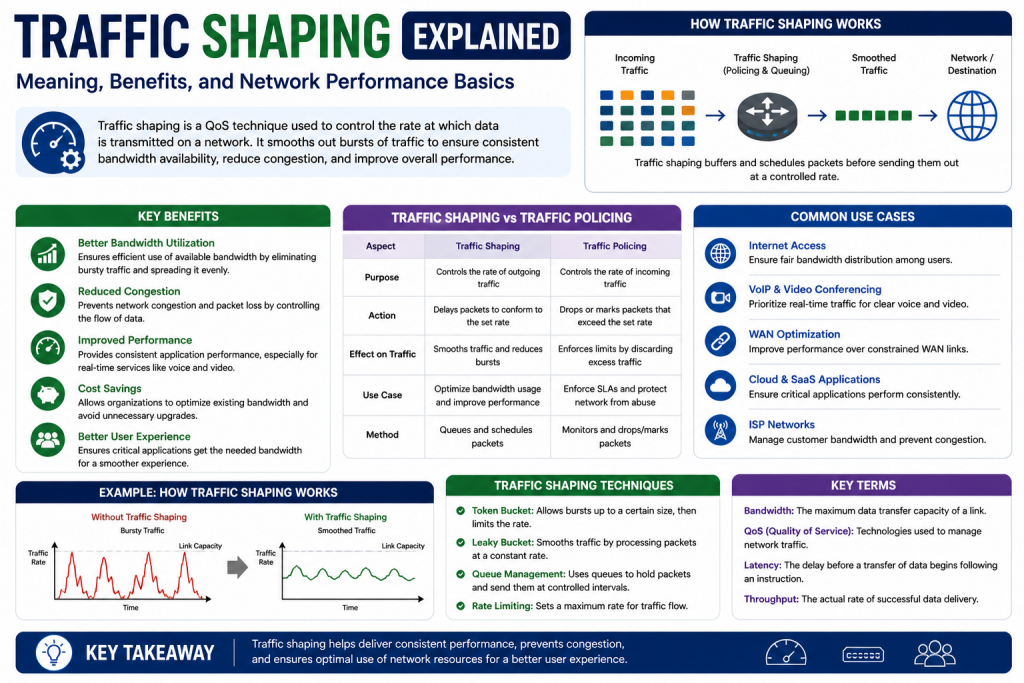
Traffic shaping operates by controlling the rate at which data packets are transmitted across a network. This is achieved through a combination of techniques that regulate bandwidth usage and prioritize certain types of traffic.
At a basic level, traffic shaping involves setting limits on how much data can be sent over the network within a given period of time. These limits are typically defined in terms of bits per second. When traffic exceeds the allowed rate, it is temporarily delayed rather than being dropped. This helps smooth out bursts of traffic and prevents congestion.
Another key aspect of traffic shaping is prioritization. Not all traffic is treated equally. High-priority traffic, such as voice or video communication, is given preferential treatment and is transmitted with minimal delay. Lower-priority traffic, such as file downloads or background updates, may be delayed if necessary to ensure that critical applications receive sufficient bandwidth.
Traffic shaping also relies on the classification of data packets. Before traffic can be managed, the network must identify the type of data being transmitted. This can be done based on factors such as the application generating the traffic, the protocol being used, or the source and destination addresses. Once classified, packets are assigned to specific categories that determine how they will be handled.
Buffers play an important role in traffic shaping. When traffic exceeds the configured rate, packets are stored in buffers and released gradually. This prevents sudden spikes in traffic from overwhelming the network and helps maintain a steady flow of data.
Scheduling algorithms are used to determine the order in which packets are transmitted. These algorithms ensure that high-priority traffic is delivered promptly while still allowing lower-priority traffic to be processed over time. The choice of scheduling algorithm can have a significant impact on network performance.
Overall, traffic shaping works by combining these techniques to create a controlled and predictable flow of data. By regulating transmission rates and prioritizing traffic, it helps maintain network stability and ensures that critical applications perform as expected.
Importance of Traffic Shaping in Modern Networks
The importance of traffic shaping cannot be overstated in today’s digital environment. As organizations rely more heavily on network-based services, the ability to manage traffic effectively becomes essential.
One of the primary benefits of traffic shaping is improved application performance. By prioritizing critical traffic, organizations can ensure that important applications run smoothly even during periods of high demand. This is particularly important for real-time services such as voice and video communication, where delays or interruptions can significantly impact the user experience.
Traffic shaping also helps reduce network congestion. Congestion occurs when the demand for bandwidth exceeds the available capacity. This can lead to packet loss, increased latency, and degraded performance. By controlling the rate at which data is transmitted, traffic shaping prevents congestion from reaching critical levels.
Another important advantage is cost efficiency. Expanding network capacity can be expensive, especially for large organizations. Traffic shaping provides a cost-effective alternative by optimizing the use of existing resources. Instead of adding more bandwidth, organizations can manage their current capacity more effectively.
In addition to performance and cost benefits, traffic shaping enhances network reliability. By maintaining a steady flow of data and preventing congestion, it reduces the likelihood of service disruptions. This is particularly important for businesses that rely on continuous network availability.
Traffic shaping also plays a role in maintaining fairness within the network. Without it, certain users or applications may consume a disproportionate amount of bandwidth, leaving others with limited access. By enforcing limits and prioritization rules, traffic shaping ensures a more balanced distribution of resources.
Security is another area where traffic shaping provides value. Networks are often targeted by attacks that aim to overwhelm systems with excessive traffic. By controlling the flow of data, traffic shaping can help mitigate the impact of such attacks and protect critical services.
Overall, traffic shaping is a fundamental component of modern network management. It enables organizations to deliver consistent performance, optimize resource usage, and maintain a reliable and secure network environment.
Key Concepts Behind Traffic Shaping
Understanding traffic shaping requires familiarity with several key concepts that define how it operates. These concepts form the foundation of traffic management and are essential for designing effective policies.
One of the most important concepts is bandwidth allocation. Bandwidth refers to the amount of data that can be transmitted over a network within a given period of time. Traffic shaping involves allocating bandwidth to different types of traffic based on their priority and importance.
Another key concept is prioritization. Traffic shaping assigns different levels of priority to various types of traffic. High-priority traffic is transmitted first, while lower-priority traffic may be delayed if necessary. This ensures that critical applications receive the resources they need.
Rate limiting is also an essential aspect of traffic shaping. This involves setting a maximum transmission rate for certain types of traffic. When traffic exceeds this rate, it is delayed rather than being dropped. This helps prevent congestion and maintains a steady flow of data.
Queue management is another important concept. Traffic shaping uses queues to store packets that cannot be transmitted immediately. Different types of traffic may be assigned to different queues, each with its own priority level. Scheduling algorithms are then used to determine the order in which packets are transmitted.
Classification is the process of identifying and categorizing traffic. This can be based on various factors, including application type, protocol, and source or destination address. Accurate classification is essential for effective traffic shaping, as it determines how traffic will be handled.
Policing and shaping are closely related but distinct concepts. Policing enforces strict limits by dropping packets that exceed the allowed rate, while shaping focuses on delaying packets to smooth out traffic flow. Both techniques are used to control network traffic, but shaping is generally considered more flexible.
Another important concept is buffering. Buffers temporarily store packets that cannot be transmitted immediately. This allows the network to handle bursts of traffic more effectively and prevents sudden spikes from causing congestion.
Finally, monitoring and adjustment are critical for maintaining effective traffic shaping policies. Network conditions can change over time, and policies must be updated accordingly. Continuous monitoring ensures that traffic shaping remains aligned with organizational needs.
Challenges in Implementing Traffic Shaping
While traffic shaping offers many benefits, implementing it effectively can be challenging. One of the main challenges is accurately identifying and classifying traffic. With the increasing use of encryption and complex applications, it can be difficult to determine the type of traffic being transmitted.
Another challenge is balancing priorities. Assigning too much priority to certain applications can negatively impact others. Network administrators must carefully design policies to ensure that all applications receive adequate resources.
Scalability is also a concern. As networks grow, traffic shaping solutions must be able to handle larger volumes of data without compromising performance. This requires efficient algorithms and robust infrastructure.
Monitoring and maintenance can also be demanding. Traffic shaping policies must be continuously evaluated and adjusted to reflect changing network conditions. This requires time, expertise, and the right tools.
Despite these challenges, traffic shaping remains an essential tool for network management. With careful planning and implementation, organizations can overcome these obstacles and achieve significant improvements in network performance.
Advanced Traffic Shaping Techniques and Strategies
As networks evolve and handle increasingly complex workloads, basic traffic shaping concepts are no longer sufficient on their own. Organizations must adopt advanced techniques and strategies to manage diverse traffic patterns, ensure optimal performance, and meet strict service requirements. These advanced approaches build upon foundational principles and introduce more refined control over how data is transmitted across the network.
One of the most widely used strategies in traffic shaping is hierarchical shaping. This approach involves organizing traffic policies into multiple levels, allowing administrators to control bandwidth allocation at both macro and micro levels. For example, an organization might allocate a fixed portion of bandwidth to a specific department and then further divide that allocation among different applications within that department. This layered structure provides greater flexibility and ensures that resources are distributed efficiently.
Another advanced technique is adaptive traffic shaping. Unlike static policies, adaptive shaping dynamically adjusts bandwidth allocation based on real-time network conditions. This allows networks to respond to sudden changes in demand, such as spikes in user activity or unexpected traffic bursts. Adaptive systems use monitoring tools and algorithms to analyze traffic patterns and make adjustments automatically, reducing the need for manual intervention.
Deep packet inspection is also used in advanced traffic shaping. This technique involves examining the contents of data packets to identify the type of application generating the traffic. By analyzing packet payloads, administrators can apply more precise policies and ensure that traffic is classified accurately. However, deep packet inspection can be resource-intensive and may raise privacy concerns, so it must be implemented carefully.
Traffic shaping can also be integrated with load balancing to distribute traffic evenly across multiple network paths. This helps prevent any single path from becoming congested and improves overall network performance. By combining shaping and load balancing, organizations can achieve both efficient resource utilization and high availability.
Another important strategy is application-aware traffic shaping. Modern networks support a wide range of applications, each with unique requirements. Application-aware shaping identifies specific applications and applies tailored policies to meet their needs. For example, a video conferencing application may require low latency and consistent bandwidth, while file transfer applications can tolerate delays. By recognizing these differences, administrators can optimize performance for each application.
These advanced techniques demonstrate that traffic shaping is not a one-size-fits-all solution. Instead, it requires careful planning and customization to meet the specific needs of each network environment. By leveraging these strategies, organizations can achieve greater control over their networks and deliver a better user experience.
Application-Based and Route-Based Traffic Shaping
Traffic shaping can be broadly categorized into two main approaches: application-based shaping and route-based shaping. Each approach has its own advantages and is suited to different scenarios.
Application-based traffic shaping focuses on identifying and managing traffic based on the application generating it. This approach relies on the ability to recognize specific applications, either through port numbers, protocols, or more advanced techniques such as deep packet inspection. Once identified, traffic from each application is assigned a priority level and handled according to predefined policies.
This method is particularly effective in environments where applications have distinct and predictable characteristics. For example, voice and video applications can be given high priority to ensure smooth communication, while less critical applications such as software updates can be assigned lower priority. Application-based shaping provides a high level of granularity and allows administrators to fine-tune network performance.
However, application-based shaping can become challenging when dealing with encrypted traffic. As more applications use encryption to protect data, it becomes difficult to identify them based solely on packet contents. In such cases, alternative methods must be used.
Route-based traffic shaping addresses this challenge by focusing on the source and destination of traffic rather than the application itself. This approach uses information such as IP addresses and network paths to classify traffic. For example, traffic destined for a specific server or network segment can be prioritized based on its importance.
Route-based shaping is particularly useful in environments where application identification is not feasible or where traffic patterns are more predictable based on network topology. It is also commonly used in wide area networks, where traffic must be managed across multiple locations.
In many cases, organizations use a combination of both approaches to achieve the best results. By combining application-based and route-based shaping, administrators can create comprehensive policies that address a wide range of traffic scenarios.
Bandwidth Control Methods in Traffic Shaping
Effective traffic shaping relies on various methods for controlling bandwidth. These methods determine how data is regulated and ensure that network resources are used efficiently.
One of the most common methods is rate limiting. This involves setting a maximum transmission rate for specific types of traffic. When traffic exceeds this rate, it is delayed or queued until bandwidth becomes available. Rate limiting helps prevent any single application from consuming excessive resources and ensures a fair distribution of bandwidth.
Another important method is traffic buffering. Buffers temporarily store packets that cannot be transmitted immediately. This allows the network to handle bursts of traffic without dropping packets. By smoothing out these bursts, buffering helps maintain a steady flow of data and reduces the likelihood of congestion.
Token bucket and leaky bucket algorithms are widely used in traffic shaping. The token bucket algorithm allows for bursts of traffic by accumulating tokens over time. When data is transmitted, tokens are consumed, and if enough tokens are available, the transmission proceeds. This approach provides flexibility while still enforcing overall rate limits.
The leaky bucket algorithm, on the other hand, enforces a more consistent transmission rate. Data is processed at a fixed rate, and any excess packets are either delayed or discarded. This method is useful for maintaining a steady flow of traffic but may be less flexible than the token bucket approach.
Another method is priority queuing, where traffic is divided into different queues based on priority levels. High-priority queues are processed first, ensuring that critical traffic is transmitted with minimal delay. Lower-priority queues are processed when resources are available.
Weighted fair queuing is another advanced technique that ensures a balanced distribution of bandwidth among different types of traffic. Each queue is assigned a weight, which determines how much bandwidth it receives. This approach provides fairness while still allowing for prioritization.
These bandwidth control methods form the backbone of traffic shaping. By combining them effectively, administrators can create policies that optimize network performance and meet the needs of various applications.
Tools and Technologies for Traffic Shaping
Implementing traffic shaping requires the use of specialized tools and technologies. These tools provide the functionality needed to classify, prioritize, and control network traffic.
In Linux environments, traffic shaping is typically implemented using the traffic control utility. This command-line tool allows administrators to configure queuing disciplines, filters, and classes that define how traffic is handled. Queuing disciplines determine how packets are processed, while filters are used to classify traffic and assign it to specific classes.
The flexibility of this tool makes it a popular choice for managing traffic in Linux-based systems. Administrators can create complex policies that address a wide range of scenarios, from simple rate limiting to advanced hierarchical shaping.
In enterprise environments, network devices such as routers and switches often include built-in traffic shaping capabilities. These devices provide command-line interfaces that allow administrators to configure quality of service policies and traffic shaping rules. By applying these configurations directly on network hardware, organizations can achieve high performance and low latency.
Software-defined networking has also introduced new possibilities for traffic shaping. In this approach, network control is centralized, allowing administrators to manage traffic from a single interface. This provides greater visibility and simplifies the process of implementing and adjusting traffic shaping policies.
Cloud-based networking platforms also incorporate traffic shaping features. These platforms allow organizations to manage traffic across distributed environments and ensure consistent performance for cloud applications. By leveraging cloud-based tools, organizations can extend traffic shaping capabilities beyond traditional on-premises networks.
Monitoring tools play a crucial role in traffic shaping. These tools provide insights into network performance, traffic patterns, and potential issues. By analyzing this data, administrators can make informed decisions and adjust policies as needed.
Overall, the choice of tools and technologies depends on the specific requirements of the network. By selecting the right solutions, organizations can implement effective traffic shaping strategies and maintain optimal performance.
Traffic Shaping in Real-World Scenarios
Traffic shaping is used in a wide range of real-world scenarios to address different challenges and requirements. Understanding these scenarios helps illustrate the practical benefits of traffic shaping.
In enterprise networks, traffic shaping is used to ensure that critical business applications receive the necessary bandwidth. For example, a company may prioritize its customer relationship management system to ensure that employees can access it without delays. At the same time, less critical activities such as web browsing may be assigned lower priority.
In service provider networks, traffic shaping is used to manage bandwidth among multiple customers. Providers often offer different service tiers, with higher-paying customers receiving better performance. Traffic shaping allows providers to enforce these tiers and ensure that resources are allocated according to subscription levels.
Educational institutions also use traffic shaping to manage network usage. With large numbers of students accessing online resources, it is important to ensure that academic applications receive priority. Traffic shaping can be used to limit bandwidth for non-essential activities and maintain a productive learning environment.
In cloud environments, traffic shaping helps ensure consistent performance for applications hosted on shared infrastructure. By controlling how traffic is distributed, organizations can prevent congestion and maintain service quality.
Another important use case is in protecting networks from malicious activity. Traffic shaping can be used to limit the impact of attacks that attempt to overwhelm systems with excessive traffic. By controlling the flow of data, administrators can ensure that legitimate users continue to have access to services.
These real-world examples demonstrate the versatility of traffic shaping and its importance in modern networking. By applying the right strategies, organizations can address a wide range of challenges and achieve their performance goals.
Challenges and Considerations in Advanced Traffic Shaping
While advanced traffic shaping techniques offer many benefits, they also introduce new challenges and considerations. One of the main challenges is complexity. As policies become more sophisticated, they can be difficult to design, implement, and maintain.
Another consideration is performance overhead. Techniques such as deep packet inspection require additional processing power, which can impact network performance. Administrators must balance the need for detailed traffic analysis with the available resources.
Scalability is also a concern. As networks grow, traffic shaping solutions must be able to handle increased volumes of data without compromising performance. This requires careful planning and the use of efficient algorithms.
Security and privacy are important considerations as well. Inspecting packet contents can raise privacy concerns, especially in environments where sensitive data is transmitted. Organizations must ensure that their traffic shaping practices comply with relevant regulations and policies.
Interoperability is another challenge. Networks often consist of devices and systems from multiple vendors, and ensuring that traffic shaping policies work seamlessly across these components can be difficult.
Despite these challenges, advanced traffic shaping remains a critical tool for managing modern networks. By addressing these considerations and implementing best practices, organizations can maximize the benefits of traffic shaping while minimizing potential drawbacks.
Best Practices for Implementing Traffic Shaping
Implementing traffic shaping effectively requires more than just understanding the concepts and technologies. It involves careful planning, thoughtful design, and continuous management. Organizations that follow best practices are more likely to achieve consistent performance, efficient resource utilization, and long-term network stability.
The first step in any traffic shaping implementation is to clearly define network objectives. Administrators must understand what they are trying to achieve, whether it is improving application performance, reducing congestion, or ensuring fair bandwidth distribution. Without clear goals, it becomes difficult to design effective policies.
Once objectives are established, the next step is to identify and classify all network traffic. Every application and service should be analyzed based on its importance, bandwidth requirements, and sensitivity to delay. Critical applications such as voice communication, video conferencing, and customer-facing systems should be given higher priority, while less important activities can be assigned lower priority levels.
Accurate classification is essential for successful traffic shaping. Misclassification can lead to poor performance, as important traffic may not receive the resources it needs. Administrators should use reliable methods for identifying traffic, including protocol analysis, port-based identification, and advanced techniques where necessary.
Policy design is another critical aspect. Traffic shaping policies should be structured to reflect organizational priorities. This includes defining bandwidth limits, priority levels, and handling rules for different types of traffic. Policies should be simple enough to manage but flexible enough to adapt to changing conditions.
Testing is an important part of the implementation process. Before deploying traffic shaping policies across the entire network, administrators should test them in a controlled environment. This helps identify potential issues and ensures that policies work as intended. Testing also provides an opportunity to fine-tune configurations and optimize performance.
Monitoring and analysis play a crucial role in maintaining effective traffic shaping. Network conditions can change over time, and policies must be adjusted accordingly. Administrators should use monitoring tools to track performance metrics such as bandwidth usage, latency, and packet loss. By analyzing this data, they can identify areas for improvement and make necessary adjustments.
Documentation is often overlooked but is essential for long-term success. All traffic shaping policies, configurations, and changes should be documented clearly. This makes it easier to troubleshoot issues, train new staff, and maintain consistency across the network.
Finally, organizations should adopt a proactive approach to traffic shaping. Instead of reacting to problems after they occur, administrators should anticipate potential challenges and implement policies to prevent them. This forward-thinking approach helps ensure a stable and efficient network environment.
Traffic Shaping and Network Security
Traffic shaping is not only a performance optimization tool but also an important component of network security. By controlling how data flows across the network, it can help mitigate the impact of various types of cyber threats and ensure that critical services remain available.
One of the most significant security benefits of traffic shaping is its ability to reduce the impact of distributed denial of service attacks. These attacks attempt to overwhelm a network with excessive traffic, causing legitimate users to lose access to services. Traffic shaping can limit the rate of incoming traffic and prioritize legitimate requests, helping to maintain service availability.
Traffic shaping can also be used to detect unusual traffic patterns. Sudden spikes in traffic or unexpected behavior may indicate malicious activity. By monitoring traffic flow and applying shaping policies, administrators can identify and respond to potential threats more quickly.
Another security advantage is the ability to isolate and control suspicious traffic. For example, traffic from unknown or untrusted sources can be assigned a lower priority or restricted entirely. This helps protect the network from unauthorized access and reduces the risk of data breaches.
In addition to protecting against external threats, traffic shaping can help manage internal security risks. Employees may inadvertently consume excessive bandwidth or use unauthorized applications, which can impact network performance and security. By enforcing traffic shaping policies, organizations can control how resources are used and ensure compliance with security guidelines.
Encryption presents both challenges and opportunities for traffic shaping in security contexts. While encryption makes it more difficult to identify the contents of traffic, it also ensures that data is protected during transmission. Administrators must balance the need for visibility with the importance of maintaining data privacy.
Integration with other security measures is also important. Traffic shaping should be used alongside firewalls, intrusion detection systems, and other security tools to create a comprehensive defense strategy. By combining these technologies, organizations can achieve a higher level of protection.
Overall, traffic shaping enhances network security by controlling traffic flow, detecting anomalies, and protecting critical services. It is an essential component of a well-rounded security strategy.
Performance Optimization Through Traffic Shaping
One of the primary goals of traffic shaping is to optimize network performance. By managing how data is transmitted, organizations can ensure that applications run smoothly and users experience minimal disruptions.
Performance optimization begins with understanding application requirements. Different applications have different needs in terms of bandwidth, latency, and reliability. Real-time applications such as voice and video communication require low latency and consistent bandwidth, while other applications may be more tolerant of delays.
Traffic shaping allows administrators to allocate resources based on these requirements. By prioritizing critical applications, they can ensure that these applications receive the necessary bandwidth and perform as expected. This leads to improved user satisfaction and productivity.
Another aspect of performance optimization is reducing network congestion. Congestion occurs when too much data is transmitted at once, overwhelming the network. Traffic shaping helps prevent this by controlling the rate of data transmission and smoothing out traffic bursts.
Efficient use of bandwidth is also a key factor. Instead of allowing bandwidth to be used inefficiently, traffic shaping ensures that it is distributed according to priority and need. This maximizes the value of existing resources and reduces the need for costly upgrades.
Latency reduction is another important benefit. By prioritizing time-sensitive traffic, traffic shaping minimizes delays and ensures that data is delivered promptly. This is particularly important for applications that require real-time communication.
Consistency is another advantage. Traffic shaping creates a predictable network environment where performance remains stable even during periods of high demand. This predictability is essential for maintaining service quality and meeting user expectations.
Overall, traffic shaping is a powerful tool for optimizing network performance. By carefully managing traffic flow, organizations can achieve efficient resource utilization, reduced congestion, and improved application performance.
Monitoring and Maintaining Traffic Shaping Policies
Once traffic shaping policies are implemented, ongoing monitoring and maintenance are essential to ensure their effectiveness. Networks are dynamic environments, and conditions can change rapidly. Without proper monitoring, even well-designed policies can become outdated or ineffective.
Monitoring involves collecting data on network performance and traffic patterns. This includes metrics such as bandwidth usage, latency, packet loss, and throughput. By analyzing this data, administrators can gain insights into how the network is performing and identify potential issues.
Real-time monitoring is particularly important. It allows administrators to detect problems as they occur and respond quickly. For example, if a sudden spike in traffic is detected, policies can be adjusted to prevent congestion and maintain performance.
Regular reviews of traffic shaping policies are also necessary. As new applications are introduced and user behavior changes, policies must be updated to reflect these changes. This ensures that traffic shaping remains aligned with organizational needs.
Automation can play a significant role in maintaining traffic shaping policies. Automated systems can monitor network conditions and adjust policies dynamically, reducing the need for manual intervention. This is especially useful in large or complex networks where manual management can be challenging.
Troubleshooting is another important aspect of maintenance. When issues arise, administrators must be able to identify the root cause and implement solutions . This requires a thorough understanding of traffic shaping policies and how they interact with other network components.
Training and knowledge sharing are also important. Network administrators should stay up to date with the latest technologies and best practices. This ensures that they can effectively manage traffic shaping and adapt to new challenges.
By maintaining a proactive approach to monitoring and maintenance, organizations can ensure that their traffic shaping policies continue to deliver optimal performance and reliability.
Future Trends in Traffic Shaping
As technology continues to evolve, traffic shaping is also undergoing significant changes. Emerging trends are shaping the way networks are managed and introducing new possibilities for traffic control.
One of the most important trends is the integration of artificial intelligence and machine learning. These technologies enable networks to analyze traffic patterns and make intelligent decisions automatically. AI-driven traffic shaping can adapt to changing conditions in real time, improving performance and efficiency.
Software-defined networking is another major trend. This approach separates the control plane from the data plane, allowing administrators to manage traffic centrally. Software-defined networking provides greater flexibility and simplifies the implementation of traffic shaping policies.
The growth of cloud computing is also influencing traffic shaping. As more applications move to the cloud, organizations must manage traffic across distributed environments. Cloud-based traffic shaping solutions provide the tools needed to maintain performance and ensure consistent service delivery.
The rise of the Internet of Things is creating new challenges for traffic shaping. With a large number of connected devices generating data, networks must handle increased traffic volumes and diverse requirements. Traffic shaping will play a critical role in managing this complexity.
Edge computing is another emerging trend. By processing data closer to its source, edge computing reduces latency and improves performance. Traffic shaping at the edge allows for more efficient data handling and better user experiences.
Security considerations are also driving innovation in traffic shaping. As cyber threats become more sophisticated, traffic shaping techniques are being integrated with advanced security measures to provide enhanced protection.
These trends highlight the evolving nature of traffic shaping and its importance in modern networking. By staying informed and adapting to new developments, organizations can ensure that their networks remain efficient and secure.
Conclusion
Traffic shaping is a fundamental technique that enables organizations to control and optimize the flow of data across their networks. By regulating transmission rates, prioritizing critical traffic, and managing bandwidth effectively, it ensures that networks remain stable, efficient, and capable of supporting modern applications.
Throughout this discussion, it is clear that traffic shaping goes beyond simple bandwidth management. It plays a vital role in improving performance, enhancing security, and ensuring fairness in resource allocation. From foundational concepts to advanced techniques and real-world applications, traffic shaping provides the tools needed to address the challenges of modern networking.
Successful implementation requires careful planning, accurate traffic classification, well-designed policies, and continuous monitoring. Organizations that follow best practices can achieve significant improvements in network performance and reliability while making the most of their existing resources.
As networks continue to evolve with the adoption of cloud computing, artificial intelligence, and connected devices, the importance of traffic shaping will only increase. It will remain a key component of network management, helping organizations adapt to changing demands and maintain high levels of service quality.
In a world where reliable connectivity is essential, traffic shaping stands out as a critical strategy for ensuring that networks can meet the needs of both today and the future.
Continue exploring the technologies and certification concepts that matter most to you.