In an era dominated by cloud platforms, automation, artificial intelligence, and specialized software, some professionals may underestimate the value of mastering foundational workplace tools. Yet Microsoft Office remains one of the most universally used productivity ecosystems in the world. Across corporations, schools, government institutions, healthcare systems, startups, and nonprofit organizations, Microsoft 365 applications continue to power communication, reporting, data analysis, project planning, and presentations.
From Word documents that formalize proposals to Excel spreadsheets that drive financial decisions, from Outlook calendars that organize executive schedules to PowerPoint decks that secure investor confidence, Microsoft Office tools remain embedded in the daily workflow of millions. Because these applications are so common, many people assume basic familiarity is enough. However, there is a major difference between casual usage and verified expertise.
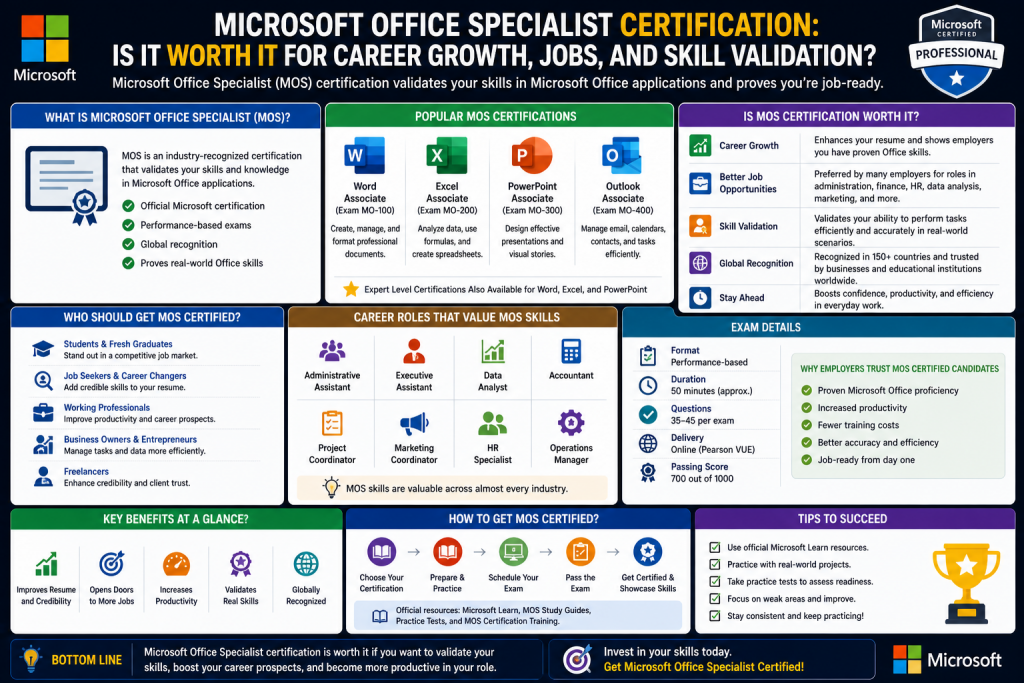
This distinction is where Microsoft Office Specialist (MOS) certification becomes increasingly relevant. MOS certification is not merely a test of whether someone has opened Excel before or created a PowerPoint presentation once. It is a structured validation of practical, job-ready skills that prove an individual can use Microsoft Office applications effectively, efficiently, and professionally.
For students entering competitive job markets, administrative professionals seeking advancement, educators modernizing lesson delivery, analysts refining data capabilities, and business professionals aiming to strengthen productivity, MOS certification can represent more than technical knowledge—it can serve as a strategic professional asset.
Understanding whether MOS is worth your time requires a deep exploration of what it actually is, how it works, what skills it validates, and who benefits most from it. Before considering salary implications or career ROI, it is essential to understand the certification itself, its structure, and its practical role in modern work environments.
What Is Microsoft Office Specialist Certification? A Practical Definition
Microsoft Office Specialist certification is an official credential designed to validate proficiency in Microsoft Office applications. Rather than focusing on broad IT infrastructure, networking, or cybersecurity concepts, MOS centers specifically on the productivity tools that drive everyday business execution.
This focus makes MOS unique. It is not intended for network engineers configuring enterprise systems or software developers building applications. Instead, it targets the practical software ecosystem used by office workers, project managers, operations teams, students, educators, and business professionals.
MOS certifications are designed around specific Microsoft applications, including:
- Microsoft Word
- Microsoft Excel
- Microsoft PowerPoint
- Microsoft Outlook
- Microsoft Access
Each exam tests real-world capabilities within its designated application. Candidates are evaluated not on abstract theory but on execution. This means demonstrating the ability to complete practical tasks such as formatting reports, analyzing data, creating professional presentations, managing email systems, or organizing databases.
This practical orientation is one of MOS’s defining strengths. Employers often care less about whether a professional can define a feature and more about whether they can use it effectively under deadline pressure. MOS certification bridges this gap by testing real productivity.
Because Microsoft Office applications are deeply integrated into modern organizations, MOS certification can be seen as a digital fluency benchmark. It provides measurable proof that a candidate can operate efficiently in environments where workplace software competence directly impacts output quality.
The Structure of MOS Certification Levels
One of the strongest features of the MOS program is its layered structure, allowing professionals to certify according to their skill level and career needs.
The primary levels include Associate and Expert.
Associate certifications focus on foundational and intermediate skills. These certifications validate a candidate’s ability to navigate software confidently, execute standard tasks, and produce polished work. Associate-level users are expected to manage daily business demands with competence.
Expert certifications go further by validating advanced capabilities. These exams are tailored toward users who need deeper command of application functionality, such as advanced formatting, automation, complex data manipulation, or enterprise-level productivity enhancements.
For example:
Word Associate may focus on creating and formatting professional documents, while Word Expert may test advanced references, forms, collaboration, and document automation.
Excel Associate may emphasize formulas, charts, and worksheet management, while Excel Expert could include advanced functions, PivotTables, macros, and data governance.
This tiered design allows candidates to align certification paths with real-world responsibilities rather than pursuing unnecessary credentials.
For many professionals, the Associate level provides immediate value because it aligns closely with common business tasks. For others, particularly analysts, project coordinators, or operations managers, advancing toward Expert-level validation can strengthen specialization.
This modular flexibility makes MOS more accessible than many certification ecosystems. Rather than forcing candidates into broad pathways, it allows targeted skill-building.
Why MOS Is Different from Traditional Technical Certifications
When comparing MOS to certifications in cybersecurity, cloud, networking, or coding, it is important to recognize that MOS serves a fundamentally different purpose.
Technical certifications often validate infrastructure expertise, architecture knowledge, or advanced systems management. MOS instead validates operational productivity.
This distinction matters because workplace success is not always determined by highly technical knowledge alone. In many organizations, business execution depends on:
- Creating proposals
- Presenting findings
- Tracking budgets
- Managing communication
- Organizing workflows
- Producing reports
A highly technical employee may still struggle professionally if they cannot communicate ideas effectively through documents, spreadsheets, or presentations.
MOS certification addresses this often-overlooked gap by emphasizing business enablement rather than backend systems.
In practical terms, MOS proves someone can transform ideas into deliverables.
For example:
A marketing coordinator may use PowerPoint to pitch campaigns.
An HR specialist may use Word for policy creation.
A finance assistant may use Excel for forecasting.
An executive assistant may rely on Outlook for calendar optimization.
In each case, Microsoft Office proficiency becomes a force multiplier.
This role-based practicality explains why MOS certification remains relevant even as technology evolves.
A Case Study in Practical Certification
To understand MOS more concretely, examining one certification such as PowerPoint Associate (MO-310) is particularly useful.
PowerPoint is often misunderstood as simple slide creation software. In reality, professional PowerPoint use involves communication strategy, design principles, audience engagement, and information hierarchy.
The MO-310 certification validates a candidate’s ability to:
- Create presentations from scratch
- Manage slide masters and themes
- Insert multimedia elements
- Use transitions and animations appropriately
- Design content for readability and professionalism
- Organize information visually
- Collaborate effectively
These are not superficial skills. In modern workplaces, presentations can influence investor confidence, employee training outcomes, sales performance, executive decision-making, and client acquisition.
A poorly designed presentation can weaken strong ideas. A polished one can amplify credibility.
MOS PowerPoint certification therefore validates more than software familiarity—it confirms communication readiness.
This example illustrates a broader truth about MOS certifications: they are often underestimated because they focus on “common” software, but mastery of common software frequently separates average professionals from standout performers.
What Skills Do MOS Certifications Actually Validate?
MOS exams are intentionally hands-on. They measure task execution in environments that simulate real software use.
This includes several categories:
Document Creation and Formatting
Word certifications emphasize:
- Professional layouts
- Styles and themes
- Tables
- References
- Collaboration tools
- Proofing
These are critical for producing reports, contracts, academic papers, and business communication.
Data Analysis and Visualization
Excel certifications often include:
- Functions
- Formulas
- Charts
- Tables
- Conditional formatting
- Data organization
Excel remains one of the most commercially valuable software tools due to its role in finance, operations, logistics, and analytics.
Visual Communication
PowerPoint certifications validate:
- Design principles
- Slide organization
- Media integration
- Presentation flow
- Branding consistency
Communication and Scheduling
Outlook certifications focus on:
- Email organization
- Calendar coordination
- Task management
- Contact systems
Collectively, MOS certifications validate workplace execution, not theoretical understanding.
This is especially important because many professionals overestimate their competence in software they use casually. MOS testing often reveals knowledge gaps in efficiency, shortcuts, advanced features, and optimization.
Execution Over Memorization: A Critical Advantage
Many certification systems are criticized for encouraging memorization over performance. MOS largely avoids this problem by emphasizing application.
Rather than asking, “What menu contains X feature?” MOS is more likely to require actual use of that feature.
This means:
- Creating
- Editing
- Formatting
- Managing
- Organizing
As a result, certified individuals often gain immediate practical improvements, not just resume enhancements.
This experiential model makes MOS particularly valuable for learners who want tangible workplace benefits.
Who Benefits Most from MOS Certification?
While MOS can help nearly anyone, some groups benefit more directly.
Students and Early Career Professionals
For those with limited work history, MOS can validate digital readiness. It provides a recognized credential that supports employability.
Administrative Professionals
Executive assistants, office managers, and support staff often rely heavily on Microsoft Office. MOS can improve efficiency and credibility.
Educators
Teachers and trainers frequently use Word, PowerPoint, and Excel for curriculum delivery, reporting, and classroom management.
Business Professionals
Marketing, sales, HR, and operations teams benefit from stronger productivity and communication.
Career Changers
For individuals re-entering the workforce or shifting into office-based roles, MOS can establish relevant baseline capability.
The Growing Importance of Verified Digital Fluency
As workplaces become more hybrid and remote, software competence becomes more visible.
In physical offices, informal support may mask skill gaps. In distributed environments, self-sufficiency matters more.
Professionals increasingly need to:
- Build reports independently
- Present virtually
- Analyze data
- Collaborate digitally
MOS certification can therefore signal adaptability in modern workplaces.
Perception Matters: Why Employers Value Certification
Many resumes claim “proficient in Microsoft Office.”
This phrase is so common that it often loses credibility.
MOS certification adds external validation.
It transforms:
“Claims proficiency”
into
“Verified by Microsoft standards.”
This distinction can improve trust, especially in roles where Office capability is central.
MOS as a Foundation, Not a Final Destination
Perhaps the most strategic way to view MOS certification is as a foundational credential.
It may not replace specialized credentials in cybersecurity, project management, or cloud architecture, but it strengthens the productivity layer beneath all of them.
Professionals who combine:
- Technical specialization
- Communication ability
- Data literacy
- Presentation strength
often outperform those with isolated expertise.
MOS can therefore serve as a strategic career accelerator by improving execution quality across virtually any profession.
Beyond Software Skills—Why MOS Can Influence Career Growth
Understanding what Microsoft Office Specialist certification is only tells part of the story. The more important question for many professionals is whether earning this credential translates into real workplace advantages. Certifications require time, preparation, financial investment, and focus, so evaluating return on investment matters.
For some credentials, value is obvious because they directly align with specialized technical roles. For Microsoft Office Specialist certification, however, the value proposition can seem less dramatic at first glance because Microsoft Office applications are so common. Many people use Word, Excel, and PowerPoint daily, which can create the impression that formal certification offers little advantage.
Yet this assumption often overlooks how employers actually evaluate productivity, efficiency, communication, and digital readiness. Knowing how to open Excel is not the same as using it strategically for analysis. Building a basic PowerPoint deck is not equivalent to designing persuasive executive presentations. Typing in Word is very different from producing polished, collaborative, publication-quality documentation.
The workplace increasingly rewards professionals who can move beyond functional familiarity into operational excellence. This is where MOS certification can become strategically valuable. It demonstrates not just software use, but validated competence in business-critical tools.
For students entering crowded job markets, professionals seeking promotions, administrators aiming to differentiate themselves, and career changers pursuing credibility, MOS certification can provide a measurable edge.
This section explores the deeper professional impact of MOS certification, including resume strength, productivity gains, confidence development, employer perception, workplace performance, and long-term career relevance.
Resume Differentiation in a Competitive Job Market
One of the most immediate benefits of MOS certification is its ability to strengthen a resume.
Many applicants list “Microsoft Office proficiency” as a generic skill. Because this phrase appears so frequently, hiring managers may treat it as background noise. In many cases, it carries little weight because it lacks evidence.
This creates a common hiring challenge: employers often cannot easily distinguish between:
- Basic familiarity
- Intermediate productivity
- Advanced capability
A candidate may claim proficiency but struggle with spreadsheet analysis, formatting consistency, presentation design, or collaboration tools.
MOS certification addresses this credibility gap.
By earning certification, professionals replace self-reported skill claims with externally validated proof. This distinction can matter significantly in roles where Microsoft Office applications are essential to daily operations.
For example:
- Executive assistants may need advanced calendar and communication management
- Sales coordinators may depend on polished presentations
- Financial assistants may require reliable Excel performance
- HR professionals may manage documentation workflows
- Educators may develop training resources
In these contexts, certification serves as a trust signal.
It tells employers:
This person has demonstrated practical competence under structured standards.
While MOS alone may not secure a position, it can improve applicant visibility, especially when employers compare similarly qualified candidates.
For early-career professionals with limited experience, this differentiation can be particularly valuable because certifications can partially compensate for shorter work histories.
Productivity as a Career Multiplier
One of the most underestimated benefits of MOS certification is improved productivity.
The preparation process itself often reveals underused features, shortcuts, design principles, automation tools, and best practices that dramatically improve efficiency.
Many workers use Microsoft Office inefficiently simply because they learned through habit rather than structured training.
For example:
A Word user may manually format every document section instead of using styles and templates.
An Excel user may perform repetitive calculations manually rather than applying formulas or PivotTables.
A PowerPoint user may overdesign slides without understanding visual hierarchy.
These inefficiencies accumulate.
Over weeks, months, and years, lost productivity can significantly impact output, stress levels, and professional reputation.
MOS preparation often transforms this dynamic by teaching:
- Better workflow design
- Advanced formatting
- Time-saving features
- Data tools
- Collaboration systems
- Professional design consistency
This means certification can improve not only employability but daily performance.
In practical workplace terms, faster and more polished execution often leads to:
- Higher trust from managers
- Greater project ownership
- Reduced rework
- Improved presentation quality
- Enhanced communication
Professionals who consistently produce cleaner reports, better presentations, or more accurate spreadsheets may gradually become more visible as dependable contributors.
This operational reliability can influence promotions more than many employees realize.
Confidence and Professional Credibility
Confidence in the workplace often stems from competence.
When professionals know they can efficiently handle software demands, they often communicate more assertively, contribute more effectively, and approach assignments with less hesitation.
MOS certification can strengthen this confidence in several ways.
First, the certification process introduces structure. Rather than relying on fragmented knowledge, candidates develop systematic understanding.
Second, passing a Microsoft-backed exam can reinforce self-trust.
Third, digital badges and credentials offer visible proof of achievement.
This confidence can influence workplace behavior:
- Volunteering for presentation tasks
- Managing reporting responsibilities
- Supporting team processes
- Leading documentation efforts
For example, a team member certified in PowerPoint may become the preferred presenter for leadership meetings. An Excel-certified employee may be trusted with reporting dashboards.
This type of trust often creates indirect career growth through expanded responsibility.
Confidence also matters psychologically. Many professionals experience software anxiety, particularly when dealing with advanced Excel or formal presentations. Certification can reduce uncertainty by replacing guesswork with capability.
Employer Trust and Organizational Perception
Employers value predictability.
When organizations hire or promote someone, they want confidence that tasks can be completed accurately and efficiently.
MOS certification contributes to this trust because it signals standardization.
Unlike vague self-assessments, certification confirms exposure to structured competencies.
This can be particularly useful in organizations with:
- Standardized reporting
- Client-facing presentations
- Administrative precision
- Documentation-heavy processes
- Data tracking
In many workplaces, managers do not have time to individually assess every candidate’s software depth. Certifications can therefore act as screening shortcuts.
This is especially relevant in large applicant pools where quick differentiators matter.
Additionally, some employers actively encourage certification because:
- It reduces training costs
- Improves employee productivity
- Supports digital transformation
- Strengthens team consistency
Organizations increasingly prioritize measurable upskilling. MOS can align with these priorities.
MOS in Student and Graduate Career Strategy
For students and recent graduates, MOS certification can serve a different but equally important function.
Many graduates compete for entry-level roles with:
- Similar degrees
- Limited practical experience
- Generic resumes
In such cases, operational certifications can improve employability by demonstrating workplace readiness.
A student with MOS certification may signal:
- Initiative
- Professional preparation
- Technical fluency
- Productivity awareness
This can be particularly useful for internships, administrative roles, junior analyst positions, and office support opportunities.
MOS may also help bridge the gap between academic learning and workplace execution.
For instance, a business student may understand marketing theory, but MOS PowerPoint certification can show presentation competence. A finance student may understand accounting principles, but MOS Excel certification can validate spreadsheet execution.
This practical layer can strengthen transition into employment.
MOS and Remote Work Readiness
Hybrid and remote work have changed professional expectations.
Distributed teams often rely more heavily on digital communication, asynchronous collaboration, and independent productivity.
This shift increases the value of software mastery.
Remote workers frequently need to:
- Prepare documents independently
- Build presentations virtually
- Track data
- Coordinate schedules
- Communicate clearly
Without nearby support, software inefficiencies become more visible.
MOS certification can therefore function as a remote-readiness signal.
It demonstrates that a candidate is likely better prepared for digital self-management.
As organizations continue integrating remote or hybrid structures, validated productivity may become even more valuable.
Financial ROI: Low Barrier, Potentially High Visibility
Compared to many professional certifications, MOS is relatively accessible.
It generally involves:
- Lower cost
- Shorter preparation timelines
- No major prerequisites
- Practical scope
This lower barrier changes ROI calculations.
While MOS may not command the salary premiums associated with highly specialized technical certifications, its cost-to-benefit ratio can still be compelling because:
- Preparation time is manageable
- Skills are immediately usable
- Certification is globally recognized
- Benefits can impact multiple job functions
For professionals whose work heavily involves Microsoft Office, even moderate productivity gains may justify the investment.
For example:
Saving one hour weekly through Excel efficiency improvements can compound significantly over a year.
Additionally, some employers reimburse certification expenses or include professional development funding.
This can make MOS an especially attractive low-risk credential.
PowerPoint and Presentation-Driven Careers
PowerPoint certification deserves special emphasis because presentations often carry outsized business impact.
In many industries:
- Sales teams pitch products
- Executives report strategy
- Trainers educate staff
- Consultants present findings
- Educators deliver lessons
Presentation quality can influence:
- Revenue
- Credibility
- Stakeholder confidence
- Learning outcomes
Strong PowerPoint skills are therefore not merely aesthetic—they are strategic communication tools.
MOS PowerPoint certification can validate readiness for these high-visibility responsibilities.
Professionals who communicate ideas clearly often gain disproportionate influence.
MOS as a Foundation for Broader Professional Development
MOS should not necessarily be viewed as an endpoint.
Its greatest strategic value may come from serving as a foundation.
For example:
MOS + Project Management = stronger execution
MOS + Data Analytics = better reporting
MOS + Marketing = stronger communication
MOS + Administration = greater efficiency
Professionals who combine domain expertise with productivity mastery often outperform peers who rely solely on one dimension.
This layered strategy can strengthen long-term career architecture.
Limitations: Understanding What MOS Does Not Do
A balanced evaluation also requires acknowledging limitations.
MOS certification:
- Does not replace specialized technical credentials
- May not significantly impact highly technical career paths alone
- Is most valuable when Microsoft Office use is relevant to role demands
- Should be integrated into broader career strategy
Its value depends partly on context.
For example, MOS may be highly useful for office administration but less central for backend software engineering.
However, even in technical fields, communication and documentation remain relevant.
Turning Certification Into Career Architecture
Understanding Microsoft Office Specialist certification requires more than knowing what it is or why employers may value it. The final and perhaps most important question is practical: how do you actually earn MOS certification, and how can you ensure it becomes more than just another digital badge?
For many professionals, certifications fall short of their expected value not because the credential itself lacks credibility or market relevance, but because it is often pursued reactively rather than strategically. Too many individuals collect certifications based on trends, peer pressure, or vague assumptions that “more credentials” automatically equal better career outcomes. In reality, a certification delivers the strongest return when it directly supports a professional’s current responsibilities, addresses meaningful skill gaps, strengthens performance in target roles, or prepares them for future advancement. Strategic certification planning requires asking critical questions.
Does this credential improve my effectiveness in my current job? Will it help me qualify for the role I want next? Does it complement my existing expertise or fill an important weakness? Is it recognized in the industries I care about? Without this intentional alignment, even respected certifications can become underused assets—impressive on paper but disconnected from measurable career progress. Professionals may invest time, money, and energy into earning credentials that neither increase income nor expand opportunity simply because those certifications do not serve a defined purpose
. A more effective approach treats certification as career infrastructure rather than decoration. Each credential should function as a deliberate building block within a broader professional strategy. When certifications align with role demands, future opportunities, organizational needs, and evolving market trends, they become far more than resume boosters—they become tools for advancement, capability expansion, and strategic differentiation. This mindset transforms certification from passive achievement into active career architecture, ensuring that learning investments produce tangible professional momentum rather than temporary validation.
MOS certification offers a relatively accessible pathway into validated digital productivity, but maximizing its benefits requires intentional planning. Candidates should understand exam logistics, study approaches, application selection, career relevance, and long-term integration with broader professional development.
This matters because Microsoft Office remains deeply integrated across industries. While tools evolve, organizations continue to depend on documentation, communication, reporting, presentations, scheduling, and data workflows. Professionals who can execute these tasks at a higher level often improve not only their efficiency but also their visibility and strategic usefulness.
This section explores the complete certification journey—from exam structure and preparation to practical implementation, cost considerations, skill maintenance, and how MOS can fit into sustainable career growth.
Understanding the MOS Certification Process
One of the biggest advantages of MOS certification is accessibility.
Unlike many technical certifications that require extensive prerequisites, prior job experience, or advanced infrastructure knowledge, MOS certifications are designed to validate application-level competency. This makes them approachable for:
- Students
- Entry-level professionals
- Administrative workers
- Career changers
- Educators
- Experienced professionals seeking validation
MOS exams are typically performance-based and conducted in a simulated Microsoft Office environment. Rather than answering purely theoretical multiple-choice questions, candidates are often required to complete practical tasks.
This design is critical because it reflects real-world productivity.
For example, depending on the exam, candidates may need to:
- Format business documents
- Create charts
- Build slide presentations
- Manage worksheet data
- Organize communications
- Apply advanced software features
This practical emphasis ensures the certification reflects operational skill rather than passive memorization.
The standard exam duration is generally under an hour, which makes the process more manageable than many multi-hour certification tests. While the shorter timeframe may appear easier, candidates should not underestimate the challenge. Time pressure combined with task precision requires familiarity and speed.
Choosing the Right Microsoft Application for Your Goals
One of the smartest decisions in the MOS journey is selecting the right certification path.
Not every candidate needs every MOS credential.
Strategic professionals often begin by asking:
What software drives my current or target role?
For example:
Word
Ideal for:
- Administrative support
- HR
- Legal documentation
- Academic work
- Policy creation
Excel
Ideal for:
- Finance
- Operations
- Data analysis
- Inventory
- Budgeting
- Business intelligence
PowerPoint
Ideal for:
- Marketing
- Sales
- Training
- Education
- Leadership communication
- Consulting
Outlook
Ideal for:
- Executive assistance
- Office coordination
- Project support
- Communication-heavy roles
Selecting certifications based on role relevance improves ROI because preparation directly supports workplace needs.
For many professionals, Excel and PowerPoint often provide especially strong commercial value because of their influence on analysis and communication.
The 100-Hour Rule: Why Practice Matters
Microsoft commonly recommends around 100 hours of hands-on experience before attempting certification in a given application.
This guideline reflects an important reality: familiarity is not mastery.
Many users interact with Office applications casually but lack structured proficiency.
For example:
Someone may create spreadsheets weekly but never use:
- PivotTables
- Lookup functions
- Conditional formatting
- Advanced charting
Likewise, a PowerPoint user may build presentations without understanding:
- Slide masters
- Theme consistency
- Visual storytelling
- Accessibility principles
The difference between routine use and certification-level skill often lies in depth, efficiency, and optimization.
Effective preparation should include:
- Real software practice
- Scenario-based exercises
- Timed simulations
- Feature exploration
- Workflow repetition
Passive reading alone is rarely sufficient.
Self-Study vs Guided Learning
Candidates generally prepare through one of three major pathways:
Self-Directed Learning
Best for:
- Experienced Office users
- Disciplined learners
- Budget-conscious candidates
Advantages:
- Flexible
- Low-cost
- Personalized pace
Challenges:
- Can miss exam-specific objectives
- Less structure
- Harder to identify blind spots
Textbooks and Study Guides
Best for:
- Structured independent learners
- Those who prefer comprehensive references
Advantages:
- Organized curriculum
- Exam mapping
- Repeatable review
Challenges:
- Less interactive
- May feel theoretical without practice
Instructor-Led or Online Courses
Best for:
- Beginners
- Busy professionals
- Those who benefit from demonstrations
Advantages:
- Guided progression
- Visual instruction
- Practice labs
- Accountability
Challenges:
- Higher cost
- Variable quality depending on provider
The ideal strategy often combines structured instruction with hands-on repetition.
Common Mistakes Candidates Make
Many MOS candidates underestimate the exam because Office tools feel familiar.
This can lead to several avoidable mistakes:
Assuming Daily Use Equals Exam Readiness
Routine use often covers only a fraction of tested capabilities.
Ignoring Time Management
Knowing how to complete a task eventually is different from completing it efficiently under pressure.
Overlooking Advanced Features
MOS exams often test beyond surface-level actions.
Neglecting Practical Simulations
Exam familiarity can improve confidence and speed.
Choosing the Wrong Application
Certification value increases when aligned with career needs.
Avoiding these mistakes can significantly improve both pass rates and long-term utility.
Cost Considerations and Financial Accessibility
MOS certification is generally more affordable than many enterprise or technical certifications.
This lower cost can make it appealing for:
- Students
- Early professionals
- Budget-conscious learners
- Career changers
Beyond exam fees, potential costs may include:
- Practice materials
- Courses
- Retakes
However, the overall financial barrier is often moderate relative to broader certification ecosystems.
Professionals should also explore:
- Employer reimbursement
- Academic discounts
- Institutional training programs
- Workforce development grants
Because Microsoft Office proficiency is broadly relevant, some employers actively support MOS certification.
The Digital Badge Advantage
Modern certification extends beyond paper certificates.
MOS often includes digital badges that can be displayed on:
- Online portfolios
- Professional profiles
- Internal HR systems
This matters because visibility increases value.
A credential hidden in a file folder offers less strategic benefit than one integrated into professional branding.
Digital badges can:
- Reinforce credibility
- Improve recruiter visibility
- Support personal branding
- Signal continuous development
In competitive environments, these small visibility enhancements can compound.
Using MOS Skills Immediately After Certification
Certification value increases dramatically when skills are applied immediately.
Professionals should actively seek opportunities to use their upgraded capabilities by:
- Improving templates
- Automating reports
- Designing stronger presentations
- Organizing team workflows
- Streamlining communication
This immediate application serves two purposes:
First, it reinforces retention.
Second, it turns certification into visible workplace performance.
The more directly MOS skills improve real outcomes, the stronger the credential’s practical ROI.
MOS in a Broader Certification Ecosystem
MOS should rarely be viewed in isolation.
Instead, it often works best when paired strategically.
Examples include:
MOS + Project Management
Enhances reporting, scheduling, stakeholder communication
MOS + Data Analytics
Strengthens Excel-based analysis and presentation
MOS + Teaching Credentials
Improves curriculum creation and digital instruction
MOS + Sales Training
Supports persuasive presentations and reporting
MOS + Administrative Certifications
Creates operational excellence
This stacking strategy transforms MOS from a standalone credential into part of broader professional architecture.
Maintaining Relevance in a Changing Microsoft Ecosystem
Microsoft 365 continues evolving with:
- Cloud collaboration
- AI assistance
- Automation
- Real-time teamwork
- Cross-platform integration
This means professionals should view MOS not as a one-time event but as a foundation for ongoing digital literacy.
To remain competitive:
- Explore software updates
- Learn AI-enhanced productivity tools
- Expand app integration knowledge
- Practice regularly
Lifelong learning preserves credential value.
Who Should Prioritize MOS Most Strongly?
MOS may be especially strategic for:
- Students
- Administrative professionals
- Educators
- Operations staff
- Marketing coordinators
- Sales support
- Entry-level analysts
- Career changers
For these groups, the balance of accessibility, relevance, and visibility can be particularly favorable.
When MOS May Be Less Central
While Microsoft Office Specialist certification may have less direct influence on career advancement for highly specialized software engineers, deep infrastructure architects, or pure research scientists, that does not mean it lacks value entirely. These professionals often operate in environments where technical depth, research output, system design, or code quality outweigh traditional office productivity credentials. For example, a cloud architect may be evaluated more heavily on infrastructure automation, platform reliability, or security architecture than on spreadsheet or presentation mastery. Similarly, research scientists may gain greater recognition through publications, experimentation, or domain expertise than through Office certifications alone. However, even in these advanced roles, communication remains a critical professional differentiator. Engineers still present technical roadmaps, architects create executive summaries, and researchers produce grant proposals, publish findings, or deliver presentations to stakeholders. In these situations, strong PowerPoint, Word, or Excel capabilities can enhance clarity, efficiency, and influence. The real determining factor is context. MOS certification provides the greatest return when Microsoft Office applications significantly shape daily productivity, reporting, collaboration, or communication. If Office tools are central to delivering outcomes, MOS can be highly strategic. If they are peripheral, its impact may be supplementary rather than transformational. Ultimately, MOS is most valuable when aligned with how professionals create, communicate, and operationalize their expertise.
Building a Sustainable Certification Strategy
The most effective professionals often approach certifications strategically rather than impulsively.
A balanced strategy may include:
Learning core fundamentals
Choosing role-aligned certifications
Building practical labs
Gaining real experience
Expanding strategically
Avoiding certification overload
This prevents wasted effort and improves career coherence.
Rather than collecting random credentials, professionals should design certifications like infrastructure—each serving a purpose.
For many, MOS can represent a strong foundational layer because it improves universal productivity.
Long-Term Perspective: Certification as Capability, Not Decoration
One of the greatest mistakes professionals make is treating certifications solely as resume accessories.
The real value comes from transformed capability.
MOS is most beneficial when it changes how you:
- Communicate
- Analyze
- Present
- Organize
- Execute
When these changes improve work quality consistently, certification becomes an operational advantage rather than a symbolic achievement.
This mindset shift is crucial.
Conclusion: Is Microsoft Office Specialist Certification Worth Your Time?
For many professionals, the answer is yes—especially when pursued strategically.
Microsoft Office Specialist certification offers an unusually practical combination of accessibility, workplace relevance, productivity enhancement, and professional validation. It may not always deliver the prestige of advanced technical credentials, but its value lies in operational impact.
MOS can strengthen resumes, validate real skills, improve efficiency, boost confidence, and support long-term career development across a wide range of industries.
Its true power comes from transforming everyday software use into measurable professional competence.
For students, administrative professionals, educators, analysts, business users, and many office-based workers, MOS can be a smart investment because it improves both employability and execution.
Ultimately, modern careers often reward not just knowledge, but delivery.
If your professional life depends on creating stronger documents, analyzing data more effectively, communicating clearly, or presenting persuasively, Microsoft Office Specialist certification can absolutely be worth your time—not simply as a credential, but as a career-building tool.
Continue exploring the technologies and certification concepts that matter most to you.