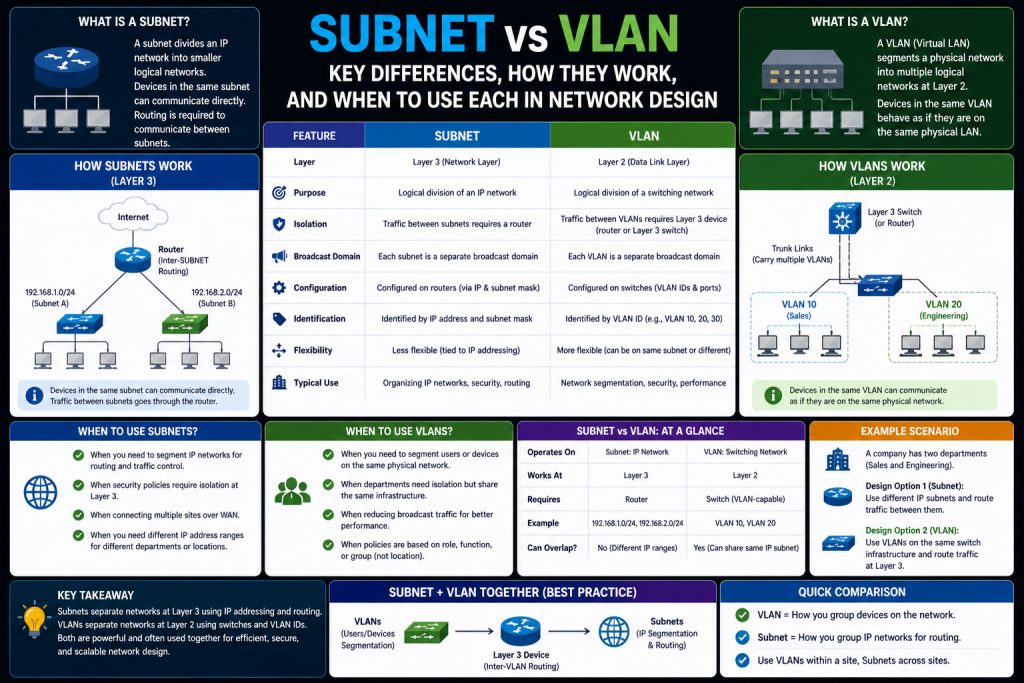
In modern networking, one of the most essential concepts for both beginners and experienced professionals is segmentation. As networks grow larger and more complex, administrators need ways to organize devices, improve performance, strengthen security, and simplify management. Two of the most common technologies used for this purpose are Virtual Local Area Networks (VLANs) and subnets.
At first glance, VLANs and subnets may appear similar because both divide larger networks into smaller, more manageable sections. This similarity often creates confusion, especially for students preparing for certifications such as CCNA, Network+, or other networking exams. However, despite their shared purpose of segmentation, VLANs and subnets function at entirely different layers of the OSI model and solve different types of networking challenges.
To truly understand the distinction, it is important to move beyond simplified definitions and explore how each technology operates, where it functions, and why it matters in real-world infrastructure. VLANs primarily manage broadcast domains at Layer 2, while subnets organize IP networks at Layer 3. These two concepts often work together, but they are not interchangeable.
Understanding how VLANs and subnets differ is critical because improper implementation can lead to security vulnerabilities, poor network performance, routing inefficiencies, and troubleshooting difficulties. Whether you are building a small office network, managing enterprise infrastructure, or studying network architecture, mastering these concepts forms a foundation for more advanced technologies.
This guide explores the OSI model, the role of Layer 2 and Layer 3, VLAN fundamentals, subnet fundamentals, and the practical reasons why these technologies remain essential in networking.
The OSI Model: Why Layers Matter
Before comparing VLANs and subnets, it is necessary to understand the framework in which they operate. The Open Systems Interconnection (OSI) model is a conceptual structure that explains how data moves through a network. It divides networking processes into seven layers, each with distinct responsibilities.
The seven layers are:
Application Layer (Layer 7)
Presentation Layer (Layer 6)
Session Layer (Layer 5)
Transport Layer (Layer 4)
Network Layer (Layer 3)
Data Link Layer (Layer 2)
Physical Layer (Layer 1)
Each layer serves a different purpose. Layer 1 handles physical transmission, such as cables, electrical signals, and wireless frequencies. Layer 2 manages device addressing within the same local network using MAC addresses. Layer 3 manages logical addressing and routing through IP addresses.
This layered model matters because VLANs and subnets operate at different points in the communication process. VLANs work at Layer 2, influencing how Ethernet frames move inside a local network. Subnets work at Layer 3, determining how IP packets are logically grouped and routed.
A useful way to visualize this is by thinking of a building:
Layer 1 is the hallways and wiring.
Layer 2 is the room organization on each floor.
Layer 3 is the postal address system that determines which building or department receives mail.
VLANs rearrange rooms and departments inside the building without physically moving walls. Subnets define addressing systems so communication reaches the correct section efficiently.
Without understanding this distinction, many beginners mistakenly believe VLANs and subnets perform the same function. In reality, one controls local segmentation, while the other controls logical IP organization.
What Is a VLAN? Logical Segmentation at Layer 2
A VLAN, or Virtual Local Area Network, is a method of dividing a physical switch infrastructure into multiple separate broadcast domains. In a traditional physical LAN, all devices connected to a switch may share the same broadcast traffic unless separated by routers or additional hardware. VLANs solve this by allowing a single switch to behave like multiple isolated switches.
This virtualization of network segments changed network design significantly. Before VLAN technology became common, organizations often needed separate physical switches for each department or security zone. VLANs eliminated much of that hardware burden.
For example, consider a company with three departments:
Accounting
Human Resources
Sales
Without VLANs, each department might require dedicated switching hardware to isolate traffic. With VLANs, one switch can logically separate each department into VLAN 10, VLAN 20, and VLAN 30.
Devices in VLAN 10 cannot directly communicate with VLAN 20 unless routing is specifically configured.
This creates several advantages:
Improved security through traffic isolation
Reduced broadcast traffic
Simplified network design
Lower hardware costs
Greater flexibility for organizational changes
A user in accounting on the first floor can belong to the same VLAN as another accounting user on the tenth floor, even if they connect through different switches. VLAN trunking allows these VLANs to span multiple switches while preserving segmentation.
VLAN identification is typically achieved using IEEE 802.1Q tagging, which inserts VLAN information into Ethernet frames. Switches use these tags to determine where traffic belongs.
This capability creates logical separation independent of physical location, which is one of the greatest strengths of VLAN design.
Broadcast Domains and VLAN Functionality
One of the primary purposes of VLANs is controlling broadcast domains.
In Ethernet networks, broadcast traffic is sent to all devices within the same broadcast domain. Examples include ARP requests, DHCP discovery, and certain service announcements. In a flat network with hundreds or thousands of devices, excessive broadcasts can consume bandwidth and reduce performance.
VLANs contain broadcast traffic within specific logical boundaries.
For example:
A broadcast sent by a device in VLAN 10 remains inside VLAN 10 unless forwarded by Layer 3 services.
This segmentation improves efficiency because devices in other VLANs are not forced to process irrelevant traffic.
Broadcast control becomes increasingly important as networks scale. In enterprise environments, reducing unnecessary broadcasts helps preserve switch resources, improve endpoint performance, and reduce congestion.
By segmenting departments, functions, or security zones into VLANs, administrators create cleaner traffic patterns.
Common VLAN types include:
Data VLANs for user devices
Voice VLANs for IP phones
Management VLANs for switch administration
Guest VLANs for visitor internet access
Native VLANs for trunk communication
Each serves a distinct operational purpose, allowing networks to maintain organization while enhancing security and performance.
Inter-VLAN Communication and Layer 3 Dependency
Although VLANs are highly effective for segmentation, they do not eliminate the need for routing.
A critical point that often confuses beginners is this:
Devices in different VLANs cannot communicate without Layer 3 intervention.
This means that even if two VLANs exist on the same physical switch, they remain isolated unless a router or Layer 3 switch performs inter-VLAN routing.
For instance:
VLAN 10: 192.168.10.0/24
VLAN 20: 192.168.20.0/24
A computer in VLAN 10 cannot reach VLAN 20 by default.
To enable communication, administrators configure:
Router-on-a-stick
Layer 3 switch interfaces (SVIs)
Dynamic routing protocols
This separation strengthens security by default. Sensitive departments can remain isolated unless explicit access rules are created.
This is why VLANs are often used alongside access control lists, firewall policies, and network segmentation strategies.
What Is a Subnet? Logical Segmentation at Layer 3
A subnet, short for subnetwork, is a logical subdivision of an IP network. Unlike VLANs, which separate traffic at the Ethernet frame level, subnets organize devices based on IP addressing.
Every IPv4 address contains two components:
Network portion
Host portion
Subnetting borrows bits from the host portion to create smaller networks.
For example:
192.168.1.0/24 allows 254 usable hosts.
If divided into two /25 subnets:
192.168.1.0/25
192.168.1.128/25
Each subnet now supports 126 usable hosts.
This process enables administrators to:
Conserve IP address space
Improve routing efficiency
Control network growth
Strengthen segmentation
Simplify troubleshooting
Subnetting is fundamental in IP design because routers depend on network boundaries to forward traffic correctly.
Without subnetting, organizations would face inefficient address allocation and oversized broadcast domains.
Subnet Masks and CIDR Notation
Subnetting relies heavily on subnet masks and CIDR notation.
A subnet mask identifies which portion of an IP address represents the network.
Examples:
255.255.255.0 = /24
255.255.255.128 = /25
255.255.255.192 = /26
CIDR notation simplifies mask representation by counting network bits.
For instance:
/24 = 24 network bits
/16 = 16 network bits
/30 = 30 network bits
Understanding CIDR is essential because modern networking relies on variable-length subnet masking for efficient address utilization.
Subnetting calculations involve:
Number of subnets
Hosts per subnet
Network addresses
Broadcast addresses
Usable host ranges
These calculations are especially important for certification exams and practical deployment.
Why Subnetting Matters in Real Networks
Subnetting is not merely an academic exercise. It directly affects real-world operations.
A single large network with thousands of devices creates problems:
Broadcast overload
Security limitations
Complex troubleshooting
Address exhaustion
Poor traffic management
Subnets solve these issues by dividing networks into structured units.
Examples include:
Separate subnet for servers
Separate subnet for wireless clients
Separate subnet for management interfaces
Separate subnet for branch offices
This organization allows routers and firewalls to apply policies more precisely.
For example:
10.1.10.0/24 = Finance
10.1.20.0/24 = HR
10.1.30.0/24 = IT
Traffic between these networks can be filtered, monitored, or prioritized.
VLANs and Subnets Together
In most enterprise environments, VLANs and subnets are used together.
A common design is:
One VLAN = One Subnet
For example:
VLAN 10 → 192.168.10.0/24
VLAN 20 → 192.168.20.0/24
VLAN 30 → 192.168.30.0/24
This alignment simplifies management because Layer 2 and Layer 3 boundaries match.
Benefits include:
Simpler troubleshooting
Predictable routing
Improved security
Cleaner documentation
Easier policy enforcement
However, while common, this is a design choice rather than a strict requirement.
Common Beginner Misunderstandings
Many new network professionals confuse VLANs and subnets because both divide networks.
Key clarification:
VLAN = Layer 2 segmentation
Subnet = Layer 3 segmentation
Another misunderstanding is assuming VLANs automatically provide routing. They do not.
Similarly, subnets alone do not isolate switch-level broadcast domains unless VLAN architecture supports that segmentation.
Recognizing where each operates helps avoid:
Misconfigured switches
Improper ACL placement
Routing failures
Security gaps
Deepening the Comparison Between VLANs and Subnets
Once the foundational concepts of VLANs and subnets are understood, the next step is examining how these technologies influence actual network behavior. While beginners often focus on the technical definitions—Layer 2 versus Layer 3—the real distinction becomes clearer when viewed through operational priorities such as security, performance, scalability, administration, and troubleshooting.
In enterprise networking, VLANs and subnets are not merely academic concepts. They are strategic design tools used to shape traffic flow, enforce organizational policy, support compliance requirements, and maintain network efficiency. A poorly segmented network can become vulnerable, congested, difficult to manage, and expensive to troubleshoot. A well-designed segmented network, by contrast, improves security posture, simplifies control, and enhances user experience.
Although VLANs and subnets often work together, they solve different categories of problems. VLANs primarily control local traffic separation inside switching infrastructure, while subnets govern logical IP design and packet routing across broader network boundaries.
To fully appreciate their roles, it is essential to explore how they affect security architecture, broadcast management, network performance, routing strategies, and organizational growth.
Security Benefits of VLANs
Security is one of the strongest reasons organizations implement VLANs. At the most basic level, VLANs isolate devices into separate Layer 2 environments. This isolation means devices in one VLAN cannot directly communicate with devices in another VLAN unless routing is intentionally configured.
This separation significantly reduces exposure.
For example, imagine a business with these groups:
Finance Department
Human Resources
Guest Wi-Fi Users
IP Security Cameras
Server Infrastructure
Without VLANs, all these devices might share the same switch broadcast domain. In such a scenario, a compromised guest device could potentially scan internal systems, intercept broadcast traffic, or exploit weak endpoints.
By creating separate VLANs:
VLAN 10 = Finance
VLAN 20 = HR
VLAN 30 = Guests
VLAN 40 = Security Systems
VLAN 50 = Servers
Traffic is logically isolated, making unauthorized lateral movement more difficult.
This segmentation supports the principle of least privilege by ensuring users and devices only access resources relevant to their role.
VLANs are especially useful for:
Guest isolation
Voice traffic separation
IoT containment
Payment card environments
Departmental segregation
Security zone architecture
For example, payment systems may require restricted communication under compliance frameworks. VLAN segmentation helps enforce these boundaries before traffic even reaches a firewall.
However, VLANs are not perfect security controls by themselves. VLAN hopping attacks, switch spoofing, and trunk misconfigurations can undermine segmentation if switch security practices are weak. Proper configurations such as disabling unused ports, changing native VLANs, and restricting trunk negotiation are essential.
Security Benefits of Subnets
Subnets contribute to security differently. Because subnets operate at Layer 3, they are primarily associated with routing control, policy enforcement, and access management through routers or Layer 3 switches.
Subnetting allows administrators to define logical address spaces that can be filtered with:
Access Control Lists (ACLs)
Firewalls
Security appliances
Monitoring systems
Traffic inspection platforms
For example:
10.10.10.0/24 = Finance
10.10.20.0/24 = HR
10.10.30.0/24 = Guest
A firewall can explicitly deny guest subnet access to finance subnet resources while allowing internet access.
This control is more granular than VLAN isolation alone because Layer 3 devices can inspect source and destination IPs, protocols, and ports.
Subnets are particularly valuable for:
Branch office separation
Data center zones
VPN design
WAN architecture
Cloud segmentation
Server access controls
If VLANs act like walls inside a building, subnets function more like controlled roads between districts.
Subnetting also improves visibility. Security teams can monitor traffic between subnets to detect unusual patterns, malware movement, or unauthorized communication attempts.
Still, subnetting alone does not inherently stop Layer 2 risks within a switch. If multiple sensitive devices share the same VLAN, they may remain exposed to local attacks.
Broadcast Domains vs Collision Domains
One of the most practical technical differences between VLANs and subnets involves broadcast domains.
A broadcast domain is a network segment where broadcast traffic reaches all devices.
Examples include:
ARP requests
DHCP discovery
Service advertisements
Broadcasts consume resources because every device in the domain must process them.
VLANs directly define broadcast domains.
Each VLAN is its own separate broadcast environment. If a device in VLAN 10 sends an ARP request, only VLAN 10 devices receive it.
This is extremely important because large flat networks can become inefficient. Hundreds or thousands of endpoints processing unnecessary broadcasts can reduce performance.
Subnets also influence broadcast behavior because IP broadcasts typically remain within subnet boundaries. However, Layer 2 VLAN architecture is what physically contains many local broadcasts.
This distinction matters:
VLAN = Immediate broadcast containment at switch level
Subnet = IP boundary for routing and logical segmentation
When VLAN and subnet boundaries align, broadcast control becomes cleaner and easier to manage.
Collision domains, historically relevant in hub environments, are less of a concern in switched networks because each switch port usually forms its own collision domain.
Performance Optimization Through VLANs
Beyond security, VLANs improve network performance by reducing unnecessary traffic and organizing communication patterns.
For example, if all accounting systems frequently communicate with accounting servers, placing them within the same VLAN minimizes excessive broadcast spread.
Benefits include:
Reduced broadcast overhead
Better bandwidth utilization
Lower endpoint processing
Improved local communication efficiency
Enhanced quality for latency-sensitive traffic
Voice VLANs are particularly important because IP telephony depends on predictable performance. Separating voice from data traffic allows prioritization through Quality of Service policies.
For example:
Voice VLAN = prioritized
Data VLAN = standard priority
This can reduce jitter and latency during calls.
VLANs also simplify traffic engineering in campus environments. Organizations can strategically separate workloads based on application type, department, or security requirement.
However, too many VLANs can create management complexity. Poor documentation, inconsistent naming, or excessive segmentation can produce confusion and operational burden.
Performance Optimization Through Subnetting
Subnetting improves performance primarily through routing efficiency and host limitation.
A large /16 network may contain over 65,000 addresses, creating major broadcast and management issues.
Breaking that into smaller /24 networks offers:
Smaller broadcast scope
Faster fault isolation
Reduced ARP traffic
Better route summarization
Improved IP utilization
Smaller subnets also help network administrators avoid overprovisioning.
For example:
A branch office with 30 devices does not need a /24 with 254 addresses. A /27 may be more appropriate.
Efficient subnetting preserves address space and improves administrative precision.
In larger infrastructures, subnet design influences routing table complexity. Hierarchical subnetting allows route summarization, which reduces router workload.
Example:
10.10.1.0/24
10.10.2.0/24
10.10.3.0/24
Can often be summarized as:
10.10.0.0/16
This simplification reduces routing overhead in large networks.
Inter-VLAN Routing and the Relationship Between VLANs and Subnets
One of the most important practical concepts is how VLANs and subnets interact when communication must occur between segments.
By default:
Different VLANs cannot communicate without Layer 3 routing.
This is where inter-VLAN routing becomes necessary.
Common methods include:
Router-on-a-Stick
Layer 3 Switch SVIs
Dedicated routers
Firewall routing
Router-on-a-Stick uses one physical router interface with multiple subinterfaces, each tagged for a VLAN.
Example:
Gig0/0.10 = VLAN 10
Gig0/0.20 = VLAN 20
This design is functional but can become a bottleneck.
Modern enterprise networks more commonly use Layer 3 switches, which route between VLANs internally at wire speed.
This is faster and more scalable.
In these cases, each VLAN often maps to its own subnet:
VLAN 10 → 192.168.10.0/24
VLAN 20 → 192.168.20.0/24
This relationship creates a predictable architecture.
Without subnet distinction, routing logic becomes far more complicated.
Administrative Flexibility and Organizational Design
VLANs provide exceptional flexibility because physical location no longer defines network membership.
For example:
A finance employee on floor 1
A finance employee on floor 8
Both can belong to the same VLAN despite different switch locations.
This simplifies moves, adds, and changes.
Subnets, on the other hand, provide scalable address planning.
For example:
Corporate HQ = 10.1.0.0/16
Branch A = 10.2.0.0/16
Branch B = 10.3.0.0/16
This hierarchical design improves WAN management and route predictability.
Together, VLANs and subnets support:
Campus networks
Healthcare systems
Universities
Retail chains
Government networks
Manufacturing plants
A university, for instance, may use VLANs for students, faculty, labs, and guest access while subnetting by building or campus.
Troubleshooting VLAN Problems
VLAN-related issues often involve Layer 2 configuration mistakes.
Common examples:
Incorrect VLAN assignment
Trunk port misconfiguration
Native VLAN mismatch
Disabled ports
Missing VLAN database entries
VLAN pruning errors
Symptoms may include:
No connectivity inside expected group
Intermittent communication
Broadcast leakage
Voice failures
Troubleshooting often begins with:
Switchport mode
VLAN membership
802.1Q trunk status
MAC address table review
Because VLANs operate below IP, Layer 3 tools alone may not identify the issue.
Troubleshooting Subnet Problems
Subnet issues are usually tied to Layer 3 logic.
Common examples:
Incorrect subnet mask
Wrong default gateway
Overlapping subnets
Duplicate IPs
Routing table errors
CIDR mistakes
Symptoms include:
Can ping local devices but not remote
Can reach internet but not internal servers
Asymmetric routing
Address exhaustion
Subnet troubleshooting typically uses:
IP configuration checks
Traceroute
Routing table analysis
Gateway verification
ACL review
Understanding binary and subnet masks remains essential here.
Common Design Mistakes
Several mistakes appear repeatedly in new network designs:
Using one large flat VLAN for everything
Ignoring subnet growth needs
Misaligning VLANs and subnets
Overcomplicating segmentation
Poor naming conventions
Lack of documentation
Forgetting inter-VLAN security policies
For example, placing finance and guest devices in separate VLANs but allowing unrestricted routing between them defeats much of the security benefit.
Similarly, creating dozens of tiny subnets without strategic planning can complicate management unnecessarily.
Good design balances segmentation with operational simplicity.
Why Certifications Emphasize VLANs and Subnets
Networking certifications consistently emphasize these concepts because they are foundational.
Students must understand:
VLAN tagging
Trunking
Access ports
Subnet masks
CIDR
Default gateways
Routing
Broadcast domains
These are not isolated exam topics—they are practical daily networking skills.
Whether deploying cloud-connected offices, enterprise campuses, or branch infrastructures, VLAN and subnet design remains central.
Why VLAN and Subnet Design Shapes Modern Networks
Understanding the technical definitions of VLANs and subnets is only the beginning. In real-world environments, the effectiveness of a network depends less on knowing what these technologies are and more on knowing how to design, implement, secure, and maintain them strategically.
In production networks, VLANs and subnets are rarely deployed in isolation. They are integrated into broader architectures involving routing protocols, firewalls, wireless systems, virtualization platforms, cloud environments, compliance policies, and business continuity planning. Decisions about segmentation affect not only traffic flow but also operational efficiency, cybersecurity posture, troubleshooting speed, future scalability, and even regulatory compliance.
A small business with one office may only need a few VLANs and subnets, while a multinational enterprise may require hundreds or thousands. In both cases, the same core principles apply: organize traffic intelligently, isolate risk, preserve performance, and create predictable infrastructure.
This section focuses on how VLANs and subnets are used in practical deployment, common mistakes organizations make, advanced architectural considerations, and why mastering these concepts is critical for long-term networking success.
Building a Practical VLAN Strategy
When implementing VLANs, the first major question is not technical—it is organizational.
Administrators must decide how to segment users, systems, and services in ways that reflect both operational needs and security priorities.
Common VLAN design strategies include:
Department-based VLANs
Function-based VLANs
Security-based VLANs
Location-based VLANs
Application-based VLANs
Department-Based Design
A common beginner approach is assigning VLANs by department:
VLAN 10 = Finance
VLAN 20 = HR
VLAN 30 = Sales
VLAN 40 = IT
This is intuitive and easy to understand. It supports policy separation and aligns with organizational structure.
However, this design may become inefficient if departments span multiple buildings, security requirements vary inside departments, or workloads diversify.
Function-Based Design
A more scalable strategy often focuses on device function:
VLAN 10 = User Devices
VLAN 20 = Voice
VLAN 30 = Servers
VLAN 40 = Printers
VLAN 50 = Wireless Guests
VLAN 60 = IoT Devices
This model often improves standardization and security.
For example, all printers may share similar communication needs regardless of department. Grouping them functionally simplifies policy enforcement.
Security-Based Design
High-security environments often segment by trust level:
Trusted Internal Systems
Restricted Internal Systems
Public Access
Management Infrastructure
Compliance Systems
This approach is common in healthcare, finance, and government sectors.
The most effective VLAN strategy depends on balancing:
Security
Performance
Administrative simplicity
Growth potential
Compliance obligations
Developing a Scalable Subnetting Plan
Just as VLANs require strategic segmentation, subnetting demands long-term planning.
A poor subnetting plan can create:
Address exhaustion
Overlapping networks
Difficult mergers
Complex routing
Troubleshooting challenges
Good subnetting is hierarchical and scalable.
Example of Structured Enterprise Addressing:
10.1.0.0/16 = Headquarters
10.2.0.0/16 = Regional Office A
10.3.0.0/16 = Regional Office B
Within Headquarters:
10.1.10.0/24 = User Devices
10.1.20.0/24 = Voice
10.1.30.0/24 = Servers
This layered approach offers several benefits:
Predictable design
Route summarization
Simplified troubleshooting
Easier expansion
Reduced routing complexity
Subnetting should also account for future growth. If a site currently has 100 users but may grow to 400, assigning only a /25 may create unnecessary readdressing later.
Strategic subnet planning means designing for tomorrow, not just today.
The One VLAN to One Subnet Model
One of the most common and practical enterprise standards is mapping one VLAN to one subnet.
Example:
VLAN 10 → 192.168.10.0/24
VLAN 20 → 192.168.20.0/24
VLAN 30 → 192.168.30.0/24
This model simplifies:
DHCP scope design
Routing
Access policies
Monitoring
Documentation
Troubleshooting
When a device has an IP in 192.168.20.0/24, administrators immediately know it belongs to VLAN 20.
This clarity becomes invaluable in larger infrastructures.
Although more complex mappings are technically possible, unnecessary deviation from one-to-one alignment often increases confusion.
Inter-VLAN Routing in Enterprise Networks
As organizations grow, segmentation alone is not enough. Departments and systems often need controlled communication.
Examples include:
Users accessing servers
HR accessing payroll systems
Wireless clients accessing internet only
Guests denied internal resources
This is where inter-VLAN routing becomes a central architectural component.
Router-on-a-Stick
This method uses one router interface with multiple VLAN-tagged subinterfaces.
Advantages:
Simple for small networks
Cost-effective
Easy to understand
Disadvantages:
Performance bottleneck
Single point of failure
Limited scalability
Layer 3 Switching
Modern enterprises often use multilayer switches.
Advantages:
High-speed internal routing
Reduced bottlenecks
Scalable design
Integrated ACLs
Disadvantages:
Higher cost
Greater complexity
Layer 3 switching has become standard in medium-to-large enterprise networks because it supports fast internal communication while preserving segmentation.
Wireless Networks, VLANs, and Subnets
Wireless infrastructure has significantly expanded the practical importance of segmentation.
Modern wireless networks commonly use multiple SSIDs mapped to VLANs:
Corporate Wi-Fi → VLAN 10
Guest Wi-Fi → VLAN 20
IoT Wi-Fi → VLAN 30
This structure keeps guest users isolated while preserving internal resources.
For example:
Guest users may access only internet
Corporate users access internal systems
IoT devices communicate only with management servers
Without VLAN and subnet separation, wireless environments can become major security liabilities.
Voice Networks and Specialized VLANs
Voice traffic introduces unique performance demands.
IP phones require:
Low latency
Low jitter
Reliable QoS
Voice VLANs separate voice packets from general data traffic.
Benefits include:
Traffic prioritization
Better call quality
Simpler management
Enhanced security
For example:
Data VLAN = Standard
Voice VLAN = Priority Queue
Without this separation, large file transfers or heavy application traffic could degrade call quality.
Cloud, Virtualization, and Software-Defined Networking
Although VLANs and traditional subnetting began in physical networks, they remain highly relevant in virtualized and cloud environments.
Virtualization
Hypervisors often use VLAN tagging to separate:
Production VMs
Development VMs
Management traffic
Storage traffic
Cloud Platforms
Cloud providers rely on subnetting concepts extensively:
Public Subnets
Private Subnets
Management Networks
Security Zones
Even in software-defined architectures, segmentation principles remain unchanged:
Separate workloads
Control communication
Minimize exposure
Technologies evolve, but segmentation remains fundamental.
Common Deployment Mistakes
Even experienced teams can create avoidable problems.
Over-Segmentation
Too many VLANs or tiny subnets may create:
Administrative burden
Complex ACLs
Documentation failures
Operational confusion
Under-Segmentation
Too few VLANs may create:
Security risk
Broadcast overload
Compliance issues
Lateral movement opportunities
Poor Naming Conventions
VLAN 2, VLAN 3, VLAN 4 tells administrators little.
Better examples:
VLAN 10-FINANCE
VLAN 20-HR
VLAN 30-GUEST
Ignoring Security on Trunks
Trunk misconfigurations can expose multiple VLANs.
Overlapping IP Space
Mergers, acquisitions, or poor planning can create duplicate subnets, complicating VPNs and routing.
Troubleshooting at Scale
In large environments, troubleshooting often begins by determining whether an issue is:
Layer 1
Layer 2
Layer 3
VLAN Indicators
Incorrect switchport
Missing VLAN
Trunk issue
MAC learning failure
Subnet Indicators
Wrong gateway
Incorrect mask
ACL block
Routing error
Professionals who quickly identify the relevant OSI layer solve problems faster.
This is why understanding VLANs and subnets conceptually is more valuable than memorization alone.
Compliance and Regulatory Considerations
Industries such as healthcare, finance, and government often require segmentation for regulatory reasons.
Examples include:
Payment card systems
Medical records
Research environments
Public access systems
Segmentation helps support:
Least privilege
Audit boundaries
Traffic logging
Threat containment
In these environments, segmentation is often mandatory rather than optional.
Career Relevance for Networking Professionals
VLANs and subnets are among the most career-critical networking concepts because they appear in:
CCNA
Network+
Security+
CCNP
Cloud certifications
Cybersecurity roles
Professionals use these concepts in:
Network engineering
Cloud architecture
Security operations
Wireless deployment
Data center design
Systems administration
Mastery signals more than exam readiness—it demonstrates infrastructure thinking.
Best Practices for Long-Term Success
Effective segmentation design usually follows several principles:
Plan for growth
Align VLANs and subnets logically
Document everything
Use consistent naming
Secure trunks
Implement ACLs
Avoid unnecessary complexity
Review regularly
Test failover
Audit periodically
Network design should evolve alongside business needs.
A startup may begin with:
Users
Servers
Guests
An enterprise may later require:
Compliance
Voice
IoT
Cloud
Branch offices
Third-party contractors
Design flexibility matters.
The Strategic Relationship Between VLANs and Subnets
The most important takeaway is that VLANs and subnets are not competing technologies—they are complementary architectural tools that solve different layers of networking challenges while working best when designed together with intention.
VLANs answer a Layer 2 question:
Who shares this local network space?
They define which devices belong to the same broadcast domain, determine how Ethernet frames are segmented, and control how local traffic is grouped within switching infrastructure. VLANs help organize users, systems, and services into logical communities regardless of physical location, improving security boundaries, traffic efficiency, and administrative flexibility.
Subnets answer a Layer 3 question:
How is this IP space organized and routed?
They determine how IP addresses are structured, how hosts are logically grouped, how traffic moves between networks, and how routers make forwarding decisions. Subnetting shapes scalability, supports route optimization, preserves address space, and creates manageable network hierarchies.
Together, VLANs and subnets answer a broader strategic question:
How should communication be structured securely, efficiently, and predictably across the organization?
This combined approach allows administrators to create environments where local traffic is properly segmented at the switch level while routing, policy enforcement, and access control are managed at the IP level. In practice, this means a business can isolate departments, secure sensitive systems, reduce unnecessary broadcasts, simplify troubleshooting, and scale infrastructure without sacrificing performance.
A VLAN without proper subnet planning can become operationally messy. Devices may be separated at Layer 2, but poor IP design can create overlapping ranges, routing confusion, difficult policy management, or long-term scalability issues. Without thoughtful subnet structure, logical separation may exist physically but remain inefficient administratively.
A subnet without VLAN support can expose local traffic unnecessarily. While IP boundaries may exist, devices sharing the same switching environment could still face excessive broadcasts, weaker isolation, or increased risk from local Layer 2 attacks. This can reduce the effectiveness of segmentation, especially in environments with security-sensitive workloads.
When VLANs and subnets are aligned intentionally—often through a one VLAN to one subnet model—network operations become significantly cleaner. Administrators can identify device roles faster, apply policies more accurately, troubleshoot with greater precision, and expand infrastructure more confidently.
For example:
Finance VLAN + Finance Subnet
Guest VLAN + Guest Subnet
Voice VLAN + Voice Subnet
Server VLAN + Server Subnet
This alignment creates clarity across switching, routing, DHCP, firewalling, monitoring, and documentation.
The strongest architectures combine both deliberately because modern networking demands layered design. Security is stronger when segmentation occurs at multiple levels. Performance improves when broadcast traffic is controlled locally and routing paths are optimized logically. Compliance becomes easier when boundaries are visible and enforceable. Troubleshooting becomes faster when administrators can immediately recognize both physical and logical placement.
In advanced enterprise environments, this layered segmentation also supports:
Zero-trust principles
Micro-segmentation strategies
Regulatory compliance
Branch scalability
Cloud integration
Wireless isolation
Voice prioritization
IoT containment
Ultimately, VLANs and subnets represent two sides of intelligent network architecture. One structures local communication, the other structures logical communication. One controls proximity, the other controls reachability.
When organizations understand and apply both effectively, they move beyond simply building networks that function—they build networks that are resilient, secure, scalable, and strategically engineered for long-term success.
Conclusion
VLANs and subnets are foundational technologies that extend far beyond textbook definitions. They are core architectural tools that shape how modern networks perform, scale, and defend themselves.
VLANs provide Layer 2 segmentation by creating isolated broadcast domains, improving local security, and enhancing traffic organization across switching environments.
Subnets provide Layer 3 segmentation by structuring IP address allocation, supporting routing efficiency, simplifying administration, and enabling long-term scalability.
When strategically combined, these technologies create networks that are more secure, more manageable, and more adaptable to changing business requirements.
From small business deployments to enterprise campuses, from cloud networks to virtualized systems, the principles of segmentation remain central to infrastructure success.
For aspiring networking professionals, learning the difference between VLANs and subnets is not simply about passing certification exams—it is about developing the architectural mindset required to design systems that are resilient, scalable, and secure.
In the end, successful networking is not just about connecting devices. It is about connecting them intelligently, safely, and strategically.
Continue exploring the technologies and certification concepts that matter most to you.