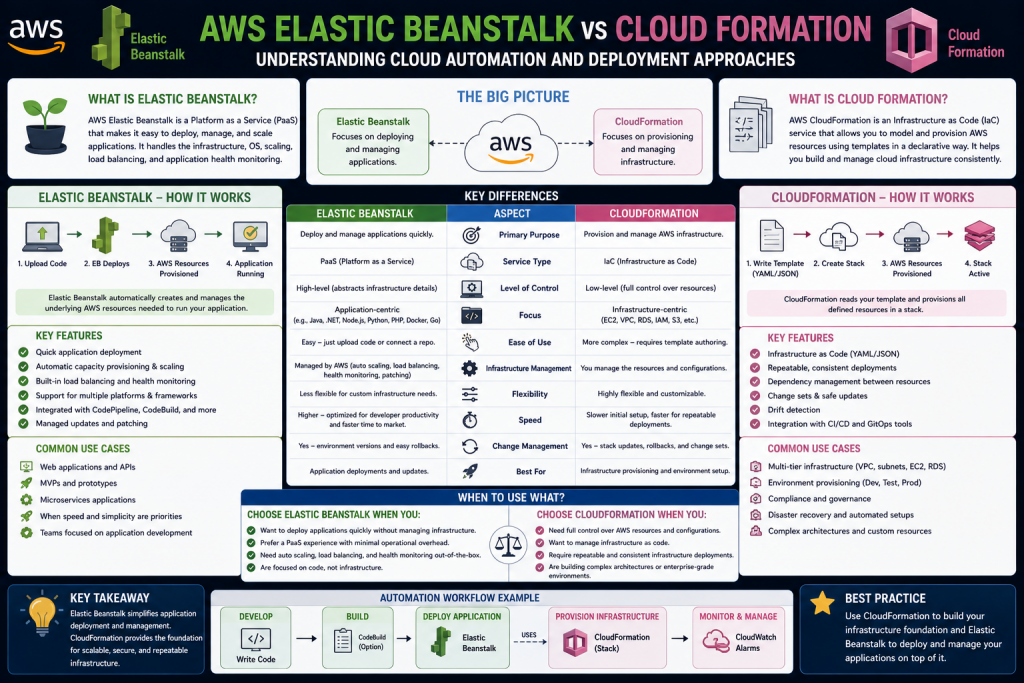
Cloud computing has transformed the way organizations design, deploy, and manage applications. Instead of relying on physical servers and manual configurations, businesses now use cloud platforms to build flexible, scalable, and highly available systems. However, as systems grow in size and complexity, managing infrastructure manually becomes inefficient and error-prone. This challenge has led to the rise of automation in cloud environments.
Automation in the cloud refers to the ability to create, configure, deploy, and manage resources without continuous human intervention. It allows organizations to reduce repetitive tasks, improve consistency, and accelerate deployment cycles. In traditional IT environments, setting up infrastructure often involves multiple manual steps such as provisioning servers, configuring networks, installing software, and managing security settings. These steps were time-consuming and difficult to replicate consistently across environments.
With cloud automation, these processes can be standardized and repeated reliably. This not only improves efficiency but also reduces the chances of configuration errors. As a result, development teams can focus more on building applications rather than managing infrastructure.
Modern cloud automation is closely tied to DevOps practices, which emphasize collaboration between development and operations teams. DevOps promotes continuous integration, continuous delivery, and infrastructure as code. These principles encourage teams to treat infrastructure in the same way they treat application code—something that can be written, tested, versioned, and deployed systematically.
Within this ecosystem, AWS provides multiple services that support automation at different levels. Some services focus on monitoring and logging, while others handle deployment and infrastructure management. Among these, AWS Elastic Beanstalk and AWS CloudFormation stand out as two widely used solutions that simplify cloud operations, but in very different ways.
Understanding the Role of AWS Elastic Beanstalk in Application Deployment
AWS Elastic Beanstalk is designed to simplify the process of deploying and managing applications in the cloud. It provides an environment where developers can upload their code, and the platform automatically handles the underlying infrastructure setup. This includes provisioning compute resources, configuring load balancing, managing scaling, and monitoring application health.
The main idea behind Elastic Beanstalk is abstraction. Instead of requiring users to manually configure servers, networks, and storage, it hides these complexities behind a managed service. Developers simply focus on writing code, while AWS takes responsibility for running the application in a scalable and reliable environment.
Elastic Beanstalk supports a wide range of programming languages and frameworks. This includes Java, Python, PHP, Node.js, Ruby, .NET, Go, and Docker-based applications. This flexibility allows teams from different technology backgrounds to use the same deployment platform without changing their development stack.
When an application is deployed using Elastic Beanstalk, the service automatically creates an environment that includes all necessary resources. These resources typically include virtual servers for running the application, networking configurations for communication, and load balancing components for distributing traffic. The system also sets up monitoring tools to track performance and detect issues.
One of the most important features of Elastic Beanstalk is automatic scaling. As user demand increases, the platform can add more computing resources to handle additional load. When demand decreases, it can reduce resources to optimize cost. This dynamic scaling ensures that applications remain responsive while avoiding unnecessary expenses.
Another important capability is health monitoring. Elastic Beanstalk continuously checks the status of application instances. If an instance becomes unhealthy or stops responding, it can automatically replace it with a new one. This helps maintain high availability without manual intervention.
How Elastic Beanstalk Simplifies Infrastructure Management
Elastic Beanstalk is often described as a Platform-as-a-Service solution because it sits between raw infrastructure and fully managed application hosting. It provides just enough control for developers to customize their environment while still handling most of the operational complexity.
The deployment process is straightforward. A developer selects a platform that matches the application technology, uploads the application code, and configures basic settings such as environment type and scaling preferences. Once this is done, Elastic Beanstalk takes over and provisions the necessary infrastructure. It automatically handles configuration, deployment steps, and runtime setup in the background, ensuring that the application is launched in a fully functional environment without requiring manual server management. This includes creating computer instances, setting up networking, attaching load balancers, and installing required runtime dependencies based on the selected platform.
In addition, Elastic Beanstalk continuously monitors the deployd application to ensure it remains healthy and responsive. If any component fails or beceomes unstable, the service can automatically replace or repair it without interrupting the overall application availability. It also manages scaling based on incoming traffic, meaning resources are increased or decreased automatically depending on demand. This helps maintain performance while controlling costs. Developers do not need to manually intervene in most operational tasks, which significantly reduces workload. The system also supports logging and monitoring integration, allowing teams to track performance metrics and troubleshoot issues when needed. Overall, this streamlined deployment process allows teams to focus primarily on development rather than infrastructure management.
Behind the scenes, it creates computer instances, configures networking rules, sets up load balancing, and installs required runtime environments. It also integrates logging and monitoring tools to provide visibility into application performance.
This abstraction allows development teams to deploy applications quickly without needing deep knowledge of cloud infrastructure. It reduces the learning curve and speeds up development cycles.
Elastic Beanstalk also provides flexibility in configuration. While it automates infrastructure setup, users can still modify underlying resources if needed. This includes adjusting instance types, configuring database connections, and customizing scaling rules.
Benefits of Using AWS Elastic Beanstalk
One of the main advantages of Elastic Beanstalk is simplicity. It significantly reduces the complexity involved in deploying applications to the cloud. Developers do not need to manually configure servers or networking components, which saves time and reduces operational overhead.
Another key benefit is speed. Applications can be deployed in minutes rather than hours or days. This rapid deployment capability is especially valuable in agile development environments where frequent updates and iterations are required.
Elastic Beanstalk also improves consistency. Since the platform automatically manages infrastructure, environments are less likely to differ from one another. This reduces issues caused by configuration drift, where different environments behave differently due to manual changes.
Scalability is another important benefit. The platform automatically adjusts resources based on traffic demand, ensuring that applications remain stable during usage spikes. This removes the need for manual scaling decisions and allows systems to handle unpredictable workloads.
Additionally, Elastic Beanstalk integrates with other AWS services. It can work alongside monitoring tools, storage systems, and security services to create a more complete cloud solution.
Limitations and Considerations of Elastic Beanstalk
Despite its advantages, Elastic Beanstalk is not suitable for every use case. Because it abstracts infrastructure management, it limits direct control over underlying resources. This can be a disadvantage for organizations that require highly customized environments or fine-grained control over every component.
Another limitation is flexibility. While it supports many configuration options, it still follows predefined patterns for infrastructure setup. Complex architectures that require custom networking or advanced deployment strategies may not fit well within its framework.
In addition, although it reduces operational complexity, it does not eliminate the need for infrastructure understanding. Developers still need to understand how scaling, load balancing, and compute resources work in order to configure environments effectively.
For highly advanced cloud architectures, teams may eventually outgrow Elastic Beanstalk and move toward more flexible infrastructure management solutions.
Real-World Use Cases of Elastic Beanstalk
Elastic Beanstalk is commonly used for web application deployment. It is well-suited for startups and development teams that need to launch applications quickly without investing time in infrastructure setup.
It is also used for API backends that require automatic scaling based on user traffic. Since it handles load balancing and instance management automatically, it ensures consistent performance even during traffic fluctuations.
Another common use case is application prototyping. Developers can quickly build and test ideas without worrying about infrastructure configuration. This allows faster experimentation and innovation.
It is also useful for migrating existing applications into the cloud. Instead of redesigning architecture from scratch, teams can deploy applications in a managed environment with minimal changes.
Introduction to AWS Cloud Automation Evolution
While Elastic Beanstalk focuses on simplifying application deployment, cloud environments often require a deeper level of control over infrastructure itself. As systems grow larger, organizations need the ability to design and manage entire architectures in a structured and repeatable way. This requirement leads to infrastructure automation approaches that go beyond application hosting.
In many enterprise environments, infrastructure is not just a collection of servers but a complex system of interconnected components. These include networking layers, security configurations, storage systems, and compute resources. Managing these manually becomes increasingly difficult as complexity increases.
To address this, infrastructure automation tools allow engineers to define entire environments in a structured format. Instead of clicking through interfaces or manually configuring systems, infrastructure can be described in code and deployed automatically. This approach improves consistency, scalability, and maintainability.
AWS CloudFormation represents this deeper level of automation, where infrastructure is treated as code rather than a set of manually managed resources.
Introduction to Cloud Infrastructure Complexity
Cloud computing has fundamentally changed how modern applications are built, deployed, and maintained. Instead of relying on fixed physical servers, organizations now operate in flexible environments where resources can be created and removed dynamically. This flexibility brings significant advantages, but it also introduces complexity. As systems scale, managing infrastructure manually becomes increasingly difficult and inefficient.
Every application in the cloud requires multiple components working together. These include compute resources, storage systems, networking configurations, security rules, monitoring tools, and scaling mechanisms. When these components are configured manually, even small mistakes can lead to performance issues or system failures. Additionally, maintaining consistency across multiple environments becomes challenging when infrastructure is built separately each time.
To address these challenges, automation has become a central part of cloud architecture. Automation ensures that systems can be deployed repeatedly in a predictable manner without requiring manual intervention. It also reduces operational overhead and improves reliability.
AWS provides multiple automation tools, each designed for different levels of abstraction. Some tools focus on simplifying application deployment, while others focus on giving complete control over infrastructure design. AWS CloudFormation belongs to the second category, enabling users to define entire cloud environments using code.
Understanding Infrastructure as Code in AWS
Infrastructure as code is a method of managing and provisioning cloud resources using structured definitions instead of manual processes. In this approach, infrastructure is described in a file that defines what resources should exist and how they should be configured. This file acts as a single source of truth for the entire environment, ensuring that every deployment follows the same structure without variation. Instead of relying on manual clicks or repeated configuration steps, engineers can automate the creation of complete systems in a consistent and repeatable way. This approach also reduces the chances of human error, which is common in manual setups where small misconfigurations can lead to major system issues.
Infrastructure as code also improves collaboration between development and operations teams because both groups can work from the same definitions. Changes to infrastructure can be reviewed, tested, and approved before deployment, just like application code. This makes the entire process more structured and reliable. It also supports scalability, since the same configuration file can be used to create multiple environments across different regions or accounts. Over time, this approach helps organizations build more stable, predictable, and maintainable cloud systems while reducing operational overhead and improving deployment efficiency.
This file acts as a blueprint for the entire system. Once it is executed, the cloud environment is created automatically according to the defined specifications. This ensures that infrastructure is consistent every time it is deployed.
AWS CloudFormation is built entirely on this concept. It allows users to write templates that describe complete environments, including servers, databases, networks, and security configurations. These templates are then used to automatically provision infrastructure.
The main advantage of this approach is repeatability. The same template can be used to create identical environments across different regions or accounts. This eliminates inconsistencies that often occur when environments are created manually.
How AWS CloudFormation Creates Infrastructure
CloudFormation operates by interpreting templates that define infrastructure components. These templates describe resources and their relationships within a system.
When a template is deployed, CloudFormation reads all resource definitions and identifies dependencies between them. It ensures that resources are created in the correct order based on these relationships. For example, networking components are created before compute resources that depend on them.
This dependency management is one of the most important features of CloudFormation because it removes the need for manual sequencing during infrastructure setup. In large cloud environments, many resources depend on each other, such as virtual networks, security groups, databases, and application servers. If these components are not created in the correct order, deployment failures can occur or systems may not function properly.
CloudFormation automatically analyzes these relationships and builds a dependency graph to determine the correct provisioning sequence. It also handles complex scenarios where multiple resources depend on the same component or where indirect dependencies exist between services. This ensures that infrastructure is always created in a stable and predictable way. In addition, it reduces human error and simplifies the deployment process for engineers. Instead of worrying about which resource should be created first, teams can focus on designing the architecture while CloudFormation handles execution order automatically, improving reliability and efficiency in cloud deployments.
Once the template is processed, CloudFormation creates a stack. A stack represents a complete infrastructure environment built from the template. It includes all defined resources configured and connected according to the design.
This stack becomes a single manageable unit. Instead of handling individual resources separately, engineers manage the entire environment as one system. This simplifies large-scale infrastructure management and improves operational efficiency.
Managing Infrastructure Changes Over Time
CloudFormation is not only used for creating infrastructure but also for managing changes. Infrastructure often evolves as applications grow and requirements change.
When a template is updated, CloudFormation compares the new version with the existing stack. It identifies differences and applies only the necessary changes. This ensures that updates are efficient and controlled.
This process reduces the risk of downtime because only modified components are updated. Unchanged resources remain unaffected, which helps maintain system stability.
If an update fails, CloudFormation can automatically roll back the infrastructure to its previous stable state. This rollback mechanism is essential for maintaining reliability in production systems.
It ensures that partially applied changes do not disrupt system functionality.
Infrastructure Lifecycle Management in CloudFormation
CloudFormation manages infrastructure throughout its entire lifecycle. This includes creation, modification, and deletion of resources.
During creation, all resources defined in the template are provisioned automatically. During updates, only the necessary components are modified. During deletion, all resources associated with a stack are removed.
This lifecycle approach ensures that environments remain clean and organized. It prevents unused resources from accumulating, which can reduce costs and improve resource efficiency.
Lifecycle management also simplifies environment management in large systems where multiple deployments exist simultaneously.
Ensuring Environment Consistency Across Deployments
One of the biggest challenges in cloud computing is maintaining consistency across environments. In many organizations, development, testing, and production environments are created separately, which often leads to inconsistencies.
Even small differences in configuration can lead to unexpected behavior during deployment. An application that works in one environment may fail in another due to mismatched settings.
CloudFormation solves this problem by allowing the same template to be used for all environments. This ensures that every environment is identical in structure and configuration.
This consistency improves reliability and reduces debugging complexity because environments behave the same way across all stages of development.
Version Control and Infrastructure Management Practices
CloudFormation integrates with version control systems, allowing infrastructure to be managed like software code. Templates can be stored in repositories, tracked over time, and updated through controlled processes. This integration brings strong discipline to infrastructure management because every change becomes visible, reviewable, and reversible. Teams can collaborate on infrastructure design in the same way they collaborate on application development, using structured workflows such as code reviews and approval processes. This reduces the risk of misconfiguration and ensures that infrastructure changes are properly validated before deployment.
It also improves traceability, as every modification in a template can be linked to a specific requirement, bug fix, or feature update. Over time, this creates a complete history of how the infrastructure evolved. If an issue occurs, teams can quickly identify which change caused it and revert to a stable version.
Version control also enables branching strategies, allowing different infrastructure variations to be tested safely before being merged into production. This is especially useful in large organizations where multiple teams work on shared environments. Overall, this approach makes infrastructure more reliable, maintainable, and aligned with modern DevOps practices.
This provides a complete history of infrastructure changes. Every modification is recorded, making it easier to understand how systems have evolved.
Version control also improves collaboration. Multiple engineers can work on infrastructure definitions while maintaining control over changes through review processes.
If a new configuration introduces issues, teams can revert to a previous version of the template. This ensures fast recovery and minimizes downtime.
Version control also helps standardize infrastructure across projects and teams, ensuring consistency across the organization.
Flexibility in Infrastructure Design with CloudFormation
CloudFormation provides deep flexibility in designing cloud systems. It allows users to define every component of an infrastructure, including compute, networking, storage, and security.
This level of control is essential for complex systems that require custom architectures. Many enterprise applications cannot rely on simplified deployment tools because they need precise configurations.
CloudFormation allows engineers to design systems exactly as required without limitations. It supports advanced architectures and multi service integrations.
It also supports modular design, allowing infrastructure to be broken into reusable components. These components can be combined to build larger systems, improving maintainability.
This flexibility makes CloudFormation suitable for advanced cloud environments.
Scalability Through Infrastructure Definition
CloudFormation does not directly handle runtime scaling. Instead, it defines the infrastructure that enables scaling.
For example, it can create auto scaling groups and load balancers that support dynamic resource adjustment. However, scaling decisions are executed by these underlying services.
This approach separates infrastructure design from runtime behavior. CloudFormation ensures that systems are built in a way that supports scalability from the beginning.
This makes it suitable for applications that require long term scalability planning.
Complexity and Technical Requirements
CloudFormation is a powerful tool, but it requires technical expertise. Users must understand AWS services and how they interact with each other.
Templates must define relationships between multiple resources. This requires careful planning and system design knowledge.
Unlike simplified tools, CloudFormation does not abstract infrastructure complexity. It exposes all configuration details, which increases the learning curve.
As systems grow, templates can become complex and require proper structuring to maintain readability.
Despite this complexity, CloudFormation is widely used in enterprise environments due to its flexibility and control.
Real World Applications of CloudFormation
CloudFormation is widely used in enterprise environments where infrastructure is complex and requires structured management.
It is commonly used to build multi tier architectures where multiple services must work together in a coordinated system.
It is also used in DevOps pipelines to automate infrastructure provisioning as part of continuous integration and deployment processes.
Another important use case is disaster recovery. Entire environments can be recreated in different regions using templates, ensuring business continuity.
CloudFormation is also used for environment replication, allowing development and testing environments to mirror production systems exactly.
This improves testing accuracy and reduces deployment risks.
Security and Governance Advantages
CloudFormation improves security by allowing standardized configurations across all environments.
Security rules such as encryption, access control, and network restrictions can be defined within templates.
This ensures that security policies are consistently applied across systems.
It also improves auditing because all changes are tracked and documented.
Security becomes an integral part of infrastructure design rather than an external process.
Operational Efficiency Through Automation
CloudFormation improves operational efficiency by automating infrastructure provisioning.
Once templates are created, environments can be deployed repeatedly without manual intervention.
This reduces deployment time and minimizes human error.
It also allows teams to quickly create new environments as needed.
Automation reduces operational workload and improves overall productivity.
Difference Between Application and Infrastructure Automation
Elastic Beanstalk and CloudFormation represent two different layers of cloud automation.
Elastic Beanstalk focuses on application deployment and simplifies infrastructure management automatically.
CloudFormation focuses on infrastructure design and provides full control over system architecture.
Elastic Beanstalk is best for simplicity and speed, while CloudFormation is best for flexibility and control.
Both tools serve important roles depending on system requirements.
Final Understanding of CloudFormation Role in AWS
CloudFormation is a core service for infrastructure automation in AWS. It allows organizations to define entire environments using code, ensuring consistency, scalability, and reliability.
Although it requires more technical expertise than simplified deployment tools, it provides unmatched control over cloud architecture.
It is best suited for complex systems where infrastructure must be carefully designed and managed across multiple environments.
Through infrastructure as code, CloudFormation enables organizations to build scalable and maintainable cloud systems that can evolve safely over time.
Introduction to Choosing the Right AWS Automation Approach
Modern cloud systems depend heavily on automation, but not all automation tools serve the same purpose. Some tools are designed to simplify application deployment, while others are designed to provide full control over infrastructure architecture. AWS Elastic Beanstalk and AWS CloudFormation represent two different philosophies of cloud automation. This difference becomes important when organizations decide how much control they want over their cloud environment versus how much simplicity they need in day-to-day operations.
Elastic Beanstalk focuses on abstracting infrastructure complexity so developers can deploy applications quickly without worrying about servers, networking, or scaling configurations. It automates most operational tasks in the background, making it ideal for fast development cycles and straightforward application hosting.
On the other hand, CloudFormation is built for structured infrastructure design where every component is explicitly defined and managed through code. It allows teams to create reproducible environments with full visibility into resources and dependencies. This makes it suitable for large-scale systems, enterprise architectures, and environments where consistency and governance are critical. The choice between these tools depends on whether the priority is speed and simplicity or control and precision in infrastructure management.
Elastic Beanstalk focuses on ease of use. It allows developers to deploy applications quickly without dealing with infrastructure details. CloudFormation focuses on precision and control. It allows engineers to define entire systems using code and manage every component of the architecture.
Choosing between them is not about which tool is better overall, but about which tool fits a specific use case. Understanding their strengths, limitations, and ideal scenarios is essential for building efficient cloud systems.
Core Philosophy Difference Between Both Tools
The fundamental difference between Elastic Beanstalk and CloudFormation lies in abstraction level.
Elastic Beanstalk is an application-centric service. It hides infrastructure complexity and allows developers to focus on code. The system automatically handles server provisioning, load balancing, scaling, and monitoring.
CloudFormation is an infrastructure-centric service. It does not hide complexity. Instead, it exposes full control over every resource in the system. Users define exactly how infrastructure should be built and connected.
This difference creates two different working styles. One prioritizes simplicity and speed. The other prioritizes control and flexibility.
Ease of Use and Learning Experience
Elastic Beanstalk is designed for simplicity. Developers can deploy applications with minimal configuration. The platform automatically creates the necessary infrastructure and manages it throughout the application lifecycle.
This makes it ideal for beginners or teams that want to avoid infrastructure complexity. The learning curve is very low because most decisions are handled by the platform.
CloudFormation requires a deeper understanding of cloud architecture. Users must define infrastructure in templates and understand how different AWS services interact. This includes networking, compute, storage, and security concepts.
The learning curve is significantly higher, but the long-term benefits include greater control and scalability.
Deployment Speed and Operational Workflow
Elastic Beanstalk provides fast deployment. Applications can be uploaded and running in minutes. This makes it ideal for rapid development cycles, testing environments, and frequent updates.
CloudFormation takes longer to set up initially because infrastructure must be defined in templates. However, once templates are created, they can be reused to deploy identical environments quickly.
Elastic Beanstalk is optimized for immediate deployment speed. CloudFormation is optimized for repeatable infrastructure deployment.
Infrastructure Control and Customization
Elastic Beanstalk provides limited control over infrastructure. While users can adjust settings like instance type and scaling behavior, the underlying infrastructure is managed by AWS.
This simplifies management but reduces flexibility.
CloudFormation provides full control over infrastructure. Every component of the system can be defined, including networking rules, security configurations, compute resources, and storage systems.
This makes it suitable for complex architectures that require custom design.
Scalability and Performance Management
Elastic Beanstalk handles scaling automatically. It monitors application load and adjusts resources accordingly. This makes it ideal for applications with unpredictable traffic patterns.
CloudFormation does not handle scaling directly. Instead, it defines infrastructure that supports scaling, such as auto scaling groups and load balancers. The actual scaling behavior is managed by those services.
Elastic Beanstalk provides automatic runtime scaling. CloudFormation provides scalable architecture design.
Maintenance and Operational Responsibility
Elastic Beanstalk reduces operational burden by managing infrastructure automatically. It handles updates, monitoring, scaling, and health checks without user intervention.
This means developers do not need to spend time configuring servers, installing runtime environments, or setting up load balancers manually. The platform continuously monitors application performance and system health in the background, ensuring that any issues are detected early.
If an instance becomes unhealthy, Elastic Beanstalk can automatically replace it with a new one without affecting the overall application availability. It also manages version deployments, allowing applications to be updated with minimal downtime through controlled rollout strategies. In addition, Elastic Beanstalk simplifies patch management by applying necessary updates to underlying infrastructure components when required.
This helps maintain security and stability without requiring manual maintenance from the development team. Scaling is also handled intelligently, as the system can increase or decrease resources based on traffic patterns. Overall, it provides a fully managed environment where operational tasks are significantly reduced, allowing teams to focus more on application development, feature improvement, and user experience rather than infrastructure maintenance.
This reduces the need for DevOps expertise.
CloudFormation requires more operational involvement. While it automates infrastructure creation, ongoing changes must be managed through template updates.
This gives more control but also requires more responsibility from engineering teams.
Flexibility in System Design
Elastic Beanstalk is best suited for standard application architectures such as web applications and APIs. It does not support highly customized infrastructure designs.
CloudFormation allows complete flexibility in system design. It supports complex architectures, including multi-tier systems, distributed applications, and multi-region deployments.
Organizations that need custom infrastructure designs typically prefer CloudFormation.
Consistency Across Environments
Elastic Beanstalk simplifies deployment but does not guarantee full environment consistency across complex architectures.
CloudFormation ensures strict consistency because the same template is used to create all environments. This eliminates configuration differences between development, testing, and production.
This consistency improves reliability and reduces deployment issues.
Cost Management Considerations
Both services use underlying AWS resources, so costs depend on infrastructure usage rather than the tools themselves.
Elastic Beanstalk may lead to slightly higher costs if resources are not optimized because it automatically provisions infrastructure based on application needs.
CloudFormation allows more precise cost control because every resource is explicitly defined.
Organizations that require strict cost optimization often prefer CloudFormation.
Security and Compliance Control
Elastic Beanstalk provides built-in security configurations but limited customization options.
CloudFormation provides full control over security architecture. Security policies can be defined in templates and applied consistently across all environments.
This makes CloudFormation more suitable for regulated industries and enterprise environments where compliance is critical.
Real World Use Case Comparison
Elastic Beanstalk is commonly used for web applications, APIs, and startups that need fast deployment without infrastructure management.
It is also widely used for prototyping and testing environments where speed is more important than customization.
CloudFormation is used in enterprise environments, large-scale systems, and DevOps pipelines.
It is ideal for multi-tier applications, disaster recovery systems, and global infrastructure deployments.
When to Use AWS Elastic Beanstalk
Elastic Beanstalk should be used when the primary goal is simplicity and speed.
It is ideal when developers want to focus on writing code rather than managing infrastructure.
It is suitable for small teams, startups, and rapid application development.
It is also useful when infrastructure requirements are standard and do not require complex customization.
When to Use AWS CloudFormation
CloudFormation should be used when full control over infrastructure is required.
It is ideal for large-scale systems with complex architecture requirements.
It is suitable for enterprise environments where consistency, security, and compliance are important.
It is also essential for DevOps pipelines and automated infrastructure management.
Combined Usage in Real Architectures
In many real-world systems, Elastic Beanstalk and CloudFormation are used together.
CloudFormation may be used to define the underlying infrastructure, while Elastic Beanstalk is used to deploy applications on top of that infrastructure.
This hybrid approach provides both control and simplicity.
It allows organizations to balance flexibility with ease of use depending on system requirements.
Strategic Decision Framework
Choosing between Elastic Beanstalk and CloudFormation depends on several factors.
If speed of deployment is the priority, Elastic Beanstalk is the better choice.
If infrastructure control and customization are required, CloudFormation is the better choice.
If the system is simple and application-focused, Elastic Beanstalk is sufficient.
If the system is complex and infrastructure-heavy, CloudFormation is necessary.
Understanding these factors helps organizations select the right tool for each scenario.
Common Mistakes in Choosing Between the Two
One common mistake is using Elastic Beanstalk for systems that require deep infrastructure customization. This can lead to limitations later as system complexity grows.
Another mistake is using CloudFormation for simple applications where it adds unnecessary complexity.
Choosing the wrong tool can increase operational overhead and slow down development.
Proper evaluation of requirements is essential before selecting an automation approach.
Future of Cloud Automation in AWS
Cloud automation continues to evolve toward greater abstraction and flexibility.
Tools like Elastic Beanstalk will continue to simplify application deployment.
Tools like CloudFormation will continue to support complex infrastructure design.
Over time, both approaches will likely integrate more closely with DevOps automation pipelines and container-based architectures.
The future of cloud computing will continue to emphasize automation, scalability, and infrastructure as code principles.
Conclusion
AWS Elastic Beanstalk and AWS CloudFormation represent two essential but fundamentally different approaches to cloud automation.
Elastic Beanstalk focuses on simplifying application deployment by managing infrastructure automatically. It is ideal for developers who want to deploy applications quickly without dealing with infrastructure complexity.
CloudFormation focuses on infrastructure as code, providing full control over system architecture. It is designed for complex environments where precision, scalability, and consistency are critical.
Neither tool replaces the other. Instead, they serve different layers of cloud computing. Elastic Beanstalk operates at the application level, while CloudFormation operates at the infrastructure level.
The right choice depends on project requirements, system complexity, and long-term scalability needs. Understanding both tools allows organizations to design more efficient, reliable, and scalable cloud systems.
Continue exploring the technologies and certification concepts that matter most to you.