Every modern application depends on data to function. Whether it is a social media platform, an online store, a banking system, or even a simple mobile app, data is always at the center of its operations. This data may include user profiles, passwords, transactions, product details, messages, or analytics information. Without a proper system to manage this data, applications would quickly become slow, unreliable, and extremely difficult to maintain.
In early computing systems, data was often stored in simple files. While file-based storage can work for very small applications, it becomes inefficient when the amount of data increases or when multiple users need to access the same information at the same time. Files do not provide advanced features such as structured querying, relationships between data, or strong consistency controls. As applications became more complex, developers needed a better way to store and manage data.
This need led to the development of databases. A database is a structured system designed specifically to store, organize, and retrieve data efficiently. Unlike simple files, databases allow applications to search, update, and manage large amounts of information in a controlled and reliable way. They also provide mechanisms for security, backup, and performance optimization.
Among different types of databases, relational databases are one of the most widely used models. They organize data into tables, where each table contains rows and columns. These tables can be linked together through relationships, allowing developers to manage complex data structures in a structured way. This approach makes it easier to store and retrieve related information, such as customers and their orders or employees and their departments.
However, managing relational databases is not a simple task. Traditionally, organizations had to install database software on physical or virtual servers, configure them manually, maintain backups, apply security patches, and monitor performance continuously. These tasks required specialized knowledge and significant effort. As a result, database administration became a major responsibility for IT teams.
To reduce this burden, cloud computing introduced managed database services. These services allow organizations to use databases without worrying about the underlying infrastructure. One of the most popular managed relational database services is Amazon RDS.
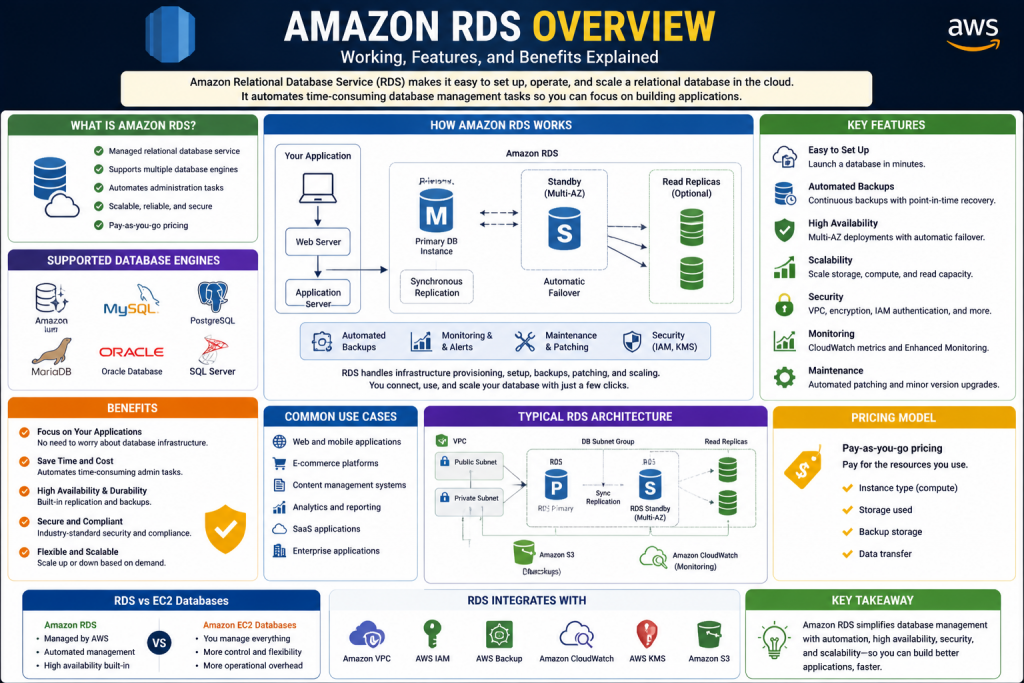
Amazon RDS, short for Amazon Relational Database Service, is a cloud-based service that simplifies the process of setting up, operating, and scaling relational databases. It is designed to remove much of the manual work involved in database administration, allowing developers and organizations to focus more on building applications rather than managing infrastructure.
Understanding the Role of Relational Databases
Before understanding Amazon RDS in detail, it is important to understand what relational databases actually do and why they are important.
Relational databases are designed to store structured data in a way that reflects real-world relationships. For example, in an online shopping system, there may be tables for customers, products, orders, and payments. Each of these tables is related to the others. A customer can place multiple orders, and each order can contain multiple products. These relationships are defined and managed within the database.
One of the biggest advantages of relational databases is their ability to use a query language, commonly known as SQL. SQL allows users to ask complex questions about their data in a simple and structured way. For example, a developer can easily retrieve all products within a certain price range or find all orders placed by a specific customer.
Relational databases also ensure data consistency. This means that the information stored remains accurate and reliable even when multiple users are accessing or modifying it at the same time. This is especially important in business applications where incorrect data can lead to serious problems.
Another important feature of relational databases is indexing. Indexes help speed up data retrieval by allowing the database to find information more quickly without scanning every record. This improves performance, especially when working with large datasets.
Despite these advantages, managing relational databases manually requires significant effort. Tasks such as scaling the database, applying updates, handling backups, and ensuring high availability can become complex and time-consuming.
Challenges of Traditional Database Management
In traditional setups, organizations are responsible for managing every aspect of their database systems. This includes installing database software, configuring storage, managing server resources, and ensuring security.
One of the major challenges is maintenance. Databases require regular updates and patches to remain secure and efficient. Without proper maintenance, systems can become vulnerable to security risks or performance issues.
Another challenge is scalability. As applications grow, the amount of data increases, and more users start accessing the system. Scaling a traditional database often requires adding more hardware or manually adjusting configurations. This process can be complex and may lead to downtime if not handled properly.
Backup and recovery is another critical area. Data loss can have serious consequences for businesses. In traditional systems, administrators must manually create backups and ensure that recovery processes are in place. If backups are not managed correctly, recovering lost data can be difficult or even impossible.
Security is also a major concern. Databases often contain sensitive information such as personal details, financial records, or business data. Protecting this information requires careful configuration of access controls, encryption, and network security.
Due to these challenges, managing databases has traditionally required dedicated database administrators. However, as cloud computing evolved, it became possible to automate many of these tasks.
Introduction to Amazon RDS
Amazon RDS is a managed database service provided by Amazon Web Services. It is designed to simplify the process of running relational databases in the cloud. Instead of manually setting up and maintaining database servers, users can create and manage databases through a fully managed environment.
With Amazon RDS, many of the operational tasks associated with databases are handled automatically. This includes installation, patching, backups, scaling, and monitoring. As a result, developers do not need to spend time managing infrastructure and can focus more on application development.
Amazon RDS supports multiple database engines. These include popular relational database systems such as MySQL, PostgreSQL, MariaDB, Oracle, and Microsoft SQL Server. This flexibility allows organizations to choose the database technology that best fits their needs while still benefiting from managed services.
One of the key advantages of Amazon RDS is ease of use. Creating a database instance is a simple process that can be done through a web interface or command-line tools. Users can specify the type of database, storage capacity, and performance requirements, and the service handles the rest.
Another important feature is automation. Amazon RDS automatically handles routine tasks such as software patching and backups. This reduces the operational workload and ensures that databases remain up to date and secure.
How Amazon RDS Fits into Cloud Infrastructure
Amazon RDS operates within cloud infrastructure, which means it relies on virtualized computing resources rather than physical hardware managed by users. This infrastructure is provided by Amazon Web Services, which operates large-scale data centers around the world.
When a user creates an RDS instance, the database is hosted on virtual machines that run within this cloud environment. These virtual machines are managed by the service provider, ensuring that hardware failures, maintenance, and scaling are handled automatically.
This cloud-based approach provides several advantages. First, it improves flexibility. Users can increase or decrease database resources based on demand without needing to purchase new hardware. Second, it improves reliability, as cloud systems are designed with redundancy to prevent downtime.
Amazon RDS also integrates with other cloud services. For example, it can work with storage systems, networking tools, and security services to provide a complete database solution. This integration makes it easier to build and manage complex applications in the cloud.
Separation of Responsibilities in Database Management
A key concept behind Amazon RDS is separation of responsibilities. This principle means dividing system tasks into different layers so that each layer focuses on a specific function.
In traditional database systems, developers or IT teams must handle everything, including infrastructure, security, backups, and performance tuning. This creates a heavy workload and increases the risk of errors.
With Amazon RDS, responsibility is divided. The cloud provider manages the infrastructure, while developers focus on designing and using the database. This separation allows teams to work more efficiently and reduces operational complexity.
For example, developers can focus on writing queries and designing data structures, while Amazon RDS handles tasks such as server maintenance, storage management, and system updates.
This approach improves productivity and allows organizations to scale faster without being slowed down by infrastructure management tasks.
Importance of Managed Database Services
Managed database services like Amazon RDS have become essential in modern application development. As applications grow in complexity, managing infrastructure manually becomes inefficient and expensive.
By using a managed service, organizations can reduce operational overhead, improve reliability, and enhance security. Automated backups ensure that data is always protected, while built-in monitoring tools help detect and resolve issues quickly.
Managed services also improve performance by optimizing resource allocation. Instead of manually tuning databases, users can rely on the service to handle performance optimization automatically.
Another important benefit is cost efficiency. Organizations do not need to invest in dedicated hardware or large database administration teams. Instead, they can pay for resources as needed, which makes budgeting more flexible.
Introduction to the Internal Architecture
Amazon RDS is often described as a fully managed database service, but to understand its real value, it is important to look at how it works behind the scenes. While users interact with a simple interface to create and manage databases, a complex system operates underneath to ensure performance, reliability, security, and scalability.
At a high level, Amazon RDS works by running database engines inside managed cloud environments. These environments are built on top of virtualized computing resources, which allow databases to run without requiring users to manage physical hardware. This abstraction is one of the key reasons why RDS is so widely used in modern application development.
When a user creates a database instance in Amazon RDS, the system automatically provisions the necessary computing resources. These resources include virtual machines, storage systems, networking components, and security configurations. The entire setup is handled in the background, without requiring manual intervention.
The Role of Virtual Machines in Amazon RDS
Amazon RDS relies heavily on virtual machines to run database instances. A virtual machine is a software-based representation of a physical computer. It behaves like a real server but operates within a shared physical infrastructure.
Each RDS database instance runs inside a virtual machine that is dedicated to that specific database. This isolation ensures that one database does not interfere with another, even if they are running on the same physical hardware.
The use of virtual machines provides flexibility and efficiency. It allows resources to be allocated dynamically based on demand. If a database requires more processing power or memory, the underlying system can adjust resource allocation accordingly.
This virtualization layer also improves reliability. If a physical server fails, the virtual machine can be moved to another server without disrupting the database service. This helps maintain high availability and reduces downtime.
Storage Architecture in Amazon RDS
Storage is one of the most important components of any database system. In Amazon RDS, storage is managed using a specialized cloud storage system that is separate from the compute layer.
This separation allows storage and computing resources to scale independently. For example, if a database needs more storage but not more processing power, only the storage layer can be expanded.
Amazon RDS uses persistent storage, meaning that data is not lost even if the database instance is restarted or moved. This is achieved through a distributed storage system that automatically replicates data across multiple physical locations.
Replication ensures durability and reliability. Even if one storage device fails, copies of the data are available elsewhere, preventing data loss.
The storage system also supports automatic backups. These backups are created regularly and stored separately from the main database. This allows users to restore their data to a previous state if needed.
Database Engines Supported by Amazon RDS
Amazon RDS does not use a single database system. Instead, it supports multiple relational database engines. This gives users flexibility to choose the technology that best suits their application needs.
Each database engine has its own strengths. Some are optimized for speed, while others focus on advanced features or compatibility with existing systems. Amazon RDS supports several widely used engines, allowing developers to migrate existing applications with minimal changes.
When a database instance is created, users select the engine they want to use. The system then configures the environment specifically for that engine. This includes installing the correct software version, setting up configurations, and optimizing performance settings.
Even though different engines behave differently, Amazon RDS manages them in a consistent way. This means users interact with a unified interface regardless of which database engine they choose.
Automation of Administrative Tasks
One of the most important features of Amazon RDS is automation. Traditional database management requires constant manual effort to maintain performance, security, and reliability. Amazon RDS reduces this burden by automating many of these tasks.
One of the key automated tasks is software patching. Database engines regularly receive updates that fix bugs, improve performance, or address security vulnerabilities. In traditional systems, administrators must manually install these updates. In Amazon RDS, patching is handled automatically.
Another important automated task is backups. Amazon RDS automatically creates backups of database instances at regular intervals. These backups can be used to restore data in case of failure or accidental deletion.
Monitoring is also automated. The system continuously tracks performance metrics such as CPU usage, memory consumption, storage utilization, and query performance. This information helps identify potential issues before they become serious problems.
By automating these tasks, Amazon RDS reduces the operational workload for developers and system administrators. It also improves consistency, as automated processes are less prone to human error.
High Availability and Failover Mechanisms
High availability is a critical requirement for modern applications. It ensures that systems remain operational even when failures occur. Amazon RDS provides built-in high availability features to achieve this goal.
One of the key mechanisms used is database replication. In a high availability setup, a primary database instance is paired with one or more standby instances. These standby instances maintain a copy of the data and remain ready to take over if the primary instance fails.
If a failure occurs, Amazon RDS automatically performs a failover. This means the standby instance becomes the new primary instance, and the application continues running with minimal disruption.
This process is designed to be fast and automated, reducing downtime and improving reliability. Users do not need to manually intervene during failover events.
High availability setups also improve performance in some cases. Read operations can be distributed across multiple instances, reducing the load on the primary database.
Security Architecture in Amazon RDS
Security is a fundamental aspect of Amazon RDS. Since databases often store sensitive information, protecting data from unauthorized access is essential.
Amazon RDS uses multiple layers of security to protect data. One of these layers is identity and access management. This system controls who can access database resources and what actions they are allowed to perform.
Access to databases can be restricted based on user roles and permissions. Only authorized users and applications can connect to the database, reducing the risk of unauthorized access.
Network security is another important layer. Amazon RDS allows users to define network rules that control which IP addresses or systems can access the database. This helps isolate databases from public exposure when necessary.
Data encryption is also supported. Data can be encrypted both at rest and in transit. Encryption at rest protects stored data, while encryption in transit protects data as it moves between the database and applications.
These security features are essential for meeting regulatory requirements in industries such as healthcare, finance, and government services.
Performance Optimization in Amazon RDS
Performance is a key factor in database systems. Amazon RDS includes several features designed to optimize database performance automatically.
One important feature is resource scaling. If a database experiences increased load, resources such as CPU and memory can be adjusted to handle the demand. This ensures that performance remains stable even during peak usage.
Another optimization feature is caching. Frequently accessed data can be stored in memory for faster retrieval. This reduces the need to repeatedly access storage systems, improving response times.
Query optimization is also handled by the database engine itself. The system analyzes queries and determines the most efficient way to retrieve data. This reduces processing time and improves overall performance.
Monitoring tools also play a role in performance optimization. By analyzing usage patterns, the system can identify bottlenecks and suggest improvements.
Networking and Connectivity in Amazon RDS
Amazon RDS operates within a cloud network environment. Each database instance is assigned network configurations that control how it communicates with other systems.
Connections to RDS databases are typically made through secure network channels. These connections can be restricted to specific applications or services, ensuring controlled access.
Network isolation is an important feature. Databases can be placed in private networks that are not directly accessible from the public internet. This improves security by reducing exposure to external threats.
Amazon RDS also supports integration with other cloud services. Applications running in the same environment can connect to databases using secure internal networks, improving performance and reducing latency.
Backup and Recovery Systems
Data protection is one of the most critical aspects of database management. Amazon RDS includes automated backup and recovery systems to ensure data safety.
Backups are created automatically and stored in separate locations. These backups allow users to restore their database to a previous state if data is lost or corrupted.
Point-in-time recovery is another important feature. It allows users to restore a database to a specific moment in time. This is useful in situations where data corruption occurs or accidental changes are made.
The backup system operates continuously in the background. Users do not need to manually create backups or manage backup schedules.
Introduction to Advanced Database Management
Amazon RDS is not just a simple database hosting service. It is a fully managed relational database platform designed to handle complex, large-scale, and production-grade workloads. While earlier explanations focused on what Amazon RDS is and how it works internally, it is equally important to understand how it behaves in real-world environments and what advanced features make it suitable for enterprise applications. It is widely used in environments where performance, reliability, and continuous availability are critical requirements. Large organizations depend on it to run applications that must remain operational 24/7 without interruptions.
In addition to basic database functionality, Amazon RDS provides advanced operational capabilities that support mission-critical systems. These include automated scaling, intelligent monitoring, and built-in recovery mechanisms that ensure consistent performance even during unexpected traffic spikes or system stress. Businesses benefit from reduced operational complexity because most administrative tasks are handled automatically.
Another important aspect is integration with other cloud services, which allows organizations to build complete application ecosystems around their databases. This makes it easier to connect storage, compute, and analytics services together in a seamless way. Amazon RDS also supports different deployment models, allowing businesses to choose configurations based on performance needs, compliance requirements, and budget constraints.
Overall, its enterprise-grade design ensures that it can support demanding workloads while maintaining stability, security, and efficiency across diverse real-world scenarios.
Modern applications are no longer small or simple. They serve millions of users, process large volumes of transactions, and require high availability at all times. To support these demands, Amazon RDS provides advanced capabilities such as scaling, performance optimization, monitoring, replication, and disaster recovery.
These features make it possible for businesses to run critical systems such as banking applications, e-commerce platforms, healthcare systems, and enterprise software without worrying about database infrastructure management.
Scalability in Amazon RDS
Scalability is one of the most important requirements for any modern database system. As applications grow, the amount of data they handle also increases. More users, more transactions, and more requests put pressure on the database. If the system cannot scale efficiently, performance issues begin to appear.
Amazon RDS provides two main types of scaling: vertical scaling and read scaling.
Vertical scaling refers to increasing the resources of a single database instance. This includes upgrading CPU, memory, and storage capacity. In traditional systems, this process often requires downtime and manual configuration. In Amazon RDS, vertical scaling can be done with minimal disruption, making it easier to adjust resources as needed.
Read scaling is achieved through the use of read replicas. A read replica is a copy of the primary database that handles read-only queries. This reduces the load on the main database and improves performance for applications with heavy read traffic. For example, an e-commerce website may use read replicas to handle product browsing while the main database processes orders and updates.
These scaling options allow Amazon RDS to handle workloads ranging from small applications to large enterprise systems.
Read Replicas and Load Distribution
Read replicas play a crucial role in improving database performance. In many applications, read operations are much more frequent than write operations. For example, users frequently browse products, view profiles, or search data, while updates happen less often.
By distributing read traffic across multiple replicas, Amazon RDS ensures that the primary database is not overloaded. This improves response time and provides a smoother experience for users.
Read replicas are also useful for reporting and analytics. Instead of running heavy queries on the main database, businesses can run them on replicas without affecting production performance.
In some configurations, read replicas can also be promoted to become primary databases in case of failure, improving system resilience.
Performance Monitoring and Optimization
Performance monitoring is a critical part of managing any database system. Amazon RDS includes built-in monitoring tools that continuously track system performance and resource usage.
These tools collect data on CPU utilization, memory usage, storage capacity, disk I/O, and query performance. By analyzing this data, administrators can identify bottlenecks and optimize system performance. This continuous monitoring helps ensure that the database remains stable even under heavy workloads. For example, if CPU usage is consistently high, it may indicate that queries need optimization or that the instance size should be increased. Similarly, high disk I/O can suggest inefficient query patterns or the need for better indexing strategies. Memory usage insights help determine whether caching is effective or if additional resources are required.
Query performance monitoring is especially important because slow queries can significantly impact application response times. By identifying frequently executed or poorly optimized queries, developers can refine database design and improve efficiency. Storage capacity tracking also ensures that databases do not run out of space unexpectedly, which could lead to system failures or downtime.
In addition, these monitoring tools often provide historical trends, allowing administrators to understand how performance changes over time. This helps in planning future scaling decisions and predicting resource needs more accurately. Overall, performance monitoring in Amazon RDS plays a crucial role in maintaining reliability, improving efficiency, and ensuring smooth user experiences across applications.
For example, if CPU usage is consistently high, it may indicate that the database needs more processing power or query optimization. If storage is nearing capacity, it may be time to expand storage or archive old data.
Amazon RDS also provides insights into slow-running queries. These queries can significantly impact performance if not optimized. By identifying them, developers can improve database structure or indexing strategies.
This continuous monitoring helps maintain stable performance even under heavy workloads.
Automated Backups and Point-in-Time Recovery
Data protection is essential in any database system. Amazon RDS provides automated backup features to ensure that data is never lost due to system failure or human error.
Backups are created automatically at regular intervals and stored in secure locations. These backups include both database data and transaction logs.
One of the most powerful features of Amazon RDS is point-in-time recovery. This allows users to restore their database to any specific moment within the backup retention period. For example, if accidental data deletion occurs, the database can be restored to a state just before the error happened.
This level of recovery flexibility is extremely valuable for businesses where data accuracy is critical.
Disaster Recovery and Multi-AZ Deployment
Disaster recovery is another important feature of Amazon RDS. Unexpected failures such as hardware crashes, network issues, or data center outages can disrupt applications. To prevent this, Amazon RDS supports Multi-AZ deployment. In this setup, a standby database is automatically maintained in a separate availability zone, continuously synchronizing data with the primary instance.
If a failure occurs in the main database, the system automatically performs a failover to the standby instance with minimal downtime. This process does not require manual intervention, which significantly reduces recovery time and ensures business continuity. It is especially important for critical applications where even short periods of downtime can cause financial loss or service disruption.
In a Multi-AZ setup, a standby database instance is created in a different availability zone. This standby instance continuously replicates data from the primary database.
If the primary database fails, Amazon RDS automatically switches to the standby instance. This process is called failover. It happens automatically and quickly, minimizing downtime.
Multi-AZ deployment ensures that applications remain available even in case of infrastructure failures. This is especially important for mission-critical systems such as financial applications and healthcare platforms.
Security and Compliance in Production Environments
Security becomes even more important when Amazon RDS is used in real-world production environments. Many organizations handle sensitive data that must be protected according to strict regulations.
Amazon RDS provides multiple layers of security to meet these requirements. Access control ensureSecurity becomes even more important when Amazon RDS is used in real-world production environments. Many organizations handle sensitive data that must be protected according to strict regulations.
This includes personal user information, financial records, healthcare data, and business-critical information that cannot be exposed or misused. To address these concerns, Amazon RDS provides multiple layers of security that work together to protect data at every level.
One important layer is access control, which ensures that only authorized users and applications can connect to the database. This is managed through identity-based policies and strict permission rules. By limiting access, organizations reduce the risk of unauthorized usage or data breaches.
Another key layer is network security. Amazon RDS allows databases to be placed inside private networks, preventing direct exposure to the public internet. Security groups and firewall-like rules can be configured to define exactly which systems are allowed to communicate with the database.
Encryption also plays a major role in securing data. Data can be encrypted both while stored and while being transferred between systems. This ensures that even if data is intercepted, it cannot be read without proper authorization.
Together, these security mechanisms help organizations meet compliance requirements and maintain trust while safely operating sensitive applications in cloud environments.
that only authorized users can interact with the database. This is managed through identity-based policies and authentication systems.
Network isolation allows databases to be placed in private environments that are not accessible from the public internet. This reduces exposure to external threats.
Encryption is used to protect data both at rest and in transit. This ensures that even if data is intercepted or accessed without permission, it remains unreadable.
These security features help organizations comply with industry standards and regulations such as financial compliance rules and healthcare data protection requirements.
Real-World Use Cases of Amazon RDS
Amazon RDS is widely used across different industries due to its flexibility and reliability.
In e-commerce platforms, it is used to manage product catalogs, customer data, order processing, and payment records. The ability to scale and handle high traffic makes it suitable for online retail systems.
In financial systems, Amazon RDS is used to store transaction data, account information, and audit logs. Security and consistency are especially important in this sector, making RDS a strong choice.
In healthcare applications, it is used to manage patient records, appointment systems, and medical histories. Data protection and compliance features are critical in this environment.
In enterprise applications, Amazon RDS supports internal systems such as human resource management, inventory tracking, and reporting tools.
These examples show how versatile and widely applicable Amazon RDS is in modern software systems.
Cost Management and Efficiency
Another important aspect of Amazon RDS is cost efficiency. Traditional database systems require significant investment in hardware, maintenance, and IT staff. In contrast, Amazon RDS operates on a pay-as-you-use model. This means organizations are charged based on the actual resources they consume, such as storage capacity, database instance type, data transfer, and backup usage. There is no need to purchase expensive physical servers upfront or maintain unused infrastructure for future growth.
This pricing approach helps businesses of all sizes manage their budgets more effectively. Startups, for example, can begin with small database configurations and gradually scale up as their application grows, without making large initial investments. Large enterprises can also benefit by optimizing costs across multiple database workloads and environments.
Another advantage is that operational costs are significantly reduced. Since Amazon RDS handles tasks like backups, patching, monitoring, and maintenance automatically, organizations do not need large database administration teams. This reduces staffing costs and minimizes the time spent on routine database management tasks.
Cost efficiency is also improved through automatic scaling and resource optimization. When demand is low, resources can remain minimal, and when demand increases, resources can scale dynamically. This flexibility ensures that companies only pay for what they actually use, making Amazon RDS a financially efficient solution for modern application development.
This means organizations only pay for the resources they use, such as storage, computing power, and data transfer. This reduces upfront costs and makes budgeting more flexible.
Cost optimization is also achieved through features like automated scaling and resource management. Systems can be adjusted based on demand, preventing unnecessary resource usage.
This makes Amazon RDS suitable for both small startups and large enterprises.
Limitations and Considerations
Although Amazon RDS offers many advantages, it also has some limitations that users should consider.
One limitation is reduced control over underlying infrastructure. Since the service is managed, users do not have direct access to the operating system or hardware.
Another consideration is vendor dependency. Applications built heavily around managed services may become dependent on a specific cloud provider.
Additionally, while RDS simplifies many tasks, complex database tuning may still require expert knowledge.
Despite these limitations, the benefits of managed services often outweigh the drawbacks for most applications.
Conclusion
Amazon RDS is a powerful managed relational database service designed to simplify database management in cloud environments. It combines the reliability of traditional relational databases with the flexibility and automation of cloud computing.
Through features such as scalability, read replicas, automated backups, monitoring, high availability, and strong security, Amazon RDS enables organizations to build and run applications efficiently without worrying about infrastructure management.
In real-world scenarios, it supports a wide range of applications from small websites to large enterprise systems. Its ability to reduce operational complexity while maintaining performance and reliability makes it one of the most widely used database services in modern cloud computing.
Overall, Amazon RDS represents a shift toward automation and managed infrastructure, allowing developers and businesses to focus more on innovation and less on maintenance.
Continue exploring the technologies and certification concepts that matter most to you.