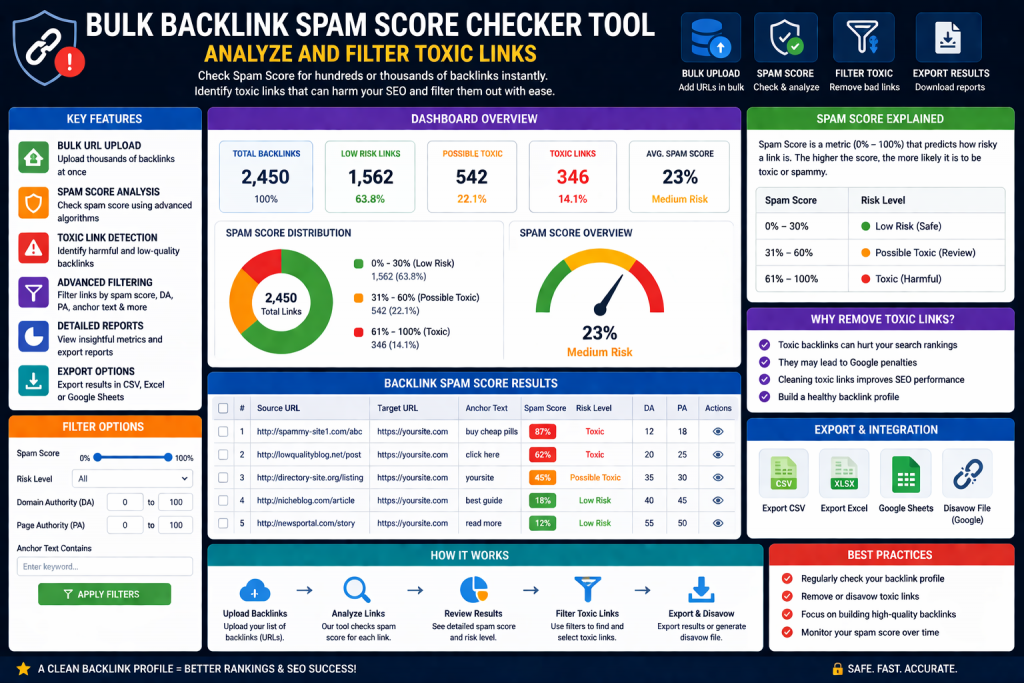
In the world of search engine optimization, backlinks play a central role in determining how websites perform in search rankings. A backlink is simply a link from one website to another, but its value depends heavily on the quality and trustworthiness of the source. High-quality backlinks can significantly improve a website’s authority, visibility, and organic traffic. On the other hand, low-quality or spam-related backlinks can have the opposite effect and may even harm a website’s ranking performance.
Search engines continuously evaluate backlinks to understand whether they are natural, relevant, and trustworthy. Because of this, website owners and SEO professionals must regularly analyze their backlink profiles to ensure they are not being influenced by harmful or suspicious links. Over time, large websites may accumulate thousands of backlinks from different sources, making manual evaluation extremely difficult.
To address this challenge, SEO tools were developed to automate the process of backlink analysis. These tools help users understand which links are beneficial and which ones may pose a risk. One of the most important aspects of this evaluation is identifying spam-like behavior in linking domains. This is where spam scoring systems become highly useful.
Understanding Spam Score in SEO Context
Spam score is a numerical value used to measure the likelihood that a website exhibits characteristics commonly associated with spam or low-quality behavior. This score is generated based on multiple indicators that are observed across a domain’s structure, linking patterns, and content behavior.
Each domain is evaluated against a set of predefined signals. These signals may include unusual linking patterns, lack of trustworthy content, over-optimization of anchor text, or association with known low-quality networks. When several of these signals are present, the spam score increases.
The scoring system typically uses a defined range to represent risk levels. A lower score indicates a safer and more reliable domain, while a higher score suggests potential issues. This allows SEO professionals to quickly prioritize which backlinks require further investigation.
However, it is important to understand that spam score is not an absolute judgment. It is a probabilistic indicator designed to assist in decision-making rather than replace human evaluation. Some legitimate websites may occasionally show higher scores due to structural similarities with spam-like sites, while some spam sites may temporarily appear clean. Therefore, spam scoring should always be used as a supporting metric rather than a final decision tool.
Importance of Backlink Analysis in Modern SEO
Backlink analysis is one of the most critical components of SEO strategy. Search engines rely heavily on backlinks to determine the credibility and authority of a website. When a website receives links from reputable and relevant sources, it is generally considered more trustworthy. This can lead to improved rankings and increased visibility in search results.
However, not all backlinks contribute positively. Some links may come from irrelevant directories, low-quality blogs, or automated link networks. These types of links can dilute a website’s authority and may even trigger penalties if they are detected as manipulative.
Regular backlink analysis helps website owners maintain a clean and healthy link profile. It ensures that harmful links are identified early and removed or disavowed before they can cause damage. It also helps in identifying strong link-building opportunities by analyzing which types of websites are providing valuable referrals.
In competitive industries, backlink quality can often be the deciding factor between high-ranking and low-ranking websites. This makes continuous monitoring an essential part of any SEO strategy.
Challenges of Manual Backlink Evaluation
In the early days of SEO, backlink analysis was primarily done manually. SEO professionals would use available tools to check individual URLs and assess their quality one by one. While this method worked for small websites, it quickly became inefficient as websites grew larger.
One of the main challenges was time consumption. Reviewing each backlink individually required significant effort, especially for websites with thousands of referring domains. This made it difficult for SEO teams to maintain up-to-date analyses.
Another challenge was inconsistency. Different tools often provided slightly different metrics, leading to confusion when comparing results. Without a standardized system, it became difficult to make reliable decisions based on the data.
Human error was also a major issue. When working with large datasets, it is easy to overlook certain links or misinterpret information. This could lead to incorrect conclusions about the quality of a backlink profile.
As websites continued to grow and the number of backlinks increased, it became clear that manual analysis was no longer sufficient. A more scalable and automated solution was needed.
Emergence of Automated Bulk Analysis Tools
To overcome the limitations of manual analysis, automated bulk backlink analysis tools were developed. These tools allow users to process large lists of URLs at once and retrieve important SEO metrics in a structured format.
Instead of analyzing each backlink individually, users can input hundreds or even thousands of domains into a single system. The tool then processes all entries automatically and returns relevant data for each one. This includes spam evaluation scores, domain authority, and page-level metrics.
The introduction of automation significantly improved efficiency in SEO workflows. Tasks that previously took hours or days could now be completed in a fraction of the time. This allowed SEO professionals to focus more on strategy and decision-making rather than repetitive manual work.
Automation also improved accuracy. Since the data is processed systematically, there is less room for human error. All links are evaluated using the same criteria, ensuring consistency across the entire dataset.
Role of Domain Authority and Page Authority
In addition to spam scoring, other important metrics are used in backlink analysis. Domain authority is one of the most widely recognized indicators of a website’s overall strength. It reflects the quality and quantity of backlinks pointing to a domain and provides a general estimate of its ability to rank in search engines.
Page authority, on the other hand, focuses on individual pages rather than entire domains. This metric helps determine how influential a specific page might be in search results. A website may have strong domain authority overall, but individual pages can vary in strength depending on their content and backlinks.
When combined with spam score, these metrics provide a more complete picture of backlink quality. A link from a high-authority domain with a low spam score is generally considered highly valuable. Conversely, a link from a low-authority domain with a high spam score is often considered risky.
SEO professionals use these combined insights to make informed decisions about link-building strategies and backlink cleanup processes.
Why Bulk Processing Became Necessary
As SEO became more data-driven, the need for bulk processing tools became increasingly important. Modern websites often have complex backlink profiles with thousands of referring domains. Manually analyzing each one is not practical in large-scale operations.
Bulk processing allows SEO teams to handle large datasets efficiently. Instead of focusing on individual links, they can analyze entire backlink profiles at once. This helps identify patterns and trends that would otherwise be difficult to detect.
For example, bulk analysis can reveal whether a website has a high concentration of low-quality links from specific sources. It can also highlight sudden spikes in backlinks, which may indicate unnatural link-building activity.
This type of analysis is essential for maintaining long-term SEO health. It allows website owners to proactively manage their backlink profiles rather than reacting to penalties after they occur.
Data Collection and SEO Tool Integration
Behind most bulk backlink analysis systems is a combination of data collection mechanisms and SEO tool integrations. These systems gather information from large web indexes that continuously crawl and analyze websites across the internet.
Once collected, this data is structured into accessible metrics such as spam scores, authority values, and linking patterns. SEO tools then use this structured data to provide insights to users.
Integration between tools is a key aspect of modern SEO workflows. It allows different systems to share data and work together seamlessly. This improves efficiency and ensures that users always have access to the most up-to-date information.
By leveraging these integrations, SEO professionals can build custom workflows tailored to their specific needs. This includes automated reporting, scheduled backlink audits, and large-scale data processing.
Practical Importance of Spam Detection in SEO Strategy
Spam detection is not just a technical feature; it is a critical part of long-term SEO strategy. Search engines are constantly evolving to identify and penalize manipulative linking practices. As a result, websites must ensure that their backlink profiles remain clean and natural.
Spam detection tools help identify potentially harmful links before they negatively impact rankings. By removing or disavowing these links, website owners can protect their search visibility and maintain domain authority.
In addition to protection, spam analysis also supports better link-building strategies. By understanding what types of links are considered risky, SEO professionals can avoid poor-quality sources and focus on building relationships with reputable websites.
This leads to more sustainable SEO growth and reduces the risk of penalties in the future.
Introduction to the Practical Implementation Process
After understanding the importance of backlink analysis and spam evaluation in SEO, the next step is to explore how an automated bulk backlink checking system is actually installed and used in practice. This involves setting up the required environment, installing necessary tools, preparing input data, and executing the process that allows large-scale backlink evaluation.
The purpose of this system is to simplify and automate what would otherwise be a very time-consuming manual process. Instead of checking each backlink individually, users can process hundreds or even thousands of domains in one execution cycle. This makes it especially useful for SEO professionals managing large websites or multiple client projects.
The installation and setup process requires a basic understanding of programming tools and command-line usage. Although it may seem technical at first, each step follows a logical sequence designed to prepare the system for efficient data processing.
Setting Up the Required Environment
Before using a bulk backlink analysis system, it is necessary to prepare the working environment. This includes installing a programming language environment and additional libraries that support data processing and web interaction.
A commonly used approach involves setting up a Python environment. Python is widely used in automation, data analysis, and web scraping due to its simplicity and powerful library support. Once Python is installed, it becomes possible to run scripts that handle large-scale backlink processing tasks.
After installing Python, the next step is to ensure that the system has access to required dependencies. These dependencies are external libraries that extend Python’s functionality. They allow the script to interact with web services, process structured data, and handle automated tasks efficiently.
Two commonly used libraries in this type of setup are used for HTML parsing and browser automation. The first helps extract and organize data from web responses, while the second allows automated interaction with web-based tools that may require login or session-based access.
Installing these libraries is typically done through a command-line interface. Once installed successfully, the system becomes ready for script execution.
Understanding the Role of Automation Scripts
At the core of a bulk backlink checker is an automation script. This script is responsible for processing input data, sending requests to SEO data sources, collecting results, and organizing the output in a structured format.
The script usually begins by reading a list of domains provided by the user. These domains are stored in a simple text-based file. Each line represents a separate domain that needs to be analyzed.
Once the input list is loaded, the script begins processing each domain one by one. For each entry, it sends a request to a data source that returns SEO metrics such as spam score, domain authority, and page authority.
The script then collects this information and stores it in a structured format. This allows users to easily export the results into spreadsheet software for further analysis.
Automation scripts eliminate the need for repetitive manual work. Instead of copying and pasting URLs into different tools, the entire process is handled automatically from start to finish.
Preparing the Input Data for Processing
Before running the bulk backlink checker, it is necessary to prepare the input data correctly. This step is important because the quality and format of input data directly affect the accuracy of the results.
The input data usually consists of a list of domains extracted from a backlink monitoring tool. These domains represent websites that are linking to the target website.
It is important to ensure that the list is clean and properly formatted. In most cases, only the domain name is required, not the full URL path. For example, instead of including full page links, only the main domain is used.
This simplification helps improve processing efficiency and ensures consistent results. It also reduces unnecessary complexity when analyzing spam scores and authority metrics.
Once the list is prepared, it is saved in a plain text file. Each domain is placed on a separate line to allow the script to read and process them sequentially.
Running the Automation Script
After preparing the environment and input data, the next step is to execute the automation script. This is typically done through a command-line interface or terminal.
When the script is executed, it begins by loading the input file. It reads each domain and processes them one by one. For each domain, it sends a request to the SEO data source and retrieves relevant metrics.
During execution, the system may display status messages indicating progress. This helps users understand that the script is actively processing data.
Depending on the number of domains being analyzed, the process may take several minutes to complete. Larger datasets naturally require more processing time, but the automation still significantly reduces overall workload compared to manual methods.
In some cases, temporary warnings or alerts may appear during execution. These are typically related to browser automation or session handling. However, they do not usually affect the overall performance of the script, and the process continues running in the background.
Data Collection and Output Generation
Once the script begins processing domains, it collects multiple SEO metrics for each entry. These metrics are stored in a structured format that can be easily exported and analyzed.
The most commonly collected metrics include spam evaluation scores, domain authority values, and page-level authority scores. Each of these metrics provides a different perspective on the quality and trustworthiness of a domain.
Spam score helps identify potential risk factors associated with a domain. Domain authority reflects overall strength and credibility, while page authority focuses on individual page influence.
After processing all domains, the script generates an output file containing all collected data. This file is usually formatted in a way that can be easily imported into spreadsheet software.
Users can then review the results, sort them based on different metrics, and identify patterns in their backlink profile.
Importance of Structured Output for SEO Analysis
Structured output is one of the most important aspects of bulk backlink analysis. Without proper organization, even large amounts of data become difficult to interpret.
By organizing results in a consistent format, SEO professionals can quickly identify high-risk and high-value backlinks. This improves decision-making and allows for more efficient optimization strategies.
Structured data also enables further analysis using spreadsheet tools. Users can apply filters, sorting functions, and conditional formatting to highlight important patterns.
For example, backlinks with high spam scores can be automatically highlighted for review. Similarly, high-authority links can be identified as valuable assets in the backlink profile.
This structured approach transforms raw data into actionable insights, making it a powerful tool for SEO strategy development.
Handling Large-Scale Data Processing
One of the key advantages of bulk backlink checking systems is their ability to handle large datasets efficiently. However, processing large volumes of data requires careful system management.
When dealing with thousands of domains, system performance can become a concern. To address this, automation scripts are designed to process data in controlled sequences rather than overwhelming the system with simultaneous requests.
This sequential processing ensures stability and reduces the risk of errors during execution. It also helps maintain consistent communication with external data sources.
In addition, time delays may be included between requests to avoid overwhelming external services. This ensures that the system operates within acceptable usage limits and maintains reliable performance.
Troubleshooting Common Setup Issues
During installation and setup, users may encounter certain technical issues. These issues are usually related to missing dependencies, incorrect file formatting, or configuration errors.
One common issue is missing libraries. If required libraries are not installed correctly, the script may fail to execute. This can usually be resolved by reinstalling the necessary components using the command-line interface.
Another common issue is incorrect input formatting. If the domain list is not properly structured, the script may not be able to read the data correctly. Ensuring that each domain is placed on a separate line typically resolves this problem.
Occasionally, users may also encounter browser-related warnings during automation. These warnings are generally harmless and can often be ignored, as the script continues to run in the background.
Proper setup and attention to detail can help avoid most of these issues and ensure smooth execution of the tool.
Role of Automation in Modern SEO Workflows
Automation has become an essential part of modern SEO workflows. As websites grow in size and complexity, manual processes are no longer sufficient to handle data analysis efficiently.
Automated bulk backlink checkers allow SEO professionals to focus on strategy rather than repetitive tasks. By reducing manual workload, these tools free up time for more important activities such as content planning, link-building strategy, and performance optimization.
Automation also improves consistency. Since all data is processed using the same logic, results are more reliable and easier to compare across different datasets.
In addition, automation reduces the risk of human error. This leads to more accurate analysis and better decision-making in SEO campaigns.
Transition Toward Scalable SEO Analysis
The use of bulk backlink analysis systems represents a shift toward scalable SEO practices. Instead of focusing on individual links, SEO professionals can now analyze entire link profiles at once.
This scalability is essential in today’s digital environment, where websites can accumulate thousands of backlinks within a short period of time. Without automation, managing this level of complexity would be extremely difficult.
By combining structured data, automated processing, and SEO metrics, these systems provide a powerful framework for maintaining healthy backlink profiles and improving search engine performance.
Introduction to Advanced Backlink Analysis
After setting up and running a bulk backlink spam score checker, the real value comes from how the results are interpreted and used in SEO strategy. Collecting data is only the first step; the real impact lies in analyzing patterns, identifying risks, and making informed decisions that improve website performance in search engines.
Advanced usage of backlink analysis tools focuses on deeper evaluation rather than surface-level metrics. Instead of simply looking at individual scores, SEO professionals examine relationships between different metrics such as spam score, domain authority, and page authority. This helps in building a more complete understanding of the backlink profile.
At this stage, the goal shifts from data collection to strategic optimization. The insights gathered from bulk analysis are used to clean backlink profiles, strengthen link-building efforts, and improve long-term search visibility.
Understanding the Meaning Behind Spam Scores
Spam scores are often misunderstood as absolute indicators of website quality. In reality, they represent probability-based risk assessments rather than definitive judgments. A higher score suggests that a domain shares characteristics commonly found in low-quality or manipulative websites, but it does not automatically mean the site is harmful.
When analyzing results in bulk, it is important to interpret spam scores in context. A single high-risk indicator may not be enough to classify a domain as toxic. However, multiple signals combined together can strongly suggest potential issues.
SEO professionals often categorize spam scores into ranges to simplify decision-making. Lower ranges are considered safe, mid ranges require manual review, and high ranges are flagged for potential removal or disavowal.
This layered interpretation helps avoid unnecessary removal of legitimate backlinks while still protecting the website from harmful influences.
Combining Metrics for Better Decision Making
One of the most powerful aspects of bulk backlink analysis is the ability to combine multiple SEO metrics. Spam score alone does not provide a complete picture. It must be evaluated alongside domain authority and page authority.
A domain with a low spam score and high authority is typically considered a strong backlink source. These links contribute positively to search rankings and should be preserved or even strengthened through further engagement.
On the other hand, a domain with high spam score and low authority is often considered risky. These links may have little to no positive impact and can sometimes harm overall SEO performance.
There are also mixed cases where a domain has high authority but a moderate spam score. These cases require careful manual review because they may still provide value despite some risk indicators.
By combining multiple metrics, SEO professionals can make more balanced and accurate decisions.
Identifying Patterns in Backlink Profiles
Bulk analysis allows for pattern recognition across entire backlink profiles. Instead of focusing on individual links, SEO experts can identify trends that reveal the overall health of a website’s link structure.
For example, a sudden increase in backlinks from low-quality domains may indicate unnatural link-building activity. Similarly, a large number of links coming from unrelated industries can suggest poor targeting or automated link generation.
Patterns can also reveal positive insights. A steady increase in high-authority backlinks over time indicates strong organic growth and effective SEO strategies.
By analyzing these patterns, SEO professionals can adjust their strategies to improve long-term performance and avoid potential penalties.
Cleaning and Disavowing Harmful Backlinks
One of the primary uses of spam score analysis is backlink cleanup. Once harmful or suspicious links are identified, they can be removed or disavowed to prevent negative impact on search rankings.
The cleanup process usually involves reviewing high-risk domains and determining whether they should remain part of the backlink profile. If a link is clearly harmful or irrelevant, it is often removed or flagged for disavowal.
Disavowal is a process where search engines are informed to ignore certain backlinks when evaluating a website. This helps prevent negative SEO impact from low-quality or spammy sources.
However, this process must be handled carefully. Removing too many links without proper analysis can potentially reduce overall authority. This is why bulk analysis tools are essential for making informed decisions.
Strengthening Link Building Strategies
Bulk backlink analysis is not only useful for identifying harmful links but also for improving future link-building strategies. By understanding which types of backlinks provide the most value, SEO professionals can focus their efforts more effectively. This approach shifts SEO work from random link acquisition to a more structured and data-driven strategy that prioritizes quality over quantity.
When analyzing backlink data in bulk, patterns begin to emerge that highlight which sources consistently contribute strong authority signals. These may include niche-relevant blogs, educational resources, industry publications, or high-traffic informational sites. Recognizing these patterns helps SEO teams refine their outreach targets and build relationships with websites that are more likely to provide long-term value.
Another important benefit is the ability to evaluate anchor text distribution across backlinks. This helps ensure that link-building remains natural and avoids over-optimization, which can be flagged by search engines. Balanced anchor text profiles contribute to safer and more sustainable SEO growth.
Bulk analysis also helps identify content types that attract links most frequently. This insight can guide future content creation efforts, ensuring that new pages are designed with linkability in mind. Over time, this leads to a stronger backlink ecosystem, improved domain authority, and more stable search engine rankings.
High-authority domains with low spam scores are typically the most valuable targets for link building. These websites are trusted by search engines and can significantly improve ranking performance.
Analyzing existing backlink profiles helps identify which sources are already providing strong value. This information can then be used to find similar websites for future outreach campaigns.
Over time, this leads to a more refined and strategic approach to link building, where quality is prioritized over quantity.
Improving SEO Efficiency Through Automation
Automation plays a major role in improving SEO efficiency. Bulk backlink checkers eliminate the need for repetitive manual tasks and allow professionals to focus on higher-level strategy.
Instead of spending time checking individual links, SEO teams can process entire datasets in minutes. This dramatically increases productivity and allows for more frequent backlink audits.
Automation also improves consistency in analysis. Since all data is processed using the same logic, results are uniform and easier to compare over time.
This consistency is especially important for tracking SEO progress. Regular automated audits help ensure that backlink profiles remain healthy and free from harmful influences.
Scaling SEO Operations for Large Websites
Large websites often have thousands or even millions of backlinks. Managing this level of complexity requires scalable systems that can handle large volumes of data efficiently.
Bulk backlink analysis tools are designed specifically for this purpose. They allow SEO teams to process large datasets without sacrificing speed or accuracy.
Scalability also enables ongoing monitoring. Instead of performing occasional manual audits, websites can continuously track their backlink profiles and respond quickly to changes.
This proactive approach is essential in competitive industries where SEO performance can change rapidly.
Integrating Analysis Results into SEO Strategy
Once backlink data has been analyzed, the next step is integrating insights into overall SEO strategy. This involves using the results to guide decisions related to content creation, outreach, and technical optimization. The analysis does not hold value on its own unless it is translated into actionable improvements that enhance website performance.
One important application is content planning. By studying which pages attract high-quality backlinks, SEO teams can identify topics that naturally generate interest and authority. This information can be used to create similar or expanded content that targets the same audience. It also helps in updating existing pages to make them more link-worthy.
Outreach strategy is another key area influenced by backlink insights. When data shows that certain types of websites consistently provide strong backlinks, marketers can focus their outreach efforts on those sources. This makes link-building campaigns more efficient and increases the chances of gaining authoritative links.
Technical optimization also benefits from backlink analysis. If certain pages receive strong external links but still underperform, it may indicate technical issues such as slow loading speed, poor internal linking, or indexing problems. Fixing these issues ensures that link equity is fully utilized.
Overall, integrating backlink insights into SEO strategy helps create a more data-driven and performance-focused approach to long-term growth.
For example, if analysis reveals that certain types of websites consistently provide high-quality backlinks, SEO teams can focus their outreach efforts on similar sources.
If harmful patterns are detected, corrective actions such as disavowing links or adjusting link-building practices can be implemented.
This integration ensures that data is not just collected but actively used to improve performance.
Continuous Monitoring and Long-Term SEO Health
SEO is not a one-time process. It requires continuous monitoring and adjustment to maintain strong performance over time. Backlink profiles can change frequently as new links are added and old links disappear.
Regular use of bulk backlink analysis tools helps ensure that websites remain in good standing. By scheduling periodic audits, SEO professionals can detect issues early and respond before they affect rankings.
Long-term SEO health depends on maintaining a clean and natural backlink profile. Continuous monitoring is the most effective way to achieve this goal.
Interpreting Data for Strategic Insights
Beyond technical analysis, backlink data can also provide strategic insights into competitor behavior and industry trends.
By analyzing competitor backlink profiles, SEO professionals can identify new opportunities for link building. They can see which sources are linking to competitors and explore similar outreach possibilities.
This competitive analysis helps uncover gaps in existing strategies and opens new pathways for growth.
Data interpretation is therefore not just about identifying problems but also about discovering opportunities.
Common Mistakes in Backlink Analysis
Despite the power of bulk analysis tools, there are common mistakes that can reduce their effectiveness. One of the most frequent mistakes is relying too heavily on a single metric such as spam score. While spam score is useful for identifying potential risk signals, it does not provide a complete picture of a backlink’s quality. A domain may have a slightly higher spam score due to certain structural patterns, but still be a legitimate and valuable source of traffic and authority.
Over-dependence on one metric can lead to poor decision-making, especially in SEO where context matters greatly. For example, a website might show a moderate spam score but also have strong domain authority and highly relevant content within the same niche. Ignoring these additional signals could result in mistakenly disavowing useful backlinks that actually contribute positively to rankings.
Another issue that arises from focusing only on spam score is the risk of oversimplification. SEO is a multi-dimensional field where different factors interact with each other. Backlinks should be evaluated based on relevance, authority, traffic quality, and linking context, not just a single numerical value.
A balanced approach is always more effective. Combining multiple metrics and manually reviewing borderline cases ensures more accurate decisions. This helps maintain a healthy backlink profile while avoiding unnecessary loss of valuable link equity.
Another mistake is removing backlinks without proper review. Not all high-risk indicators mean a link is harmful, and unnecessary removal can sometimes weaken SEO performance.
Ignoring context is also a common issue. Backlinks should always be evaluated based on relevance, authority, and relationship to the content.
Avoiding these mistakes ensures more accurate analysis and better SEO outcomes.
Future of Automated SEO Analysis
The future of SEO is increasingly data-driven and automated. As search engines become more advanced, the need for intelligent analysis tools will continue to grow.
Bulk backlink analysis systems are expected to become more sophisticated, incorporating machine learning and predictive analytics. These advancements will allow for even more accurate detection of spam and higher-quality SEO insights.
Automation will continue to reduce manual workload, allowing SEO professionals to focus more on strategy and creativity.
Conclusion
Bulk backlink spam score checking represents a powerful approach to modern SEO analysis. It transforms a complex and time-consuming process into an efficient, scalable, and structured workflow.
By combining metrics such as spam score, domain authority, and page authority, SEO professionals can gain deep insights into backlink quality and website performance. This enables better decision-making, improved link-building strategies, and stronger long-term search visibility.
Automation plays a central role in this process, allowing large datasets to be processed quickly and accurately. It eliminates manual inefficiencies and ensures consistent results across all evaluations.
Ultimately, the value of bulk backlink analysis lies not only in data collection but in how that data is interpreted and applied. When used correctly, it becomes a powerful tool for maintaining a healthy backlink profile, improving SEO performance, and achieving sustainable growth in search rankings.
Continue exploring the technologies and certification concepts that matter most to you.