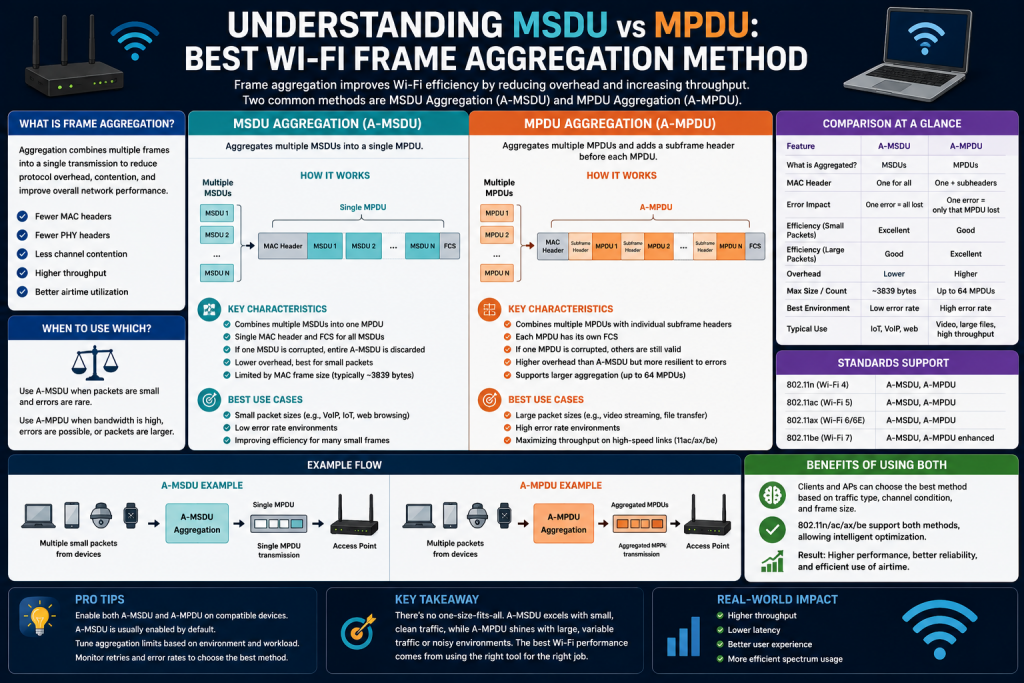
Frame aggregation is a key optimization technique in modern Wi-Fi networks that improves efficiency, reduces overhead, and increases overall throughput. It became widely used with the introduction of IEEE 802.11n, which aimed to make wireless communication faster and more reliable in increasingly congested environments.
At its core, frame aggregation combines multiple data frames into a single transmission opportunity, reducing the number of times a device must compete for access to the wireless medium. This is important because every individual transmission in Wi-Fi includes overhead such as headers, acknowledgments, and contention delays. By reducing these, aggregation improves performance.
There are two main types of frame aggregation used in Wi-Fi networks: A-MSDU (Aggregated MAC Service Data Unit) and A-MPDU (Aggregated MAC Protocol Data Unit). While both aim to improve efficiency, they operate differently and are suited for different network conditions.
Understanding the difference between them is essential for optimizing wireless performance in real-world environments.
What Is Frame Aggregation?
In wireless networking, data is transmitted in units called frames. Each frame contains not only user data but also control information required for transmission. When many small frames are sent individually, a large portion of airtime is consumed by overhead rather than actual data. This overhead includes MAC headers, acknowledgments, interframe spacing, and contention delays, all of which reduce the effective throughput of the network. As a result, even if a Wi-Fi link has a high theoretical data rate, the real performance experienced by users can be significantly lower due to inefficient use of airtime.
In addition, wireless networks operate in a shared medium, meaning all devices must compete for access to the same channel. This competition increases latency and reduces efficiency when a large number of small packets are transmitted separately. Frame aggregation helps solve this problem by combining multiple data units into a single transmission opportunity, reducing contention and improving channel utilization. It also allows devices to send more useful data per transmission, which is especially important in modern environments where applications generate continuous streams of traffic such as video streaming, cloud services, and real-time communication.
Frame aggregation solves this problem by combining multiple frames into a single transmission or transmission burst. This reduces contention on the wireless channel and improves efficiency.
However, aggregation introduces a trade-off between efficiency and reliability. Larger aggregated frames are more efficient but riskier, while smaller or more independent frames are more reliable but less efficient.
A-MSDU (Aggregated MAC Service Data Unit)
A-MSDU is the more tightly packed form of aggregation. It works by combining multiple MSDUs (data units from higher network layers) into a single large frame before transmission.
All the combined data is encapsulated under a single MAC header, and the entire structure is transmitted as one unit.
How A-MSDU Works
When A-MSDU is used, multiple packets are grouped together and sent as a single 802.11 frame. From the wireless medium’s perspective, it looks like one large transmission even though it contains multiple data payloads inside.
This means:
- Only one MAC header is used
- Only one transmission opportunity is required
- Only one acknowledgment is expected
However, this also means that all the data is tightly coupled together during transmission.
Advantages of A-MSDU
A-MSDU is highly efficient in terms of airtime usage. Since multiple frames share a single header, less bandwidth is wasted on control information.
It is most effective in:
- Low-interference environments
- Short-distance wireless links
- Controlled enterprise deployments
- Stable RF conditions
In such environments, reducing overhead significantly improves performance.
Disadvantages of A-MSDU
The biggest weakness of A-MSDU is risk concentration. If any part of the aggregated frame is corrupted during transmission, the entire frame must be retransmitted.
This creates several issues:
- Higher retransmission cost
- Increased latency under poor signal conditions
- Poor performance in congested networks
- Sensitivity to noise and interference
Because of this, A-MSDU is not ideal for unstable wireless environments.
A-MPDU (Aggregated MAC Protocol Data Unit)
A-MPDU uses a more flexible approach to aggregation. Instead of combining everything into one large frame, it aggregates multiple independent MPDUs and sends them together in a single transmission burst.
Each frame remains individually intact with its own header and error-checking mechanism.
How A-MPDU Works
A-MPDU allows multiple frames to be transmitted in a single contention period. However, unlike A-MSDU, each frame is treated independently by the receiver.
This is supported by a mechanism called Block ACK, which acknowledges multiple frames at once instead of requiring individual acknowledgments.
The process includes:
- Negotiation using ADDBA exchange
- Transmission of multiple MPDUs in a burst
- Block acknowledgment of received frames
- Selective retransmission of failed frames
Advantages of A-MPDU
A-MPDU is more resilient in real-world environments. Since each frame is independent, errors do not affect the entire aggregation. This independence allows the wireless system to recover gracefully from partial transmission failures without significantly degrading overall performance. It also improves user experience in environments where multiple devices are competing for airtime, such as offices, campuses, and public hotspots.
Key benefits include:
Better performance in noisy environments
Reduced retransmission overhead
Improved reliability
Efficient error handling using Block ACK
This makes it ideal for modern Wi-Fi networks where interference is common. It is especially useful in high-density deployments where consistent throughput and stable connections are more important than maximizing theoretical efficiency under perfect conditions.
Disadvantages of A-MPDU
Although more reliable, A-MPDU introduces more overhead because each frame still carries its own header and metadata. This means that even though data transmission is optimized in terms of error handling, additional bits are still required for framing, sequencing, and acknowledgment tracking. In high-throughput networks, this overhead can become noticeable when large volumes of small packets are transmitted frequently. However, modern hardware and advanced Wi-Fi standards help minimize the performance impact through efficient processing and scheduling techniques.
Limitations include:
Higher protocol overhead
Less raw efficiency compared to A-MSDU in ideal conditions
Potential airtime consumption in large bursts
Despite these limitations, it remains the preferred method in most deployments because it performs consistently well across a wide range of real-world wireless conditions, especially where interference and client diversity are present.
Block ACK Mechanism
A-MPDU relies heavily on the Block ACK system. Instead of acknowledging each frame individually, the receiver sends a single response that contains information about all received frames.
This response includes a bitmap indicating which frames were successfully received and which failed.
This mechanism improves efficiency by:
- Reducing acknowledgment overhead
- Allowing selective retransmission
- Improving performance in unreliable conditions
It makes A-MPDU significantly more practical for real-world wireless environments.
Key Differences Between A-MSDU and A-MPDU
Although both methods aim to improve throughput, their design philosophies are different.
A-MSDU focuses on:
- Maximum efficiency
- Minimal header overhead
- Single large transmission unit
- Higher risk in case of errors
A-MPDU focuses on:
- Reliability
- Independent frame handling
- Selective retransmission
- Better performance in real conditions
In simple terms, A-MSDU prioritizes efficiency, while A-MPDU prioritizes reliability.
Performance Comparison in Real Networks
In ideal laboratory conditions with minimal interference, A-MSDU can outperform A-MPDU due to its lower overhead. However, real wireless environments rarely remain stable.
In practical deployments:
- Signal interference is common
- Clients move frequently
- Multiple devices compete for airtime
- Environmental noise affects transmission
Because of these factors, A-MPDU consistently performs better in real-world scenarios.
Most modern Wi-Fi systems favor A-MPDU or a combination of both methods.
Using A-MSDU and A-MPDU Together
Modern wireless standards allow both A-MSDU and A-MPDU to be used together. This hybrid approach provides a balance between efficiency and reliability.
In this configuration:
- A-MSDU reduces internal frame overhead
- A-MPDU handles retransmissions efficiently
However, combining both also introduces complexity and potential airtime usage challenges.
This approach works best in:
- Controlled enterprise environments
- Medium-density networks
- Well-designed RF systems
Careful tuning is required to avoid unnecessary airtime consumption.
Practical Considerations
In real-world Wi-Fi design, theoretical efficiency is not the only factor that matters. Network conditions, interference levels, client behavior, and traffic patterns all influence performance. Environmental factors such as physical obstacles, distance from access points, and competing nearby networks can also significantly impact overall throughput and stability. Even small changes in signal quality can affect how well aggregation performs in practice.
Key considerations include:
Airtime efficiency is critical in dense environments
Reliability is more important than perfect efficiency
Retransmissions cost more than slightly higher overhead
Modern networks favor stability over theoretical optimization
Because of this, A-MPDU has become the default aggregation method in most modern wireless systems. It provides a better balance between performance and reliability, especially in unpredictable and high-traffic environments where consistent connectivity is more important than maximum theoretical speed.
Conclusion
Frame aggregation is an essential feature in modern Wi-Fi that significantly improves network performance by reducing overhead and increasing throughput. The two primary methods, A-MSDU and A-MPDU, achieve this goal in different ways.
A-MSDU is highly efficient because it combines multiple data units into a single transmission, but it is vulnerable to errors since any failure requires retransmitting the entire frame. This makes it suitable only for clean, low-interference environments.
A-MPDU, on the other hand, sends multiple independent frames together and uses Block ACK to manage acknowledgments. This allows for selective retransmission and makes it far more reliable in real-world conditions, even though it introduces slightly more overhead.
In practical networking scenarios, A-MPDU is generally the better choice because wireless environments are rarely perfect. However, A-MSDU still has value in controlled environments where efficiency is the top priority.
Ultimately, the best frame aggregation method depends on the network environment, traffic density, and performance requirements. A balanced and well-tuned approach often delivers the best results.
Continue exploring the technologies and certification concepts that matter most to you.