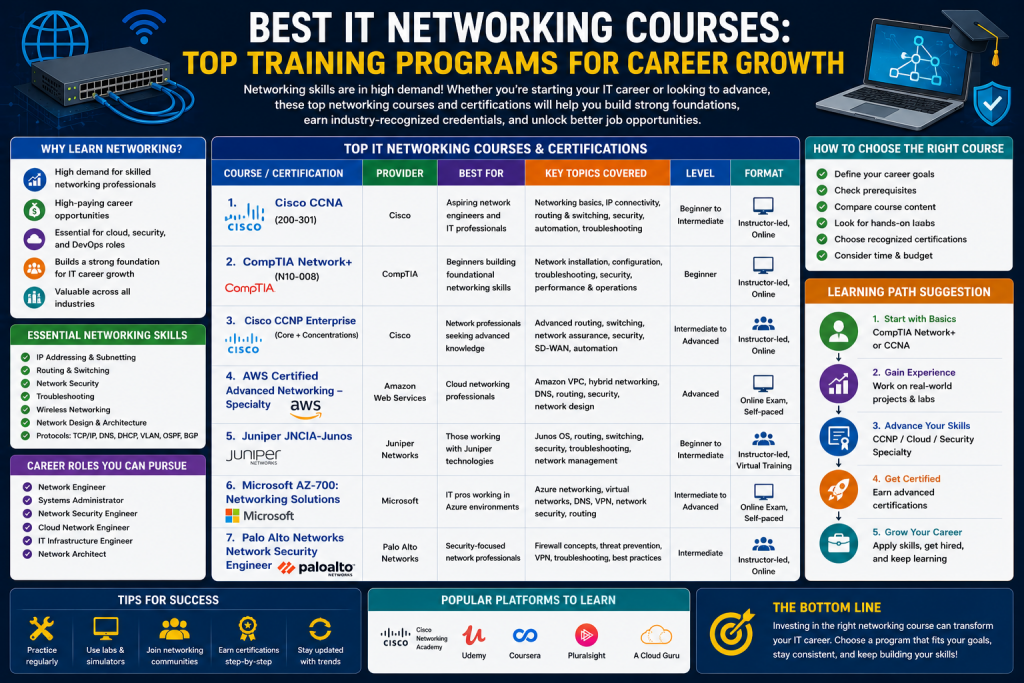
Networking is one of the most essential pillars of modern IT systems. Whether you are aiming to become a network engineer, cybersecurity specialist, DevOps engineer, or even a software developer, understanding how networks function gives you a major advantage. IT networking is not just about cables and routers anymore—it is about cloud systems, virtual networks, security protocols, and how all devices communicate in real time.
In today’s digital world, almost every application depends on a network in some way. From mobile apps and websites to banking systems and online gaming, everything relies on stable and secure data communication. This is why networking knowledge has become a core requirement across almost all IT roles. As organizations move toward cloud computing and hybrid infrastructures, professionals who understand how data flows between on-premises systems and cloud environments are in especially high demand.
Networking also plays a critical role in cybersecurity. Without a strong understanding of how networks are structured, it becomes difficult to identify vulnerabilities or protect systems from attacks. Concepts like firewalls, VPNs, encryption, and intrusion detection systems all rely heavily on networking fundamentals.
Additionally, modern networking involves automation and virtualization, allowing systems to be managed more efficiently and at scale. This evolution makes networking not only a foundational skill but also a future-ready career path with continuous growth opportunities.
In this guide, we explore some of the best IT networking courses available today, what makes them valuable, and how you can choose the right one based on your career goals. We also include practical learning tips to help you succeed faster.
What Makes IT Networking Courses Important?
Before choosing a course, it is important to understand why networking skills are in such high demand. Every digital system relies on communication between devices. Whether it is sending an email, streaming a video, or accessing cloud storage, networking makes it possible. Behind every simple online action, there are complex processes involving routers, switches, servers, and communication protocols working together to ensure data reaches the correct destination efficiently and securely.
In today’s connected world, businesses depend heavily on reliable networks to operate smoothly. Companies use internal networks for sharing files, managing databases, running applications, and supporting communication tools like video conferencing and messaging platforms. Even a small network issue can lead to downtime, financial loss, and reduced productivity. This is why organizations actively seek professionals who can design, manage, and troubleshoot networks effectively.
Another reason networking skills are in high demand is the rapid growth of cloud computing. Services like data storage, virtual machines, and online applications all rely on large-scale networks that span across global data centers. Understanding how these systems communicate helps IT professionals manage cloud environments more effectively.
Additionally, with increasing cyber threats, secure networking has become more important than ever. Skilled network professionals are needed to implement security measures, monitor traffic, and prevent unauthorized access. As technology continues to evolve, networking remains a critical foundation for almost every IT career path..
Learning networking helps you:
- Understand how data moves across systems
- Troubleshoot connectivity issues
- Improve cybersecurity awareness
- Build and manage enterprise networks
- Work with cloud platforms like AWS and Azure
Even if you are not directly working as a network engineer, networking knowledge strengthens your overall IT foundation.
How to Choose the Right IT Networking Course
There is no single “best” networking course for everyone. The right choice depends on your experience level and career goals.
If you are a beginner, focus on foundational topics like:
- OSI and TCP/IP models
- IPv4 and IPv6 basics
- Subnetting fundamentals
- DNS and DHCP
- Basic switching and routing
If you are an intermediate or advanced learner, you may want to focus on:
- Network security and firewalls
- Advanced routing protocols (OSPF, BGP)
- Enterprise networking
- Cloud networking and SD-WAN
- Automation and scripting
If your goal is career advancement, certifications can help guide your learning path and improve job opportunities.
Top IT Networking Courses to Consider
Below are some of the most recommended IT networking courses that help learners build strong practical and theoretical skills.
CompTIA Network+ Certification Course (N10-009)
The CompTIA Network+ certification is one of the best starting points for anyone entering the IT networking field. It provides a strong foundation in networking concepts and is widely recognized by employers worldwide.
This course covers essential topics such as:
- Network architecture and design
- Network operations and troubleshooting
- Security fundamentals
- IPv4 and IPv6 addressing
- Wireless networking
- Network services like DNS and DHCP
One of the major benefits of this course is that it focuses on real-world understanding rather than just theory. Beginners often find it approachable because it breaks down complex topics into simple explanations.
This certification is especially useful for:
- Entry-level IT professionals
- Help desk technicians
- Students starting an IT career
- Anyone preparing for advanced certifications later
By completing Network+, learners build a strong foundation that supports more advanced certifications like CCNA or cybersecurity credentials.
Cisco CCNA (200-301) Certification Course
The Cisco Certified Network Associate (CCNA) is one of the most respected certifications in the networking industry. It is often considered a gateway to professional-level networking careers.
This course is more advanced and includes topics such as:
- Network fundamentals and IP services
- Routing and switching technologies
- VLANs and trunking (802.1Q)
- OSPF routing protocol
- Network security basics
- Wireless LAN configuration
- Automation and programmability
CCNA is highly practical and prepares learners for real-world enterprise networking environments. It is ideal for those who want to become:
- Network administrators
- System engineers
- Network support engineers
- Infrastructure specialists
One of the biggest advantages of CCNA training is hands-on learning. You get exposure to Cisco devices, simulations, and labs that prepare you for actual job environments.
Although it is more challenging than beginner courses, CCNA significantly boosts career opportunities and salary potential.
Intro to Networking (Free Course)
For beginners who want to explore networking without financial commitment, introductory courses are a great starting point. Free courses help learners understand basic networking concepts before moving to advanced certifications.
This type of course typically includes:
- Basic explanation of how networks work
- Introduction to TCP/IP model
- Simple IP addressing concepts
- Overview of routers and switches
- Basic packet flow understanding
One of the biggest advantages of free courses is accessibility. You can start learning immediately without any investment. They also help you decide whether networking is the right career path for you.
These beginner-friendly lessons are ideal for:
- Students exploring IT fields
- Career changers
- Absolute beginners in networking
Once you complete the basics, you can transition to structured certification courses like Network+ or CCNA.
SD-WAN Practice Lab Training Course
Modern networking is rapidly shifting toward cloud-based and software-defined systems. SD-WAN (Software-Defined Wide Area Network) is one of the most important technologies used in enterprises today.
This type of course focuses on practical lab environments where learners can:
- Design SD-WAN architectures
- Configure virtual routers and controllers
- Work with cloud-based networking tools
- Simulate enterprise WAN environments
- Understand traffic optimization techniques
Hands-on labs are extremely important because they bridge the gap between theory and real-world experience. Many learners struggle with enterprise-level tools without lab exposure.
This course is ideal for:
- Intermediate to advanced network engineers
- Professionals moving into cloud networking
- IT specialists looking to upgrade their skills
SD-WAN knowledge is becoming increasingly valuable as companies move toward cloud-first infrastructure.
Key Benefits of Learning IT Networking
Investing time in networking courses offers several long-term benefits:
- Strong career foundation in IT
- High demand job opportunities globally
- Better understanding of cybersecurity
- Pathway to cloud and DevOps roles
- Higher salary potential with certifications
Networking is also a skill that remains relevant across multiple IT domains, making it a long-term career asset.
Tips to Succeed in IT Networking Courses
Learning networking requires consistency and practice. Here are some proven strategies to improve your learning experience:
Focus on hands-on practice
Reading theory is not enough. Use tools like packet analyzers and simulators to practice real scenarios.
Build a home lab
Even a simple setup using a computer and virtual machines can help you practice networking concepts.
Study consistently
Short, daily study sessions are more effective than long, irregular ones.
Take notes and revise
Networking concepts build on each other, so regular revision is important.
Work on real-world scenarios
Try to simulate real networking problems to strengthen problem-solving skills.
Why Certification Matters in Networking
Certifications act as proof of your knowledge and skills. They are especially important in networking careers because employers often require validated expertise.
Some of the most popular networking certifications include:
- CompTIA Network+
- Cisco CCNA
- CompTIA Security+
- Cisco CCNP (advanced level)
Certifications not only improve job prospects but also help you stay updated with industry standards.
Future of Networking Careers
Networking is evolving rapidly due to cloud computing, automation, and cybersecurity demands. Traditional networking roles are expanding into hybrid roles involving cloud infrastructure and security.
Future networking professionals will likely work with:
- Cloud platforms (AWS, Azure, Google Cloud)
- Network automation tools
- AI-driven network monitoring systems
- Zero-trust security architectures
This makes networking one of the most future-proof IT career paths.
Conclusion
IT networking is a foundational skill that supports almost every modern technology system. Whether you are a beginner or an experienced IT professional, choosing the right networking course can significantly impact your career growth.
Courses like CompTIA Network+ provide strong foundational knowledge, while CCNA offers deeper technical expertise for enterprise environments. Free introductory courses help beginners get started, and advanced SD-WAN labs prepare professionals for modern cloud-based networks.
The key to success in networking is consistent learning, hands-on practice, and real-world application. With the right course and dedication, you can build a strong and rewarding career in IT networking.
Continue exploring the technologies and certification concepts that matter most to you.