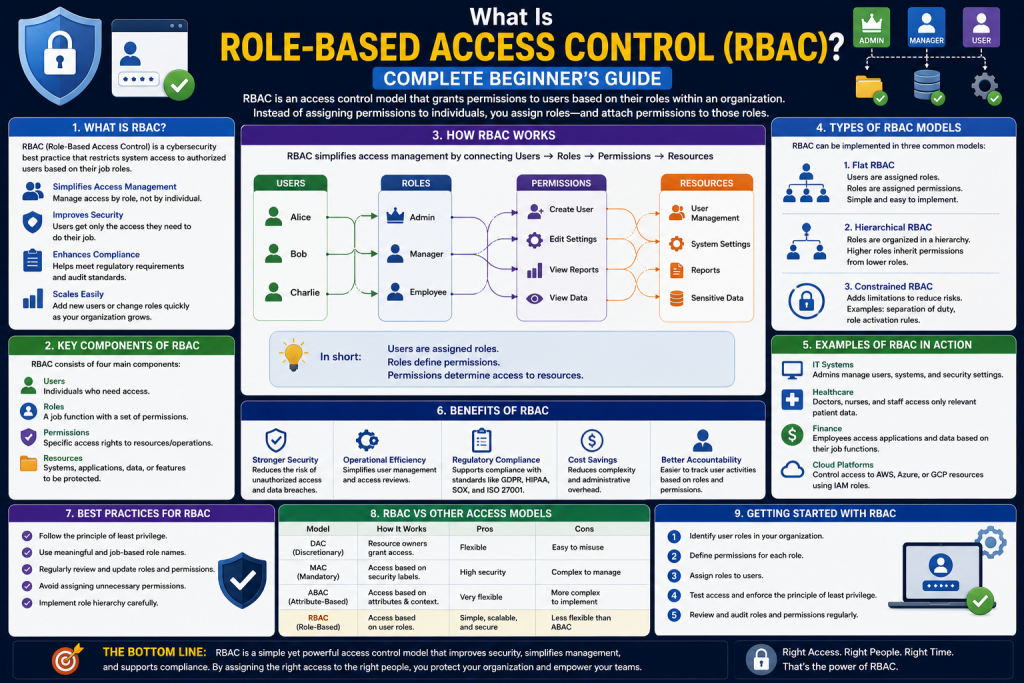
Role-Based Access Control (RBAC) is one of the most widely used security models in modern IT environments. It is designed to regulate who can access specific resources within a system based on their assigned role in an organization. Instead of assigning permissions individually to each user, RBAC simplifies access management by grouping permissions into roles and assigning users to those roles.
This approach significantly reduces administrative workload, especially in large organizations where managing access for hundreds or thousands of users can become complex and error-prone. By centralizing permissions within roles, system administrators can ensure consistency and avoid accidental over-privileging of users. It also improves security by ensuring that users only receive access required for their job responsibilities.
RBAC is highly effective in environments where job functions are clearly defined, such as corporate enterprises, educational institutions, healthcare systems, and government organizations. For example, a hospital may assign doctors, nurses, and administrative staff different roles, each with access limited to relevant systems and patient data.
Another important benefit of RBAC is its scalability. As organizations grow, new employees can be quickly assigned to predefined roles without reconfiguring individual permissions. This makes onboarding and offboarding processes much more efficient.
Additionally, RBAC supports compliance with security standards and regulations by making it easier to audit user access and demonstrate proper control over sensitive information.
This approach significantly improves security, scalability, and administrative efficiency. In large organizations where hundreds or thousands of users interact with sensitive systems daily, RBAC ensures that access is controlled, consistent, and easier to manage.
RBAC is also closely tied to core cybersecurity principles such as the CIA Triad—Confidentiality, Integrity, and Availability. Among these, RBAC primarily strengthens confidentiality by ensuring that sensitive data is only accessible to authorized users.
What is Role-Based Access Control?
Role-Based Access Control is a security mechanism that restricts system access based on roles assigned to users within an organization. Each role is associated with a specific set of permissions that define what actions a user can perform. This model ensures that users are granted access only to the resources necessary for their job responsibilities, reducing the risk of unauthorized access and potential security breaches.
In RBAC, access control is managed at the role level rather than the individual user level, which makes it significantly easier to administer in large and complex systems. Instead of manually assigning permissions to each user, administrators define roles such as “Administrator,” “Manager,” or “Employee,” and assign appropriate permissions to these roles. Users are then mapped to one or more roles depending on their job functions.
This structured approach improves security by enforcing the principle of least privilege, meaning users only receive the minimum level of access required to perform their tasks. It also enhances operational efficiency, as changes in user responsibilities can be managed simply by updating role assignments rather than modifying individual permissions.
Additionally, RBAC supports better auditing and compliance, as organizations can easily track which roles have access to sensitive data and ensure that access policies align with security standards and regulations.
Instead of giving permissions directly to users, RBAC works in a structured way:
- Roles are created based on job functions
- Permissions are assigned to roles
- Users are assigned to one or more roles
For example, a company might define roles such as “HR Manager,” “Finance Officer,” and “IT Administrator.” Each role has predefined permissions aligned with job responsibilities. A finance officer may have access to payroll systems, while an IT administrator may manage servers and network configurations.
This separation ensures users only access what they need to perform their duties.
Core Components of RBAC
RBAC is built on three fundamental components that work together to control access effectively.
Roles
Roles represent job functions within an organization. Each role defines a collection of permissions required to perform specific tasks.
Common examples include:
- Administrator
- Manager
- Employee
- Guest
Roles act as the bridge between users and permissions, making access control more structured and manageable.
Users
Users are individuals who interact with the system. Each user is assigned one or more roles depending on their responsibilities.
For example:
- A system administrator may have multiple roles for different systems
- A regular employee may only have one role tied to their department
Users do not directly receive permissions; instead, they inherit them through roles.
Permissions
Permissions define what actions are allowed on system resources. These can include:
- Read access (view data)
- Write access (modify data)
- Execute access (run programs or scripts)
- Delete access (remove data or resources)
Permissions are assigned to roles, not users, ensuring consistency and reducing administrative workload.
How RBAC Works in Practice
RBAC operates through a simple but powerful structure:
- An organization defines roles based on job responsibilities
- Each role is assigned specific permissions
- Users are assigned to roles
- Users automatically inherit permissions from their roles
For example, if a “Sales Manager” role has access to customer databases, every user assigned to that role will automatically gain the same access without individual configuration.
This model reduces complexity and ensures consistency across the system.
RBAC Compared to Other Access Control Models
To understand the importance of RBAC, it is useful to compare it with other access control methods.
Discretionary Access Control (DAC)
In DAC, resource owners manually decide who gets access. While flexible, this approach can lead to security risks because permissions can become inconsistent or overly permissive.
Mandatory Access Control (MAC)
MAC is a strict model where access is controlled by predefined security policies and classifications. Users cannot change permissions. While highly secure, it is often too rigid for dynamic business environments.
RBAC Advantages Over DAC and MAC
RBAC strikes a balance between flexibility and security:
- More structured than DAC
- More flexible than MAC
- Easier to manage at scale
- Better suited for modern enterprise environments
Advantages of Role-Based Access Control
RBAC offers several key benefits that make it the preferred choice for organizations worldwide.
Improved Security
By limiting access based on roles, RBAC reduces the risk of unauthorized access. Users only receive permissions necessary for their job functions, minimizing exposure to sensitive data.
Simplified Administration
Instead of managing permissions for individual users, administrators manage roles. This significantly reduces complexity and administrative overhead.
Scalability
RBAC is highly scalable. As organizations grow, new users can simply be assigned existing roles without reconfiguring permissions from scratch.
Easier Compliance and Auditing
Regulatory frameworks often require organizations to monitor and audit user access. RBAC simplifies this process by making it easy to review role assignments instead of individual permissions.
Reduced Risk of Human Error
Since permissions are standardized within roles, there is less chance of accidental misconfiguration.
How to Implement RBAC
Implementing RBAC requires careful planning and structured execution. It is typically done in three phases.
Planning Phase
This is the foundation of RBAC implementation.
Identify Roles and Responsibilities
Organizations must analyze job functions and define appropriate roles. Each role should reflect real-world responsibilities.
Map Permissions to Roles
Once roles are defined, appropriate permissions must be assigned. This step requires careful attention to avoid over-privileged or under-privileged roles.
Develop RBAC Policies
Clear policies must be created to define how roles are assigned, managed, and reviewed.
Implementation Phase
This is where RBAC is deployed into the system.
Deploy RBAC Systems
Organizations implement tools or access control systems that enforce RBAC rules.
Integrate with Existing Infrastructure
RBAC must be integrated into existing applications, servers, and databases.
Testing and Validation
Before full deployment, testing ensures that permissions are correctly enforced and no unauthorized access is possible.
Maintenance Phase
RBAC is not a one-time setup; it requires continuous management.
Regular Policy Reviews
Roles and permissions should be reviewed periodically to ensure they remain relevant.
User Lifecycle Management
Access must be updated when users join, change roles, or leave the organization.
Monitoring and Auditing
Continuous monitoring helps detect suspicious activity and ensures compliance with security policies.
Best Practices for RBAC Implementation
To maximize the effectiveness of RBAC, organizations should follow several best practices.
Principle of Least Privilege
Users should only be granted the minimum level of access required to perform their tasks.
Separation of Duties
Critical tasks should be divided among multiple users to prevent fraud or abuse of power.
Regular Access Reviews
Periodic audits ensure that users still have appropriate access based on their current roles.
Employee Training
Employees should understand why access restrictions exist and how to request additional permissions if needed.
Use of Automation Tools
Automation can streamline role assignment, access reviews, and monitoring, reducing manual effort and errors.
Common Challenges in RBAC
Despite its advantages, RBAC can present challenges if not properly managed.
- Role explosion: Too many roles can make the system complex
- Poor role design: Incorrect role definitions lead to security gaps
- Maintenance overhead: Regular updates are required to keep roles accurate
- Lack of governance: Without policies, RBAC can become inconsistent
Addressing these challenges requires careful planning and continuous oversight.
Real-World Use Cases of RBAC
RBAC is used in many industries and systems, including:
- Banking systems for securing financial data
- Healthcare systems for protecting patient records
- Corporate networks for managing employee access
- Cloud platforms for controlling infrastructure access
- Educational institutions for managing student and staff systems
In each case, RBAC ensures secure and efficient access management.
Conclusion
Role-Based Access Control is a foundational security model that helps organizations manage access to sensitive systems in a structured and efficient way. By assigning permissions to roles rather than individual users, RBAC simplifies administration, enhances security, and supports scalability.
It plays a critical role in modern cybersecurity strategies by enforcing the principle of least privilege and reducing the risk of unauthorized access. When properly implemented and maintained, RBAC not only strengthens system security but also improves operational efficiency and compliance.
Organizations that adopt RBAC effectively are better positioned to manage growing infrastructures, protect sensitive data, and maintain strong security governance in an increasingly complex digital environment.
Continue exploring the technologies and certification concepts that matter most to you.