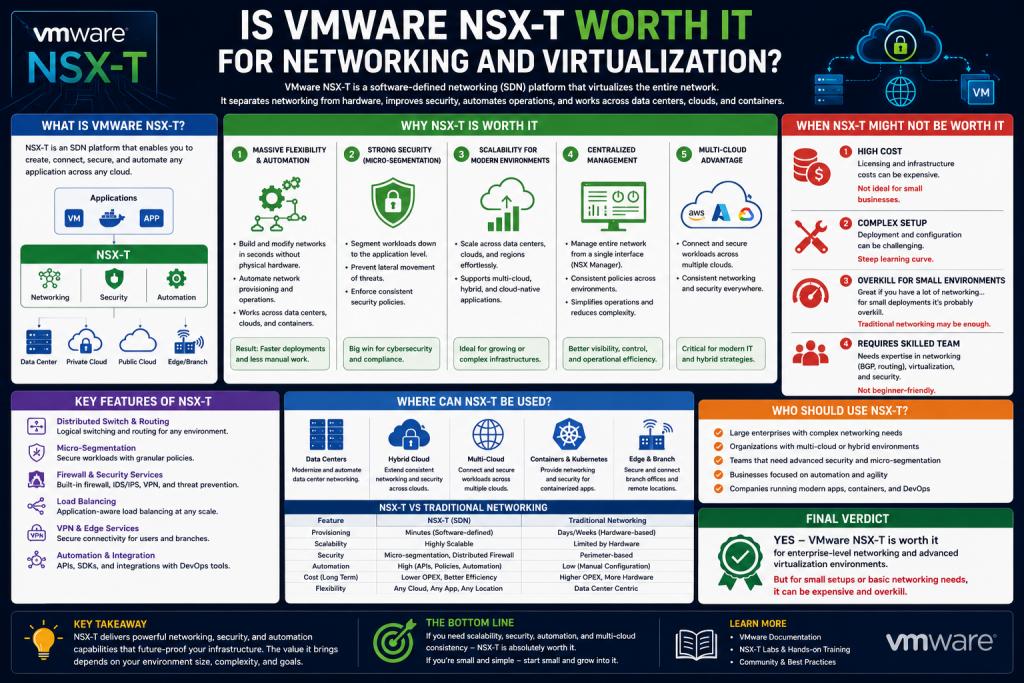
Modern IT environments are no longer limited to traditional physical networks. Organizations are rapidly moving toward cloud computing, hybrid infrastructures, and software-defined systems. In this evolving landscape, network virtualization has become a key technology that allows businesses to manage complex environments with greater flexibility, security, and efficiency. Among the available solutions, VMware NSX-T stands out as one of the most advanced platforms for network virtualization and software-defined networking.
The question many organizations face is whether adopting NSX-T is actually worth the investment. While the platform offers powerful capabilities, it also introduces complexity that requires planning, skilled management, and proper understanding of its architecture. To answer this question, it is important to explore what NSX-T is, how it works, its advantages, challenges, and where it fits in modern IT infrastructure.
What is VMware NSX-T
VMware NSX-T is a network virtualization and security platform designed to create and manage entire networks in software rather than relying only on physical hardware. It allows administrators to build virtual networks that operate independently of the underlying physical infrastructure.
Unlike traditional networking, where routers, switches, and firewalls are hardware-based, NSX-T abstracts these functions into software components. This means networks can be created, modified, or removed quickly without needing physical changes to the data center.
NSX-T is designed for modern, multi-cloud, and multi-platform environments. It supports different types of infrastructures, including on-premises data centers, public clouds, and container-based applications. This flexibility makes it suitable for organizations that operate across diverse environments.
How NSX-T Works
NSX-T works by creating a virtual networking layer on top of existing physical infrastructure. This layer separates network services from hardware, allowing centralized control and automation.
At its core, NSX-T uses several components that work together:
The management layer is responsible for configuration and control. It provides a centralized interface where administrators can define networking and security policies.
The control layer handles network logic and ensures that configurations are properly distributed across the environment.
The data plane is responsible for forwarding traffic between virtual machines, containers, and physical systems based on the defined policies.
By separating these functions, NSX-T allows organizations to manage complex networks with greater precision and consistency.
Key Features of NSX-T
NSX-T provides a wide range of capabilities that make it a powerful solution for modern IT environments.
One of its most important features is network virtualization, which allows the creation of fully isolated virtual networks within the same physical infrastructure. This improves flexibility and reduces dependency on hardware.
Another major feature is micro-segmentation. This enables organizations to apply security policies at a very granular level, even down to individual workloads. It helps reduce the risk of lateral movement by attackers within a network.
NSX-T also supports automation, allowing network configurations and security policies to be deployed programmatically. This reduces manual effort and minimizes human error.
Load balancing is another key capability, ensuring that application traffic is distributed efficiently across resources.
In addition, NSX-T is designed for multi-cloud environments, enabling consistent networking and security policies across private and public cloud platforms.
Why Organizations Use NSX-T
Organizations adopt NSX-T for several strategic reasons. One of the primary motivations is operational efficiency. By virtualizing the network, businesses can reduce the time required to deploy new applications or services.
Security is another major driver. Traditional network security often relies on perimeter-based defenses, but NSX-T enables internal segmentation and policy enforcement closer to workloads. This significantly reduces the attack surface.
Scalability is also a key benefit. As organizations grow, NSX-T allows them to expand their network infrastructure without major physical upgrades.
In addition, NSX-T supports cloud adoption strategies. Many enterprises operate in hybrid or multi-cloud environments, and NSX-T provides a consistent networking model across these platforms.
NSX-T in Modern IT Environments
In today’s IT landscape, applications are increasingly distributed across virtual machines, containers, and cloud services. Traditional networking approaches often struggle to keep up with this level of complexity. As organizations adopt microservices-based architectures and DevOps practices, applications are no longer hosted in a single environment. Instead, they are spread across multiple layers of infrastructure that may include private data centers, public cloud platforms, and edge locations.
This distributed model creates challenges in terms of connectivity, security, and management. Each application component may require its own network rules, routing paths, and security policies, which can quickly become difficult to manage using manual or hardware-based configurations. Traditional networks are often slow to adapt, requiring physical changes or complex reconfigurations that delay deployment and reduce agility.
In contrast, modern networking solutions like NSX-T are designed to address these challenges by abstracting network functions into software. This allows organizations to create and manage virtual networks that can be adjusted dynamically based on application needs. It also enables consistent policy enforcement across all environments, regardless of where workloads are running.
As a result, businesses gain greater flexibility and operational efficiency. They can deploy applications faster, scale resources on demand, and maintain stronger security across distributed systems without being limited by physical infrastructure constraints.
NSX-T addresses this challenge by decoupling networking from physical hardware. This allows organizations to treat their network as software that can be dynamically adjusted based on workload demands.
It is particularly useful in environments where DevOps practices are used. Developers can request network resources as part of application deployment processes, enabling faster delivery cycles and improved collaboration between development and operations teams.
Skills and Expertise Required
Implementing and managing NSX-T requires a certain level of technical expertise. Administrators need a strong understanding of networking concepts such as routing, switching, and firewall policies. In addition to these fundamentals, they must also be comfortable working with virtualized environments where network components are defined in software rather than physical devices. This shift in approach can be challenging for professionals who are more familiar with traditional hardware-based networking.
A solid grasp of IP addressing, subnetting, and network segmentation is essential because NSX-T heavily relies on logical network design. Administrators must also understand how distributed firewalls and virtual routers function within a software-defined infrastructure. Since NSX-T often integrates with cloud platforms and containerized applications, familiarity with cloud computing concepts adds further value.
Beyond networking knowledge, automation and scripting skills are becoming increasingly important. NSX-T supports automation through APIs, which allows organizations to streamline configuration and management tasks. Administrators who can work with automation tools are better positioned to manage large-scale environments efficiently.
Troubleshooting skills are also critical, as identifying issues in a virtualized network can be more complex than in traditional setups. Problems may occur across different layers, including compute, network, and storage, requiring a systematic approach to resolution.
Overall, managing NSX-T demands a combination of traditional networking expertise, virtualization knowledge, and modern automation skills to ensure smooth operation.
In addition, familiarity with virtualization platforms is essential, since NSX-T integrates closely with virtualized environments.
Knowledge of cloud computing and automation tools is also beneficial, as NSX-T is often used in hybrid and multi-cloud architectures.
Because of its complexity, organizations typically invest in training their IT teams before deploying NSX-T in production environments.
Challenges of Using NSX-T
While NSX-T offers significant advantages, it is not without challenges.
One of the main challenges is complexity. The platform introduces advanced networking concepts that may require time to learn and properly implement.
Another challenge is cost. Licensing and infrastructure requirements can be significant, especially for smaller organizations.
Integration with existing systems can also be difficult if legacy infrastructure is involved. Proper planning is necessary to ensure a smooth transition.
Additionally, organizations must ensure they have skilled personnel to manage and maintain the environment effectively. Without proper expertise, the benefits of NSX-T may not be fully realized.
Is VMware NSX-T Worth It
Determining whether NSX-T is worth it depends on the size and needs of an organization. For large enterprises, data centers, and cloud-focused businesses, NSX-T provides substantial value. It becomes especially useful in environments where network traffic is complex, workloads are distributed across multiple platforms, and security requirements are strict. These organizations often manage thousands of virtual machines, applications, and users, so having a centralized and automated way to control networking greatly improves efficiency.
In such environments, NSX-T helps reduce manual configuration work and allows IT teams to deploy network changes much faster. This is important for businesses that need to respond quickly to changing demands, such as scaling applications or launching new services. The platform also enhances security by enabling micro-segmentation, which limits how far an attacker can move within a network if a breach occurs.
Another major advantage is consistency across hybrid and multi-cloud environments. Many enterprises no longer rely on a single data center, and NSX-T ensures that networking policies remain consistent whether workloads are running on-premises or in the cloud. This reduces operational complexity and improves overall control.
However, smaller organizations with simple networking needs may not fully benefit from NSX-T, as the platform is designed for advanced use cases and large-scale infrastructure.
Its ability to automate network management, enhance security, and support multi-cloud environments makes it highly suitable for complex infrastructures.
Organizations that deal with frequent scaling, distributed applications, or strict security requirements will benefit the most from NSX-T.
However, for smaller environments with simple networking needs, the platform may be more complex than necessary. In such cases, the cost and learning curve may outweigh the benefits.
Overall, NSX-T is most valuable when used in environments that require advanced networking, automation, and security across multiple platforms.
Conclusion
VMware NSX-T represents a significant evolution in the way networks are designed and managed. By shifting networking from hardware to software, it enables greater flexibility, scalability, and security in modern IT environments.
While it comes with a learning curve and requires skilled administration, the benefits it provides are substantial for organizations operating at scale or across multiple cloud platforms.
For enterprises seeking to modernize their infrastructure and improve operational efficiency, NSX-T is a powerful and future-ready solution. Its value becomes most evident in complex environments where traditional networking approaches are no longer sufficient.
Continue exploring the technologies and certification concepts that matter most to you.