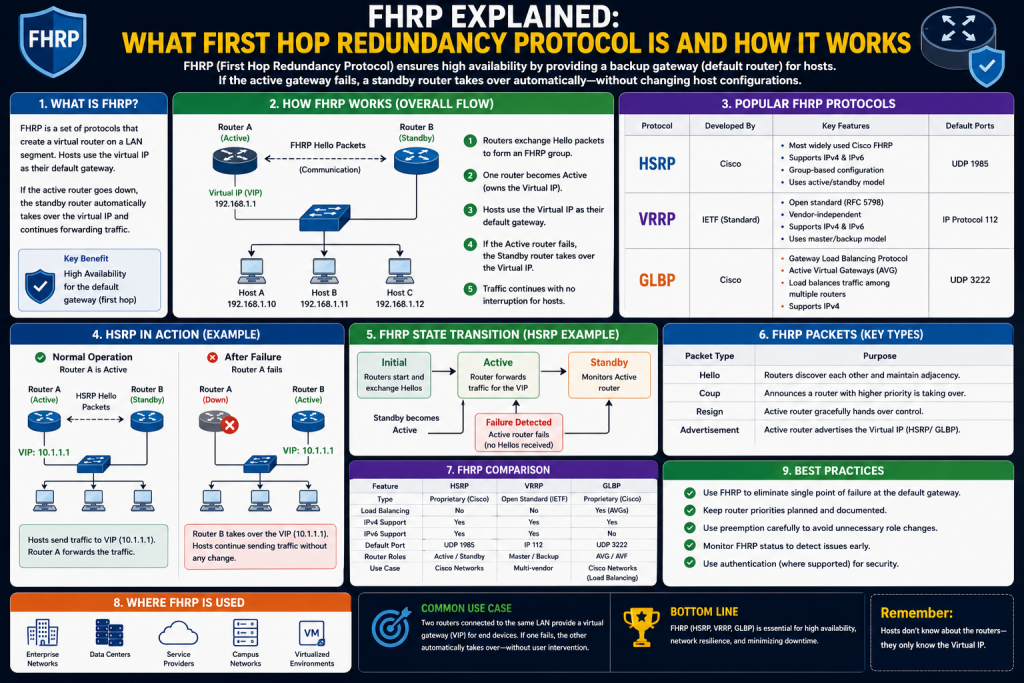
First Hop Redundancy Protocol (FHRP) is a group of networking protocols designed to improve reliability and availability at the network’s default gateway level. In any IP-based network, devices rely on a default gateway to communicate outside their local subnet. If that gateway fails, communication across networks is disrupted, leading to downtime and service interruption. FHRP solves this issue by allowing multiple routers to work together and present a single virtual gateway to connected devices. If one router fails, another immediately takes over without affecting users or applications. This seamless transition is what makes FHRP an essential component in modern enterprise network design.
Understanding Network Redundancy and High Availability
Network redundancy is the practice of building backup components into an infrastructure so that failure of one element does not result in a complete outage. In a typical network, redundancy can be applied to routers, switches, links, power supplies, and even entire data paths. The goal is to eliminate single points of failure that could disrupt services.
High availability is closely related to redundancy but focuses more on maintaining continuous service with minimal downtime. Organizations often aim for near-perfect uptime, where even a few minutes of disruption per year is considered unacceptable. To achieve this level of availability, networks must include automated failover systems, fast detection of failures, and mechanisms that allow services to continue without interruption. FHRP plays a key role in this strategy by ensuring that the default gateway remains available at all times.
What is First Hop Redundancy Protocol (FHRP)
FHRP is specifically designed to address the risk of default gateway failure in IP networks. The default gateway is the first device a host communicates with when sending traffic outside its local network. If this device becomes unavailable, communication stops completely. FHRP prevents this by creating a virtual router that multiple physical routers share.
Instead of configuring devices with a single physical router as their gateway, they are configured with a virtual IP address. Behind this virtual address, multiple routers work together to provide redundancy. One router actively handles traffic, while others remain in standby mode, ready to take over if needed. This ensures continuous connectivity even if a router experiences failure or maintenance downtime.
Importance and Benefits of FHRP
The primary purpose of FHRP is to eliminate the default gateway as a single point of failure. In traditional network setups, if the gateway router goes offline, all connected devices lose external connectivity. FHRP resolves this vulnerability by introducing automatic failover capabilities.
One of the most important benefits of FHRP is uninterrupted network access. Users do not experience disconnection during a failover because the transition happens quickly and transparently. Another advantage is improved reliability, as multiple routers share responsibility for gateway services. In some implementations, traffic distribution across multiple routers can also improve efficiency and performance.
FHRP also reduces operational complexity during failures. Without it, administrators would need to manually reconfigure devices or intervene physically when a router goes down. With FHRP, failover is automatic, reducing downtime and operational overhead.
Types of FHRP Protocols
There are several implementations of FHRP, each with different characteristics and use cases.
Hot Standby Router Protocol is a widely used Cisco-developed solution. It operates in an active-standby model where one router actively forwards traffic while others remain ready to take over. It uses priority settings and virtual addressing to manage failover behavior.
Virtual Router Redundancy Protocol is an open standard used across different vendor devices. It functions similarly to HSRP but allows better interoperability in mixed environments. VRRP is commonly used in multi-vendor networks due to its standardized nature.
Gateway Load Balancing Protocol is another Cisco-based solution that not only provides redundancy but also distributes traffic across multiple active routers. This improves resource utilization and performance in addition to redundancy.
Common Address Redundancy Protocol is an open-source alternative often used in BSD-based systems. It was developed to avoid licensing issues associated with other protocols while still offering reliable failover capabilities.
How FHRP Works in a Network
FHRP operates by forming a virtual router group. Multiple physical routers are configured to participate in this group and share a virtual IP address. This virtual IP is configured as the default gateway on client devices.
Within the group, one router is selected as the active device. This router handles all traffic directed to the virtual gateway. The remaining routers act as backups, continuously monitoring the active router’s status through periodic messages known as hello packets.
If the active router fails to send these messages within a defined time period, the standby routers detect the failure. A new election process then begins to determine which router will take over as the active device. This decision is typically based on priority values configured by the administrator. The router with the highest priority becomes the new active gateway.
Once the new router takes over, it assumes the virtual IP and MAC address, ensuring that connected devices do not detect any change. Traffic continues to flow normally, and users remain unaware that a failover has occurred.
Failover and Convergence Process
Failover is the process of switching from a failed active router to a backup router. This process is designed to be automatic and extremely fast. The speed at which the network converges to a new active state is known as convergence time.
Modern FHRP implementations are optimized for rapid convergence, often completing failover in less than a second. This ensures minimal or no disruption to active sessions such as video calls, file transfers, or web browsing.
The effectiveness of failover depends on proper configuration of timers, priority settings, and tracking mechanisms that monitor router health and connectivity.
Implementing FHRP in Network Design
Implementing FHRP requires careful planning. Administrators must decide how many routers will participate in redundancy, how priorities will be assigned, and how failover behavior should be controlled.
Best practices include enabling authentication between routers to prevent unauthorized participation in the redundancy group. Tracking mechanisms should also be configured so that routers can detect not only device failure but also upstream connectivity issues.
Preemption settings determine whether a higher-priority router can automatically reclaim its active role after recovery. While useful, this feature must be configured carefully to avoid unnecessary switching between devices.
Proper documentation of virtual IP addresses and configuration details is also essential for long-term maintenance and troubleshooting.
Security Considerations in FHRP
Although FHRP improves reliability, it also introduces potential security concerns if not properly secured. Unauthorized devices could attempt to join the redundancy group and disrupt traffic flow. To prevent this, authentication mechanisms should always be enabled between participating routers. In addition, network administrators should use strong key-based authentication rather than simple passwords to reduce the risk of spoofing attacks. Access control lists can also be applied to restrict which devices are allowed to send or receive FHRP messages. Regular monitoring is important to detect unusual behavior, such as unexpected changes in active routers or suspicious failover events within the network environment.
Access control measures can also be applied to restrict FHRP-related traffic. Monitoring tools should be used to detect unusual behavior, such as unexpected router advertisements or frequent role changes. Keeping firmware updated is also important to protect against known vulnerabilities.
FHRP in Modern Network Environments
Modern networking environments, including cloud systems and software-defined networks, have introduced new approaches to redundancy. However, the core principles of FHRP remain relevant. Even in virtualized environments, the need for a reliable default gateway still exists.
In IPv6 networks, updated versions of redundancy protocols provide similar functionality with improved scalability. In cloud infrastructures, redundancy is often built into the platform itself, but enterprise hybrid networks still rely on traditional FHRP concepts.
As networks continue to evolve, FHRP remains a foundational concept for ensuring gateway availability and resilience.
Challenges and Limitations of FHRP
Despite its advantages, FHRP has some limitations. One challenge is compatibility across different vendors, as not all implementations work seamlessly together. This can complicate network design in multi-vendor environments. In addition, troubleshooting FHRP issues can become difficult when multiple routers and protocols are involved, especially in large-scale networks. Misconfiguration of priorities, timers, or authentication settings may lead to unexpected failovers or even network instability. Another concern is that FHRP does not eliminate all single points of failure, such as upstream routing issues or core network failures. Therefore, it must be combined with other redundancy mechanisms for complete resilience and proper end-to-end network availability.
Configuration complexity is another factor. Proper setup requires careful tuning of priorities, timers, and tracking mechanisms. Misconfiguration can lead to unstable behavior or unexpected failovers.
There is also a small amount of overhead associated with maintaining heartbeat communication between routers. While minimal, it can become noticeable in very large-scale deployments.
Conclusion
First Hop Redundancy Protocol is a critical technology for building resilient and highly available networks. By eliminating the default gateway as a single point of failure, it ensures continuous connectivity even during router outages. Through virtual routing, automatic failover, and fast convergence, FHRP plays a key role in modern enterprise network design.
Understanding how FHRP works and how to implement it properly allows network engineers to build systems that are both reliable and scalable. As network environments continue to grow in complexity, FHRP remains an essential tool for maintaining uninterrupted communication and ensuring business continuity.
Continue exploring the technologies and certification concepts that matter most to you.