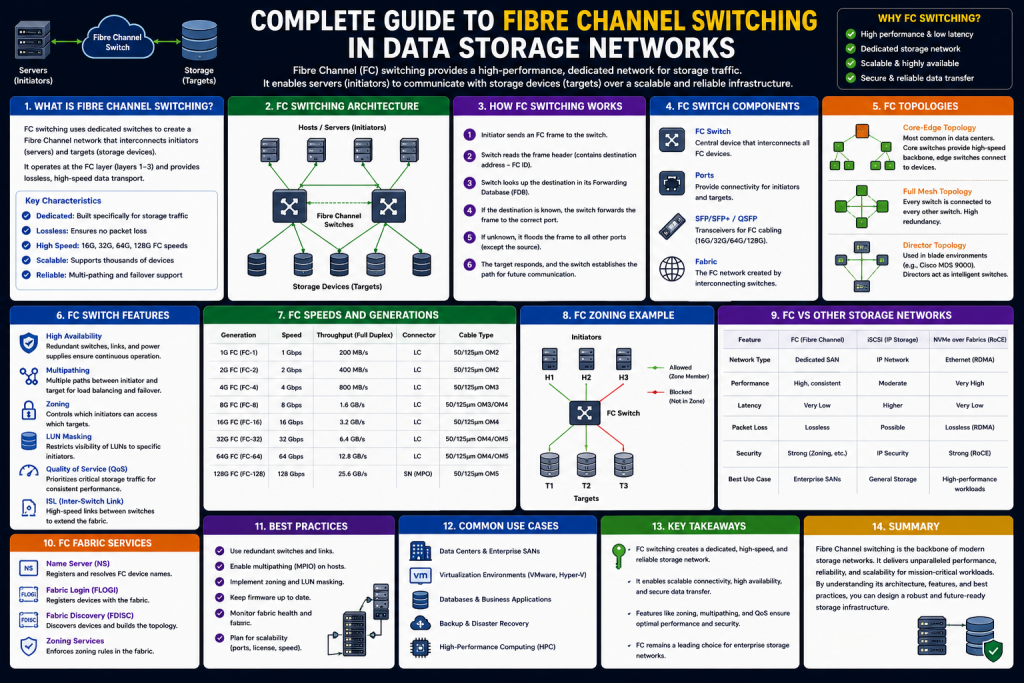
Fibre Channel switching is a core technology used in enterprise storage networks to enable fast, reliable, and scalable communication between servers and storage systems. It is primarily designed for environments where large volumes of data must be transferred with minimal delay and maximum stability, such as data centers, cloud infrastructure, and enterprise storage area networks.
Unlike general-purpose networking technologies, Fibre Channel is optimized specifically for storage traffic. It uses a dedicated architecture that reduces congestion and ensures predictable performance. To understand Fibre Channel switching clearly, it is important to explore its purpose, components, working principles, and real-world applications.
Understanding Fibre Channel Technology
Fibre Channel is a high-speed networking technology developed to connect storage devices and servers in a specialized environment known as a storage area network. It allows devices to communicate efficiently without relying on traditional Ethernet networks, which can become overloaded with mixed traffic.
The main goal of Fibre Channel is to provide fast, lossless data transfer. This makes it highly suitable for critical applications such as database systems, virtualization platforms, and large-scale analytics workloads.
Fibre Channel has been in use for decades, but it continues to evolve to meet modern data demands. Even with the rise of newer technologies, it remains a trusted choice in enterprise storage due to its stability and performance.
What Fibre Channel Switching Means
Fibre Channel switching refers to the use of specialized network switches that manage and direct data flow within a Fibre Channel network. These switches form the backbone of a structure known as a switched fabric.
A switched fabric is a network topology where multiple devices are interconnected through intelligent switches. Instead of devices communicating directly or through a simple shared medium, the switches actively control how data travels between servers and storage systems.
This switching mechanism ensures that data takes the most efficient path, reduces bottlenecks, and supports multiple simultaneous connections without performance degradation.
Why Fibre Channel Switching is Important
Modern organizations deal with massive volumes of data that must be accessed quickly and reliably. Traditional networking methods can struggle under heavy storage workloads because they mix different types of traffic, such as internet browsing, email, and file sharing.
Fibre Channel switching solves this problem by creating a dedicated pathway for storage communication. This separation improves performance, reduces latency, and ensures consistent throughput.
Another important advantage is reliability. Fibre Channel networks are designed to maintain stable connections even under heavy load. This makes them ideal for mission-critical systems where downtime is not acceptable.
Key Components of Fibre Channel Networks
A Fibre Channel environment consists of several important hardware and software components working together to form a complete storage network.
One of the most important components is the Host Bus Adapter. This is a specialized interface installed in servers that allows them to connect to the Fibre Channel network. It handles communication between the server and storage devices efficiently.
Another essential component is the Fibre Channel switch. These switches manage data flow within the storage network and ensure that information is delivered to the correct destination without delay.
Cabling and transceivers are also critical. Fibre Channel commonly uses optical fiber cables, which allow data to travel at extremely high speeds over long distances. In some cases, copper cables may be used for shorter connections.
Storage arrays, servers, and controllers also form part of the ecosystem, working together to store, retrieve, and manage data across the network.
How Fibre Channel Switching Works
The working process of Fibre Channel switching is based on intelligent routing within a switched fabric.
When a server needs to access data from a storage device, the request is sent through its Host Bus Adapter. The Fibre Channel switch receives this request and determines the best available path to the storage system.
Once the request enters the Fibre Channel fabric, the switch performs a process known as intelligent frame forwarding. It examines the destination address of the data packet and checks its internal routing tables to identify the most efficient route. These routing tables are continuously updated to reflect the current state of the network, including active connections, available ports, and potential congestion points. This allows the switch to make real-time decisions that optimize performance.
The Fibre Channel switch also ensures that the connection between the server and storage device is isolated from other traffic flows. This creates a dedicated communication path, often referred to as a virtual circuit, which prevents interference from other simultaneous data transfers. As a result, multiple servers can communicate with different storage devices at the same time without slowing each other down.
In addition, the switch supports load balancing by distributing traffic evenly across multiple available paths when more than one route exists. This improves overall network efficiency and reduces the risk of bottlenecks. If a preferred path becomes unavailable due to a failure or maintenance, the switch automatically reroutes traffic through an alternative path, ensuring continuous and reliable access to storage resources.
Instead of broadcasting the request across the entire network, the switch creates a dedicated connection between the server and storage device. This direct communication path remains active only for the duration of the data transfer.
Once the transfer is complete, the connection is released, allowing the switch to handle new requests efficiently. This dynamic process ensures high performance and efficient use of network resources.
Fibre Channel Protocol and Communication
Fibre Channel communication follows a set of rules known as the Fibre Channel Protocol. This protocol defines how data is packaged, transmitted, and received across the network.
It ensures that communication between devices is consistent and error-free. The protocol also supports features like flow control, which prevents data overload and ensures smooth transmission even under heavy workloads.
In some environments, Fibre Channel traffic can also be carried over Ethernet networks using specialized techniques. This allows organizations to integrate storage traffic into existing network infrastructure while maintaining performance benefits.
Role of Switching in Storage Area Networks
Fibre Channel switching plays a central role in Storage Area Networks, which are dedicated networks designed for high-speed data storage access.
In a Storage Area Network, multiple servers connect to centralized storage systems. Fibre Channel switches manage all communication between these devices, ensuring that data flows efficiently and without interference.
These switches act as intelligent intermediaries that control how data is transmitted across the storage fabric. Instead of allowing uncontrolled or shared communication paths, they create dedicated and optimized routes for each data transfer session. This reduces congestion and ensures that storage traffic does not compete with other types of network traffic. As a result, performance remains consistent even when many servers are accessing storage at the same time.
Fibre Channel switches also improve scalability in the environment. As organizations grow, additional servers and storage devices can be added to the network without redesigning the entire infrastructure. The switching fabric automatically adapts to new connections and maintains efficient routing between all nodes. This flexibility is one of the main reasons Fibre Channel is widely used in enterprise data centers.
Another important role of these switches is maintaining low latency. Since storage operations often require real-time access to data, even small delays can impact application performance. Fibre Channel switching minimizes these delays by ensuring direct and fast communication paths.
Additionally, these switches provide redundancy and fault tolerance. If one path fails, traffic can be redirected through alternate routes, maintaining uninterrupted access to critical data.
This architecture is widely used in enterprise environments where performance, scalability, and reliability are critical. It allows organizations to expand storage capacity without significantly impacting network performance.
Fibre Channel vs Traditional Ethernet Networks
One of the key differences between Fibre Channel and traditional Ethernet networks lies in their purpose and design.
Ethernet is a general-purpose networking technology used for everyday communication, such as internet access, file sharing, and application connectivity. It is flexible and cost-effective but can become congested when handling large storage workloads.
Fibre Channel, on the other hand, is designed exclusively for storage traffic. It provides a dedicated, high-speed, and lossless environment that ensures consistent performance.
While Ethernet continues to improve with technologies like data center bridging, Fibre Channel remains the preferred choice for environments that require maximum reliability and performance.
Fibre Channel in Modern Data Centers
In modern data centers, Fibre Channel switching is widely used to support virtualization, cloud computing, and large-scale data processing.
Virtual machines often require fast access to shared storage systems, and Fibre Channel provides the necessary speed and stability. Similarly, cloud service providers rely on Fibre Channel networks to ensure that customer data is stored and retrieved efficiently.
As data continues to grow, the importance of scalable storage networks increases. Fibre Channel switching allows organizations to expand their infrastructure without sacrificing performance.
Advantages of Fibre Channel Switching
One of the biggest advantages of Fibre Channel switching is its high performance. It is designed to handle large amounts of data with minimal delay.
Another advantage is reliability. Fibre Channel networks are highly stable and are built to avoid packet loss, which is critical for storage operations.
Scalability is also a major benefit. Organizations can easily add more switches, servers, and storage devices without disrupting existing operations.
Security is another strength. Because Fibre Channel networks are separate from general-purpose networks, they reduce exposure to external threats.
Challenges of Fibre Channel Switching
Despite its advantages, Fibre Channel switching also has some challenges.
One of the main challenges is cost. Fibre Channel hardware, including switches and adapters, can be more expensive than standard Ethernet equipment.
It also requires specialized knowledge to configure and manage. Network administrators need training and experience to design and maintain Fibre Channel environments effectively.
Additionally, integrating Fibre Channel with other network types can sometimes be complex, especially in hybrid infrastructures.
Fibre Channel Use Cases
Fibre Channel switching is commonly used in industries that require high-performance storage systems.
In finance, it supports real-time transaction processing and risk analysis systems.
In healthcare, it helps manage large volumes of patient data, medical imaging, and research information.
In telecommunications, it supports backend systems that handle customer data and service delivery.
In media and entertainment, it is used for storing and processing large video and audio files.
Future of Fibre Channel Technology
Although newer storage networking technologies continue to emerge, Fibre Channel remains highly relevant.
It continues to evolve with improvements in speed, efficiency, and integration capabilities. Many organizations still rely on it for mission-critical applications where stability and performance are essential.
As data demands grow, Fibre Channel switching will likely continue to play an important role in enterprise storage infrastructure, especially in environments where predictable performance is required.
Conclusion
Fibre Channel switching is a specialized networking technology designed to support high-speed, reliable, and scalable storage communication. It operates through intelligent switches that form a switched fabric, allowing servers and storage systems to communicate efficiently.
Its ability to deliver consistent performance makes it a preferred choice for enterprise data centers and storage area networks. Although it requires investment and technical expertise, the benefits in terms of speed, reliability, and scalability make it a valuable part of modern IT infrastructure.
As organizations continue to generate and process massive amounts of data, Fibre Channel switching remains a trusted solution for ensuring that storage systems operate smoothly and efficiently.
Continue exploring the technologies and certification concepts that matter most to you.