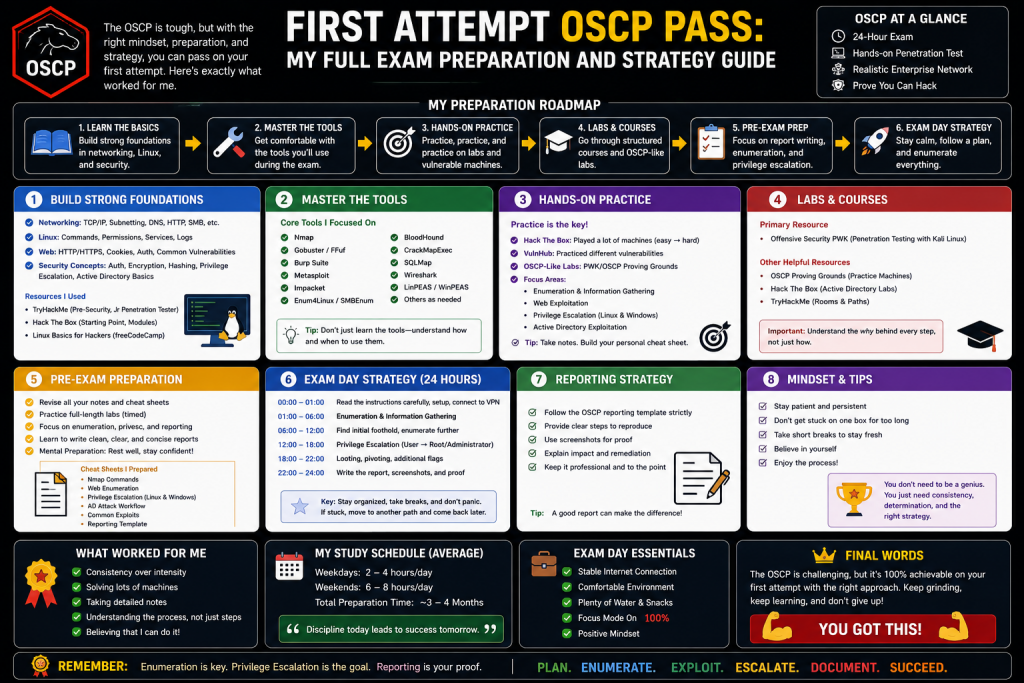
Passing the OSCP certification exam was one of the most demanding professional challenges I have ever faced. It required long hours of study, practical experimentation, and a strong ability to stay calm under pressure. There were moments during my preparation when I seriously questioned whether I was ready or even capable of completing it. The workload felt intense, and the learning curve was steep, but the process also became one of the most rewarding experiences of my cybersecurity journey.
What made the OSCP unique was not just the technical difficulty but the mindset it required. It was not about memorizing concepts but about applying them in real environments under time constraints. I had to build confidence in enumeration, exploit development basics, privilege escalation, and lateral movement across systems. Over time, I developed a structured approach that helped me stay focused and eventually succeed on my first attempt.
This is a breakdown of how I prepared, what strategies worked, what I would improve, and how I approached the exam itself.
Understanding the Preparation Strategy
Before starting formal training, I realized the importance of planning. The OSCP is not just another certification; it requires consistent effort over weeks or months. Since access to labs and course material is time-limited, I needed to ensure I was already comfortable with foundational skills before the clock started. I also treated this phase as a way to reduce future pressure by eliminating weak areas early.
By identifying gaps in networking, Linux usage, and scripting beforehand, I was able to enter the training with more confidence. This preparation mindset helped me stay organized and made the learning process smoother once I officially began the course.
One of the biggest mistakes learners make is jumping into the course without preparation. I avoided that by first strengthening my understanding of core systems and tools. I treated preparation as a separate phase rather than rushing directly into the official material.
The key idea was simple: reduce surprises during the actual course so that most of my time could be spent on practice and exploitation rather than basic learning.
Strengthening Networking Fundamentals
Networking knowledge is essential for penetration testing. I focused heavily on understanding how data moves across systems, how IP addressing works, and how ports and services communicate.
I made sure I understood concepts like subnetting, routing basics, DNS resolution, and TCP vs UDP behavior. These concepts are critical because almost every penetration testing task depends on correctly identifying how a system communicates.
Instead of just reading theory, I practiced using tools like packet analysis utilities and basic network scanning. This helped me connect theoretical concepts to real traffic behavior. Once I became comfortable with these fundamentals, identifying attack surfaces in lab environments became much easier.
Building Linux Skills for Practical Use
Linux played a major role in my preparation. At first, I was not very confident using the terminal, but I quickly realized that penetration testing requires strong command-line fluency.
I started with basic concepts like file permissions, directory structures, and process management. I also learned how users and groups work in Linux environments. This helped me understand how privilege escalation often occurs due to misconfigurations. As I went deeper, I began exploring how different permission levels interact with system files and services, especially in cases where improper configurations could expose sensitive data or allow unauthorized access. I practiced identifying files with special permissions, such as SUID and SGID bits, and learned how these could be abused to gain elevated privileges.
In addition, I spent time understanding how processes run in the background and how services are managed within the system. This included analyzing running processes, checking scheduled tasks like cron jobs, and reviewing configuration files that might contain hardcoded credentials or weak settings. I also explored environment variables and PATH misconfigurations, which are often overlooked but can provide useful attack vectors.
By combining all of these concepts, I developed a more complete understanding of how Linux systems operate under normal conditions and how small misconfigurations can create serious security weaknesses. This hands-on practice made it much easier to recognize privilege escalation opportunities during real-world scenarios and lab exercises.
After that, I moved to more practical exercises where I interacted with virtual systems. I practiced navigating file systems, searching for sensitive files, and manipulating permissions. These exercises helped me become more comfortable working entirely in a terminal environment.
Over time, I became faster at identifying useful files, misconfigurations, and system weaknesses.
Developing Bash and Python Scripting Skills
Although the OSCP does not require advanced programming, basic scripting knowledge is extremely useful. I focused on understanding how simple Bash and Python scripts work rather than writing complex programs. This helped me interpret automation scripts used in penetration testing tools and modify them when needed for specific tasks. I also practiced reading code to understand logic flow, which made it easier to troubleshoot issues during exploitation.
In many cases, small script adjustments saved a significant amount of time during repetitive tasks like scanning or data extraction. This foundational knowledge improved my efficiency and made my workflow more flexible in real testing scenarios.
The goal was to be able to read scripts, modify them slightly, and understand what they were doing during exploitation. Many tools used in penetration testing rely on scripting, so even basic familiarity made a big difference.
I practiced working with simple automation tasks like scanning ports, parsing output, and handling network connections. This helped me save time during lab work because I could automate repetitive tasks instead of doing everything manually.
Practicing with Virtual Lab Environments
Before starting the official course, I spent time practicing in external lab environments. This helped me understand how real-world vulnerabilities appear in systems.
These practice environments introduced me to enumeration techniques, service discovery, and basic exploitation workflows. I became familiar with tools used for scanning, testing vulnerabilities, and gaining initial access.
The most important lesson I learned during this stage was the importance of enumeration. Almost every successful attack began with thorough information gathering. I trained myself to never rush into exploitation without fully understanding the target system.
Starting the Official OSCP Course Material
When I began the official course material, I focused primarily on the written content. It provided structured guidance on penetration testing methodologies, tools, and techniques.
The material gradually introduced more advanced topics like buffer overflows and exploit usage. Instead of rushing through, I made sure I fully understood each section before moving forward.
I also completed most of the exercises provided throughout the course. Even though they were time-consuming, they reinforced key concepts and helped me prepare for the exam environment.
Documenting my work during these exercises also helped me later when preparing reports, which is an important part of the certification process.
Working Through the Lab Environment
The lab environment was where most of my real learning happened. It simulated a network with multiple systems that required exploitation and lateral movement.
I started by scanning systems and identifying potential entry points. Initially, progress was slow, but as I gained experience, I became more efficient at spotting vulnerabilities.
One of the most important skills I developed in the lab was pivoting between systems. Some machines acted as gateways to other internal networks, and compromising them allowed access to more complex environments.
Over time, I was able to compromise multiple systems and move deeper into the network structure. This phase built my confidence significantly because it closely resembled real-world penetration testing scenarios.
Managing Study Time Effectively
Time management played a critical role throughout my preparation. I structured my study sessions into focused blocks and avoided burnout by taking regular breaks.
On average, I studied for several hours a day, balancing preparation with work and personal responsibilities. Consistency was more important than intensity. Even short daily practice sessions helped reinforce my skills.
I also made sure to review my progress regularly and adjust my learning approach when needed. If I struggled with a topic, I revisited it multiple times instead of moving on too quickly.
Approaching Exam Day
On the day of the exam, preparation shifted from learning to execution. The exam required compromising multiple systems within a strict time limit, followed by detailed documentation.
I ensured that my workspace was ready, with all necessary tools and notes prepared in advance. Staying calm was extremely important because stress can easily lead to mistakes.
During the exam, I focused on structured methodology: enumeration first, followed by targeted exploitation. If I got stuck on a system, I moved on and returned later with a fresh perspective. I made sure not to waste too much time on a single machine because time management was critical for completing all required objectives. I also kept detailed notes for every step so I could easily revisit earlier findings without starting from scratch. Whenever I returned to a system, I often noticed details I had missed before, which helped me progress further. This approach kept my workflow efficient and reduced stress during difficult moments.
Breaks were essential. Stepping away for a few minutes helped me reset my thinking and avoid frustration.
Careful note-taking was also crucial because the final report required detailed documentation of every step taken during exploitation.
Conclusion
Passing the OSCP certification on my first attempt was the result of consistent preparation, structured learning, and disciplined execution. The journey required patience, persistence, and a willingness to learn from mistakes.
The most important takeaway was that success in this certification is not about memorizing techniques but about developing a methodical approach to problem-solving. Every system teaches something new, and every challenge builds deeper understanding.
Looking back, the effort was worth it. The skills gained during preparation have had a lasting impact on my cybersecurity knowledge and practical abilities.
Continue exploring the technologies and certification concepts that matter most to you.