Not all network traffic carries the same importance. In any modern network, some applications require faster delivery and higher priority, while others can tolerate delays without affecting user experience. For example, voice calls and video conferencing demand smooth, real-time delivery, while file downloads or background updates are less sensitive to delays.
This is where Quality of Service becomes essential. Quality of Service is a collection of techniques used in networking to manage and prioritize traffic so that critical applications perform reliably even when network resources are limited. Instead of treating all packets equally, QoS allows networks to make intelligent decisions about which traffic should be prioritized, delayed, limited, or dropped.
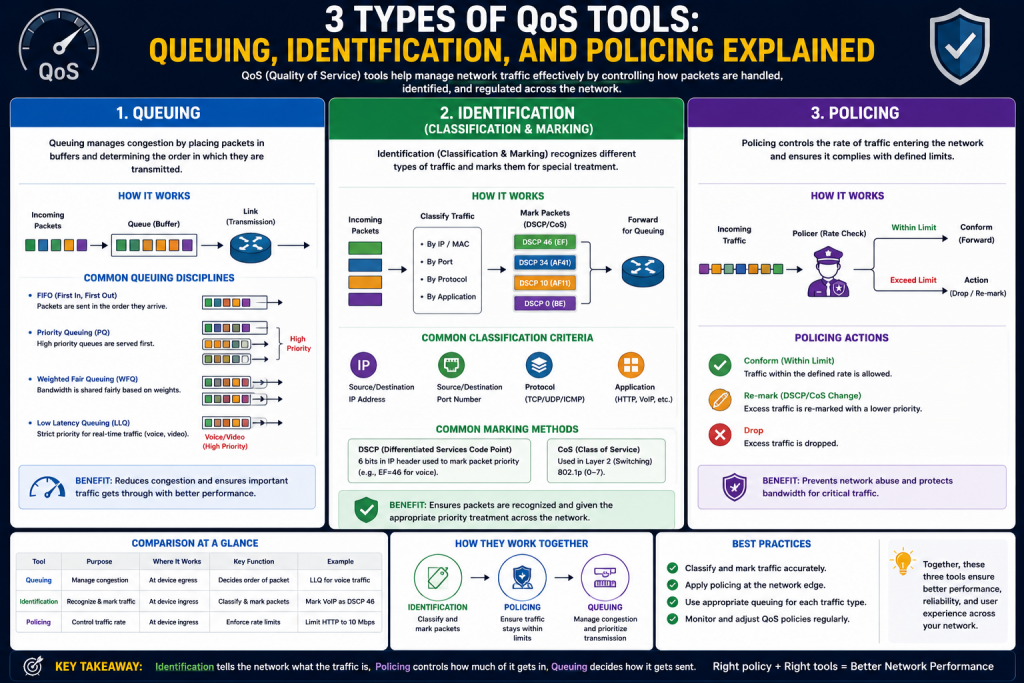
QoS is not a single tool or feature. It is a combination of multiple mechanisms that work together to manage traffic efficiently. Among these mechanisms, three of the most important and widely used categories are identifying traffic, queuing traffic, and policing traffic. Each plays a unique role in ensuring smooth and controlled data flow across a network.
Understanding Quality of Service in Networking
In a busy network, congestion is a common challenge. When too many devices try to send data at the same time, packets can be delayed, dropped, or delivered out of order. This can seriously affect performance, especially for real-time applications like VoIP calls or live video streaming.
Quality of Service helps solve this problem by creating rules that determine how traffic should be handled. Instead of treating all data equally, QoS assigns priority levels based on the type of traffic, its importance, and its requirements.
Some traffic may be marked as high priority and sent first, while less important traffic may be delayed or limited. This ensures that essential services continue to function smoothly even under heavy network load.
To achieve this, QoS uses several tools and techniques, but they generally fall into three major functional categories: identifying traffic, queuing traffic, and policing traffic.
Identifying Traffic in QoS
Before a network can prioritize traffic, it must first understand what type of traffic it is dealing with. This process is known as identifying or classifying traffic.
Identification is the foundation of QoS because it allows network devices to recognize different types of data streams. Without identification, all packets would look the same, making prioritization impossible.
Traffic identification is typically based on characteristics such as source and destination addresses, port numbers, or application signatures. For example, voice traffic used in calls can be identified separately from web browsing or file transfers. This process allows network devices to clearly understand what type of data is passing through them and how it should be handled. In more advanced systems, deep packet inspection techniques are also used to analyze the actual content of the data packets, providing even more accurate identification of applications and services.
Once traffic is identified, it can be grouped into specific classes based on its importance and performance requirements. These classes help the network decide which type of traffic should receive higher priority and which can be delayed during congestion. For instance, real-time communication like VoIP and video conferencing is often placed in high-priority classes because they are sensitive to delays and packet loss. On the other hand, background activities such as software updates or large file downloads are assigned lower priority since they are less time-sensitive.
Traffic identification is also essential for applying security and bandwidth policies effectively. It ensures that critical business applications receive the resources they need while limiting unnecessary or non-essential traffic. This structured approach improves overall network efficiency, stability, and user experience across all connected services.
Once traffic is identified, it can be assigned to a specific category or class. These classes help the network decide how to treat each type of traffic. For instance, voice and video traffic may be placed in a high-priority class, while bulk data transfers may be placed in a lower-priority class.
Modern networks often use advanced techniques to identify traffic more accurately. Instead of relying only on basic rules like port numbers, deeper inspection methods can analyze packet content to determine the exact application generating the traffic.
The goal of identification is not to modify or control traffic directly, but to prepare it for further QoS actions such as queuing or policing.
Queuing in QoS
Once traffic is identified, it must be managed when network congestion occurs. This is where queuing becomes important.
Queuing is the process of organizing packets into different waiting lines before they are transmitted. When a network device becomes busy and cannot send all packets immediately, it stores them temporarily in queues.
The key idea behind queuing is prioritization. Some queues are given higher priority than others, meaning packets in those queues are sent first. This ensures that important traffic experiences minimal delay even during congestion.
For example, voice packets may be placed in a high-priority queue so they are transmitted immediately, while large file downloads may be placed in a lower-priority queue and sent later.
Different queuing strategies exist, but they all aim to manage limited bandwidth efficiently. Some methods focus on strict priority, while others divide bandwidth fairly among different traffic classes.
Queuing is especially important for real-time applications. Even small delays can affect call quality or video playback, so prioritizing these packets ensures a smoother user experience.
However, queuing does not eliminate congestion. Instead, it manages how congestion is handled by controlling the order in which packets are sent.
Policing in QoS
While queuing manages traffic inside the network, policing controls how much traffic is allowed to enter or pass through a network link.
Policing is a strict traffic control method that enforces predefined limits. If traffic exceeds the allowed rate, excess packets are either dropped or marked for lower priority handling.
This helps prevent any single application or user from consuming too much bandwidth and affecting others on the network.
For example, if a network administrator sets a bandwidth limit for video streaming traffic, policing ensures that once that limit is reached, additional video packets are discarded or downgraded.
Unlike queuing, policing does not store excess traffic for later delivery. Instead, it enforces limits immediately, which makes it a more aggressive form of traffic control.
Policing is often used in environments where strict bandwidth control is necessary, such as service provider networks or enterprise networks with shared resources.
It is particularly useful for preventing abuse, controlling unnecessary traffic, and maintaining fairness among users.
How These Three QoS Tools Work Together
Identifying, queuing, and policing are not isolated tools. They work together as part of a complete QoS strategy.
First, traffic is identified and classified so the network understands what type of data it is dealing with. Next, policies are applied to decide how that traffic should be treated. Finally, queuing and policing mechanisms enforce those policies during actual data transmission. This entire process ensures that the network operates in a structured and predictable way even under heavy load. It also allows administrators to control bandwidth usage, reduce congestion, and maintain consistent performance for critical applications. By combining these steps, QoS creates an efficient traffic management system that adapts to real-time network conditions and helps different services coexist without interfering with each other’s performance or reliability.
For example, once voice traffic is identified, it may be assigned to a high-priority class. During congestion, queuing ensures it is transmitted first, while policing ensures that no single voice stream consumes more bandwidth than allowed.
Similarly, less important traffic such as file downloads may be placed in lower priority queues and may also be subject to stricter policing rules.
Together, these tools allow networks to operate efficiently even under heavy load.
Importance of QoS in Modern Networks
As networks continue to grow in size and complexity, QoS becomes increasingly important. Modern networks support cloud applications, remote work, video conferencing, online gaming, and IoT devices all at the same time. This creates a highly competitive environment for bandwidth, where different types of traffic constantly compete for priority and resources. Without proper QoS mechanisms in place, delays, jitter, and packet loss can easily occur, leading to poor application performance and frustrated users. Organizations rely on QoS to ensure that mission-critical services such as voice calls, real-time collaboration tools, and business applications remain stable even during peak usage. At the same time, QoS helps balance the load by preventing non-essential traffic from overwhelming the network. This balance is essential for maintaining efficiency, improving user experience, and ensuring that modern digital services run smoothly across diverse and demanding network environments.
Without QoS, all this traffic would compete equally for bandwidth, leading to delays, jitter, and packet loss. This would severely impact user experience and business operations.
QoS ensures that critical applications receive the resources they need while maintaining fairness and stability across the network.
It also helps organizations optimize bandwidth usage, reduce congestion issues, and improve overall performance.
Conclusion
Quality of Service is a vital part of modern networking that ensures efficient and reliable data delivery. Among its many techniques, identifying traffic, queuing packets, and policing bandwidth are three of the most important tools used to manage network performance.
Identification allows the network to understand what type of traffic is flowing. Queuing ensures that important traffic is transmitted first during congestion. Policing enforces strict limits to prevent excessive bandwidth usage.
When used together, these tools create a balanced and controlled network environment where critical applications perform smoothly even under heavy load.
Understanding these QoS mechanisms is essential for anyone working with networks, as they form the foundation of traffic management and performance optimization in today’s digital world.
Continue exploring the technologies and certification concepts that matter most to you.