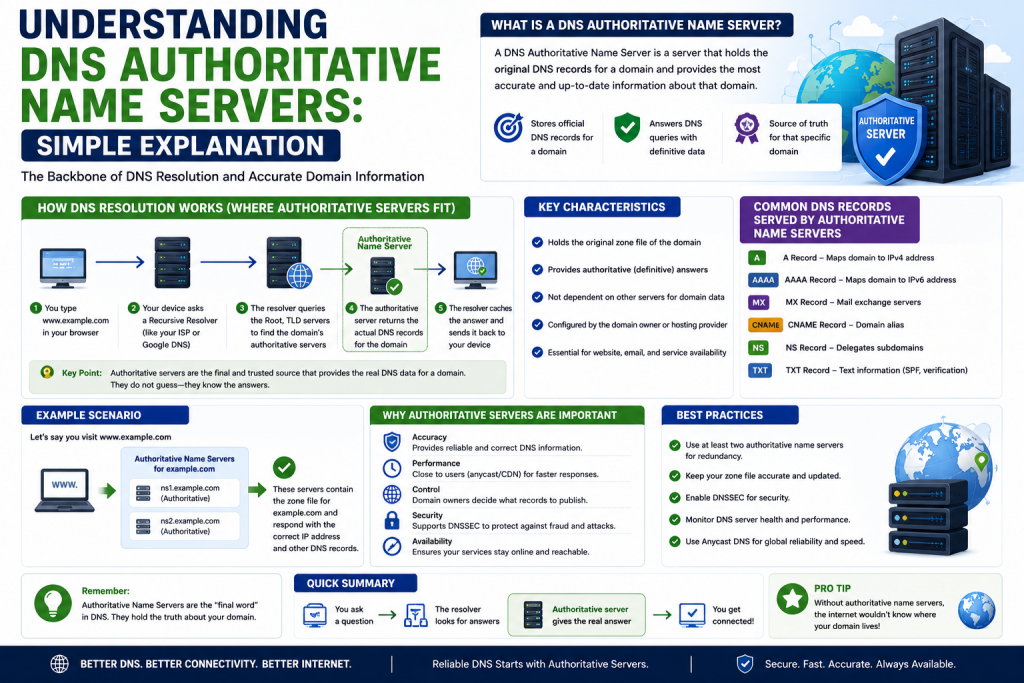
The Domain Name System (DNS) is a core part of how the internet works. It allows users to access websites using readable names instead of numeric IP addresses. Behind this system are specialized servers that store and provide DNS information. Among them, authoritative name servers are the most important because they provide the official and final source of DNS data. Without them, domain name resolution would not be reliable or consistent. DNS operates in a hierarchical structure where different servers handle different stages of the resolution process, but authoritative servers sit at the top of the data authority chain for a specific domain. This ensures that every response they provide is based on verified and controlled zone records maintained by the domain owner.
These servers also play a key role in ensuring global consistency of internet navigation. When multiple users across different locations request the same domain, authoritative name servers ensure they all receive accurate and synchronized responses. They help reduce confusion caused by outdated or incorrect cached information stored on other DNS systems. In addition, they support scalability by handling large volumes of queries through redundant configurations and load distribution. This makes them essential for high-traffic websites and online services. Their reliability directly impacts website availability, email delivery, and overall network performance across the internet.
Understanding Authoritative Name Servers
An authoritative name server is a DNS server that holds the original DNS records for a domain. It responds to DNS queries with definitive answers because it contains the official zone data. When a request is made for a domain, the authoritative server is the final point that provides the correct IP address or other DNS information. These servers ensure that DNS data remains accurate and controlled by the domain administrator. They play a critical role in maintaining trust within the DNS hierarchy because their responses are considered the most reliable source of truth for a domain. Unlike caching or recursive DNS servers, they do not rely on stored or previously fetched data from other sources; instead, they serve responses directly from their configured zone files. This makes them essential for ensuring consistency across the internet when resolving domain names.
Authoritative name servers also help enforce centralized control over DNS records, allowing administrators to manage services like websites, email routing, and subdomains from a single point of configuration. When updates are made to DNS records, these servers propagate the changes to other systems through synchronization or delegation processes. They also support redundancy by working alongside secondary servers to ensure high availability. If one server becomes unreachable, others can continue responding without disruption. This structure improves both reliability and performance of domain resolution across global networks.
Role of Authoritative Name Servers in DNS
Authoritative name servers are responsible for storing DNS records and answering queries with trusted information. They act as the final authority in the DNS lookup process. When a user enters a website address, the system eventually reaches the authoritative server to get the correct response. This makes them essential for ensuring that internet traffic is directed accurately.
Types of Authoritative Name Servers
There are two main types of authoritative name servers that work together to ensure reliability and availability.
Primary Authoritative Name Server
The primary authoritative name server is the main source of DNS records. It stores the original and editable version of all DNS data for a domain. Any changes such as adding or modifying records are made on this server. It acts as the master copy of DNS information and ensures all updates are centrally managed.
Secondary Authoritative Name Server
The secondary authoritative name server works as a backup system. It copies DNS data from the primary server and keeps it synchronized. Its purpose is to provide redundancy in case the primary server becomes unavailable. While it can respond to DNS queries, it does not allow direct changes to DNS records.
DNS Zone Files and Their Importance
DNS zone files are structured text files that store all DNS records for a domain. These files define how domain names are mapped to IP addresses and other services. Authoritative name servers use these files to respond to DNS queries. They act as the official configuration source for DNS information.
Common DNS Record Types
DNS zone files contain different types of records that define how a domain behaves.
A Record
An A record maps a domain name to an IPv4 address and is commonly used for website routing.
AAAA Record
An AAAA record maps a domain name to an IPv6 address and supports modern internet addressing systems.
CNAME Record
A CNAME record creates an alias for another domain name, allowing multiple names to point to the same destination.
MX Record
MX records define mail servers responsible for handling email delivery for a domain.
NS Record
NS records specify which servers are authoritative for a domain and guide DNS queries to the correct location.
TXT Record
TXT records store text-based information used for verification, security, and email authentication purposes.
Structure of a DNS Zone File
A DNS zone file is organized in a structured format that includes different sections. It starts with a time-to-live setting that controls how long DNS data can be cached. The Start of Authority section defines administrative information about the domain. Name server records identify the authoritative servers, while other records define services such as web hosting and email. Each part plays a role in ensuring accurate DNS resolution.
How Authoritative Name Servers Are Configured
Configuring authoritative name servers involves several steps. First, DNS software is selected based on system requirements. Next, the software is installed and configured with proper settings. DNS zone files are then created for each domain, containing all necessary records. The Start of Authority and name server records are defined to establish control. Additional records are added depending on services required. Finally, domain settings are updated and testing is performed to ensure everything works correctly.
The Importance of TTL in DNS
Time-to-Live (TTL) determines how long DNS information is stored in cache before being refreshed. A higher TTL improves performance by reducing queries, while a lower TTL allows faster updates when changes are made. TTL helps balance speed and data accuracy in DNS systems. It also plays a key role in controlling how quickly updates to DNS records become visible across different networks and devices. When TTL values are set too high, outdated information may persist in caches for longer periods, which can delay important changes such as server migrations or IP updates. On the other hand, very low TTL values increase the number of DNS queries sent to authoritative servers, which can raise network traffic and load. Administrators often adjust TTL settings based on the stability of the environment and how frequently changes are expected. For example, stable records like mail servers may use higher TTL values, while frequently changing services may use lower values. TTL also affects DNS resilience, as cached records can continue to function even if an authoritative server becomes temporarily unreachable. This makes it an important mechanism for improving both performance and reliability in distributed DNS systems.
Troubleshooting Authoritative Name Server Issues
DNS issues can affect website accessibility and require proper troubleshooting. One common issue is propagation delay, where DNS changes take time to update globally. Testing tools can be used to check whether DNS records are resolving correctly. Network connectivity should also be verified to ensure DNS requests are not blocked. Server logs can help identify errors or misconfigurations that may be causing issues. In many cases, incorrect DNS caching on local devices or intermediate resolvers can also lead to outdated results being displayed even after changes are made. Flushing the local DNS cache or restarting network services can often resolve these inconsistencies. Another frequent problem is incorrect record configuration, such as wrong IP addresses in A or AAAA records, or misconfigured CNAME chains that point to non-existent targets. Firewall restrictions can also interrupt DNS traffic, especially if UDP or TCP port 53 is blocked. In more complex environments, split-horizon DNS setups may create confusion if internal and external users receive different responses. Monitoring tools and diagnostic commands help administrators trace resolution paths step by step to locate where failure occurs. Regular auditing of DNS records and proper version control of zone files can also reduce long-term issues and improve system stability.
Why Authoritative Name Servers Matter
Authoritative name servers are essential for the proper functioning of the internet. They ensure that domain names resolve to correct IP addresses and that DNS data remains accurate. They also provide redundancy and improve reliability through primary and secondary server setups. Without them, internet navigation would become unreliable and inconsistent.
Conclusion
Authoritative name servers are a critical part of the DNS system. They store and manage official DNS records and ensure that domain name resolution is accurate and reliable. By working with zone files, record types, and structured configurations, they maintain the stability of internet communication. Understanding how these servers operate is essential for anyone working in networking or IT because they form the foundation of how the internet is accessed and managed.
Continue exploring the technologies and certification concepts that matter most to you.