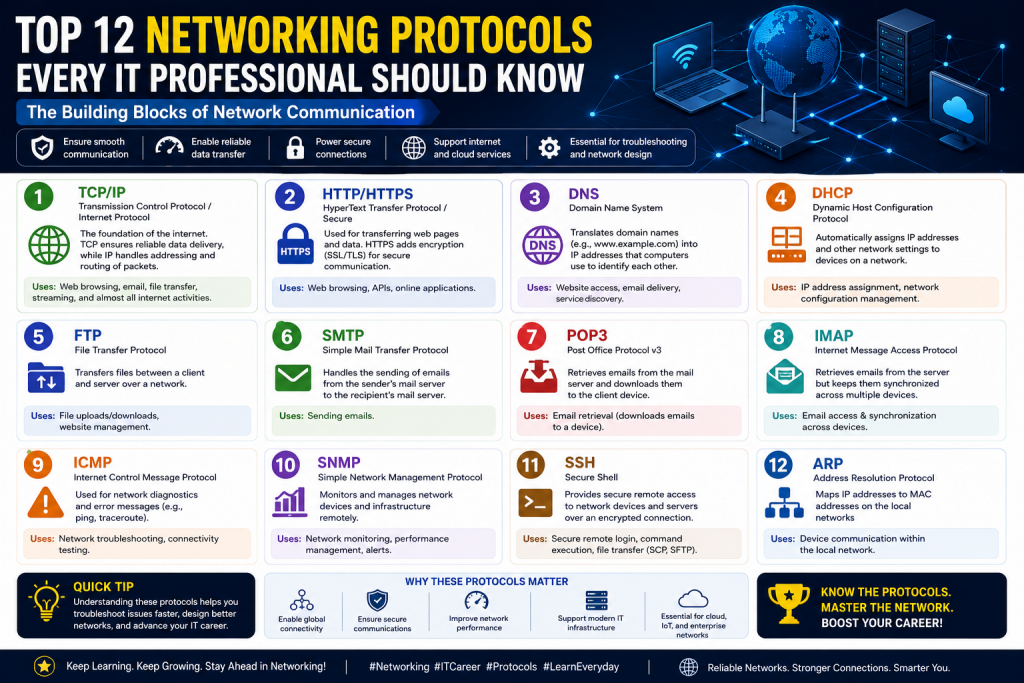
A strong understanding of networking protocols is essential for anyone pursuing a career in IT or network engineering. These protocols form the foundation of how devices communicate, how data moves across networks, and how services remain reliable and secure. Although networking can feel overwhelming at first due to the number of terms and concepts involved, learning the most important protocols makes the subject much more manageable.
Below are 12 essential networking protocols that every IT professional should understand, along with why they matter in real-world environments.
Address Resolution Protocol (ARP)
ARP is used to map IP addresses to MAC addresses within a local network. When a device wants to communicate with another device on the same network, it first needs to determine the physical hardware address associated with the destination IP.
The process involves broadcasting a request asking which device owns a specific IP address. The correct device responds with its MAC address, allowing communication to proceed. This mapping is stored in a cache to improve performance.
However, ARP cache entries can sometimes become outdated or incorrect. When this happens, communication issues may occur, such as traffic being sent to the wrong device. Clearing or refreshing the ARP cache often resolves these problems and restores proper connectivity.
Spanning Tree Protocol (STP)
STP is designed to prevent network loops in switched environments. Loops occur when multiple active paths exist between switches, causing broadcast storms and network instability.
By intelligently blocking redundant paths, STP ensures only one active path exists between network devices while keeping backup links available in case of failure. This helps maintain both stability and redundancy.
Although STP is highly useful, improper configuration can sometimes delay network traffic, especially during initial port activation. Some ports may temporarily block traffic while checking for potential loops, which can affect services like DHCP if not properly configured.
IEEE 802.1Q (VLAN Tagging)
IEEE 802.1Q is the standard used for VLAN tagging. It allows multiple virtual networks to exist on the same physical network infrastructure by tagging Ethernet frames with VLAN identifiers.
This enables network segmentation without requiring separate physical connections for each network segment. It improves scalability, security, and traffic management in enterprise environments.
Before this standard, vendors used proprietary methods that were not compatible with each other. IEEE 802.1Q solved this issue by introducing a universal tagging mechanism that works across different hardware platforms.
TCP/IP Protocol Suite
TCP/IP is the fundamental communication model used across modern networks and the internet. It includes several layers responsible for routing, addressing, and data delivery.
Internet Protocol (IP) handles addressing and routing of packets between networks. Transmission Control Protocol (TCP) ensures reliable communication by establishing connections and verifying data delivery. User Datagram Protocol (UDP) provides faster, connectionless communication where reliability is less critical.
Internet Control Message Protocol (ICMP) is also part of this suite and is commonly used for diagnostic tools like connectivity testing and latency measurement.
Understanding TCP/IP is crucial for troubleshooting network issues and ensuring efficient communication between systems.
Hypertext Transfer Protocol (HTTP)
HTTP is used for transferring web content between clients and servers. It is the foundation of web browsing and is also used in APIs and many web-based applications.
When a user accesses a website, their browser sends HTTP requests to a server, which responds with the requested data. This can include web pages, images, or application data.
HTTP status codes play an important role in troubleshooting. For example, codes like 200 indicate success, while 404 indicates missing content. Understanding these responses helps diagnose application and connectivity issues.
File Transfer Protocol (FTP)
FTP is used for transferring files between systems over a network. It operates using separate channels for control and data transmission.
It supports different modes, including active and passive connections. In active mode, the server initiates data connections, while in passive mode, the client handles the connection setup. Passive mode is more commonly used in modern networks due to firewall compatibility.
Secure versions of FTP use encryption to protect data during transfer, making them more suitable for modern environments. Despite newer alternatives, FTP remains relevant in legacy systems.
Network Time Protocol (NTP)
NTP is responsible for synchronizing clocks across network devices. Accurate timekeeping is critical for authentication systems, logging, and security processes.
Many security protocols rely on synchronized time to function correctly. Even small time differences between systems can cause authentication failures or inconsistencies in logs.
Organizations often use internal time servers that synchronize with external trusted sources. This ensures all systems within the network maintain consistent and accurate time settings.
NTP operates in a hierarchical structure known as stratum levels. At the top are highly accurate reference clocks, such as atomic clocks or GPS-based time sources, which are classified as Stratum 0. Directly connected servers, known as Stratum 1 devices, synchronize with these sources and then distribute time to lower-level servers and clients. As the stratum number increases, the distance from the original reference time also increases, though accuracy is still maintained within acceptable limits.
In enterprise environments, dedicated internal NTP servers are often deployed to reduce dependency on external networks and improve security. These internal servers act as trusted time sources for all devices within the organization, ensuring consistent timestamps across systems. This is especially important for logging, where accurate time correlation is needed for troubleshooting security incidents or analyzing system behavior.
NTP also helps in distributed computing environments, where multiple systems must work together in real time. Without proper synchronization, data inconsistencies, transaction errors, and system conflicts may occur.
Internet Group Management Protocol (IGMP)
IGMP is used for managing multicast group memberships. It allows devices to join or leave multicast groups so that network routers can efficiently deliver data only to interested recipients.
This is especially useful for streaming applications such as live video broadcasts within large organizations. Instead of sending multiple copies of the same data, multicast allows a single stream to be distributed efficiently.
IGMP helps reduce unnecessary network traffic and improves bandwidth utilization.
Simple Mail Transfer Protocol (SMTP)
SMTP is the standard protocol used for sending email between servers. It handles outgoing mail delivery and ensures messages are properly routed across networks.
When an email is sent, SMTP servers communicate to transfer the message from the sender’s domain to the recipient’s mail server. Additional protocols are used for retrieving email, but SMTP is responsible for transmission.
Understanding SMTP is useful for diagnosing email delivery issues, analyzing mail headers, and identifying delays in message routing.
Secure Shell (SSH)
SSH is a secure protocol used for remote access to devices and secure file transfers. It replaces older, insecure protocols by encrypting all communication between client and server.
Administrators commonly use SSH to manage servers, routers, and other network devices remotely. It provides a command-line interface that allows full system control over secure connections.
Because of its encryption and security features, SSH is widely used in both enterprise and cloud environments.
Border Gateway Protocol (BGP)
BGP is the protocol responsible for routing data between large networks on the internet. It determines the best paths for data to travel between different autonomous systems.
Unlike internal routing protocols, BGP focuses on policy-based routing rather than speed alone. It ensures that data follows the most efficient or strategically preferred path based on network agreements.
BGP is essential for internet service providers and large organizations with multiple external connections.
BGP works by exchanging routing information between different autonomous systems using path vectors. Instead of simply choosing the shortest route, it evaluates multiple attributes such as path length, network policies, reliability, and administrative preferences. This makes it highly flexible and suitable for managing complex global internet routing decisions. Because of this behavior, BGP is often referred to as a “path vector protocol” rather than a traditional distance-vector or link-state protocol.
One of the key strengths of BGP is its ability to support redundancy and failover. If one route becomes unavailable due to a network failure, BGP can quickly reroute traffic through an alternative path, helping maintain internet stability. It is also widely used in multi-homed environments where organizations connect to more than one internet service provider to improve performance and reliability.
However, BGP is also sensitive to misconfigurations, which can lead to routing leaks or even global outages. For this reason, careful planning, filtering, and route validation are critical when implementing BGP in production networks.
Open Shortest Path First (OSPF)
OSPF is an interior routing protocol used within organizations to efficiently route traffic between internal networks. It calculates the shortest path for data based on network topology.
When changes occur in the network, OSPF quickly updates routing tables to reflect the new structure. This makes it highly efficient for dynamic environments where network changes are frequent.
It is widely used in enterprise networks due to its scalability and fast convergence.
Conclusion
Networking protocols are the backbone of modern communication systems. Each protocol plays a specific role, from addressing and routing to security and data transfer. Understanding these 12 key protocols provides a strong foundation for anyone entering the IT or networking field.
As networks continue to grow in complexity, mastering these protocols becomes even more important. They not only help in troubleshooting and configuration but also form the basis for advanced networking concepts and technologies.
Continue exploring the technologies and certification concepts that matter most to you.