In modern cloud computing environments, system downtime directly impacts business performance, customer trust, and revenue. Even short interruptions can lead to significant financial loss and reduced productivity. As organizations increasingly rely on cloud-based applications, designing systems that remain operational under failure conditions has become essential. Downtime does not only affect external customers but also internal operations, delaying workflows, halting transactions, and disrupting critical decision-making processes. In competitive industries, even a few minutes of unavailability can result in customers switching to alternative services, which makes reliability a key differentiator.
To address these risks, cloud architectures are designed with resilience in mind, ensuring systems can recover quickly or continue operating during unexpected failures. This involves distributing workloads across multiple servers, regions, or availability zones to eliminate single points of failure. It also requires careful planning of data replication, load balancing, and automated recovery mechanisms.
Modern cloud platforms provide tools that simplify these designs, allowing organizations to focus more on application logic rather than infrastructure maintenance. Monitoring and alerting systems further enhance reliability by detecting issues early and triggering automated responses before users are affected. As a result, businesses can achieve higher uptime, improved user satisfaction, and stronger operational stability, even in the face of hardware failures, network issues, or unexpected spikes in demand.
Two core strategies used to achieve resilient cloud systems are high availability and fault tolerance. While they are often confused, they serve different purposes and are applied based on business requirements, cost considerations, and system criticality. Understanding the difference between them is essential for designing reliable cloud architectures.
Understanding High Availability
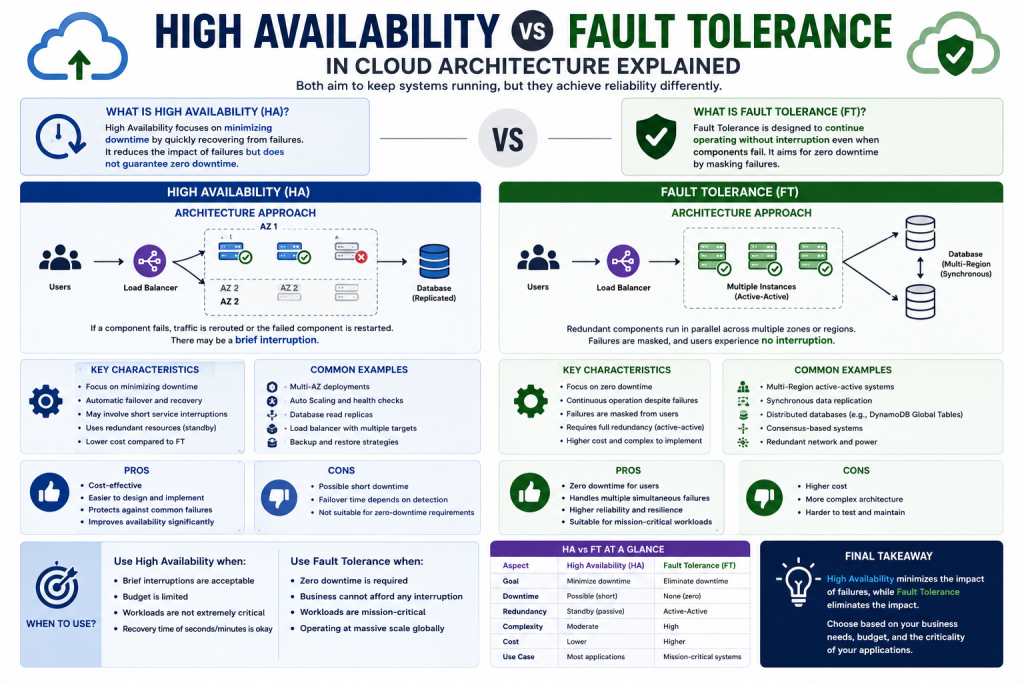
High availability refers to a system design approach that ensures a service remains accessible most of the time, even when some components fail. The goal is to minimize downtime and maintain acceptable service performance during disruptions.
A highly available system is built using redundancy. This means that critical components are duplicated so that if one fails, another can immediately take over. In cloud environments, this is commonly achieved by distributing resources across multiple availability zones. These zones are physically separate data center locations within the same region, designed to reduce the risk of a single point of failure.
For example, a web application running on cloud servers can be deployed across multiple zones. If one zone experiences an outage due to hardware failure or network issues, traffic is automatically redirected to another functioning zone. Users may experience slight delays or reduced performance, but the service remains accessible.
Databases in high availability setups are also replicated. A primary database handles read and write operations, while a secondary replica is kept in sync and can serve read requests if the primary fails. However, in some configurations, write operations may be temporarily unavailable during failover, and data synchronization may not always be real-time.
High availability systems typically aim for very high uptime percentages, often referred to as “five nines,” meaning 99.999% availability. This translates to only a few minutes of downtime per year. While achieving this level of uptime requires careful design, cloud platforms have made it more accessible and cost-effective than traditional infrastructure setups.
Key Characteristics of High Availability
High availability systems generally include the following characteristics:
- Redundant infrastructure components
- Load balancing across multiple instances
- Automatic failover mechanisms
- Geographic distribution within a region
- Minimal service disruption during failures
These systems are ideal for applications where short periods of degraded performance are acceptable but complete outages are not.
Understanding Fault Tolerance
Fault tolerance takes system reliability a step further. A fault-tolerant system is designed to continue operating fully without any noticeable impact to users, even when failures occur.
Unlike high availability, which may allow reduced functionality during failures, fault tolerance ensures continuous full service. The system automatically handles failures in the background without affecting user experience. This means that even if one or more components fail, users continue interacting with the application as if nothing has happened. The system is designed in such a way that redundancy exists at every critical layer, including compute, storage, networking, and database services. When a failure occurs, traffic, processing, or data access is instantly shifted to healthy resources without any interruption.
In a fault-tolerant architecture, synchronization between systems happens continuously and in real time. This ensures that all replicas remain consistent and ready to take over instantly if required. Advanced routing mechanisms and automated recovery processes detect failures immediately and reroute operations within milliseconds. Because of this design, users do not experience downtime, lag, or partial service restrictions.
This level of resilience is especially important for applications where even a few seconds of disruption can lead to financial loss or safety risks. For example, financial trading platforms, airline reservation systems, and critical healthcare applications depend heavily on fault tolerance. However, achieving this level of reliability requires significantly more resources, planning, and cost compared to high availability systems. Despite the complexity, fault tolerance provides the highest level of assurance for uninterrupted digital services.
To achieve this level of resilience, fault-tolerant architectures use extensive redundancy across multiple layers. This often includes multiple servers, multiple availability zones, and even multiple geographic regions. If an entire region becomes unavailable, the system seamlessly switches to another region without interruption.
Databases in fault-tolerant systems are continuously replicated in real time across regions. This ensures that no data is lost and that transactions can continue without delay. Similarly, application servers are duplicated and synchronized to ensure consistent performance everywhere.
Fault tolerance is more complex and expensive to implement compared to high availability. However, it is essential for mission-critical systems where even seconds of downtime can cause severe consequences.
Key Characteristics of Fault Tolerance
Fault-tolerant systems typically include:
- Real-time replication of data and services
- Multi-region deployment
- Continuous operation during failures
- No noticeable impact to end users
- Advanced monitoring and automated recovery systems
These systems are commonly used in industries such as finance, healthcare, large-scale e-commerce, and global communication platforms.
How Cloud Architecture Supports High Availability and Fault Tolerance
Cloud platforms provide built-in services that simplify the implementation of both high availability and fault tolerance. Instead of managing physical hardware, organizations can use managed services that automatically scale, replicate, and recover from failures.
For example, computer services allow applications to run across multiple instances that are distributed across availability zones. If one instance fails, traffic is redirected to healthy ones automatically.
Storage systems often replicate data across multiple locations to prevent data loss. Some services even support cross-region replication for disaster recovery purposes.
Load balancers distribute incoming traffic evenly across multiple servers. This ensures that no single server becomes overwhelmed and improves both performance and reliability.
Serverless computing also contributes to resilience. Functions automatically scale based on demand and run in multiple isolated environments. If one execution environment fails, another takes over without manual intervention.
Real-World Application Example
Consider an online retail application that processes thousands of transactions per minute. In a high availability setup, the application might run across multiple availability zones within a region. If one zone fails, users are redirected to another zone, but some transactions may be delayed or temporarily restricted.
In a fault-tolerant setup, the same application could operate across multiple regions. If an entire region experiences failure due to a major outage, the system automatically switches to another region without disrupting ongoing transactions. Customers continue shopping without noticing any issue.
Similarly, database systems in high availability might use a primary-secondary model, while fault-tolerant systems use continuous multi-region replication to ensure zero data loss and uninterrupted access.
Choosing Between High Availability and Fault Tolerance
The choice between high availability and fault tolerance depends on several factors, including cost, application importance, and acceptable risk levels.
High availability is generally suitable for most business applications where occasional brief disruptions are acceptable. It provides strong resilience at a lower cost and is easier to implement and manage.
Fault tolerance is more appropriate for critical systems where downtime is unacceptable. However, it requires significantly more resources, planning, and operational complexity.
Organizations must evaluate the importance of their systems and decide how much downtime they can realistically tolerate. For many applications, a combination of both strategies is used, where high availability is implemented within regions and fault tolerance is achieved through multi-region deployment for critical services.
Common Use Cases
High availability is commonly used for:
- Business websites
- Internal company applications
- Content delivery systems
- Standard database applications
Fault tolerance is commonly used for:
- Banking and financial systems
- Global e-commerce platforms
- Healthcare systems
- Real-time communication services
Each use case requires a different balance between cost and reliability.
Best Practices for Resilient Architecture
Designing resilient systems involves more than just choosing between high availability and fault tolerance. Several best practices help improve system reliability:
- Distribute resources across multiple availability zones
- Automate failover processes
- Use load balancing to manage traffic efficiently
- Implement regular backups and replication
- Monitor system health continuously
- Test failure scenarios to identify weaknesses
- Design applications to handle partial failures gracefully
By following these principles, organizations can significantly reduce downtime and improve user experience.
Conclusion
High availability and fault tolerance are two essential strategies in cloud architecture, each serving a distinct purpose. High availability focuses on minimizing downtime through redundancy and failover mechanisms, ensuring that systems remain operational even when parts of the infrastructure fail. Fault tolerance goes further by ensuring uninterrupted service without any noticeable impact to users, even during major system failures.
While high availability is more cost-effective and widely used, fault tolerance is critical for systems that require continuous operation without interruption. The choice between the two depends on application requirements, business priorities, and budget constraints.
Modern cloud platforms make both approaches more accessible than ever, enabling organizations to build reliable, scalable, and resilient systems. By understanding and applying these concepts effectively, businesses can ensure consistent performance, protect data integrity, and maintain customer trust even in the face of unexpected failures.
Continue exploring the technologies and certification concepts that matter most to you.