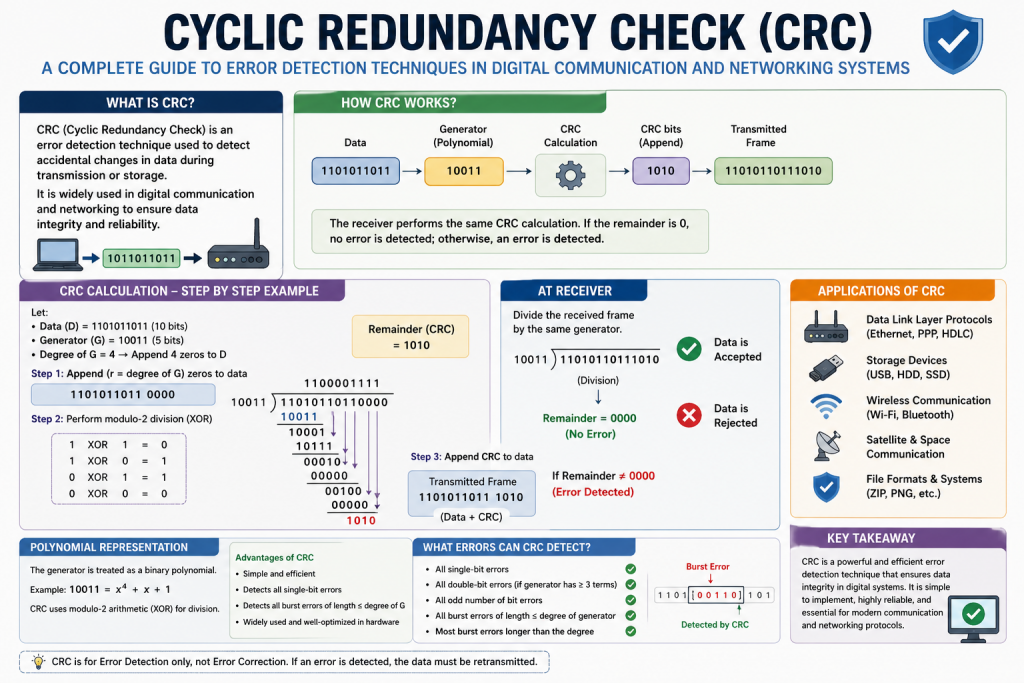
In the digital world, the accuracy and consistency of data are critical. Whether information is being transferred across a network, stored on a device, or processed by an application, it must remain unchanged from its original form. Even the smallest alteration, such as a flipped bit, can lead to errors ranging from minor glitches to serious system failures. This is where data integrity mechanisms come into play.
Cyclic Redundancy Check, commonly known as CRC, is one of the most widely used methods for verifying data integrity. It is designed to detect errors in digital data and ensure that what is received is exactly what was sent. CRC is used in many systems, including networking, storage devices, and file transfers, making it an essential concept for anyone working in technology.
Understanding the Need for Error Detection
When data travels from one point to another, it passes through various physical and logical layers. During this journey, it can be affected by noise, interference, hardware faults, or software issues. These factors can introduce errors into the data, causing it to become corrupted.
For example, in a network environment, data is transmitted as electrical signals, radio waves, or light pulses. External interference, such as electromagnetic signals from other devices, can disrupt these transmissions. Similarly, damaged cables or faulty hardware can lead to incomplete or incorrect data delivery.
Without a mechanism to detect these errors, systems would have no reliable way of knowing whether the data they received is accurate. This could result in incorrect computations, faulty communications, or even system crashes. CRC provides a solution by enabling systems to identify when data has been altered during transmission.
What is a Cyclic Redundancy Check
A Cyclic Redundancy Check is an error-detection technique that uses mathematical calculations to generate a value based on a block of data. This value, known as a checksum, acts as a fingerprint for the data.
Before data is transmitted, the sender applies a CRC algorithm to calculate the checksum. This checksum is then attached to the data and sent along with it. When the data reaches the receiver, the same CRC algorithm is applied to the received data to generate a new checksum. The receiver then compares the newly calculated checksum with the one that was originally sent.
If both values match, it indicates that the data has not been altered. If they differ, it means that an error has occurred during transmission.
Real World Analogy for CRC
To better understand CRC, consider a simple real-world scenario. Imagine sending a sealed package through the mail. To ensure that the package arrives intact, you might seal it with tamper-evident tape or record its weight before sending it.
When the recipient receives the package, they can check the seal and compare the weight to verify that nothing has been altered. If the seal is broken or the weight has changed, it indicates that the package may have been tampered with.
CRC works in a similar way, but instead of physical seals or weight measurements, it uses mathematical calculations to verify data integrity. The checksum acts like a digital seal that helps detect whether the data has been modified.
The Concept of a Checksum
The checksum is a central component of CRC. It is a value derived from the original data using a specific algorithm. This value is unique to the data, meaning that even a small change in the data will produce a different checksum.
For example, if a single bit in the data is altered, the resulting checksum will be significantly different. This sensitivity makes CRC highly effective at detecting errors.
The checksum is not meant to describe the data in detail but rather to provide a quick way to verify its integrity. Because it is much smaller than the original data, it can be transmitted efficiently without adding significant overhead.
How CRC Generates a Checksum
Although CRC is based on complex mathematical operations, the general idea can be explained in simple terms. The data is treated as a sequence of binary numbers, and a predefined algorithm is applied to calculate the checksum.
The algorithm processes the data in a structured way, ensuring that every bit contributes to the final result. This process creates a fixed-size output, regardless of the size of the input data.
The result is a checksum that represents the entire data block. This checksum is then appended to the data before transmission.
The Transmission Process with CRC
The use of CRC in data transmission follows a clear sequence of steps. First, the sender prepares the data that needs to be transmitted. The CRC algorithm is then applied to this data to generate the checksum.
Once the checksum is calculated, it is attached to the original data. The combined data and checksum are then sent over the network or communication channel.
At the receiving end, the system separates the data from the checksum. It then applies the same CRC algorithm to the received data to generate a new checksum. This newly calculated checksum is compared with the one that was received.
If the two checksums match, the data is considered valid. If they do not match, the data is flagged as corrupted, and appropriate action can be taken, such as requesting a retransmission.
Error Detection vs Error Correction
It is important to understand that CRC is designed for error detection, not error correction. This means that CRC can identify when data has been altered, but it cannot determine how to fix the error.
When a mismatch is detected, the system typically requests that the data be sent again. This approach is efficient because it avoids the complexity of trying to correct errors directly.
Error correction techniques do exist, but they are generally more complex and require additional data to be transmitted. CRC strikes a balance by providing reliable error detection with minimal overhead.
Why CRC is Widely Used
CRC is popular because it offers a combination of simplicity, efficiency, and effectiveness. It can detect a wide range of errors, including single-bit errors, burst errors, and random data corruption.
Another advantage of CRC is its speed. The calculations can be performed quickly, making it suitable for real-time applications such as network communication and streaming.
Additionally, CRC can be implemented in both hardware and software, allowing it to be used in a variety of systems. This flexibility makes it a standard choice for many applications.
Sensitivity to Data Changes
One of the most important properties of CRC is its sensitivity to changes in data. Even a minor alteration can produce a completely different checksum. This makes it highly effective at detecting errors.
For instance, if a single bit in a data packet is flipped due to interference, the checksum generated at the receiving end will not match the original checksum. This immediate detection allows the system to respond quickly and prevent corrupted data from being used.
This sensitivity is what makes CRC reliable, as it minimizes the chances of undetected errors.
Limitations of CRC
While CRC is highly effective at detecting errors, it is not perfect. There is a small possibility that two different data sets could produce the same checksum. This situation is known as a collision.
Although collisions are rare, they can occur, especially with smaller checksum sizes. However, the likelihood of such events is low enough that CRC is still considered reliable for most applications.
Another limitation is that CRC cannot correct errors. It can only indicate that an error has occurred. This means that additional mechanisms are required to handle error recovery.
CRC in Everyday Technology
CRC is used in many aspects of modern technology, often without users being aware of it. It plays a role in ensuring the reliability of data in various systems.
In networking, CRC is used to verify the integrity of data packets. In storage devices, it helps detect data corruption. In file transfers, it ensures that downloaded files are complete and unaltered.
Because of its efficiency and reliability, CRC has become a standard method for error detection across different industries.
Importance for Learning and Practice
Understanding CRC is important for students and professionals in fields such as networking, cybersecurity, and software development. It provides insight into how systems maintain data integrity and handle errors.
For those preparing for technical certifications or working in IT, a solid understanding of CRC can be valuable. It helps in diagnosing network issues, understanding protocol behavior, and ensuring reliable
Introduction to CRC Variants
Cyclic Redundancy Check is not a single fixed method but a family of algorithms designed to detect errors in data. These algorithms differ in how they calculate the checksum, how large the checksum is, and how effective they are at detecting errors. The most common CRC variants are CRC-8, CRC-16, and CRC-32. Each of these uses a different number of bits to represent the checksum, which directly affects both performance and reliability.
Understanding these variants is important because different systems require different balances between speed, computational effort, and accuracy. Some applications prioritize speed and low resource usage, while others require extremely reliable error detection, even if it means higher computational cost.
What Defines a CRC Algorithm
A CRC algorithm is defined by a set of parameters that determine how the checksum is calculated. The most important factor is the size of the checksum, measured in bits. This size determines how many unique checksum values are possible.
For example, an 8-bit CRC can produce 256 different values, while a 16-bit CRC can produce 65,536 values. A 32-bit CRC can generate over 4 billion unique values. The larger the number of possible values, the lower the chance that two different pieces of data will produce the same checksum.
Another defining feature of CRC algorithms is the mathematical rule used to process the data. Although the underlying math involves binary operations and polynomial division, most systems handle these calculations automatically, so users do not need to perform them manually.
Understanding Data Collisions
One of the key concepts in CRC is the idea of a data collision. A collision occurs when two different sets of data produce the same checksum. When this happens, the CRC mechanism fails to detect an error because the checksum appears valid even though the data is incorrect.
Collisions are rare, but they are not impossible. The probability of a collision depends on the size of the checksum and the complexity of the algorithm. Smaller CRC values are more likely to produce collisions because they have fewer possible outcomes.
To understand this better, imagine assigning identification numbers to a large number of objects. If the number of possible IDs is small, you will quickly run out of unique values and be forced to reuse them. This increases the chance of duplicates. Similarly, a small CRC size increases the chance that different data will share the same checksum.
Why Larger CRCs Reduce Collision Risk
Increasing the size of the checksum significantly reduces the likelihood of collisions. This is because there are more possible values available, making it less likely that two different data sets will produce the same result.
For instance, a CRC-8 algorithm, with only 256 possible values, is more prone to collisions than CRC-16 or CRC-32. In contrast, CRC-32 offers billions of possible combinations, making collisions extremely unlikely in most practical scenarios.
This is why more critical systems, such as those handling large volumes of data or requiring high reliability, often use larger CRC algorithms.
Trade-Off Between Speed and Reliability
Choosing a CRC algorithm involves balancing speed and reliability. Smaller CRCs are faster to compute and require fewer system resources. This makes them suitable for applications where performance is critical and the risk of errors is relatively low.
However, smaller CRCs are less reliable because they are more prone to collisions. Larger CRCs, on the other hand, provide better error detection but require more computational power and time.
This trade-off means that there is no single best CRC algorithm for all situations. The choice depends on the specific requirements of the system.
CRC-8 and Its Use Cases
CRC-8 is one of the simplest CRC algorithms. It produces an 8-bit checksum, which means it can generate 256 possible values. Because of its simplicity, CRC-8 is very fast and requires minimal processing power.
This makes it suitable for small systems with limited resources, such as embedded devices and sensors. In these environments, efficiency is often more important than maximum reliability.
However, the limited number of possible checksum values means that CRC-8 has a higher risk of collisions. As a result, it is not ideal for applications where data integrity is critical.
CRC-16 as a Balanced Approach
CRC-16 offers a middle ground between performance and reliability. With 16 bits, it can generate 65,536 possible checksum values. This significantly reduces the risk of collisions compared to CRC-8.
CRC-16 is widely used in communication protocols and industrial systems because it provides a good balance between speed and accuracy. It is reliable enough for many applications while still being efficient enough for real-time processing.
Because of this balance, CRC-16 is one of the most commonly used CRC algorithms in practice.
CRC-32 for High Reliability
CRC-32 is a more advanced algorithm that produces a 32-bit checksum. This allows for over 4 billion possible values, making collisions extremely rare.
This level of reliability makes CRC-32 suitable for applications where data integrity is critical. It is commonly used in file systems, data storage, and network protocols.
The main drawback of CRC-32 is that it requires more computational resources than smaller CRC algorithms. However, modern systems are typically powerful enough to handle this without significant performance issues.
Mathematical Foundation Simplified
At the heart of CRC is a mathematical process based on binary arithmetic. Data is treated as a sequence of bits, and a predefined rule is applied to calculate the checksum.
This process involves dividing the data by a specific value and using the remainder as the checksum. Although the actual calculations are complex, they are optimized in hardware and software, making them fast and efficient.
The important takeaway is that the mathematical structure of CRC ensures that even small changes in the data produce noticeable differences in the checksum.
Error Detection Capabilities
CRC algorithms are particularly effective at detecting common types of errors. These include single-bit errors, where one bit is flipped, and burst errors, where multiple bits are affected in a sequence.
The ability to detect burst errors is especially important in networking, where interference can affect multiple bits at once. CRC algorithms are designed to identify these patterns and flag corrupted data.
Different CRC variants have different levels of effectiveness in detecting errors. Larger CRCs generally provide better coverage and are more likely to detect complex error patterns.
Choosing the Right CRC Algorithm
Selecting the appropriate CRC algorithm depends on several factors. These include the size of the data, the likelihood of errors, the available processing power, and the required level of reliability.
For example, a small embedded system with limited resources may use CRC-8 to conserve power and processing capacity. A communication protocol that requires moderate reliability might use CRC-16. A system handling critical data, such as file transfers or storage, would likely use CRC-32.
Understanding these trade-offs helps engineers design systems that are both efficient and reliable.
Real-World Applications of CRC Variants
Different CRC algorithms are used in various real-world applications. CRC-8 is often found in simple devices and low-power systems. CRC-16 is commonly used in industrial communication protocols and data transmission systems.
CRC-32 is widely used in networking and storage systems. It is often applied to large files to ensure that they have not been corrupted during transfer or storage.
These applications highlight how CRC algorithms are tailored to meet the needs of different environments.
Performance Considerations
Performance is an important factor when implementing CRC. Systems that process large amounts of data or operate in real time must be able to calculate checksums quickly.
Hardware implementations of CRC can significantly improve performance by performing calculations directly within network devices or processors. Software implementations, while more flexible, may be slower depending on the system.
Optimizations such as lookup tables and parallel processing can also improve the speed of CRC calculations.
Reliability in Modern Systems
As technology continues to evolve, the need for reliable data transmission and storage becomes even more important. CRC remains a key tool for ensuring data integrity in modern systems.
Its ability to quickly detect errors makes it suitable for a wide range of applications, from simple devices to complex networks. By choosing the right CRC algorithm, systems can achieve the desired balance between performance and reliability.
Introduction to CRC in Network Environments
Cyclic Redundancy Check plays a critical role in modern networking by helping ensure that data transmitted between devices remains accurate and intact. In a network, data is constantly moving between computers, servers, routers, and other devices. This data is divided into smaller units known as frames or packets before being sent across communication channels.
Because these packets travel through various physical media such as cables, wireless signals, or fiber optics, they are exposed to conditions that can introduce errors. CRC is integrated into networking protocols to detect such errors and maintain the reliability of communication systems.
How CRC Works in Data Transmission
When a device sends data over a network, it first divides the data into manageable chunks. Each chunk is then processed using a CRC algorithm to generate a checksum. This checksum is appended to the data packet before transmission.
As the packet travels through the network, it may pass through multiple devices such as switches and routers. When the packet reaches its destination, the receiving device applies the same CRC algorithm to the received data to generate a new checksum.
The receiving system then compares the newly generated checksum with the one included in the packet. If the two values match, the packet is considered valid and is processed further. If they do not match, the packet is identified as corrupted.
In most cases, corrupted packets are discarded, and the system requests that the sender retransmit the data. This process ensures that only accurate data is accepted and used.
Role of CRC in Network Protocols
CRC is widely used in network protocols at the data link layer, where it serves as a primary mechanism for error detection. Protocols such as Ethernet include a field specifically for CRC, often referred to as the Frame Check Sequence.
This field contains the checksum calculated before transmission. When a device receives a frame, it verifies the checksum before accepting the data. This ensures that errors introduced during transmission are detected early in the communication process.
By incorporating CRC into protocols, networks can maintain high levels of reliability even in environments where errors are common.
Real-Time Error Detection
One of the key advantages of CRC is its ability to detect errors in real time. As data is received, the checksum can be calculated and compared immediately. This allows systems to identify problems quickly and take corrective action without significant delay.
Real-time error detection is especially important in applications such as video streaming, online gaming, and voice communication, where delays or corrupted data can significantly impact user experience.
By detecting errors instantly, CRC helps maintain smooth and reliable communication.
Common Causes of CRC Errors
CRC errors occur when the checksum calculated at the receiving end does not match the checksum sent with the data. These mismatches indicate that the data has been altered during transmission.
There are several common causes of CRC errors. One major cause is electrical interference. In environments with many electronic devices, signals can interfere with each other, leading to data corruption.
Another common cause is faulty cables or connectors. Physical damage, such as frayed wires or bent pins, can disrupt the transmission of signals and result in errors.
Hardware issues can also contribute to CRC errors. Overheating components, failing network cards, or improperly installed devices can all lead to unreliable data transmission.
Environmental factors, such as poor cable management or improper shielding, can further increase the likelihood of errors.
Impact of CRC Errors on Network Performance
CRC errors can have a significant impact on network performance. When errors occur, corrupted packets must be discarded and retransmitted. This increases the amount of data being sent over the network and can lead to congestion.
Frequent retransmissions can cause delays, reduce throughput, and increase latency. In severe cases, high error rates can lead to network downtime, making systems unavailable to users.
For businesses and organizations that rely on network connectivity, these issues can result in lost productivity and reduced efficiency.
Monitoring CRC Errors
To maintain network health, it is important to monitor CRC error rates. Network devices such as switches and routers provide statistics that show the number of CRC errors detected over time.
By analyzing these statistics, network administrators can identify patterns and detect potential issues. For example, a sudden increase in CRC errors on a specific port may indicate a problem with the connected cable or device.
Consistent monitoring allows administrators to address issues before they escalate into major problems.
Identifying Patterns in Errors
Analyzing patterns in CRC errors can help pinpoint the root cause of network issues. Different types of problems often produce distinct patterns of errors.
For instance, errors that occur consistently on a single connection may suggest a hardware issue, such as a damaged cable. Errors that appear across multiple connections may indicate interference or a broader network problem.
Time-based patterns can also provide insights. Errors that occur during peak usage hours may be related to congestion, while random errors may point to environmental factors.
By studying these patterns, network engineers can take targeted actions to resolve issues efficiently.
Troubleshooting CRC Errors
Troubleshooting CRC errors involves a systematic approach to identifying and resolving the underlying cause. The first step is to check physical connections. Ensuring that cables are properly connected and free from damage can often resolve the issue.
If the problem persists, replacing cables or connectors may be necessary. Testing with known good equipment can help determine whether the issue lies with the hardware.
Network devices should also be inspected for proper configuration and operation. Updating firmware or drivers may resolve compatibility issues that contribute to errors.
Environmental factors should not be overlooked. Reducing interference, improving cable management, and ensuring proper ventilation can all help minimize errors.
Best Practices for Managing CRC Errors
Effective management of CRC errors requires a proactive approach. Regular monitoring and maintenance are essential for preventing issues and ensuring reliable network performance.
Routine inspections of cables and hardware can help identify potential problems before they lead to errors. Proper installation practices, such as using high-quality cables and maintaining appropriate spacing between devices, can reduce the risk of interference.
Implementing logging and alert systems allows administrators to respond quickly to changes in error rates. Automated alerts can notify administrators of potential issues, enabling faster resolution.
Redundancy is another important strategy. By having backup systems in place, networks can continue operating even when errors occur, minimizing downtime.
CRC in File Integrity Verification
Beyond networking, CRC is also used to verify the integrity of files. When files are downloaded or transferred, a checksum can be provided to ensure that the file has not been corrupted.
Users can calculate the checksum of the downloaded file and compare it with the provided value. If the values match, the file is considered intact. If not, it indicates that the file may be incomplete or corrupted.
This process is commonly used for software distribution, where ensuring the integrity of files is critical.
CRC in Storage Systems
Storage devices also use CRC to detect data corruption. Hard drives, solid-state drives, and other storage systems rely on CRC to ensure that data remains accurate over time.
When data is read from storage, the system can verify its integrity using CRC. If an error is detected, corrective measures can be taken, such as retrieving data from backup or marking the affected sector as unreliable.
This helps maintain the reliability of storage systems and protects against data loss.
Importance of CRC in Security
While CRC is primarily an error-detection mechanism, it also has implications for security. Detecting unexpected changes in data can help identify potential tampering or unauthorized modifications.
However, it is important to note that CRC is not a cryptographic tool. It is not designed to provide protection against intentional attacks. Instead, it serves as a basic integrity check that can complement other security measures.
For stronger protection, CRC is often used alongside cryptographic hashing algorithms.
Limitations in Networking Context
Despite its effectiveness, CRC has limitations in networking environments. It cannot identify the exact location of an error or determine how to correct it. It only indicates that an error has occurred.
This limitation means that CRC works primarily as a detection tool rather than a complete solution for data reliability. When a mismatch is identified, the system knows something went wrong, but it has no information about which bit or section of the data was altered. As a result, the most common response is to discard the corrupted data and request a retransmission from the sender. While this approach is effective in ensuring accuracy, it can introduce delays, especially in networks where errors occur frequently.
Another important limitation is that CRC does not provide any protection against intentional data manipulation. Because it is based on predictable mathematical calculations, it is possible for an attacker to alter the data and recompute a valid checksum. This means CRC alone is not suitable for security-sensitive applications where data authenticity and protection against tampering are required. In such cases, stronger techniques like cryptographic hashing and encryption are used alongside CRC to provide additional layers of security.
CRC is also not completely immune to undetected errors. Although rare, there is a possibility that two different sets of data may produce the same checksum, a situation known as a collision. When this happens, corrupted data may pass the CRC check and be treated as valid. The likelihood of this occurring depends on the size and complexity of the CRC algorithm being used. Larger CRC values, such as those used in more advanced algorithms, significantly reduce this risk but cannot eliminate it entirely.
In high-speed or high-traffic networks, frequent retransmissions caused by CRC-detected errors can impact performance. Each retransmission consumes bandwidth and adds to network congestion, which may further increase the chance of additional errors. This creates a cycle where network efficiency is reduced due to repeated error handling processes.
Additionally, CRC does not provide insight into the root cause of errors. While it can signal that a problem exists, it cannot distinguish whether the issue is due to hardware failure, signal interference, configuration errors, or environmental factors. Network administrators must rely on additional diagnostic tools and monitoring systems to investigate and resolve the underlying issues.
Because of these limitations, CRC is typically used in combination with other techniques. Error correction methods, advanced monitoring systems, and secure validation mechanisms are often implemented alongside CRC to create a more comprehensive approach to data integrity and reliability.
Additionally, while rare, it is possible for corrupted data to produce the same checksum as valid data. This means that some errors may go undetected.
Because of these limitations, CRC is often combined with other techniques to ensure comprehensive error handling.
Evolution and Continued Relevance
As networks have evolved, the importance of reliable data transmission has only increased. Modern applications require high-speed communication with minimal errors. This demand is driven by the rapid growth of technologies such as cloud computing, real-time streaming, online collaboration tools, and large-scale data processing systems. These applications depend on continuous and accurate data flow, where even slight interruptions or errors can affect performance and user experience.
With the expansion of global connectivity, networks now handle massive volumes of data every second. From video conferencing and online gaming to financial transactions and remote operations, the margin for error has become extremely small. Users expect instant responses and seamless interactions, which means that networks must deliver data quickly while maintaining its integrity. Any delay caused by retransmissions or corrupted data can lead to noticeable slowdowns and reduced efficiency.
Advancements in network infrastructure, such as high-speed fiber optics and wireless technologies, have made it possible to transmit data faster than ever before. However, these improvements also introduce new challenges, including increased sensitivity to interference and signal degradation over long distances. As a result, maintaining accuracy in such environments requires robust error detection mechanisms.
Reliable data transmission is also critical for emerging technologies like the Internet of Things, autonomous systems, and remote healthcare services. These systems often rely on real-time data to make decisions, and any corruption in that data can have serious consequences. Ensuring that information remains consistent and error-free is essential for their safe and effective operation.
As networks continue to grow in complexity and scale, the need for dependable error detection and data verification methods becomes even more important, supporting both performance and trust in digital systems.
CRC continues to be a fundamental tool in achieving these goals. Its efficiency and effectiveness make it suitable for both legacy systems and modern technologies.
Even as new methods are developed, CRC remains a standard component of many protocols and systems.
Conclusion
Cyclic Redundancy Check is a vital mechanism for maintaining data integrity in networking and beyond. By generating and verifying checksums, it enables systems to detect errors quickly and reliably.
In network environments, CRC helps ensure that data packets are transmitted accurately, reducing the risk of corruption and improving overall performance. It plays a key role in identifying issues such as interference, faulty hardware, and configuration problems.When data moves across a network, it often passes through multiple devices such as switches, routers, and transmission media. Each of these points introduces the possibility of errors. CRC acts as a checkpoint at the receiving end, verifying whether the data has remained intact throughout its journey. If a mismatch is detected, the system can quickly discard the corrupted packet and request a retransmission, preventing incorrect data from being processed further.
This process not only improves reliability but also contributes to efficient network management. By tracking CRC error rates, network administrators can gain insights into the health of the network. For example, a sudden increase in CRC errors on a specific interface may indicate a failing cable, poor signal quality, or electromagnetic interference from nearby devices. Identifying these issues early allows for timely maintenance and reduces the likelihood of larger disruptions.
CRC also supports performance optimization by minimizing the impact of undetected errors. Without such a mechanism, corrupted data could propagate through systems, leading to repeated failures and increased processing overhead. By catching errors early, CRC helps maintain smooth communication and reduces unnecessary load on network resources.
In modern high-speed networks, where large volumes of data are transmitted continuously, the role of CRC becomes even more critical. It ensures that data integrity is preserved without significantly affecting transmission speed, making it an essential component of reliable and efficient network operations.
Although CRC does not correct errors, its ability to detect them efficiently makes it an essential part of modern communication systems. When combined with proper monitoring, maintenance, and complementary technologies, CRC contributes significantly to the stability and reliability of digital systems.
From networking to storage and file verification, CRC remains a cornerstone of data integrity. Understanding how it works and how to manage CRC-related issues is crucial for anyone involved in technology, as it helps ensure that data remains accurate, consistent, and trustworthy in an increasingly connected world.
Continue exploring the technologies and certification concepts that matter most to you.