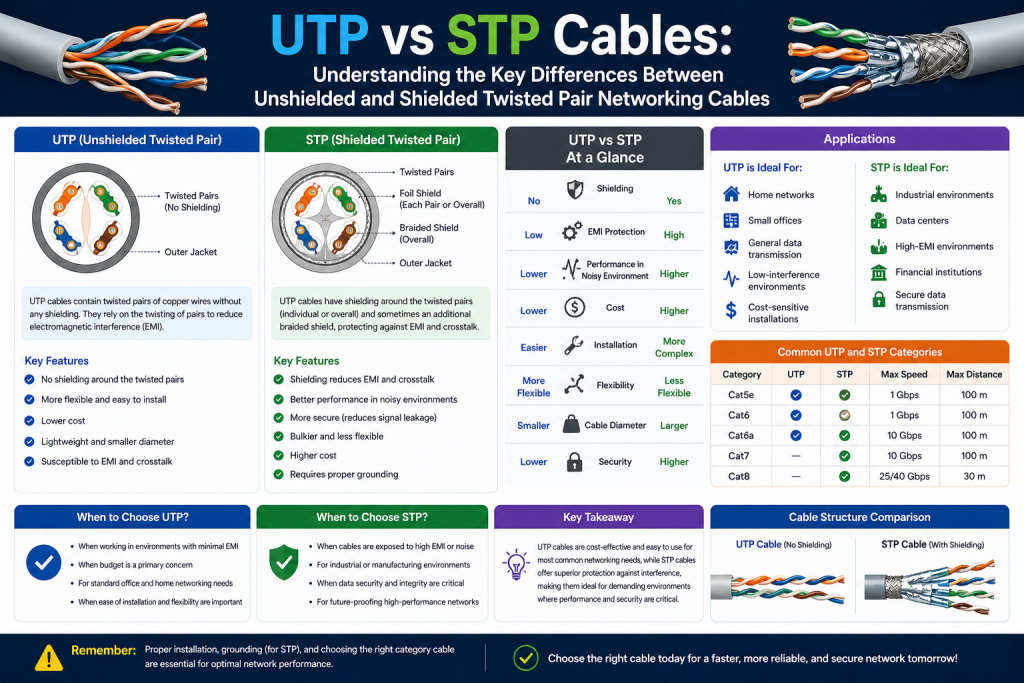
When building or upgrading a network, one of the most important yet often overlooked decisions involves selecting the right type of Ethernet cable. While routers, switches, and internet speeds tend to receive most of the attention, the physical medium that carries data between devices plays an equally critical role. Among the most widely used cable types are Unshielded Twisted Pair (UTP) and Shielded Twisted Pair (STP), each designed to serve specific networking needs.
At first glance, these cables may appear similar. Both rely on twisted pairs of copper wires to transmit data, and both are used in Ethernet networks across homes, offices, and industrial environments. However, the differences between them become significant when considering factors such as electromagnetic interference, installation complexity, cost, and performance reliability.
Understanding these differences is essential for making informed decisions. Choosing the wrong cable type can lead to network instability, reduced speeds, or unnecessary expenses. On the other hand, selecting the appropriate cable ensures efficient data transmission and long-term reliability.
This discussion begins by focusing on UTP cables, their structure, standards, advantages, and limitations. By building a strong foundation in how UTP works, it becomes easier to understand how it compares to shielded alternatives later on.
What Are UTP Cables
Unshielded Twisted Pair cables are the most commonly used type of Ethernet cabling in modern networks. As the name suggests, these cables do not include any additional shielding beyond their basic insulation. Instead, they rely on a clever design technique to minimize interference and maintain signal quality.
Inside a UTP cable are multiple pairs of copper wires. Each pair is twisted together in a specific pattern. This twisting is not random; it is carefully engineered to reduce electromagnetic interference and prevent signals from different pairs from interfering with one another. This phenomenon, known as crosstalk, can degrade performance if not properly managed.
The twisting works by ensuring that any interference affecting one wire in the pair is equally applied to the other wire. When the signal is processed, these interferences effectively cancel each other out, allowing the original data to be transmitted accurately. This simple yet effective design eliminates the need for additional shielding in many environments.
UTP cables are typically enclosed in a plastic outer jacket that protects the internal wires from physical damage. While this jacket provides basic protection, it does not offer the same level of defense against electromagnetic interference as shielded cables. This makes UTP more suitable for environments where interference levels are relatively low.
Structure and Design of UTP Cables
The internal structure of UTP cables plays a crucial role in their performance. Each cable contains multiple pairs of copper conductors, usually four pairs in standard Ethernet cables. These pairs are color-coded to simplify installation and ensure proper connections.
The twisting of the wire pairs varies in rate and pattern. This variation helps reduce the likelihood of interference between pairs, further improving signal integrity. Without this variation, signals from one pair could more easily interfere with those in another, leading to reduced performance.
In higher-category UTP cables, additional design elements may be included to improve performance. For example, some cables feature internal separators that keep the wire pairs apart, reducing crosstalk even further. Others may use higher-quality materials to support faster data transmission and higher frequencies.
Despite these enhancements, the fundamental principle remains the same: using twisted pairs to manage interference without relying on external shielding. This approach keeps the design simple, cost-effective, and easy to work with.
UTP Cable Standards and Compliance
To ensure consistent performance across different manufacturers and installations, UTP cables are governed by established industry standards. These standards define how cables should be constructed, tested, and categorized based on their capabilities.
Organizations such as the Telecommunications Industry Association and the International Organization for Standardization play a key role in developing these standards. Their guidelines ensure that cables meet specific requirements for speed, frequency, and reliability.
One widely recognized standard outlines the specifications for structured cabling systems, including UTP cables. This standard ensures that cables from different manufacturers can work together seamlessly, which is especially important in large-scale installations.
Compliance with these standards is essential in professional environments. In settings such as data centers or corporate networks, even minor inconsistencies can lead to significant issues. By following standardized guidelines, network designers can ensure predictable performance and compatibility.
Standards also help define cable categories, which indicate the performance level of a given cable. These categories are an important factor when selecting the right cable for a specific application.
UTP Cable Categories and Performance Levels
UTP cables are available in different categories, each designed to support specific data transmission speeds and frequencies. These categories provide a clear way to compare performance and choose the appropriate cable for a given network.
Category 5e is one of the most commonly used types. It supports gigabit Ethernet speeds and is suitable for most home and small office applications. Its affordability and reliability make it a popular choice for general networking needs.
Category 6 cables offer improved performance, including higher bandwidth and better resistance to interference. They are capable of supporting faster speeds over shorter distances, making them ideal for more demanding environments.
Category 6a takes performance a step further by supporting higher frequencies and maintaining high speeds over longer distances. This makes it suitable for larger networks and applications that require consistent performance.
Higher categories, such as Category 7, are designed for even more advanced applications. They offer greater bandwidth and improved shielding characteristics, although they are less commonly used in typical installations.
As the category increases, so do the performance capabilities. However, higher-category cables are often more expensive and less flexible, which can make installation more challenging. This highlights the importance of selecting a cable that meets current needs without unnecessarily increasing costs.
Advantages of UTP Cables
One of the most significant advantages of UTP cables is their cost-effectiveness. Because they do not include additional shielding, they are less expensive to produce and purchase. This makes them an attractive option for large installations where budget considerations are important.
Another benefit is their flexibility. UTP cables are generally thinner and more pliable than shielded cables, making them easier to install. They can be routed through tight spaces, around corners, and within cable management systems with relative ease.
Ease of installation also extends to connectors. UTP cables typically use standard connectors that are simple to attach and widely available. This reduces the need for specialized tools and simplifies the installation process.
Availability is another advantage. UTP cables are widely produced by numerous manufacturers, ensuring a steady supply and competitive pricing. This makes it easy to find cables that meet specific requirements without significant delays.
Additionally, UTP cables are sufficient for most everyday networking needs. In environments with minimal interference, they provide reliable performance without the added complexity of shielding.
Limitations of UTP Cables
Despite their many advantages, UTP cables are not without limitations. The most notable drawback is their susceptibility to electromagnetic interference. In environments with high levels of electrical noise, this can lead to signal degradation and reduced performance.
Sources of interference can include electrical wiring, machinery, and other electronic devices. When UTP cables are exposed to these sources, the lack of shielding makes it more difficult to maintain signal integrity.
Another limitation is related to distance. As the length of the cable increases, signal strength decreases. This can limit the effectiveness of UTP cables in large installations unless additional equipment is used to boost the signal.
Higher-category UTP cables, while offering improved performance, can also be more rigid. This can make them harder to work with during installation, especially in complex setups.
These limitations do not make UTP cables unsuitable but rather highlight the importance of using them in appropriate environments. Understanding where they perform best helps avoid potential issues.
Common Uses of UTP Cables
UTP cables are widely used in residential and commercial networking. In homes, they connect devices such as computers, routers, gaming consoles, and smart televisions. Their ability to support high-speed internet makes them ideal for everyday use.
In office environments, UTP cables are used to connect workstations, printers, and other devices to the network. Their flexibility and ease of installation make them well-suited for structured cabling systems.
They are also commonly used for patch cables, which connect devices to wall outlets or network switches. These short connections benefit from the simplicity and reliability of UTP design.
Educational institutions, small businesses, and retail environments also rely heavily on UTP cables. In these settings, the balance between cost and performance makes them a practical choice.
Why UTP Remains Popular
The continued popularity of UTP cables can be attributed to their simplicity and effectiveness. They provide a reliable solution for most networking needs without unnecessary complexity.
Advancements in cable design have further improved their performance, allowing them to support higher speeds and handle more demanding applications. Despite the availability of more advanced cable types, UTP remains the standard choice for many installations.
Another reason for their popularity is ease of maintenance. Troubleshooting and replacing UTP cables is straightforward, which helps reduce downtime and maintenance costs.
Their compatibility with existing infrastructure also plays a role. Many networks are already built using UTP cables, making it easier to expand or upgrade without significant changes.
Preparing for the Comparison with STP
Understanding UTP cables provides a strong foundation for comparing them with shielded alternatives. While UTP excels in simplicity and cost-effectiveness, it is not always the best choice for every environment.
In situations where interference is a concern, additional protection may be necessary. This is where STP cables come into play, offering enhanced resistance to electromagnetic noise through specialized shielding.
The decision between UTP and STP is not about choosing one over the other universally. Instead, it involves evaluating the specific needs of the network and selecting the cable type that best meets those requirements.
By examining the strengths and limitations of UTP cables, it becomes easier to identify scenarios where they are most effective and where alternative solutions may be more appropriate. This understanding sets the stage for a deeper exploration of shielded cables and their role in modern networking.
Understanding Shielded Twisted Pair Cables
Shielded Twisted Pair cables are designed to address one of the most important challenges in network communication: maintaining signal integrity in environments where electrical interference is present. While unshielded cables rely solely on twisted wire pairs to minimize interference, shielded cables add an extra layer of protection that significantly improves performance in demanding conditions.
At their core, STP cables share the same fundamental structure as unshielded cables. They use pairs of copper wires twisted together to carry data signals. This twisting reduces internal interference between the wires, ensuring that signals remain clear and consistent. However, what sets STP cables apart is the addition of shielding that surrounds the wires, offering an extra defense against external electromagnetic disturbances.
This shielding is especially valuable in environments where electrical noise is unavoidable. Industrial machinery, high-voltage power lines, and even dense clusters of electronic devices can all produce interference that disrupts network signals. STP cables are specifically designed to function reliably under such conditions, making them an essential component in specialized networking scenarios.
Structure and Components of STP Cables
The structure of STP cables is more complex than that of unshielded cables due to the inclusion of protective layers. Inside the cable, multiple pairs of copper wires are twisted together, just like in UTP cables. Each pair is carefully designed to reduce crosstalk, which occurs when signals from one pair interfere with another.
Beyond this basic structure, STP cables incorporate shielding that can take several forms. In some designs, each individual pair of wires is wrapped in a thin layer of foil. This foil acts as a barrier that blocks electromagnetic signals from entering or leaving the cable. In other designs, the entire group of wire pairs is enclosed in a braided metal shield, which provides a more comprehensive level of protection.
Some advanced STP cables combine both foil and braided shielding. This dual-layer approach offers enhanced protection against a wider range of interference types, making these cables suitable for highly demanding environments. The combination of internal twisting and external shielding ensures that data signals remain stable even when exposed to significant electromagnetic noise.
The outer jacket of STP cables is typically thicker and more durable than that of unshielded cables. This added protection not only safeguards the internal components but also contributes to the overall robustness of the cable. However, it also makes the cable less flexible, which can impact installation.
Types of Shielding Used in STP Cables
Different types of shielding are used in STP cables, each offering unique benefits depending on the environment and application. Understanding these variations helps in selecting the right cable for specific networking needs.
One common type is foil shielding, where a thin layer of aluminum or similar material wraps around the wire pairs. This type of shielding is particularly effective against high-frequency interference. It creates a barrier that reflects external signals, preventing them from affecting the data transmission inside the cable.
Another type is braided shielding, which consists of a mesh of fine metal strands surrounding the cable. This design provides stronger and more durable protection, especially against lower-frequency interference and physical stress. Braided shielding is often used in environments where cables may be exposed to both electrical noise and mechanical wear.
There are also hybrid designs that combine foil and braided shielding. These cables offer the benefits of both methods, providing comprehensive protection against a wide range of interference sources. While these cables are more expensive, they are often necessary in environments where performance cannot be compromised.
The choice of shielding type depends on factors such as the level of interference, installation conditions, and budget. Each type has its strengths and limitations, making it important to evaluate the specific requirements of the network.
How STP Cables Reduce Electromagnetic Interference
Electromagnetic interference is one of the primary challenges in maintaining reliable network performance. It occurs when external electromagnetic fields disrupt the signals traveling through a cable. This can lead to data corruption, reduced speeds, and unstable connections.
STP cables reduce interference by acting as a barrier between the internal wires and the external environment. The shielding absorbs or reflects electromagnetic signals, preventing them from reaching the copper conductors inside the cable. This ensures that the data being transmitted remains unaffected by external noise.
In addition to blocking external interference, the shielding also helps contain the signals within the cable. This reduces the likelihood of signals leaking out and interfering with nearby cables. This containment is especially important in environments where multiple cables are bundled together, such as in server racks or cable trays.
The effectiveness of shielding depends on proper grounding. The shield must be connected to a grounding system that safely dissipates any absorbed electromagnetic energy. Without proper grounding, the shielding may not function as intended and could even introduce additional interference.
Advantages of STP Cables
One of the most significant advantages of STP cables is their ability to maintain signal integrity in challenging environments. By reducing the impact of electromagnetic interference, these cables ensure reliable data transmission even in the presence of strong electrical noise.
This makes STP cables ideal for industrial settings, where machinery and equipment generate high levels of interference. In such environments, unshielded cables may struggle to maintain consistent performance, leading to frequent disruptions. STP cables provide a more stable solution.
Another advantage is their ability to support higher data transmission speeds over longer distances. The reduction in interference allows signals to travel more efficiently, making STP cables suitable for high-performance networks that require consistent throughput.
STP cables also reduce crosstalk between adjacent cables. This is particularly important in dense installations where multiple cables are placed close together. By minimizing interference between cables, STP ensures that each connection operates independently without affecting others.
Durability is another benefit. The additional shielding and thicker construction make STP cables more resistant to physical damage. This can be especially valuable in environments where cables are exposed to wear and tear.
Disadvantages of STP Cables
Despite their advantages, STP cables come with several drawbacks that must be considered. One of the most obvious is cost. The additional materials and more complex construction make these cables more expensive than unshielded alternatives.
Installation can also be more challenging. The thicker and less flexible design of STP cables makes them harder to route through tight spaces. This can increase installation time and require more effort, especially in complex setups.
Proper grounding is essential for STP cables to function effectively. This adds another layer of complexity to the installation process. Without correct grounding, the benefits of shielding may be lost, and the cable may not perform as expected.
Working with STP cables also requires specialized connectors and tools. Shielded connectors are bulkier and can be more difficult to handle. This can make termination more time-consuming and may require additional training or expertise.
These factors make STP cables less suitable for simple installations where their benefits are not needed. In such cases, the added cost and complexity may not be justified.
Common Applications of STP Cables
STP cables are commonly used in environments where reliability and performance are critical. Industrial facilities are one of the primary use cases. In these settings, heavy machinery and electrical systems generate significant interference, making shielding essential.
Data centers also rely on STP cables for high-speed connections. These facilities require consistent performance and cannot afford disruptions. The use of shielded cables helps ensure stable communication between servers, switches, and other equipment.
Healthcare facilities, research laboratories, and broadcasting environments may also use STP cables. In these settings, accurate data transmission is crucial, and even minor interference can have serious consequences.
Another application is in outdoor or harsh environments. The added durability of STP cables makes them suitable for installations where cables may be exposed to physical stress or environmental factors.
Performance Considerations for STP Cables
When evaluating STP cables, several performance factors must be considered. One of the most important is the level of interference in the environment. In areas with minimal interference, the benefits of shielding may not be noticeable. However, in noisy environments, STP cables can significantly improve performance.
Cable length is another consideration. STP cables generally perform better over longer distances compared to unshielded cables. This makes them suitable for large installations where maintaining signal quality is a challenge.
Data transmission speed is also important. High-speed networks require cables that can handle increased bandwidth without degradation. STP cables are often better suited for these applications due to their ability to reduce interference.
Installation quality plays a critical role in performance. Proper grounding, correct termination, and careful routing are all essential for achieving optimal results. Poor installation can negate the advantages of shielding.
Challenges in Installing STP Cables
Installing STP cables requires careful planning and attention to detail. The added complexity of shielding means that standard installation practices may not always be sufficient.
One of the main challenges is ensuring proper grounding. This involves connecting the shielding to a grounding system that safely dissipates electromagnetic energy. Without this connection, the shielding cannot perform its intended function.
Handling the cables can also be more difficult due to their stiffness. This can make it challenging to route them through tight spaces or around obstacles. Installers may need to use specialized tools or techniques to achieve the desired layout.
Termination is another critical step. Shielded connectors must be properly attached to maintain the integrity of the shielding. This requires precision and experience, as improper termination can lead to performance issues.
Despite these challenges, proper installation ensures that STP cables deliver their full benefits. Investing time and effort in correct installation can result in a more reliable and efficient network.
Role of STP in Modern Networking
As network demands continue to grow, the role of STP cables becomes increasingly important. High-speed data transmission, increased device density, and the presence of electronic equipment all contribute to the need for reliable cabling solutions.
STP cables provide a way to address these challenges by offering enhanced protection against interference. This makes them a valuable option for environments where performance cannot be compromised.
While they may not be necessary for every installation, their importance in specialized scenarios cannot be overlooked. Understanding when and how to use STP cables is essential for designing networks that meet modern requirements.
Preparing for the Final Comparison
With a clear understanding of both UTP and STP cables, the next step is to compare them directly and determine how to choose between them. Each cable type has its strengths and limitations, and the right choice depends on the specific needs of the network.
By examining factors such as cost, performance, installation complexity, and environmental conditions, it becomes possible to make informed decisions. This knowledge ensures that the selected cable type aligns with both current requirements and future growth.
The final section will bring these insights together, focusing on practical decision-making and real-world applications.
Making the Right Choice Between UTP and STP
Selecting between Unshielded Twisted Pair and Shielded Twisted Pair cables is not a matter of simply choosing the more advanced or more expensive option. Instead, it requires a careful understanding of the environment, the technical requirements of the network, and long-term performance expectations. Both cable types are designed to transmit data efficiently, but they perform best under different conditions.
The decision-making process begins by evaluating the physical environment in which the cables will be installed. In locations where electromagnetic interference is minimal, such as typical homes and office buildings, UTP cables are often more than sufficient. Their design already includes twisted pairs that reduce internal interference, and in low-noise environments, this is usually enough to maintain stable connections.
However, in environments where electrical noise is a constant factor, such as factories or areas with heavy equipment, STP cables provide a clear advantage. The added shielding helps block interference that could otherwise disrupt communication. This makes STP a more reliable option in situations where performance consistency is critical.
Understanding the purpose of the network is equally important. A simple home network used for browsing, streaming, and occasional file transfers has very different requirements compared to a high-performance data center. Matching the cable type to the network’s purpose ensures that resources are used efficiently without unnecessary overspending.
Evaluating Environmental Factors
Environmental conditions play a major role in determining which cable type is most appropriate. Interference can come from a wide range of sources, including electrical wiring, machinery, lighting systems, and even other network cables. Identifying these sources is an essential step in the planning process.
In a typical office environment, interference levels are usually low. Devices such as computers, printers, and routers do not generate significant electromagnetic noise. In these settings, UTP cables perform reliably and offer a cost-effective solution.
In contrast, industrial environments present a different set of challenges. Equipment such as motors, generators, and heavy-duty machinery can produce strong electromagnetic fields. These fields can interfere with unshielded cables, leading to data errors and reduced performance. STP cables are designed to handle these conditions by providing a protective barrier that maintains signal integrity.
Another factor to consider is cable placement. Cables that run alongside power lines or near electronic equipment are more likely to experience interference. In such cases, using shielded cables can help prevent potential issues. Proper planning of cable routes can also reduce exposure to interference, improving overall performance.
Temperature, humidity, and physical conditions may also influence the choice. In harsh environments where cables may be exposed to physical stress, the durability of STP cables can be an advantage. Their thicker construction provides additional protection against damage.
Considering Network Performance Requirements
Performance requirements vary depending on the type of network being implemented. Factors such as data speed, bandwidth, and reliability all influence the choice of cable.
For most residential and small business networks, UTP cables provide sufficient performance. Modern categories of UTP cables support high-speed data transmission, making them suitable for activities such as streaming, online gaming, and general internet use.
In larger networks, especially those handling large volumes of data, performance becomes more critical. Data centers, for example, require consistent and high-speed connections to ensure efficient operation. In these environments, even minor disruptions can have significant consequences. STP cables help maintain stable performance by reducing interference.
Bandwidth requirements are also important. As the number of connected devices increases, so does the demand for bandwidth. Choosing cables that can support current and future bandwidth needs is essential for maintaining network efficiency.
Latency and data accuracy are additional considerations. In applications such as financial systems, healthcare, or real-time communication, even small delays or errors can be problematic. Using the appropriate cable type helps ensure that data is transmitted accurately and without delay.
Cost and Budget Considerations
Budget constraints often play a significant role in network design. UTP cables are generally more affordable than STP cables, making them a popular choice for cost-conscious projects. Their lower price, combined with ease of installation, helps reduce overall expenses.
However, focusing solely on initial cost can lead to issues in the long run. In environments where interference is a concern, using cheaper unshielded cables may result in performance problems that require costly troubleshooting and upgrades. In such cases, investing in STP cables from the beginning can be more economical over time.
Installation costs should also be considered. UTP cables are easier to handle and require less specialized equipment, which reduces labor costs. STP cables, on the other hand, may require additional time and expertise to install correctly.
Maintenance and future upgrades are another aspect of cost. Choosing cables that can support future network demands can reduce the need for replacements. This is particularly important in large installations where replacing cables can be time-consuming and expensive.
Balancing cost with performance requirements is key. The goal is to achieve reliable performance without unnecessary expenditure.
Installation and Maintenance Factors
The ease of installation is an important consideration when selecting network cables. UTP cables are known for their flexibility and simplicity. They are easier to route through walls, ceilings, and cable management systems, making them ideal for standard installations.
STP cables, due to their added shielding, are thicker and less flexible. This can make installation more challenging, especially in tight spaces. Proper planning is required to ensure that the cables can be routed effectively.
Grounding is a critical aspect of STP cable installation. The shielding must be properly connected to a grounding system to function correctly. Without proper grounding, the benefits of shielding may not be realized, and performance could be compromised.
Maintenance is generally simpler with UTP cables. Their straightforward design makes it easier to identify and resolve issues. STP cables, while more robust, may require more careful handling during maintenance to avoid damaging the shielding.
Documentation and labeling are also important for both cable types. Keeping track of cable routes and connections helps simplify troubleshooting and future upgrades.
Scalability and Future-Proofing
As technology continues to evolve, networks must be able to adapt to changing requirements. Scalability is an important factor in cable selection, as it determines how easily a network can be expanded or upgraded.
UTP cables are widely used and compatible with most networking equipment. This makes them a practical choice for networks that may need to grow over time. Upgrading to higher-category UTP cables can also improve performance without requiring a complete overhaul.
STP cables offer advantages in high-performance environments where future demands are expected to increase significantly. Their ability to handle higher frequencies and reduce interference makes them suitable for advanced applications.
Planning for future needs involves considering factors such as increased data usage, additional devices, and new technologies. Choosing cables that can support these changes helps ensure long-term reliability.
A well-designed network should not only meet current requirements but also be prepared for future developments. This reduces the need for frequent upgrades and minimizes disruption.
Hybrid Network Approaches
In many cases, the best solution is not to choose one cable type exclusively but to use a combination of both. Hybrid network designs allow for greater flexibility and efficiency by matching cable types to specific areas within the network.
For example, UTP cables can be used for standard office connections where interference is minimal. At the same time, STP cables can be installed in areas with higher levels of interference or where performance is critical. This approach balances cost and performance effectively.
Hybrid designs are commonly used in large organizations and complex installations. They allow network designers to address specific challenges without overcomplicating the entire system.
Proper planning is essential when implementing a hybrid approach. Ensuring compatibility between different cable types and maintaining consistent performance across the network requires careful consideration.
Real-World Applications and Practical Examples
In real-world scenarios, the choice between UTP and STP often depends on the specific requirements of the project. A small business setting, for instance, may rely entirely on UTP cables due to their affordability and ease of installation. These networks typically do not face significant interference issues, making UTP a practical choice.
In contrast, a manufacturing facility may require STP cables to ensure reliable communication between machines and control systems. The presence of heavy equipment and electrical noise makes shielding ضروری for maintaining performance.
Educational institutions often use a combination of both cable types. Classrooms and administrative offices may use UTP cables, while specialized labs or technical areas may require STP cables.
Data centers represent one of the most demanding environments. These facilities often use high-performance cables, including STP, to ensure stable and high-speed connections. The need for reliability and efficiency makes shielding an important factor.
These examples highlight the importance of tailoring cable selection to the specific needs of each environment.
Common Mistakes to Avoid
One common mistake is assuming that more expensive cables are always better. While STP cables offer additional protection, they are not necessary for every environment. Using them in low-interference settings may lead to unnecessary costs without significant benefits.
Another mistake is neglecting proper installation practices. Even the best cables cannot perform well if they are not installed correctly. Ensuring proper routing, termination, and grounding is essential for achieving optimal performance.
Ignoring future requirements is also a common issue. Choosing cables that only meet current needs may lead to limitations as the network grows. Planning for scalability helps avoid costly upgrades later.
Failing to assess the environment accurately can lead to poor decisions. Conducting a thorough evaluation of interference sources and network requirements is essential for selecting the right cable type.
Conclusion
Choosing between UTP and STP cables is a critical decision that affects the performance, reliability, and cost of a network. Both cable types have their strengths, and understanding these strengths is essential for making informed choices.
UTP cables offer simplicity, affordability, and ease of installation, making them ideal for most residential and office environments. They provide reliable performance in low-interference settings and are widely used due to their practicality.
STP cables, on the other hand, are designed for environments where interference is a concern. Their shielding provides enhanced protection, ensuring stable performance in challenging conditions. While they come with higher costs and installation complexity, their benefits are essential in specific scenarios.
The key to making the right choice lies in evaluating the environment, understanding performance requirements, and considering long-term needs. In many cases, a combination of both cable types provides the best solution, allowing for flexibility and efficiency.
By carefully assessing all relevant factors, it becomes possible to design a network that meets current demands while remaining adaptable for future growth. This balanced approach ensures that the network operates efficiently, reliably, and cost-effectively over time.
Continue exploring the technologies and certification concepts that matter most to you.