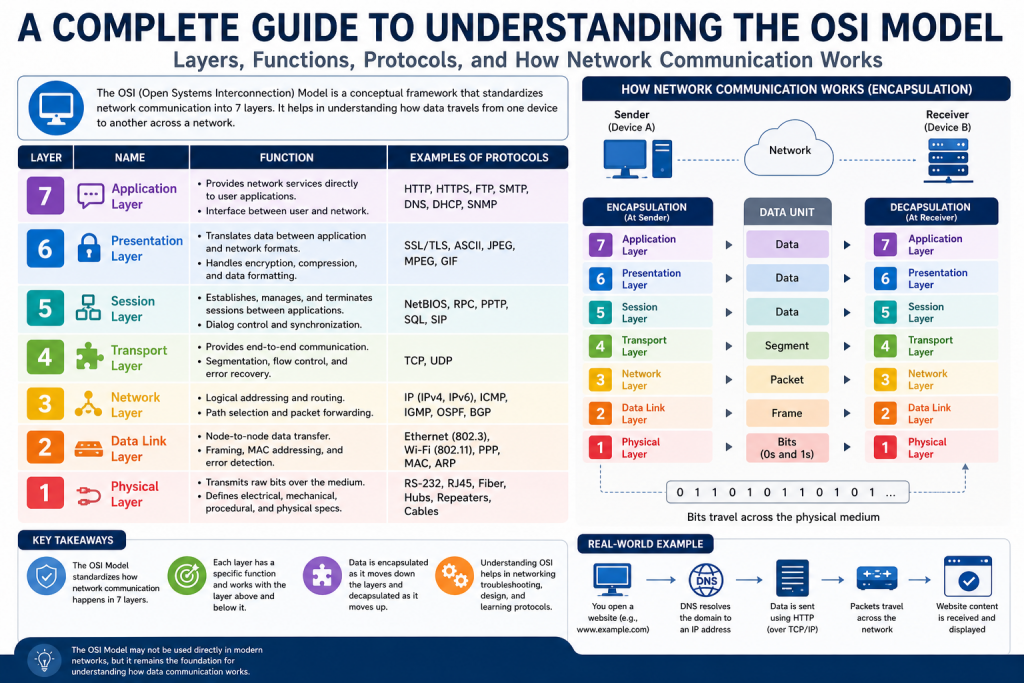
The Open Systems Interconnection model, commonly known as the OSI Model, is one of the most important concepts in networking. It provides a structured way to understand how data travels from one device to another across a network. Although it is a theoretical model, it is widely used in education, certifications, and practical troubleshooting because it simplifies complex communication processes into manageable layers.
For many learners, the OSI Model can feel difficult at first. This is mainly because it introduces multiple layers, each with its own purpose, terminology, and functions. Without real-world experience, it may seem abstract. However, once the logic behind the layers is understood, it becomes a powerful tool for understanding how networks operate.
An OSI Model chart is simply a visual representation of these seven layers. It usually displays them in order, either from top to bottom or bottom to top. Learning how to read this chart properly requires more than just memorizing the names of the layers. It involves understanding what each layer does, how data is handled, and how different technologies fit into the model.
Why the OSI Model Is Important
The OSI Model plays a key role in helping people understand network communication. It acts as a guide that explains how data moves step by step from a source device to a destination device. Each layer has a specific function, and together they ensure smooth and reliable communication.
One of the biggest advantages of the OSI Model is that it breaks down a complex process into smaller parts. Instead of trying to understand networking as one large system, you can focus on one layer at a time. This makes learning easier and helps in identifying problems when something goes wrong.
Another important benefit is standardization. The OSI Model provides a common language for networking professionals. Whether someone is working with hardware, software, or security, they can refer to specific layers when discussing issues or designing systems.
It is also widely used in certification exams and training programs. Many networking concepts are explained using the OSI Model, so having a strong understanding of it is essential for anyone entering the IT field.
Challenges in Learning the OSI Model
Despite its usefulness, the OSI Model can be challenging to learn. One reason is that it is not always used exactly as described in real-world networks. Modern networking often combines multiple layers or uses different models like TCP/IP.
Another challenge is the amount of information involved. Each layer has its own protocols, functions, and devices. Trying to memorize everything at once can be overwhelming. This is why it is important to focus on understanding the purpose of each layer rather than memorizing every detail.
Lack of hands-on experience can also make learning difficult. Without seeing how networks operate in practice, it can be hard to relate the layers to real situations. However, using simple examples and focusing on the flow of data can make the model easier to understand.
Using Memory Techniques to Remember the Layers
Many learners use memory techniques, known as mnemonics, to remember the order of the OSI layers. These are simple phrases where each word represents a layer.
One popular mnemonic from top to bottom is:
All People Seem To Need Data Processing
This represents the layers in the following order:
Application
Presentation
Session
Transport
Network
Data Link
Physical
Another common mnemonic from bottom to top is:
Please Do Not Throw Sausage Pizza Away
This represents:
Physical
Data Link
Network
Transport
Session
Presentation
Application
These phrases are useful for quick recall, especially during exams. However, they should not replace actual understanding. Knowing what each layer does is far more important than simply remembering the order.
How to Read an OSI Model Chart Effectively
When looking at an OSI Model chart, it is important to focus on a few key elements. These elements help you understand what each layer represents and how it contributes to the overall communication process.
The first thing to consider is the type of data handled at each layer. Data changes form as it moves through the layers, starting as user data and eventually becoming signals.
The second element is protocols. Each layer uses specific protocols that define how data is transmitted and processed. Understanding which protocols belong to which layer helps in understanding network operations.
The third element is the function of the layer. Each layer has a unique role, such as transmitting signals, routing data, or managing connections.
The fourth element is the devices associated with the layer. Different networking devices operate at different layers, and knowing this helps in identifying where certain tasks are performed.
By focusing on these four aspects, you can interpret any OSI Model chart more easily and understand what is happening at each level.
Important Concepts Before Exploring the Layers
Before diving into the individual layers, it is helpful to understand some basic concepts that apply across the entire model.
One important concept is that you do not need to learn everything at once. The OSI Model is detailed, and each layer can be studied in depth. At the beginning, it is better to understand the general purpose of each layer.
Another concept is that devices can operate at multiple layers. For example, a computer can run applications at the top layer while also handling physical transmission at the bottom layer. This overlap is normal and should not cause confusion.
Encapsulation is another key concept. As data moves down the layers, each layer adds its own information in the form of headers. These headers contain instructions that help the receiving system process the data correctly.
When the data reaches its destination, the headers are removed in a process called de-encapsulation. This ensures that the original data can be read and used by the application.
Physical Layer
The physical layer is the foundation of the OSI Model. It is responsible for the actual transmission of data over a physical medium. At this layer, data is represented as bits, which are simply ones and zeros.
These bits are transmitted through cables, fiber optics, or wireless signals. The physical layer defines how signals are generated, transmitted, and received.
It also deals with hardware elements such as connectors, cables, and voltage levels. This layer does not interpret the data; it only ensures that signals are sent and received correctly.
Technologies at this layer include Ethernet signaling, Wi-Fi transmission, and fiber optic communication.
Devices associated with the physical layer include hubs, repeaters, cables, and wireless access points. These devices simply move signals without analyzing their content.
Data Link Layer
The data link layer builds on the physical layer by organizing bits into frames. A frame is a structured unit of data that includes both the payload and additional information for delivery.
This layer ensures reliable communication between devices on the same network. It handles error detection and controls how devices access the network.
The data link layer uses MAC addresses to identify devices. Each device has a unique MAC address that is used for communication within a local network.
Frames include several components, such as the source address, destination address, data, and error-checking information.
Protocols at this layer include Ethernet and others used for local communication.
Devices associated with the data link layer include switches and network interface cards. These devices use MAC addresses to forward data to the correct destination.
Network Layer
The network layer is responsible for delivering data between different networks. It introduces logical addressing through IP addresses.
At this layer, data is packaged into units called packets. Each packet contains information about the source and destination addresses.
The network layer determines the best path for data to travel. This process is known as routing.
Routers are the primary devices at this layer. They analyze packets and decide where to send them next based on network conditions.
Protocols used at this layer include IP and ICMP.
A key concept to remember is the difference between MAC addresses and IP addresses. MAC addresses are used at the data link layer, while IP addresses are used at the network layer.
Understanding Data Flow in the Lower Layers
As data moves through the OSI Model, it passes through each layer in sequence. When sending data, it moves from higher layers down to lower layers. When receiving data, the process is reversed.
Each layer adds or removes information as needed. This ensures that data is properly formatted and delivered to the correct destination.
The first three layers focus on the physical movement of data. They handle transmission, framing, and routing.
Simplifying the First Three Layers
A simple way to understand the lower layers is to think of them in basic terms.
The physical layer deals with signals and hardware.
The data link layer manages frames and local communication.
The network layer handles routing and addressing.
This simplified view makes it easier to remember their roles and understand how they work together.
Building a Strong Networking Foundation
Understanding the first three layers of the OSI Model is essential for building a strong foundation in networking. These layers handle the core functions that allow data to move across networks.
Even though modern networking technologies may not strictly follow the OSI Model, the concepts remain highly relevant. They help in troubleshooting, designing networks, and understanding how different systems interact.
As you continue learning, the higher layers will add more complexity by introducing communication management, data formatting, and user interaction. However, everything depends on the lower layers working correctly.
By focusing on the fundamentals and understanding how each layer contributes to the overall process, you can develop a clear and practical understanding of networking.
Exploring the Middle and Upper Layers of the OSI Model
After understanding the first three layers of the OSI Model, it becomes easier to move into the middle and upper layers. These layers focus less on the physical movement of data and more on how communication is managed, controlled, and presented to users.
While the lower layers handle transmission, framing, and routing, the upper layers deal with reliability, session management, data formatting, and user interaction. Together, they ensure that data not only reaches its destination but is also usable and meaningful.
This section explains Layers 4 to 6 in detail, helping you understand how they function within an OSI Model chart and how they contribute to the overall communication process.
Transport Layer Overview
The transport layer is responsible for ensuring reliable communication between devices. It acts as a bridge between the lower layers, which handle delivery, and the upper layers, which handle applications and data presentation.
At this layer, data is divided into smaller units for transmission and then reassembled at the destination. This process ensures that even large amounts of data can be sent efficiently across a network.
The transport layer also introduces the concept of end-to-end communication. This means that it is responsible for ensuring that data sent from one device reaches the correct application on another device.
Another important function of this layer is the use of port numbers. These numbers help identify which application should receive the data. For example, web traffic and email traffic use different ports, allowing a device to manage multiple communications at the same time.
Data Units at the Transport Layer
At the transport layer, data is organized into segments when using certain protocols and into datagrams when using others.
Segments are used in connection-oriented communication, where reliability is important. Datagrams are used in connectionless communication, where speed is more important than reliability.
Each unit includes additional information that helps manage the communication process. This includes sequence numbers, acknowledgments, and port numbers.
These elements ensure that data can be tracked, reordered if necessary, and delivered correctly to the intended application.
Protocols Used in the Transport Layer
Two of the most important protocols at this layer are TCP and UDP.
TCP is designed for reliability. It ensures that data is delivered in the correct order and without errors. It uses acknowledgments to confirm that data has been received successfully. If data is lost, it is retransmitted.
UDP, on the other hand, focuses on speed. It does not use acknowledgments or retransmissions. This makes it faster but less reliable.
Both protocols are useful in different situations. Applications that require accuracy, such as file transfers or web browsing, typically use TCP. Applications that require speed, such as video streaming or online gaming, often use UDP.
Functions of the Transport Layer
The transport layer performs several important functions that ensure smooth communication.
One of its main tasks is segmentation. Large pieces of data are broken into smaller segments before being sent across the network. This makes transmission more efficient and manageable.
Another function is flow control. This ensures that a fast sender does not overwhelm a slow receiver. The transport layer adjusts the rate of data transmission based on the receiver’s ability to process data.
Error detection and correction are also handled here. The transport layer checks for errors and requests retransmission if necessary.
Multiplexing is another key function. It allows multiple applications to share the same network connection by assigning different port numbers.
Together, these functions make the transport layer essential for reliable and efficient communication.
Devices Associated with the Transport Layer
Although the transport layer is mostly handled by software, certain network devices also operate at this level.
Firewalls often inspect transport layer information to filter traffic based on port numbers. This helps in controlling access and improving security.
Load balancers also work at this layer. They distribute incoming traffic across multiple servers to ensure efficiency and reliability.
These devices play an important role in managing and optimizing network communication.
Understanding the Transition from Layer 3 to Layer 4
The transition between the network layer and the transport layer is an important step in the communication process.
At the network layer, data is organized into packets and routed to the destination network. Once the data reaches the correct network, the transport layer takes over.
Here, packets are converted into segments or datagrams, depending on the protocol being used. This transformation allows the transport layer to manage communication between specific applications.
This transition highlights the shift from network-level communication to application-level communication.
Session Layer Overview
The session layer is responsible for establishing, managing, and terminating communication sessions between devices.
A session is a continuous exchange of data between two systems. The session layer ensures that this exchange happens smoothly and can recover from interruptions if necessary.
This layer is often less visible in modern networking because many of its functions are handled by other layers or protocols. However, it still plays an important conceptual role in the OSI Model.
Role of Sessions in Communication
Sessions are important because they allow devices to maintain a consistent connection while exchanging data.
For example, when you log into a remote system or access a service, a session is created. This session keeps track of the interaction and ensures that data is exchanged in the correct order.
If a connection is interrupted, the session layer can help resume communication from where it left off, rather than starting over.
This makes communication more efficient and reliable.
Functions of the Session Layer
The session layer performs several key functions.
One of its main tasks is session establishment. It sets up the connection between devices before data transfer begins.
Another function is session management. This involves maintaining the connection and ensuring that data flows correctly between devices.
The session layer also handles session termination. Once communication is complete, it ensures that the connection is properly closed.
Synchronization is another important feature. The session layer can insert checkpoints into the data stream. If a failure occurs, communication can resume from the last checkpoint instead of restarting entirely.
Protocols Associated with the Session Layer
Several protocols are linked to the session layer, although their classification can sometimes vary.
These include protocols used for remote communication, authentication, and session management.
Because the boundaries between the session, presentation, and application layers can be unclear, some protocols may be associated with multiple layers depending on the context.
Devices Associated with the Session Layer
The session layer is mainly handled by software running on end devices such as computers and servers.
These systems manage sessions internally, ensuring that communication remains stable and organized.
Although there are no specific hardware devices dedicated solely to this layer, its functions are essential for many applications.
Presentation Layer Overview
The presentation layer is responsible for how data is formatted, encoded, and presented to the application layer.
It ensures that data sent from one system can be understood by another, even if they use different formats or structures.
This layer acts as a translator between different systems, converting data into a standard format.
Data Formatting and Translation
One of the main roles of the presentation layer is data translation.
Different systems may use different formats for text, images, and other types of data. The presentation layer converts this data into a common format that can be understood by both the sender and the receiver.
For example, text may be encoded using standard character formats, while images may be converted into widely supported file types.
This ensures compatibility between different systems and applications.
Encryption and Decryption
Security is another important function of the presentation layer.
Data can be encrypted before transmission to protect it from unauthorized access. At the receiving end, the data is decrypted so that it can be used.
This process helps ensure that sensitive information remains secure during communication.
Encryption is widely used in applications such as online banking, email, and secure web browsing.
Compression and Decompression
The presentation layer also handles data compression.
Compression reduces the size of data, making it faster to transmit across the network. This is especially useful for large files such as images, videos, and documents.
At the receiving end, the data is decompressed back to its original form.
This process improves efficiency without losing important information.
Protocols Associated with the Presentation Layer
Protocols related to encryption and data formatting are commonly associated with this layer.
As with the session layer, there can be some overlap in how these protocols are classified.
The important point is that the presentation layer ensures data is properly structured, secure, and ready for use by applications.
Devices Associated with the Presentation Layer
Like the session layer, the presentation layer is primarily handled by software on computers and servers.
These systems perform tasks such as encoding, encryption, and compression.
Although there are no dedicated hardware devices for this layer, its functions are essential for ensuring that data is usable and secure.
Understanding the Upper Layers Together
Layers 5 and 6, along with Layer 7, are often grouped together because their functions are closely related.
They deal with how data is managed, formatted, and used by applications.
In some networking models, these layers are combined into a single layer. However, the OSI Model separates them to provide a clearer understanding of each function.
Simplifying Layers 4 to 6
A simple way to understand these layers is to think of them in terms of their main roles.
The transport layer ensures reliable communication and manages data flow.
The session layer manages connections between devices.
The presentation layer formats and secures data.
This simplified view makes it easier to remember their functions and how they contribute to the overall process.
Building Toward Application-Level Communication
As data moves up from the transport layer to the presentation layer, it becomes more refined and ready for use.
By the time it reaches the top layer, it is fully prepared for interaction with applications and users.
Understanding these middle and upper layers helps complete the picture of how data travels through the OSI Model.
Each layer adds its own functionality, ensuring that communication is reliable, organized, and meaningful.
This layered approach makes networking more efficient and easier to understand, even in complex systems.
Understanding the Final Layer of the OSI Model and Bringing It All Together
After exploring the lower and middle layers of the OSI Model, the final step is to understand the top layer and how all seven layers work together as a complete system. The uppermost layer is where users and applications directly interact with the network. It represents the point where technical networking processes become real-world actions such as browsing a website, sending an email, or transferring files.
While the earlier layers focus on transmission, routing, reliability, and formatting, the final layer focuses on delivering meaningful services to users. Understanding this layer completes the overall picture of how the OSI Model operates from start to finish.
Application Layer Overview
The application layer is the highest layer of the OSI Model. It provides the interface between the user and the network. This is the layer where software applications communicate with the network to perform tasks.
It is important to understand that the application layer does not refer to the applications themselves, such as web browsers or email clients. Instead, it refers to the protocols and services that allow these applications to communicate over the network.
This layer enables users to access network services such as web browsing, file transfer, email communication, and remote access. It acts as the entry and exit point for data in the OSI Model.
Role of the Application Layer in Communication
The application layer plays a critical role in making network communication possible for users. Without it, the lower layers would still function, but users would not be able to interact with the network in a meaningful way.
When a user performs an action such as opening a website, the application layer is responsible for initiating the communication. It prepares the data and ensures that the correct protocol is used.
It also handles requests and responses between systems. For example, when a user requests a webpage, the application layer ensures that the request is sent and that the response is received and passed to the appropriate software.
This layer simplifies complex networking processes, allowing users to perform tasks without needing to understand what is happening behind the scenes.
Data Handling at the Application Layer
At the application layer, data is simply referred to as data. Unlike the lower layers, no additional headers specific to this layer are added.
The focus here is on delivering usable information to applications. This means that by the time data reaches this layer, it has already been processed, formatted, and verified by the lower layers.
The application layer ensures that data is ready for presentation to the user. It also ensures that outgoing data is properly prepared for transmission through the lower layers.
Protocols Used at the Application Layer
A wide range of protocols operate at the application layer. These protocols define how different types of communication are handled.
Protocols for web browsing allow users to access websites and interact with web servers. Email protocols enable sending and receiving messages across networks. File transfer protocols allow users to upload and download files.
Other protocols support tasks such as remote system access, network management, and time synchronization.
Each protocol is designed for a specific purpose, but they all operate at the same layer because they provide services directly to users and applications.
Devices Associated with the Application Layer
Devices at the application layer are primarily end-user systems such as computers, smartphones, and servers.
Servers play a particularly important role because they provide services such as hosting websites, managing email, and storing data.
Other devices, such as advanced firewalls and load balancers, can also operate at this layer by inspecting application-level data to improve security and performance.
Understanding the Interaction Between Layers
One of the most important aspects of the OSI Model is how the layers interact with each other. Each layer has a specific role, but they all work together to ensure successful communication.
When data is sent from one device to another, it starts at the application layer and moves down through each layer. At each step, the data is modified to include additional information needed for transmission.
By the time the data reaches the physical layer, it has been converted into signals that can travel across a network.
At the receiving end, the process is reversed. The data moves up through the layers, and each layer removes the information added by the corresponding layer on the sending side.
This step-by-step process ensures that data is delivered accurately and can be understood by the receiving application.
Encapsulation and De-Encapsulation Revisited
Encapsulation is a key concept that connects all layers of the OSI Model.
As data moves down the layers, each layer adds its own header. These headers contain important information such as addresses, error-checking data, and control information.
This process allows each layer to perform its function without interfering with the others.
At the receiving end, de-encapsulation occurs. Each layer removes its header and passes the remaining data to the next layer.
By the time the data reaches the application layer, all headers have been removed, and the original data is ready for use.
This process is essential for ensuring that data can travel across complex networks and still be understood at its destination.
Real-World Example of OSI Model Communication
To better understand how the OSI Model works, consider a simple example of sending a message over the internet.
At the application layer, a user writes a message and sends it using an application. The data is passed to the presentation layer, where it may be encoded or encrypted.
The session layer establishes a connection between the sender and receiver. The transport layer then breaks the message into smaller segments and ensures reliable delivery.
The network layer determines the best path for the data to travel. The data link layer organizes the data into frames and prepares it for transmission.
Finally, the physical layer converts the data into signals and sends it across the network.
At the receiving end, the process is reversed, and the message is reconstructed and delivered to the application.
This example shows how all layers work together to achieve a simple task.
Simplifying the Entire OSI Model
Although the OSI Model includes seven layers, it can be simplified to make it easier to understand.
The physical layer deals with signals and hardware.
The data link layer handles frames and local communication.
The network layer manages routing and addressing.
The transport layer ensures reliable communication.
The session layer manages connections.
The presentation layer formats and secures data.
The application layer provides services to users.
This simplified view helps in remembering the roles of each layer and how they contribute to the overall process.
Comparing OSI with Real-World Networking
In real-world networking, the OSI Model is not always followed exactly. Many modern systems use the TCP/IP model, which combines several OSI layers.
For example, the session, presentation, and application layers are often grouped together in practical implementations.
Despite these differences, the OSI Model remains valuable because it provides a clear framework for understanding networking concepts.
It helps professionals identify where problems occur and how different technologies interact.
Common Mistakes When Learning the OSI Model
Many learners make the mistake of trying to memorize every detail without understanding the concepts.
Another common mistake is confusing the roles of different layers. For example, mixing up the functions of the data link and network layers can lead to misunderstandings.
It is also common to overlook the importance of encapsulation and how data changes as it moves through the layers.
Focusing on the purpose of each layer and how they interact can help avoid these mistakes.
Practical Tips for Mastering the OSI Model
One effective way to learn the OSI Model is to study it layer by layer. Start with the basic functions and gradually add more details.
Using diagrams and visual aids can also help in understanding how data flows through the layers.
Practicing with real-world examples, such as analyzing how a web request works, can make the model more relatable.
It is also helpful to revisit the model regularly. Even experienced professionals review it from time to time to refresh their understanding.
The Role of the OSI Model in Troubleshooting
The OSI Model is widely used in troubleshooting network issues.
When a problem occurs, it can be analyzed layer by layer to identify where the issue lies.
For example, if there is no physical connection, the issue may be at the physical layer. If data is not being routed correctly, the problem may be at the network layer.
This structured approach makes it easier to diagnose and fix problems.
Bringing All Layers Together
The true strength of the OSI Model lies in how all layers work together.
Each layer performs a specific function, but none of them operate in isolation. Communication is only successful when all layers function correctly.
This cooperative structure allows data to move smoothly from one point to another without confusion or loss. Every layer depends on the one below it to handle its responsibilities while also providing support to the layer above it. For example, higher layers rely on lower layers to ensure accurate delivery, while lower layers depend on higher layers to provide properly formatted data. This relationship creates a chain of processes where each step is essential to the overall outcome.
If even one layer fails or behaves incorrectly, the entire communication process can be disrupted. A problem at the physical layer, such as a damaged cable, can stop data transmission completely. Similarly, an issue at the transport layer might cause data to arrive incomplete or out of order. Because of this interdependence, network troubleshooting often involves checking each layer step by step.
This layered design also improves flexibility. Engineers can update or improve one layer without changing the entire system. As a result, the OSI Model supports innovation while maintaining stability in network communication.
This layered approach allows for flexibility and scalability. New technologies can be developed for one layer without affecting the others.
It also makes it easier to design and manage complex networks.
Conclusion
The OSI Model is a foundational concept in networking that helps explain how data travels from one device to another. By dividing the communication process into seven layers, it provides a clear and organized way to understand complex systems.
From the physical transmission of bits to the user-facing application layer, each level plays a vital role. The lower layers handle transmission and routing, the middle layers ensure reliability and session management, and the upper layers focus on data presentation and user interaction.
Although modern networks may not strictly follow the OSI Model, its concepts remain highly relevant. It serves as a valuable learning tool, a common language for professionals, and a practical framework for troubleshooting.
By focusing on the purpose of each layer and understanding how they interact, anyone can develop a strong foundation in networking. With practice and continued learning, the OSI Model becomes not just a theory, but a useful guide for understanding real-world communication systems.
Continue exploring the technologies and certification concepts that matter most to you.