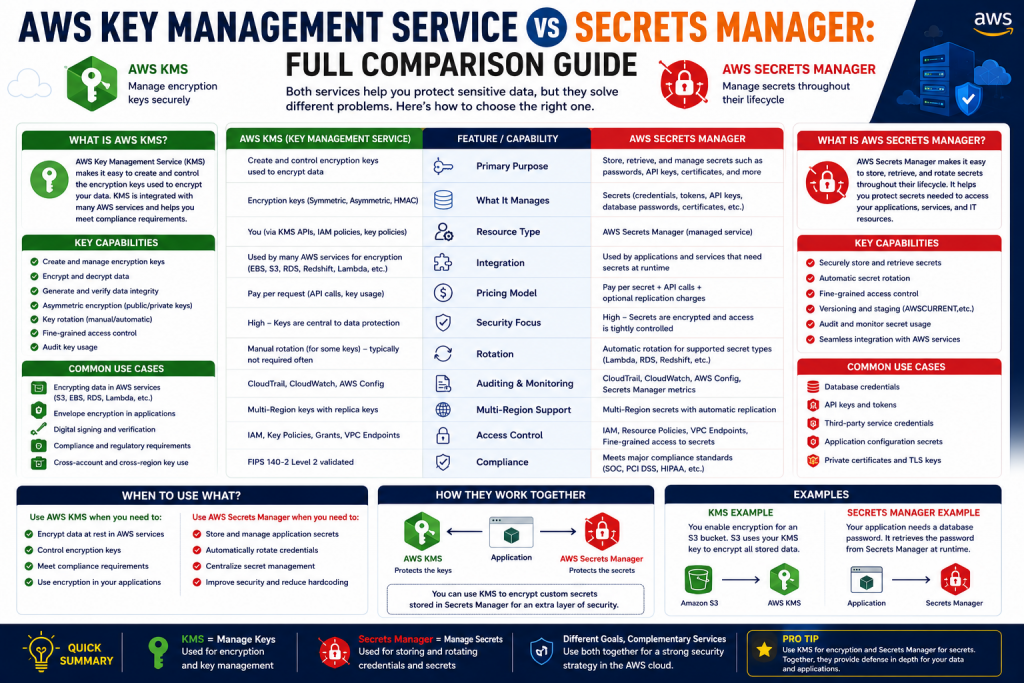
Cloud security relies heavily on protecting sensitive information from unauthorized access. In modern cloud environments like Amazon Web Services, security is not only about controlling who can access data but also about how that data is protected while stored and in transit. Two of the most important services used for this purpose are AWS Key Management Service (KMS) and AWS Secrets Manager. Although both deal with protecting sensitive information, they serve different roles in the security ecosystem. Understanding how they differ and how they work together is essential for anyone working with AWS infrastructure.
Understanding AWS Key Management Service (KMS)
AWS Key Management Service is a managed service designed to create, control, and manage encryption keys used to protect data across AWS services and applications. These encryption keys are used to transform readable data into unreadable formats, ensuring that even if data is intercepted, it cannot be understood without the correct key.
At its core, AWS KMS focuses on cryptographic key management. It helps organizations generate encryption keys, store them securely, and control their usage through strict access policies. These keys are used by various AWS services such as storage systems, databases, and application workloads to encrypt sensitive information.
KMS is built on strong security standards and uses advanced encryption algorithms to protect data. It operates using a system where data encryption keys are themselves protected by higher-level master keys. This layered approach ensures that even if one layer is compromised, the underlying data remains secure.
Another important aspect of AWS KMS is its integration with hardware security modules. These modules are physical computing devices designed specifically to protect cryptographic keys. They ensure that keys are never exposed in plain form and remain protected throughout their lifecycle.
AWS KMS also provides both customer-managed keys and AWS-managed keys. Customer-managed keys allow users to have full control over key creation and usage policies, while AWS-managed keys are automatically handled by the service for common use cases. This flexibility allows organizations to choose the level of control that suits their security requirements.
How AWS KMS Works in Practice
AWS KMS uses a technique known as envelope encryption. In this process, a data encryption key is used to encrypt data, and that key itself is then encrypted using a master key stored in KMS. This approach significantly improves security because the actual encryption key used on data is never directly exposed.
When an application needs to encrypt or decrypt data, it sends a request to KMS. The service checks permissions and either provides a new encryption key or decrypts an existing one depending on the request. All of this happens in a controlled and secure environment.
KMS also integrates with auditing services that track every usage of encryption keys. This allows organizations to monitor who accessed a key, when it was used, and for what purpose. Such visibility is crucial for compliance and security auditing.
Use Cases of AWS KMS
AWS KMS is primarily used to protect data at rest. This includes encrypting data stored in databases, storage systems, and application services. It is also widely used for digital signing, where data integrity and authenticity need to be verified.
Organizations use KMS when they need centralized control over encryption keys. It is especially useful in environments where multiple services need consistent and secure encryption standards.
Understanding AWS Secrets Manager
AWS Secrets Manager is a service designed specifically to manage sensitive credentials such as passwords, API keys, database credentials, and authentication tokens. Unlike KMS, which focuses on encryption keys, Secrets Manager focuses on application-level secrets used for authentication and access control.
In cloud applications, hardcoding credentials directly into code is a major security risk. If an attacker gains access to the codebase, they can easily extract these credentials. Secrets Manager solves this problem by securely storing credentials and providing them only when needed.
This service acts as a centralized vault for secrets. Applications can retrieve credentials at runtime without exposing them in source code or configuration files. This significantly reduces the risk of credential leakage.
How Secrets Manager Works
AWS Secrets Manager stores secrets in an encrypted format, and it uses AWS KMS to perform encryption operations behind the scenes. When an application requests a secret, Secrets Manager verifies access permissions and securely returns the requested information.
One of the most powerful features of Secrets Manager is automatic rotation. This means credentials such as database passwords can be changed automatically at regular intervals without manual intervention. This reduces the risk of long-term credential misuse.
Secrets Manager can also integrate with AWS Lambda functions to automate secret retrieval and rotation processes. This allows applications to always use up-to-date credentials without requiring manual updates.
Like KMS, Secrets Manager also integrates with monitoring tools that track access to secrets. This ensures visibility into how and when sensitive credentials are being used.
Use Cases of AWS Secrets Manager
Secrets Manager is widely used in application development and database management. It is ideal for storing credentials that applications need to access external services securely.
Common use cases include database authentication, API key storage, third-party service integration, and managing OAuth tokens. It is especially valuable in dynamic environments where credentials need to be frequently rotated for security compliance.
Key Differences Between AWS KMS and Secrets Manager
Although both services are used for securing sensitive information, their purposes are fundamentally different.
AWS KMS is focused on encryption key management. It is responsible for generating and controlling cryptographic keys used to encrypt and decrypt data. Its primary role is to protect data at rest by ensuring encryption keys are securely managed.
AWS Secrets Manager, on the other hand, is focused on storing and managing application secrets. It handles credentials that applications use for authentication and access control.
Another major difference is how they are used. KMS is typically used at the infrastructure level for encryption purposes, while Secrets Manager is used at the application level for managing login credentials and API access.
KMS is often used indirectly through other AWS services, while Secrets Manager is directly integrated into application workflows.
How AWS KMS and Secrets Manager Work Together
Although they serve different purposes, AWS KMS and AWS Secrets Manager are closely connected within the AWS security ecosystem. Secrets Manager relies on AWS Key Management Service to encrypt all stored secrets before they are saved. This means that every password, API key, or database credential stored in Secrets Manager is first encrypted using a KMS key. In this way, KMS functions as the foundational encryption layer that protects the confidentiality of secrets at rest.
This integration ensures that Secrets Manager does not manage encryption independently but instead depends on the robust cryptographic infrastructure provided by KMS. When a secret is created or updated, Secrets Manager automatically calls KMS to generate a data encryption key. That key is then used to encrypt the secret before it is stored securely. When an application requests access to the secret, Secrets Manager again interacts with KMS to decrypt it in a controlled and secure manner.
This relationship also enhances security management because access to secrets is indirectly governed by KMS key policies. Even if a user has permission to retrieve a secret, they must also have appropriate permissions to use the underlying KMS key. This dual-layer protection strengthens overall security and ensures that sensitive credentials remain protected throughout their lifecycle.
When a secret is stored, it is first encrypted using a KMS key. When it is retrieved, KMS is used again to decrypt the secret securely. This integration ensures that secrets are always protected using strong encryption standards.
By combining both services, organizations can achieve a strong security architecture where encryption keys and application secrets are both securely managed.
Security and Compliance Benefits
Both services play an important role in maintaining security and compliance in cloud environments. They help organizations meet regulatory requirements by ensuring that sensitive data is encrypted and access is strictly controlled.
KMS provides detailed auditing of key usage, while Secrets Manager tracks access to credentials. Together, they provide full visibility into how sensitive information is being used across the environment.
These capabilities are essential for industries that require strict compliance standards, such as finance, healthcare, and government sectors.
Best Practices for Using AWS KMS and Secrets Manager
Organizations should follow several best practices when using these services to maintain a strong security posture. In AWS Key Management Service, encryption keys should be rotated on a regular schedule to reduce the risk of long-term key exposure and to comply with security standards. Access to these keys should be tightly controlled using the principle of least privilege, ensuring that only users, roles, or services that genuinely require access are granted permissions. This helps minimize the attack surface and prevents unauthorized usage of sensitive cryptographic material.
In addition to rotation and access control, organizations should also monitor key usage through logging and auditing tools to detect any unusual or unauthorized activity. Proper separation of duties should be enforced so that no single user has excessive control over key management and data access. By applying these practices consistently, organizations can significantly strengthen the security of their encryption strategy and reduce the likelihood of data compromise.
For Secrets Manager, credentials should always be stored securely and rotated automatically whenever possible. Applications should never hardcode secrets and should instead retrieve them dynamically at runtime.
Combining both services with proper access control policies ensures a strong and layered security architecture.
Conclusion
AWS Key Management Service and AWS Secrets Manager are both essential tools for securing cloud environments, but they serve different purposes. KMS focuses on managing encryption keys that protect data at rest, while Secrets Manager focuses on storing and managing sensitive application credentials.
When used together, they provide a powerful and integrated security solution. KMS ensures that data is encrypted using secure keys, while Secrets Manager ensures that applications can safely access credentials without exposing them.
Understanding the difference between these two services is crucial for designing secure and scalable AWS architectures. By implementing both correctly, organizations can significantly strengthen their cloud security posture and reduce the risk of data breaches.
Continue exploring the technologies and certification concepts that matter most to you.