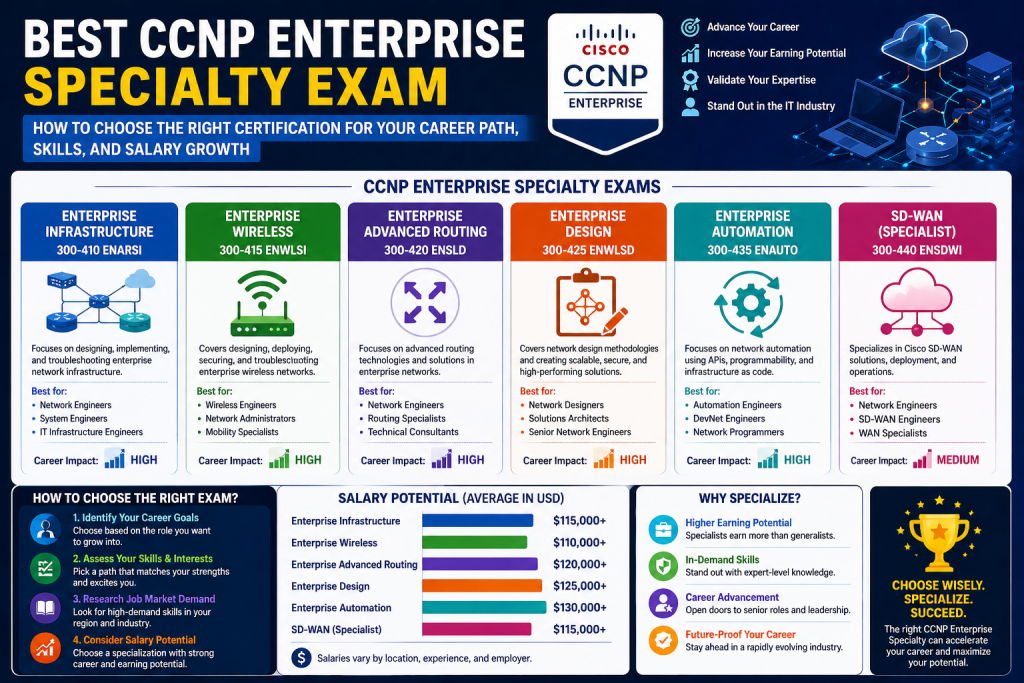
The networking certification ecosystem has evolved significantly in recent years, and one of the most noticeable transformations has been the restructuring of professional-level certifications. The CCNP Enterprise certification is now designed to reflect real-world networking roles more accurately, combining a broad foundation with targeted specialization. This change has created a more flexible pathway for professionals, but it has also introduced complexity when deciding which direction to take.
In the past, certification tracks were more rigid. Candidates would choose a path such as routing and switching, wireless networking, or design, and follow a predefined sequence of exams. Each track clearly aligned with a specific job role, making it relatively easy to understand which certification to pursue. However, the modern structure consolidates these paths into a single framework, requiring candidates to make more strategic decisions.
Instead of following a linear progression, candidates must now pass a core exam and then select a specialty exam that aligns with their career goals. This modular approach allows for greater customization, enabling professionals to focus on areas that are most relevant to their interests and the demands of the industry.
While this flexibility is beneficial, it also requires a deeper understanding of the available options. Choosing the right specialty exam is no longer a simple decision. It involves evaluating your current skills, identifying your interests, and considering your long-term career aspirations.
The Evolution from Generalization to Specialization
One of the key shifts in the certification model is the move from early specialization to a more structured progression. At the entry level, certifications now focus on building a strong foundation in networking fundamentals. This ensures that all candidates have a consistent baseline of knowledge before advancing to more complex topics.
Specialization is now introduced at the professional level, which aligns with how careers typically զարգել in the IT industry. Most individuals begin in general roles where they gain exposure to various technologies and responsibilities. Over time, they discover specific areas that interest them more and choose to specialize in those domains.
This approach has several advantages. It allows candidates to make more informed decisions about their specialization, based on real-world experience rather than assumptions. It also ensures that professionals develop a well-rounded understanding of networking before focusing on a specific area.
For example, someone who starts in a general networking role may initially work with routing, switching, wireless, and security technologies. As they gain experience, they may realize that they enjoy troubleshooting complex routing issues or designing network architectures. This insight helps them choose a specialization that aligns with their interests and strengths.
The shift toward specialization at the professional level also reflects the increasing complexity of modern networks. Organizations now require professionals with deep expertise in specific areas, rather than generalists who have a superficial understanding of many topics.
The Importance of a Strong Foundational Core
At the heart of the CCNP Enterprise certification is the core exam. This exam serves as the foundation for all specialties and ensures that candidates have a comprehensive understanding of enterprise networking concepts.
The core exam covers a wide range of topics, including network architecture, virtualization, infrastructure, security, automation, and network assurance. These areas are essential for any networking professional, regardless of their chosen specialization.
By requiring all candidates to pass the core exam, the certification ensures consistency in knowledge and skills. This is important because it establishes a common baseline for all certified professionals. Whether you specialize in wireless networking, automation, or design, you will rely on the concepts covered in the core exam.
The core exam also prepares candidates for real-world challenges. It emphasizes practical knowledge and problem-solving skills, which are critical for success in networking roles. Instead of focusing solely on theoretical concepts, the exam tests your ability to apply your knowledge in realistic scenarios.
Another benefit of the core exam is that it allows specialty exams to focus more deeply on specific topics. Since candidates have already demonstrated their understanding of foundational concepts, specialty exams can explore advanced material without revisiting the basics.
This structure not only improves the quality of the certification but also makes it more relevant to the needs of the industry. It ensures that certified professionals are both knowledgeable and capable of handling complex networking tasks.
Exploring the Breadth of Specialty Options
The CCNP Enterprise certification offers a diverse range of specialty exams, each focusing on a specific area of networking. This variety allows candidates to tailor their certification journey according to their interests and career goals.
Some specialties focus on traditional networking concepts, such as advanced routing and services. These are ideal for professionals who enjoy working with network infrastructure and troubleshooting complex issues. Other specialties focus on design, enabling candidates to work on planning and building network solutions.
There are also specialties that focus on emerging technologies. Automation and programmability are becoming increasingly important as networks become more dynamic and software-driven. Similarly, cloud connectivity is a growing area as organizations move their operations to cloud-based environments.
Wireless networking is another key area of specialization. With the increasing reliance on wireless connectivity, there is a growing demand for professionals who can design, implement, and manage wireless networks. This includes understanding new technologies and ensuring reliable performance in complex environments.
The wide range of specialties means that candidates have many options to choose from. However, it also means that selecting the right exam requires careful consideration. Each specialization represents a different set of skills and career opportunities, so it is important to understand what each one involves.
Aligning Certification Choices with Professional Goals
Choosing a specialty exam is not just about passing a test. It is about shaping your career and positioning yourself for future opportunities. Each specialization aligns with different job roles and responsibilities, making it essential to choose one that matches your goals.
For example, if you enjoy hands-on technical work, you may want to focus on a specialization that emphasizes implementation and troubleshooting. These roles often involve configuring devices, resolving issues, and maintaining network performance.
On the other hand, if you are interested in planning and designing networks, a design-focused specialization may be more suitable. These roles require a strong understanding of both technical and business requirements, as well as the ability to create scalable and efficient solutions.
If you are drawn to emerging technologies, specializations in automation or cloud networking may be a good fit. These areas are rapidly growing and offer exciting opportunities for innovation and career advancement.
It is also important to consider your current experience. If you already have experience in a particular area, choosing a related specialization can help you build on your existing skills. This can make it easier to prepare for the exam and apply your knowledge in your job.
However, if you are looking to transition into a new field, selecting a different specialization can help you develop new skills and open up new career opportunities. This can be particularly beneficial if you are interested in moving into a high-demand area such as automation or cloud networking.
The Role of Industry Trends in Decision-Making
The networking industry is constantly evolving, with new technologies and trends shaping the way networks are designed and managed. When choosing a specialty exam, it is important to consider these trends and how they may impact your career.
For example, the increasing adoption of cloud computing has created a demand for professionals who understand cloud connectivity and hybrid network environments. Similarly, the rise of automation has made programmability and scripting skills more valuable than ever.
Security is another critical area, as organizations continue to prioritize the protection of their networks and data. While security is covered in various certifications, it also plays a role in many CCNP Enterprise specialties.
By staying informed about industry trends, you can choose a specialization that aligns with future opportunities. However, it is important to balance this with your personal interests. Pursuing a specialization solely based on demand may not lead to long-term satisfaction if it does not align with your passions.
Flexibility and Adaptability in Certification Paths
One of the most significant advantages of the modern certification structure is its flexibility. Candidates are not locked into a single path and can adapt their certification journey as their career evolves.
Once you pass the core exam, you can choose any specialty exam to complete your certification. If your interests change later, you can pursue additional specialties without retaking the core exam. This allows you to expand your skills and explore new areas of networking.
This flexibility is particularly important in a rapidly changing industry. As new technologies emerge, professionals need to continuously update their skills to stay relevant. The ability to adapt your certification path makes it easier to keep up with these changes.
For example, someone who starts with a focus on traditional networking may later decide to move into automation or cloud networking. The certification structure supports this transition, allowing you to build on your existing knowledge while developing new expertise.
Making an Informed and Strategic Choice
Choosing the right CCNP Enterprise specialty exam requires careful thought and planning. With so many options available, it is important to take the time to evaluate your interests, experience, and career goals.
Start by identifying the aspects of networking that you enjoy the most. Consider the tasks and responsibilities that you find most engaging, as well as the areas where you excel. This can help you narrow down your options and focus on the specializations that are most relevant to you.
Next, think about your long-term goals. Consider the roles you want to pursue and the skills required for those positions. This can help you choose a specialization that supports your career objectives and provides opportunities for growth.
It is also helpful to research job opportunities and industry trends. Understanding what skills are in demand can guide your decision, but it is important to balance this with your personal interests.
Finally, remember that there is no single correct choice. Each specialization offers its own opportunities and challenges, and success depends more on your dedication and willingness to learn than the specific exam you choose.
By taking a thoughtful and strategic approach, you can choose a specialty exam that not only helps you achieve your certification but also sets you on a path toward a successful and fulfilling career in networking.
Deep Dive into Advanced Routing and Services Specialization
One of the most popular and widely recognized specializations within the CCNP Enterprise track focuses on advanced routing and services. This path is often seen as the closest modern equivalent to traditional routing and switching expertise. It is designed for professionals who want to build a strong technical foundation in how enterprise networks operate at a deeper level.
This specialization emphasizes Layer 3 technologies, which are responsible for routing traffic between networks. Candidates learn how to configure, troubleshoot, and optimize routing protocols such as OSPF, EIGRP, and BGP. These protocols form the backbone of enterprise networking, enabling communication between different segments of a network and across wide-area environments.
In addition to routing, this path also covers advanced services such as VPN technologies. Understanding how to securely connect remote sites and users is a critical skill in today’s distributed work environments. Professionals who pursue this specialization often find themselves working on complex network infrastructures where reliability and performance are essential.
This specialization is ideal for individuals who enjoy hands-on technical work. It requires a strong problem-solving mindset and the ability to analyze network behavior. Roles that align with this path include network engineer and senior network administrator, where responsibilities often involve maintaining and troubleshooting large-scale enterprise networks.
Understanding the Role of SD-WAN and Edge Technologies
Another important specialization focuses on software-defined wide area networking, commonly known as SD-WAN. This area has gained significant attention in recent years as organizations look for more flexible and cost-effective ways to connect their networks.
Traditional WAN architectures often rely on expensive and rigid infrastructure. SD-WAN introduces a more dynamic approach by using software to manage and optimize network traffic. This allows organizations to improve performance, reduce costs, and simplify network management.
This specialization covers topics such as zero-touch provisioning, which enables devices to be deployed with minimal manual configuration. It also explores how overlay networks function, allowing multiple virtual networks to operate on top of a single physical infrastructure.
Monitoring and managing SD-WAN environments is another key component. Professionals learn how to analyze network performance, identify issues, and ensure that applications receive the necessary bandwidth and priority.
This path is well-suited for individuals interested in modern networking technologies and edge solutions. It is particularly relevant for roles such as WAN engineer and network solutions designer, where there is a focus on connecting branch offices and optimizing network performance across distributed environments.
Exploring Enterprise Network Design as a Career Path
For those who prefer planning and designing networks rather than implementing them, the design-focused specialization offers an excellent opportunity. This path is centered on creating efficient, scalable, and secure network architectures that meet organizational requirements.
Designing a network involves more than just selecting hardware and software. It requires a deep understanding of business needs, performance requirements, and security considerations. Professionals in this area must balance multiple factors, including cost, scalability, and reliability.
This specialization covers topics such as advanced routing design, campus network architecture, and software-defined access. It also includes network services and security considerations, ensuring that designs are both functional and secure.
One of the key skills developed in this path is the ability to translate business requirements into technical solutions. This involves working closely with stakeholders to understand their needs and then designing a network that meets those requirements.
Careers in this area often include roles such as network architect and network manager. These positions require strong analytical and communication skills, as well as the ability to think strategically about network infrastructure.
Wireless Network Design and Its Growing Importance
Wireless networking has become an essential part of modern enterprise environments. With the increasing reliance on mobile devices and the demand for seamless connectivity, designing effective wireless networks is more important than ever.
The wireless design specialization focuses on planning and creating wireless solutions that provide reliable coverage and performance. This includes understanding how radio frequency signals behave and how to optimize their use in different environments.
Candidates learn about site surveys, which are used to assess the physical environment and determine the best placement for wireless access points. They also study mobility concepts, which ensure that users can move throughout a network without losing connectivity.
This specialization also covers the integration of wired and wireless infrastructure. A well-designed wireless network must work seamlessly with the underlying wired network to provide consistent performance.
Professionals who pursue this path often work as wireless design engineers or consultants. Their role is to create wireless networks that meet the needs of organizations, whether in offices, campuses, or large public venues.
Implementing and Managing Wireless Networks
While design is important, there is also a need for professionals who can implement and manage wireless networks. This specialization focuses on the practical aspects of deploying and maintaining wireless solutions.
Candidates learn how to configure wireless devices, secure networks, and monitor performance. Troubleshooting is a major component, as wireless networks can be affected by various factors such as interference and signal degradation.
Device hardening is another important topic. Ensuring that wireless networks are secure is critical, as they are often more vulnerable to attacks than wired networks. Professionals must understand how to protect networks from unauthorized access and other threats.
Monitoring tools and techniques are also covered, allowing professionals to identify and resolve issues before they impact users. This proactive approach is essential for maintaining high levels of performance and reliability.
This specialization is ideal for individuals who enjoy hands-on work and problem-solving. Roles such as wireless engineer and network integrator are common for professionals in this area.
The Rise of Network Automation and Programmability
Automation is transforming the way networks are managed. As networks become more complex, manual configuration and management are no longer efficient. This has led to the growing importance of automation and programmability in networking.
This specialization focuses on using programming and automation tools to manage network operations. Candidates learn languages such as Python and explore technologies like APIs, NETCONF, RESTCONF, and data modeling.
Automation allows professionals to streamline repetitive tasks, reduce errors, and improve efficiency. For example, instead of manually configuring multiple devices, scripts can be used to apply configurations automatically.
This path also explores the integration of networking with DevOps practices. This includes version control, continuous integration, and automated testing, which are commonly used in software development.
Professionals who pursue this specialization often work as network automation engineers or DevOps engineers. These roles require a combination of networking knowledge and programming skills, making them highly valuable in modern IT environments.
Understanding Cloud Connectivity in Enterprise Networks
As organizations move their operations to the cloud, the need for reliable connectivity between on-premises networks and cloud environments has become critical. This specialization focuses on designing and implementing cloud connectivity solutions.
Candidates learn how to establish secure connections using technologies such as IPsec and how to implement routing protocols in cloud environments. Understanding how to troubleshoot connectivity issues is also an important aspect.
This path covers hybrid networking, where organizations use a combination of on-premises infrastructure and cloud services. Professionals must understand how to integrate these environments seamlessly to ensure consistent performance and security.
Cloud connectivity is a rapidly growing area, and professionals with expertise in this field are in high demand. Roles such as cloud network engineer and cloud architect are common for individuals who pursue this specialization.
The Importance of Network Assurance and Performance Monitoring
Ensuring that networks perform reliably and meet organizational requirements is a critical aspect of modern networking. The network assurance specialization focuses on monitoring, analyzing, and optimizing network performance.
Candidates learn how to collect and analyze data from network devices to identify trends and detect issues. This includes understanding how to use monitoring tools and interpret the data they provide.
Another key area is alerting and reporting. Professionals must be able to identify potential problems and take action before they impact users. This proactive approach helps maintain high levels of service quality.
This specialization also covers the use of advanced analytics and automation to improve network performance. By leveraging data, professionals can make informed decisions and optimize network operations.
Careers in this area often include roles such as network operations center engineer and site reliability engineer. These positions focus on maintaining the health and performance of network infrastructure.
Choosing the Right Specialization Based on Your Interests
With so many options available, choosing the right specialization can be challenging. The key is to align your choice with your interests and career goals.
If you enjoy working with routing and troubleshooting, the advanced routing specialization may be the best fit. If you are interested in modern networking technologies, SD-WAN or cloud connectivity could be more appealing.
For those who prefer planning and design, the network design specialization offers a strategic perspective. If you enjoy hands-on work with wireless technologies, the wireless implementation or design paths may be ideal.
Automation is a great choice for individuals who enjoy programming and want to work at the intersection of networking and software development. Meanwhile, network assurance is suitable for those who are interested in monitoring and optimizing network performance.
It is important to take the time to evaluate your interests and consider how each specialization aligns with your career aspirations. This will help you make a more informed decision and set you on a path toward success.
Building a Long-Term Career Strategy
Choosing a specialization is just the beginning. To succeed in your career, you need to continuously develop your skills and adapt to new technologies.
The networking field is constantly evolving, and staying up to date is essential. This may involve pursuing additional certifications, gaining hands-on experience, and learning new tools and technologies.
It is also important to build a strong foundation in networking concepts. Even as you specialize, a broad understanding of networking will help you adapt to different roles and challenges.
Networking with other professionals and staying engaged with the industry can also provide valuable insights and opportunities. By taking a proactive approach to your career, you can ensure long-term success.
Ultimately, the right specialization is one that aligns with your interests, supports your career goals, and keeps you motivated to continue learning and growing in the field of networking.
Evaluating the Network Assurance and Analytics Specialization
One of the most forward-looking specializations within the CCNP Enterprise track focuses on network assurance. As enterprise environments grow in size and complexity, ensuring consistent performance and reliability has become just as important as building the network itself. This specialization is centered on visibility, monitoring, and intelligent analysis of network behavior.
Professionals in this area work with tools and platforms that collect large volumes of data from network devices. This data includes metrics related to performance, latency, packet loss, and application behavior. The goal is not just to observe what is happening but to interpret the data in a meaningful way. By analyzing trends and patterns, network assurance specialists can identify potential issues before they affect users.
A key component of this specialization is understanding telemetry and data collection methods. Modern networks generate continuous streams of information, and knowing how to capture and process this data is essential. Candidates learn how to use monitoring solutions that provide real-time insights into network health.
Another important aspect is alerting and incident response. Instead of reacting to problems after they occur, network assurance professionals implement proactive systems that detect anomalies and trigger alerts. This allows teams to respond quickly and minimize downtime.
This specialization is well-suited for roles such as network operations center engineer or site reliability engineer. These positions focus on maintaining service quality, improving user experience, and ensuring that networks meet performance expectations.
Comparing Traditional Networking with Modern Approaches
As you progress through the CCNP Enterprise path, it becomes clear that networking is no longer limited to traditional hardware-based configurations. The industry is shifting toward software-defined and cloud-integrated models, which require a different set of skills and perspectives.
Traditional networking focuses heavily on manual configuration of routers and switches. While these skills are still important, modern environments demand automation, scalability, and flexibility. Technologies such as SD-WAN, cloud networking, and automation frameworks are transforming how networks are designed and managed.
Understanding the differences between these approaches is essential when choosing a specialization. Some professionals prefer the stability and depth of traditional networking, where they can master protocols and infrastructure. Others are drawn to modern approaches that involve programming, cloud platforms, and dynamic network management.
Neither path is inherently better than the other. Instead, they represent different aspects of the same field. Many organizations require a combination of both traditional and modern skills, making it valuable to have at least a basic understanding of each area.
Choosing a specialization often depends on where you see yourself in the future. If you enjoy working directly with hardware and protocols, a traditional path may be more appealing. If you are interested in innovation and emerging technologies, a modern specialization may offer more opportunities.
How to Identify Your Strengths and Interests
Selecting the right CCNP Enterprise specialty exam requires self-awareness. Understanding your strengths and interests is one of the most important steps in making the right decision. Without this clarity, it is easy to choose a path that does not align with your natural abilities or career aspirations.
Start by reflecting on your past experiences. Consider the tasks you have enjoyed the most in your current or previous roles. These could include troubleshooting network issues, designing systems, writing scripts, or analyzing performance data. Identifying patterns in your preferences can provide valuable insights.
It is also helpful to assess your technical strengths. Some individuals excel at problem-solving and debugging, making them well-suited for roles in routing or wireless implementation. Others have a strong analytical mindset, which is beneficial for design or network assurance roles. Those who enjoy coding and automation may find fulfillment in programmability-focused specializations.
In addition to technical skills, consider your working style. Do you prefer hands-on tasks or strategic planning? Do you enjoy working independently or collaborating with teams? These factors can influence your choice of specialization and the types of roles you pursue.
Taking the time to evaluate these aspects can help you make a more informed decision. It ensures that your certification journey aligns with your natural strengths and keeps you motivated לאורך your career.
The Importance of Practical Experience
While certifications are valuable, they are most effective when combined with practical experience. The CCNP Enterprise certification is designed to validate real-world skills, and hands-on experience plays a crucial role in achieving success.
Working with actual network equipment or simulation tools allows you to apply theoretical knowledge in practical scenarios. This helps reinforce your understanding and builds confidence in your abilities. Whether you are configuring routing protocols, setting up wireless networks, or automating tasks, practical experience is essential.
Employers often look for candidates who can demonstrate their skills in real-world environments. Having hands-on experience not only improves your chances of passing the exam but also enhances your employability.
If you do not have access to physical equipment, there are many virtual labs and simulation platforms available. These tools provide a safe environment to practice and experiment with different configurations.
In addition to technical practice, real-world experience also helps you develop soft skills such as communication, teamwork, and problem-solving. These skills are equally important in professional settings and can significantly impact your career growth.
Adapting to Continuous Changes in Networking
The field of networking is constantly evolving, driven by advancements in technology and changing business needs. This makes continuous learning an essential part of any networking career.
New technologies such as automation, artificial intelligence, and cloud computing are reshaping the industry. Professionals must stay updated with these developments to remain relevant. This requires a commitment to ongoing education and skill development.
The CCNP Enterprise certification is designed with this in mind. Its flexible structure allows candidates to adapt their specialization as their interests and the industry evolve. This ensures that your skills remain aligned with current trends.
Staying informed about industry developments can also help you identify new opportunities. For example, the growing demand for automation skills has created new roles that did not exist a few years ago. Similarly, the expansion of cloud services has increased the need for professionals with expertise in cloud connectivity.
By embracing continuous learning, you can stay ahead of these changes and position yourself for long-term success.
Building a Career Roadmap with CCNP Enterprise
Earning a CCNP Enterprise certification is a significant milestone, but it should be viewed as part of a larger career strategy. Developing a clear roadmap can help you make the most of your certification and achieve your professional goals.
Start by defining your long-term objectives. Consider where you want to be in the next five to ten years. This could include roles such as network architect, cloud engineer, or automation specialist. Having a clear vision will guide your decisions and help you stay focused.
Next, identify the steps needed to achieve these goals. This may include gaining experience in specific technologies, pursuing additional certifications, or developing new skills. Breaking your goals into smaller, manageable steps makes them more achievable.
It is also important to seek opportunities for growth within your current role. Taking on new responsibilities, working on challenging projects, and collaborating with experienced professionals can accelerate your development.
Networking with peers and industry professionals can also provide valuable insights and opportunities. Engaging with the community allows you to learn from others and stay informed about industry trends.
By creating a structured plan and actively working toward your goals, you can maximize the value of your CCNP Enterprise certification.
Overcoming Common Challenges in the Certification Journey
Pursuing a professional-level certification is not without its challenges. Many candidates face obstacles such as time constraints, complex topics, and balancing study with work responsibilities. Recognizing these challenges and developing strategies to overcome them is essential for success.
One common challenge is managing time effectively. Preparing for a CCNP exam requires consistent effort and dedication. Creating a study schedule and setting realistic goals can help you stay on track. Breaking down topics into smaller sections makes the process more manageable.
Another challenge is understanding complex concepts. Networking technologies can be intricate, and it is normal to encounter difficulties. Using multiple learning resources, such as books, videos, and labs, can help reinforce your understanding.
Staying motivated לאורך the preparation process is also important. Setting milestones and celebrating small achievements can keep you engaged. Joining study groups or online communities can provide support and encouragement.
Finally, it is important to approach the certification with a mindset of learning rather than just passing the exam. Focusing on gaining knowledge and skills will not only help you succeed in the exam but also in your career.
Balancing Certification with Real-World Skills
While certifications validate your knowledge, real-world skills determine how effectively you can apply that knowledge. Balancing both aspects is crucial for building a successful career in networking.
Employers value professionals who can demonstrate practical skills and solve real-world problems. This means that simply passing an exam is not enough. You need to be able to apply your knowledge in practical scenarios.
Combining certification study with hands-on practice is the best approach. For example, while learning about routing protocols, you can practice configuring them in a lab environment. This reinforces your understanding and builds confidence.
Soft skills are also an important part of professional success. Communication, teamwork, and problem-solving abilities are essential in collaborative work environments. Developing these skills alongside technical expertise can enhance your career prospects.
By focusing on both certification and practical experience, you can build a well-rounded skill set that meets the demands of modern networking roles.
Conclusion
Choosing the right CCNP Enterprise specialty exam is a significant decision that can shape your career in networking. With multiple specializations available, each focusing on a different aspect of enterprise networking, it is essential to take a thoughtful and strategic approach.
The key is to align your choice with your interests, strengths, and long-term goals. Whether you are drawn to advanced routing, wireless networking, automation, cloud connectivity, or network assurance, each path offers unique opportunities and challenges. There is no single correct choice, and success depends more on your dedication and willingness to learn than the specific specialization you choose.
The modern certification structure provides flexibility, allowing you to adapt your path as your career evolves. By combining a strong foundation with targeted specialization, you can develop the skills needed to succeed in a rapidly changing industry.
Ultimately, the CCNP Enterprise certification is not just about earning a credential. It is about building expertise, gaining confidence, and preparing for the next stage of your career. By making an informed decision and committing to continuous learning, you can create a rewarding and successful journey in the field of networking.
Continue exploring the technologies and certification concepts that matter most to you.