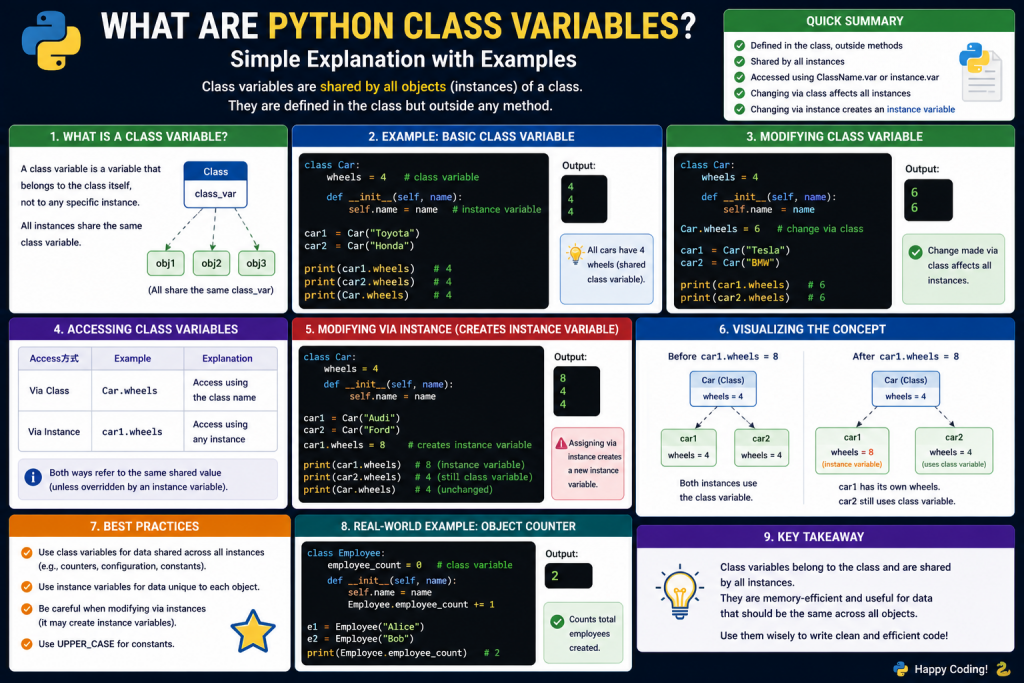
In programming, a variable is one of the most basic and important concepts. A variable is simply a name that refers to a value stored in memory. You can imagine it as a container that holds information which can be used later in the program. This information can be a number, text, or even more complex data.
Variables are used everywhere in Python because they make it possible to store, change, and reuse data easily. Without variables, programming would be extremely repetitive and inefficient.
For example, consider the following simple Python code:
x = 40
y = 75
z = x + y
In this example, x stores the value 40, y stores the value 75, and z stores the result of adding both values. The variable z will now contain 115.
Python also allows variables to store text values, known as strings:
my_car = “Chevy Impala”
mileage = 10000.21
Here, my_car stores a string, and mileage stores a decimal number. Python is flexible because you do not need to declare the type of variable before using it.
You can also combine variables with text output:
print(“My car is a ” + my_car + ” and its mileage is ” + str(mileage))
This flexibility makes Python easy for beginners to learn and use. Variables are the foundation of everything you do in programming.
Understanding Object Oriented Programming
Python is known as an object oriented programming language. This means that it organizes code around objects rather than just functions and logic. Objects are real-world representations of things, and they contain both data and behavior.
Object oriented programming helps programmers structure their code in a more organized and reusable way. Instead of writing everything in one place, you group related data and functions together inside classes.
This is where the concept of classes becomes important.
What is a Class in Python
A class in Python is a blueprint used to create objects. You can think of it like a design or template. The class defines what data the object will have and what actions it can perform.
For example, imagine a class called Dog. This class can describe all dogs in general. It can include behaviors like barking or running, and it can also include properties like name or breed.
Here is a simple example:
class Dog:
def bark(self):
print(“I am a dog. Bark bark!”)
def woof(self)
print(“I am a big dog. WOOF WOOF!”)
def yip(self):
print(“I am a small dog. YIP YIP!”)
In this class, we have defined three methods. A method is simply a function that belongs to a class. Each method describes the behavior of a dog.
Now we can create objects from this class:
dog1 = Dog()
dog2 = Dog()
Here, dog1 and dog2 are objects created from the Dog class. Each object is independent but follows the structure defined in the class.
We can call methods on these objects:
dog1.woof()
dog2.bark()
Even though both objects come from the same class, they can behave differently depending on which method is called.
This is the power of object oriented programming. It allows us to create multiple independent objects from one blueprint.
Why We Need Variables Inside Classes
So far, we have only looked at methods inside a class. However, classes are not just about behavior. They are also about storing data.
For example, every dog has a name, a breed, and an age. These are pieces of information that we want to store inside the object.
This is where class variables and instance variables come in.
Before understanding them, it is important to know that variables inside a class behave differently from normal variables. They are connected to the structure of the class itself.
Introduction to Class Variables
A class variable is a variable that belongs to the class itself. It is shared by all objects created from that class. This means every object sees the same value unless it is changed.
Let’s look at a simple example:
class Dog:
legs = 4
def bark(self):
print(“I am a dog. Bark bark!”)
In this example, legs = 4 is a class variable. It is not inside any method. It belongs to the class itself.
Now let’s create some objects:
dog1 = Dog()
dog2 = Dog()
When we access the class variable:
print(dog1.legs)
print(dog2.legs)
The output will be:
Both objects return the same value because the variable is shared across the class.
This shows that class variables are not tied to individual objects. Instead, they belong to the entire class.
Why Class Variables Are Useful
Class variables are useful when a property should be common for all objects. For example, most dogs have four legs. Instead of defining legs separately for every dog, we define it once in the class.
This reduces repetition and makes code cleaner.
Another example could be a shared counter or a default setting that applies to all objects.
However, class variables must be used carefully because changing them affects all objects.
Behavior of Class Variables
One important thing to understand is that class variables can be modified. When you change a class variable, it affects every object that uses it.
For example:
Dog.legs = 5
Now if we check again:
print(dog1.legs)
print(dog2.legs)
Both will now show:
This happens because the value belongs to the class, not individual objects.
This behavior is very powerful but can also be dangerous if not used properly.
The Risk of Changing Class Variables
Although class variables are useful, they can cause problems if changed unexpectedly. Since they are shared, modifying them affects all objects.
For example, imagine a program where every dog is supposed to have four legs. If someone accidentally changes the class variable to five, all dog objects will reflect the wrong value.
This can lead to incorrect program behavior and bugs that are difficult to find.
Because of this, class variables are usually used for values that are constant or rarely changed.
Difference Between Class and Instance Concept
Before moving forward, it is important to understand a key idea.
A class represents a general structure. An object represents a specific example of that structure.
Class variables belong to the general structure, while instance variables belong to specific objects.
This distinction is very important in object oriented programming.
Transition Toward Instance Variables
So far, we have focused on class variables. However, not all data should be shared between objects. In many cases, each object needs its own separate data.
For example, every dog has a different name and age. These values should not be shared between all dogs.
This is where instance variables come in, which will be explained in the next part.
Instance variables allow each object to store its own unique information while still following the structure of the class.
Understanding Instance Variables in Python Classes
After understanding class variables, the next important concept in object oriented programming is instance variables. These variables are very important because they allow each object to store its own unique data. Unlike class variables, which are shared among all objects, instance variables belong only to the specific object they are created in.
To understand instance variables properly, it is important to first recall that a class is a blueprint. When we create objects from a class, each object is independent. Instance variables help define what makes each object unique.
For example, consider a situation where we are creating multiple dogs. Each dog has a different name, breed, and age. If we used class variables for these, all dogs would end up sharing the same values, which is not correct. Instead, we use instance variables.
Instance variables are defined inside a special method called the constructor. In Python, this method is written as init. This method runs automatically when a new object is created.
The Role of the Constructor Method
The constructor method is one of the most important parts of a class. It is used to initialize instance variables. When you create a new object, Python automatically calls the init method and passes the values you provide.
Here is an example of a class with instance variables:
class Dog:
legs = 4
def __init__(self, name, breed, age):
self.name = name
self.breed = breed
self.age = age
In this example, the variables name, breed, and age are instance variables. They are defined using the keyword self, which refers to the current object.
Each time a new Dog object is created, these variables will store different values.
Creating Objects with Instance Variables
Now let’s create some objects using the Dog class.
dog1 = Dog(“Hershey”, “Chow Chow”, 5)
dog2 = Dog(“Spartacus”, “Terrier”, 3)
In this case, we are passing different values for each object. These values are stored inside instance variables.
Now if we access these variables:
print(dog1.name)
print(dog2.name)
The output will be:
Hershey
Spartacus
This shows that each object has its own separate data.
How Instance Variables Work
Instance variables are stored inside each object. This means that every object has its own copy of these variables. They are not shared like class variables.
When you use self.name, you are saying that this variable belongs to the specific object being created. This is why different objects can have different values even though they come from the same class.
For example, dog1 and dog2 both have a name variable, but the values are different. This is the main purpose of instance variables.
Difference Between Class Variables and Instance Variables
At this stage, it is important to clearly understand the difference between the two types of variables.
Class variables belong to the class and are shared among all objects. Instance variables belong to individual objects and are unique for each object.
For example, if we define:
class Dog:
legs = 4
Then legs are shared by all dogs. But if we define:
self.name = name
The name is different for every dog.
This difference is very important in real programming because it affects how data is stored and managed.
Why Instance Variables Are Important
Instance variables are important because they allow objects to represent real-world entities more accurately. In real life, no two dogs are exactly the same. They have different names, ages, and breeds.
Without instance variables, we would not be able to represent this uniqueness in code.
Instance variables help in storing data that changes from object to object. This makes programs more flexible and realistic.
How Instance Variables Are Stored
When an object is created, Python allocates memory for that object. Instance variables are stored inside that memory space.
Each object has its own memory location. This is why changing an instance variable in one object does not affect another object.
For example:
dog1.name = “Max”
This change only affects dog1. It does not change dog2.
Accessing Instance Variables
You can access instance variables using the object name followed by a dot and the variable name.
For example:
print(dog1.breed)
print(dog2.age)
This will print the values stored inside each object.
Instance variables are always accessed through objects, not through the class itself.
If you try to access them using the class name, Python will give an error because they do not belong to the class.
Real World Analogy for Instance Variables
To understand instance variables better, think of a classroom.
The class represents all students in general. But each student has their own name, roll number, and marks.
The class is like the blueprint, and each student is an object created from that blueprint. The personal details of each student are instance variables.
Even though all students belong to the same class, their personal information is different.
This makes it easier to understand how object oriented programming separates data in real systems. Each student object can be updated individually without affecting others, just like instance variables work in Python classes. This separation ensures that data remains organized and prevents confusion when multiple objects exist at the same time. If one student updates their marks after an exam, it does not change the marks of other students because each object stores its own values independently.
In programming terms, this design helps simulate real world scenarios more accurately. Every object behaves like a real entity with its own state and identity. This is especially useful in large systems where thousands or even millions of objects may exist simultaneously. Without instance variables, it would be impossible to maintain unique information for each object.
Instance variables also improve program flexibility because they allow changes at the object level without affecting the entire class structure. This makes the system more scalable and easier to manage as complexity increases.
Behavior of Instance Variables
Instance variables are created when an object is created. They are destroyed when the object is deleted or removed from memory.
Each object manages its own instance variables. This means changes are local to that object only.
For example, if we change the age of dog1:
dog1.age = 10
This change will not affect dog2.
This behavior makes instance variables very safe for storing unique data.
Importance of Self Keyword
The self keyword plays a very important role in instance variables. It refers to the current object being created or used.
When you write:
self.name = name
You are telling Python that the variable name belongs to the specific object.
Without self, Python would not know where to store the variable.
Multiple Objects and Instance Variables
One of the most powerful features of instance variables is that you can create many objects from the same class, and each object will have different data.
For example:
dog1 = Dog(“Bella”, “Poodle”, 2)
dog2 = Dog(“Rocky”, “Bulldog”, 6)
dog3 = Dog(“Luna”, “Husky”, 4)
Each of these objects has its own name, breed, and age.
Even though they come from the same class, they behave independently.
Memory Separation in Instance Variables
One important technical concept is memory separation. Each object is stored in a different memory location. This is why instance variables do not interfere with each other. This separation ensures that every object maintains its own independent state throughout the program execution. It also allows multiple objects of the same class to exist simultaneously without risking data conflicts or unexpected overwriting of values.
If dog1 changes its name, dog2 remains unaffected because it is stored separately. This independence is crucial in real-world applications where multiple entities are processed at the same time. For example, in a system with many user accounts, each user must retain their own personal information without being influenced by changes made to another user object.
This separation is what makes object oriented programming powerful and safe. It provides reliability, predictability, and better control over data management. Developers can confidently modify one object without worrying about unintended side effects on others. It also improves debugging efficiency because issues can be traced to specific objects rather than affecting the entire system.
Common Mistakes with Instance Variables
Beginners often make mistakes when working with instance variables. One common mistake is forgetting to use self.
Another mistake is trying to access instance variables using the class name instead of the object.
For example:
Dog.name
This will cause an error because name is not a class variable.
It is important to always remember that instance variables belong to objects, not classes.
Instance Variables
Instance variables are a core concept in object oriented programming. They allow each object to store its own unique data. They are defined inside the constructor method using self. Each object gets its own separate copy of these variables.
Because of this structure, instance variables make it possible for objects to behave independently even when they are created from the same class. This independence is what allows object oriented programming to model real world systems effectively. For example, in a system representing students, each student object can have its own name, age, marks, and other details stored as instance variables. Even though all students follow the same class structure, their individual data remains separate and unchanged by other objects.
Instance variables are also important for maintaining state within an object. State refers to the current condition or data stored inside an object at any given time. As the program runs, instance variables can be updated to reflect changes, such as updating a user’s balance in a banking system or changing the status of an order in an e-commerce application.
Another important aspect is that instance variables improve code clarity. Since each object carries its own data, it becomes easier to track and manage information without confusion between different objects. This separation reduces the risk of accidental data overwriting and makes debugging much simpler.
Overall, instance variables provide structure, independence, and flexibility, making them essential for building scalable and well-organized object oriented programs.
Unlike class variables, instance variables are not shared. They are independent and safe for storing object-specific data.
Understanding instance variables is essential before moving to more advanced programming concepts because they form the foundation of how objects store and manage information.
Advanced Understanding of Class Variables and Instance Variables
At this stage, you already understand what variables, classes, class variables, and instance variables are. The final step is to bring everything together and understand how these concepts behave in real programming situations. This includes deeper behavior, common mistakes, real world usage, and how professionals think about these concepts when designing software.
Class variables and instance variables may seem simple at first, but their interaction inside large programs can become complex. The key to mastering them is understanding not only what they are, but also how and when to use them correctly.
In real applications, these variables are not just theoretical concepts. They directly affect how data flows through a system, how memory is used, and how predictable your program behaves.
How Class Variables Behave in Real Applications
Class variables are shared across all objects of a class. This shared nature makes them powerful but also dangerous if not used carefully.
In real systems, class variables are often used for constants or shared configuration values. For example, if all objects in a system need to follow the same rule or default value, a class variable is appropriate.
However, problems arise when developers mistakenly use class variables for data that should be unique to each object.
For example, imagine a system where multiple users are created. If a class variable is used to store a username, then all users will end up sharing the same name. This would be incorrect and lead to serious logic errors.
The important idea is that class variables represent shared state, not individual state.
Understanding Deep Behavior of Class Variables
One important behavior of class variables is that they can be accessed in multiple ways. They can be accessed through the class itself or through objects.
When accessed through an object, Python first checks if the object has its own version of the variable. If not, it looks at the class variable.
This creates a layered lookup system.
For example, if a class variable exists and an object does not override it, the class value is used. But if the object defines its own version, that value takes priority.
This behavior can sometimes confuse beginners because it looks like the class variable has changed, when in reality the object is just overriding it locally.
This concept is very important in debugging and understanding unexpected behavior in Python programs.
How Instance Variables Override Class Behavior
Instance variables always belong to individual objects. When an instance variable has the same name as a class variable, it overrides the class variable for that specific object only. This behavior is important because it allows Python to prioritize object-specific data over shared data whenever needed. It does not remove or change the class variable itself; it simply creates a separate value for that particular object.
This means that the object will use its own value instead of the shared one. The lookup process in Python first checks the instance level. If it finds a matching variable there, it uses it immediately. If not, it falls back to the class variable. This layered system is what makes Python flexible and powerful in handling object data.
However, other objects will still use the class variable unless they also override it. This ensures that the default behavior remains consistent across all objects while still allowing exceptions where needed. It creates a balance between uniform structure and individual customization.
This allows flexibility because different objects can behave differently even if they come from the same class. It is especially useful in systems where most objects share common behavior but a few require special modifications.
For example, if a class defines a default value, but one object needs a different value, instance variables allow that customization without affecting other objects. This helps maintain both consistency and individuality in program design, making code more adaptable and easier to manage in complex applications.
Real World Example of Both Variables Working Together
In real applications, class variables and instance variables are often used together.
Imagine a banking system where there is a class representing bank accounts.
The bank name might be a class variable because it is shared across all accounts. Every account belongs to the same bank, so the bank name does not change per account.
However, account holder name, balance, and account number are instance variables because they are different for each account.
This combination allows efficient data storage and clear structure.
Each account object stores its own data, while shared information remains at the class level.
Memory Perspective of Variables
To understand variables deeply, it is useful to think about memory. When a program runs, Python allocates memory to store different types of data, and how this memory is used depends on whether we are working with class variables or instance variables.
Class variables are stored once in memory and shared by all objects. This makes them memory efficient when used correctly. Since only one copy exists, all objects refer to the same location in memory, which reduces duplication and saves system resources. This is especially useful in large applications where many objects need access to the same constant or shared value.
Instance variables are stored separately for each object. This means every object has its own memory space. Each time a new object is created, Python allocates fresh memory for its instance variables. This ensures that the data remains independent and modifications in one object do not affect others.
While this uses more memory, it is necessary for storing unique data. Without this separation, it would be impossible to represent real-world objects properly, where each entity has its own attributes and state.
This tradeoff between memory usage and data separation is a key concept in programming. Developers must balance efficiency with correctness depending on the situation.
Good programmers understand when to prioritize shared storage and when to use individual storage. They design classes in a way that optimizes memory while still maintaining clear and accurate data representation across all objects.
Common Mistakes Developers Make
One of the most common mistakes is using class variables for data that should be unique. This usually happens when beginners assume that all variables inside a class behave the same way. As a result, they store object-specific information in class variables, which causes all objects to share the same value. This leads to incorrect behavior when each object is supposed to maintain its own separate state.
Another mistake is forgetting that class variables are shared, which leads to unexpected changes across all objects. When a developer modifies a class variable through one object, it can unintentionally affect every other object created from the same class. This can create confusing bugs where data seems to change “on its own” in different parts of the program.
Beginners also sometimes assume that changing a variable in one object will not affect others, but this depends on whether it is a class variable or an instance variable. Without understanding this distinction, they may incorrectly expect isolation between objects when in reality the data is being shared at the class level.
Another mistake is misunderstanding variable scope and trying to access instance variables directly through the class. Since instance variables belong only to individual objects, accessing them through the class name results in errors or unexpected behavior.
These mistakes can lead to bugs that are difficult to identify because the code may appear correct at first glance. The structure may look logical, but the underlying variable behavior may be incorrect, causing issues only during runtime or under specific conditions.
In larger projects, these problems become even more serious because multiple modules and developers may rely on the same class structure. A small mistake in variable design can spread across the entire system and affect multiple features at once. This is why careful planning is essential before writing classes. Developers often review their class design to ensure that only truly shared data is stored at the class level, while everything else is correctly placed in instance variables. Understanding the difference between class and instance variables helps prevent these issues. It allows developers to choose the correct type of variable from the beginning, resulting in cleaner code, fewer errors, and more predictable program behavior.
When to Use Class Variables
Class variables should be used when the value is truly common for all objects.
They are useful for:
- Default settings
- Constants
- Shared configuration
- Values that rarely change
If a value is expected to remain the same for every object, a class variable is appropriate.
However, if there is even a possibility that the value should be different for each object, instance variables are a better choice.
When to Use Instance Variables
Instance variables should be used when each object needs its own unique data.
They are useful for:
- Object-specific information
- User data
- State that changes per object
- Dynamic values
Instance variables are the backbone of object oriented programming because they allow each object to behave independently.
Without instance variables, object oriented programming would lose much of its power.
How Professionals Think About These Variables
Experienced developers do not just think about variables individually. They think about structure, design, and data flow. This means they focus on how information moves through a system, how different parts of a program interact, and how data should be organized to keep the system clean and efficient. Instead of randomly assigning values to variables, they carefully plan the architecture before writing code.
When designing a class, they first decide what information is shared and what is unique. This step is very important because it defines the foundation of the class. Shared information becomes class variables. Unique information becomes instance variables. This separation is not accidental; it is a deliberate design choice that ensures each object behaves correctly while still following a common structure.
This decision affects performance, clarity, and maintainability of the program. Good use of class variables reduces unnecessary duplication of data, which can improve memory usage. Proper use of instance variables ensures that each object remains independent and does not interfere with others. When this balance is maintained, the code becomes easier to read and understand, even for other developers working on the same project.
Good design leads to fewer bugs and easier updates in the future. It also allows systems to scale more smoothly because changes in one part of the program do not unintentionally break other parts.
Debugging Issues Related to Variables
Many programming bugs come from misunderstanding variable behavior.
For example, if a class variable is accidentally modified, it may seem like multiple objects are changing randomly.
In reality, they are all referencing the same shared value.
Similarly, if instance variables are not properly initialized, objects may behave unpredictably.
Debugging these issues requires careful understanding of how Python handles variable storage and access.
Printing values and checking object states often helps identify whether a variable is class-level or instance-level.
Importance of Understanding Both Concepts
Without this knowledge, programs may work in small cases but fail in larger, more complex systems. This happens because early testing often uses limited data and simple scenarios, which do not expose deeper design problems. As the program grows, hidden issues related to shared data, object independence, and variable scope begin to appear, making the system harder to maintain and debug.
These concepts are not just theoretical. They are used in real applications such as web development, data science, automation, and software engineering. In web development, improper handling of shared and instance-level data can lead to issues like users seeing incorrect information or sessions overlapping. In data science, incorrect use of class-level storage can distort results when processing multiple datasets or training models. In automation systems, where multiple processes run simultaneously, incorrect variable handling can cause tasks to interfere with each other, leading to inconsistent outputs. In software engineering, especially in large-scale applications, clear separation between shared and unique data is essential for building reliable and maintainable systems.
A strong understanding of these variables improves code quality and reduces errors. It helps developers design systems that behave consistently under different conditions and scale without breaking. It also makes debugging easier because the flow of data becomes more predictable. Ultimately, mastering these concepts leads to better architecture, cleaner code, and more professional-level programming practices.
Conclusion
Class variables and instance variables are fundamental building blocks of object oriented programming in Python.
Class variables are shared across all objects and represent common data that belongs to the class itself. They are efficient but must be used carefully because changes affect every object.
Instance variables belong to individual objects and store unique data. They allow each object to behave independently and represent real world entities more accurately.
The combination of both types of variables gives Python its flexibility and power in structuring programs.
Understanding when to use class variables and when to use instance variables is a key skill for any Python developer. It improves code clarity, prevents bugs, and helps build scalable applications.
Mastering these concepts is an important step toward becoming confident in object oriented programming and writing professional level Python code.
Continue exploring the technologies and certification concepts that matter most to you.