As organizations across nearly every industry continue shifting toward data-driven operations, the Chief Data Officer (CDO) has become one of the most influential executive positions in modern business. Once considered a niche leadership role primarily found in highly technical enterprises, the CDO is now a cornerstone of strategy in healthcare, finance, retail, government, manufacturing, and technology sectors alike. Companies no longer view data simply as information stored in systems. Instead, data has evolved into a strategic business asset that drives innovation, shapes customer experiences, improves compliance, supports operational efficiency, and creates competitive advantage.
This transformation has dramatically elevated the value of executive leaders who can oversee enterprise-wide data strategy. As a result, chief data officer salaries have grown significantly, reflecting both the complexity of the role and the measurable business outcomes tied to effective data leadership. Today’s CDO is expected to do far more than manage databases or supervise analytics teams. They are strategic executives responsible for aligning data initiatives with broader organizational goals while balancing governance, compliance, innovation, and revenue opportunities.
For professionals pursuing executive data leadership or organizations evaluating compensation benchmarks, understanding the modern CDO role begins with recognizing how responsibilities, business expectations, and market demand intersect.
What Is a Chief Data Officer?
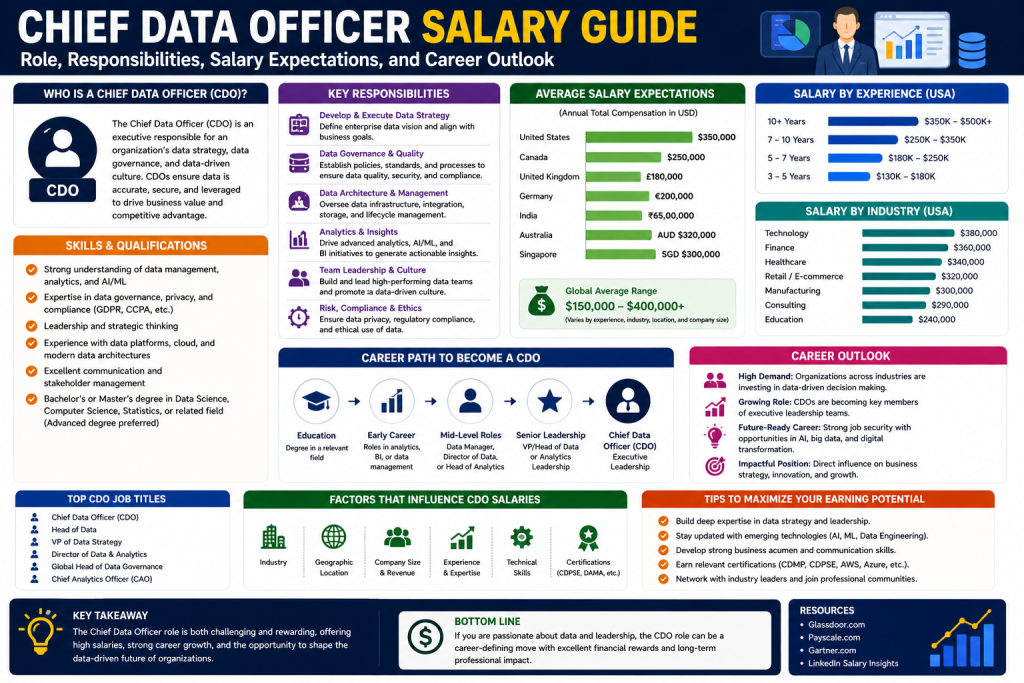
A Chief Data Officer is the senior executive responsible for establishing, governing, and optimizing an organization’s data strategy. At its core, the role exists to ensure that company data is accurate, secure, accessible, compliant, and strategically leveraged to support decision-making. While responsibilities may vary depending on company size, industry, and digital maturity, the CDO generally acts as the bridge between technical data operations and executive business strategy.
In practical terms, this means a CDO is responsible for transforming raw information into actionable business intelligence while ensuring data remains trustworthy and legally compliant. This leadership role often spans multiple departments, including analytics, governance, cybersecurity, privacy, cloud modernization, digital transformation, and AI readiness.
In many enterprises, the CDO reports directly to the CEO, COO, CIO, or board, reflecting the growing recognition that data is no longer an IT issue alone—it is a business-critical asset. Organizations increasingly depend on data leaders to influence strategic planning, customer insights, operational resilience, and innovation roadmaps.
As digital ecosystems expand, companies also expect CDOs to navigate emerging challenges such as artificial intelligence governance, machine learning ethics, predictive analytics, real-time decision systems, and global privacy regulations. This broad scope is a major reason compensation for CDOs often rivals other top-tier executive roles.
Core Responsibilities of a Chief Data Officer
The role of the Chief Data Officer extends across multiple disciplines, requiring a combination of business leadership, technical fluency, regulatory understanding, and organizational influence.
Data governance remains one of the foundational responsibilities. CDOs develop policies and frameworks that determine how data is collected, stored, shared, protected, and used throughout the enterprise. Strong governance ensures consistency, quality, and trust while minimizing errors and compliance risks.
Data quality management is equally important. Poor data quality can undermine strategic decisions, distort analytics, and create costly operational mistakes. CDOs implement standards and controls to maintain data integrity across departments.
Analytics leadership is another central pillar. CDOs oversee the systems, teams, and methodologies used to generate insights from enterprise data. This often includes business intelligence dashboards, predictive analytics, machine learning initiatives, and executive reporting frameworks.
Regulatory compliance has become a defining component of the role. With privacy laws and sector-specific regulations expanding globally, organizations rely on CDOs to ensure proper governance over sensitive data while reducing legal and reputational risk.
Strategic alignment is where the role becomes distinctly executive. Chief Data Officers collaborate with finance leaders, technology executives, product teams, marketing leadership, and operations departments to ensure data strategies directly support broader organizational objectives.
Talent development also falls under many CDOs’ leadership scope. Building strong teams of analysts, engineers, governance professionals, architects, and privacy experts is often essential for scaling enterprise-wide transformation.
Why Chief Data Officers Have Become Essential
Several business trends have accelerated demand for CDOs.
First, organizations are generating more data than ever before. Customer interactions, cloud systems, IoT devices, digital marketing platforms, enterprise applications, and AI systems all produce enormous amounts of information. Without executive oversight, this data can become fragmented, underutilized, or risky.
Second, regulatory pressure has intensified. Privacy laws, cybersecurity expectations, and governance standards require organizations to treat data management as a boardroom priority rather than a technical afterthought.
Third, artificial intelligence and advanced analytics have elevated data quality to strategic importance. AI systems are only as effective as the data feeding them, making executive oversight critical for long-term innovation.
Fourth, investors and stakeholders increasingly evaluate companies based on digital maturity. Organizations with mature data strategies often outperform competitors in efficiency, personalization, and agility.
These factors collectively explain why businesses are willing to pay substantial salaries for proven CDO leadership.
Chief Data Officer Salary Expectations Across the United States
Chief Data Officer compensation can vary dramatically based on geography, industry, organizational maturity, and executive influence. In major metropolitan markets with strong enterprise presence, salaries often reach into the high six figures, especially when equity, bonuses, and performance incentives are included.
In top-tier markets such as San Francisco, New York, and Seattle, base salaries commonly exceed $300,000 for experienced CDOs, with total compensation packages often stretching well beyond that. These cities tend to host organizations with advanced digital ecosystems, aggressive innovation goals, and large-scale regulatory responsibilities.
Secondary growth markets like Boston, Austin, Washington D.C., and Chicago also offer highly competitive compensation, often ranging from the mid-$200,000s to over $300,000 depending on company size and strategic scope.
Meanwhile, smaller or lower-cost markets may offer lower base salaries, but compensation often remains highly attractive relative to local living expenses. In many cases, organizations in these markets may provide broader operational influence or accelerated executive mobility.
This regional variation highlights an important reality: salary is not solely determined by title. Scope, complexity, and business impact matter just as much as location.
Geographic Trends in CDO Compensation
Large coastal technology hubs often offer the highest salaries due to a combination of competition, cost of living, and enterprise sophistication. Companies in these markets frequently require advanced expertise in cloud ecosystems, AI governance, privacy frameworks, and large-scale analytics.
Government-heavy regions and healthcare centers may also offer strong compensation due to regulatory complexity. Industries managing sensitive consumer or patient data often prioritize governance leadership.
Emerging markets can provide compelling opportunities as well. As more mid-market organizations modernize operations, experienced CDOs may command premium salaries by building data programs from the ground up.
In some cases, relocating to a high-growth region may significantly increase compensation potential, but professionals should also weigh taxation, cost of living, equity opportunities, and career trajectory.
How Organizational Data Maturity Impacts Salary
One of the biggest factors influencing salary is whether a company already has a mature data ecosystem or is just beginning its transformation.
Organizations in early-stage data maturity often pay aggressively to attract executives capable of designing governance frameworks, building infrastructure, and creating cultural transformation from scratch. This greenfield opportunity can command premium pay due to complexity.
Mature enterprises may also offer high compensation, but often expect more advanced specialization, such as AI governance, monetization strategy, or multinational compliance.
In essence, salary often rises in proportion to transformation responsibility. Building a data organization can be just as lucrative as optimizing one.
Industries Offering the Highest CDO Salaries
Not all industries compensate CDOs equally.
Financial services often ranks among the highest-paying sectors due to strict regulations, fraud prevention, and complex analytics demands.
Healthcare organizations increasingly pay premium salaries as patient privacy, interoperability, and predictive health systems become more critical.
Technology companies frequently offer substantial compensation because data often directly influences product innovation and monetization.
Retail and e-commerce sectors also invest heavily in data leadership for personalization, supply chain optimization, and customer intelligence.
Government and defense sectors may offer lower direct salaries than private tech, but strategic influence and mission complexity can still be substantial.
Career Outlook for Aspiring Chief Data Officers
The demand for Chief Data Officers is expected to remain strong as organizations continue modernizing digital infrastructure. Data governance, privacy, cloud transformation, and AI strategy are unlikely to become less important in coming years.
For aspiring CDOs, the path often begins in business intelligence, data architecture, analytics management, cybersecurity governance, or enterprise IT leadership. Over time, professionals who combine technical mastery with strategic communication often rise fastest.
Increasingly, organizations seek leaders who can connect technical ecosystems with measurable business outcomes. This means future CDOs must develop financial literacy, executive communication skills, and regulatory awareness alongside data expertise.
The role may also evolve into broader leadership pathways, including Chief Digital Officer, Chief Analytics Officer, Chief Information Officer, or even CEO positions in highly data-centric organizations.
Final Thoughts on the Modern Chief Data Officer Role
The Chief Data Officer is no longer a niche executive title—it is one of the most strategically important positions in modern enterprise leadership. As businesses become increasingly reliant on data for growth, compliance, and innovation, CDOs are commanding salaries that reflect their expanding influence.
Success in this field requires more than technical knowledge. It demands strategic thinking, governance expertise, leadership maturity, and the ability to transform data into measurable business value.
For current and aspiring data leaders, understanding salary expectations is only one part of the equation. Long-term earning power is shaped by industry specialization, executive visibility, transformation capability, and the ability to lead organizations through increasingly complex digital landscapes.
In today’s economy, companies that treat data as a strategic asset are investing heavily in the leaders who can unlock its full potential—and Chief Data Officers are at the center of that transformation.
Experience, Industry Demand, Leadership Scope, and How to Increase Executive Compensation
While location plays a major role in determining Chief Data Officer compensation, geography alone does not explain why one executive earns significantly more than another. Two professionals may hold the same title in similar-sized organizations yet have compensation packages separated by hundreds of thousands of dollars. The difference often comes down to strategic influence, organizational maturity, technical specialization, industry complexity, and measurable business outcomes.
The modern Chief Data Officer is no longer compensated simply for overseeing data management. Organizations increasingly reward CDOs based on their ability to drive transformation, reduce enterprise risk, unlock revenue opportunities, modernize infrastructure, and guide executive decision-making. This means salary growth is often tied less to title alone and more to business impact.
Understanding the deeper salary drivers behind this role is essential for professionals seeking executive advancement, negotiating compensation, or planning a long-term data leadership career.
Why Chief Data Officer Salaries Vary So Widely
One of the defining characteristics of CDO compensation is its broad range. In some organizations, the role functions primarily as a governance and compliance position focused on policy, data quality, and risk management. In others, the CDO acts as a transformative executive leading AI strategy, digital modernization, cloud migration, monetization, and enterprise innovation.
This variation in role complexity explains why compensation can differ so dramatically. A CDO responsible for internal governance in a mid-sized company may earn substantially less than a CDO leading multinational data monetization initiatives.
Compensation also reflects the level of strategic visibility. CDOs who report directly to CEOs, boards, or investors are generally viewed as business architects rather than operational specialists. That distinction often leads to larger salaries, bonus structures, and equity packages.
Additionally, organizational urgency influences compensation. Companies facing digital disruption, compliance pressure, or aggressive modernization often pay premium salaries to attract leaders who can execute large-scale transformation quickly.
Data Maturity and Organizational Readiness
A company’s stage in its data journey has enormous influence on executive compensation.
Organizations in the early phases of digital transformation often require foundational leadership. These companies may need a CDO to establish governance standards, centralize fragmented systems, recruit specialized teams, define enterprise architecture, and build executive trust in data. Because these responsibilities involve creating systems from scratch, compensation can be highly competitive.
In contrast, mature organizations may already have data warehouses, governance protocols, analytics systems, and compliance structures in place. Here, the CDO may focus more on optimization, innovation, AI strategy, or monetization. While salaries remain high, the nature of the role shifts from foundational design to enterprise-scale acceleration.
In many cases, greenfield opportunities can offer exceptional salary upside because organizations are investing in change leadership, not just oversight.
Regulatory Complexity as a Salary Multiplier
Few factors increase executive compensation more consistently than regulatory pressure.
Organizations operating in industries with strict legal requirements often prioritize experienced CDOs because poor governance can create catastrophic financial and reputational damage. Healthcare, financial services, insurance, government, defense, and global e-commerce sectors often require advanced expertise in privacy frameworks, governance controls, audit readiness, and data ethics.
A CDO managing GDPR, HIPAA, CCPA, PCI-DSS, SOC 2, or cross-border privacy regulations carries greater strategic burden than one in a less regulated environment. This burden often translates directly into salary premiums.
Regulatory complexity also affects board-level involvement. When compliance failures could result in legal action, investor concerns, or public scrutiny, CDOs become critical strategic protectors of enterprise stability.
Industry-Specific Salary Differences
Industry specialization can significantly alter compensation expectations.
Financial institutions frequently offer some of the highest CDO salaries because data leadership intersects with fraud prevention, customer analytics, risk modeling, and strict governance obligations. Banks, investment firms, and insurance organizations often require executives who can balance innovation with rigorous oversight.
Healthcare and pharmaceutical sectors also command strong compensation due to privacy sensitivity, operational complexity, and growing demand for predictive health analytics.
Technology companies may provide especially lucrative packages when data directly supports product ecosystems, AI platforms, advertising models, or SaaS innovation. In these environments, data leadership can directly influence revenue generation.
Retail and logistics organizations increasingly value CDOs for personalization, demand forecasting, supply chain intelligence, and omnichannel optimization.
Manufacturing, telecommunications, and energy sectors may also offer high compensation when IoT ecosystems, predictive maintenance, or enterprise-scale modernization are central priorities.
Ultimately, industry matters because it shapes both business risk and strategic opportunity.
How Experience Impacts Chief Data Officer Compensation
Years of experience alone do not determine salary, but career progression significantly shapes executive earning power.
Professionals entering first-time CDO roles often come from business intelligence, enterprise architecture, analytics leadership, or information governance backgrounds. At this stage, salaries may be strong but often reflect narrower strategic authority.
Mid-career CDOs typically oversee broader governance structures, executive collaboration, enterprise reporting, and organizational modernization. Compensation increases as leaders demonstrate successful implementation across departments.
Senior enterprise CDOs with decades of experience often command top-tier salaries because they influence revenue strategy, innovation, compliance resilience, and investor confidence simultaneously.
Experience also builds political capital. Seasoned CDOs are often more effective at navigating executive relationships, organizational resistance, and board communication—skills that substantially increase compensation potential.
Boardroom Influence and Executive Visibility
Not all CDOs operate with the same level of authority.
A major differentiator in compensation is whether the executive serves primarily as a technical overseer or as a strategic business advisor.
CDOs with regular board access, investor visibility, or CEO-level collaboration often earn significantly more than peers operating deeper within IT or analytics structures. This is because compensation increasingly reflects business influence rather than technical stewardship alone.
Board-facing CDOs often contribute to:
Corporate strategy
Digital transformation planning
AI governance
Data monetization
Risk mitigation
Mergers and acquisitions
Brand trust
When data leadership becomes integral to strategic growth, compensation often expands to reflect enterprise-level accountability.
Cloud Transformation and Emerging Technology Leadership
Modern enterprises are increasingly modernizing data ecosystems through cloud migration, AI integration, and real-time intelligence systems. CDOs who can lead these transitions often command premium compensation.
Organizations moving from legacy infrastructure to cloud-native platforms require leaders who understand architecture, cost governance, interoperability, security, and transformation strategy.
Executives with expertise in AI governance, machine learning frameworks, ethical data design, and advanced analytics may also receive salary advantages because these competencies are increasingly scarce.
As enterprises race to operationalize AI responsibly, CDOs who combine governance with innovation are positioned for substantial salary growth.
Team Building and Organizational Leadership
Salary often correlates with leadership scale.
A CDO managing a small governance office may earn significantly less than one overseeing hundreds of professionals across engineering, analytics, architecture, privacy, and strategy.
Larger teams require stronger operational maturity, budget ownership, executive communication, and change management capabilities.
Building cross-functional teams also signals strategic trust. Organizations often compensate leaders more aggressively when they are responsible for developing talent pipelines, shaping culture, and institutionalizing data literacy.
How Certifications and Education Influence Compensation
At the executive level, certifications rarely guarantee salary increases on their own, but they can strengthen negotiation power and credibility.
Certifications in data governance, privacy, and cloud ecosystems may provide an advantage in competitive environments, particularly when organizations prioritize modernization or compliance.
Executive education programs, MBAs, and strategic leadership development can also increase earning potential by expanding financial literacy and business communication skills.
In highly competitive markets, credentials may help differentiate candidates, but measurable business outcomes remain the strongest compensation driver.
Negotiating Higher Chief Data Officer Compensation
Executive salary growth often depends on strategic positioning.
To maximize compensation, CDOs should focus on outcomes tied directly to organizational value. Revenue acceleration, operational savings, compliance resilience, customer intelligence, and innovation outcomes create stronger negotiation leverage than technical competence alone.
Successful negotiation strategies often include:
Demonstrating measurable ROI from governance or analytics initiatives
Leading enterprise-wide modernization
Expanding strategic influence beyond IT
Building AI readiness frameworks
Reducing regulatory exposure
Presenting business outcomes in financial terms
Compensation discussions become more favorable when CDOs frame themselves not as cost centers, but as enterprise value creators.
Career Risks That Can Limit Salary Growth
Despite strong demand, certain limitations can cap compensation.
Executives who remain narrowly focused on governance without strategic innovation may earn less than peers driving transformation.
Similarly, professionals lacking executive communication skills may struggle to gain board visibility.
Over-specialization in one technical ecosystem without broader business fluency can also reduce long-term earning power.
The highest-paid CDOs are typically those who evolve from technical experts into enterprise strategists.
Future Salary Growth for Chief Data Officers
As data ecosystems continue expanding, salary growth potential remains strong.
Several emerging trends are likely to increase executive compensation opportunities:
AI governance expansion
Real-time enterprise intelligence
Global privacy regulation growth
Data monetization strategies
ESG data transparency
Cybersecurity-data convergence
Cross-border governance complexity
These shifts suggest that future CDOs may command even greater compensation as organizations increasingly rely on data not just for operations, but for survival and innovation.
Final Thoughts on Chief Data Officer Compensation Growth
Chief Data Officer salaries are shaped by far more than job title. Compensation reflects business complexity, transformation responsibility, executive visibility, industry pressure, and measurable strategic outcomes.
Professionals who understand governance alone may secure strong salaries, but those who combine governance with innovation, compliance leadership, and strategic transformation often achieve the highest earning potential.
For aspiring and current CDOs, salary growth depends on continuously expanding influence—from managing data systems to shaping enterprise futures.
As businesses become more data-dependent, the executives who can align governance, innovation, privacy, and profitability will remain among the most valuable leaders in the modern economy.
Chief Data Officer Tools, Certifications, Executive Skills, and Long-Term Career Strategies for Maximum Salary Growth
Reaching the Chief Data Officer level is not the end of a professional journey—it is often the point where technical knowledge, executive leadership, strategic innovation, and business transformation must converge at the highest level. While salary benchmarks, geographic trends, and organizational maturity all influence compensation, long-term earning power is often determined by a CDO’s ability to continuously adapt, modernize, and lead through complexity.
At this stage, success is rarely defined by technical expertise alone. Organizations expect CDOs to anticipate industry disruption, guide enterprise-wide modernization, and create scalable strategies that align data initiatives with larger business goals. This may involve overseeing cloud migrations, shaping AI governance policies, improving compliance frameworks, or unlocking new revenue opportunities through advanced analytics and data monetization. The executive landscape is constantly evolving, and CDOs must remain agile enough to respond to regulatory changes, emerging technologies, cybersecurity threats, and shifting stakeholder expectations.
Leadership also becomes increasingly people-focused, requiring the ability to mentor high-performing teams, influence boards, collaborate across departments, and build a culture where data is trusted and strategically leveraged. As enterprises become more dependent on data for survival and innovation, the CDO role transforms into one of organizational architecture and future planning. Those who continue expanding beyond operational oversight into visionary leadership are often the ones who achieve the highest compensation, broadest influence, and most enduring executive relevance.
The highest-paid Chief Data Officers are rarely compensated solely because they understand data. They earn premium salaries because they know how to build enterprise ecosystems, create governance at scale, implement modern technologies, manage compliance pressures, influence boards, and transform data into competitive advantage.
To remain valuable in a rapidly evolving business landscape, today’s CDO must combine technical expertise with executive-level business capabilities. This includes mastering modern data platforms, understanding governance technologies, pursuing relevant certifications, expanding leadership capacity, and strategically positioning themselves for broader influence.
As organizations increasingly prioritize AI, cloud ecosystems, privacy, and digital transformation, the tools and skills that define successful CDOs continue to evolve.
Why Tools and Technology Matter for Chief Data Officers
At the executive level, Chief Data Officers are not expected to operate every technical system personally. However, they must understand how major platforms, governance tools, cloud ecosystems, and analytics environments function strategically.
The modern enterprise relies on increasingly complex data architectures that span multiple business units, regions, and regulatory frameworks. CDOs must be capable of selecting, aligning, and optimizing technologies that support organizational goals while ensuring resilience and compliance.
Technology fluency directly impacts compensation because organizations place higher value on leaders who can modernize infrastructure, reduce inefficiencies, and future-proof data ecosystems.
A CDO who understands emerging architectures can make more strategic decisions about scalability, vendor investments, governance, interoperability, and innovation.
Essential Data Platforms Every Chief Data Officer Should Understand
Enterprise data platforms form the foundation of organizational intelligence. These systems support storage, transformation, analytics, and large-scale data orchestration.
Cloud-native platforms are especially important because modern organizations increasingly prioritize flexibility, speed, and global scalability.
A strong CDO should understand how enterprise platforms support:
Data warehousing
Real-time processing
AI readiness
Cross-cloud integration
Data lakehouse architectures
Cost optimization
Operational governance
Knowledge of these systems allows CDOs to guide modernization initiatives, oversee vendor strategy, and align technical architecture with long-term business priorities.
The most competitive executives are often those who can bridge technical ecosystem understanding with financial and strategic decision-making.
Business Intelligence and Analytics Leadership
Business intelligence remains one of the most visible expressions of enterprise data value. Dashboards, reporting frameworks, predictive analytics, and decision intelligence systems all depend on executive oversight.
A Chief Data Officer must understand how organizations translate raw information into measurable action.
This means being fluent in the strategic value of:
Visualization systems
Executive dashboards
Self-service analytics
Predictive forecasting
Operational KPIs
Performance metrics
Data democratization
Organizations increasingly reward CDOs who can improve decision speed, reporting trust, and organizational agility through better analytics frameworks.
Analytics leadership is not just about reporting. It is about shaping enterprise behavior through trustworthy insights.
Data Governance Technologies and Their Strategic Value
Governance is one of the defining pillars of the Chief Data Officer role. Without governance, even the most advanced analytics systems can create misinformation, risk, or compliance failure.
Modern governance technologies support:
Data lineage
Metadata management
Master data management
Access controls
Data quality assurance
Stewardship frameworks
Policy enforcement
CDOs who excel in governance are often more valuable because governance protects business integrity while enabling innovation safely.
As organizations expand globally and privacy regulations become stricter, governance expertise increasingly acts as both a salary driver and a strategic differentiator.
Privacy, Security, and Compliance Platforms
Data privacy is no longer a secondary concern. It is central to executive strategy.
Chief Data Officers working in regulated sectors often oversee privacy frameworks alongside governance initiatives. This requires strategic awareness of privacy operations, legal obligations, consent frameworks, and security collaboration. In industries such as healthcare, finance, insurance, government, and global e-commerce, privacy oversight is not simply about protecting information—it is about preserving trust, reducing liability, and ensuring the organization can operate without interruption from compliance failures or legal penalties. A CDO must understand how privacy regulations influence data collection, storage, sharing, retention, and deletion practices across the enterprise. This includes coordinating with legal teams, cybersecurity leaders, compliance officers, and executive stakeholders to build frameworks that support both innovation and regulatory alignment. They may also oversee privacy-by-design strategies, ensuring new products, platforms, and analytics systems are developed with compliance requirements embedded from the beginning rather than added later as corrective measures.
Effective privacy leadership also involves managing third-party vendor risks, international data transfer policies, breach response coordination, and employee education on data-handling responsibilities. As regulations continue evolving, particularly across international markets, CDOs must remain agile and informed. Their ability to balance governance with privacy protection directly impacts brand reputation, customer confidence, and executive decision-making, making privacy strategy an increasingly critical component of enterprise-wide data leadership.
Modern privacy leadership often intersects with:
Consent management
Risk monitoring
Data classification
Rights management
Policy automation
Audit readiness
Cybersecurity coordination
Organizations facing high compliance burdens often pay premium salaries for CDOs who can reduce legal exposure while preserving innovation.
In many enterprises, privacy and governance expertise significantly increase executive relevance.
Cloud Ecosystems and Multi-Platform Leadership
Cloud transformation continues reshaping enterprise data architecture. Organizations increasingly rely on cloud ecosystems to support scalability, modernization, AI adoption, and cost flexibility.
Chief Data Officers who understand cloud strategy often hold greater executive influence because infrastructure modernization is often directly tied to growth.
This includes strategic familiarity with:
Cloud data warehouses
Data lakes
Migration planning
Hybrid environments
Cost governance
Security architecture
Cross-cloud interoperability
The most effective CDOs are often those who can translate cloud architecture decisions into business outcomes such as speed, efficiency, resilience, and innovation.
Top Certifications for Chief Data Officers
Although certifications alone rarely guarantee executive advancement, they can strengthen credibility, improve strategic readiness, and support salary negotiations.
The most valuable certifications often fall into three categories:
Data governance and management
Privacy and compliance
Cloud and modernization
Governance certifications can reinforce enterprise credibility, especially in organizations focused on operational maturity.
Privacy certifications are particularly valuable in sectors where legal complexity significantly impacts business risk.
Cloud certifications may increase compensation opportunities when organizations prioritize digital modernization.
Executive education can also play a meaningful role. Leadership development programs, strategic finance education, and board governance training can help CDOs evolve beyond technical specialization.
Ultimately, certifications are most powerful when paired with practical business impact.
Executive Skills That Separate Average CDOs from Elite CDOs
Many professionals possess strong technical knowledge. Far fewer develop the executive competencies required for top-tier compensation.
The highest-paid Chief Data Officers typically excel in:
Strategic communication
Financial literacy
Organizational politics
Board engagement
Change management
Talent development
Cross-functional collaboration
Innovation leadership
These skills transform data executives into enterprise strategists.
A technically brilliant leader may still face salary limitations if they cannot influence stakeholders, communicate ROI, or shape enterprise strategy.
The ability to explain data initiatives in business terms often separates six-figure professionals from top-tier executives.
AI Governance and Emerging Opportunities
Artificial intelligence is creating one of the most significant opportunities for CDO salary growth.
As organizations integrate AI into operations, the importance of trustworthy data, governance frameworks, ethical oversight, and compliance readiness becomes even greater.
Chief Data Officers increasingly play a role in:
AI policy development
Bias reduction
Data integrity for machine learning
Responsible innovation
Model governance
Risk mitigation
Enterprise AI strategy
Executives who can guide AI responsibly may command substantial compensation premiums in coming years.
AI governance is rapidly becoming a boardroom issue, and data leaders with this expertise are likely to become even more influential.
Building Long-Term Career Mobility Beyond the CDO Role
For many professionals, Chief Data Officer is not the final destination.
The role increasingly serves as a pathway into broader executive leadership, including:
Chief Digital Officer
Chief Analytics Officer
Chief Information Officer
Chief Transformation Officer
Chief Operating Officer
Chief Executive Officer
This career mobility often depends on whether a CDO develops broader business acumen beyond technical ecosystems.
Professionals who successfully connect data to profitability, innovation, customer strategy, and enterprise resilience often position themselves for wider leadership roles.
Expanding beyond data stewardship into strategic enterprise leadership can dramatically increase long-term compensation.
How to Future-Proof Your Chief Data Officer Career
Long-term salary success depends on adaptability.
The business landscape continues evolving through:
AI disruption
Regulatory shifts
Cloud acceleration
Cybersecurity threats
Global privacy changes
Automation
Ethical governance demands
To remain competitive, CDOs must continually refine both technical awareness and strategic capability.
This may include:
Pursuing executive education
Leading transformation programs
Expanding governance maturity
Developing AI oversight expertise
Strengthening board relationships
Building broader business fluency
Future-proofing is not about mastering every tool—it is about remaining strategically indispensable.
Mistakes That Can Limit Long-Term Earning Potential
Even experienced CDOs can reduce salary growth by focusing too narrowly.
Common limitations include:
Remaining purely technical
Avoiding executive visibility
Neglecting financial literacy
Ignoring regulatory evolution
Failing to scale teams
Overlooking AI strategy
Avoiding transformation leadership
Compensation growth often slows when CDOs fail to evolve from operational specialists into strategic architects.
The Global Outlook for Chief Data Officer Demand
As digital ecosystems expand worldwide, demand for data leadership is expected to remain strong across industries.
Global drivers include:
Cross-border privacy regulation
Enterprise AI adoption
Digital transformation
Data monetization
Operational intelligence
Customer personalization
Cybersecurity integration
This suggests the Chief Data Officer role may continue gaining strategic importance rather than declining.
Professionals who combine governance, innovation, compliance, and enterprise strategy are likely to remain highly compensated for years to come.
Conclusion
The Chief Data Officer role has evolved into one of the most strategically important positions in modern business leadership. While salary can be influenced by location, industry, and experience, the highest compensation levels are typically reserved for executives who go beyond traditional data management.
Today’s most successful CDOs are architects of transformation. They build governance systems, modernize infrastructure, guide AI strategy, protect privacy, shape innovation, and align enterprise data with measurable business outcomes.
Long-term salary growth depends on mastering more than technology. It requires leadership, strategic communication, business fluency, compliance expertise, and the ability to consistently demonstrate value at the highest organizational levels.
For aspiring and current CDOs, the path to maximum compensation is clear: develop technical depth, expand executive influence, embrace emerging technologies, and position yourself not merely as a data leader, but as a business strategist.
In an economy increasingly shaped by information, organizations are willing to invest heavily in leaders who can transform data into growth, resilience, and competitive advantage—and Chief Data Officers remain at the center of that future.
Continue exploring the technologies and certification concepts that matter most to you.