A modern network cannot function without strong security, yet it also cannot operate if everything is blocked. Organizations depend on continuous internet access for communication, services, and business operations. At the same time, threats such as hackers, malware, and unauthorized access attempts are always present. Managing this balance between accessibility and protection is one of the biggest challenges in networking.
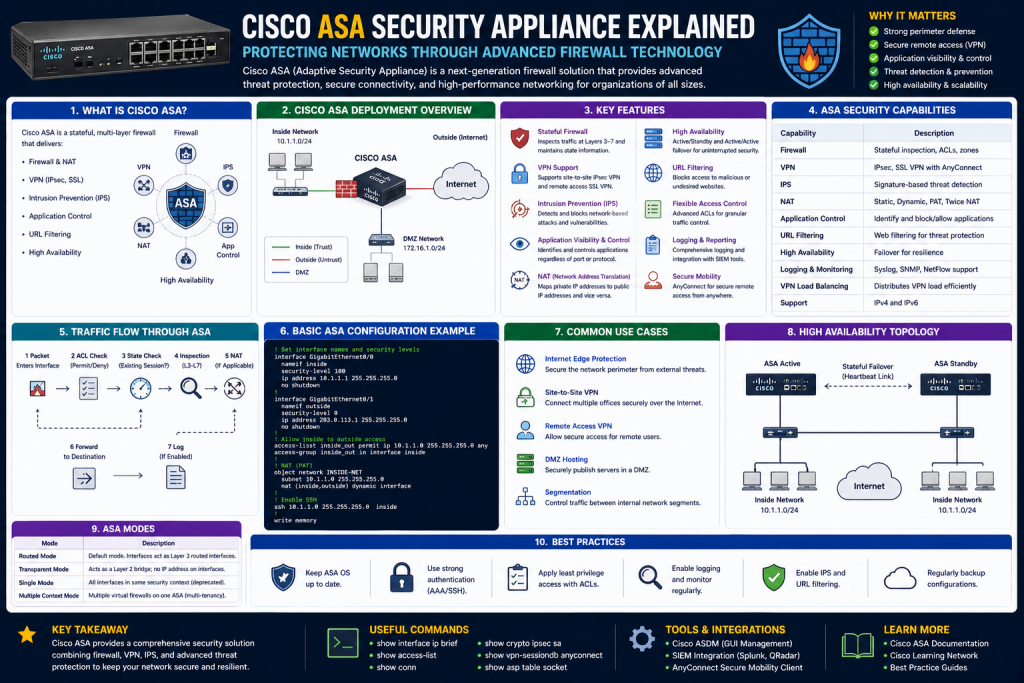
A Cisco Adaptive Security Appliance, commonly known as ASA, is designed to solve this problem. Developed by Cisco Systems, the ASA is a multifunction security device that combines several essential technologies into one platform. Instead of relying on separate tools for firewall protection, virtual private networks, and traffic monitoring, the ASA integrates all of these capabilities into a single system.
In simple terms, the ASA acts as a smart security gateway. It controls which traffic is allowed to enter or leave a network, monitors ongoing connections, and protects sensitive data. It is not just a barrier but an intelligent system that understands network behavior and responds accordingly.
The Purpose of Cisco ASA in Network Security
The primary goal of a Cisco ASA is to protect a network while still allowing legitimate communication to take place. Completely blocking access to the internet would provide maximum security, but it would also make the network unusable. Businesses need to access websites, cloud services, and external systems, so a more flexible solution is required.
The ASA addresses this need by inspecting and controlling traffic in real time. It ensures that users inside the network can access external resources while preventing unauthorized users from gaining access to internal systems. This is achieved through a combination of filtering, monitoring, and intelligent decision-making.
The device also supports secure remote access, which is increasingly important as more employees work from different locations. By providing encrypted communication channels, the ASA ensures that sensitive information remains protected even when transmitted over public networks.
Understanding Network Zones and Security Levels
One of the key concepts behind how a Cisco ASA operates is the idea of security levels. These levels represent the degree of trust assigned to different parts of a network. Instead of treating all traffic equally, the ASA evaluates where the traffic is coming from and where it is going.
Most network environments are divided into three main zones. The inside network represents the internal environment where trusted users and devices operate. This zone is given the highest level of trust. The outside network represents the internet, which is considered untrusted. The DMZ, or demilitarized zone, is a separate area used for hosting public-facing services such as web servers or email systems. This zone has a moderate level of trust.
Each interface on the ASA is assigned a security level, usually represented by a number. Higher numbers indicate greater trust. The ASA uses these values to determine how traffic should flow between different parts of the network.
Default Traffic Behavior in Cisco ASA
The ASA follows a simple but effective set of default rules based on security levels. Traffic is allowed to flow from a higher security level to a lower one. This means that users inside the network can access the internet without restrictions. On the other hand, traffic from a lower security level to a higher one is blocked by default. This prevents external users from initiating connections into the internal network.
These default rules provide a strong baseline for security. Without any additional configuration, the ASA already blocks most unwanted traffic. At the same time, it allows normal activities such as web browsing and email communication to function without interruption.
Administrators can modify these rules by creating specific policies that allow certain types of traffic. For example, they can permit external users to access a public web server located in the DMZ while still protecting the internal network.
Why Networks Cannot Be Completely Isolated
From a security perspective, the safest network would be one that is completely isolated from the outside world. However, this approach is not practical for most organizations. Modern businesses rely on constant connectivity for their operations.
Employees need to access online tools and services. Customers expect to interact with websites and applications. Data must be shared across different systems and locations. All of this requires a connection to external networks.
The challenge is not to eliminate connectivity but to control it. The ASA provides a way to manage this connection safely. It allows necessary communication while blocking anything that could pose a threat.
Stateful Inspection and Its Importance
One of the most important features of the Cisco ASA is stateful inspection. This mechanism allows the device to track active connections and make decisions based on the context of the traffic.
Traditional packet filtering methods examine each packet individually without considering the overall connection. This approach can either be too restrictive or too permissive. Stateful inspection solves this problem by maintaining information about active sessions.
When a user initiates a connection, the ASA records details such as the source address, destination address, protocol, and port numbers. This information is stored in a state table. When a response is received, the ASA checks whether it matches an existing entry in this table.
If the response matches a known session, it is allowed through. If it does not, it is blocked. This ensures that only legitimate traffic associated with established connections is permitted.
How Stateful Inspection Works in Practice
To understand stateful inspection more clearly, consider a typical scenario. A user inside a network wants to access a website. The user sends a request to the internet, which passes through the ASA. The ASA allows the request and records the session details.
When the website sends a response back, the ASA examines the incoming traffic. It compares the response with the stored session information. If the details match, the ASA recognizes the response as valid and allows it to pass through.
If an external system tries to send unsolicited traffic that does not match any existing session, the ASA blocks it. This prevents unauthorized access attempts while still allowing normal communication.
This process happens continuously and automatically for all active connections. It allows the network to function efficiently while maintaining strong security.
Benefits of Stateful Inspection
Stateful inspection provides several important advantages. It allows dynamic handling of traffic without requiring manual configuration for every possible scenario. It improves security by ensuring that only expected responses are allowed. It also enhances performance by reducing unnecessary processing and avoiding overly restrictive rules.
Another benefit is scalability. The ASA can handle a large number of simultaneous connections, making it suitable for both small and large networks. As the number of users increases, the ASA continues to track and manage connections effectively.
Dynamic Exceptions and Session Management
One of the key strengths of stateful inspection is its ability to create dynamic exceptions. When a user initiates a connection, the ASA temporarily allows return traffic for that specific session. Once the session is closed, the exception is removed.
This approach reduces the need for permanent rules that could create security risks. Instead of leaving ports open indefinitely, the ASA opens them only when necessary and closes them afterward.
Session management also plays an important role in maintaining network performance. The ASA keeps track of active sessions and removes inactive ones to free up resources. This ensures that the device continues to operate efficiently even under heavy load.
Balancing Security and Usability
A major challenge in network security is finding the right balance between protection and usability. If security measures are too strict, they can disrupt normal operations. If they are too lenient, they can expose the network to risks.
The Cisco ASA addresses this challenge by combining intelligent inspection with flexible configuration options. It allows administrators to define policies that match the specific needs of their organization. At the same time, it automates many processes to reduce complexity.
Users can access the resources they need without unnecessary delays, while the network remains protected against threats. This balance is essential for maintaining productivity and security.
Role of the ASA in Modern Networks
In today’s digital environment, networks are more complex than ever. They include a mix of on-premises systems, cloud services, and remote users. This complexity increases the need for robust security solutions.
The Cisco ASA plays a central role in protecting these networks. It acts as a control point where all traffic is inspected and managed. By enforcing security policies and monitoring activity, it helps prevent unauthorized access and data breaches.
The ASA also supports integration with other security technologies, allowing organizations to build a comprehensive defense strategy. This makes it a valuable component of modern network infrastructure.
Preparing for Advanced Features
The concepts covered in this part provide the foundation for understanding how the Cisco ASA works. Security levels and stateful inspection are the core mechanisms that enable the device to control traffic effectively.
More advanced features, such as packet filtering, network address translation, and virtual private networks, build on these principles. By understanding the basics, it becomes easier to explore these additional capabilities in detail.
Introduction to Advanced ASA Features
In the first part, the focus was on the foundational concepts that make a Cisco ASA effective, including security levels and stateful inspection. These features establish how the device evaluates and manages traffic at a basic level. However, modern networks require more than just tracking connections. They need precise control over which traffic is allowed, how addresses are handled, and how secure communication is established across untrusted networks.
This is where the advanced capabilities of the ASA come into play. Features such as packet filtering, access control lists, network address translation, and port address translation extend the functionality of the ASA beyond simple inspection. These tools allow administrators to shape traffic flow, expose specific services safely, and ensure that internal systems remain hidden from external threats.
Understanding these features is essential for building a secure and efficient network environment. Each one plays a specific role, and together they form a comprehensive system for managing and protecting network communication.
Packet Filtering and Traffic Control
Packet filtering is one of the most important mechanisms used by a Cisco ASA to control inbound and outbound traffic. While stateful inspection focuses on tracking active connections, packet filtering provides a way to define explicit rules about what traffic is allowed or denied.
This is achieved through the use of access control lists, commonly referred to as ACLs. These lists contain a series of rules that specify conditions such as source address, destination address, protocol type, and port numbers. When a packet reaches the ASA, it is compared against these rules. If it matches a permitted rule, it is allowed through. If it does not match any rule or matches a deny condition, it is blocked.
Packet filtering gives administrators precise control over network access. It allows them to define exactly which types of traffic are acceptable and which should be rejected. This level of control is essential for protecting sensitive systems while still allowing necessary communication.
Access Control Lists in Detail
Access control lists are the backbone of packet filtering. They are applied to specific interfaces on the ASA, typically on the outside interface where traffic enters from the internet. Each rule in an ACL is evaluated in order, from top to bottom.
The first rule that matches the packet determines the outcome. This means that the order of rules is critical. More specific rules are usually placed at the top, while more general rules are placed further down. At the end of every ACL, there is an implicit deny rule that blocks any traffic not explicitly permitted.
For example, an administrator might create a rule that allows HTTP and HTTPS traffic to a web server located in the DMZ. This would enable external users to access the website while preventing them from accessing other parts of the network. Additional rules could be added to allow other services or restrict access based on specific conditions.
Protecting the Internal Network with a DMZ
The concept of a demilitarized zone, or DMZ, is closely tied to packet filtering. The DMZ is a separate network segment used to host systems that need to be accessible from the internet, such as web servers, mail servers, or application servers.
By placing these systems in the DMZ, the ASA creates a buffer between the outside network and the internal network. Even if a system in the DMZ is compromised, the attacker does not gain direct access to the internal environment.
Packet filtering rules are used to control traffic to and from the DMZ. External users are allowed to access specific services in the DMZ, but they are not allowed to initiate connections to the internal network. This layered approach adds an extra level of protection.
Real-World Use of Packet Filtering
Consider a scenario where a company hosts an online store. The web server for the store is located in the DMZ. Customers need to access this server to browse products and make purchases.
The ASA is configured with an access control list that allows HTTP and HTTPS traffic to the web server’s IP address. All other types of traffic are blocked. This ensures that customers can use the website without exposing the internal network to risk.
At the same time, internal users can access external resources without restriction, thanks to the default behavior of allowing traffic from higher to lower security levels. This combination of rules provides both accessibility and security.
Network Address Translation Explained
Another critical feature of the Cisco ASA is network address translation, commonly known as NAT. This technology allows devices with private IP addresses to communicate with external networks using a public IP address.
Most internal networks use private IP address ranges, such as those defined by RFC 1918. These addresses are not routable on the internet, which means they cannot be used directly for communication with external systems. NAT solves this problem by translating private addresses into a public address that can be recognized on the internet.
When a device inside the network sends a request, the ASA replaces the private source address with its own public address. When the response is received, the ASA translates the address back to the original private address and forwards the response to the correct device.
Types of NAT in Cisco ASA
The ASA supports different types of NAT, each designed for specific use cases. Static NAT creates a one-to-one mapping between a private IP address and a public IP address. This is often used for servers that need to be accessible from the internet.
Dynamic NAT allows a pool of public IP addresses to be shared among multiple internal devices. When a device initiates a connection, it is assigned a public address from the pool. Once the session ends, the address is returned to the pool for reuse.
These methods provide flexibility in how addresses are managed and ensure that communication can take place efficiently.
Port Address Translation and Its Advantages
Port address translation, or PAT, is an extension of NAT that allows multiple devices to share a single public IP address. Instead of assigning a unique public address to each device, PAT uses different port numbers to distinguish between connections.
When a device sends a request, the ASA replaces the private IP address with its public address and assigns a unique port number. This combination of address and port number identifies the session. When the response is received, the ASA uses the port number to determine which device the response should be sent to.
PAT is widely used because it conserves public IP addresses and allows many devices to access the internet simultaneously. It is especially useful in environments where public addresses are limited.
How NAT and PAT Work Together
NAT and PAT often work together to provide efficient and secure communication. For example, a company might use static NAT for its web server, allowing it to be accessed from the internet with a consistent public address. At the same time, it might use PAT for internal users, enabling them to share a single public address for outbound connections.
This combination ensures that public services remain accessible while internal devices are protected and hidden from external networks. It also simplifies network design and reduces the need for additional resources.
Security Benefits of Address Translation
In addition to enabling communication, NAT and PAT provide security benefits. By hiding internal IP addresses, they make it more difficult for attackers to identify and target specific devices. External systems only see the public address of the ASA, not the individual devices behind it.
This adds an extra layer of protection, complementing the firewall and packet filtering mechanisms. While NAT alone is not a complete security solution, it plays an important role in reducing exposure.
Interaction Between Packet Filtering and NAT
Packet filtering and NAT work closely together within the ASA. When a packet is received, the ASA applies NAT rules to translate addresses and then evaluates the packet against access control lists. This sequence ensures that traffic is properly identified and controlled.
Administrators must consider both NAT and ACL configurations when designing network policies. A misconfiguration in either area can lead to connectivity issues or security vulnerabilities. Careful planning and testing are essential to ensure that the system operates as intended.
Managing Complexity in Large Networks
As networks grow in size and complexity, managing traffic becomes more challenging. The ASA provides tools to handle this complexity, allowing administrators to create structured and organized configurations.
By grouping related rules and using consistent naming conventions, administrators can maintain clarity and reduce the risk of errors. Regular monitoring and updates are also important to ensure that the configuration remains effective as network requirements change.
Performance Considerations
The advanced features of the ASA are designed to operate efficiently, even in high-traffic environments. Hardware acceleration and optimized processing allow the device to handle large volumes of data without significant delays.
However, performance can be affected by factors such as the number of rules, the complexity of configurations, and the volume of traffic. Administrators must balance security requirements with performance considerations to achieve the best results.
Preparing for Secure Remote Access
While this part has focused on packet filtering and address translation, these features also play a role in enabling secure remote access. VPN connections rely on proper NAT configuration and access control rules to function correctly.
In the next part, the focus will shift to VPN technologies and management options, exploring how the ASA provides secure connectivity for remote users and how administrators interact with the device.
Introduction to VPNs and Secure Connectivity
In modern networking, protecting data is not limited to controlling traffic within a local environment. Organizations must also ensure that information remains secure when it travels across public networks such as the internet. Employees often work remotely, connect from different locations, and access sensitive systems outside the traditional office environment. This creates a need for secure communication channels that protect data from interception or unauthorized access.
The Cisco Adaptive Security Appliance, developed by Cisco Systems, addresses this challenge by providing robust virtual private network capabilities. These capabilities allow organizations to create encrypted tunnels that protect data as it moves between devices and networks. By integrating VPN functionality directly into the ASA, organizations can manage both network security and remote access from a single platform.
Understanding Virtual Private Networks
A virtual private network, commonly known as a VPN, is a technology that creates a secure connection over an untrusted network. Instead of sending data in plain text, a VPN encrypts the information so that it cannot be easily read or intercepted by unauthorized parties.
When a user connects to a network through a VPN, their data is encapsulated within a secure tunnel. This tunnel ensures that even if the data passes through public infrastructure, it remains protected. The receiving system decrypts the data and delivers it to its destination.
VPNs are essential for organizations that handle sensitive information, such as financial data, customer records, or proprietary business information. They also enable remote workers to access internal resources as if they were physically present within the office network.
Types of VPNs Supported by Cisco ASA
The Cisco ASA supports multiple types of VPN technologies, each designed for specific use cases. The two most commonly used types are SSL VPN and IPsec VPN.
SSL VPNs are typically used for remote access. They allow users to connect to the network using a web browser or a lightweight client application. This makes them convenient and easy to deploy, especially for users who may not have specialized software installed on their devices.
IPsec VPNs are often used for site-to-site connections. These connections link entire networks together, allowing them to communicate securely over the internet. IPsec provides strong encryption and is widely used for connecting branch offices to a central location.
Both types of VPNs provide secure communication, but they differ in how they are implemented and managed. The ASA supports both, giving organizations flexibility in designing their network architecture.
How VPN Tunnels Work in ASA
A VPN tunnel is a secure pathway through which data travels between two endpoints. When a VPN connection is established, the ASA and the remote device agree on encryption methods, authentication procedures, and other parameters.
Once the tunnel is established, all data sent through it is encrypted before leaving the source device. The ASA receives the encrypted data, decrypts it, and forwards it to the appropriate destination within the network. The same process occurs in reverse for outgoing data.
This process ensures that sensitive information remains protected throughout its journey. Even if the data is intercepted, it cannot be read without the proper decryption keys.
Remote Access VPN Scenarios
Remote access VPNs are commonly used by employees who need to connect to the corporate network from outside the office. For example, a user working from a café or home can establish a VPN connection to the ASA and gain access to internal resources.
Once connected, the user’s device behaves as if it is part of the internal network. They can access files, applications, and services just as they would in the office. This allows organizations to maintain productivity while ensuring that data remains secure.
The ASA manages these connections, ensuring that only authorized users can connect and that their data is protected. Authentication methods such as usernames, passwords, and certificates are used to verify the identity of users before granting access.
Site-to-Site VPN Connections
In addition to remote access, the ASA can also establish site-to-site VPN connections. These connections link two or more networks together, allowing them to communicate securely over the internet.
For example, a company with multiple branch offices can use site-to-site VPNs to connect each location to the main office. This creates a unified network where resources can be shared securely.
The ASA handles the encryption and decryption of data between sites, ensuring that communication remains private. This eliminates the need for dedicated leased lines, reducing costs while maintaining security.
Encryption and Data Protection
Encryption is a critical component of VPN functionality. It ensures that data cannot be read by unauthorized parties. The ASA supports various encryption algorithms, allowing organizations to choose the level of security that meets their needs.
Strong encryption methods provide a high level of protection but may require more processing power. The ASA is designed to handle this efficiently, ensuring that security does not come at the expense of performance.
In addition to encryption, the ASA also supports integrity checks and authentication mechanisms. These features ensure that data has not been altered during transmission and that it comes from a trusted source.
Managing VPN Connections
Managing VPN connections involves configuring policies, authentication methods, and encryption settings. The ASA provides tools to simplify this process, allowing administrators to create and manage VPN configurations efficiently.
Administrators can define which users are allowed to connect, what resources they can access, and how their connections are secured. They can also monitor active connections and troubleshoot issues as they arise.
Proper management is essential to ensure that VPN connections remain secure and reliable. Regular updates and monitoring help maintain the integrity of the system.
ASA Management Interfaces
The Cisco ASA can be managed using two primary interfaces: the command line interface and the graphical user interface. Each approach offers unique advantages and is suited to different types of users.
The command line interface provides direct access to the ASA’s configuration. It allows administrators to enter commands and make precise changes. This method is often preferred by experienced professionals who are comfortable with command syntax and want full control over the device.
The graphical user interface, often referred to as ASDM, provides a visual way to manage the ASA. It includes tools and wizards that guide users through common tasks, such as setting up VPN connections. This makes it easier for beginners to configure the device.
Combining CLI and GUI for Efficiency
Many administrators use both the command line interface and the graphical interface together. The graphical interface is useful for initial setup and visualization, while the command line interface is better suited for fine-tuning and troubleshooting.
For example, an administrator might use the graphical interface to configure a VPN and then review the generated commands. These commands can be modified and applied through the command line, providing greater flexibility.
This combination allows administrators to take advantage of the strengths of both interfaces, improving efficiency and accuracy.
Evolution of Cisco ASA Hardware and Software
Over time, Cisco ASA devices have evolved to meet changing security needs. Early models were designed for smaller networks, while newer models support larger and more complex environments.
Modern ASA devices often run advanced software that includes additional security features. This evolution reflects the growing importance of cybersecurity and the need for more sophisticated solutions.
Organizations can choose from a range of ASA models based on their requirements. Smaller businesses may use compact devices, while larger enterprises may deploy high-performance systems capable of handling significant traffic volumes.
Integration with Modern Security Solutions
The Cisco ASA is not limited to standalone operation. It can be integrated with other security technologies to create a comprehensive defense system. This includes intrusion prevention systems, advanced threat detection tools, and centralized management platforms.
By combining these technologies, organizations can enhance their ability to detect and respond to threats. The ASA serves as a foundation for this integrated approach, providing essential security functions while supporting additional capabilities.
Challenges and Best Practices
While the Cisco ASA is a powerful tool, it requires careful configuration and management. Misconfigured rules or incorrect settings can lead to security vulnerabilities or connectivity issues.
Best practices include regularly reviewing configurations, updating software, and monitoring network activity. Administrators should also follow established security guidelines and ensure that only necessary services are exposed to the internet.
In addition to these steps, maintaining proper access control is essential for strengthening overall security. Only authorized personnel should be allowed to make configuration changes, and role-based access should be enforced wherever possible. This reduces the risk of accidental misconfigurations and limits the potential impact of compromised credentials. Strong authentication methods, such as multi-factor authentication, can further enhance protection by adding an extra layer of verification before access is granted.
Another important practice is maintaining clear and consistent documentation of network configurations and security policies. Proper documentation helps administrators understand the existing setup, troubleshoot issues more efficiently, and ensure continuity when responsibilities are transferred between team members. It also makes it easier to identify unauthorized or unintended changes in the system.
Regular backups of configurations should also be performed and stored securely. In the event of hardware failure, cyberattacks, or configuration errors, backups allow administrators to quickly restore the system to a known working state. This minimizes downtime and ensures business continuity. Testing these backups periodically is equally important to confirm that they can be restored successfully when needed.
Network segmentation is another effective strategy for improving security. By dividing the network into smaller segments, organizations can limit the spread of potential threats. Even if one segment is compromised, the attacker’s ability to move laterally across the network is restricted. This approach works well alongside firewall policies and access control rules to create multiple layers of defense.
Continuous monitoring and alerting systems should also be implemented to detect unusual activity in real time. Automated alerts can notify administrators of suspicious behavior, such as repeated failed login attempts or unexpected traffic patterns. Early detection allows for faster response and reduces the likelihood of significant damage.
Finally, ongoing training and awareness for network administrators are crucial. Security threats are constantly evolving, and staying informed about new vulnerabilities, attack techniques, and best practices helps ensure that the network remains protected over time.
Training and experience play an important role in managing ASA devices effectively. As networks become more complex, the need for skilled professionals continues to grow.
Conclusion
The Cisco ASA is a comprehensive network security solution that combines multiple technologies into a single platform. It provides protection through traffic control, stateful inspection, packet filtering, and address translation. In addition, it offers robust VPN capabilities that enable secure communication across public networks.
Beyond these core functions, the Cisco ASA also plays a critical role in simplifying network management and improving operational efficiency. By integrating multiple security features into one device, it reduces the need for separate systems, which can lower costs and make administration easier. Network administrators can configure policies, monitor traffic, and respond to potential threats from a centralized point, ensuring consistent enforcement of security rules across the entire network.
Another important advantage of the ASA is its ability to scale according to organizational needs. Whether it is deployed in a small business environment or a large enterprise network, the ASA can handle varying levels of traffic and complexity. This flexibility allows organizations to expand their infrastructure without compromising security or performance.
The ASA also supports detailed logging and monitoring capabilities, giving administrators visibility into network activity. By analyzing logs and traffic patterns, potential threats can be identified early, allowing for quick response and mitigation. This proactive approach helps prevent security incidents before they escalate into serious problems.
Furthermore, the Cisco ASA is designed to work alongside other modern security solutions, creating a layered defense strategy. This integration enhances overall protection by combining multiple security technologies that work together to detect, prevent, and respond to threats effectively.
In this final part, the focus was on how the ASA supports secure connectivity through VPNs, how it manages encrypted communication, and how administrators interact with the device. These features are essential for modern networks that require both flexibility and strong security.
Across all three parts, a complete picture emerges of how the Cisco ASA operates. It is not just a firewall but a sophisticated system designed to manage and protect network traffic in a dynamic environment. By understanding its features and capabilities, organizations can build secure and efficient networks that meet the demands of today’s digital world.
Continue exploring the technologies and certification concepts that matter most to you.