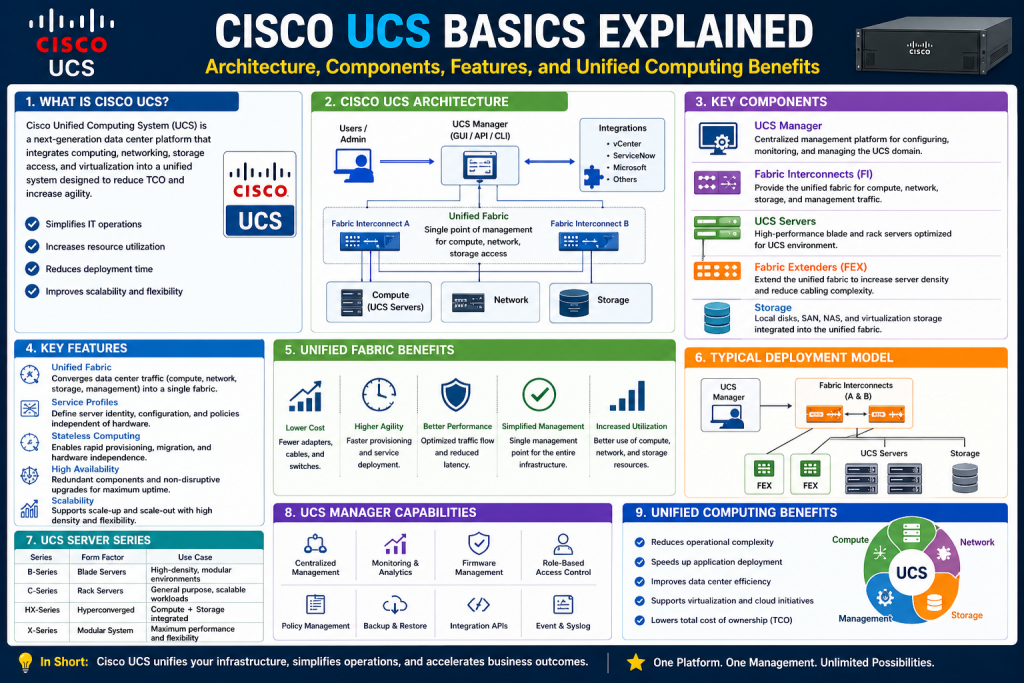
The term Unified Computing System, commonly referred to as UCS, describes an integrated approach to computing infrastructure that combines servers, networking, and management into a single unified platform. While different vendors offer similar solutions, UCS is most closely associated with Cisco, which popularized and refined this architecture for modern data centers.
Traditional IT environments often consist of separate components such as servers, switches, storage systems, and management tools. Each of these components requires its own configuration, maintenance, and expertise. Over time, this separation creates complexity, increases operational costs, and makes scaling more difficult. UCS was developed to address these challenges by merging these elements into a cohesive system.
In a UCS environment, all components are designed to work together seamlessly. This integration reduces the need for manual configuration and simplifies management tasks. Instead of treating servers and networking as independent systems, UCS treats them as part of a unified ecosystem. This shift in design philosophy helps organizations operate more efficiently and respond quickly to changing business needs.
The Evolution of Data Center Infrastructure
To understand the importance of UCS, it is helpful to look at how data centers have evolved over time. Early data centers were relatively simple, consisting of standalone servers connected to basic networking equipment. As businesses grew and technology advanced, these environments became more complex.
Organizations began adding more servers to handle increasing workloads. Each server required its own power supply, cooling, and network connections. Networking infrastructure also became more sophisticated, with multiple switches and routers used to manage traffic and ensure reliability. Storage systems were added to support growing amounts of data, further increasing complexity.
This expansion led to several challenges. Managing a large number of devices became time-consuming and required specialized knowledge. Troubleshooting issues often involved navigating multiple systems and interfaces. Additionally, the physical space required for all this equipment increased significantly, along with the associated costs for power and cooling.
Virtualization technologies helped address some of these issues by allowing multiple virtual machines to run on a single physical server. However, virtualization also introduced new complexities, particularly in terms of network configuration and resource management. UCS builds on the benefits of virtualization while addressing its limitations by providing a more integrated and streamlined infrastructure.
Core Concept of Unified Computing
At its core, UCS is about integration and simplification. Instead of managing separate systems, administrators can manage a unified platform that includes compute, network, and storage access components. This integration is achieved through both hardware design and software management.
One of the key concepts behind UCS is abstraction. Rather than configuring each server individually, administrators can define policies and profiles that apply to multiple systems. These profiles include settings for networking, storage access, and server identity. When a new server is added to the system, it can automatically inherit these settings, reducing the need for manual configuration.
Another important concept is stateless computing. In traditional environments, each server has a fixed identity and configuration. In a UCS environment, server identity is abstracted into profiles that can be assigned to any physical server. This means that if a server fails, its profile can be quickly reassigned to another server, minimizing downtime.
Automation is also a key feature of UCS. Routine tasks such as provisioning servers, configuring networks, and deploying applications can be automated, reducing the workload on IT staff and improving consistency across the environment.
Key Objectives of Cisco UCS
Cisco UCS is designed to achieve several important objectives that address common challenges in data center environments. One of the primary goals is to reduce hardware requirements. By consolidating multiple functions into fewer devices, UCS minimizes the number of components needed in a data center.
Another objective is to reduce the physical footprint of infrastructure. Data centers often have limited space, and expanding them can be costly. UCS systems are designed to maximize computing power within a compact form factor, allowing organizations to make better use of available space.
Improving manageability is another key goal. UCS provides centralized management tools that allow administrators to control the entire system from a single interface. This reduces the need for multiple management tools and simplifies day-to-day operations.
Reducing cabling complexity is also a major benefit. Traditional data centers often have extensive cabling to connect servers, switches, and storage systems. UCS integrates these connections within the system, resulting in a cleaner and more organized environment.
Energy efficiency is another important consideration. By reducing the number of physical components and optimizing cooling, UCS systems consume less power and generate less heat. This leads to lower operational costs and a smaller environmental footprint.
Finally, UCS aims to reduce total cost of ownership. By simplifying management, reducing hardware requirements, and improving efficiency, organizations can lower both initial investment and ongoing operational expenses.
Overview of Cisco UCS Architecture
The architecture of Cisco UCS is designed to support integration, scalability, and efficiency. It consists of several key components that work together to create a unified system.
The chassis serves as the foundation of the system. It houses multiple blade servers and provides shared resources such as power and cooling. This shared approach reduces redundancy and improves efficiency.
Blade servers are compact computing units that fit into the chassis. They are designed to be easily installed and replaced, making them ideal for dynamic environments where workloads may change frequently.
Fabric interconnects are central to the UCS architecture. They act as the main networking component, connecting all parts of the system and providing access to external networks. These devices handle both data and management traffic, ensuring seamless communication.
Fabric extenders extend the capabilities of the fabric interconnects into the chassis. They provide connectivity for blade servers and help reduce the need for additional switches and cabling.
Network adapters connect servers to the fabric interconnects. These adapters are optimized for high performance and can support multiple virtual connections, allowing efficient use of resources.
Management software provides a centralized interface for controlling the entire system. Administrators can use this software to configure servers, manage networks, and monitor performance, all from a single location.
Benefits of Integration in UCS
The integration provided by UCS offers several significant benefits. One of the most important is simplified management. With a single interface for controlling the entire system, administrators can perform tasks more quickly and with fewer errors.
Another benefit is improved scalability. UCS systems can be expanded by adding more servers or chassis without disrupting existing operations. This allows organizations to grow their infrastructure as needed.
Consistency is also improved. By using predefined profiles and policies, administrators can ensure that all systems are configured in the same way. This reduces the risk of configuration errors and makes it easier to maintain compliance with organizational standards.
Performance is enhanced through optimized communication between components. Since all parts of the system are designed to work together, data can be transferred more efficiently, reducing latency and improving overall performance.
Reliability is increased through built-in redundancy. Components such as power supplies and network connections are designed to provide backup in case of failure, ensuring continuous operation.
Understanding the Role of Virtualization
Virtualization plays a critical role in modern data centers, and UCS is designed to support it effectively. Virtualization allows multiple virtual machines to run on a single physical server, improving resource utilization and flexibility.
In a UCS environment, virtualization is integrated into the overall architecture. Network adapters can support multiple virtual interfaces, allowing each virtual machine to have its own network connection. This improves performance and simplifies network configuration.
Storage access is also integrated, allowing virtual machines to access shared storage resources efficiently. This enables features such as live migration, where virtual machines can be moved between servers without downtime.
UCS management tools are designed to work with virtualization platforms, providing a unified interface for managing both physical and virtual resources. This integration simplifies operations and improves visibility into the entire environment.
Physical Design and Efficiency
The physical design of UCS systems is focused on efficiency and ease of use. The chassis is compact and designed to house multiple servers, reducing the amount of space required in a data center.
Power is distributed through a centralized system within the chassis, allowing multiple servers to share the same power resources. This reduces the number of power supplies needed and improves efficiency.
Cooling is also centralized, with shared cooling systems designed to maintain optimal operating conditions for all components. This reduces energy consumption and simplifies maintenance.
The reduction in cabling is another important aspect of the design. By integrating networking components within the system, UCS minimizes the need for external cables, resulting in a cleaner and more organized environment.
Foundation for Modern IT Infrastructure
Cisco UCS provides a strong foundation for modern IT infrastructure. Its integrated design, centralized management, and support for virtualization make it well-suited for a wide range of applications, from small business environments to large enterprise data centers.
As organizations continue to adopt cloud computing, big data, and other advanced technologies, the need for efficient and scalable infrastructure will continue to grow. UCS addresses these needs by providing a flexible and reliable platform that can adapt to changing requirements.
By combining compute, network, and management into a single system, UCS simplifies the complexities of traditional data centers and enables organizations to focus on delivering value through technology rather than managing infrastructure.
Understanding the Building Blocks of UCS
A unified computing system is not a single device but a collection of tightly integrated components designed to function as one system. In environments built around Cisco UCS, each hardware and software element is purpose-built to support the others. This design eliminates much of the fragmentation found in traditional data centers.
The main building blocks include blade chassis, blade servers, rack servers, fabric interconnects, fabric extenders, network adapters, and centralized management software. Each of these elements plays a distinct role, but their real value comes from how they interact with each other.
Unlike traditional architectures where servers, switches, and storage systems are configured independently, UCS components are pre-integrated. This means that when a new component is added, it automatically becomes part of the system with minimal manual intervention. This reduces deployment time and minimizes configuration errors.
Blade Chassis and Its Role in UCS
The blade chassis acts as the physical enclosure that houses multiple blade servers. It is designed to provide shared infrastructure such as power, cooling, and connectivity. This shared model significantly reduces redundancy and improves efficiency.
Inside the chassis, multiple slots are available for blade servers. These servers slide into place and connect automatically to the system’s internal resources. This plug-and-play design makes it easy to add or replace servers without complex setup procedures.
The chassis also includes integrated components such as fabric extenders and power distribution units. These components eliminate the need for additional external devices, further simplifying the overall architecture.
Power is delivered through centralized power supplies located within the chassis. These supplies distribute electricity to all installed servers, reducing the need for individual power connections. This not only saves space but also improves energy efficiency.
Cooling is another critical function handled by the chassis. Instead of each server having its own cooling system, the chassis provides shared cooling through high-efficiency fans. This ensures consistent airflow and reduces energy consumption.
Blade Servers and Their Advantages
Blade servers are compact computing units designed to fit within the chassis. They provide processing power, memory, and local storage while relying on the chassis for power, cooling, and networking.
One of the main advantages of blade servers is their density. Multiple servers can be housed within a single chassis, allowing organizations to maximize computing power in a limited space. This is especially important in data centers where space is at a premium.
Blade servers are also highly scalable. New servers can be added quickly by inserting additional blades into available slots. This allows organizations to expand their infrastructure without significant disruption.
Another key benefit is ease of maintenance. If a blade server fails, it can be replaced quickly without affecting the rest of the system. The stateless nature of UCS allows the server’s configuration to be reapplied automatically, minimizing downtime.
Blade servers are commonly used in virtualized environments, where multiple workloads run on a single physical server. Their high performance and efficient resource utilization make them ideal for such applications.
Rack Servers in UCS Environments
While blade servers are a central component of UCS, rack servers also play an important role. These are traditional servers that are mounted in racks but are integrated into the UCS management framework.
Rack servers provide flexibility for workloads that require specific configurations or higher performance levels. They can be used alongside blade servers within the same UCS environment, allowing organizations to choose the best option for each workload.
Like blade servers, rack servers in a UCS environment benefit from centralized management and integrated networking. This ensures consistency across the infrastructure and simplifies administration.
Rack servers are particularly useful for applications that require large amounts of storage or specialized hardware. By integrating them into the UCS ecosystem, organizations can maintain a unified management approach while supporting diverse workloads.
Fabric Interconnects as the Core Network Component
Fabric interconnects are a critical part of the UCS architecture. They act as the central networking hub, connecting all components within the system and providing access to external networks.
These devices function similarly to network switches but offer additional capabilities. They handle both data traffic and management communication, ensuring seamless interaction between servers and other components.
Fabric interconnects are designed for high performance and low latency. They support multiple types of traffic, including Ethernet and storage protocols, allowing data to flow efficiently across the system.
Redundancy is built into the design. Typically, UCS systems use multiple fabric interconnects to ensure continuous operation in case of failure. This enhances reliability and minimizes downtime.
Another important feature is policy-based management. Administrators can define network policies that are applied across the system, ensuring consistent configuration and simplifying management.
Fabric Extenders and Their Function
Fabric extenders serve as an extension of the fabric interconnects. They are located within the chassis and provide connectivity for blade servers.
Unlike traditional switches, fabric extenders do not operate independently. Instead, they are managed by the fabric interconnects, which handle all configuration and control functions. This reduces complexity and simplifies network management.
Fabric extenders allow multiple virtual connections to be created from a single physical interface. This capability is particularly useful in virtualized environments, where multiple virtual machines may require separate network connections.
By centralizing control in the fabric interconnects, fabric extenders help reduce the number of devices that need to be managed. This leads to a more streamlined and efficient network architecture.
Network Adapters and Virtual Connectivity
Network adapters connect servers to the UCS fabric. These adapters are designed to support high-speed communication and multiple virtual interfaces.
In traditional environments, each server may require multiple network interface cards to support different types of traffic. UCS simplifies this by using converged network adapters that can handle multiple traffic types over a single connection.
These adapters support virtualization technologies, allowing multiple virtual machines to share the same physical interface. Each virtual machine can have its own virtual network connection, ensuring isolation and performance.
The ability to create multiple virtual interfaces also reduces the need for additional hardware. This contributes to the overall efficiency and cost-effectiveness of the UCS system.
Centralized Management with UCS Software
One of the most significant advantages of UCS is its centralized management software. This software provides a single interface for controlling the entire system, including servers, networking, and storage access.
Administrators can use this interface to configure hardware, monitor performance, and troubleshoot issues. This eliminates the need to switch between multiple tools and simplifies day-to-day operations.
The management software supports policy-based configuration, allowing administrators to define templates and profiles for different types of servers. These profiles can be applied automatically, ensuring consistency across the environment.
Automation is another key feature. Tasks such as provisioning new servers, updating firmware, and configuring networks can be automated, reducing the workload on IT staff.
The software also provides detailed monitoring and reporting capabilities. Administrators can track system performance, identify potential issues, and make informed decisions about resource allocation.
How Components Work Together in a Unified System
The true power of UCS lies in how its components work together. Each element is designed to integrate seamlessly with the others, creating a cohesive system that is greater than the sum of its parts.
When a blade server is inserted into the chassis, it automatically connects to the fabric extenders, which in turn connect to the fabric interconnects. The management software detects the new server and applies the appropriate configuration based on predefined profiles.
Networking, storage access, and management are all handled through the same infrastructure. This eliminates the need for separate networks and reduces complexity.
If a server fails, its profile can be reassigned to another server, allowing workloads to continue running with minimal disruption. This level of flexibility is a key advantage of UCS.
The integrated design also simplifies scaling. Additional servers or chassis can be added without major changes to the existing infrastructure. This allows organizations to grow their systems as needed.
Efficiency and Performance Benefits
The integrated nature of UCS provides significant efficiency and performance benefits. By reducing the number of components and simplifying connections, the system can operate more efficiently.
Data can be transferred more quickly between components, reducing latency and improving application performance. This is particularly important for workloads that require high levels of processing power and fast data access.
The reduction in cabling also improves airflow within the data center, enhancing cooling efficiency. This contributes to lower energy consumption and reduced operational costs.
Centralized management further improves efficiency by reducing the time required to perform routine tasks. Administrators can focus on strategic initiatives rather than spending time on manual configuration and troubleshooting.
Flexibility and Adaptability of UCS Systems
UCS systems are designed to be flexible and adaptable. They can support a wide range of workloads, from traditional applications to modern cloud-based services.
The ability to mix blade and rack servers within the same environment allows organizations to choose the best hardware for each workload. This flexibility ensures that resources are used efficiently.
Support for virtualization and automation enables organizations to adapt quickly to changing demands. New applications can be deployed rapidly, and resources can be reallocated as needed.
The modular design of UCS also makes it easy to upgrade components. As new technologies become available, organizations can integrate them into their existing infrastructure without significant disruption.
The Growing Complexity of Modern Data Centers
As organizations expanded their digital operations, data centers evolved into highly complex environments. What once consisted of a few standalone servers has grown into an intricate ecosystem of computing, networking, and storage components. Managing this complexity has become one of the biggest challenges for IT teams.
Traditional data centers are often built using a collection of separate devices from different vendors. Each server, switch, and storage system is configured and managed independently. While this approach provides flexibility, it also introduces fragmentation. Administrators must understand multiple interfaces, tools, and configurations, which increases the likelihood of errors.
Over time, as more systems are added to meet business demands, the environment becomes harder to manage. Even simple tasks such as adding a new server or modifying network settings can require coordination across multiple systems. This complexity not only slows down operations but also increases the risk of downtime.
Heat Generation and Cooling Challenges
One of the most significant issues in any data center is heat. Servers and networking equipment generate large amounts of heat during operation. Without proper cooling, this heat can damage components and reduce system performance.
Even small data centers can experience significant heat buildup. As more servers are added, the temperature rises, requiring more advanced cooling solutions. Large-scale environments face even greater challenges, often relying on sophisticated cooling systems to maintain safe operating conditions.
Cooling systems themselves consume a considerable amount of energy. In some cases, the cost of cooling can rival or even exceed the cost of powering the equipment. This makes energy efficiency a critical concern for organizations.
Innovative approaches have been explored to address this issue. For example, Microsoft experimented with underwater data centers to take advantage of natural cooling. While such solutions are not practical for most organizations, they highlight the extent to which heat management is a challenge in modern computing environments.
Cabling Complexity and Network Management
Cabling is another major challenge in traditional data centers. Each server typically requires multiple connections for networking, storage access, and management. These connections often run through different switches and devices, creating a web of cables throughout the facility.
As the number of devices increases, so does the complexity of the cabling. It is not uncommon for data centers to have bundles of dozens or even hundreds of cables running between racks. This can make it extremely difficult to trace individual connections when troubleshooting issues.
Redundancy further adds to this complexity. To ensure reliability, servers are often connected to multiple network paths. While this improves uptime, it also increases the number of cables and connections that must be managed.
Poor cable management can lead to several problems. It can restrict airflow, contributing to overheating. It can also make maintenance more difficult, as technicians must navigate through dense bundles of cables to access equipment.
Space Limitations and Physical Constraints
Data centers require more than just space for racks of equipment. Each rack needs additional room for airflow, maintenance access, and safety requirements. This means that the actual space needed is significantly larger than the footprint of the equipment itself.
As organizations grow, they often find that their existing data center space is no longer sufficient. Expanding a data center can be expensive and time-consuming, especially in urban environments where space is limited.
In addition to equipment, data centers must accommodate other infrastructure such as power distribution systems, backup power supplies, and cooling units. Work areas for technicians and storage for spare parts also take up valuable space.
Fire suppression systems add another layer of complexity. Traditional water-based systems are not suitable for data centers, as they can damage electronic equipment. Instead, specialized systems are required, which often need additional space for installation.
Operational and Management Challenges
Managing a traditional data center requires a high level of expertise. Different systems may require specialized knowledge, leading organizations to employ multiple IT professionals with different skill sets.
Coordination between teams can become a challenge, especially when changes need to be made across multiple systems. Miscommunication or errors in configuration can lead to outages or performance issues.
Routine tasks such as provisioning new servers or updating configurations can be time-consuming. These tasks often involve manual processes, which increase the risk of mistakes and slow down operations.
Monitoring and troubleshooting are also more difficult in fragmented environments. Administrators must gather information from multiple sources to identify issues, which can delay resolution and impact business operations.
How Cisco UCS Addresses These Challenges
The unified approach of Cisco UCS is specifically designed to address the challenges of traditional data centers. By integrating compute, network, and management into a single system, UCS simplifies operations and improves efficiency.
This integration removes the need to manage separate systems individually, which significantly reduces administrative overhead and the chances of configuration errors.
In a traditional environment, IT teams often spend a large amount of time coordinating between different platforms and tools. With UCS, these processes are centralized, allowing administrators to control the entire infrastructure from one interface. This not only saves time but also improves consistency across all systems, ensuring that configurations are applied uniformly.
Another major advantage is faster deployment. New servers and resources can be provisioned quickly using predefined templates and policies. This enables organizations to respond rapidly to changing business requirements without delays caused by manual setup processes.
Additionally, UCS improves resource utilization by allowing better allocation of computing and networking resources. Workloads can be distributed more efficiently, reducing waste and improving overall system performance. The result is a more streamlined, reliable, and cost-effective data center environment that supports both current operations and future growth.
One of the most immediate benefits is the reduction in physical equipment. By consolidating multiple functions into fewer devices, UCS reduces the number of components that need to be installed and maintained. This leads to a smaller physical footprint and lower space requirements.
Cooling efficiency is also improved. With fewer components and a more compact design, UCS systems generate less heat. The integrated cooling mechanisms are optimized for the system, reducing the need for large and energy-intensive cooling solutions.
Cabling complexity is significantly reduced. Since networking is integrated within the system, there is less need for external cables. This results in a cleaner and more organized environment, making maintenance and troubleshooting easier.
Simplified Management and Automation
One of the most transformative aspects of UCS is its centralized management. Administrators can control the entire system from a single interface, eliminating the need for multiple tools and reducing complexity.
This centralized approach allows for consistent configuration across all components. Policies and profiles can be defined once and applied to multiple servers, ensuring uniformity and reducing the risk of errors.
Automation further enhances efficiency. Tasks that would traditionally require manual intervention can be performed automatically. This includes provisioning servers, configuring networks, and deploying applications.
Automation not only saves time but also improves reliability. By reducing human involvement in routine tasks, the likelihood of mistakes is minimized. This leads to more stable and predictable operations.
Improved Scalability and Flexibility
UCS systems are designed to scale easily. Additional resources can be added by inserting new servers or expanding the system with additional chassis. This allows organizations to grow their infrastructure without significant disruption.
The modular design of UCS provides flexibility in how resources are allocated. Organizations can adjust their infrastructure to meet changing demands, whether that involves adding more computing power or reallocating resources to different applications.
This flexibility is particularly important in modern environments where workloads can vary significantly. UCS allows organizations to respond quickly to these changes, ensuring that resources are used efficiently.
Enhanced Reliability and Redundancy
Reliability is a critical requirement for any data center. UCS addresses this through built-in redundancy at multiple levels. Components such as power supplies and network connections are designed to provide backup in case of failure.
The stateless nature of UCS further enhances reliability. Server configurations are stored in profiles rather than on the physical hardware. If a server fails, its profile can be reassigned to another server, allowing operations to continue with minimal interruption.
This capability reduces downtime and improves overall system availability. It also simplifies disaster recovery, as systems can be restored quickly using predefined configurations.
Cost Efficiency and Long-Term Benefits
While the initial investment in UCS may be significant, the long-term benefits often outweigh the costs. By reducing hardware requirements, improving energy efficiency, and simplifying management, UCS can lower overall operational expenses.
Reduced power and cooling requirements contribute to lower energy costs. Simplified management reduces the need for large IT teams, leading to savings in labor costs.
The ability to scale efficiently also means that organizations can invest in infrastructure gradually, rather than making large upfront investments. This makes UCS a cost-effective solution for growing businesses.
The Future of Unified Computing
As technology continues to evolve, the principles behind UCS are becoming increasingly important. Organizations are adopting cloud computing, edge computing, and other advanced technologies that require flexible and scalable infrastructure.
These shifts are not just incremental improvements but represent a fundamental transformation in how IT systems are designed, deployed, and managed. Traditional models that relied heavily on fixed hardware configurations and siloed systems are no longer sufficient to meet the demands of modern workloads, which are dynamic, distributed, and highly data-driven.
Unified computing systems, particularly those pioneered by Cisco, address these challenges by offering a more integrated and adaptable approach. Instead of treating compute, networking, and storage as separate domains, UCS brings them together into a single cohesive architecture. This integration enables organizations to manage their entire infrastructure as a unified entity, reducing complexity and improving operational efficiency. As a result, IT teams can focus more on innovation and less on maintaining fragmented systems.
One of the most significant drivers behind the growing importance of UCS is the rise of cloud computing. Cloud environments require infrastructure that can scale rapidly to accommodate fluctuating workloads. Applications may experience sudden spikes in demand, and systems must be able to respond instantly without compromising performance. UCS supports this need by enabling rapid provisioning of resources. Through centralized management and automation, new servers and services can be deployed in minutes rather than hours or days. This agility is essential for businesses that rely on cloud-based services to deliver value to their customers.
In addition to scalability, cloud computing demands high levels of efficiency. Resources must be utilized effectively to minimize costs while maintaining performance. UCS achieves this by optimizing the use of hardware through virtualization and resource pooling. Multiple workloads can run on shared infrastructure without interference, allowing organizations to maximize the value of their investments. This efficiency is particularly important in large-scale environments where even small improvements can lead to significant cost savings.
Unified computing systems provide a strong foundation for these technologies. Their integrated design and centralized management make it easier to deploy and manage complex environments.
Automation and orchestration are also becoming more important. UCS systems are well-suited to support these trends, enabling organizations to operate more efficiently and respond quickly to changing demands.
The focus on efficiency, scalability, and simplicity ensures that UCS will remain relevant as data center technologies continue to advance.
Conclusion
Unified computing systems represent a significant shift in how data centers are designed and managed. By integrating compute, networking, and management into a single platform, Cisco UCS addresses many of the challenges associated with traditional infrastructure.
From reducing hardware and cabling complexity to improving cooling efficiency and simplifying management, UCS provides a comprehensive solution for modern IT environments. Its emphasis on automation, scalability, and reliability allows organizations to operate more efficiently and adapt to changing needs.
As businesses continue to rely on technology for growth and innovation, the importance of efficient and flexible infrastructure will only increase. UCS offers a forward-looking approach that not only solves current challenges but also prepares organizations for the future of computing.
Continue exploring the technologies and certification concepts that matter most to you.