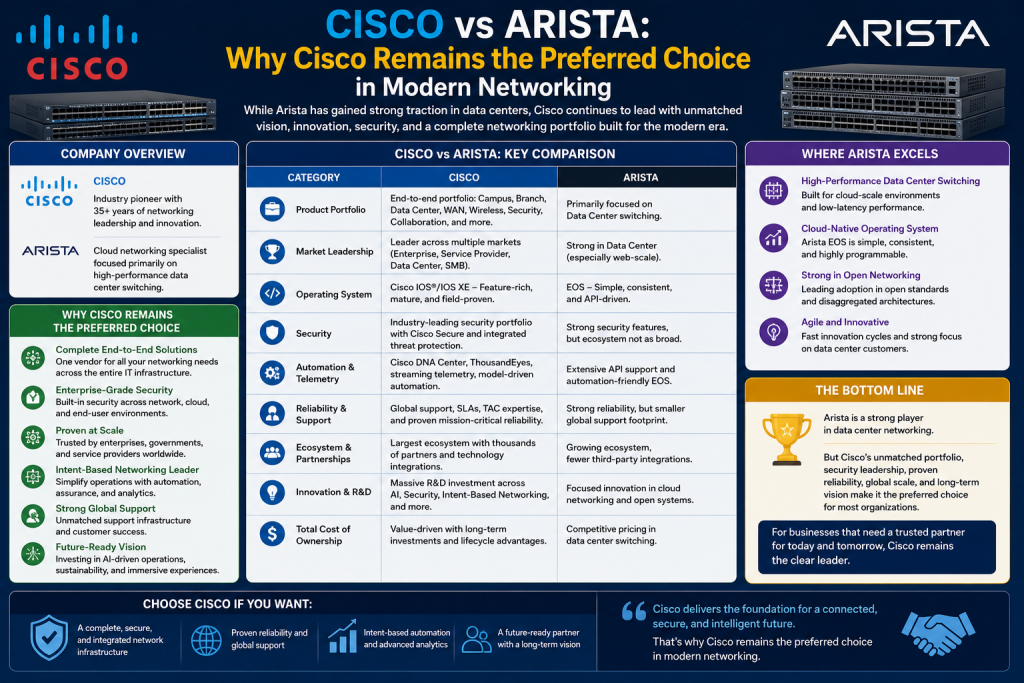
Cisco and Arista are two of the most recognized names in the networking industry. Both companies provide high-performance networking solutions, but they serve slightly different priorities and markets. Cisco is known for its wide ecosystem, enterprise-grade solutions, and global dominance, while Arista has built a strong reputation in high-speed data center and cloud networking environments.
Cisco has traditionally focused on delivering end-to-end networking infrastructure that supports organizations of all sizes, from small businesses to large global enterprises. Its portfolio includes routing, switching, wireless networking, collaboration tools, and advanced security solutions, all designed to work together within a unified ecosystem. This broad approach makes Cisco particularly attractive for organizations that want a single vendor to manage multiple layers of their IT infrastructure.
Arista, on the other hand, has taken a more specialized approach by concentrating heavily on high-performance networking for large-scale data centers and cloud providers. Its solutions are widely used in environments where speed, low latency, and scalability are critical. Arista’s strength lies in its simplicity, automation capabilities, and efficient operating system designed for modern cloud architectures.
One of the key differences between the two is ecosystem depth. Cisco offers a highly integrated environment with extensive hardware and software compatibility, along with strong security and management tools. This makes it suitable for enterprises that require a full-stack solution with unified support. Arista focuses more on performance optimization and programmability, which appeals to cloud-native companies and hyperscalers that prioritize agility and automation over a broad product suite.
In terms of support and adoption, Cisco benefits from a larger global user base, extensive documentation, and a vast pool of certified professionals, making implementation and troubleshooting easier in many regions. Arista, while smaller in scale, is highly respected in technical communities for its innovation in network operating systems and modern data center design.
Ultimately, both companies are strong in their respective domains, but their suitability depends on whether an organization values comprehensive enterprise networking or specialized high-performance cloud infrastructure.
Choosing between Cisco and Arista is not just about comparing products; it is about selecting a long-term networking strategy. This article explores why Cisco continues to be the preferred choice for most organizations despite Arista’s strong technical strengths in specific areas.
Cisco’s Market Leadership and Global Presence
Cisco’s dominance in the networking industry is not accidental. It has maintained its leadership position for decades due to continuous innovation, reliable hardware, and strong enterprise adoption. Cisco holds a significant share of the global enterprise networking market, making it one of the most widely deployed networking vendors in the world.
This large market presence creates a powerful advantage. Organizations choosing Cisco benefit from long-term product availability, consistent firmware updates, and widespread technical support. When companies invest in Cisco, they are investing in a stable ecosystem that is unlikely to become obsolete quickly.
Another key advantage of Cisco’s market leadership is the availability of skilled professionals. Because Cisco technologies are widely used, there is a large global workforce trained in Cisco systems, making hiring and troubleshooting significantly easier for organizations.
Continuous Innovation Through Strategic Acquisitions
One of Cisco’s strongest growth strategies is its focus on acquisitions. Over the years, Cisco has acquired numerous companies to expand its capabilities in cybersecurity, cloud computing, artificial intelligence, and network management.
These acquisitions allow Cisco to stay ahead of emerging technologies without building everything from scratch. For example, Cisco has strengthened its security and observability portfolio through strategic acquisitions that enhance threat detection, analytics, and system visibility.
This approach ensures that Cisco remains competitive in rapidly evolving fields such as AI-driven networking and cloud security. It also allows Cisco customers to access cutting-edge technologies integrated directly into the Cisco ecosystem rather than relying on third-party tools.
A Complete End-to-End Networking Ecosystem
One of Cisco’s biggest advantages over Arista is its comprehensive product ecosystem. Cisco offers a full range of networking solutions including routers, switches, wireless access points, collaboration tools, security systems, and cloud management platforms.
This end-to-end integration significantly reduces compatibility issues. When all networking components come from a single vendor, organizations experience fewer interoperability problems and more consistent performance across their infrastructure.
Cisco also provides unified management platforms that allow IT teams to monitor and control the entire network from a single interface. This simplifies network administration and reduces operational complexity, especially in large enterprise environments.
Arista, while highly efficient in data center switching, does not offer the same breadth of integrated solutions outside its core focus areas.
Cloud, Hybrid Cloud, and SD-WAN Capabilities
Cisco has made significant advancements in cloud and hybrid cloud networking. It supports all major cloud providers including AWS, Microsoft Azure, and Google Cloud, enabling seamless integration across multi-cloud environments.
One of Cisco’s most impactful technologies in this area is SD-WAN. It allows organizations to securely connect branch offices, remote workers, and cloud applications with optimized performance and centralized control.
Cisco also offers cloud security tools that protect data across distributed environments. These solutions ensure secure access regardless of where applications or users are located, making Cisco a strong choice for hybrid work environments.
Arista, on the other hand, focuses more on high-performance cloud data center switching, making it less versatile for organizations that require hybrid or multi-cloud networking solutions.
Strong Support System and Global Community
Cisco is widely recognized for its world-class technical support services. Its Technical Assistance Center (TAC) provides 24/7 global support, helping organizations resolve critical network issues quickly.
In addition to official support, Cisco has one of the largest and most active networking communities in the world. Engineers, administrators, and IT professionals regularly share knowledge, troubleshooting techniques, and best practices across forums and certification groups.
This strong community ecosystem ensures that solutions to common problems are easily accessible. It also reduces downtime, as network engineers can quickly find answers or guidance when issues arise.
Arista’s community is growing but is still smaller in comparison, which can make it harder to find detailed troubleshooting resources for niche issues.
Cisco Certifications and Career Opportunities
Another major advantage of Cisco is its globally recognized certification program. Cisco certifications such as CCNA, CCNP, and CCIE are considered industry standards in networking careers.
These certifications validate practical skills in networking, security, and infrastructure management. Because Cisco technologies are so widely used, professionals with Cisco certifications are highly sought after by employers around the world.
This creates a strong talent ecosystem where organizations can easily find skilled engineers, and professionals can build long-term careers in networking.
Arista also offers certifications, but they do not yet have the same global recognition or job market demand as Cisco certifications.
Advanced Security and Zero Trust Architecture
Security is a critical part of modern networking, and Cisco has heavily invested in this area. Cisco offers a wide range of security solutions designed to protect networks, endpoints, applications, and cloud environments.
One of Cisco’s key approaches is Zero Trust Architecture, which follows the principle of “never trust, always verify.” This model ensures that every user and device must be continuously authenticated and authorized before gaining access to resources.
Cisco also provides advanced tools such as multi-factor authentication, endpoint protection, threat intelligence, and cloud security platforms. These tools work together to create a layered defense system that protects against modern cyber threats.
Arista provides secure networking solutions, but Cisco’s broader security ecosystem makes it more suitable for organizations with complex security requirements.
Versatility Across Industries
Cisco’s solutions are used across nearly every industry, including healthcare, education, finance, government, and telecommunications. This versatility makes it a reliable choice for organizations of all sizes.
Small and medium-sized businesses benefit from Cisco’s cloud-managed solutions, while large enterprises use its advanced infrastructure for global operations. Cisco Meraki, for example, provides simplified network management for organizations that want scalable and easy-to-deploy networking solutions.
Arista is highly effective in data center environments but is less commonly used in industries that require broad networking capabilities beyond high-performance switching.
Cisco vs Arista: Key Difference in Strategy
The main difference between Cisco and Arista lies in their strategic focus. Cisco aims to be a complete networking and security provider, offering solutions for every layer of IT infrastructure.
Arista focuses primarily on high-speed, low-latency networking for cloud and data center environments. While this makes Arista excellent in its niche, it limits its versatility compared to Cisco.
Organizations that require a complete, scalable, and future-proof networking solution often prefer Cisco because it reduces vendor complexity and improves long-term operational efficiency.
Future Outlook of Cisco in Networking
Cisco continues to evolve with emerging technologies such as artificial intelligence, automation, and intent-based networking. These innovations aim to make networks more intelligent, self-healing, and easier to manage.
As businesses continue to adopt hybrid work models and cloud-first strategies, Cisco’s integrated approach positions it strongly for the future. Its ability to adapt to changing technology trends ensures that it will remain a dominant force in the networking industry.
Conclusion
Cisco and Arista both offer powerful networking solutions, but they serve different purposes. Arista excels in high-performance data center and cloud networking environments, while Cisco provides a complete, enterprise-wide networking ecosystem.
For most organizations, Cisco remains the preferred choice due to its market leadership, extensive product range, strong security capabilities, global support, and widely recognized certifications. Its ability to deliver end-to-end solutions makes it a more flexible and future-ready option.
While Arista is an excellent choice for specialized environments, Cisco’s versatility, innovation, and global ecosystem make it the stronger overall solution for modern enterprise networking needs.
Continue exploring the technologies and certification concepts that matter most to you.