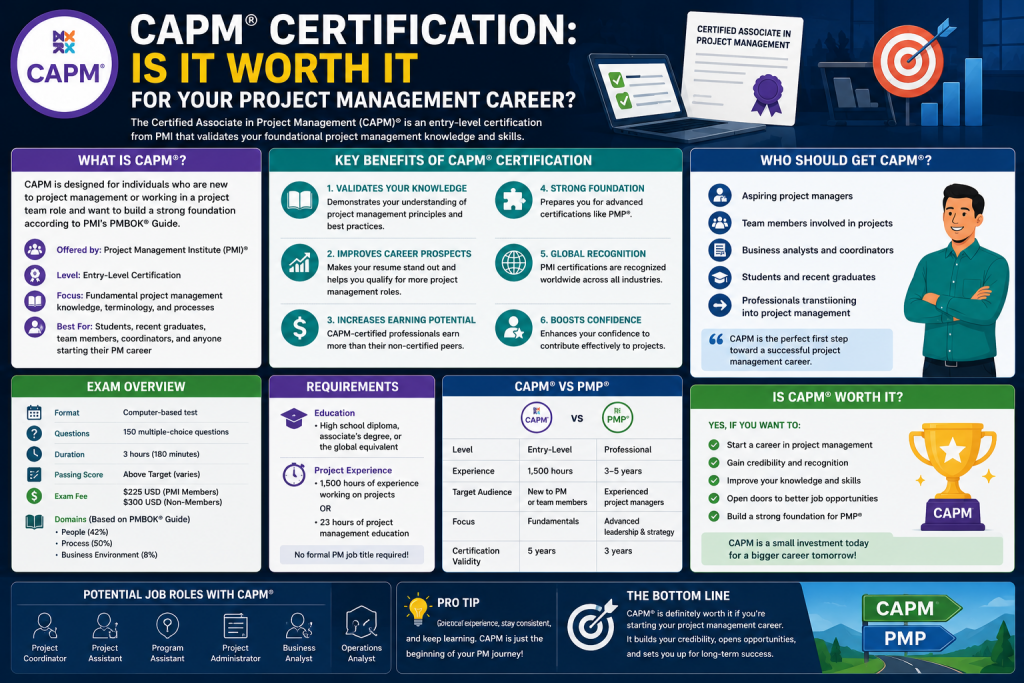
The Certified Associate in Project Management (CAPM®) certification, offered by the Project Management Institute (PMI®), is widely recognized as one of the most accessible entry points into the project management profession. It is designed for individuals who are new to the field and want to build a strong foundation in project management principles, terminology, and structured processes.
In an increasingly competitive job market, especially in IT and business operations, certifications often play an important role in helping candidates stand out. However, many professionals still question whether the CAPM certification is truly worth the investment of time, money, and effort.
This expanded guide explores what the CAPM is, who should consider it, what benefits it offers, its limitations, and whether it is a smart career move in 2026 and beyond.
What Is the CAPM Certification?
The CAPM certification is a globally recognized credential that validates foundational knowledge in project management. It is based on PMI’s Project Management Body of Knowledge (PMBOK® Guide), which defines standard practices used across industries worldwide.
In addition to providing a structured understanding of project management principles, the CAPM certification helps candidates become familiar with the language, processes, and frameworks that are commonly used in professional environments. This is especially important for individuals who are new to the field, as project management has its own terminology that can be difficult to understand without formal training. By studying the PMBOK® Guide, candidates learn how projects are initiated, planned, executed, monitored, and closed in a systematic way.
The certification also introduces important concepts such as stakeholder communication, risk management, quality control, and resource allocation. These areas are essential for ensuring that projects are completed successfully within scope, time, and budget constraints. Even though CAPM is an entry-level certification, it provides a strong theoretical base that prepares individuals for more advanced roles in the future.
Another key benefit is that it aligns candidates with globally accepted project management standards. This means the knowledge gained is not limited to one industry or region but can be applied in IT, construction, healthcare, finance, and many other sectors.
Unlike advanced certifications such as PMP, CAPM does not require extensive professional experience. Instead, it focuses on theoretical understanding and structured learning.
The certification is designed to ensure that candidates understand:
Basic project lifecycle stages
Core project management terminology
Fundamental frameworks and methodologies
Introductory concepts of agile and predictive approaches
This makes it especially valuable for individuals who are new to structured project environments.
Who Should Consider CAPM?
The CAPM certification is not intended for senior project managers or experienced professionals. Instead, it is best suited for individuals who are at the beginning of their project management journey.
It is especially useful for:
Recent graduates entering the workforce
Career changers moving into IT or business roles
Entry-level employees working in project teams
Administrative staff supporting project activities
Professionals planning to pursue PMP in the future
For experienced project managers, CAPM may not provide significant added value, but for beginners, it can serve as a strong professional foundation.
Eligibility Requirements for CAPM
One of the key advantages of CAPM is its low entry barrier compared to other PMI certifications.
To qualify for the exam, candidates must have:
A secondary degree such as a high school diploma or equivalent
23 hours of project management education completed before the exam
These training hours can be obtained through online courses, training providers, or PMI-approved education programs.
Unlike PMP, there is no requirement for documented project leadership experience, making CAPM highly accessible to beginners.
What You Learn in CAPM
The CAPM certification is structured around PMI’s standardized framework for managing projects. It introduces candidates to essential concepts used in real-world project environments.
Key topics include:
Project initiation, planning, execution, monitoring, and closing
Scope, time, cost, and quality management
Risk identification and mitigation
Stakeholder communication and engagement
Resource and team coordination
Introduction to agile methodologies
Project documentation and reporting systems
The focus is on building awareness of how projects are structured rather than managing them independently.
CAPM Exam Structure
The CAPM exam is designed to test conceptual understanding rather than hands-on experience.
Exam details include:
150 multiple-choice questions
180 minutes total duration
Computer-based testing format
Online proctored or test center option
Approximately $225–$300 exam fee depending on PMI membership
Although the exam is considered entry-level, it still requires serious preparation due to the depth of terminology and frameworks involved.
Difficulty Level of the CAPM Exam
Many candidates underestimate the CAPM exam because it is labeled as entry-level. However, the difficulty lies in the volume of concepts and unfamiliar terminology.
Challenges include:
Memorizing PMI-specific terminology
Understanding process groups and knowledge areas
Applying theoretical concepts to scenario-based questions
Managing time effectively during the exam
With proper study and consistent practice, most candidates are able to pass successfully, but it is not an exam that can be approached casually.
Career Opportunities After CAPM
The CAPM certification can open doors to several entry-level roles in project environments. While it does not guarantee employment, it can significantly improve a candidate’s visibility to employers.
Common job roles include:
Project Coordinator
Junior Project Manager
Project Support Specialist
IT Project Assistant
Operations Coordinator
These roles often serve as stepping stones toward more advanced positions in project management.
In industries such as IT, construction, healthcare, and finance, CAPM can help candidates transition into structured project roles more easily.
Salary Expectations for CAPM Holders
Salary outcomes for CAPM-certified professionals vary widely depending on experience, location, and industry.
Typical ranges include:
Entry-level roles: around $45,000 per year
Mid-level support roles: $60,000–$80,000 per year
Experienced professionals in project environments: $90,000+
It is important to understand that CAPM itself does not directly guarantee a high salary. Instead, it enhances employability and supports career progression over time.
Benefits of CAPM Certification
The CAPM certification offers several important advantages for beginners entering the project management field.
Key benefits include:
Strong foundational knowledge of project management
Globally recognized certification from PMI
Improved job market competitiveness
Better understanding of structured project workflows
Preparation for advanced certifications like PMP
Increased confidence when working in project teams
For many individuals, CAPM serves as the first step toward a long-term career in project management.
Limitations of CAPM
While CAPM has many advantages, it is not suitable for everyone.
Some limitations include:
No requirement for real-world project experience validation
Limited recognition compared to PMP in senior roles
Minimal impact on salary alone
Requires renewal through continuing education every three years
Less valuable for experienced professionals
Because of these limitations, CAPM should be viewed as a starting point rather than a final career goal.
CAPM vs PMP
CAPM and PMP are often compared, but they serve very different purposes.
CAPM is designed for beginners who are learning project management fundamentals. It focuses on knowledge and understanding.
PMP is designed for experienced professionals who have already managed real projects and demonstrated leadership capabilities.
In simple terms:
CAPM builds foundational knowledge
PMP validates professional experience and leadership ability
Many professionals use CAPM as a stepping stone toward PMP certification later in their careers.
Is CAPM Worth It?
The value of CAPM depends on individual career goals, experience level, and industry needs.
CAPM is worth it if:
You are new to project management
You want to enter IT or business operations roles
You need structured knowledge of project processes
You plan to pursue PMP in the future
CAPM may not be worth it if:
You already have significant project management experience
You are seeking immediate salary growth
Your employer does not value certifications
You are already working in senior project roles
In most cases, CAPM is more valuable as a long-term career investment rather than a short-term financial benefit.
Preparation Tips for CAPM
Success in the CAPM exam depends on structured and consistent preparation.
Effective strategies include:
Studying the PMBOK Guide thoroughly
Completing structured online training courses
Practicing mock exams regularly
Using flashcards for key terminology
Joining study groups or online forums
Focusing on understanding concepts rather than memorization
A disciplined study plan significantly increases the chances of passing the exam on the first attempt.
Future Value of CAPM
As organizations increasingly adopt structured project management practices, certifications like CAPM continue to gain relevance.
In 2026 and beyond, industries such as IT, construction, healthcare, and business services are expected to rely even more on project-based work. This trend increases demand for professionals who understand structured methodologies.
CAPM helps individuals build a foundation that supports long-term career growth in these evolving industries.
Conclusion
The Certified Associate in Project Management (CAPM) certification is a strong entry-level credential for individuals who want to begin a career in project management. It provides essential knowledge, global recognition, and a structured pathway into more advanced certifications like PMP.
While it may not deliver immediate high salaries or senior roles, its real value lies in building a strong foundation and improving long-term career prospects.
For students, career changers, and beginners, CAPM can be a smart and strategic first step into the world of project management. Ultimately, whether it is worth it depends on your goals, but for many, it serves as the beginning of a rewarding professional journey.
Continue exploring the technologies and certification concepts that matter most to you.