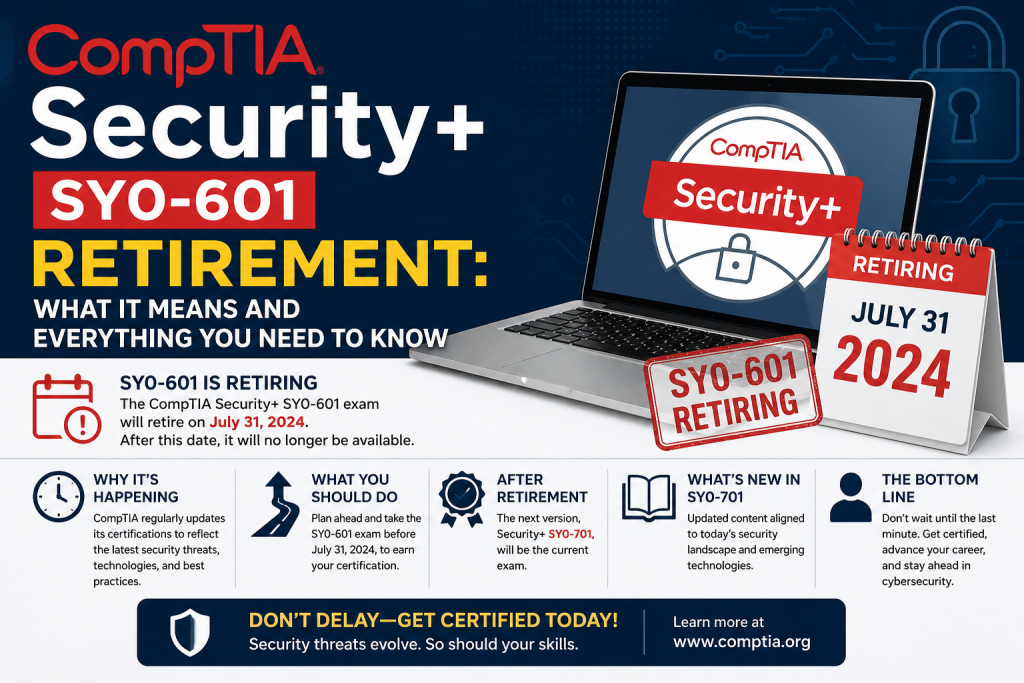
CompTIA retired Security+ SY0-601 on July 31, 2024. That exam is no longer a booking option, even though articles written during the transition still advise students to finish their SY0-601 preparation before retirement. The underlying Security+ certification continues, but exam objectives change with each version. In October 2026, Security+ SY0-701 remains available and a new version, SY0-801, is expected to launch in November. Those are two separate transitions, and mixing their dates or domain weights can send candidates toward the wrong materials.
This comparison explains what changed when SY0-701 replaced SY0-601, what knowledge still transfers from older courses, and how to decide which current or upcoming exam matches your real test date. Exam-version planning matters, but passing a security exam also requires the ability to apply technical controls, interpret evidence and explain the consequences of a security decision.
Security+ moved from SY0-601 to SY0-701 in 2023–24
SY0-701 launched on November 7, 2023, while SY0-601 continued through July 2024. Both examinations validated foundational cybersecurity knowledge. Threats, cryptographic protections, access control, security design, incident response and organizational governance were important in both. The change was not from an abstract, theory-only exam to an entirely practical one. Rather, CompTIA reorganized topics and updated its emphasis to reflect work in cloud, hybrid and more automated security environments.
CompTIA’s published comparison explains that the newer blueprint reduced the number of numbered objectives while reclassifying the responsibility areas. The standalone Implementation domain of SY0-601 no longer appears under that name. Some of its content is reflected in security architecture and operations. A learner who searches only for identical headings might assume a topic vanished when it actually moved into a different administrative or operational context.
That means version-specific study planning requires more than copying an old course outline. A good migration method is to mark the historical lesson’s actual concepts, identify whether they still appear within the current official objective wording, and then verify product-specific instructions against contemporary technical references.
Domain weights changed substantially
SY0-601 and SY0-701 both have five domains, but they use different names and weights. The following columns show the two complete blueprints side by side, each in its own official order. Do not interpret each row as a perfect subject-to-subject replacement; some former objectives were redistributed between several new domains.
| SY0-601 (retired) | Weight | SY0-701 (V7) | Weight |
|---|---|---|---|
| Attacks, Threats and Vulnerabilities | 24% | General Security Concepts | 12% |
| Architecture and Design | 21% | Threats, Vulnerabilities and Mitigations | 22% |
| Implementation | 25% | Security Architecture | 18% |
| Operations and Incident Response | 16% | Security Operations | 28% |
| Governance, Risk and Compliance | 14% | Security Program Management and Oversight | 20% |
Security Operations now carries the largest SY0-701 weight, 28%. It covers areas such as monitoring, alert interpretation, incident response, identity operations, vulnerability management and the execution of security processes. Security Program Management and Oversight also demands attention to risk decisions, third parties, auditing and awareness. None of this means the other domains can be ignored: architecture, threat behavior and core principles remain necessary to understand operational situations.
These published weights describe the exam blueprint, not an exact number of scored questions from each domain on a particular sitting. A scenario about an exposed cloud service could involve architectural design, an identity error, a known vulnerability and an operational response at the same time.
What older Security+ courses still teach well
Encryption, hashing, digital signatures, certificate trust, least privilege, network segmentation, malware behavior, risk assessment and incident lifecycle concepts are not obsolete simply because an exam code retired. When a course explains why an attacker might exploit a misconfigured service or how a signature helps establish integrity, that principle can remain useful for SY0-701 candidates. Foundational learning is transferable when the explanation is technically accurate.
But products and recommended configurations change. A lab showing a legacy perimeter appliance may not cover how private cloud connections, federated identities or mobile endpoints alter the problem. An archived screenshot may describe controls differently from their current software interface. An old question bank may omit newer emphasis or overweight retired objectives. Treat such material as supplementary background, not as the complete test blueprint.
It is useful to connect each concept to a realistic decision. A SIEM is not merely a place where logs appear; a team must decide which signals are important, which anomalies need investigation and which evidence must be retained. An access-control policy is not simply a list of role names; it should reflect who requires which capability and how that access is reviewed. Current security operations and identity and access control examples help turn older vocabulary into modern judgment.
SY0-701 and the approaching SY0-801 launch
As of October 12, 2026, SY0-701 remains an active Security+ option. The published V7 retirement schedule lists June 11, 2027 for English, with August 13, 2027 for Japanese, Portuguese, Spanish and Thai. Security+ V8 (SY0-801) has been described for a launch on or around November 17, 2026. Because that launch is still in the future, verify current availability, version details and retirement policy with CompTIA when you register.
The V8 objectives retain several familiar subject families but alter the domain weights and explicitly discuss newer areas such as AI-related security threats. A resource prepared for V8 should not silently substitute its domain allocation for the SY0-701 allocation above. Likewise, a learner halfway through sound SY0-701 preparation need not assume the existing exam becomes unavailable immediately on the expected V8 release date.
Version and certification validity should be kept separate. Passing an active exam earns the Security+ certification rather than a special version-labelled credential. Security+ currently carries a three-year validity period, with renewal options governed by CompTIA’s continuing-education requirements. A new examination version does not automatically cancel an individual’s recently earned certification.
Choose the exam version using your intended test date
If you can realistically prepare and schedule SY0-701 before its announced retirement, using well-aligned SY0-701 resources may be the most efficient path. If you have not started learning and expect to test well into the next cycle, review SY0-801 objectives and available training before choosing. The exam code on your registration and the objective version used by your primary learning resources should match; otherwise, you may spend weeks mastering outdated emphasis while leaving current topics unattended.
Language availability also matters. Different language versions can have different published retirement dates, and V8’s initial availability may not match every language supported by V7. Always confirm your exact booking conditions rather than making a decision based on an English-language headline alone. Do not rely on an old voucher price as a universal current cost, because regional fees and policies may change.
The SY0-701 exam plan explains the active blueprint and readiness approach. When comparing versions, use CompTIA’s current objectives as the official content inventory and the commercial exam listing only for exam-specific preparation and practice options.
Build transferable security judgment
One practice scenario might involve suspicious sign-ins followed by access to confidential data. You need to identify possible identity compromise, what logs or alerts can confirm the timeline, which containment action limits harm and how that action might disrupt approved work. The correct next step depends on evidence and authority. Simply recognizing the words “phishing,” “MFA” and “SIEM” does not settle the incident.
Another scenario may involve an unpatched network appliance. The team needs to assess exploitability and exposure, plan a mitigation, consider whether the device can be isolated or replaced, and document risk ownership while remediation is pending. A scanner finding is evidence of a vulnerability, not a completed mitigation or a business-approved risk decision. The vulnerability and mitigation material provides practical examples.
For architecture, consider whether a sensitive service should be protected by an application-layer control, network segmentation, stronger identities or some combination of them. A network firewall cannot replace data permissions. Encryption at rest does not guarantee that a management interface is secure. A restore plan is incomplete if nobody has tested recovering the application dependencies. These reasoning habits will remain useful even when the exam’s labels change.
For current SY0-701 planning, the established exam format also matters: CompTIA lists a maximum of 90 multiple-choice and performance-based questions within 90 minutes, with a passing score of 750 on a 100–900 scale. The maximum is not a guaranteed number of items on your particular sitting. Practising how to interpret a question, decide what evidence is missing and eliminate unsuitable options is therefore more useful than memorizing a supposed exact question allocation from an older course.
Keep a dated version checklist with three lines: the code you are booked to take, the official objectives matching that code and the retirement or availability information confirmed at registration. If a study resource contradicts those details, resolve the difference before using it as your main syllabus. This habit becomes increasingly important during periods when two active versions overlap.
Use historical materials deliberately
SY0-601 deserves its place in Security+ history, and good technical instruction from that era may still strengthen fundamentals. But its retired exam schedule, outdated objective weights and older product instructions should not be presented as current SY0-701 facts. The planned V8 version is also a separate future transition whose scheduling and final scope should be rechecked before an exam purchase.
Make one clear decision: which exam code will you actually sit? Then check the current official objectives, work through meaningful operational scenarios, and use practice results to find missing understanding. This protects the value of older learning without mistaking an archived certification article for today’s registration instructions.
Continue exploring the technologies and certification concepts that matter most to you.