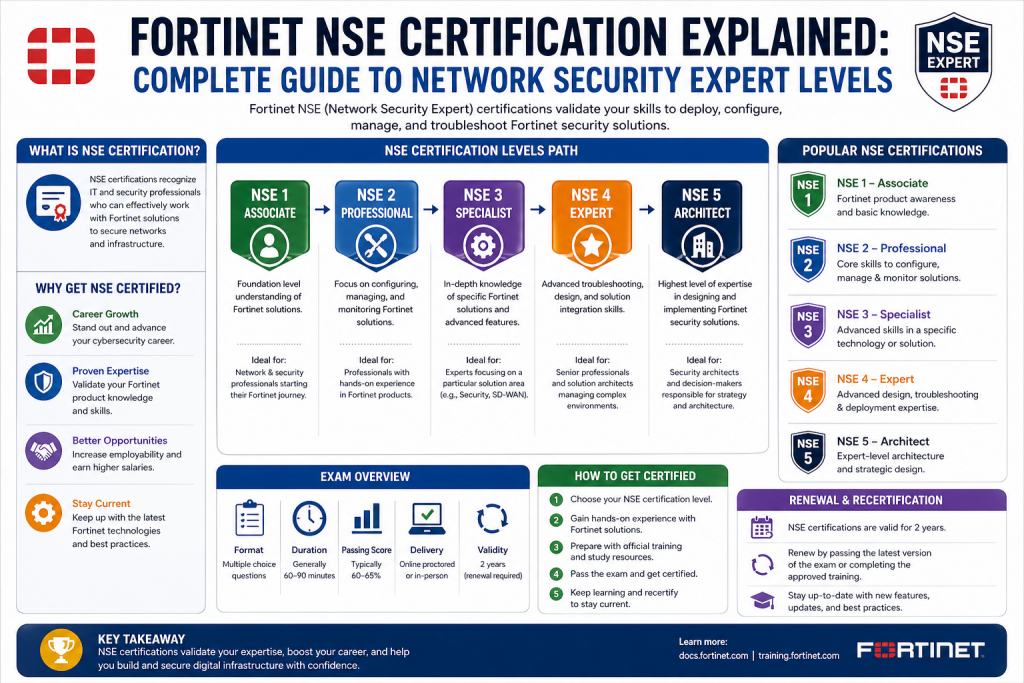
The cybersecurity industry continues to expand at an unprecedented pace as organizations around the world face increasingly complex and persistent threats. With digital transformation accelerating across every sector, the need for skilled cybersecurity professionals has never been greater. In this environment, certifications play a critical role in validating expertise, demonstrating practical skills, and helping professionals stand out in a competitive job market.
One of the most recognized certification pathways in the cybersecurity field is the Fortinet Network Security Expert program. This program has gained global recognition for its structured approach to skill development and its strong alignment with real-world job roles. As of 2026, the certification framework has been refined to provide a clearer and more practical roadmap for learners at all stages of their careers.
The Fortinet NSE program is designed to guide individuals from basic cybersecurity awareness to advanced technical mastery. It offers a progressive learning path that ensures candidates build a strong foundation before moving on to more complex concepts and responsibilities. Whether someone is just starting out in IT or is already an experienced security professional, the program provides a clear direction for growth and specialization.
Evolution of the NSE Certification Structure
Over the years, the NSE certification program has undergone several updates to keep pace with industry changes and technological advancements. One of the most notable changes leading into 2026 was the reintroduction of the NSE levels from 1 through 8 as the core structure of the program. While earlier versions emphasized role-based certifications, the updated model combines both approaches to create a more intuitive system.
This evolution was driven by the need to simplify the certification pathway while still maintaining its depth and flexibility. By restoring the familiar level-based progression, Fortinet has made it easier for candidates to understand where they are in their journey and what steps they need to take next. At the same time, the addition of certification designations tied to job roles ensures that each level has practical relevance in the workplace.
The updated framework reflects a broader shift in the cybersecurity industry toward skills-based learning. Employers are no longer just looking for theoretical knowledge; they want professionals who can apply their skills in real-world scenarios. The NSE program addresses this need by focusing on practical competencies and hands-on experience.
Overview of the NSE Levels and Certification Designations
The Fortinet NSE program is organized into eight levels, each representing a different stage of professional development. These levels are grouped into five main certification designations, which help align the program with specific job roles and career paths.
The first designation is Fortinet Certified Fundamentals, which includes NSE 1 and NSE 2. These levels are focused on building foundational knowledge and are ideal for beginners or individuals exploring cybersecurity for the first time. They provide an introduction to key concepts such as threat landscapes, security principles, and basic networking ideas.
The next stage is the Fortinet Certified Associate, aligned with NSE 3. At this level, candidates gain a broader understanding of Fortinet products and how they are used in real-world environments. This stage is particularly useful for IT professionals who interact with security solutions but may not yet be deeply involved in technical implementation.
The Fortinet Certified Professional designation includes NSE 4 and NSE 5. These levels represent a significant step into technical expertise. Candidates are expected to demonstrate their ability to configure, manage, and analyze network security systems. The skills gained here are directly applicable to roles such as network security engineers and analysts.
Beyond this is the Fortinet Certified Solution Specialist designation, which covers NSE 6 and NSE 7. These levels focus on advanced technologies and specialized domains within the Fortinet ecosystem. Professionals at this stage are typically responsible for designing and implementing complex security solutions.
The final designation is Fortinet Certified Expert, associated with NSE 8. This is the highest level of certification and is intended for experienced professionals who can design, troubleshoot, and optimize large-scale security infrastructures.
Progressive Learning and Skill Development
One of the defining features of the NSE certification program is its emphasis on progressive learning. Each level builds upon the knowledge and skills acquired in previous stages, creating a structured pathway that supports continuous development. This approach ensures that candidates do not just memorize information but truly understand how to apply it in practical situations.
At the foundational levels, the focus is on awareness and basic concepts. Candidates learn about the importance of cybersecurity, common threats, and the role of security technologies in protecting digital assets. As they move to higher levels, the emphasis shifts toward technical skills, including configuration, troubleshooting, and system management.
By the time candidates reach the advanced levels, they are expected to have a deep understanding of both theory and practice. They must be able to design complex security architectures, analyze threats, and implement effective solutions. This progression mirrors the real-world career path of cybersecurity professionals, making the program highly relevant and practical.
Another important aspect of this learning model is the integration of hands-on experience. Many of the certifications require candidates to demonstrate their ability to work with actual systems and tools. This ensures that they are prepared to handle real-world challenges and can contribute effectively in professional environments.
Flexibility in the Certification Path
While the NSE program is structured as a progression from level 1 to level 8, it also offers a degree of flexibility. Candidates are not strictly required to complete every level before moving on to more advanced certifications. This allows experienced professionals to focus on the areas that are most relevant to their roles and career goals.
For example, someone with a strong background in networking and security may choose to start at a higher level, such as NSE 4. On the other hand, beginners may prefer to follow the full progression to build a solid foundation. This flexibility makes the program accessible to a wide range of learners, from students to seasoned professionals.
However, it is generally recommended that candidates follow the progression, especially if they are new to cybersecurity. Each level provides important knowledge that supports success in the next stage. Skipping levels without the necessary background can make it more difficult to understand advanced concepts.
The ability to customize the learning path is one of the reasons why the NSE program is so widely adopted. It allows individuals to tailor their certification journey to their unique needs and circumstances while still benefiting from a structured framework.
Real-World Relevance and Industry Demand
The cybersecurity landscape is constantly evolving, with new threats and technologies emerging on a regular basis. In this dynamic environment, certifications must be closely aligned with real-world requirements to remain valuable. The NSE program addresses this by focusing on practical skills and industry-relevant knowledge.
Each certification is designed to reflect the responsibilities of specific job roles. This ensures that candidates are not only prepared to pass exams but are also capable of performing effectively in their positions. For employers, this alignment provides confidence that certified professionals have the skills needed to protect their systems and data.
The demand for cybersecurity professionals continues to grow globally, and this trend is expected to continue in the coming years. Organizations across all industries are investing heavily in security, creating a wide range of opportunities for skilled individuals. Certifications like NSE help bridge the gap between education and employment by providing a recognized standard of competence.
In addition to technical skills, the program also emphasizes broader concepts such as risk management, threat intelligence, and strategic planning. These skills are increasingly important as cybersecurity becomes a critical component of business operations. Professionals who understand both the technical and strategic aspects of security are highly valued in the job market.
Benefits of Pursuing NSE Certification
There are several benefits to pursuing certification within the Fortinet NSE program. One of the most significant is the ability to validate skills and knowledge. In a field where practical expertise is essential, having a recognized certification can make a strong impression on employers and colleagues.
Another benefit is career advancement. As candidates progress through the levels, they gain new skills and qualifications that can open doors to higher-level roles. This can lead to increased responsibilities, greater job satisfaction, and higher earning potential.
The program also supports continuous learning. Cybersecurity is a rapidly changing field, and professionals must stay updated with the latest developments to remain effective. The NSE pathway encourages ongoing education and skill development, helping individuals stay ahead of industry trends.
Networking opportunities are another advantage. Being part of a globally recognized certification program connects professionals with a broader community of learners and experts. This can lead to valuable connections, knowledge sharing, and career opportunities.
Finally, the structured nature of the program provides a clear roadmap for growth. Instead of navigating the vast field of cybersecurity without direction, candidates can follow a defined path that guides them from beginner to expert. This clarity is especially helpful for those who are new to the industry or considering a career change.
Building a Strong Foundation in Cybersecurity
The early stages of the Fortinet NSE certification program are designed to introduce learners to the essential concepts of cybersecurity while gradually preparing them for more technical responsibilities. These foundational levels play a critical role in shaping how individuals understand security, threats, and the technologies used to protect digital environments. Rather than overwhelming learners with complex configurations or advanced tools, the program begins with a focus on awareness, clarity, and structured learning.
Cybersecurity is a broad field that combines technical knowledge, analytical thinking, and strategic awareness. For beginners, this can feel overwhelming. The first few levels of the NSE pathway are intentionally designed to simplify this complexity. They provide a clear entry point for individuals who may have little to no prior experience in cybersecurity or even in information technology.
At this stage, the emphasis is not just on learning definitions or memorizing concepts. Instead, the goal is to develop a mindset that prioritizes security awareness. Learners begin to understand how cyber threats impact organizations and individuals, why security measures are necessary, and how different components of a secure system work together. This foundational understanding becomes the backbone for all future learning.
NSE 1 Introduction to Cybersecurity Fundamentals
NSE 1 serves as the starting point for the entire certification journey. It introduces learners to the basic principles of cybersecurity in a way that is accessible and easy to understand. This level is particularly suitable for students, beginners, and professionals from non-technical backgrounds who want to gain insight into the world of cybersecurity.
The content covered in NSE 1 focuses on the threat landscape. Learners explore different types of cyber threats, including malware, phishing attacks, ransomware, and social engineering tactics. These topics are explained in a practical context, helping individuals recognize how such threats appear in real life and how they can affect both individuals and organizations.
Another important aspect of NSE 1 is the introduction to core security principles. Concepts such as confidentiality, integrity, and availability are explained as the foundation of all cybersecurity practices. These principles help learners understand the goals of security systems and why certain measures are implemented.
NSE 1 also highlights the importance of user awareness. Many cyber incidents occur not because of technical failures but due to human error. By educating individuals about safe online behavior, password management, and recognizing suspicious activity, this level helps reduce the risk of common attacks.
One of the strengths of NSE 1 is its simplicity. It does not require prior technical knowledge, making it accessible to a wide audience. At the same time, it provides valuable insights that are relevant to anyone who uses digital technology. Completing this level gives learners a sense of confidence and prepares them for more advanced topics.
NSE 2 Technical Introduction to Cybersecurity
After completing the introductory level, learners move on to NSE 2, which builds on the concepts introduced earlier while adding a technical perspective. This level acts as a bridge between general awareness and practical understanding. It begins to explore how cybersecurity works behind the scenes.
In NSE 2, learners are introduced to basic networking concepts. Understanding how networks function is essential for cybersecurity because most threats target network infrastructure. Topics such as IP addressing, data transmission, and network protocols are explained in a simplified manner, allowing learners to grasp their importance without getting lost in technical details.
The level also introduces key security technologies. Learners gain an overview of firewalls, antivirus systems, intrusion detection systems, and other tools used to protect networks. While the focus is not on configuration or deployment, it helps learners understand what these tools do and how they contribute to a secure environment.
Another important component of NSE 2 is the introduction to the Fortinet ecosystem. Learners become familiar with the range of solutions offered and how they are used to address different security challenges. This exposure is valuable for understanding how modern security infrastructures are built and managed.
NSE 2 also emphasizes the relationship between different security layers. Instead of viewing security as a single solution, learners begin to see it as a combination of multiple components working together. This layered approach is a key concept in cybersecurity and is essential for building effective defenses.
By the end of NSE 2, learners have a clearer understanding of how cybersecurity operates in practice. They are better equipped to connect theoretical concepts with real-world applications, making it easier to transition into more advanced levels.
Transition from Awareness to Practical Knowledge
The progression from NSE 1 to NSE 2 represents an important shift in learning. While the first level focuses on awareness, the second level introduces practical understanding. This transition is carefully designed to ensure that learners are not overwhelmed while still being challenged to expand their knowledge.
At this stage, learners begin to think more critically about security. They start asking questions about how systems are protected, how attacks are detected, and how organizations respond to incidents. This curiosity is essential for developing problem-solving skills, which are crucial in cybersecurity roles.
The program also encourages learners to explore beyond the course material. By gaining a basic understanding of concepts, individuals are better prepared to engage with additional resources, such as labs, simulations, and real-world scenarios. This self-driven learning approach helps reinforce knowledge and build confidence.
Another important aspect of this transition is the development of technical vocabulary. Understanding the language of cybersecurity is essential for effective communication. As learners progress through these levels, they become more comfortable with industry terms and concepts, which prepares them for professional environments.
NSE 3 Fortinet Associate Knowledge
NSE 3 marks the transition to the associate level and represents a significant step forward in the certification journey. At this stage, learners move beyond basic concepts and begin to explore how cybersecurity solutions are applied in real-world environments. This level is aligned with the Fortinet Certified Associate designation and is particularly relevant for IT professionals.
The focus of NSE 3 is on understanding Fortinet products and their role in network security. Learners are introduced to key features, functionalities, and use cases. Instead of diving into detailed configurations, the emphasis is on understanding how these solutions address specific security challenges.
One of the key benefits of NSE 3 is its practical orientation. Learners gain insight into how organizations use security technologies to protect their networks, manage threats, and ensure compliance. This real-world perspective is valuable for individuals who want to work in IT or cybersecurity roles.
NSE 3 also helps learners understand the broader context of security within an organization. It explores how different teams collaborate to maintain security, how policies are implemented, and how incidents are managed. This holistic view is important for understanding the role of cybersecurity in business operations.
Another important aspect of this level is the introduction to deployment scenarios. Learners explore how security solutions are implemented in different environments, such as small businesses, large enterprises, and cloud-based systems. This exposure helps them understand the flexibility and scalability of modern security technologies.
Skills Developed in the Early NSE Levels
The foundational and associate levels of the NSE program are designed to develop a wide range of skills that are essential for success in cybersecurity. These skills go beyond technical knowledge and include critical thinking, problem-solving, and communication.
One of the key skills developed at this stage is threat awareness. Learners become more aware of the types of threats that exist and how they can be identified. This awareness is crucial for preventing attacks and responding effectively when incidents occur.
Another important skill is analytical thinking. Cybersecurity often involves analyzing data, identifying patterns, and making informed decisions. The early levels introduce these concepts in a simplified manner, preparing learners for more advanced analysis in later stages.
Communication skills are also emphasized. Being able to explain security concepts to non-technical stakeholders is an important part of many cybersecurity roles. By developing a clear understanding of fundamental concepts, learners are better equipped to communicate effectively.
Technical familiarity is another outcome of these levels. While learners may not yet be experts, they gain enough knowledge to understand how systems work and how they can be protected. This familiarity provides a strong foundation for further technical training.
Career Opportunities After Completing Early Levels
Completing NSE 1 through NSE 3 can open the door to entry-level opportunities in cybersecurity and IT. While these certifications alone may not qualify someone for advanced roles, they demonstrate a commitment to learning and a basic understanding of security concepts.
Common roles for individuals at this stage include security support specialist, IT support technician, and junior network administrator. These positions provide valuable hands-on experience and serve as a stepping stone to more advanced roles.
Employers often value candidates who have completed these certifications because they show initiative and a willingness to learn. Even for non-technical roles, having a basic understanding of cybersecurity can be a significant advantage.
For students and career changers, these certifications provide a clear pathway into the industry. They help individuals build confidence and gain the knowledge needed to pursue further training and certifications.
Importance of a Strong Foundation
In cybersecurity, a strong foundation is essential for long-term success. The field is constantly evolving, and professionals must be able to adapt to new challenges and technologies. By starting with a solid understanding of fundamental concepts, learners are better prepared to להתמודד these changes.
The early levels of the NSE program ensure that candidates develop this foundation. They provide the knowledge and skills needed to understand more advanced topics and to apply them effectively in real-world situations.
Skipping foundational learning can lead to gaps in knowledge that become problematic later on. By taking the time to build a strong base, learners can progress more confidently and achieve better outcomes in their careers.
Preparing for the Next Stage
After completing the foundational and associate levels, learners are well-prepared to move on to the professional certifications. They have developed a solid understanding of cybersecurity concepts, gained familiarity with security technologies, and built the skills needed for further learning.
The next stage of the NSE program focuses on hands-on technical skills, including configuration, management, and analysis. These levels require a deeper understanding of systems and a greater level of responsibility.
By successfully completing the early stages, learners have already taken an important step toward becoming cybersecurity professionals. They are now ready to build on this foundation and continue their journey toward advanced expertise.
Advancing Beyond the Fundamentals
After completing the foundational and associate levels of the Fortinet NSE certification program, learners enter a phase where technical expertise becomes the primary focus. This stage is where theory meets real-world application, and candidates are expected to demonstrate their ability to work with actual security systems, solve problems, and manage complex environments.
The transition into the professional and advanced levels is significant. It requires not only a solid understanding of cybersecurity concepts but also the ability to apply that knowledge in practical scenarios. At this point, learners are no longer just studying cybersecurity; they are actively developing the skills needed to perform in professional roles.
The certifications in this stage are designed to align closely with job responsibilities. Each level focuses on specific competencies that are directly relevant to real-world tasks such as configuring firewalls, analyzing network traffic, managing security infrastructure, and designing secure architectures. This alignment ensures that candidates are well-prepared for the demands of the cybersecurity industry.
NSE 4 Network Security Professional
NSE 4 marks the beginning of the professional level and is one of the most important certifications in the entire program. It focuses on network security and is centered around the configuration and management of FortiGate devices. This level is often considered the entry point for hands-on cybersecurity roles.
At this stage, candidates learn how to implement and manage security policies. They gain practical experience in controlling network traffic, configuring firewall rules, and ensuring that systems are protected against unauthorized access. These tasks are fundamental to maintaining a secure network environment.
Another key aspect of NSE 4 is troubleshooting. Security professionals must be able to identify and resolve issues quickly to minimize risks and maintain system integrity. This certification helps learners develop the analytical skills needed to diagnose problems and implement effective solutions.
NSE 4 also introduces concepts such as virtual private networks, user authentication, and network segmentation. These topics are essential for creating secure communication channels and protecting sensitive data. By mastering these concepts, candidates become capable of handling real-world security challenges.
This certification is highly valued in the industry because it demonstrates practical skills that are immediately applicable in the workplace. Many employers consider NSE 4 a benchmark for hiring network security professionals.
NSE 5 Network Security Analyst
Building on the skills acquired in NSE 4, NSE 5 focuses on analysis and centralized management. This level is designed for professionals who need to monitor, analyze, and optimize security operations across multiple systems and devices.
One of the primary areas covered in NSE 5 is the use of management and analytics tools. Candidates learn how to work with systems that collect and analyze network data, providing insights into security events and potential threats. This ability to interpret data is critical for identifying patterns and responding to incidents effectively.
NSE 5 also emphasizes the importance of visibility in cybersecurity. Organizations need to have a clear understanding of what is happening within their networks in order to detect and prevent attacks. This certification helps learners develop the skills needed to achieve that visibility.
Another important component is automation. Managing large networks manually can be inefficient and error-prone. NSE 5 introduces concepts related to automating tasks and streamlining operations, which improves efficiency and reduces the likelihood of human error.
By completing NSE 4 and NSE 5, candidates achieve the Fortinet Certified Professional designation. This certification validates their ability to manage both the operational and analytical aspects of network security, making them well-suited for roles such as security analyst or network administrator.
Developing Real-World Technical Expertise
The professional level certifications are heavily focused on practical skills. Unlike the earlier stages, which emphasize understanding concepts, this phase requires candidates to actively apply their knowledge. This hands-on approach is essential for developing true expertise.
Learners are encouraged to work with real systems, perform configurations, and simulate scenarios that reflect actual security challenges. This experiential learning helps bridge the gap between theory and practice, ensuring that candidates are prepared for real-world situations.
Another important aspect of this stage is problem-solving. Cybersecurity professionals often face complex issues that require careful analysis and creative solutions. The certifications in this level are designed to develop these skills, preparing candidates to handle a wide range of challenges.
Time management and decision-making also become critical. Security incidents often require quick responses, and professionals must be able to prioritize tasks and make informed decisions under pressure. The experience gained during this stage helps build confidence and competence in these areas.
NSE 6 Network Security Specialist
NSE 6 represents a shift toward specialization within the Fortinet ecosystem. At this level, candidates explore advanced technologies beyond core firewall functionality. This includes areas such as email security, secure wireless networks, network access control, and advanced threat protection.
One of the key features of NSE 6 is its modular approach. Candidates can choose specific topics based on their interests and career goals. This flexibility allows professionals to develop expertise in areas that are most relevant to their roles.
For example, someone working in a corporate environment may focus on email security to protect against phishing attacks, while another professional might specialize in wireless security to secure large networks. This targeted learning approach makes the certification highly adaptable.
NSE 6 also emphasizes integration. Modern security systems are not isolated; they are part of a larger ecosystem that includes multiple technologies and platforms. Candidates learn how to integrate different solutions to create a cohesive security strategy.
This level is particularly valuable for professionals who want to move into specialized roles or take on more complex responsibilities. It provides the knowledge and skills needed to design and implement comprehensive security solutions.
NSE 7 Advanced Security Expertise
NSE 7 is designed for experienced professionals who are responsible for managing and deploying complex security environments. This level requires a deep understanding of both technical concepts and system architecture.
At this stage, candidates typically focus on a specific domain, such as cloud security, advanced threat protection, or secure networking. This specialization allows them to develop expertise in a particular area and become a subject matter expert.
NSE 7 involves advanced configuration, troubleshooting, and optimization. Professionals must be able to design systems that meet specific requirements, implement them effectively, and ensure that they operate efficiently. This requires a high level of technical skill and attention to detail.
Another important aspect of this level is strategic thinking. Security is not just about technology; it is also about aligning solutions with organizational goals. Candidates learn how to design security architectures that support business objectives while minimizing risks.
This certification is often pursued by senior engineers, consultants, and architects who play a key role in shaping an organization’s security strategy. It demonstrates a high level of competence and the ability to handle complex challenges.
NSE 8 Expert Level Mastery
NSE 8 is the highest level of certification in the Fortinet NSE program and represents the pinnacle of expertise. It is designed for professionals with extensive experience in cybersecurity who are capable of designing and managing large-scale, enterprise-level security infrastructures.
This certification is unique because it includes both a written exam and a practical assessment. The practical component requires candidates to demonstrate their ability to solve complex problems in a controlled environment. This ensures that they have not only theoretical knowledge but also the skills needed to apply it.
NSE 8 covers a wide range of topics, including advanced networking, security technologies, and system integration. Candidates must have a comprehensive understanding of how different components work together to create a secure environment.
Achieving this certification requires significant preparation and experience. It is not uncommon for candidates to spend years developing the skills needed to succeed at this level. However, the effort is well worth it, as NSE 8 is highly respected in the industry.
Professionals who earn this certification are recognized as experts and leaders in the field. They are often involved in high-level decision-making, system design, and strategic planning. Their expertise is invaluable to organizations that need to protect complex and critical systems.
Career Growth and Opportunities
The professional and advanced levels of the NSE program open up a wide range of career opportunities. As candidates progress through these certifications, they gain the skills and experience needed to take on more challenging and rewarding roles.
At the professional level, individuals may work as network security engineers, analysts, or administrators. These roles involve managing security systems, monitoring networks, and responding to incidents. They provide valuable experience and serve as a foundation for further growth.
As professionals move into the specialist and advanced levels, they may take on roles such as security consultant, solutions architect, or senior engineer. These positions involve designing and implementing security solutions, as well as advising organizations on best practices.
At the expert level, opportunities expand even further. Professionals may work in leadership roles, overseeing security operations and developing strategies to protect organizational assets. They may also work as independent consultants, providing expertise to multiple clients.
In addition to job opportunities, these certifications can lead to higher earning potential. Advanced certifications are often associated with senior roles and increased responsibilities, which are typically accompanied by higher salaries.
Continuous Learning and Staying Relevant
Cybersecurity is a field that requires continuous learning. New threats, technologies, and regulations are constantly emerging, and professionals must stay updated to remain effective. The NSE program supports this ongoing development by providing a structured pathway for learning and advancement.
Even after achieving advanced certifications, professionals are encouraged to continue learning and refining their skills. This may involve pursuing additional certifications, attending training programs, or gaining experience in new areas.
Staying relevant also requires a proactive approach. Professionals must keep up with industry trends, understand emerging threats, and adapt to new technologies. This commitment to learning is essential for long-term success in cybersecurity.
Conclusion
The professional to expert levels of the Fortinet NSE certification program represent the culmination of a comprehensive learning journey. These stages focus on practical skills, advanced technologies, and real-world application, preparing candidates for the most demanding roles in cybersecurity.
From configuring network security systems at NSE 4 to mastering complex enterprise environments at NSE 8, each level builds on the previous one and contributes to a deeper understanding of cybersecurity. The program not only develops technical expertise but also fosters critical thinking, problem-solving, and strategic planning skills.
For individuals pursuing a career in cybersecurity, the NSE pathway provides a clear and structured roadmap. It supports growth from beginner to expert, offering opportunities for specialization and advancement along the way. The certifications are widely recognized and valued by employers, making them a powerful tool for career development.
As the cybersecurity landscape continues to evolve, the importance of skilled professionals will only increase. By following the NSE certification path and committing to continuous learning, individuals can position themselves for long-term success in this dynamic and rewarding field.
Continue exploring the technologies and certification concepts that matter most to you.