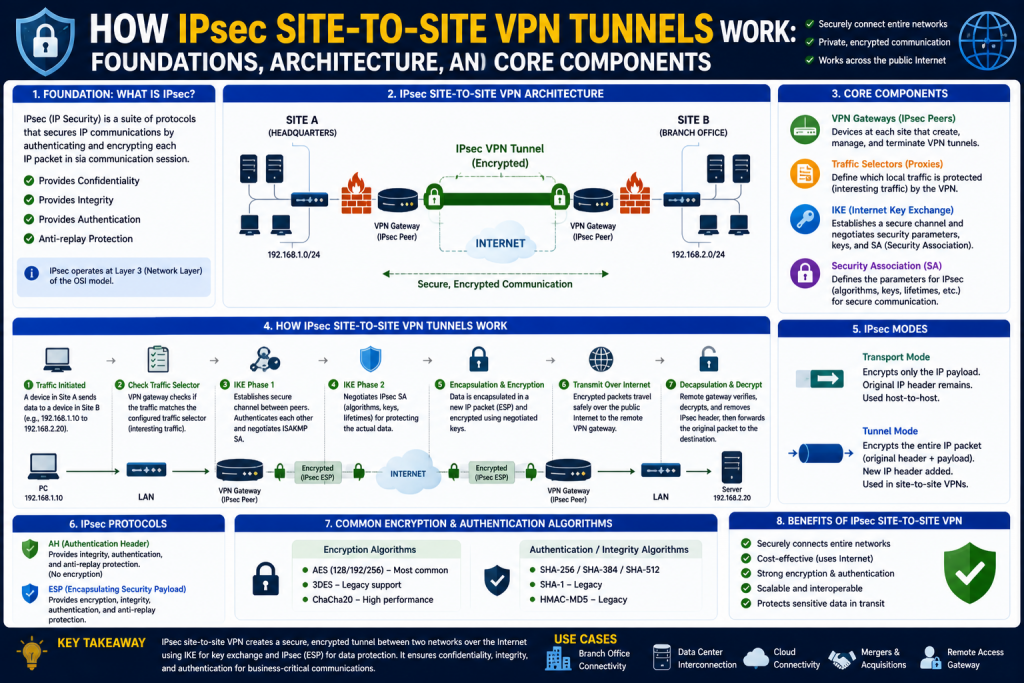
Organizations often need to connect multiple offices, branch locations, cloud environments, or partner networks across public internet infrastructure without exposing sensitive data. Sending private corporate traffic directly across the internet without encryption creates serious risks, including interception, tampering, session hijacking, and unauthorized surveillance. To solve this challenge, network engineers rely on Virtual Private Networks (VPNs), and one of the most trusted technologies behind enterprise VPNs is Internet Protocol Security, better known as IPsec.
IPsec is a framework of security protocols designed to protect IP communications by authenticating and encrypting each packet of data during transmission. Rather than simply forwarding traffic from one network to another, IPsec creates a secure, encrypted tunnel through which traffic can safely pass, even when traversing untrusted public networks. This process makes it possible for two geographically distant private networks to communicate as though they were directly connected through a private leased line.
A site-to-site VPN is one of the most common uses of IPsec. In this model, entire networks communicate securely through VPN gateways such as routers, firewalls, or security appliances. Instead of encrypting traffic for a single user, site-to-site VPNs protect communications between locations. For example, a company headquarters can securely connect to a branch office, allowing devices on both sides to exchange data securely without requiring every workstation to individually configure VPN software.
This design is highly scalable, cost-effective, and widely used in enterprise networking because it replaces expensive dedicated WAN circuits with encrypted internet-based tunnels. As long as both endpoints are configured correctly, IPsec provides confidentiality, integrity, authentication, and anti-replay protection.
What IPsec Actually Does
At its core, IPsec secures data in four primary ways.
First, it encrypts traffic so unauthorized parties cannot read the data even if packets are intercepted.
Second, it authenticates the source of traffic, confirming that the sending device is a trusted peer rather than an impersonator.
Third, it ensures data integrity, verifying that packets were not altered during transit.
Fourth, it protects against replay attacks by preventing attackers from capturing valid packets and retransmitting them maliciously.
IPsec achieves these goals through a collection of protocols and negotiated security parameters rather than through a single mechanism. This is why understanding IPsec requires examining several components, including Internet Key Exchange (IKE), Security Associations (SAs), transform sets, encryption algorithms, and tunnel interfaces.
The Difference Between Site-to-Site and Remote Access VPNs
Although both rely on VPN technologies, site-to-site VPNs differ significantly from remote access VPNs.
Remote access VPNs connect an individual device, such as a laptop, to a corporate network. Each user authenticates independently.
Site-to-site VPNs connect entire networks together. Routers or firewalls at each location handle encryption and decryption for all traffic crossing the tunnel.
This distinction is important because site-to-site deployments emphasize gateway configuration, routing, subnet management, and tunnel resilience rather than individual user authentication.
Tunnel Mode vs Transport Mode
IPsec commonly operates in two modes: transport mode and tunnel mode.
Transport mode encrypts only the payload of an IP packet while preserving the original IP header. This is often used for host-to-host communication.
Tunnel mode encapsulates the entire original packet inside a new encrypted packet with a new IP header. This is the standard for site-to-site VPNs because it protects both payload and addressing information while allowing private internal networks to communicate across public infrastructure.
Tunnel mode effectively hides internal addressing schemes from external observers, adding both security and flexibility.
The Role of Internet Key Exchange (IKE)
Before encrypted communication can begin, both VPN peers must agree on how they will secure traffic. This negotiation happens through IKE.
IKE establishes security parameters, authenticates peers, and generates shared encryption keys.
Traditionally, this process occurs in two phases.
Phase 1 establishes a secure management channel between peers. During this stage, devices authenticate one another using methods such as pre-shared keys or digital certificates. They also negotiate encryption standards, hashing methods, Diffie-Hellman groups, and session lifetimes.
Phase 2 uses the secure channel created in Phase 1 to negotiate the actual IPsec tunnel parameters that will protect user data.
If Phase 1 fails, Phase 2 never begins. This is why matching policies on both ends is critical.
Important Cryptographic Elements in IPsec
Several technical settings determine the strength and compatibility of an IPsec tunnel.
Encryption algorithms protect confidentiality. AES is commonly preferred because of its strong security and efficiency.
Hashing algorithms verify integrity. SHA variants are often used to ensure packets have not been modified.
Authentication methods confirm identity. Pre-shared keys are common in smaller deployments, while certificates scale better for large enterprises.
Diffie-Hellman groups determine the strength of key exchange. Higher groups generally provide stronger security but may require more processing power.
Lifetime values specify how long a security association remains valid before renegotiation occurs.
These settings must align on both VPN peers. A mismatch in even one critical parameter can prevent tunnel establishment.
Security Associations and Transform Sets
A Security Association is essentially an agreement between devices defining how traffic will be protected. It includes encryption type, authentication method, key material, and operational settings.
Transform sets define which security protocols and algorithms are used for Phase 2 IPsec protection.
For example, a transform set may specify AES-256 encryption combined with SHA-HMAC for integrity.
Because transform sets shape how actual user traffic is protected, both peers must support the same configuration.
Virtual Tunnel Interfaces and Their Importance
Traditional IPsec deployments often relied on crypto maps tied directly to physical interfaces. While functional, crypto maps could become complex, especially in environments with multiple remote peers, dynamic routing, or changing subnets.
Virtual Tunnel Interfaces (VTIs) simplify deployment by creating logical tunnel interfaces that behave similarly to regular routed interfaces.
This approach offers several advantages.
VTIs allow dynamic routing protocols like OSPF or EIGRP to run directly over the tunnel.
They eliminate the need for complex access control lists to define “interesting traffic.”
They improve scalability by treating VPN tunnels more like point-to-point routed links.
They simplify troubleshooting because interface states are easier to monitor than policy-based crypto maps.
In essence, VTIs modernize IPsec by combining strong encryption with routing flexibility.
How Packet Flow Works in an IPsec Site-to-Site Tunnel
When a device on one local network sends traffic to a device on a remote network, the local router examines its routing table and determines that the destination should traverse the tunnel.
The original packet is encrypted according to IPsec policies.
A new outer IP header is added containing the public IP addresses of the VPN gateways.
The encrypted packet crosses the public internet.
The remote VPN gateway receives the packet, verifies authenticity, decrypts it, removes the outer header, and forwards the original packet to its internal destination.
To end users, communication appears seamless, even though multiple security processes occur behind the scenes.
Routing Across the Tunnel
Routing is one of the most overlooked yet essential elements of a successful site-to-site VPN.
Without proper routing, even a fully functional tunnel cannot deliver traffic correctly.
Static routes can manually define remote network paths, but this becomes cumbersome as networks grow.
Dynamic routing protocols offer automation.
EIGRP allows routers to exchange route information efficiently.
OSPF supports broader interoperability.
BGP may be used in advanced enterprise or cloud deployments.
Using VTIs makes dynamic routing especially effective because the tunnel behaves like a standard routed link.
Key Benefits of IPsec Site-to-Site VPNs
IPsec remains popular because it offers significant advantages.
It dramatically reduces WAN costs compared to private leased circuits.
It provides strong encryption over public infrastructure.
It supports vendor interoperability when standards are followed.
It scales across multiple sites and cloud integrations.
It integrates with enterprise firewalls and routers.
It allows secure branch office connectivity without sacrificing performance.
These benefits explain why IPsec continues to serve as a cornerstone technology even as SD-WAN and zero-trust architectures evolve.
Common Deployment Challenges
Despite its strengths, IPsec can be complex.
Configuration mismatches are a leading cause of deployment failure.
NAT traversal may complicate tunnel establishment when devices sit behind address translation.
Firewall policies must permit IKE and ESP traffic.
MTU and fragmentation issues may impact performance.
Routing loops or missing route advertisements can break connectivity even when encryption succeeds.
Performance overhead from encryption may require hardware acceleration in larger deployments.
Because of these variables, successful implementation requires careful planning.
Authentication Options: Pre-Shared Keys vs Certificates
Pre-shared keys are simple and widely used for small deployments. Both peers use the same secret value during authentication.
However, they present scalability and security limitations. Managing multiple shared secrets across large environments becomes difficult.
Digital certificates provide stronger identity assurance and simplify enterprise-scale deployments through Public Key Infrastructure (PKI).
The choice depends on network size, security requirements, and operational maturity.
Why Compatibility Matters
Every IPsec peer must agree on critical settings.
If one side uses AES-256 and the other expects AES-128, negotiation fails.
If one side uses SHA-256 while the other expects SHA-1, authentication fails.
If Diffie-Hellman groups differ, key exchange fails.
This requirement for exact compatibility makes documentation and standardized templates essential in enterprise environments.
Preparing for Deployment
Before building a tunnel, administrators should define:
Local and remote protected subnets
Public IP addresses for each VPN endpoint
IKE Phase 1 settings
IPsec Phase 2 transform sets
Authentication method
Tunnel interface addressing
Routing strategy
Firewall allowances
Monitoring and logging requirements
Proper planning reduces troubleshooting time significantly.
The Strategic Importance of IPsec in Enterprise Security
Although networking technologies continue to evolve, IPsec remains foundational because it directly addresses a timeless challenge: secure communication across untrusted networks.
From branch offices to hybrid cloud, disaster recovery replication, partner connectivity, and secure infrastructure extension, IPsec provides a proven method for protecting data in motion.
Its reliability, standards-based architecture, and broad vendor support make it a critical skill for network engineers, cybersecurity professionals, and infrastructure architects alike.
Mastering IPsec site-to-site VPNs is not just about learning commands. It involves understanding encryption theory, authentication models, routing logic, tunnel architecture, and operational troubleshooting. Once these principles are understood, deploying secure tunnels becomes far more intuitive.
A properly designed IPsec site-to-site VPN transforms the public internet into a secure enterprise transport mechanism, enabling organizations to communicate globally while maintaining confidentiality, trust, and operational continuity.
Preparing for IPsec Site-to-Site Tunnel Deployment
Once the foundational concepts of IPsec, IKE, tunnel mode, and Virtual Tunnel Interfaces are understood, the next stage is practical deployment. This is where network engineers transform theory into operational connectivity by configuring two VPN peers to establish encrypted communication over a public network. Successful IPsec deployment is not simply about enabling encryption. It requires coordinated preparation across security policies, peer definitions, transform sets, tunnel interfaces, and routing protocols.
Before entering configuration mode on any router or firewall, the most important step is planning. IPsec is extremely precise, and even a minor mismatch between endpoints can prevent tunnel establishment. Preparation should include documenting public IP addresses for both peers, defining local and remote protected networks, selecting authentication methods, choosing encryption and hashing algorithms, assigning Diffie-Hellman groups, deciding on key lifetimes, and planning the routing method that will exchange network reachability information.
Thorough planning also involves evaluating firewall policies, NAT requirements, bandwidth expectations, redundancy goals, and future scalability needs. Administrators should determine whether the deployment will rely on static routing for simplicity or dynamic routing protocols for flexibility and growth. They must also assess whether pre-shared keys are sufficient or if digital certificates are more appropriate for long-term security and manageability. Network diagrams, addressing schemes, failover paths, and interface assignments should be clearly documented before implementation begins.
This preparation stage is also the ideal time to identify potential compatibility concerns between hardware vendors, firmware versions, or cryptographic capabilities. Without this level of preparation, troubleshooting becomes significantly more difficult because failures may stem from multiple overlapping causes. A carefully planned deployment minimizes downtime, reduces configuration errors, and accelerates implementation by ensuring every technical and operational requirement is considered in advance. In enterprise environments, strategic preparation often determines whether an IPsec deployment becomes a stable long-term solution or a recurring source of operational issues.
For example, imagine two branch offices connected over the internet. One site may have an internal network of 10.1.1.0/24 with a public-facing IP address of 15.0.0.1, while the remote site may use 10.3.3.0/24 with a public IP of 35.0.0.3. The purpose of the IPsec tunnel is to securely connect these two private networks.
Step One: Establishing IKE Phase 1 Policies
IKE Phase 1 is responsible for creating the secure management channel through which further negotiations occur. Without this foundation, the tunnel cannot proceed.
During this stage, both peers must agree on:
Encryption algorithm
Hashing algorithm
Authentication method
Diffie-Hellman group
Security Association lifetime
A common enterprise configuration might use AES for encryption, SHA for integrity, pre-shared keys for authentication, Diffie-Hellman Group 14 for strong key exchange, and a lifetime of 86,400 seconds.
When configuring these values, consistency is everything. If one router expects AES-256 while the other uses AES-128, the tunnel fails. If one side uses SHA-256 while the other uses SHA-1, negotiation fails.
This phase essentially creates a trusted control channel, often called the ISAKMP or IKE Security Association.
Choosing Authentication: Pre-Shared Keys
For many deployments, pre-shared keys remain the simplest authentication mechanism.
A pre-shared key is a shared secret configured identically on both devices. During Phase 1, each side proves it knows the secret.
While easy to configure, pre-shared keys should be:
Long
Complex
Randomized
Securely stored
Weak shared keys undermine tunnel security, even when encryption is strong.
In enterprise environments, certificates may replace pre-shared keys for scalability, but pre-shared keys remain common in branch-to-branch deployments.
Step Two: Creating IPsec Transform Sets
After IKE Phase 1 succeeds, Phase 2 defines how actual traffic will be protected.
This is where transform sets come into play.
A transform set combines:
Encryption protocol
Integrity protocol
Tunnel mode settings
A common transform set might specify:
ESP with AES-256 for confidentiality
ESP with SHA-HMAC for integrity
Tunnel mode for packet encapsulation
Transform sets define the security applied to user traffic crossing the VPN. These settings must also match on both peers.
The Encapsulating Security Payload (ESP) protocol is widely preferred because it provides both encryption and authentication. Authentication Header (AH) exists but is less common because it lacks payload encryption and has compatibility limitations with NAT.
Step Three: Building the IPsec Profile
The IPsec profile binds transform set policies into a reusable object that can be attached to tunnel interfaces.
This profile acts as the security identity of the tunnel.
Once created, it simplifies deployment because administrators can apply one profile to an interface rather than repeatedly defining cryptographic settings.
The profile references the transform set and determines how traffic traversing that interface will be encrypted.
This modular structure improves manageability and reduces configuration complexity.
Step Four: Creating the Virtual Tunnel Interface
Virtual Tunnel Interfaces fundamentally modernize IPsec deployment.
Instead of policy-based crypto maps tied to physical interfaces, VTIs create logical routed interfaces dedicated to encrypted communication.
A tunnel interface requires several critical elements:
Tunnel mode
Source interface or source IP
Destination peer IP
Logical IP addressing or unnumbered addressing
Applied IPsec profile
Tunnel mode should specify IPsec IPv4.
The source identifies the local public-facing interface.
The destination identifies the remote peer’s public IP.
IP unnumbered is commonly used to borrow an existing loopback IP, simplifying address management.
Applying the IPsec profile activates encryption for traffic crossing the tunnel.
Once configured correctly on both ends, the tunnel becomes a secure point-to-point connection.
Why IP Unnumbered Is Useful
Using IP unnumbered avoids assigning dedicated subnet addresses to tunnel interfaces.
Instead, the interface borrows an address from an existing loopback.
Benefits include:
Reduced IP consumption
Simpler management
Easier routing integration
Improved consistency
Loopback addresses also tend to remain stable regardless of physical interface state changes.
Defining Tunnel Source and Destination
The tunnel source should reference the internet-facing interface or IP.
For example:
Site A source = 15.0.0.1
Site B source = 35.0.0.3
Each site’s destination is the other site’s source.
This creates a static point-to-point encrypted path across public infrastructure.
If source or destination settings are incorrect, tunnel establishment fails regardless of cryptographic compatibility.
Applying Routing Protocols Across the Tunnel
Encryption alone does not create useful communication. Routers still need to know which networks exist behind each peer.
This is why routing integration is essential.
Virtual Tunnel Interfaces excel because routing protocols can operate directly over them.
EIGRP is commonly used in Cisco-centric environments due to simplicity and efficiency.
OSPF offers broader vendor interoperability.
BGP may serve complex enterprise or cloud architectures.
For example, enabling EIGRP autonomous system 777 on both sides allows each router to advertise local subnets across the tunnel dynamically.
Site A advertises 10.1.1.0/24.
Site B advertises 10.3.3.0/24.
Once adjacency forms, each router learns remote routes automatically.
This eliminates the burden of manually maintaining static routes.
Advantages of Dynamic Routing Over Static Routing
Static routing may work for small deployments, but dynamic routing offers major benefits:
Automatic failover support
Simpler subnet expansion
Reduced administrative overhead
Faster route convergence
Scalability across many locations
In modern enterprise VPNs, dynamic routing is often preferred.
Tunnel Bring-Up Process
When traffic matching remote destinations is detected, the tunnel initiation process begins:
Peer identification
IKE Phase 1 negotiation
Authentication validation
Diffie-Hellman key exchange
IKE SA creation
IPsec Phase 2 negotiation
Transform set agreement
IPsec SA creation
Tunnel interface activation
Routing adjacency formation
Traffic encryption and forwarding
Each stage depends on the successful completion of the previous one.
Common Deployment Errors During Configuration
Many first-time deployments fail because of avoidable mistakes:
Mismatched pre-shared keys
Incorrect peer IPs
Transform set inconsistencies
ACL or firewall blocks
Missing routes
NAT interference
Incorrect tunnel mode
Wrong source interface
IPsec is unforgiving of inconsistency, so validation at every step matters.
NAT Traversal Considerations
When VPN peers sit behind Network Address Translation devices, standard ESP traffic may face issues.
NAT-T solves this by encapsulating IPsec packets in UDP, usually on port 4500.
This allows encrypted traffic to pass through NAT devices while preserving security.
Without NAT traversal, many tunnels behind consumer or enterprise NAT devices may fail.
Firewall Requirements for Tunnel Establishment
Firewalls between peers must allow:
UDP 500 for IKE
UDP 4500 for NAT-T
ESP protocol 50
Blocking these ports or protocols prevents successful negotiation.
This is often overlooked during deployment.
Why Loopbacks Improve Stability
Using loopback interfaces for tunnel identity provides resilience.
Physical interfaces may fail, flap, or change.
Loopbacks remain logically stable.
This supports:
Reliable routing
Consistent peer identification
Simpler failover
Greater design flexibility
For larger environments, loopback-based design is considered best practice.
Verifying Initial Configuration Before Activation
Before expecting a functional tunnel, engineers should verify:
Public reachability between peers
Correct IKE policies
Matching transform sets
Correct pre-shared keys
Proper profile attachment
Source and destination definitions
Firewall allowances
Routing process configuration
Skipping validation often leads to prolonged troubleshooting.
Scaling Beyond a Single Tunnel
Once one tunnel works, organizations often expand to:
Hub-and-spoke VPNs
Full mesh VPNs
Cloud VPN integrations
Multi-region disaster recovery
Partner network interconnects
VTIs make scaling easier because each tunnel behaves like a standard interface.
This architecture supports more predictable growth.
Performance Considerations During Deployment
Encryption consumes CPU resources.
Key factors affecting performance include:
Encryption strength
Hardware acceleration
Packet size
Traffic volume
Concurrent tunnels
AES generally offers strong security with efficient hardware support, making it a practical choice.
High-throughput environments may require dedicated VPN appliances or hardware crypto modules.
Security Best Practices During Configuration
Strong deployment should include:
AES-256 where supported
SHA-2 hashing
High Diffie-Hellman groups
Long random pre-shared keys
Certificate adoption when possible
Logging enabled
Dead Peer Detection
Perfect Forward Secrecy
Regular key rotation
These practices strengthen resilience against evolving threats.
Operational Outcome of a Properly Configured Tunnel
When deployment is complete:
Tunnel interfaces show active
IKE Security Associations establish
IPsec Security Associations establish
Routing neighbors form
Remote routes appear
End-to-end pings succeed
Traffic flows securely
At this point, users at both sites often experience seamless connectivity without realizing their traffic crosses an encrypted internet-based path.
Strategic Deployment Value
Deploying an IPsec site-to-site VPN is more than a technical exercise. It is a strategic capability that allows businesses to:
Reduce MPLS costs
Connect branch offices securely
Enable hybrid cloud connectivity
Protect partner communications
Support disaster recovery
Expand globally
When designed properly, site-to-site VPNs combine affordability, security, scalability, and operational control.
Understanding deployment mechanics prepares network professionals not only to configure tunnels but to build resilient enterprise architectures that support modern distributed business operations. The transition from theory to implementation is where IPsec becomes a practical business asset, and mastering this stage is essential for real-world networking success.
Bringing an IPsec Site-to-Site VPN from Deployment to Reliable Production
Building an IPsec site-to-site VPN tunnel is only the beginning of the journey. A successful configuration does not automatically guarantee operational stability, consistent performance, or long-term security. Once a tunnel is deployed, network administrators must verify that it functions correctly, troubleshoot negotiation failures when they arise, optimize performance for production workloads, and continuously monitor the environment to ensure secure business continuity.
This operational phase is where theory and configuration become enterprise-grade infrastructure. Even a perfectly designed VPN can fail due to routing errors, firewall restrictions, NAT complications, expired credentials, MTU mismatches, or hardware limitations. Understanding how to validate and maintain IPsec tunnels is what separates basic implementation from true network engineering expertise. In production environments, VPN management becomes a continuous lifecycle rather than a one-time deployment task. Administrators must regularly monitor tunnel health, review security logs, validate routing behavior, and ensure that software updates or policy changes do not unintentionally disrupt connectivity. Business-critical applications often depend on these encrypted tunnels for voice traffic, cloud services, file replication, and remote operational systems, meaning even minor disruptions can create major financial or operational consequences. Effective maintenance also requires awareness of evolving cybersecurity threats, as outdated cryptographic standards or weak authentication methods can gradually turn a once-secure deployment into a vulnerability. Capacity planning is equally important, since growing traffic demands may overwhelm hardware resources and introduce latency or packet loss. Skilled network engineers approach IPsec operations strategically by combining security hardening, performance tuning, documentation, change management, and proactive troubleshooting. This broader operational discipline ensures that VPN infrastructure remains resilient, scalable, and aligned with both technical and business objectives over time.
A properly functioning IPsec site-to-site VPN should accomplish several objectives simultaneously. It must establish secure key exchange, negotiate encryption parameters successfully, form tunnel interfaces, route traffic accurately, maintain consistent uptime, and recover gracefully from failures. Each layer of operation must be tested and monitored.
The First Verification Step: Confirming Reachability
Before analyzing encryption or VPN-specific details, administrators should first verify that both VPN peers can reach each other across the public network.
This means ensuring:
Public IP addresses are correct
Internet connectivity exists
Intermediate firewalls permit required traffic
DNS or static peer definitions are accurate
Simple reachability tests such as ping or traceroute may confirm whether the remote endpoint is accessible. If peers cannot communicate over the internet at all, IPsec negotiation will never begin.
However, some devices block ICMP, so failed pings do not always indicate failure. In those cases, administrators should verify UDP 500, UDP 4500, and ESP availability.
Verifying IKE Phase 1 Status
IKE Phase 1 creates the secure control channel that allows further IPsec negotiation. If this stage fails, Phase 2 never starts.
The primary purpose of verification here is to confirm:
Authentication succeeded
Encryption settings matched
Hashing methods aligned
Diffie-Hellman exchange completed
Security Association formed
A successful Phase 1 state often indicates that the peers trust one another and have agreed on foundational security settings.
If Phase 1 fails, the most common causes include:
Mismatched pre-shared keys
Incorrect encryption standards
Hash mismatches
Wrong Diffie-Hellman groups
Authentication method inconsistencies
Peer IP misconfiguration
Many troubleshooting efforts begin here because without Phase 1, no encrypted tunnel can exist.
Understanding Phase 2 Verification
Once Phase 1 is successful, administrators must confirm that IPsec Security Associations are created.
Phase 2 establishes:
Transform set compatibility
Data encryption parameters
Traffic selectors
Inbound and outbound security associations
Perfect Forward Secrecy if configured
Because IPsec creates separate inbound and outbound SAs, administrators often see two directional tunnels.
If Phase 1 succeeds but Phase 2 fails, likely causes include:
Transform set mismatch
ACL or traffic selector mismatch
PFS inconsistency
NAT issues
Incorrect subnet definitions
Phase 2 problems are often more subtle than Phase 1 because trust exists, but traffic parameters do not align.
Tunnel Interface Status and Operational State
With Virtual Tunnel Interfaces, interface state becomes one of the clearest indicators of health.
A healthy tunnel generally shows:
Interface up
Line protocol up
IPsec profile attached
Routing active
If the tunnel interface is down, administrators should inspect source and destination reachability, profile application, and crypto state.
Unlike older crypto map deployments, VTIs simplify operational visibility because the tunnel behaves like a logical network interface.
Routing Validation Across the Tunnel
One of the most common misconceptions is assuming that an established tunnel automatically means application connectivity.
In reality, routing errors often break communication even when encryption is functioning perfectly.
Administrators should verify:
Routing neighbors formed successfully
Remote networks learned correctly
Static routes point properly
No overlapping subnets exist
No asymmetric routing occurs
Dynamic routing protocols like EIGRP or OSPF should show neighbor adjacency.
Routing tables should contain remote subnets learned across the tunnel.
If encryption works but packets cannot reach destination networks, routing is often the issue.
Testing End-to-End Connectivity
True validation requires testing from internal network to internal network.
For example:
Host at Site A to host at Site B
Router LAN interface to remote LAN interface
Application traffic across tunnel
Using source-specific ping tests confirms bidirectional routing and encryption.
A successful test proves:
Tunnel established
Traffic selectors correct
Routing functional
Encryption operational
Remote delivery successful
This is often the most practical operational benchmark.
Common Troubleshooting Scenarios
Real-world IPsec troubleshooting often involves identifying which stage failed.
No Phase 1:
Check peer IPs, authentication, IKE policy, firewalls
Phase 1 but no Phase 2:
Check transform sets, PFS, traffic selectors
Tunnel up but no traffic:
Check routes, ACLs, subnet overlap
Intermittent drops:
Check rekey timers, MTU, unstable WAN links
Performance issues:
Check CPU, hardware crypto, fragmentation
Systematic troubleshooting prevents wasted effort.
The Role of Logs and Debugging
Modern routers and firewalls provide extensive diagnostic tools.
Logs can reveal:
Authentication failures
Proposal mismatches
Timeouts
NAT traversal activation
Dead Peer Detection events
Rekeying issues
Administrators should use debugging carefully in production because verbose logging may impact performance.
Still, logs are among the fastest ways to isolate negotiation problems.
NAT Traversal and Real-World Internet Complexity
Many IPsec tunnels operate across networks that use NAT.
Traditional ESP can struggle because NAT modifies packet headers.
NAT Traversal solves this by encapsulating traffic in UDP.
Verification should confirm:
NAT-T negotiated properly
UDP 4500 permitted
Translation stable
Without NAT-T, many branch office deployments fail unexpectedly.
MTU and Fragmentation Challenges
Encryption adds overhead, increasing packet size.
This can lead to fragmentation or dropped packets if MTU is not adjusted.
Symptoms include:
Tunnel up but slow applications
Failed large file transfers
VoIP instability
Intermittent application timeouts
Solutions often involve:
Adjusting TCP MSS
Lowering MTU
Path MTU Discovery
This issue is especially common in cloud or broadband deployments.
Dead Peer Detection and Tunnel Resilience
Dead Peer Detection (DPD) helps identify failed peers and remove stale sessions.
Without DPD:
Tunnels may appear active when remote peers are unreachable
Failover delays increase
Recovery slows
DPD improves resilience by actively monitoring peer responsiveness.
This is critical for production environments where uptime matters.
Rekeying and Security Association Lifetimes
Security Associations expire periodically to improve security.
Rekeying replaces old keys with new ones before expiration.
Misconfigured lifetimes can cause:
Unexpected tunnel drops
Frequent renegotiation
High CPU usage
Stability problems
Both peers should use compatible lifetimes to ensure smooth transitions.
High Availability and Redundancy
Enterprise deployments often require more than a single tunnel.
Redundancy options include:
Dual ISPs
Backup peers
Dynamic routing failover
Multiple tunnel interfaces
Hub-and-spoke failover
Cloud backup paths
Redundant architecture prevents single points of failure.
Performance Optimization
Production VPNs must balance security with efficiency.
Optimization strategies include:
Hardware crypto acceleration
AES over legacy ciphers
Route summarization
QoS for latency-sensitive traffic
Load balancing
Efficient rekey intervals
Bandwidth monitoring
Encryption overhead is unavoidable, but optimization minimizes impact.
Security Hardening Beyond Basic Deployment
Operational security should evolve beyond initial setup.
Recommended enhancements include:
Migrating from SHA-1 to SHA-2
Using stronger DH groups
Certificate-based authentication
Perfect Forward Secrecy
Strict ACLs
Logging and SIEM integration
Firmware updates
Zero Trust segmentation
IPsec is strong, but poor operational hygiene weakens security.
Cloud and Hybrid Network Expansion
Modern IPsec deployments frequently connect:
On-premises offices to cloud providers
Multi-cloud environments
Partner organizations
Remote industrial sites
Data centers
Disaster recovery locations
As infrastructure becomes distributed, IPsec remains a practical interoperability tool.
Human Error: The Biggest Operational Threat
Many VPN failures are not cryptographic weaknesses but administrative mistakes.
Examples include:
Wrong subnet masks
Typographical errors
Policy drift
Uncoordinated changes
Expired certificates
Improper firewall modifications
Change management and documentation are essential.
Monitoring and Ongoing Maintenance
Production VPNs require continuous oversight.
Monitoring should include:
Tunnel uptime
Latency
Packet loss
CPU load
Rekey frequency
Security alerts
Routing changes
Proactive maintenance prevents outages.
When to Upgrade or Redesign
As organizations scale, traditional IPsec may need enhancement through:
DMVPN
SD-WAN
Route-based automation
Cloud-native VPN gateways
Zero Trust frameworks
IPsec remains relevant, but architecture should evolve with business needs.
Operational Best Practices
For sustainable VPN health:
Standardize templates
Document configurations
Use naming conventions
Enable logging
Test failover
Review cryptography regularly
Audit firewall rules
Monitor continuously
Train administrators
These practices reduce downtime and improve security maturity.
Conclusion
Deploying an IPsec site-to-site VPN is not the final goal—maintaining a stable, secure, and optimized encrypted network is where real operational success begins. Verification ensures that tunnels are not merely configured, but actually delivering secure connectivity. Troubleshooting transforms failures into learning opportunities. Optimization ensures encryption does not become a performance bottleneck. Long-term monitoring protects business continuity.
IPsec remains one of the most important technologies in enterprise networking because it combines proven cryptography, interoperability, scalability, and cost efficiency. Whether connecting branch offices, cloud platforms, data centers, or partner organizations, IPsec continues to provide trusted protection for data crossing untrusted networks.
Mastery of IPsec site-to-site VPNs requires more than understanding commands. It requires understanding architecture, negotiation logic, routing behavior, security design, operational troubleshooting, and lifecycle management. Professionals who develop these skills gain the ability to design resilient infrastructures capable of supporting modern business securely and efficiently.
A well-built IPsec tunnel is more than an encrypted path—it is a strategic foundation for secure global communication.
Continue exploring the technologies and certification concepts that matter most to you.