The modern digital environment is built on cloud computing, a system that has transformed how organizations store data, run applications, and deliver services. Instead of relying on physical servers and traditional infrastructure, businesses now use cloud platforms to operate more efficiently and scale quickly. This shift has opened up a wide range of opportunities, but it has also introduced new challenges, especially when it comes to understanding how to use cloud services effectively.
Cloud platforms offer hundreds of tools, services, and configurations. When used properly, they can improve performance, reduce costs, and enhance security. However, the presence of these tools alone does not guarantee success. The real value comes from having knowledgeable individuals who can connect technical capabilities with business needs.
Many organizations face a gap between what cloud technology can do and how it is actually used. This gap exists because cloud expertise requires both technical understanding and strategic thinking. Professionals who can bridge this gap are highly valuable because they help organizations make better decisions and maximize the benefits of cloud adoption.
The Need for Cloud Knowledge
As companies increasingly move their operations to the cloud, the demand for cloud-literate professionals continues to grow. This demand is not limited to technical roles. Even individuals in management, finance, and operations need a basic understanding of cloud concepts to perform their jobs effectively.
Cloud knowledge allows professionals to evaluate solutions, understand pricing, and participate in important discussions about technology investments. Without this knowledge, decision-making becomes slower and less effective. Teams may struggle to communicate, and organizations may miss opportunities to improve their systems.
Having a foundational understanding of cloud computing helps individuals become more confident in their roles. It enables them to ask better questions, contribute meaningful insights, and collaborate more effectively with technical teams.
Understanding the AWS Certified Cloud Practitioner
One of the most recognized ways to demonstrate foundational cloud knowledge is through an entry-level certification. This certification is designed to validate a broad understanding of cloud computing concepts without requiring deep technical expertise.
It focuses on general awareness rather than specialization. Instead of preparing candidates for a specific job role, it ensures they understand how cloud systems work as a whole. This makes it suitable for a wide range of professionals, including beginners and non-technical individuals.
Earning this certification shows that a person understands key cloud concepts, including infrastructure, services, pricing, and security. It also demonstrates the ability to explain these concepts clearly, which is an important skill in many professional environments.
What the Certification Represents
This certification represents a foundational level of knowledge in cloud computing. It confirms that the individual has a broad understanding of how cloud services are structured and how they support business operations.
One of the main aspects it covers is familiarity with core services. Candidates learn about computing resources, storage solutions, networking components, and databases. They also explore how these services are used together to build scalable and reliable systems.
Another important component is understanding pricing models. Cloud services operate on different pricing structures, and knowing how these models work helps organizations manage costs effectively. Individuals who understand pricing can make better decisions about resource usage and budgeting.
The certification also emphasizes the impact of cloud computing on business strategy. It highlights how cloud adoption can improve flexibility, support growth, and enable innovation. This perspective is important because it connects technical knowledge with real-world outcomes.
Why the Certification Is Popular
This certification is often chosen by individuals who are new to cloud computing. Its broad scope makes it an ideal starting point for learning about cloud technology. Unlike advanced certifications, it does not require extensive technical experience, making it accessible to a wide audience.
Another reason for its popularity is its flexibility. It is not tied to a specific role, so it can be useful for many different career paths. Whether someone is interested in technical roles, management positions, or business-related careers, the knowledge gained from this certification is relevant.
The certification also provides a structured learning path. Instead of trying to navigate complex cloud systems independently, candidates follow a guided approach that covers essential topics. This makes the learning process more efficient and less overwhelming.
The Role of the Certification in Career Development
For individuals at the beginning of their careers, this certification can serve as a stepping stone into the technology field. It introduces key concepts and builds a foundation that can be expanded through further study and experience.
It also helps individuals explore different areas of cloud computing. By learning about a wide range of services, candidates can identify which areas interest them the most. This can guide their future learning and career decisions.
For professionals already working in related fields, the certification can enhance existing knowledge. It provides a broader perspective and helps individuals understand how different components fit together. This can improve their ability to solve problems and make decisions.
Exam Overview and Structure
To earn the certification, candidates must pass a standardized exam. This exam is designed to evaluate their understanding of cloud fundamentals and ensure they have a well-rounded knowledge base.
The exam typically includes multiple-choice and multiple-response questions. These questions test both theoretical knowledge and practical understanding. Candidates must be able to analyze scenarios and choose the best solutions based on their knowledge.
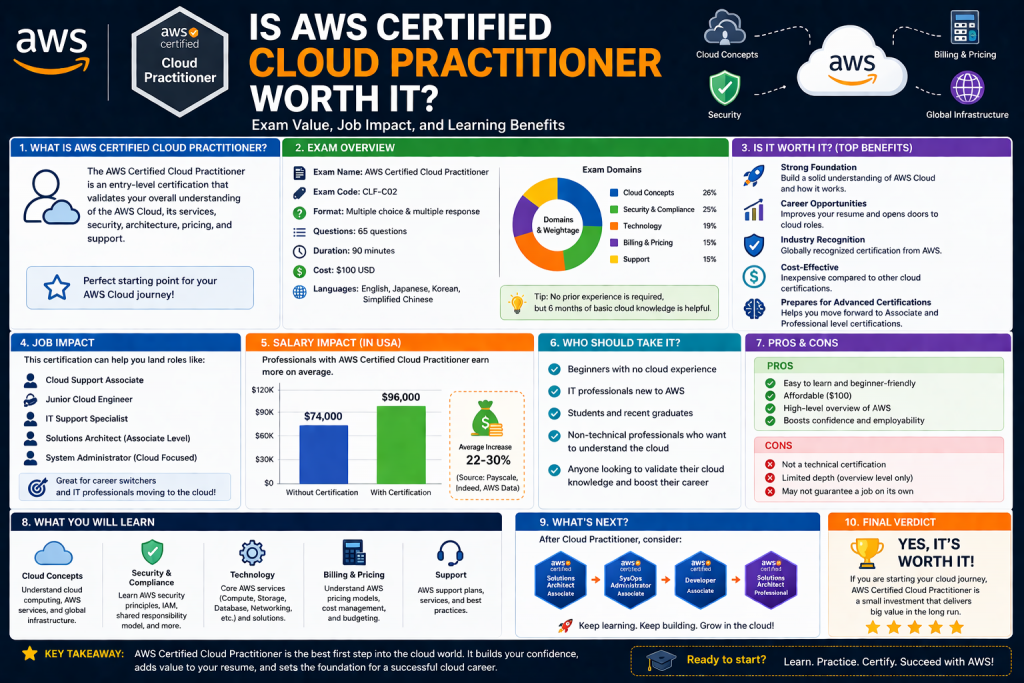
The exam is divided into four main areas. Each area focuses on a different aspect of cloud computing, ensuring that candidates develop a comprehensive understanding of the subject.
Core Topics Covered in the Exam
The first area focuses on cloud concepts. This includes understanding the basic principles of cloud computing, such as scalability, elasticity, and availability. Candidates learn how cloud systems differ from traditional infrastructure and why organizations choose to use them.
The second area covers security and compliance. This includes topics such as data protection, identity management, and the shared responsibility model. Security is a critical aspect of cloud computing, and candidates must understand how to protect systems and data.
The third area explores cloud technologies and services. This includes computing resources, storage options, networking components, and databases. Candidates must understand how these services work and how they are used in real-world scenarios.
The fourth area focuses on billing and pricing. This includes understanding cost structures, pricing models, and cost optimization strategies. Candidates learn how to manage expenses and make cost-effective decisions.
Preparing for the Certification
Preparation for the certification requires a combination of study and practical experience. While it is possible to pass the exam with theoretical knowledge alone, hands-on experience can significantly improve understanding.
Candidates are encouraged to spend time exploring cloud platforms and experimenting with different services. This helps them see how concepts are applied in real-world situations. It also makes it easier to remember information during the exam.
Study resources such as online courses, practice exams, and documentation can also be helpful. These resources provide structured learning and help candidates identify areas where they need improvement.
Recommended Experience Level
Although the certification is designed for beginners, some level of experience is recommended. This experience does not need to be extensive, but it should include basic familiarity with cloud environments.
Candidates should feel comfortable navigating cloud interfaces, understanding basic configurations, and recognizing different services. They should also be able to explain how these services are used and why they are important.
Practical experience helps candidates develop confidence and improves their ability to answer exam questions. It also makes the learning process more engaging and meaningful.
Challenges of Learning Cloud Concepts
One of the main challenges of preparing for this certification is the breadth of knowledge required. Cloud platforms offer a wide range of services, and candidates must develop a basic understanding of many different areas.
This can be overwhelming for beginners, especially those with no prior experience in technology. However, the certification is designed to introduce concepts gradually, making it easier to build knowledge over time.
Another challenge is understanding how different services work together. Cloud systems are interconnected, and candidates must learn how to combine services to create effective solutions. This requires both conceptual understanding and practical thinking.
Importance of Communication Skills
In addition to technical knowledge, the certification emphasizes communication skills. Candidates must be able to explain cloud concepts clearly and effectively.
This is important because many roles involve working with individuals who may not have a technical background. Being able to translate complex ideas into simple explanations is a valuable skill that can improve collaboration and decision-making.
Strong communication skills also help professionals present ideas, justify decisions, and build trust with stakeholders.
Building a Foundation for the Future
The certification serves as a starting point for further learning. It provides a foundation that can be expanded through advanced certifications and practical experience.
After earning this certification, individuals can choose to specialize in areas such as architecture, development, or operations. Each of these paths offers opportunities for growt
Exam Structure and Purpose
The certification exam is designed to test a candidate’s overall understanding of cloud computing fundamentals rather than deep technical expertise. Its primary purpose is to ensure that individuals can recognize key cloud services, understand how they function together, and explain their value in real-world business environments. Instead of focusing on complex coding or engineering tasks, the exam emphasizes clarity, conceptual knowledge, and decision-making skills.
Candidates are presented with multiple-choice and multiple-response questions. These questions are often scenario-based, requiring candidates to analyze a situation and choose the most appropriate solution. This format reflects real-world challenges where professionals must evaluate options and make informed decisions based on available information.
The exam is structured to assess both theoretical understanding and practical thinking. Candidates must not only know what a service does but also when and why it should be used. This ensures that certified individuals can apply their knowledge in meaningful ways.
Time management is a key aspect of the exam. Candidates must answer all questions within a fixed time limit, which requires them to balance speed and accuracy. Practicing with timed mock exams can help improve performance and reduce stress during the actual test.
Cloud Concepts
The first domain focuses on the foundational principles of cloud computing. It introduces candidates to the core ideas that define how cloud systems operate and why they are widely used across industries.
One of the most important concepts in this domain is on-demand resource availability. Cloud platforms allow users to access computing resources whenever needed, without requiring long setup times or large upfront investments. This flexibility enables organizations to respond quickly to changing demands.
Scalability is another key concept. It refers to the ability to increase or decrease resources based on workload requirements. Elasticity takes this a step further by enabling automatic scaling, ensuring that systems can handle fluctuations in demand without manual intervention.
Candidates must also understand high availability and fault tolerance. High availability ensures that systems remain accessible even during failures, while fault tolerance allows systems to continue operating despite issues. These features are essential for maintaining reliable services.
Another important topic is global infrastructure. Cloud providers operate data centers in multiple regions around the world, allowing organizations to deploy applications closer to their users. This improves performance and reduces latency.
Deployment models are also covered in this domain. Public cloud environments are shared and managed by a provider, private clouds are dedicated to a single organization, and hybrid models combine both approaches. Understanding these models helps candidates choose the right solution for different needs.
Security and Compliance
Security is one of the most critical aspects of cloud computing, and it is heavily emphasized in the exam. Candidates must understand how security responsibilities are shared between the cloud provider and the customer.
The shared responsibility model is a central concept. It defines which aspects of security are handled by the provider and which are managed by the customer. For example, the provider is responsible for securing the physical infrastructure, while customers must protect their data and manage access controls.
Identity and access management is another important topic. It involves controlling who can access resources and what actions they can perform. Candidates should understand how permissions, roles, and policies are used to manage access effectively.
Data protection is also a key focus. Candidates must be familiar with encryption methods used to secure data both at rest and in transit. They should also understand backup and recovery strategies that help prevent data loss.
Compliance is an important consideration for many organizations. Different industries have specific regulations that must be followed to protect sensitive information. Candidates should understand how cloud services support compliance through certifications, monitoring tools, and reporting capabilities.
Monitoring and logging are also part of this domain. These tools help organizations track activity, detect potential issues, and maintain security. Understanding how to use these tools is essential for maintaining a secure environment.
Cloud Technology and Services
The third domain is the most extensive and covers a wide range of cloud services. Candidates must understand the purpose and basic functionality of different types of services.
Compute services provide the processing power needed to run applications. Candidates should understand the differences between virtual machines, containers, and serverless computing. Each option offers unique advantages depending on the use case.
Storage services are designed to store and retrieve data. Different storage types are used for different purposes. Object storage is ideal for large amounts of unstructured data, while block storage is used for high-performance applications. Archive storage is suitable for long-term data retention.
Networking services enable communication between resources. Candidates should understand how virtual networks are created, how data is routed, and how load balancing distributes traffic across multiple resources to maintain performance and reliability.
Database services are also an important part of this domain. Candidates should be familiar with relational databases, which organize data into structured tables, and non-relational databases, which offer more flexibility for certain types of applications.
In addition to core services, candidates should understand supporting tools such as analytics services, messaging systems, and application integration tools. These services allow organizations to process data, connect applications, and build complex workflows.
Understanding how these services work together is essential. Cloud solutions are rarely built using a single service. Instead, they involve combinations of services that interact to meet specific requirements.
Billing and Pricing
The final domain focuses on how cloud services are priced and how organizations can manage their costs effectively. This area is especially important for professionals involved in budgeting and financial decision-making.
Cloud pricing is based on a usage model, meaning organizations pay only for the resources they use. This can lead to cost savings compared to traditional infrastructure, but it also requires careful monitoring to avoid unexpected expenses.
Candidates should understand different pricing models, including pay-as-you-go, reserved instances, and subscription-based pricing. Each model has its own advantages and is suitable for different scenarios.
Cost management tools are used to track usage and spending. These tools provide insights into how resources are being used and help identify areas where costs can be reduced.
Cost optimization strategies are also important. These include selecting the right resource sizes, shutting down unused resources, and using pricing plans that offer discounts. Understanding these strategies helps organizations maximize the value of their cloud investments.
Updates and Evolving Exam Content
Cloud computing is constantly evolving, and the certification exam is updated regularly to reflect new technologies and practices. These updates ensure that the certification remains relevant and aligned with industry standards.
Recent updates have introduced topics such as cloud migration and modern application development. These topics focus on moving existing systems to the cloud and building new applications that take full advantage of cloud capabilities.
There is also increased emphasis on emerging technologies such as artificial intelligence and machine learning. While candidates are not expected to have deep expertise in these areas, they should understand their basic concepts and use cases.
Security updates are also common, reflecting the ongoing importance of protecting data and systems. As threats evolve, so do the strategies and tools used to address them.
Effective Preparation Strategies
Preparing for the certification requires a structured and consistent approach. Candidates should begin by reviewing the exam objectives and creating a study plan that covers all domains.
Using structured learning resources such as courses and study guides can help build a strong foundation. These materials break down complex topics into manageable sections and provide clear explanations.
Practice exams are essential for assessing progress. They help candidates become familiar with the format of the questions and identify areas where they need improvement.
Hands-on experience is highly recommended. Working with cloud services allows candidates to see how concepts are applied in real-world scenarios. This practical experience reinforces theoretical knowledge and improves retention.
Combining Multiple Learning Methods
Using a combination of learning methods can significantly improve results. For example, candidates can start with a course to learn the basics, use practice exams to test their knowledge, and then gain hands-on experience to deepen their understanding.
This approach ensures that candidates are prepared for different types of questions and scenarios. It also builds confidence, which is important for performing well during the exam.
Consistency is key. Regular study sessions and continuous review help reinforce knowledge and prevent forgetting important concepts. Setting goals and tracking progress can keep candidates motivated.
Who Benefits from This Certification
This certification is valuable for a wide range of professionals. Non-technical individuals can benefit from understanding cloud concepts and improving their ability to work with technical teams.
Technical professionals who are new to cloud computing can use it as a starting point for their learning journey. It provides a broad overview that can be expanded through more advanced certifications.
Managers and decision-makers can also benefit. Understanding cloud concepts allows them to evaluate solutions, allocate resources, and plan strategies more effectively.
Even experienced professionals may find value in the certification as a way to validate their foundational knowledge and demonstrate a well-rounded understanding of cloud computing.
Challenges and Common Mistakes
Preparing for the certification comes with challenges. One common mistake is focusing too much on memorization instead of understanding. While it is important to remember key terms, true success comes from knowing how to apply concepts.
Another challenge is covering all domains effectively. The exam includes multiple areas, and neglecting any one of them can affect performance. A balanced study approach is essential.
Time management during the exam can also be difficult. Practicing under timed conditions helps candidates develop the ability to answer questions efficiently.
Building Confidence for Exam Day
Confidence plays a major role in exam performance. Candidates who feel prepared are more likely to remain calm and focused.
Repetition is an effective way to build confidence. Reviewing material multiple times helps reinforce knowledge and improve recall. Practice exams also help candidates become familiar with the test format.
Understanding the reasoning behind answers is equally important. Candidates should aim to understand why a particular answer is correct rather than simply memorizing it.
Long-Term Benefits of Preparation
The benefits of preparing for the certification go beyond passing the exam. The knowledge gained during this process can be applied in many professional situations.
It helps improve job performance, enhances communication, and supports career growth. It also provides a foundation for learning more advanced topics in the future.
As cloud technology continues to evolve, having a strong understanding of its fundamentals becomes increasingly important. This certification helps individuals stay relevant and adapt to changes in the industry.
Understanding the Overall Value of the Certification
The overall value of a cloud certification depends on an individual’s goals, career stage, and level of experience. For many people, it serves as a gateway into the world of cloud computing, offering a structured and approachable way to understand a complex and rapidly evolving field. Rather than focusing on deep technical skills, it provides a broad foundation that helps individuals see how cloud technologies support modern businesses.
Cloud computing is now a central part of how organizations operate. From startups to global enterprises, businesses rely on cloud platforms to deliver services, manage data, and scale operations. Because of this, even a basic understanding of cloud concepts can provide a significant advantage in the workplace.
This certification represents more than just knowledge. It reflects a willingness to learn, adapt, and stay current with technology trends. Employers often value this mindset because it shows that an individual is proactive and committed to professional growth.
Learning Through Preparation
One of the most important benefits of pursuing this certification is the learning process itself. Preparing for the exam requires candidates to explore a wide range of topics, many of which may be entirely new to them. This exposure helps build a comprehensive understanding of the cloud ecosystem.
As candidates progress through their studies, they begin to connect different concepts. They learn how services interact, how systems are designed, and how decisions are made in real-world scenarios. This type of learning encourages deeper understanding rather than simple memorization.
Preparation also strengthens analytical thinking. Many exam questions require candidates to evaluate situations and choose the most appropriate solution. This develops problem-solving skills that are useful in many professional roles.
Repetition is another key factor in effective learning. Reviewing concepts multiple times helps reinforce understanding and improves retention. Over time, this leads to greater confidence and a stronger grasp of the material.
Structuring Knowledge for Real-World Application
A common challenge for beginners is having scattered knowledge without a clear structure. They may understand certain tools or terms but struggle to see how everything fits together. This certification helps organize that knowledge into a logical framework.
Through structured study, candidates develop a clearer understanding of how cloud systems operate. They learn how different services connect and how decisions in one area can impact another. This organized approach makes it easier to apply knowledge in practical situations.
Structured knowledge also improves communication. When individuals can clearly explain concepts, they become more effective in discussions and teamwork. This is especially important in environments where technical and non-technical professionals collaborate.
Having a well-organized understanding reduces confusion and increases efficiency. It allows individuals to approach problems with clarity and confidence.
Validation of Skills and Professional Credibility
Earning a certification provides formal recognition of an individual’s knowledge. It shows that they have met a defined standard and understand key cloud concepts. This validation can be valuable in both job searches and career advancement.
For job seekers, a certification can enhance a resume and make them more noticeable to employers. It demonstrates initiative and a commitment to learning. In competitive job markets, this can make a meaningful difference.
For professionals already working in the field, the certification can support career progression. It may help in securing promotions, transitioning to new roles, or gaining additional responsibilities.
However, it is important to understand that certification alone is not enough. It should be combined with practical experience and continuous learning to achieve long-term success.
Career Opportunities and Growth Potential
This certification can open doors to a variety of career opportunities, especially for those who are new to the technology field. It provides a foundation that can lead to entry-level roles in cloud computing or related areas.
These roles may include positions in technical support, junior cloud operations, or roles involving cloud-based systems management. While these positions may not be highly specialized, they offer valuable experience and opportunities for growth.
As individuals gain experience, they can build on this foundation by pursuing more advanced certifications. These certifications focus on specific roles such as cloud architecture, development, or operations, allowing for deeper specialization.
Career growth is not limited to technical roles. Many non-technical positions also benefit from cloud knowledge. Professionals in management, finance, and operations can use this understanding to make better decisions and improve their effectiveness.
Benefits for Non-Technical Professionals
One of the key strengths of this certification is its accessibility to non-technical professionals. It does not require programming skills or deep technical expertise, making it suitable for individuals in a wide range of roles.
This accessibility allows people from diverse backgrounds to gain a clear understanding of cloud computing without feeling overwhelmed by complex technical details.
Many professionals work in environments where cloud technology is already in use, even if they are not directly involved in technical implementation. For example, individuals in roles such as project management, sales, marketing, human resources, and finance often interact with cloud-based tools and systems. Having a foundational understanding of cloud concepts helps them perform their responsibilities more effectively and communicate more confidently with technical teams.
This certification also helps bridge the gap between business and technology. Non-technical professionals often play a key role in decision-making processes, and understanding cloud fundamentals allows them to evaluate solutions, assess costs, and contribute meaningful insights. Instead of relying entirely on technical experts, they can participate actively in discussions and make informed recommendations.
Another important benefit is increased confidence. When individuals understand how cloud services work at a basic level, they feel more comfortable engaging in conversations, asking questions, and sharing ideas. This confidence can lead to better collaboration and improved performance in team environments.
Additionally, this certification can open up new career opportunities. Non-technical professionals who gain cloud knowledge may find themselves exploring new roles or responsibilities that involve working more closely with technology. It can also serve as a stepping stone for those who later decide to transition into more technical positions.
Non-technical professionals often work closely with technology teams or rely on cloud-based systems in their daily tasks. Having a basic understanding of cloud concepts helps them communicate more effectively and participate in decision-making processes.
For example, project managers can better understand timelines and technical requirements, while business analysts can evaluate solutions more effectively. Professionals in finance can benefit from understanding pricing models and cost management strategies.
This certification empowers non-technical individuals to contribute more actively and confidently in their roles.
Building Confidence and Communication Skills
Confidence is an important factor in professional success, and this certification can help build it. Understanding cloud concepts allows individuals to engage more actively in discussions and decision-making.
When professionals feel confident in their knowledge, they are more likely to share ideas, ask questions, and take initiative. This can lead to increased involvement in projects and greater recognition within an organization.
Improved communication is another benefit. Individuals who understand cloud concepts can explain them clearly to others, making collaboration more effective. This is especially valuable in cross-functional teams.
Over time, increased confidence and communication skills can lead to better performance and new career opportunities.
Recognizing the Limitations
While the certification offers many advantages, it is important to recognize its limitations. It is an entry-level credential, which means it focuses on foundational knowledge rather than advanced technical skills.
It does not prepare individuals for highly specialized roles on its own. Those who want to work in technical positions will need to continue learning and gain hands-on experience.
Another limitation is the breadth of coverage. While the certification introduces many topics, it does not go into depth. This means that additional study is required for more complex tasks.
Understanding these limitations helps individuals set realistic expectations and plan their next steps effectively.
Importance of Continuous Learning
Cloud computing is constantly evolving, and staying updated is essential. New services, tools, and best practices are introduced regularly, and professionals must adapt to remain relevant. in the field. As organizations continue to adopt cloud technologies, the expectations placed on professionals also increase. It is no longer enough to understand basic concepts; individuals must continuously refine their skills and stay informed about the latest developments.
One way to stay updated is by regularly exploring official documentation, attending webinars, and following industry updates. These resources provide insights into new features, improvements, and emerging trends. Engaging with online communities and forums can also be helpful, as they allow professionals to share knowledge, discuss challenges, and learn from real-world experiences.
Hands-on practice plays a crucial role in staying current. Experimenting with new tools and services helps reinforce learning and builds practical skills. By applying knowledge in real scenarios, professionals can better understand how new technologies work and how they can be used effectively.
Continuous learning is not just a recommendation but a necessity in cloud computing. Those who actively seek knowledge and adapt to change are more likely to succeed and grow in their careers.
This certification provides a strong foundation for ongoing learning. Once individuals understand the basics, they can explore more advanced topics and develop specialized skills.
Continuous learning can include advanced certifications, hands-on projects, and real-world experience. Each of these contributes to deeper understanding and professional growth.
Staying informed about industry trends is also important. Reading, networking, and participating in discussions can help individuals keep up with changes in the field.
Applying Knowledge in Real-World Scenarios
The true value of any certification lies in how the knowledge is applied. The concepts learned during preparation can be used in many real-world situations.
Understanding pricing can help organizations reduce costs, while knowledge of security can improve data protection. Familiarity with cloud services can assist in selecting the right tools for specific needs.
Applying knowledge in practical scenarios reinforces learning and helps individuals develop real skills. It also demonstrates the ability to use knowledge effectively, which is highly valued by employers.
Building a Long-Term Career Path
For many individuals, this certification is just the beginning of a longer journey. It provides a starting point that can be built upon over time.
After earning the certification, individuals can explore different career paths within cloud computing. They may choose to specialize in areas such as architecture, development, or operations, depending on their interests.
Each path offers unique opportunities for growth and advancement. By continuing to learn and gain experience, individuals can develop expertise and achieve their career goals.
Taking a long-term approach to learning and development is essential. Instead of focusing only on immediate results, individuals should consider how their skills will evolve over time.
Conclusion
The AWS Certified Cloud Practitioner certification offers a valuable introduction to cloud computing and serves as a strong foundation for future growth. It provides a structured way to learn essential concepts, develop practical understanding, and build confidence in a rapidly evolving field.
While it is not a substitute for hands-on experience or advanced technical skills, it plays an important role in starting a cloud career or enhancing existing knowledge. It helps individuals become more effective in their roles, improves communication, and opens doors to new opportunities.
Ultimately, the certification is worth pursuing for those who want to understand cloud computing, stay relevant in today’s technology-driven world, and build a path toward long-term professional success.
Continue exploring the technologies and certification concepts that matter most to you.