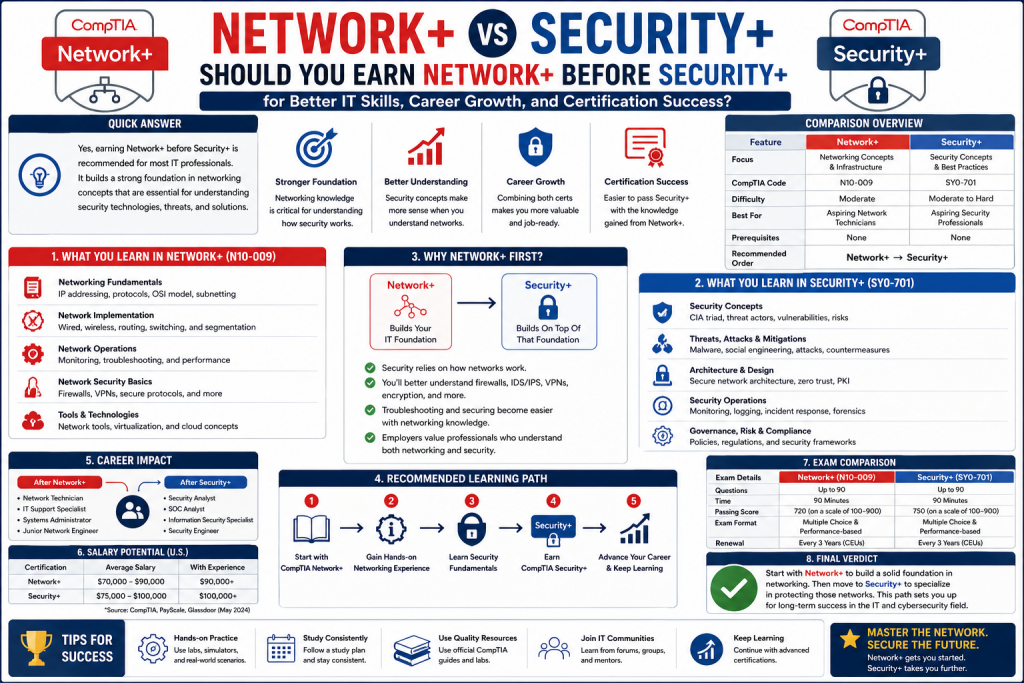
CompTIA Network+ and Security+ both help IT professionals understand how reliable systems operate, but they assess different responsibilities. Network+ focuses on connectivity, infrastructure, network operations and troubleshooting. Security+ is centered on protecting assets, recognizing threats, choosing safeguards, responding to incidents and understanding the governance behind security decisions. The right first step depends on what you already know and the work you intend to perform.
Network+ is not a formal prerequisite for Security+. You do not have to pass Network+ N10-009 before registering for Security+ SY0-701. Yet networking knowledge can make Security+ scenarios much easier to reason about. An exam item about a firewall, DNS response, segmentation rule or suspicious connection makes more sense when you can trace the ordinary network behavior before the security control changes it.
What Network+ prepares you to do
A networking role requires understanding how devices communicate and why communication fails. CompTIA Network+ assesses subjects such as physical and wireless connectivity, network addressing, protocols and services, operational processes, security concepts relevant to networks, and troubleshooting methodology. The current N10-009 version should be reviewed using its own official objectives, not an archived N10-007 or N10-008 table of contents.
A practical networking task might be diagnosing why an employee cannot reach an internal service. The process begins by identifying the source and destination, checking link state and address configuration, resolving the destination name, inspecting routes and determining whether a firewall or application problem is involved. Being able to isolate the failing layer prevents random changes that create additional problems.
Network+ is useful for people entering network support, infrastructure operations or general systems administration. It can also strengthen the foundation of people planning to move into cloud or security work because those environments still depend on addressing, routing, DNS and reliable connectivity.
What Security+ adds to networking knowledge
Security+ asks what an organization should protect, how attackers may compromise it and how controls should be selected and operated. Network concepts appear within a wider security context. Identity and authorization, data protection, incident response, vulnerability prioritization, resilience, security awareness and governance are also central. The current SY0-701 blueprint emphasizes operational decisions rather than merely reciting a network device’s function.
Suppose a remote employee cannot connect to a company service. A networking investigation may check IP connectivity, DNS resolution and routing. A security investigation also asks whether the identity is authorized, whether a conditional access policy blocked the connection, whether the device meets security requirements and whether the failed connection is a symptom of misuse. The correct diagnosis depends on both sets of evidence.
Security+ does not make networking knowledge optional. It uses it to explain security consequences. An overly broad network rule can expose a management interface. Segmentation can limit lateral movement but also interrupt essential service paths. A secure remote-access policy may be correct in principle while a stale client setting makes it fail. These are security decisions built on networking behavior, not alternatives to understanding that behavior.
A practical example: troubleshoot first, then secure
Imagine a small office network where a new application server cannot be reached from an administrator workstation. First establish normal connectivity requirements. Does the server have the right address and gateway? Does the client resolve the intended hostname? Is the route to the destination present? Is the application listening on the expected interface and port? Those questions reflect networking fundamentals.
Now consider the security boundary. Should every workstation reach the server’s management port? Should administrative access require a privileged identity or an approved jump host? What log evidence would show attempted unauthorized access? Which firewall rules are needed to allow business traffic while limiting the attack surface? A technically reachable server is not necessarily a securely configured server.
This exercise shows why the two credentials can complement each other. Network+ helps you establish what the connection should do; Security+ helps you evaluate whether that connection is appropriately protected and monitored. The Security+ network segmentation discussion makes the connection between the technical path and its trust boundary explicit.
Should a beginner take Network+ first?
For a beginner with limited networking experience, Network+ can provide an orderly way to learn addresses, switching, routing, wireless access and troubleshooting. That foundation reduces cognitive load when later Security+ lessons assume the learner knows what DNS, TLS, VLANs or firewalls actually do. It may also be directly relevant to help desk, network operations or infrastructure roles the learner can pursue while developing security skills.
For an experienced systems or network administrator, a separate Network+ examination may be unnecessary. Someone who already configures enterprise networks, manages VPNs and diagnoses routing problems may have enough foundation to study Security+ directly. The appropriate decision should be made through a skills review and a few diagnostic exercises, not by assuming every student must buy each CompTIA exam in a fixed order.
For a security career changer with strong programming but weak infrastructure fundamentals, it may be wise to spend focused time on networking even if certification is not the immediate goal. A lab that makes DNS, packet flow and subnet segmentation visible can be more valuable than memorizing a list of acronyms without context.
Choose the sequence from your target role
Read the actual job descriptions you are considering. A network support role may prioritize network monitoring, wireless troubleshooting, IP addressing and device configuration. A junior security analyst may emphasize alert analysis, common attack behavior and incident escalation, while expecting baseline network knowledge. A cloud infrastructure role may require both networking and security along with platform-specific skills. Exam names alone cannot reveal those requirements.
| Your current situation | Sensible immediate focus | Evidence to build |
|---|---|---|
| Little hands-on networking | Network+ concepts and basic lab work | Explain addressing, DNS, routes and a failed connection |
| Experienced network or systems operator | Security+ concepts, controls and incident reasoning | Analyze access, vulnerability and monitoring decisions |
| Seeking network operations work | Network troubleshooting and operations | Document a reproducible connectivity diagnosis |
| Seeking entry security work | Security+ with targeted network refresh | Triage synthetic alerts and justify security controls |
If you plan to pursue both, avoid studying the same foundational material repeatedly without increasing depth. After network protocols make sense, use them to understand attacks, segmentation choices and defensive monitoring. Every study block should lead to a capability you can demonstrate, not merely a completed page of notes.
Keep the exam versions and costs straight
CompTIA updates Network+ and Security+ independently. In October 2026, N10-009 and SY0-701 are relevant active exams, while a successor to SY0-701 is planned for late 2026. A study guide written for one version may not match a later version’s objectives. Check the CompTIA pages for your specific exam codes, available languages, dates and current registration rules before purchasing materials.
Both certifications have their own exam fees, and costs vary by market and purchase route. There is no credible universal salary increase attached to passing either one. The better return is the ability to qualify for relevant opportunities and perform the work competently. If taking both exams creates financial pressure, focus on the skills and credential most closely connected to your target role and develop other fundamentals through lower-cost practice where possible.
The A+, Network+, and Security+ comparison is useful if you are starting earlier in an IT career. If your decision is specifically between Network+ and Security+, concentrate on the operational difference: understanding network behavior versus selecting and maintaining security controls across an organization.
A short lab can help resolve uncertainty before you pay for either certification. Set up two disposable networked systems, record their addressing and expected traffic, then create a harmless connectivity failure. Diagnose it using the source address, destination address, name resolution and route instead of guessing. Once the connection works, apply a narrow security rule and verify that permitted traffic continues while the disallowed connection is blocked. This exercise exposes networking gaps and demonstrates how those gaps affect security decisions.
Then simulate an access-control problem. A test user can authenticate but should not be authorized to read a sensitive file. Explain the difference between network reachability, successful sign-in and permission to use the resource. If the first part is difficult, focus on Network+ fundamentals. If the network is clear but you cannot explain least privilege and evidence-based response, Security+ practice is the more relevant next step.
How to judge readiness for Security+
Try to explain how a client resolves a domain name, reaches a remote service and receives a response. Then ask which security controls might block or protect each stage. If you cannot explain the basic path, revisit networking fundamentals. If you can explain the path but struggle to interpret attack indicators, identity permissions, incident evidence or risk responses, your next study effort belongs closer to Security+.
For Security+ practice, use the SY0-701 operational scenarios to defend choices rather than memorize answer letters. For Network+ practice, work with authorized small network environments and document how you isolate failures. Strong preparation in both cases means you can explain why a proposed fix is appropriate and what it might break.
There is no universal rule that Network+ must always come before Security+. There is a practical rule: security decisions become more accurate when you understand the systems being protected. Choose the order that closes your real skills gap and supports the job you want to perform.
Continue exploring the technologies and certification concepts that matter most to you.