In a world where nearly every business operation, communication platform, entertainment service, and cloud application depends on stable internet access, network performance has become one of the most important elements of modern digital life. Whether an organization is transferring large volumes of cloud data, hosting video conferences, running remote offices, supporting online learning, or managing enterprise software, slow or unreliable internet can create serious bottlenecks. For individuals, the demand is equally intense. Streaming 4K video, online gaming, remote work, and smart home ecosystems all require stronger and more consistent internet performance than ever before.
As internet demand increases, many users eventually discover that a single connection may not always provide enough bandwidth, reliability, or redundancy. This challenge becomes especially noticeable during peak traffic periods when multiple users or systems compete for limited capacity. To solve this problem, networking technologies have evolved beyond simply upgrading to faster packages. One of the most powerful of these solutions is channel bonding.
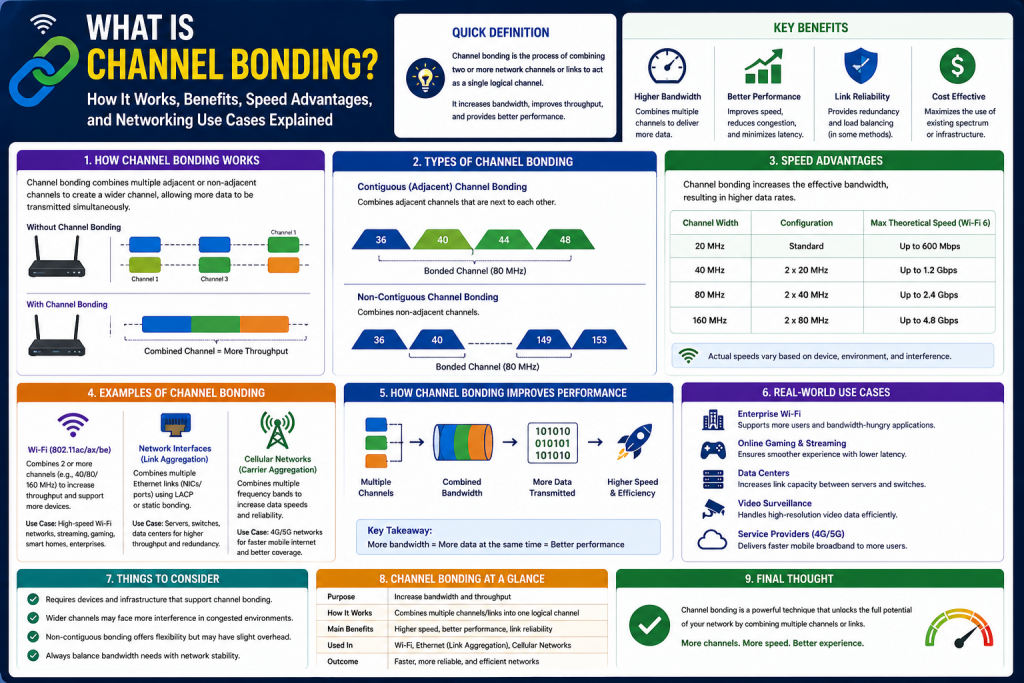
Channel bonding is a method of combining multiple internet or network connections into one unified communication path. Instead of relying on a single line of communication, channel bonding merges several separate channels so they can work together simultaneously. This creates a larger data pathway capable of handling more traffic, delivering greater speed, and improving network stability.
The concept can be compared to road traffic. A single-lane road can only handle a certain number of vehicles at a time, but when multiple lanes are added and traffic is intelligently distributed, more cars can move faster with fewer delays. In networking, each connection represents a lane, and channel bonding creates a broader highway for digital traffic.
This technology has become increasingly valuable for businesses moving operations to cloud platforms, organizations with multiple branch offices, rural users with limited broadband options, and professionals who depend on uninterrupted online services. By combining available resources into one more efficient network, channel bonding offers a practical strategy for improving both performance and reliability.
Defining Channel Bonding in Networking
At its core, channel bonding is the practice of aggregating two or more network connections so they function as one logical connection. These connections may be internet links, wireless channels, or communication pathways depending on the networking environment.
The primary goal is to increase total throughput while improving fault tolerance. Instead of each connection operating independently, bonded channels share the workload. Data is divided into packets and distributed across all available links, then reassembled at the destination. This coordinated process creates the appearance of one larger, faster, and more dependable connection.
For example, if one broadband connection provides 100 Mbps and another separate connection also provides 100 Mbps, channel bonding may allow them to work together to deliver significantly greater combined throughput under proper conditions. While exact speed gains depend on protocols, hardware, and provider support, the overall effect is often substantial.
Channel bonding can apply to multiple technologies, including:
- Broadband internet connections
- Cable modem channels
- Wireless frequency bands
- Ethernet links
- Cellular connections
This flexibility makes channel bonding useful across both enterprise and consumer environments.
Why Internet Performance Demands Have Changed
The rise of channel bonding is closely tied to how internet usage has evolved. Years ago, internet access primarily supported email, web browsing, and occasional downloads. Modern environments are dramatically different.
Today’s networks support:
- Cloud computing platforms
- Virtual desktops
- High-definition video conferencing
- Real-time collaboration tools
- Large database transfers
- Video streaming
- Online gaming
- Internet of Things ecosystems
- Remote workforces
Each of these services consumes bandwidth differently, and many require low latency as well as speed. A network that performs adequately for basic browsing may fail under enterprise cloud workloads or live streaming conditions.
Additionally, reliability is now just as important as speed. Businesses can lose productivity and revenue when outages occur, while gamers and remote workers may experience severe disruption from dropped connections or unstable latency.
Channel bonding addresses both concerns by expanding bandwidth and reducing dependence on a single point of failure.
How Channel Bonding Solves Common Network Problems
Channel bonding is not simply about making downloads faster. Its value lies in solving multiple networking challenges simultaneously.
Bandwidth Limitations
Single connections have maximum throughput limits. Once network traffic exceeds those limits, congestion occurs. Bonding multiple channels expands the available capacity, reducing slowdowns.
Connection Reliability
If one connection fails, bonded systems may reroute traffic through remaining channels. This redundancy improves uptime.
Traffic Distribution
Heavy workloads can overwhelm one connection, but channel bonding distributes traffic more efficiently across several paths.
Geographic Limitations
Users in rural or underserved areas often lack access to high-speed fiber or premium broadband. Combining DSL, LTE, or satellite links can create a more practical solution.
Latency Optimization
Some channel bonding solutions dynamically route traffic across the fastest available channels, improving responsiveness.
The Basic Mechanics Behind Channel Bonding
To understand channel bonding fully, it is important to examine how data moves across networks.
When data travels online, it is divided into packets. Each packet contains a portion of the information being transmitted, whether it is a video stream, file upload, or website request. Normally, these packets travel over one network path.
With channel bonding:
- Multiple channels are available
- Data packets are divided intelligently
- Packets are distributed across multiple links
- Packets are reassembled at the destination
This process requires coordination between sending and receiving systems. Specialized software or hardware manages packet sequencing so data arrives correctly.
Without this management layer, splitting traffic could create errors, out-of-order packets, or failed sessions.
The Evolution of Bonding Technologies
Channel bonding did not emerge overnight. It evolved alongside broader networking innovations.
Early forms appeared in telecommunications systems that combined lines for higher throughput. As internet technologies matured, broadband providers adopted similar concepts for cable and DSL. Enterprise networking then expanded the concept through link aggregation and WAN optimization.
Today, bonding technologies are more advanced than ever, incorporating:
- Load balancing
- Software-defined WAN
- Multi-WAN routers
- DOCSIS channel bonding
- LTE aggregation
- Wi-Fi spectrum bonding
These developments make channel bonding accessible to small businesses, enterprises, and even home users.
Key Terminology Related to Channel Bonding
Understanding channel bonding also requires familiarity with related networking concepts.
Bandwidth
Bandwidth refers to the total amount of data that can be transmitted over a connection in a given period.
Throughput
Throughput is the actual amount of successful data transfer.
Latency
Latency measures delay in communication.
Packet
A packet is a unit of data transmitted over a network.
Load Balancing
Load balancing distributes traffic across multiple resources.
Redundancy
Redundancy provides backup paths in case one fails.
Channel bonding often overlaps with these concepts but focuses specifically on combining channels for enhanced performance.
Real-World Business Applications
Businesses increasingly depend on uninterrupted connectivity. Channel bonding can support:
Cloud Migration
Organizations using cloud platforms require stable upstream and downstream capacity.
Remote Branch Offices
Locations with weak broadband can combine multiple lower-speed connections.
Video Collaboration
Unified communications systems benefit from improved bandwidth and lower latency.
Disaster Recovery
Redundant bonded links help maintain operations during outages.
Home and Consumer Applications
Although often associated with enterprise use, channel bonding is also relevant for home users.
Gamers
Reduced lag and stable traffic paths improve online gaming.
Streamers
Higher upload capacity supports live broadcasting.
Remote Workers
Stable video conferencing and cloud collaboration become more reliable.
Smart Homes
Multiple connected devices benefit from larger bandwidth pools.
Advantages Over Traditional Single-Link Upgrades
Many people assume upgrading to a faster plan is the only answer. While that can help, channel bonding may offer unique benefits:
- Uses multiple providers
- Adds redundancy
- Can improve both speed and reliability
- May be more practical in underserved areas
- Can optimize specific traffic types
This makes channel bonding a strategic solution rather than simply a speed boost.
Common Misunderstandings About Channel Bonding
Despite its benefits, misconceptions are common.
Myth: Channel bonding always doubles speed
Actual gains depend on implementation, protocol overhead, and provider compatibility.
Myth: It only works for large businesses
Consumer software solutions make it accessible for individuals.
Myth: It replaces all network issues
Bonding improves capacity but does not solve poor routing, server issues, or ISP outages alone.
Myth: It is the same as load balancing
Load balancing distributes traffic, while true bonding combines channels more directly.
When Channel Bonding Makes the Most Sense
Channel bonding is especially useful when:
- One connection is insufficient
- Reliability is critical
- Multiple affordable links are available
- Uptime matters
- Geographic limitations restrict options
Strategic Importance in Modern Networking
As organizations become more dependent on digital operations, channel bonding aligns with broader goals:
- Business continuity
- Scalability
- Performance optimization
- Cost control
- Network resilience
For network engineers, understanding channel bonding is no longer optional in many environments. It represents a valuable skill in designing efficient infrastructure.
Foundation for Advanced Networking Knowledge
Channel bonding also introduces concepts essential for advanced certifications and professional networking careers, including:
- WAN optimization
- Multi-path networking
- SD-WAN
- DOCSIS
- Redundancy planning
- Enterprise architecture
Mastering this concept builds stronger networking fundamentals.
Understanding the Core Functionality of Channel Bonding
To fully appreciate the power of channel bonding, it is essential to move beyond the basic definition and explore the mechanics behind how it actually works. Channel bonding is not simply a matter of plugging in multiple internet connections and instantly multiplying speed. Instead, it is a sophisticated networking process that involves traffic management, packet distribution, synchronization, and intelligent coordination between hardware, software, and communication protocols. At its core, channel bonding requires a system capable of treating multiple separate connections as components of one larger logical pathway. This means data must be carefully divided into packets, assigned across multiple channels based on availability and performance, transmitted efficiently, and then correctly reassembled at the destination without errors or delays. This process is far more complex than basic load balancing because true bonding often allows a single session or application to use multiple links simultaneously rather than simply assigning separate tasks to different connections. Effective implementation also depends on managing differences in latency, bandwidth, and packet timing across channels, since not all connections perform identically.
Specialized routers, bonding software, or compatible modem technologies are often necessary to orchestrate these tasks properly. Communication protocols play a crucial role by ensuring packet integrity, sequencing, and failover support when disruptions occur. In essence, channel bonding functions as an advanced orchestration system that transforms multiple fragmented communication resources into a coordinated, high-performance network architecture designed for efficiency, resilience, and scalability.
At a technical level, channel bonding aggregates multiple communication channels into one logical data stream. These channels may include cable broadband lines, DSL links, Ethernet interfaces, cellular networks, or wireless frequencies. Rather than treating each connection independently, bonding technology creates a framework in which these channels operate together as one larger communication resource.
This means your internet traffic is divided, transmitted, and reconstructed in ways that maximize efficiency while minimizing disruption. The result is greater throughput, improved reliability, and often lower latency.
To understand this process more clearly, imagine a shipping company that needs to move thousands of packages daily. Using only one truck would create delays, bottlenecks, and inefficiency. Instead, the company uses multiple trucks operating simultaneously, assigns packages strategically, and ensures all deliveries arrive correctly. Channel bonding functions similarly, except the “packages” are data packets and the “trucks” are network channels.
Data Packets and Traffic Distribution
All internet communication relies on packets. Whenever you stream a video, upload a file, join a video call, or load a webpage, your data is broken into small pieces called packets. These packets travel independently through networks and are reassembled when they reach their destination.
With a traditional single-link connection, all packets travel over one pathway. This creates limitations because:
- The connection has finite bandwidth
- Congestion may slow traffic
- Failure means total disruption
- Peak demand can overwhelm capacity
Channel bonding changes this model by distributing packets across multiple channels.
Packet Splitting
The bonding system examines outgoing data and divides it into smaller packet groups.
Packet Assignment
These groups are assigned across available channels based on speed, availability, and efficiency.
Transmission
Packets travel simultaneously through separate links.
Reassembly
At the receiving end, packets are reorganized into the correct sequence.
This process requires advanced coordination to ensure data integrity.
Single Session Bonding vs Load Balancing
One of the most misunderstood aspects of channel bonding is the difference between true bonding and load balancing.
Load Balancing
Load balancing distributes separate sessions or users across multiple connections. For example:
- User A uses ISP 1
- User B uses ISP 2
This improves total network efficiency but does not combine channels for one user session.
True Channel Bonding
True bonding allows one session, such as a file download or video stream, to use multiple channels simultaneously.
For example:
- One large download uses DSL + LTE + Fiber together
This distinction is critical because true bonding often requires specialized software, ISP support, or dedicated hardware.
Downstream Channel Bonding Explained
Downstream bonding focuses on incoming traffic, meaning data traveling from the internet to the user.
This includes:
- File downloads
- Video streaming
- Web browsing
- Cloud application access
- Software updates
How Downstream Bonding Works
Multiple downstream channels are grouped together, expanding total receiving capacity.
For example:
If one downstream channel provides 50 Mbps and four channels are bonded, total potential throughput may increase significantly depending on system efficiency.
Benefits of Downstream Bonding
- Faster downloads
- Smoother streaming
- Better performance during heavy traffic
- Improved support for multiple users
DOCSIS and Cable Internet
Cable providers commonly use downstream bonding through DOCSIS technology, where multiple frequency channels are combined to increase consumer broadband speeds.
This is one reason modern cable modems often advertise 16×4, 24×8, or 32×8 configurations. The first number generally refers to downstream channels.
Upstream Channel Bonding Explained
While downstream often gets more attention, upstream bonding is equally important, especially in modern cloud environments.
Upstream traffic includes:
- File uploads
- Video conferencing
- Cloud backups
- Live streaming
- VoIP communications
Why Upstream Matters More Today
Older internet models prioritized downloads because users mainly consumed content. Modern environments demand two-way performance because users now create, upload, collaborate, and stream constantly.
How Upstream Bonding Works
Multiple upload channels are combined to increase outbound data capacity.
Benefits
- Faster cloud backups
- Better video conferencing quality
- More stable live streaming
- Reduced upload bottlenecks
- Improved SaaS productivity
For businesses using remote collaboration platforms, upstream bonding can significantly improve communication quality.
The Role of Bonding Protocols
Protocols determine how bonding occurs. Different technologies use different methods.
Link Aggregation Control Protocol (LACP)
Often used in enterprise Ethernet environments, LACP combines multiple physical links into one logical connection.
Multi-Link PPP
Used in some WAN configurations to combine links.
DOCSIS
Used by cable ISPs to bond channels.
SD-WAN Platforms
Modern software-defined WAN solutions often incorporate bonding-like traffic orchestration.
Protocols matter because not all bonding methods work the same way or in every environment.
Hardware Requirements for Channel Bonding
True channel bonding often depends on compatible hardware.
Bonding Routers
Multi-WAN routers are commonly used for combining multiple internet sources.
Features
- Multiple WAN ports
- Policy routing
- Failover
- Traffic shaping
- Session persistence
Modems
Cable modems supporting DOCSIS channel bonding are common in residential broadband.
Switches
Enterprise switches may use port aggregation for internal network bonding.
Wireless Access Points
Some wireless systems bond spectrum bands for faster throughput.
Software-Based Bonding Solutions
Hardware is not the only path. Software solutions can create bonding environments without specialized infrastructure.
Common Functions
- VPN tunneling
- Packet distribution
- Session management
- Connection prioritization
Advantages
- Lower cost
- Easier deployment
- Flexibility
Disadvantages
- Subscription costs
- Potential overhead
- Variable performance
Software bonding is often useful for mobile users combining Wi-Fi and LTE.
Synchronization Challenges
Channel bonding introduces synchronization complexity because multiple links may have different:
- Speeds
- Latencies
- Packet loss rates
- Jitter
For example:
Fiber may deliver packets faster than LTE.
If packets arrive out of order, the system must buffer and reorganize them before delivery.
This creates technical challenges:
Latency Mismatch
Slow channels can delay full packet reconstruction.
Packet Reordering
Data must be sequenced properly.
Overhead
Management processes consume resources.
Effective bonding solutions minimize these issues through intelligent traffic engineering.
Redundancy and Failover
A major strength of channel bonding is resilience.
Traditional Single-Link Risk
If one connection fails, operations stop.
Bonded Environment
If one link fails:
- Traffic reroutes
- Remaining channels continue
- Downtime decreases
This makes channel bonding highly valuable for:
- Financial systems
- Healthcare platforms
- E-commerce
- Remote offices
- Security systems
Wireless Channel Bonding
Wireless technologies also use bonding principles.
Wi-Fi
Modern Wi-Fi standards may combine channels for wider bandwidth.
Cellular
LTE Advanced and 5G use carrier aggregation to combine frequencies.
Benefits
- Faster mobile speeds
- Better spectrum efficiency
- Improved coverage
DOCSIS Channel Bonding Deep Dive
DOCSIS is one of the most recognized examples.
DOCSIS 3.0
Introduced extensive channel bonding for cable internet.
DOCSIS 3.1
Expanded efficiency using OFDM.
Why It Matters
DOCSIS bonding allows cable ISPs to compete with fiber by maximizing infrastructure.
Enterprise Use Cases
Businesses often use channel bonding in:
Branch Connectivity
Combining MPLS, broadband, and LTE.
Cloud Applications
Ensuring stable SaaS access.
Unified Communications
Improving VoIP and video reliability.
Business Continuity
Maintaining uptime during outages.
Performance Factors That Influence Results
Channel bonding performance depends on:
ISP Support
Some providers limit certain forms of aggregation.
Hardware Quality
Cheap devices may bottleneck.
Protocol Efficiency
Not all systems bond equally.
Latency Diversity
Mixed connections can create inconsistencies.
Application Type
Some applications benefit more than others.
Security Considerations
Bonding multiple links can introduce security complexity.
Potential Risks
- More endpoints
- VPN dependency
- Configuration errors
- Policy inconsistencies
Best Practices
- Encryption
- Centralized management
- Firewall integration
- Monitoring
Monitoring and Optimization
Successful channel bonding requires ongoing performance analysis.
Key Metrics
- Throughput
- Latency
- Jitter
- Packet loss
- Failover time
Optimization Strategies
- Prioritize critical traffic
- Remove unstable links
- Adjust routing policies
Common Technical Misconceptions
More links always equals more speed
Only if properly configured.
Any router can do it
Many cannot.
Bonding removes all outages
It reduces risk but does not eliminate external failures.
It is only for ISPs
Businesses and individuals can use it too.
Why Understanding Technical Mechanics Matters
For network professionals, channel bonding is more than a convenience feature. It represents core networking principles:
- Resource optimization
- Redundancy engineering
- Throughput maximization
- Protocol management
- Traffic engineering
Mastering these concepts supports broader understanding of enterprise infrastructure.
The Strategic Value of Channel Bonding in Modern Connectivity
As digital dependency expands across business, education, healthcare, entertainment, and cloud infrastructure, internet performance is no longer measured solely by raw speed. Modern users require a network that is fast, reliable, scalable, resilient, and capable of adapting to changing workloads. This broader demand is precisely where channel bonding demonstrates its greatest strategic value.
Higher upload and download capacity is one of the most practical advantages of channel bonding, particularly for organizations managing increasingly data-intensive digital operations. As businesses migrate critical functions to cloud environments, they often depend on continuous data movement for backups, software updates, team collaboration, customer communications, and real-time application access. For example, companies moving data-heavy workflows to cloud environments frequently encounter congestion during large-scale backups, collaborative file sharing, virtual meetings, database replication, or application synchronization across multiple locations. When a single connection becomes saturated, performance can degrade significantly, leading to slower transfers, delayed productivity, and operational frustration. Channel bonding can reduce these bottlenecks by increasing the available communication pipeline, effectively creating a broader path for simultaneous data transmission. This expanded capacity allows large files to upload faster, cloud applications to respond more smoothly, and distributed teams to collaborate with fewer interruptions. It can also improve performance during scheduled backup windows, where high-volume data transfers might otherwise interfere with regular business operations. In industries such as media production, engineering, software development, and finance, where large datasets are frequently transferred between local systems and cloud platforms, higher bonded capacity can directly improve efficiency. By combining multiple connections, businesses gain a more scalable infrastructure that better supports modern digital transformation without being constrained by a single communication bottleneck.
Channel bonding is often initially viewed as a speed enhancement technology, but its true importance extends far beyond faster downloads. It serves as a multifaceted networking solution that can improve uptime, reduce disruptions, strengthen continuity, optimize resource use, and support mission-critical operations. For organizations and individuals alike, it can transform fragmented connectivity into a more powerful and stable infrastructure.
Channel bonding is often initially viewed as a speed enhancement technology, but its true importance extends far beyond faster downloads. While increased bandwidth is certainly one of its most visible advantages, channel bonding serves as a multifaceted networking solution designed to address broader operational priorities that are essential in today’s digitally dependent environments. It can improve uptime by creating redundancy across multiple connections, allowing traffic to continue flowing even if one link fails. This capability helps reduce disruptions that could otherwise interrupt business transactions, cloud access, remote collaboration, or customer communications. By strengthening continuity, channel bonding supports organizations that cannot afford prolonged outages, including healthcare providers, financial institutions, educational systems, logistics operations, and distributed enterprises. It also optimizes resource use by intelligently distributing traffic across available channels, helping prevent congestion, improving load efficiency, and making better use of existing infrastructure investments. Rather than forcing organizations to depend entirely on one provider or one physical connection, channel bonding creates flexibility that can support growth, adaptation, and resilience. For mission-critical operations where connectivity directly affects productivity, security, or customer trust, this flexibility can be a major strategic advantage. For organizations and individuals alike, channel bonding can transform fragmented connectivity into a more powerful, stable, and adaptive infrastructure capable of meeting modern demands for performance, reliability, and operational confidence.
Whether a company is operating remote offices, a gamer is minimizing latency, a content creator is streaming live video, or a rural household is compensating for limited ISP options, channel bonding offers a practical path toward stronger digital performance.
Primary Benefits of Channel Bonding
Understanding why channel bonding matters requires examining its major advantages in depth.
Increased Bandwidth and Throughput
The most widely recognized benefit is expanded bandwidth.
By combining multiple channels, users can often achieve significantly greater total throughput than a single connection can provide alone. This expanded bandwidth supports:
- Faster large file transfers
- Smoother 4K and 8K video streaming
- Better support for multiple simultaneous users
- Improved enterprise cloud performance
- Higher upload and download capacity
Higher upload and download capacity is one of the most practical advantages of channel bonding, particularly for organizations managing increasingly data-intensive digital operations. As businesses migrate critical functions to cloud environments, they often depend on continuous data movement for backups, software updates, team collaboration, customer communications, and real-time application access. For example, companies moving data-heavy workflows to cloud environments frequently encounter congestion during large-scale backups, collaborative file sharing, virtual meetings, database replication, or application synchronization across multiple locations. When a single connection becomes saturated, performance can degrade significantly, leading to slower transfers, delayed productivity, and operational frustration. Channel bonding can reduce these bottlenecks by increasing the available communication pipeline, effectively creating a broader path for simultaneous data transmission. This expanded capacity allows large files to upload faster, cloud applications to respond more smoothly, and distributed teams to collaborate with fewer interruptions. It can also improve performance during scheduled backup windows, where high-volume data transfers might otherwise interfere with regular business operations
. In industries such as media production, engineering, software development, and finance, where large datasets are frequently transferred between local systems and cloud platforms, higher bonded capacity can directly improve efficiency. By combining multiple connections, businesses gain a more scalable infrastructure that better supports modern digital transformation without being constrained by a single communication bottleneck.
This is especially valuable when no single high-speed provider is available, but multiple moderate-speed connections can be combined.
Enhanced Reliability Through Redundancy
In many scenarios, reliability matters more than maximum speed. While high bandwidth is valuable for handling heavy workloads, uninterrupted connectivity is often the true foundation of productivity, customer trust, and operational continuity. A business that loses internet access during customer transactions, VoIP calls, cloud application sessions, remote desktop operations, or real-time communications may face immediate operational disruption, financial loss, reduced employee productivity, and even long-term reputational damage
. For example, an e-commerce company experiencing an outage during peak sales hours could lose substantial revenue, while a healthcare provider relying on cloud-based systems may encounter serious service interruptions that affect patient care. In customer service environments, dropped VoIP systems can result in missed opportunities and frustrated clients. Channel bonding reduces this risk by adding redundancy, allowing multiple internet connections to function together so that if one fails, others can continue carrying traffic.
This failover capability creates a more resilient network infrastructure capable of maintaining business continuity even during ISP outages, hardware failures, or localized network disruptions. Beyond failover, redundancy also improves stability during congestion by distributing traffic more effectively. For organizations where uptime is directly tied to revenue, service quality, or customer confidence, channel bonding provides not just performance enhancement, but a critical safeguard against costly interruptions.
Reduced Latency and Better Real-Time Performance
Latency, not just bandwidth, determines responsiveness.
High latency can disrupt:
- Video conferencing
- Online gaming
- Voice communication
- Financial trading
- Remote desktop systems
Some channel bonding systems intelligently route traffic through the lowest-latency paths, improving user experience.
For example, gamers may benefit from more stable route optimization, while remote professionals can experience smoother virtual meetings.
Scalability Without Complete Infrastructure Replacement
Channel bonding can also provide scalability.
Rather than replacing an entire network infrastructure immediately, organizations may combine existing connections to meet growing demand.
Advantages
- Lower upgrade costs
- Flexible expansion
- Faster deployment
- Improved return on current infrastructure
This can be particularly attractive for small businesses seeking enterprise-like resilience without massive capital expenditure.
Top Real-World Use Cases for Channel Bonding
Enterprise Cloud Migration
As businesses increasingly depend on cloud software, SaaS platforms, and distributed teams, internet capacity requirements rise dramatically.
Channel bonding supports:
- Microsoft 365 or Google Workspace environments
- Cloud backups
- Virtual desktop systems
- Remote server management
- Large-scale collaboration tools
This ensures cloud adoption does not overwhelm existing network resources.
Remote and Rural Connectivity
Rural areas often face infrastructure challenges, including:
- Limited fiber access
- Weak DSL
- Satellite dependency
- Cellular variability
By bonding DSL, LTE, fixed wireless, or satellite connections, users may create more practical broadband alternatives.
This can improve:
- Distance learning
- Telemedicine
- Remote work
- Agricultural IoT
Content Creation and Live Streaming
Streamers and creators require strong upstream performance.
Uploading HD or 4K streams demands:
- Stable upload rates
- Low jitter
- Minimal packet loss
Channel bonding can combine multiple upload sources to reduce interruptions.
Disaster Recovery and Continuity Planning
Businesses increasingly include bonded networks in disaster recovery strategies.
Examples:
- LTE backup for wired outages
- Secondary ISP failover
- Temporary office deployment
This flexibility helps organizations maintain operational resilience.
Education and Hybrid Learning
Schools, universities, and online educators depend on stable bandwidth for:
- Video classrooms
- Learning platforms
- Digital testing
- Cloud resources
Channel bonding can help campuses distribute heavy traffic more effectively.
Limitations and Challenges of Channel Bonding
Despite its strengths, channel bonding is not universally perfect.
Requirement for Multiple Connections
The most obvious limitation is that bonding generally requires at least two viable connections.
This may increase:
- Subscription costs
- Equipment costs
- Complexity
For some users, a single premium fiber line may be more practical.
Technical Complexity
Proper deployment may involve:
- Router configuration
- ISP compatibility
- Software setup
- Traffic policy management
Misconfiguration can reduce benefits or create instability.
Variable Performance Gains
Performance is influenced by:
- Link quality
- Latency mismatch
- Protocol overhead
- Provider restrictions
Not all environments will experience linear speed increases.
Cost Considerations
Potential expenses include:
- Multi-WAN routers
- Bonding software subscriptions
- Additional service plans
- IT expertise
Decision-makers should compare these costs against operational needs.
Compatibility Issues
Not all applications or ISPs fully support every bonding model.
Some services may function better with load balancing than true packet-level bonding.
Implementation Strategies for Successful Deployment
Hardware-Based Implementation
This approach uses specialized routers, switches, or modems.
Best For
- Businesses
- Branch offices
- Permanent installations
Strengths
- Better control
- Enterprise features
- Security integration
Weaknesses
- Higher upfront costs
Software-Based Implementation
Software platforms can bond multiple connections on devices.
Best For
- Remote workers
- Travelers
- Small businesses
Strengths
- Flexible
- Easier deployment
- Lower initial cost
Weaknesses
- Subscription dependency
- Variable performance
Hybrid Models
Some organizations combine hardware and software for maximum flexibility.
Best Practices for Optimization
Assess Connection Diversity
Using identical providers may reduce redundancy.
Monitor Performance
Regularly measure:
- Packet loss
- Jitter
- Throughput
Prioritize Critical Applications
Business traffic should often take precedence over casual use.
Secure the Environment
Use:
- VPNs
- Firewalls
- Encryption
- Centralized management
Channel Bonding vs Competing Technologies
Fiber Upgrades
Fiber may outperform bonding in some areas, but may not always be available.
Load Balancing
Load balancing distributes users; bonding combines capacity.
SD-WAN
SD-WAN may incorporate bonding principles with broader orchestration.
5G
5G offers speed, but channel bonding may still complement it through multi-link resilience.
The Future of Channel Bonding
As networking evolves, channel bonding is likely to become more intelligent and integrated.
AI-Driven Traffic Management
Future systems may dynamically optimize:
- Cost
- Latency
- Security
- Workload
5G and Multi-Carrier Aggregation
Cellular evolution will expand bonding opportunities.
Edge Computing
Distributed systems may benefit from localized bonded links.
IoT Expansion
Billions of devices may require more adaptive connectivity frameworks.
Software-Defined Infrastructure
Channel bonding may increasingly merge into broader software-defined ecosystems.
Why Channel Bonding Remains Professionally Important
For IT professionals, network engineers, and system administrators, understanding channel bonding provides strategic advantages.
It strengthens expertise in:
- Network resilience
- WAN architecture
- Cloud readiness
- Redundancy planning
- Throughput engineering
These competencies are increasingly relevant in certification paths and enterprise networking careers.
Decision Framework: Is Channel Bonding Right for You?
Channel bonding is often ideal when organizations or individuals face connectivity challenges that cannot be solved by a single traditional internet connection alone. It becomes especially valuable when reliability is essential, such as in businesses that depend on uninterrupted cloud applications, video conferencing, e-commerce systems, or remote operational infrastructure where downtime can lead to productivity loss or financial disruption.
It is also highly effective when multiple moderate-speed connections already exist, allowing users to combine DSL, cable, LTE, fixed wireless, or other available links into a stronger unified network rather than relying on one limited pathway. As cloud workloads continue growing, channel bonding can help support bandwidth-heavy services like SaaS platforms, cloud backups, virtual collaboration tools, and remote desktop environments by distributing traffic more efficiently. In rural or underserved regions where fiber infrastructure may be unavailable or unreliable, channel bonding can provide a practical alternative by merging available lower-speed services into a more capable and resilient solution. It is equally beneficial when uptime matters for mission-critical environments such as healthcare systems, branch offices, security networks, educational platforms, or customer-facing digital services where continuous connectivity is a priority.
However, channel bonding may be less necessary in environments where affordable high-speed fiber is already available and provides sufficient bandwidth, low latency, and reliability on its own. In these cases, a single premium fiber connection may offer simpler management with fewer configuration requirements. It may also be less practical when technical management resources are limited, since deploying and maintaining channel bonding can involve hardware compatibility checks, software configuration, network policy management, and ongoing monitoring. For users or businesses without networking expertise, the complexity may outweigh the advantages. Additionally, if the total costs of multiple service subscriptions, bonding hardware, or software licensing exceed the operational value gained, a simpler connectivity model may be more cost-effective. Ultimately, the decision should be based on balancing performance needs, budget, technical capacity, and long-term operational goals.
Common Mistakes to Avoid
Ignoring Latency Differences
Mixed links can create inefficiencies.
Overlooking Security
More links mean broader exposure.
Assuming Automatic Performance
Optimization is essential.
Choosing Price Over Stability
Low-quality links may reduce overall value.
Conclusion
Channel bonding represents far more than a networking speed boost. It is a sophisticated strategy for enhancing internet performance through bandwidth aggregation, redundancy, flexibility, and intelligent traffic management. By combining multiple channels into one cohesive communication system, channel bonding can empower businesses, strengthen remote operations, improve cloud adoption, support modern content creation, and expand connectivity in underserved environments.
Its benefits are especially relevant in a digital era where uptime, adaptability, and performance consistency often matter just as much as speed itself. Although channel bonding does involve costs, technical complexity, and implementation considerations, its strategic advantages can outweigh these challenges when properly deployed.
As networks continue evolving toward software-defined ecosystems, AI optimization, cloud dependency, and distributed workforces, channel bonding is likely to remain an important component of modern connectivity planning. For organizations and individuals seeking stronger, more resilient internet infrastructure, channel bonding is not simply an option—it is increasingly becoming a competitive advantage.
Continue exploring the technologies and certification concepts that matter most to you.