Palo Alto Networks has established itself as a global leader in cybersecurity, offering advanced solutions that protect networks, cloud environments, and enterprise systems from modern cyber threats. As organizations increasingly rely on digital infrastructure, the need for skilled professionals who can secure these systems has grown significantly. Palo Alto certifications are designed to validate the knowledge and practical skills required to manage and protect IT environments using their technologies.
These certifications are not just academic credentials. They represent a professional’s ability to work with real-world security tools and respond effectively to cyber risks. For individuals entering the cybersecurity field or looking to advance their careers, Palo Alto certifications provide a clear and structured pathway to gaining expertise.
The certification program is designed to accommodate learners at different stages, from beginners with little experience to advanced professionals who manage complex enterprise security systems. This flexibility makes it one of the most accessible and practical certification tracks in the cybersecurity domain.
The Purpose of Palo Alto Certification
The primary goal of Palo Alto certification is to prepare IT professionals to defend against modern cyber threats. This involves understanding how attacks are carried out, identifying vulnerabilities, and implementing strategies to prevent breaches. Certified individuals are trained to secure networks, monitor suspicious activity, and respond to incidents in a timely and effective manner.
In today’s threat landscape, organizations face a wide range of risks, including ransomware, phishing attacks, insider threats, and data breaches. Certifications ensure that professionals are equipped with the skills needed to handle these challenges. They also provide a standardized way for employers to evaluate a candidate’s technical abilities.
Another important aspect of certification is credibility. Holding a recognized certification from a reputable organization like Palo Alto Networks signals to employers that you have undergone rigorous training and assessment. This can significantly improve your chances of landing a job or advancing within your current role.
Structure of the Certification Path
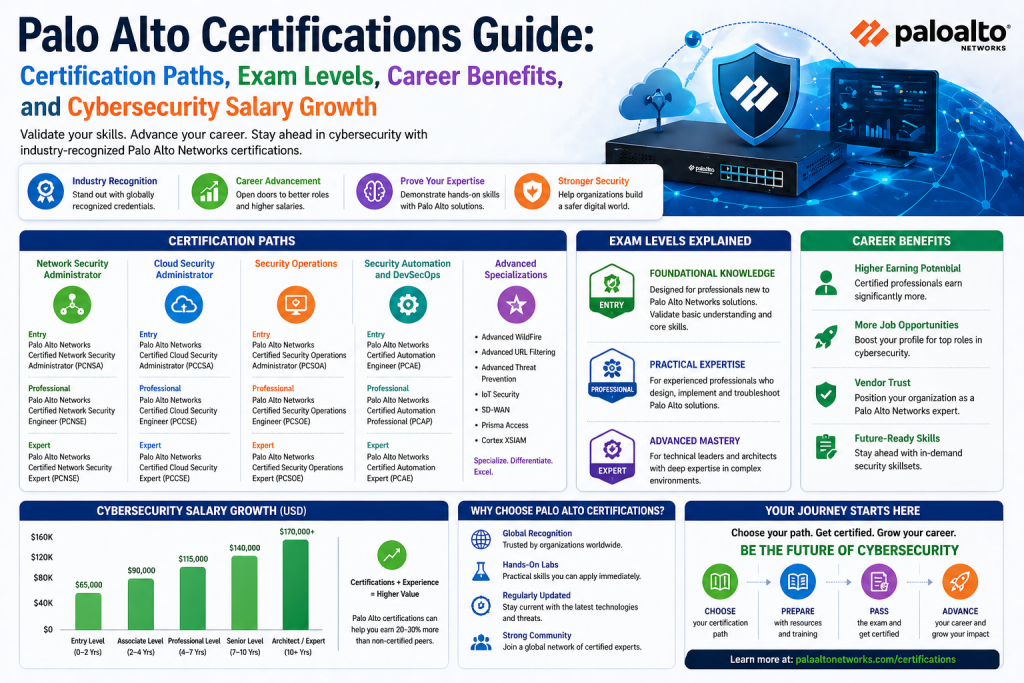
The Palo Alto certification path is carefully structured to guide learners from foundational knowledge to advanced expertise. It includes multiple levels, each focusing on specific skills and areas of cybersecurity.
At the entry level, certifications introduce basic concepts such as the cybersecurity landscape, common threats, and fundamental security practices. As learners progress, they encounter more complex topics like firewall configuration, threat detection, and network security management.
Advanced certifications require hands-on experience and a deep understanding of security technologies. These levels are designed for professionals who are responsible for designing, implementing, and maintaining secure systems in enterprise environments.
This step-by-step approach ensures that candidates build a strong foundation before moving on to more challenging material. It also allows individuals to progress at their own pace, depending on their experience and career goals.
Why Certifications Matter in Cybersecurity
Cybersecurity is a rapidly evolving field, and staying updated with the latest technologies and threats is essential. Certifications play a crucial role in this process by providing structured learning and validation of skills.
Employers often use certifications as a benchmark when hiring or promoting employees. In a competitive job market, having a certification can give you an edge over other candidates. It demonstrates your commitment to professional development and your ability to meet industry standards.
Certifications also help bridge the gap between theoretical knowledge and practical application. Many training programs include hands-on labs and real-world scenarios, allowing candidates to apply what they have learned in a controlled environment.
In addition to technical skills, certifications also help develop critical thinking and problem-solving abilities. These are essential qualities for cybersecurity professionals who must analyze complex situations and respond quickly to threats.
Comparison with Check Point Certifications
When exploring cybersecurity certifications, many professionals compare Palo Alto certifications with those offered by Check Point. Both companies are well-known for their security solutions, and their certifications are highly regarded in the industry.
Both certification tracks follow a similar structure, with multiple levels ranging from beginner to expert. They also focus on vendor-specific technologies, meaning that candidates learn how to use the tools and platforms developed by each company.
In terms of content, there is considerable overlap. Topics such as firewall management, VPN configuration, threat prevention, and network security are covered in both certification paths. This reflects the common challenges faced by cybersecurity professionals, regardless of the specific tools they use.
Salary expectations for certified professionals in both tracks are also comparable. On average, individuals can expect to earn competitive salaries, depending on their experience and role. This makes both certification paths attractive options for those looking to advance their careers.
The main difference lies in the products and technologies used. Palo Alto certifications focus on Palo Alto tools, while Check Point certifications are centered around their own solutions. As a result, the choice between the two often depends on the technologies used within your organization.
Choosing the Right Certification Path
Selecting the right certification path is an important decision that can impact your career. One of the key factors to consider is your current work environment. If your organization uses Palo Alto technologies, pursuing Palo Alto certification can help you gain relevant skills and improve your performance at work.
Another factor is your career goals. Some professionals prefer to specialize in a specific technology, while others aim to develop a broader skill set. Vendor-specific certifications are ideal for those who want to become experts in a particular platform.
It is also worth considering the demand for specific skills in your region or industry. Researching job postings and industry trends can help you identify which certifications are most valued by employers.
In many cases, professionals choose to pursue multiple certifications over time. This allows them to expand their knowledge and increase their versatility in the job market.
Entry-Level Certification Overview
The Palo Alto Networks Certified Cybersecurity Entry-Level Technician certification is the starting point for individuals who are new to cybersecurity. It is designed to provide a comprehensive introduction to key concepts and practices.
This certification covers a wide range of topics, including the cybersecurity landscape, common threats, and the lifecycle of cyberattacks. Candidates learn how attacks are planned and executed, as well as how to defend against them.
Other areas of focus include network security technologies, cloud security, and malware analysis. These topics provide a solid foundation for understanding how modern IT environments are protected.
One of the advantages of this certification is that it does not require prior experience. However, having a basic understanding of networking concepts can be beneficial. This makes it an ideal choice for students, career changers, and entry-level IT professionals.
Key Topics Covered in Entry-Level Certification
The entry-level certification introduces candidates to several important areas of cybersecurity. Understanding these topics is essential for building a strong foundation.
The cybersecurity landscape involves studying the current state of cyber threats and the techniques used by attackers. This includes understanding different types of malware, phishing attacks, and social engineering tactics.
The cyberattack lifecycle explains the an attack goes through, from initial reconnaissance to execution and impact. By understanding this process, professionals can identify and take steps to prevent attacks.
Network security technologies focus on the tools and methods used to protect data as it travels across networks. This includes firewalls, intrusion detection systems, and encryption techniques.
Cloud security and data center security are also important topics, as many organizations rely on cloud services to store and process data. Understanding how to secure these environments is critical for modern cybersecurity professionals.
Importance of Building a Strong Foundation
Starting with an entry-level certification is crucial for long-term success in cybersecurity. Without a solid understanding of basic concepts, it can be difficult to grasp more advanced topics.
A strong foundation includes knowledge of networking principles, security best practices, and common threats. It also involves developing analytical skills and the ability to when .
By mastering these basics, candidates are better prepared to pursue intermediate and advanced certifications. This progression ensures that learning is structured and effective.
Another benefit of starting at the beginner level is increased confidence. Successfully earning a certification early in your career can motivate you to continue learning and pursuing more advanced credentials.
Training and Preparation Strategies
Preparing for a certification exam requires dedication and a structured approach. Palo Alto certification exams are designed to test both knowledge and practical skills, so it is important to focus on hands-on learning.
Training programs offered by providers such as CBT Nuggets can be very helpful. These programs include video lessons, practice exams, and interactive labs that simulate real-world scenarios.
In addition to formal training, self-study is also important. This can include reading official documentation, participating in online forums, and practicing with lab environments.
Creating a study schedule can help you stay organized and ensure that you cover all the necessary topics. Consistency is key, as regular practice and review can significantly improve your chances of success.
Exam Process and Accessibility
Palo Alto certification exams are administered by Pearson VUE, which provides a secure and standardized testing environment. Candidates can choose to take exams at authorized testing centers or through online proctoring.
The cost of these exams is relatively affordable compared to many other IT certifications. This makes them accessible to a wide range of candidates, including students and early-career professionals.
The certification process is designed to be straightforward, allowing candidates to focus on their preparation without unnecessary complications. This accessibility is one of the reasons why Palo Alto certifications are among aspiring cybersecurity professionals.
Career Opportunities After Certification
Earning a Palo Alto certification can open the door to various career opportunities in cybersecurity. Common roles include network security engineer, security analyst, and systems engineer.
These roles involve responsibilities such as monitoring network activity, configuring security systems, and responding to incidents. As organizations continue to invest in cybersecurity, the demand for skilled professionals is expected to grow.
Certifications not only improve your chances of getting hired but also increase your earning potential. Professionals with recognized certifications often command higher salaries and have better opportunities for advancement.
In addition to technical skills, successful cybersecurity professionals need strong communication and problem-solving abilities. Certifications help develop these skills by exposing candidates to real-world scenarios and challenges.
Looking Ahead in the Certification Journey
The entry-level certification is just the beginning of the Palo Alto certification journey. After building a strong foundation, candidates can move on to more advanced certifications that focus on specialized skills.
These advanced certifications cover areas such as firewall configuration, threat detection, and cloud security. They require a deeper understanding of security technologies and hands-on experience with Palo Alto tools.
Continuing education and professional development are essential in cybersecurity, as the threat landscape is constantly evolving. By pursuing higher-level certifications, professionals can stay updated with the latest technologies and best practices.
The journey through Palo Alto certifications is not just about earning credentials. It is about developing the skills and knowledge needed to protect digital systems and contribute to a safer online environment.
Moving Beyond the Fundamentals
After gaining foundational knowledge through entry-level certification, the next stage in the Palo Alto certification journey involves developing practical, hands-on skills. This transition is essential because cybersecurity is not just about understanding concepts but also about applying them in real-world environments.
At this stage, professionals begin working more closely with enterprise security tools, learning how to configure systems, enforce policies, and respond to threats. The certifications at this level are designed to validate the ability to operate and manage security infrastructure effectively.
Palo Alto Networks structures its mid-level and advanced certifications to reflect real job roles. This ensures that individuals who earn these credentials are prepared to take on responsibilities such as managing firewalls, securing networks, and troubleshooting complex issues.
Palo Alto Networks Certified Network Security Administrator Overview
The Palo Alto Networks Certified Network Security Administrator certification is often considered the next logical step after foundational learning. It focuses on the practical implementation of security concepts using Palo Alto technologies.
This certification is designed for professionals who are responsible for managing and operating next-generation firewalls. It validates the ability to configure security settings, monitor network activity, and enforce policies that protect organizational assets.
Unlike entry-level certifications, this level requires a deeper understanding of networking and cybersecurity principles. Candidates are expected to have some hands-on experience with security tools and environments.
Core Skills Developed at the Administrator Level
The administrator-level certification emphasizes operational skills. Candidates learn how to configure and manage firewalls, which are a critical component of network security. These devices control the flow of traffic between networks and help prevent unauthorized access.
One of the key areas of focus is security policy configuration. This involves defining rules that determine which traffic is allowed or blocked. Understanding how to create and manage these policies is essential for maintaining a secure network.
Network Address Translation is another important topic. It allows organizations to manage IP address usage and improve security by hiding internal network structures from external threats.
Candidates also learn about application-based security, which involves identifying and controlling applications on the network. This is particularly important in modern environments where traditional port-based filtering is no longer sufficient.
Monitoring and reporting are also critical skills. Administrators must be able to analyze logs, identify suspicious activity, and respond to potential threats in a timely manner.
Importance of Firewall Technologies
Firewalls are one of the most important tools in cybersecurity, and they play a central role in Palo Alto certifications. At the administrator level, candidates gain a deeper understanding of how firewalls work and how to configure them effectively.
Modern firewalls go beyond simple packet filtering. They include advanced features such as intrusion prevention, application awareness, and user identification. These capabilities allow organizations to enforce more granular security policies.
Understanding how to use these features is essential for protecting networks against sophisticated threats. It also helps administrators optimize performance and ensure that security measures do not interfere with business operations.
Transition to the Engineer Level
After gaining experience as a network security administrator, many professionals choose to pursue the Palo Alto Networks Certified Network Security Engineer certification. This is a more advanced credential that focuses on designing, implementing, and troubleshooting security solutions.
The engineer-level certification requires a comprehensive understanding of both networking and cybersecurity. Candidates must be able to handle complex scenarios and provide effective solutions to security challenges.
This level is ideal for professionals who want to take on leadership roles or work on large-scale security projects. It demonstrates the ability to manage entire security infrastructures and ensure their reliability and effectiveness.
Palo Alto Networks Certified Network Security Engineer Overview
The Palo Alto Networks Certified Network Security Engineer certification is one of the most recognized credentials in the cybersecurity industry. It validates advanced skills in managing and securing enterprise networks.
Candidates for this certification are expected to have extensive experience with Palo Alto technologies. This includes working with operating systems, management platforms, and remote access solutions.
The certification covers a wide range of topics, including deployment, configuration, management, and troubleshooting. It ensures that professionals can handle all aspects of network security operations.
Advanced Skills Validated by the Engineer Certification
At the engineer level, the focus shifts from basic configuration to strategic implementation. Candidates learn how to design security architectures that meet organizational requirements.
Deployment skills are critical at this stage. Professionals must be able to install and configure security systems in a way that ensures optimal performance and protection.
Troubleshooting is another key area. Engineers must be able to identify and resolve issues quickly, minimizing downtime and reducing the impact of security incidents.
Management and operation of security platforms are also emphasized. This includes maintaining systems, applying updates, and ensuring that security measures remain effective over time.
Working with Enterprise Security Platforms
Enterprise security environments are complex, and managing them requires a high level of expertise. The engineer certification prepares professionals to work with these environments effectively.
This includes understanding how different components interact, such as firewalls, cloud services, and endpoint protection systems. Professionals must be able to integrate these components into a cohesive security strategy.
Automation and centralized management tools are also important. These tools allow organizations to streamline operations and respond to threats more efficiently.
Cloud Security and Specialized Certifications
As organizations increasingly adopt cloud technologies, the need for cloud security expertise has grown. Palo Alto offers specialized certifications to address this demand.
The Prisma Certified Cloud Security Engineer certification focuses on securing cloud environments. It covers topics such as cloud integration, workload protection, and identity management.
This certification is particularly relevant for professionals working with cloud platforms. It validates the ability to protect data and applications in dynamic and distributed environments.
Key Concepts in Cloud Security Certification
Cloud security introduces new challenges compared to traditional network security. Professionals must understand how to secure data across multiple environments, including public, private, and hybrid clouds.
Identity and access management is a critical component. It ensures that only authorized users can access resources, reducing the risk of unauthorized access.
Data protection and compliance are also important. Organizations must ensure that sensitive information is protected and that they meet regulatory requirements.
Incident detection and response in the cloud require specialized tools and techniques. Professionals must be able to identify threats quickly and take appropriate action.
Security Automation and Modern Practices
Automation is becoming increasingly important in cybersecurity. As threats become more complex, manual processes are no longer sufficient to keep up.
The Palo Alto Networks Certified Security Automation Engineer certification focuses on automation and orchestration. It teaches professionals how to use tools to automate repetitive tasks and improve efficiency.
This includes creating workflows, integrating systems, and using programming languages to develop automation solutions. These skills are highly valuable in modern security operations.
Benefits of Learning Automation
Automation allows organizations to respond to threats more quickly and consistently. It reduces the risk of human error and frees up resources for more strategic tasks.
Professionals with automation skills are in high demand. They can design systems that improve efficiency and enhance security.
Learning automation also provides a deeper understanding of how different security tools interact. This knowledge is essential for building effective security strategies.
Detection and Response Capabilities
Another important area of cybersecurity is threat detection and response. The Palo Alto Networks Certified Detection and Remediation Analyst certification focuses on these skills.
This certification is designed for professionals who work in security operations centers or similar roles. It validates the ability to detect, analyze, and respond to security incidents.
Candidates learn how to use advanced tools to monitor activity, investigate threats, and implement remediation strategies.
Importance of Incident Response Skills
Incident response is a critical aspect of cybersecurity. When a security breach occurs, the ability to respond quickly can make a significant difference.
Professionals must be able to analyze data, identify the source of the threat, and take action to mitigate its impact. This requires a combination of technical skills and critical thinking.
Effective incident response also involves communication and documentation. Professionals must be able to report findings and coordinate with other teams.
Training Resources and Preparation
Preparing for intermediate and advanced certifications requires a combination of study and practical experience. Training programs can provide valuable guidance and resources.
Platforms such as CBT Nuggets offer courses that cover certification topics in detail. These programs include hands-on labs and practice exams.
Self-study is also important. Candidates should spend time working with real systems and exploring different scenarios. This helps reinforce learning and build confidence.
Building Real-World Experience
Experience is one of the most important factors in achieving success in cybersecurity. Certifications validate skills, but hands-on experience demonstrates the ability to apply them.
Professionals should seek opportunities to work on real projects, whether through their jobs, internships, or personal labs. This experience can provide valuable insights and improve problem-solving skills.
Building a home lab environment is one way to gain practical experience. It allows individuals to experiment with different configurations and scenarios.
Career Growth at the Intermediate and Advanced Levels
Earning intermediate and advanced certifications can significantly enhance career prospects. These credentials demonstrate a high level of expertise and commitment to professional development.
Professionals with these certifications are often considered for roles such as network security engineer, security consultant, and systems architect. These positions involve greater responsibility and higher salaries.
As cybersecurity continues to evolve, the demand for skilled professionals is expected to grow. Certifications provide a way to stay competitive and advance in this dynamic field.
Preparing for the Next Stage
The journey through Palo Alto certifications does not end at the advanced level. Continuous learning is essential in cybersecurity, as new threats and technologies emerge regularly.
Professionals should stay updated with industry trends and continue developing their skills. This may involve pursuing additional certifications, attending training programs, or participating in professional communities.
The knowledge and experience gained through intermediate and advanced certifications provide a strong foundation for long-term success in cybersecurity.
Understanding the Cost of Palo Alto Certifications
One of the most appealing aspects of pursuing certifications from Palo Alto Networks is the relatively low cost compared to many other IT certification programs. While some certifications in the industry can cost several hundred dollars per exam, Palo Alto has maintained a pricing structure that is accessible to a wide range of learners.
Each certification exam is priced based on its level and specialization. Entry-level exams such as the cybersecurity technician certification are more affordable, while advanced certifications like the network security engineer or cloud security engineer exams are slightly higher in cost. However, even the most expensive Palo Alto exams remain competitively priced when compared to other major vendors.
This affordability makes it easier for students, early-career professionals, and even experienced engineers to pursue multiple certifications without significant financial strain. It also encourages continuous learning, as candidates are more likely to invest in additional certifications when the cost barrier is lower.
Another important factor to consider is the value received in return. Certification not only validates your skills but also enhances your professional credibility, often leading to better job opportunities and salary increases. In this sense, the cost of certification can be viewed as an investment in your future career.
Exam Registration and Testing Process
Palo Alto certification exams are administered through Pearson VUE, a globally recognized provider of professional testing services. This ensures that exams are conducted in a secure, standardized, and reliable environment.
Candidates have the option to take exams either at an authorized testing center or through an online proctored system. The online option has become increasingly popular, as it allows individuals to take exams from the comfort of their homes while still maintaining strict security protocols.
The registration process is straightforward. Candidates create an account, select their desired exam, choose a date and time, and complete the payment. Once registered, they receive confirmation and instructions on how to prepare for the exam day.
The exams themselves are designed to test both theoretical knowledge and practical understanding. Questions may include multiple-choice scenarios, configuration-based problems, and real-world situations that require analytical thinking.
Proper preparation is essential for success. Candidates should familiarize themselves with the exam format, review key topics, and practice using sample questions and lab environments.
Certification Validity and Recertification Requirements
Like many professional certifications, Palo Alto credentials are not valid indefinitely. Certifications typically expire after two years, requiring professionals to renew their credentials to maintain their certified status.
Recertification usually involves retaking the exam. This requirement ensures that certified professionals stay up to date with the latest technologies, threats, and best practices. In the fast-changing field of cybersecurity, staying current is not optional—it is necessary.
While some may view recertification as an inconvenience, it actually provides an opportunity to refresh knowledge and learn about new developments. Cybersecurity tools and techniques evolve rapidly, and periodic reassessment helps professionals remain effective in their roles.
Planning for recertification is important. Candidates should keep track of their certification expiration dates and begin preparing well in advance. This prevents last-minute stress and ensures a smooth renewal process.
Salary Expectations and Career Benefits
One of the main motivations for pursuing certification is the potential for increased earnings. Professionals with advanced certifications from Palo Alto Networks, particularly those holding the network security engineer credential, often command higher salaries.
On average, certified professionals can expect salaries ranging from approximately $100,000 to $130,000 annually, depending on their role, experience, and location. Senior positions such as security architects or senior network engineers may earn even higher salaries.
Different roles offer varying compensation levels. Network security engineers, cybersecurity analysts, and systems engineers all benefit from certification, but salaries can differ based on responsibilities and expertise.
In addition to financial benefits, certifications also provide career stability. As cybersecurity continues to be a priority for organizations, the demand for skilled professionals remains strong. Certified individuals are often seen as more reliable and capable, making them valuable assets to employers.
Job Roles for Certified Professionals
Palo Alto certifications open the door to a wide range of career opportunities. These roles span across different industries, including finance, healthcare, government, and technology.
Common job roles include network security engineer, security analyst, systems engineer, and cybersecurity consultant. Each of these roles involves protecting systems, monitoring network activity, and responding to threats.
More advanced certifications can lead to leadership positions such as security architect or senior cybersecurity engineer. These roles involve designing security strategies, managing teams, and making critical decisions to protect organizational assets.
The skills gained through certification are highly transferable, allowing professionals to work in different environments and adapt to new challenges.
Real-World Application of Skills
One of the key advantages of Palo Alto certifications is their focus on practical skills. Unlike purely theoretical certifications, these programs emphasize real-world applications.
Professionals learn how to configure firewalls, manage security policies, detect threats, and respond to incidents. These are tasks that they will perform daily in their jobs.
Hands-on experience is a critical component of learning. Many candidates build lab environments to practice their skills and gain confidence. This practical approach ensures that certified professionals are job-ready.
Employers value candidates who can demonstrate their abilities through practical examples. Certification, combined with hands-on experience, provides strong evidence of competence.
Training Options and Learning Resources
Preparing for certification requires access to quality training materials. Palo Alto Networks offers official training programs that cover exam objectives in detail.
In addition to official resources, third-party platforms such as CBT Nuggets provide comprehensive courses, including video lessons, practice exams, and interactive labs. These resources are designed to make learning more engaging and effective.
Self-study is also an important part of preparation. Candidates should review documentation, explore online forums, and stay updated with industry news.
Combining multiple learning methods often yields the best results. For example, using video courses alongside hands-on labs and practice exams can provide a well-rounded learning experience.
Challenges in the Certification Journey
While Palo Alto certifications are accessible, they are not without challenges. Candidates must invest time and effort to understand complex concepts and develop practical skills.
One common challenge is balancing study time with work and personal responsibilities. Creating a structured study plan can help manage this challenge effectively.
Another difficulty is mastering hands-on skills. Reading about configurations is not enough; candidates must practice regularly to build confidence.
Staying motivated throughout the certification journey can also be challenging. Setting clear goals and tracking progress can help maintain focus.
Despite these challenges, the rewards of certification make the effort worthwhile.
Comparing Certification Value in the Industry
In the broader cybersecurity landscape, Palo Alto certifications are often compared with those from Check Point and other vendors. Each certification track has its strengths, but Palo Alto certifications are particularly known for their focus on next-generation security technologies.
The value of a certification often depends on industry demand and the technologies used within organizations. Palo Alto’s strong market presence ensures that its certifications remain relevant.
Professionals who work with Palo Alto products will benefit most from these certifications, as they directly align with their job responsibilities.
However, even those who work with different technologies can gain valuable knowledge, as many security concepts are universal.
Long-Term Career Growth and Specialization
Cybersecurity is a field that requires continuous learning. After earning initial certifications, professionals often choose to specialize in specific areas.
Palo Alto offers certifications in cloud security, automation, and threat detection, allowing individuals to focus on areas that match their interests and career goals.
Specialization can lead to higher salaries and more advanced roles. For example, cloud security experts are in high demand as organizations migrate to cloud environments.
Automation skills are also becoming increasingly important, as organizations look for ways to improve efficiency and respond to threats more quickly.
By continuing to learn and adapt, professionals can build long and successful careers in cybersecurity.
Building a Professional Reputation
Certifications contribute to building a strong professional reputation. They demonstrate expertise, commitment, and a willingness to invest in personal development.
Employers often view certified professionals as more trustworthy and capable. This can lead to increased responsibilities and opportunities for advancement.
Networking is another important aspect of career growth. Engaging with other professionals, attending events, and participating in online communities can help build connections and expand opportunities.
A strong reputation, combined with technical skills, can significantly enhance career prospects.
Future Trends in Cybersecurity Certification
The cybersecurity landscape is constantly evolving, and certifications must adapt to keep pace. New technologies such as artificial intelligence, machine learning, and zero trust architecture are shaping the future of security.
Palo Alto certifications are likely to continue evolving to include these emerging trends. This ensures that certified professionals remain relevant and prepared for future challenges.
Cloud security, automation, and threat intelligence are expected to remain key focus areas. Professionals who develop skills in these areas will be well-positioned for future opportunities.
Staying informed about industry trends and continuously updating skills is essential for long-term success.
Making the Final Decision
Deciding to pursue Palo Alto certification is an important step in your career. It requires careful consideration of your goals, interests, and current situation.
If you are working with Palo Alto technologies or plan to do so, certification can provide significant benefits. It enhances your skills, improves your job prospects, and increases your earning potential.
Even if you are new to cybersecurity, starting with entry-level certification can set you on the right path. From there, you can progress to more advanced certifications and build your expertise.
The journey may require effort and dedication, but the rewards are substantial.
Conclusion
Palo Alto certifications offer a comprehensive pathway for individuals seeking to build or advance a career in cybersecurity. From foundational knowledge to advanced expertise, the certification program is designed to develop practical skills that are directly applicable in real-world environments.
With affordable exam costs, accessible training options, and strong industry recognition, these certifications provide excellent value for professionals at all stages of their careers. They not only validate technical abilities but also enhance credibility and open doors to new opportunities.
As cybersecurity continues to grow in importance, the demand for skilled professionals will remain high. By pursuing Palo Alto certifications, individuals can position themselves for success in a dynamic and rewarding field.
Ultimately, the decision to pursue certification should be guided by your career goals and interests. With dedication, consistent learning, and hands-on practice, Palo Alto certifications can serve as a powerful tool for achieving long-term success in cybersecurity.
Continue exploring the technologies and certification concepts that matter most to you.