Artificial intelligence has moved from an experimental niche into one of the world’s fastest-growing professional sectors. Organizations across healthcare, finance, retail, cybersecurity, transportation, and entertainment now depend on machine learning systems to automate decisions, predict outcomes, and create competitive advantages. At the center of this transformation is deep learning, a branch of machine learning that uses neural networks to process massive volumes of data and solve problems once considered impossible for machines.
Deep learning has become the driving force behind many of today’s most advanced technological breakthroughs. It powers virtual assistants that understand human speech, recommendation engines that personalize digital experiences, fraud detection systems that protect financial institutions, and medical imaging platforms capable of identifying diseases with remarkable precision. From autonomous vehicles interpreting road conditions in real time to intelligent chatbots transforming customer service, deep learning systems increasingly influence how businesses operate and how people interact with technology every day.
This rapid expansion has reshaped global labor markets by creating demand for highly skilled professionals who can design, train, deploy, and optimize neural networks. Companies are investing heavily in AI not just to improve efficiency, but to unlock entirely new products, services, and revenue streams. As a result, expertise in deep learning frameworks, data pipelines, and scalable AI architecture is becoming a strategic career asset. Professionals who understand these technologies are now positioned at the forefront of digital transformation, helping define the future of innovation across nearly every major industry.
Deep learning drives technologies such as speech recognition, recommendation engines, self-driving vehicles, fraud detection, medical image analysis, generative AI, robotics, and advanced automation systems. As businesses continue investing billions into AI initiatives, demand for developers, machine learning engineers, data scientists, and AI architects has accelerated dramatically. This growth has created a critical question for both new and experienced professionals: which deep learning framework should you learn to maximize employability and career growth?
Among the many tools available, three frameworks dominate conversations about practical AI development: PyTorch, TensorFlow, and Keras. Each has earned a strong reputation, but they serve different purposes, attract different industries, and align with different job roles. Choosing one over another can shape not only how quickly you learn but also the types of employers and projects you become qualified for.
For aspiring AI professionals, this decision often creates confusion. Some prioritize ease of learning. Others want enterprise relevance. Many are attracted to cutting-edge research or startup innovation. Because hiring markets differ between corporations, academic institutions, and emerging tech companies, understanding how each framework fits real-world opportunities is essential.
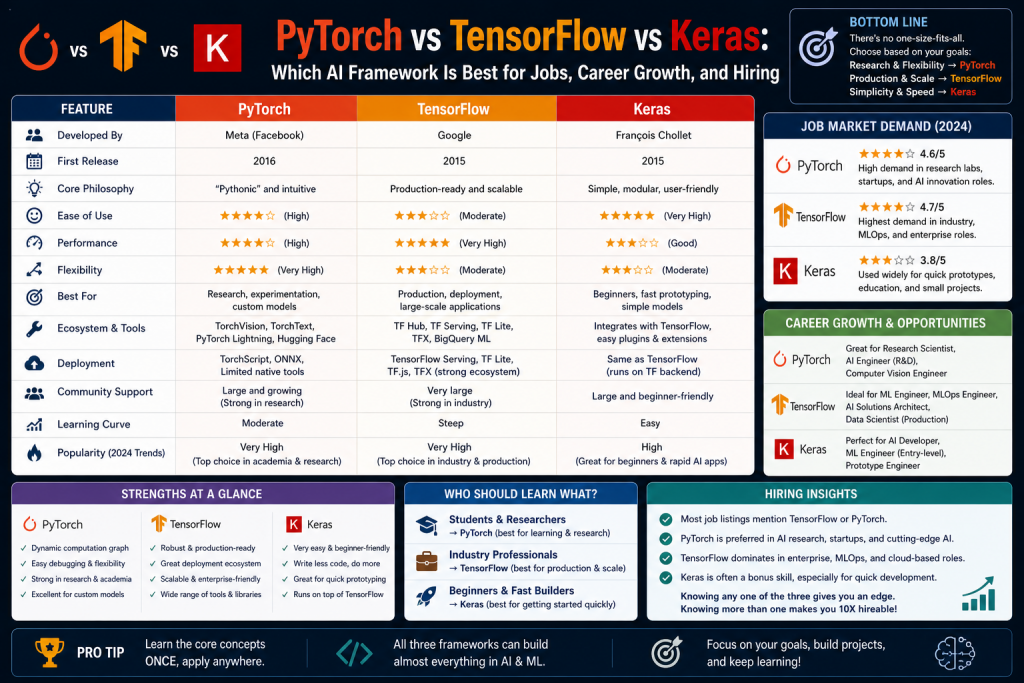
PyTorch has become a favorite in research communities and innovation-focused startups because of its flexibility, dynamic design, and developer-friendly syntax. TensorFlow remains a major force in enterprise AI due to its production-grade deployment capabilities, scalability, and infrastructure support. Keras has established itself as a beginner-friendly gateway that simplifies deep learning development while serving as a practical bridge into larger ecosystems.
However, selecting a framework is not simply a technical choice—it is a strategic career decision. The right framework can influence:
- Which jobs you qualify for
- How quickly you can build projects
- Whether you align with enterprise or startup hiring
- Your salary potential
- Your ability to transition between research and production roles
The modern hiring landscape increasingly rewards specialization paired with versatility. Employers often seek candidates who understand foundational AI concepts while also demonstrating hands-on proficiency in industry-recognized frameworks. A strong framework choice can significantly improve resume competitiveness, portfolio strength, and technical interview performance.
This guide explores these frameworks from a career-first perspective. Rather than focusing solely on code, syntax, or isolated technical features, this analysis examines how each framework influences professional opportunities, learning pathways, and long-term relevance. By understanding where PyTorch, TensorFlow, and Keras excel, professionals can make smarter choices that align technical growth with career advancement.
The Rise of Deep Learning in the Global Job Market
The rise of AI has fundamentally changed hiring priorities across industries. Businesses are no longer viewing machine learning as optional experimentation. Instead, it has become an operational necessity. This shift has increased the value of professionals who can design, train, optimize, and deploy neural networks.
As artificial intelligence becomes increasingly integrated into business strategy, organizations are shifting from curiosity-driven exploration to execution-focused implementation. In earlier years, many companies approached AI as a future-facing innovation project—something valuable but not essential. Today, that mindset has changed dramatically. AI now influences operational efficiency, customer engagement, predictive analytics, cybersecurity resilience, logistics optimization, and product innovation. This means organizations are not merely seeking data scientists who understand theory; they are actively hiring professionals who can transform machine learning concepts into practical, scalable systems.
Hiring priorities now reflect this transformation. Employers increasingly seek candidates who combine technical depth with deployment capability. Building a model in isolation is no longer enough. Businesses want professionals who understand data preprocessing, infrastructure scalability, cloud integration, automation pipelines, compliance considerations, and long-term model performance. In many sectors, machine learning is directly tied to profitability, cost reduction, and competitive positioning, making qualified talent a strategic necessity.
Several trends explain why deep learning framework selection matters more now than ever:
AI as a business-critical function
Organizations increasingly depend on AI to drive mission-critical systems. In retail, recommendation engines influence purchasing behavior. In finance, fraud detection models protect billions in transactions. In healthcare, diagnostic tools assist life-impacting decisions. In manufacturing, predictive maintenance minimizes downtime. Because these applications directly affect outcomes, employers prioritize frameworks that align with reliability, scalability, and innovation goals.
Expansion of specialized AI roles
The job market has expanded beyond general data science into highly specialized positions such as:
Machine learning engineer
Computer vision specialist
NLP engineer
MLOps architect
AI product manager
Research scientist
Each of these roles may favor different frameworks depending on priorities such as experimentation, deployment, or integration. This specialization makes framework choice more strategically important.
Production deployment has become essential
Organizations increasingly expect AI systems to function in real-world environments rather than remain confined to prototypes. This has elevated frameworks with strong deployment ecosystems and increased the value of professionals who understand model serving, monitoring, and optimization.
Cloud adoption and infrastructure integration
As companies move operations to cloud platforms, AI frameworks are increasingly judged by how effectively they integrate with scalable infrastructure. Professionals who understand both framework capabilities and cloud ecosystems often gain a hiring advantage because businesses need solutions that can scale efficiently.
Competitive labor markets
As more individuals enter AI-related fields, differentiation becomes critical. Employers often compare candidates based on practical proficiency, ecosystem familiarity, and portfolio quality. Framework expertise can serve as a competitive advantage when aligned with industry demand.
Faster innovation cycles
AI evolves quickly. New architectures, tools, and deployment methods emerge constantly. Frameworks that support experimentation and adaptability can significantly influence innovation speed. Employers increasingly value candidates who can keep pace with this rapid evolution.
Cross-industry digital transformation
AI is no longer isolated to technology companies. Traditional sectors such as agriculture, insurance, education, and public services are increasingly adopting machine learning solutions. This broadens opportunities but also increases demand for framework versatility.
Open-source ecosystem growth
The growth of open-source AI has accelerated learning and innovation, but it has also raised employer expectations. Hiring managers often expect candidates to navigate established ecosystems effectively rather than rely solely on foundational theory.
Global competition
AI talent shortages exist in many regions, but global remote work has also expanded competition. Professionals now compete not only locally but internationally, making strategic framework mastery more important for standing out.
In this environment, framework selection is no longer just a technical preference—it is often a career-defining decision. The framework a professional learns can influence:
Job accessibility
Industry alignment
Salary potential
Project opportunities
Career progression
As AI continues reshaping industries, professionals who strategically align their framework expertise with market demand position themselves for stronger long-term success. Choosing the right framework is not simply about coding efficiency; it is about building relevance in a workforce increasingly defined by intelligent systems.
AI Expansion Across Industries
AI adoption is no longer limited to large technology companies. Banks use machine learning for fraud prevention. Hospitals apply neural networks for diagnostics. Retailers use recommendation systems to personalize shopping experiences. Manufacturers rely on predictive maintenance systems. Governments and security organizations increasingly deploy AI-driven surveillance and threat detection tools.
This broad adoption means employers seek candidates with framework knowledge that fits their operational goals.
As artificial intelligence expands into nearly every economic sector, the diversity of AI applications has significantly increased the importance of specialized technical skills. Different industries prioritize different outcomes, which means framework selection often depends on whether the organization values experimentation, scalability, speed, or regulatory reliability. For example, healthcare institutions may require highly accurate deep learning systems for radiology analysis, where precision and compliance are essential. Financial institutions often focus on scalable fraud detection systems capable of processing millions of transactions in real time. Retail organizations may prioritize recommendation engines and customer behavior analytics that improve engagement and increase revenue. Manufacturing companies often depend on predictive models that reduce downtime, optimize supply chains, and improve operational efficiency.
This widespread implementation has reshaped hiring expectations. Employers increasingly want professionals who understand not only machine learning principles but also how to apply specific frameworks to industry-specific challenges. A candidate’s value often rises when they can align technical decisions with sector needs, infrastructure realities, and business priorities. As AI becomes embedded across industries, framework expertise is evolving from a technical advantage into a strategic workforce requirement.
Research vs. Production Divide
Not all AI jobs are identical. Some focus on experimentation and innovation, while others prioritize deployment and scalability. A university AI lab may prioritize PyTorch for developing novel architectures, while a multinational corporation may seek TensorFlow expertise for scalable customer-facing applications.
The Portfolio Economy
Hiring managers increasingly value demonstrable projects over theory alone. Frameworks affect how easily professionals can build:
- Computer vision systems
- NLP models
- Recommendation engines
- Predictive analytics tools
- Deployment-ready APIs
Cloud and MLOps Integration
Modern AI careers increasingly intersect with cloud platforms and machine learning operations. TensorFlow’s enterprise ecosystem often aligns naturally with production pipelines, while PyTorch increasingly integrates into advanced experimentation workflows.
Continuous Evolution
Deep learning frameworks evolve rapidly. A framework’s relevance depends not only on current popularity but also on future adoption trends, ecosystem maturity, and employer trust.
Understanding this environment helps clarify why framework choice can directly impact career outcomes.
Understanding Frameworks as Career Tools Rather Than Just Development Tools
Many beginners compare frameworks based solely on syntax or ease of use. While those factors matter, professionals should evaluate frameworks based on strategic employability. A framework that feels simple at the start may not always offer the strongest alignment with long-term career ambitions, while a more complex framework may unlock broader enterprise opportunities. Technical comfort is important, but career outcomes often depend more on industry demand, deployment relevance, and ecosystem maturity than on initial learning speed alone.
Questions Professionals Should Ask
Which framework dominates my target industry?
Do I want research, startup, or enterprise work?
How quickly can I become job-ready?
Which framework strengthens my project portfolio?
Which ecosystem offers better long-term growth?
Beyond these questions, professionals should also consider whether a framework supports cloud deployment, integrates with modern MLOps practices, or aligns with the types of problems they want to solve. For example, someone pursuing academic AI may prioritize experimentation flexibility, while an enterprise-focused candidate may benefit more from production scalability. Framework choice can influence project quality, hiring visibility, networking opportunities, and even salary trajectory.
By reframing framework choice as career planning, professionals make more informed decisions. Instead of selecting tools based only on convenience, they position themselves strategically for the industries, employers, and technical challenges they want to pursue, ultimately transforming framework selection from a coding preference into a meaningful professional investment
The Innovation Engine for Research and Advanced Experimentation
PyTorch emerged as one of the most influential deep learning frameworks because it emphasized flexibility and intuitive design. Built with a strong Pythonic approach, PyTorch feels natural to developers who prioritize experimentation and iterative problem-solving.
Its rise has been particularly strong in:
- Research institutions
- AI labs
- Advanced robotics
- Natural language processing innovation
- Computer vision startups
Why PyTorch Attracts Researchers
Research environments often involve constant experimentation. Developers may need to alter architectures dynamically, test unconventional models, or debug complex behaviors quickly. PyTorch’s dynamic computation graph allows developers to modify models during runtime, which dramatically improves experimentation speed.
Developer Experience
PyTorch is often praised for:
- Readable syntax
- Strong debugging capabilities
- Seamless Python integration
- Flexibility for custom layers
- Fast prototyping
Because of this, many professionals find PyTorch easier for understanding deep learning mechanics deeply rather than merely deploying templates.
Career Advantages
Learning PyTorch can position candidates for:
- AI research assistant roles
- Computer vision engineering
- NLP research
- Robotics development
- Startup ML engineering
Potential Career Limitations
While PyTorch’s ecosystem has matured significantly, some enterprise organizations still prioritize TensorFlow for deployment-heavy systems. Therefore, professionals relying solely on PyTorch may need supplementary deployment skills.
TensorFlow: Enterprise Reliability and Production-Scale Career Strength
TensorFlow has long been associated with scalability, production systems, and enterprise trust. It gained prominence because it solved a critical challenge: moving AI from experimentation into operational infrastructure.
TensorFlow appeals strongly to:
- Enterprise software companies
- Cloud-integrated businesses
- Production ML teams
- Mobile AI developers
- Infrastructure-heavy organizations
Why Enterprises Value TensorFlow
Large organizations prioritize:
- Stability
- Scalability
- Deployment tools
- Long-term maintainability
- Cross-platform support
TensorFlow addresses these needs with:
- Production pipelines
- Serving frameworks
- Mobile deployment
- Distributed computing
- Broad language support
Career Benefits
TensorFlow expertise often aligns with:
- Machine learning engineer
- AI software developer
- Cloud AI architect
- MLOps engineer
- Production AI consultant
Learning Challenges
TensorFlow’s complexity can create barriers for beginners. However, mastering it can significantly increase employability in larger organizations where AI systems serve millions of users.
Keras: The Accessible Starting Point for Fast Skill Development
Keras simplifies neural network development by abstracting complexity. For beginners, this can dramatically reduce entry barriers.
Where Keras Excels
Keras is highly valuable for:
- Learning fundamentals
- Rapid prototyping
- Educational environments
- Startup MVPs
- Small business experimentation
Career Strength
Keras helps:
- Beginners build portfolios quickly
- Data scientists prototype efficiently
- Analysts transition into AI
Strategic Limitation
Because Keras prioritizes simplicity, advanced professionals may eventually need deeper TensorFlow or PyTorch expertise.
Choosing Your Starting Point
For many professionals:
- Keras = Fastest entry
- PyTorch = Research strength
- TensorFlow = Enterprise security
The best starting point depends on where you want your career to go—not just what seems easiest.
Moving Beyond Basics Into Strategic Career Evaluation
Choosing between PyTorch, TensorFlow, and Keras requires more than understanding surface-level definitions. Once professionals grasp what each framework does, the next challenge is understanding how they compare in practical development, industry relevance, hiring demand, and long-term career value.
Many aspiring machine learning professionals make the mistake of choosing frameworks based on popularity alone. However, hiring decisions are influenced by much more than trend cycles. Employers evaluate whether candidates can solve business problems, adapt to technical ecosystems, and align with company infrastructure. This means framework selection should involve technical fit, business relevance, and strategic employability.
Each framework has evolved significantly, and the lines separating them have blurred in some areas. TensorFlow has improved developer accessibility. PyTorch has become stronger in deployment. Keras has grown beyond educational use into practical prototyping. Yet despite these overlaps, each still occupies a distinctive position in the job market.
To maximize career success, professionals must understand:
- How each framework performs technically
- Which industries prefer which ecosystem
- Which framework best supports portfolio building
- Where employers are investing
- How each framework affects salary potential
- Which framework aligns with future AI trends
This section explores those dimensions in depth.
PyTorch in Depth: Why It Became the Research and Startup Favorite
PyTorch’s rapid rise transformed it from an alternative framework into a dominant force within AI innovation. Its popularity did not emerge simply because it was easy to use. It succeeded because it matched how researchers and innovators actually work.
Dynamic Computation Graphs and Practical Experimentation
One of PyTorch’s defining innovations is dynamic graph execution. Rather than pre-defining every computational path before execution, PyTorch allows modifications during runtime.
This matters because cutting-edge AI development often requires:
- Testing unconventional architectures
- Debugging experimental layers
- Adjusting neural pathways quickly
- Iterating rapidly on prototypes
For researchers, flexibility is not optional—it is essential.
Why Startups Gravitate Toward PyTorch
Startups often prioritize speed, experimentation, and innovation over infrastructure maturity. They need to validate ideas quickly, pivot often, and test unique concepts before scaling.
PyTorch supports:
- Faster MVP development
- Easier debugging
- Lower experimentation friction
- Greater architectural freedom
This makes it highly valuable for:
- AI startups
- Robotics ventures
- Generative AI experimentation
- NLP product innovation
- Academic spin-offs
PyTorch Libraries That Increase Career Value
PyTorch’s ecosystem includes:
- TorchVision for computer vision
- TorchText for NLP
- TorchAudio for audio tasks
- PyTorch Lightning for scalable workflows
These tools increase professional versatility.
Career Implications
Strong PyTorch skills can improve competitiveness for:
- Research scientist positions
- Computer vision engineer roles
- NLP engineer jobs
- AI prototyping teams
- Advanced robotics
PyTorch Weaknesses
Despite major growth, PyTorch historically faced criticism in:
- Enterprise deployment maturity
- Large-scale production tooling
- Legacy business integration
Although this gap has narrowed, some organizations still perceive TensorFlow as more infrastructure-ready.
TensorFlow in Depth: The Enterprise Ecosystem
TensorFlow became dominant largely because it solved real business deployment challenges. Organizations do not simply want models that work—they need systems that can scale, integrate, and remain maintainable over years.
Static Graphs and Optimization
TensorFlow traditionally used static graphs, allowing systems to optimize execution before runtime.
This architecture benefits:
- High-performance serving
- Predictable deployment
- Resource optimization
- Cross-platform consistency
Enterprise Integration Strength
TensorFlow’s broader ecosystem includes:
- TensorFlow Serving
- TensorFlow Lite
- TensorFlow Extended (TFX)
- TensorBoard
- Cloud integration tools
These make it particularly valuable for:
- Mobile AI
- Enterprise SaaS
- Cloud deployment
- Large-scale automation
- Production MLOps
Why Corporations Continue to Invest
Large organizations prioritize:
- Reliability
- Governance
- Documentation
- Team scalability
- Security compliance
TensorFlow’s maturity supports these needs.
Professional Advantages
TensorFlow expertise often correlates with:
- Higher enterprise visibility
- Broader cloud opportunities
- MLOps integration
- Infrastructure leadership roles
Common Challenges
TensorFlow can feel overwhelming because:
- Syntax can be more complex
- Debugging may be less intuitive
- Initial learning curve is steeper
For self-taught professionals, this can delay portfolio development.
Keras in Depth: Simplicity as a Strategic Advantage
Keras is sometimes underestimated because of its simplicity. However, accessibility itself can be a strategic asset.
Why Simplicity Matters
New professionals often fail not because AI is too hard, but because complexity creates discouragement.
Keras reduces this barrier through:
- High-level APIs
- Minimal boilerplate
- Faster experimentation
- Simplified model creation
Ideal Professional Uses
Keras works especially well for:
- Students
- Career changers
- Analysts entering ML
- Early portfolio projects
- Startup rapid iteration
Business Relevance
Keras can accelerate:
- Proof-of-concept creation
- Internal testing
- Educational initiatives
Strategic Limitation
Keras abstracts complexity, which is useful initially but may reduce deep technical understanding if used exclusively.
Which Framework Gets You Job-Ready Fastest?
Fastest Initial Learning
Keras generally offers the shortest path to building functional projects.
Best for Understanding Deep Learning Mechanics
PyTorch often provides better educational depth for understanding architecture behavior.
Best for Enterprise Readiness
TensorFlow typically offers stronger long-term enterprise alignment.
Practical Career Strategy
A powerful progression often looks like:
Keras → PyTorch or TensorFlow → Deployment specialization
Community Strength and Ecosystem Influence
A framework’s community directly affects:
- Learning speed
- Troubleshooting
- Job networking
- Resource availability
PyTorch Community
Strong in:
- Research papers
- Academic communities
- Open-source experimentation
TensorFlow Community
Strong in:
- Enterprise documentation
- Corporate training
- Cloud integration
Keras Community
Strong in:
- Beginner tutorials
- Educational resources
- Introductory experimentation
Industry-Specific Framework Demand
Healthcare
Medical imaging often favors PyTorch for experimentation, while enterprise hospital systems may deploy TensorFlow.
Finance
Fraud systems, risk models, and scalable analytics often lean TensorFlow.
Autonomous Systems
PyTorch often dominates innovation-heavy robotics and perception systems.
Retail
Recommendation systems may use either, but TensorFlow often dominates larger deployments.
Education
Keras remains a strong instructional tool.
Regional Hiring Trends
North America
Balanced but role-dependent:
- Research hubs: PyTorch
- Enterprise hubs: TensorFlow
Europe
Growing balance with strong startup PyTorch usage.
Asia
TensorFlow often retains strong enterprise traction.
Which Framework Makes Better Projects?
PyTorch Projects
Excellent for:
- GANs
- NLP transformers
- Computer vision
- Experimental systems
TensorFlow Projects
Excellent for:
- Deployable SaaS models
- Mobile AI
- Production APIs
Keras Projects
Excellent for:
- Beginner portfolios
- Classification tasks
- MVP demonstrations
Salary and Advancement Considerations
Salary often depends more on role than framework alone, but framework alignment influences role eligibility.
PyTorch
May open doors to:
- Research-intensive roles
- Specialized innovation teams
TensorFlow
Often aligns with:
- Enterprise engineering
- Senior ML operations
- AI architecture
Keras
Supports:
- Entry-level transitions
- Educational acceleration
Hiring Manager Perspective: What Employers Actually Want
Most employers are not simply searching for candidates who can list PyTorch, TensorFlow, or Keras on a résumé. In real hiring environments, framework loyalty is rarely the deciding factor. What organizations truly prioritize is whether a candidate can solve meaningful problems, adapt to technical ecosystems, and deliver business value. A framework is a tool; employers want professionals who know when, why, and how to use that tool effectively.
Hiring managers often evaluate applicants through a broader lens that includes technical capability, strategic thinking, execution skills, and long-term growth potential. While framework knowledge can help secure interviews, it is usually practical competence that determines hiring outcomes.
Core qualities employers consistently value include:
Model understanding
Employers want candidates who understand more than syntax. They look for professionals who can explain:
How neural networks function
Why one architecture may outperform another
How hyperparameters influence outcomes
How to interpret overfitting, underfitting, and bias
When to optimize versus redesign
A hiring manager is often more impressed by someone who can diagnose model inefficiencies than someone who simply built a tutorial project.
Deployment readiness
In many organizations, building a model is only one stage of the workflow. Companies need professionals who can move solutions into production. This includes:
API integration
Cloud deployment
Model serving
Scalability planning
Monitoring and maintenance
Version control
A candidate who understands deployment pipelines often holds a major advantage, particularly in enterprise and SaaS environments.
The Multi-Framework Advantage
Professionals with familiarity across ecosystems often outperform specialists in broader hiring contexts.
Benefits
- Greater adaptability
- Wider job eligibility
- Better collaboration
- Reduced career rigidity
Risks
Superficial knowledge without mastery can weaken interviews.
Common Mistakes Professionals Make
Chasing Trends
Popularity can shift.
Ignoring Career Goals
Framework should align with desired role.
Overvaluing Ease
Easy entry does not always equal maximum opportunity.
Avoiding Deployment Skills
Building models is only part of employability.
Strategic Framework Selection by Career Type
Choose PyTorch If You Want
- AI research
- Computer vision
- NLP innovation
- Startup engineering
Choose TensorFlow If You Want
- Enterprise ML
- Cloud AI
- Production systems
- Scalable deployment
Choose Keras If You Want
- Fast entry
- Learning confidence
- Prototype development
Beyond Learning a Framework—Building a Sustainable AI Career
Mastering PyTorch, TensorFlow, or Keras can open doors, but true career success in artificial intelligence depends on far more than framework familiarity alone. The global AI workforce is evolving rapidly, and employers increasingly seek professionals who combine technical depth with adaptability, strategic thinking, and practical deployment experience.
The most successful machine learning professionals do not simply ask, “Which framework should I learn first?” Instead, they ask:
- How do I build long-term employability?
- Which skills remain relevant as frameworks evolve?
- How do I transition from beginner to specialist?
- What combination of projects, certifications, and real-world experience creates career resilience?
- How can I avoid becoming obsolete in a rapidly shifting industry?
These questions matter because technology changes quickly. Frameworks rise, mature, integrate, and sometimes lose dominance. New libraries emerge. Cloud ecosystems evolve. AI regulations expand. Hardware acceleration changes deployment patterns. In this environment, sustainable career growth depends on strategic skill architecture rather than short-term trend chasing.
This final section focuses on long-term planning: how to transform framework knowledge into a resilient professional path that can survive technological shifts while increasing salary potential, leadership opportunities, and technical authority.
Why Framework Mastery Alone Is Not Enough
Learning a framework can get you started, but long-term career advancement requires broader competencies.
The Difference Between Tool Use and Professional Expertise
Knowing how to train a neural network is useful. Knowing how to solve business problems with machine learning is transformative.
Professionals who advance fastest usually combine:
- Framework expertise
- Mathematics fundamentals
- Model optimization
- Deployment knowledge
- Data engineering
- Cloud integration
- Communication skills
Example
A beginner may build an image classifier using Keras.
A mid-level engineer may optimize that model with PyTorch.
A senior AI architect may deploy and scale it globally using TensorFlow, cloud services, and MLOps pipelines.
This progression demonstrates that frameworks are stepping stones—not final destinations.
Career Pathways Based on Framework Strengths
Each framework can serve as an entry point into different professional trajectories.
Research, Innovation, and Specialized AI
PyTorch often aligns best with careers focused on experimentation and innovation.
Typical Career Progression
- Junior ML Developer
- Research Assistant
- Computer Vision Engineer
- NLP Engineer
- AI Scientist
- Research Lead
Ideal Industries
- Robotics
- Autonomous systems
- AI labs
- Generative AI startups
- Healthcare imaging
- Advanced NLP
Strategic Growth Requirements
To maximize PyTorch-based careers, professionals should also develop:
- Research paper literacy
- Mathematics
- GPU optimization
- Model architecture design
- Open-source contribution
Long-Term Advantage
PyTorch professionals often gain exposure to cutting-edge systems earlier than enterprise-focused peers.
Enterprise Leadership and Scalable Systems
TensorFlow often supports careers centered on production systems and infrastructure.
Typical Career Progression
- ML Engineer
- AI Software Engineer
- MLOps Specialist
- Cloud ML Architect
- Enterprise AI Consultant
- Director of AI Systems
Ideal Industries
- SaaS
- Finance
- Retail
- Telecommunications
- Cloud services
- Enterprise automation
Strategic Growth Requirements
TensorFlow-focused professionals benefit from:
- Cloud certifications
- Kubernetes
- API deployment
- TensorFlow Serving
- Security awareness
- Data pipelines
Long-Term Advantage
TensorFlow often aligns more naturally with leadership in operational AI environments.
Keras Career Path: Entry, Transition, and Acceleration
Keras can be especially powerful for beginners or career changers.
Ideal Use Cases
- Academic learning
- Rapid portfolio creation
- Internal business analytics
- Small-team prototypes
Career Progression
Keras is often not the final specialization but a launchpad toward:
- TensorFlow
- Data science
- Applied ML
- Product prototyping
Long-Term Advantage
Keras can dramatically shorten the transition from theory into practical implementation.
The Role of Certifications in Framework-Driven Careers
Certifications remain controversial in technical communities, but they can be highly valuable when used strategically.
When Certifications Help
Certifications are most useful when:
- Entering AI from another field
- Building credibility without formal CS education
- Targeting enterprise employers
- Learning cloud ecosystems
- Demonstrating structured knowledge
When Certifications Are Less Important
Research labs and startup founders may prioritize:
- GitHub portfolios
- Publications
- Kaggle rankings
- Open-source contributions
Valuable Certification Categories
Rather than framework-only credentials, stronger long-term options often include:
- Cloud AI certifications
- Machine learning engineering
- Data engineering
- MLOps
- AI fundamentals
Strategic Advice
Certifications should support practical experience—not replace it.
Building a Portfolio That Gets You Hired
Framework knowledge becomes employable when demonstrated.
What Hiring Managers Want to See
Strong portfolios typically showcase:
- Real datasets
- Problem-solving
- Documentation
- Deployment
- Code quality
- Business understanding
Portfolio by Framework
For PyTorch
Focus on:
- GANs
- NLP
- Transformers
- Computer vision
- Experimental architectures
For TensorFlow
Focus on:
- Production APIs
- Mobile deployment
- Recommendation systems
- Business dashboards
- Scalable services
For Keras
Focus on:
- Classification
- Predictive analytics
- Educational projects
- MVPs
Portfolio Mistakes to Avoid
- Copy-paste tutorials
- Poor documentation
- No deployment
- No measurable outcomes
- Lack of originality
The Multi-Framework Professional: A Powerful Competitive Edge
The AI market increasingly rewards adaptability.
Why Multi-Framework Skills Matter
Organizations evolve. Tech stacks shift. Teams vary.
Professionals who understand multiple frameworks can:
- Transition faster
- Collaborate broadly
- Handle migrations
- Lead hybrid teams
- Reduce career dependency
Recommended Learning Sequence
A strategic progression often looks like:
- Keras for fundamentals
- PyTorch for experimentation
- TensorFlow for production
This sequence balances accessibility, innovation, and deployment readiness.
The Missing Career Multiplier
One of the largest career accelerators today is combining framework expertise with deployment systems.
MLOps Includes
- CI/CD pipelines
- Monitoring
- Versioning
- Data drift
- Infrastructure
- Scaling
Why It Matters
Many professionals can train models. Fewer can operationalize them.
This creates strong demand for professionals who bridge development and deployment.
Soft Skills: The Often-Ignored Career Force Multiplier
Technical skills alone do not guarantee advancement.
Critical Professional Skills
- Communication
- Business understanding
- Stakeholder management
- Documentation
- Team leadership
Why This Matters
Senior professionals often spend less time coding and more time:
- Designing strategy
- Translating business needs
- Leading teams
- Making architecture decisions
Freelancing, Startups, and Entrepreneurship
Framework choice can also influence independent career models.
Freelancers
TensorFlow and Keras may support business automation projects.
Startups
PyTorch often supports experimentation-heavy product innovation.
Consultants
Multi-framework versatility can increase client opportunities.
Founders
Framework decisions may shape:
- Speed to MVP
- Scaling potential
- Hiring needs
Avoiding Career Obsolescence
AI evolves constantly. Future-proofing matters.
How to Stay Relevant
- Follow research
- Build projects
- Learn deployment
- Expand cloud knowledge
- Study infrastructure
- Stay adaptable
Mindset Shift
Do not define yourself solely by a framework.
Define yourself by problem-solving capability.
Emerging Trends That May Influence Framework Relevance
Future developments include:
- Edge AI
- Generative AI
- Federated learning
- AI governance
- Low-code ML
- Hardware acceleration
Frameworks may adapt, merge, or shift priorities. Professionals who focus only on syntax may struggle; those who understand principles can pivot.
Strategic Career Models
Specialist
Deep expertise in one ecosystem.
Pros
- Strong niche authority
- High-value specialization
Cons
- Greater ecosystem dependence
Generalist
Moderate skill across multiple frameworks.
Pros
- Adaptability
- Broader employability
Cons
- Risk of shallow mastery
T-Shaped Professional
Deep expertise in one area plus broad supporting knowledge.
Best Balance
This model often creates the strongest long-term resilience.
The Psychology of Sustainable Career Growth
Professionals often fail because they:
- Chase hype
- Compare constantly
- Skip fundamentals
- Avoid difficult concepts
- Focus only on tools
Better Strategy
- Build consistently
- Prioritize fundamentals
- Learn strategically
- Expand gradually
Conclusion:
PyTorch, TensorFlow, and Keras are not merely software libraries—they are gateways into different dimensions of the AI profession.
PyTorch empowers experimentation, innovation, and advanced research. It is particularly powerful for those pursuing cutting-edge roles where creativity and technical flexibility define success.
TensorFlow remains a cornerstone for enterprise systems, scalable deployment, and production leadership. It often provides stronger alignment with organizations building robust, large-scale AI infrastructure.
Keras offers accessibility, speed, and a lower barrier to entry, making it a highly practical launchpad for beginners and professionals transitioning into machine learning.
Yet the most important truth is this: no framework alone guarantees career success.
Long-term employability comes from combining:
- Technical skill
- Portfolio strength
- Deployment knowledge
- Strategic learning
- Adaptability
- Communication
- Business relevance
The strongest professionals rarely stop at one framework. They build layered competence that evolves with the industry.
If your goal is to get hired quickly, start strategically. If your goal is to lead, expand deliberately. If your goal is long-term relevance, prioritize principles over tools.
AI is not slowing down. Opportunities will continue expanding, but competition will intensify. The professionals who thrive will be those who approach framework learning not as a trend, but as part of a larger career system.
Choose the framework that aligns with your immediate goals—but build the adaptability that protects your future. In doing so, you will not simply learn AI tools; you will position yourself to grow with one of the most transformative industries of the modern era.
Continue exploring the technologies and certification concepts that matter most to you.