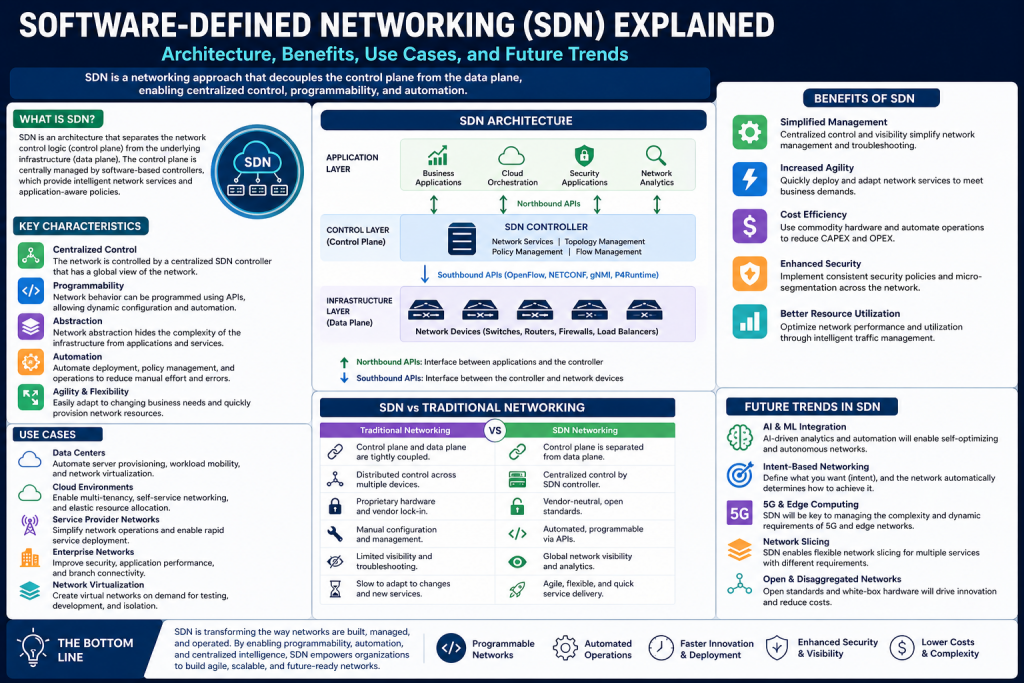
Software-Defined Networking, commonly referred to as SDN, is a modern approach to designing, building, and managing computer networks through software-based control. Instead of relying heavily on manual configuration of individual hardware devices, SDN introduces a centralized system where network intelligence is managed through software applications. This shift has transformed how networks operate, making them more flexible, scalable, and efficient.
In earlier networking models, devices such as routers, switches, and firewalls operated independently. Each device had to be configured separately, often using complex command-line interfaces. This approach created challenges when networks grew in size or when rapid changes were required. Even small adjustments could take significant time and effort, increasing the risk of errors and inconsistencies.
SDN addresses these limitations by separating the control logic from the physical devices that move data. This allows network administrators to define policies and behaviors in software and apply them across the entire network from a central location. As a result, networks become easier to manage and can quickly adapt to new demands.
Evolution of Traditional Networking
To fully understand SDN, it is important to look at how traditional networks functioned. In conventional networking, each device contained both the control plane and the data plane. The control plane made decisions about where traffic should go, while the data plane handled the actual forwarding of packets.
Because these functions were tightly integrated into each device, changes required direct interaction with the hardware. For example, updating a routing policy meant logging into multiple devices and applying configurations individually. This process was not only time-consuming but also prone to human error.
As organizations expanded and network traffic increased, these limitations became more apparent. Businesses needed networks that could scale quickly, support new applications, and maintain high performance. Traditional networking struggled to meet these demands, leading to the development of SDN as a more dynamic solution.
Core Concept of SDN Architecture
The defining characteristic of SDN is the separation of the control plane from the data plane. This separation allows decision-making processes to be centralized while the physical devices focus solely on forwarding traffic.
In SDN architecture, the network is divided into three distinct layers: the application layer, the control layer, and the infrastructure layer. Each layer has a specific role, and together they create a cohesive and flexible system.
This layered design simplifies network management by providing clear boundaries between responsibilities. It also enables programmability, allowing administrators to automate tasks and implement changes more efficiently.
Understanding SDN Through a Construction Analogy
A practical way to understand SDN is by comparing it to a construction project. Imagine building a complex structure such as a commercial building.
The application layer acts as the blueprint. It defines the purpose of the building, the layout, and the requirements. This includes decisions about design, functionality, and safety.
The control layer functions as the architect. It interprets the blueprint and creates detailed plans for how the construction should proceed. It ensures that all aspects of the design are properly translated into actionable steps.
The infrastructure layer represents the construction crew and machinery. These are the workers who carry out the actual building process based on the architect’s instructions.
This analogy highlights how SDN separates planning, decision-making, and execution into distinct components, making the entire process more organized and efficient.
Key Advantages of Software-Defined Networking
SDN provides several benefits that address the limitations of traditional networking. These advantages make it a preferred choice for modern network environments.
Network Agility
One of the most significant benefits of SDN is its ability to adapt quickly to changing requirements. In traditional networks, implementing changes often required manual intervention and downtime. With SDN, administrators can modify network behavior through software updates.
This agility allows organizations to deploy new applications, adjust traffic flows, and respond to changing conditions without disrupting operations. It also supports innovation by enabling rapid experimentation and development.
Centralized Management
SDN introduces a centralized control model where the entire network can be managed from a single interface. This eliminates the need to configure devices individually and ensures consistency across the network.
Centralized management simplifies administrative tasks and reduces the likelihood of configuration errors. It also provides a unified view of the network, making it easier to monitor performance and troubleshoot issues.
Efficient Resource Utilization
Because the SDN controller has a global view of the network, it can make informed decisions about how resources are used. This includes optimizing traffic routes, balancing loads, and allocating bandwidth where it is needed most.
Efficient resource utilization improves overall network performance and reduces operational costs. It also ensures that critical applications receive the necessary resources to function effectively.
Enhanced Security Capabilities
Security is a major concern in modern networks, and SDN provides advanced tools to address this challenge. By centralizing control, SDN allows administrators to enforce security policies consistently across all devices.
Features such as network segmentation and dynamic policy enforcement help isolate threats and prevent unauthorized access. The ability to quickly update security rules also improves the network’s ability to respond to emerging threats.
Overview of the Three SDN Layers
The layered architecture of SDN is fundamental to its functionality. Each layer plays a unique role in the overall system.
The application layer is responsible for defining network requirements and policies. It contains the software applications that communicate what the network should do.
The control layer acts as the central intelligence of the network. It processes instructions from the application layer and translates them into commands for the infrastructure layer.
The infrastructure layer consists of the physical and virtual devices that handle data transmission. These devices execute the instructions provided by the control layer.
This separation of responsibilities allows each layer to operate independently while still contributing to the overall functionality of the network.
Deep Dive into the Application Layer
The application layer is the topmost layer in the SDN architecture. It is where network behavior is defined and where innovation takes place.
Applications in this layer interact with the network by specifying requirements such as traffic handling, security policies, and service delivery. These applications do not directly control hardware devices. Instead, they communicate with the control layer, which handles the implementation.
Role of the Application Layer
The primary role of the application layer is to translate business and user needs into network policies. For example, an organization may require high-quality video conferencing, secure data transmission, or prioritized access for certain applications.
These requirements are expressed through software applications that define how the network should behave. This abstraction allows administrators to focus on goals rather than technical details.
Types of Applications in the Application Layer
The application layer supports a wide range of tools and platforms that enhance network functionality.
Security applications are used to protect the network from threats. These include firewalls, intrusion detection systems, and monitoring tools that identify suspicious activity.
Optimization tools improve network performance by managing traffic flow and balancing loads. These tools ensure that resources are used efficiently and that applications perform reliably.
Monitoring and analytics applications collect data about network performance. This information is used to identify issues, track usage patterns, and make informed decisions.
Automation platforms simplify network management by automating repetitive tasks. These tools enable administrators to deploy configurations, manage updates, and orchestrate complex operations with minimal manual effort.
How the Application Layer Communicates
Applications in this layer communicate with the control layer using specialized interfaces. These interfaces allow applications to send requests and receive responses without needing to understand the underlying hardware.
For example, a security application may request the blocking of traffic from a suspicious source. The control layer interprets this request and implements the necessary changes in the network.
This communication model ensures that applications can influence network behavior while maintaining a clear separation of responsibilities.
Practical Applications of the Application Layer
The application layer enables a wide range of practical use cases that enhance network functionality.
Organizations can implement new security policies quickly, ensuring that threats are addressed in real time. They can also optimize traffic for critical applications, improving performance and user experience.
New services can be deployed without significant changes to the underlying infrastructure. This flexibility supports innovation and allows businesses to adapt to changing needs.
Automation reduces the burden of manual management, freeing up resources and improving efficiency. Tasks that once required hours of work can now be completed in minutes.
Importance of the Application Layer in Modern Networking
The application layer is where the true value of SDN is realized. It transforms the network from a static infrastructure into a dynamic and adaptable system.
By enabling direct interaction between applications and the network, SDN allows organizations to align their network operations with business objectives. This alignment improves efficiency, supports growth, and enhances overall performance.
The flexibility of the application layer also encourages innovation. Developers can create new applications that leverage network capabilities in ways that were not possible with traditional networking.
Transition Toward the Control Layer
While the application layer defines what needs to be done, it does not handle the execution. This responsibility lies with the control layer, which acts as the intermediary between applications and infrastructure.
The control layer interprets the requirements provided by applications and determines how to implement them. It then communicates with the infrastructure layer to ensure that the necessary actions are carried out.
This separation allows each layer to focus on its specific role, creating a more efficient and manageable system.
Introduction to the Control Layer
The control layer is the central intelligence of a Software-Defined Networking environment. While the application layer defines what the network should accomplish, the control layer determines how those objectives are achieved. It acts as the bridge between high-level requirements and the physical execution performed by network devices.
At the core of the control layer is the SDN controller. This controller is a software-based system that maintains a global view of the network and makes decisions based on that information. It communicates with both the application layer above and the infrastructure layer below, ensuring that all parts of the network operate in coordination.
The introduction of a centralized control layer is one of the most significant differences between SDN and traditional networking. Instead of each device making independent decisions, the controller oversees the entire network, enabling more efficient and consistent management.
Role and Responsibilities of the Control Layer
The control layer performs several critical functions that enable SDN to operate effectively. These responsibilities ensure that the network remains responsive, efficient, and aligned with application requirements.
One of its primary roles is network intelligence. The controller continuously gathers data from network devices, including traffic patterns, device status, and performance metrics. This information allows it to maintain an up-to-date understanding of the network’s condition.
Another key function is translation. The control layer receives high-level instructions from applications and converts them into specific configurations that can be understood by network devices. This process involves interpreting policies, determining the best course of action, and generating appropriate commands.
The control layer is also responsible for instruction delivery. Once decisions are made, the controller sends commands to the infrastructure layer, directing devices to implement changes. These instructions may include routing updates, security rules, or traffic prioritization.
In addition, the control layer ensures coordination across the network. It synchronizes the actions of multiple devices, ensuring that they work together to achieve the desired outcome. This coordination is essential for maintaining consistency and avoiding conflicts.
The SDN Controller as the Network Brain
The SDN controller is often described as the brain of the network. It is responsible for decision-making, coordination, and adaptability.
In terms of decision-making, the controller determines the most efficient paths for data to travel. It evaluates factors such as network congestion, latency, and resource availability to optimize performance.
Coordination is another important function. The controller ensures that all devices operate according to the same policies and objectives. This eliminates inconsistencies and improves reliability.
Adaptability is a defining feature of the controller. It can respond to changes in real time, adjusting configurations as needed. For example, if a sudden surge in traffic occurs, the controller can redistribute resources to maintain performance.
The centralized nature of the controller allows it to make informed decisions that benefit the entire network. This contrasts with traditional systems, where devices operate in isolation and may lack a complete view of the network.
How the Control Layer Processes Requests
The interaction between the application layer and the control layer follows a structured process. This process ensures that network requirements are accurately translated into actions.
When an application sends a request, the controller first analyzes the requirement. For example, a security application might request that traffic from a specific source be blocked.
The controller then interprets this request and determines the necessary steps. It identifies which devices are affected and what configurations need to be applied.
Next, the controller generates detailed instructions. These instructions are tailored to the specific devices in the infrastructure layer, ensuring compatibility and effectiveness.
Finally, the controller sends these instructions to the relevant devices, which implement the changes. This process allows the network to adapt quickly and efficiently to new requirements.
Communication Through Northbound APIs
Communication between the application layer and the control layer is facilitated by northbound APIs. These interfaces act as communication channels that allow applications to interact with the controller.
Northbound APIs enable applications to express their requirements in a standardized way. This allows developers to create applications that can work with different SDN controllers without needing to understand the underlying hardware.
Through these APIs, applications can request changes, retrieve network information, and monitor performance. This interaction is essential for enabling programmability and automation in SDN.
The use of APIs also promotes innovation. Developers can build new applications that leverage network capabilities, creating more advanced and customized solutions.
Communication Through Southbound APIs
The control layer communicates with the infrastructure layer using southbound APIs. These interfaces allow the controller to send instructions to network devices and receive feedback.
One of the most widely used southbound protocols is OpenFlow. It provides a standardized way for controllers to interact with switches and other devices.
Southbound APIs enable the controller to configure devices, update routing tables, and enforce policies. They also allow devices to report their status and performance metrics back to the controller.
This two-way communication is essential for maintaining an accurate view of the network and ensuring that changes are implemented correctly.
The Feedback Loop in SDN
A key feature of the control layer is the feedback loop between the controller and the infrastructure layer. This loop ensures that the network remains responsive and adaptive.
Network devices continuously send information to the controller, including traffic statistics, error reports, and performance data. The controller uses this information to update its understanding of the network.
Based on this feedback, the controller can make adjustments to improve performance or address issues. For example, if a link becomes congested, the controller can reroute traffic to reduce load.
This ongoing exchange of information allows the network to operate dynamically, responding to changes in real time.
Automation and Orchestration in the Control Layer
The control layer plays a central role in enabling automation within SDN. By centralizing decision-making, it allows administrators to automate complex tasks that would otherwise require manual intervention.
Automation can include tasks such as configuring devices, deploying policies, and managing updates. These tasks can be executed quickly and consistently, reducing the risk of errors.
Orchestration goes a step further by coordinating multiple automated processes. For example, deploying a new application might involve configuring network paths, applying security rules, and allocating resources. The control layer can manage all of these tasks as a single coordinated operation.
This capability is particularly valuable in large and complex networks, where manual management would be impractical.
Policy Enforcement and Network Control
The control layer is responsible for enforcing network policies defined by the application layer. These policies govern how traffic is handled, how resources are allocated, and how security measures are applied.
When a policy is defined, the controller translates it into specific rules that can be implemented by network devices. These rules are then distributed across the network to ensure consistent enforcement.
Policy enforcement is dynamic, meaning that changes can be applied in real time. This allows the network to adapt quickly to new requirements or threats.
For example, if a security threat is detected, the controller can immediately update policies to block malicious traffic. This rapid response capability enhances the overall security of the network.
Scalability and Performance Considerations
As networks grow in size and complexity, the control layer must be able to scale accordingly. This involves handling increased traffic, managing more devices, and processing larger volumes of data.
Modern SDN controllers are designed to support scalability through distributed architectures. In some cases, multiple controllers work together to manage different parts of the network.
Performance is another important consideration. The controller must process requests quickly to ensure that the network remains responsive. Efficient algorithms and optimized communication protocols are used to achieve this.
Balancing scalability and performance is essential for maintaining the effectiveness of the control layer in large-scale environments.
Security Challenges in the Control Layer
While the control layer provides many benefits, it also introduces new security challenges. Because the controller is centralized, it becomes a critical point of vulnerability.
If the controller is compromised, it could affect the entire network. Therefore, strong security measures are necessary to protect it.
These measures include access controls, authentication mechanisms, and encryption. Regular updates and monitoring are also important to ensure that the controller remains secure.
In addition, redundancy and failover mechanisms can be implemented to maintain network functionality in case of a failure or attack.
Real-Time Adaptability and Decision Making
One of the most powerful features of the control layer is its ability to make real-time decisions. By continuously monitoring the network, the controller can respond to changes and maintain optimal performance.
For example, if a network link fails, the controller can quickly reroute traffic to an alternative path. This minimizes disruption and ensures continuity of service.
Similarly, if an application requires additional bandwidth, the controller can allocate resources dynamically. This flexibility allows the network to meet changing demands without manual intervention.
Real-time adaptability is a key factor in the efficiency and reliability of SDN.
Importance of the Control Layer in SDN
The control layer is the foundation of SDN’s functionality. It enables centralized management, automation, and dynamic control, transforming how networks are operated.
By acting as the intermediary between applications and infrastructure, it ensures that network behavior aligns with organizational goals. It also provides the intelligence needed to optimize performance and maintain security.
Without the control layer, the benefits of SDN would not be possible. It is the component that brings together all aspects of the network into a cohesive system.
Transition to the Infrastructure Layer
While the control layer is responsible for decision-making and coordination, it relies on the infrastructure layer to تنفيذ these decisions. The infrastructure layer consists of the physical and virtual devices that handle data transmission.
In the next part, the focus will shift to this layer, exploring how devices execute instructions, how they interact with the controller, and how they contribute to the overall functionality of the network.
Introduction to the Control Layer
The control layer is the central intelligence of a Software-Defined Networking environment. While the application layer defines what the network should accomplish, the control layer determines how those objectives are achieved. It acts as the bridge between high-level requirements and the physical execution performed by network devices.
At the core of the control layer is the SDN controller. This controller is a software-based system that maintains a global view of the network and makes decisions based on that information. It communicates with both the application layer above and the infrastructure layer below, ensuring that all parts of the network operate in coordination.
The introduction of a centralized control layer is one of the most significant differences between SDN and traditional networking. Instead of each device making independent decisions, the controller oversees the entire network, enabling more efficient and consistent management.
Role and Responsibilities of the Control Layer
The control layer performs several critical functions that enable SDN to operate effectively. These responsibilities ensure that the network remains responsive, efficient, and aligned with application requirements.
One of its primary roles is network intelligence. The controller continuously gathers data from network devices, including traffic patterns, device status, and performance metrics. This information allows it to maintain an up-to-date understanding of the network’s condition.
Another key function is translation. The control layer receives high-level instructions from applications and converts them into specific configurations that can be understood by network devices. This process involves interpreting policies, determining the best course of action, and generating appropriate commands.
The control layer is also responsible for instruction delivery. Once decisions are made, the controller sends commands to the infrastructure layer, directing devices to implement changes. These instructions may include routing updates, security rules, or traffic prioritization.
In addition, the control layer ensures coordination across the network. It synchronizes the actions of multiple devices, ensuring that they work together to achieve the desired outcome. This coordination is essential for maintaining consistency and avoiding conflicts.
The SDN Controller as the Network Brain
The SDN controller is often described as the brain of the network. It is responsible for decision-making, coordination, and adaptability.
In terms of decision-making, the controller determines the most efficient paths for data to travel. It evaluates factors such as network congestion, latency, and resource availability to optimize performance.
Coordination is another important function. The controller ensures that all devices operate according to the same policies and objectives. This eliminates inconsistencies and improves reliability.
Adaptability is a defining feature of the controller. It can respond to changes in real time, adjusting configurations as needed. For example, if a sudden surge in traffic occurs, the controller can redistribute resources to maintain performance.
The centralized nature of the controller allows it to make informed decisions that benefit the entire network. This contrasts with traditional systems, where devices operate in isolation and may lack a complete view of the network.
How the Control Layer Processes Requests
The interaction between the application layer and the control layer follows a structured process. This process ensures that network requirements are accurately translated into actions.
When an application sends a request, the controller first analyzes the requirement. For example, a security application might request that traffic from a specific source be blocked.
The controller then interprets this request and determines the necessary steps. It identifies which devices are affected and what configurations need to be applied.
Next, the controller generates detailed instructions. These instructions are tailored to the specific devices in the infrastructure layer, ensuring compatibility and effectiveness.
Finally, the controller sends these instructions to the relevant devices, which implement the changes. This process allows the network to adapt quickly and efficiently to new requirements.
Communication Through Northbound APIs
Communication between the application layer and the control layer is facilitated by northbound APIs. These interfaces act as communication channels that allow applications to interact with the controller.
Northbound APIs enable applications to express their requirements in a standardized way. This allows developers to create applications that can work with different SDN controllers without needing to understand the underlying hardware.
Through these APIs, applications can request changes, retrieve network information, and monitor performance. This interaction is essential for enabling programmability and automation in SDN.
The use of APIs also promotes innovation. Developers can build new applications that leverage network capabilities, creating more advanced and customized solutions.
Communication Through Southbound APIs
The control layer communicates with the infrastructure layer using southbound APIs. These interfaces allow the controller to send instructions to network devices and receive feedback.
One of the most widely used southbound protocols is OpenFlow. It provides a standardized way for controllers to interact with switches and other devices.
Southbound APIs enable the controller to configure devices, update routing tables, and enforce policies. They also allow devices to report their status and performance metrics back to the controller.
This two-way communication is essential for maintaining an accurate view of the network and ensuring that changes are implemented correctly.
The Feedback Loop in SDN
A key feature of the control layer is the feedback loop between the controller and the infrastructure layer. This loop ensures that the network remains responsive and adaptive.
Network devices continuously send information to the controller, including traffic statistics, error reports, and performance data. The controller uses this information to update its understanding of the network.
Based on this feedback, the controller can make adjustments to improve performance or address issues. For example, if a link becomes congested, the controller can reroute traffic to reduce load.
This ongoing exchange of information allows the network to operate dynamically, responding to changes in real time.
Automation and Orchestration in the Control Layer
The control layer plays a central role in enabling automation within SDN. By centralizing decision-making, it allows administrators to automate complex tasks that would otherwise require manual intervention.
Automation can include tasks such as configuring devices, deploying policies, and managing updates. These tasks can be executed quickly and consistently, reducing the risk of errors.
Orchestration goes a step further by coordinating multiple automated processes. For example, deploying a new application might involve configuring network paths, applying security rules, and allocating resources. The control layer can manage all of these tasks as a single coordinated operation.
This capability is particularly valuable in large and complex networks, where manual management would be impractical.
Policy Enforcement and Network Control
The control layer is responsible for enforcing network policies defined by the application layer. These policies govern how traffic is handled, how resources are allocated, and how security measures are applied.
When a policy is defined, the controller translates it into specific rules that can be implemented by network devices. These rules are then distributed across the network to ensure consistent enforcement.
Policy enforcement is dynamic, meaning that changes can be applied in real time. This allows the network to adapt quickly to new requirements or threats.
For example, if a security threat is detected, the controller can immediately update policies to block malicious traffic. This rapid response capability enhances the overall security of the network.
Scalability and Performance Considerations
As networks grow in size and complexity, the control layer must be able to scale accordingly. This involves handling increased traffic, managing more devices, and processing larger volumes of data.
Modern SDN controllers are designed to support scalability through distributed architectures. In some cases, multiple controllers work together to manage different parts of the network.
Performance is another important consideration. The controller must process requests quickly to ensure that the network remains responsive. Efficient algorithms and optimized communication protocols are used to achieve this.
Balancing scalability and performance is essential for maintaining the effectiveness of the control layer in large-scale environments.
Security Challenges in the Control Layer
While the control layer provides many benefits, it also introduces new security challenges. Because the controller is centralized, it becomes a critical point of vulnerability.
If the controller is compromised, it could affect the entire network. Therefore, strong security measures are necessary to protect it.
These measures include access controls, authentication mechanisms, and encryption. Regular updates and monitoring are also important to ensure that the controller remains secure.
In addition, redundancy and failover mechanisms can be implemented to maintain network functionality in case of a failure or attack.
Real-Time Adaptability and Decision Making
One of the most powerful features of the control layer is its ability to make real-time decisions. By continuously monitoring the network, the controller can respond तुरंत to changes and maintain optimal performance.
For example, if a network link fails, the controller can quickly reroute traffic to an alternative path. This minimizes disruption and ensures continuity of service.
Similarly, if an application requires additional bandwidth, the controller can allocate resources dynamically. This flexibility allows the network to meet changing demands without manual intervention.
Real-time adaptability is a key factor in the efficiency and reliability of SDN.
Importance of the Control Layer in SDN
The control layer is the foundation of SDN’s functionality. It enables centralized management, automation, and dynamic control, transforming how networks are operated.
By acting as the intermediary between applications and infrastructure, it ensures that network behavior aligns with organizational goals. It also provides the intelligence needed to optimize performance and maintain security.
Without the control layer, the benefits of SDN would not be possible. It is the component that brings together all aspects of the network into a cohesive system.
Transition to the Infrastructure Layer
While the control layer is responsible for decision-making and coordination, it relies on the infrastructure layer to تنفيذ these decisions. The infrastructure layer consists of the physical and virtual devices that handle data transmission.
In the next part, the focus will shift to this layer, exploring how devices execute instructions, how they interact with the controller, and how they contribute to the overall functionality of the network.
.i want part 3 with h2 headings in 2500 words dont bold inner text add conclusion
Introduction to the Infrastructure Layer
The infrastructure layer is the foundation of a Software-Defined Networking environment. While the application layer defines requirements and the control layer makes decisions, the infrastructure layer is responsible for executing those decisions. It consists of the physical and virtual devices that actually move data across the network.
This layer includes switches, routers, firewalls, wireless access points, and virtual networking components. These devices form the backbone of the network, enabling communication between users, applications, and services.
In traditional networking, these devices were responsible for both decision-making and data forwarding. In SDN, their role is simplified. They no longer make independent decisions about traffic flow. Instead, they follow instructions provided by the SDN controller, which resides in the control layer.
This shift allows the infrastructure layer to focus entirely on efficient data transmission, improving overall performance and simplifying network management.
Components of the Infrastructure Layer
The infrastructure layer is made up of various types of devices, each serving a specific purpose within the network.
Switches are responsible for connecting devices within a network and forwarding data packets between them. They operate at high speeds and handle large volumes of traffic, making them essential for internal network communication.
Routers connect different networks and determine the best paths for data to travel. They ensure that information reaches its destination efficiently, even when crossing multiple networks.
Firewalls provide security by filtering traffic based on predefined rules. They help protect the network from unauthorized access and potential threats.
Wireless access points enable wireless connectivity, allowing devices such as smartphones and laptops to connect to the network without physical cables.
Virtual network devices are software-based versions of these components. They can run on servers or in cloud environments, providing flexibility and scalability.
Together, these components form the physical and virtual infrastructure that supports the entire network.
Role of the Infrastructure Layer in SDN
In an SDN environment, the infrastructure layer acts as the execution engine. Its primary role is to carry out the instructions provided by the SDN controller.
When the controller determines that a change is needed, it sends commands to the relevant devices in the infrastructure layer. These devices then implement the changes, adjusting how data flows through the network.
For example, if the controller decides to block traffic from a specific source, it sends instructions to the appropriate devices. The firewalls and switches then enforce the new rules, preventing unwanted traffic from entering the network.
This centralized approach ensures consistency and reduces the complexity of managing individual devices.
Simplified Function of Network Devices
One of the key advantages of SDN is the simplification of network devices. In traditional networks, devices needed to be configured with complex logic to handle routing, security, and other functions.
In SDN, much of this complexity is removed. Devices in the infrastructure layer focus on forwarding data according to the instructions they receive. This reduces the need for manual configuration and makes devices easier to manage.
Simplified devices also make it easier to introduce new technologies and upgrades. Since the intelligence is centralized in the controller, changes can be implemented without modifying each device individually.
Interaction Between Control and Infrastructure Layers
The interaction between the control layer and the infrastructure layer is essential for the operation of SDN. This interaction is facilitated through communication protocols and APIs.
The controller sends instructions to devices using southbound APIs. These instructions specify how traffic should be handled, including routing decisions, security policies, and quality of service settings.
Devices receive these instructions and implement them तुरंत. They also send feedback to the controller, providing information about their status, performance, and traffic patterns.
This two-way communication creates a dynamic system where the controller can continuously monitor and adjust the network.
Execution of Network Policies
Network policies defined in the application layer are ultimately enforced in the infrastructure layer. The control layer translates these policies into specific rules, and the infrastructure layer تنفيذ them.
For example, a policy might require that video conferencing traffic be prioritized over other types of traffic. The controller translates this into rules that specify how packets should be handled.
Switches and routers then تنفيذ these rules by giving priority to certain types of traffic. This ensures that important applications receive the resources they need.
Policy enforcement in SDN is consistent and centralized, reducing the risk of errors and improving reliability.
Monitoring and Feedback Mechanisms
The infrastructure layer plays a crucial role in monitoring network performance. Devices continuously collect data about traffic flows, error rates, and resource usage.
This information is sent back to the controller, creating a feedback loop that enables real-time adjustments. The controller uses this data to identify issues, optimize performance, and maintain stability.
For example, if a device reports high traffic congestion, the controller can reroute traffic to reduce the load. This proactive approach helps prevent performance degradation and ensures a smooth user experience.
Importance of Physical and Virtual Devices
Both physical and virtual devices are important in modern SDN environments. Physical devices provide the hardware foundation for network operations, while virtual devices offer flexibility and scalability.
Virtualization allows network functions to run on standard servers, reducing the need for specialized hardware. This makes it easier to deploy and manage network services.
Cloud environments often rely heavily on virtual network devices, enabling rapid scaling and dynamic resource allocation. This is particularly useful for organizations with changing workloads and high demand for flexibility.
The combination of physical and virtual devices creates a hybrid infrastructure that can adapt to various requirements.
Security Considerations in the Infrastructure Layer
Security remains a critical concern in the infrastructure layer. While SDN introduces centralized control, traditional security measures are still necessary.
Firewalls, intrusion detection systems, and other security tools continue to play an important role in protecting the network. These tools work alongside the SDN controller to enforce security policies.
Devices must also be protected from unauthorized access and attacks. This includes implementing authentication mechanisms, securing communication channels, and regularly updating software.
The centralized nature of SDN can enhance security by enabling faster response to threats. However, it also requires careful planning to ensure that all components are adequately protected.
Troubleshooting and Maintenance
Even though the infrastructure layer is simplified in SDN, it still requires proper maintenance and troubleshooting. Understanding how devices operate is essential for identifying and resolving issues.
When problems occur, administrators can use data from the controller to pinpoint the source of the issue. This centralized visibility makes troubleshooting more efficient.
Maintenance tasks such as firmware updates, hardware replacements, and performance tuning are still necessary. However, SDN simplifies these tasks by reducing the need for manual configuration.
Capacity Planning and Scalability
The infrastructure layer plays a key role in determining the scalability of the network. The choice of devices and their capabilities تأثير how well the network can handle growth.
Capacity planning involves assessing current usage and predicting future demand. This helps ensure that the network can support increasing traffic and new applications.
SDN makes scalability easier by allowing administrators to add or modify devices without significant disruption. The controller automatically integrates new components into the network, maintaining consistency.
This flexibility is particularly valuable in large and dynamic environments.
Integration with Emerging Technologies
The infrastructure layer is evolving alongside new technologies such as cloud computing, edge computing, and the Internet of Things.
These technologies introduce new requirements and challenges, including increased data volumes and the need for low-latency communication.
SDN provides a framework for integrating these technologies by enabling centralized control and dynamic resource allocation. The infrastructure layer supports this integration by providing the necessary hardware and virtual components.
As technology continues to advance, the role of the infrastructure layer will become even more important.
The Role of Artificial Intelligence in SDN
Artificial intelligence is expected to play a significant role in the future of SDN. By integrating AI with the control and infrastructure layers, networks can become more intelligent and autonomous.
AI can analyze large volumes of data collected from the infrastructure layer, identifying patterns and predicting potential issues. This enables proactive maintenance and reduces downtime.
In addition, AI can optimize network performance by dynamically adjusting configurations based on real-time conditions. This improves efficiency and ensures that resources are used effectively.
Security can also benefit from AI, as it can detect anomalies and respond to threats more quickly than traditional methods.
The combination of SDN and AI has the potential to transform networking, creating systems that are self-managing and highly adaptive.
End-to-End Interaction Across All Layers
The true power of SDN lies in the interaction between its layers. The application layer defines requirements, the control layer processes these requirements, and the infrastructure layer تنفيذ them.
This continuous interaction creates a dynamic and responsive system. Changes in one layer are quickly reflected in the others, ensuring that the network remains aligned with organizational goals.
The feedback loop between the infrastructure and control layers allows for constant optimization. This ensures that the network operates efficiently and adapts to changing conditions.
By working together, the layers of SDN create a unified and flexible network architecture.
Conclusion
Software-Defined Networking represents a fundamental shift in how networks are designed, managed, and operated. By separating the control plane from the data plane and introducing a layered architecture, SDN enables greater flexibility, efficiency, and scalability.
The infrastructure layer serves as the execution engine of this architecture, carrying out the instructions provided by the control layer. Its combination of physical and virtual devices provides the foundation for modern network operations.
Throughout all layers, SDN emphasizes centralization, automation, and programmability. These principles allow organizations to adapt quickly to changing requirements, optimize performance, and enhance security.
The integration of emerging technologies and artificial intelligence further expands the potential of SDN, paving the way for more intelligent and autonomous networks.
As networks continue to grow in complexity and importance, SDN provides a powerful framework for managing them effectively. It transforms networks from static systems into dynamic platforms capable of supporting innovation and growth in an increasingly connected world.
Continue exploring the technologies and certification concepts that matter most to you.