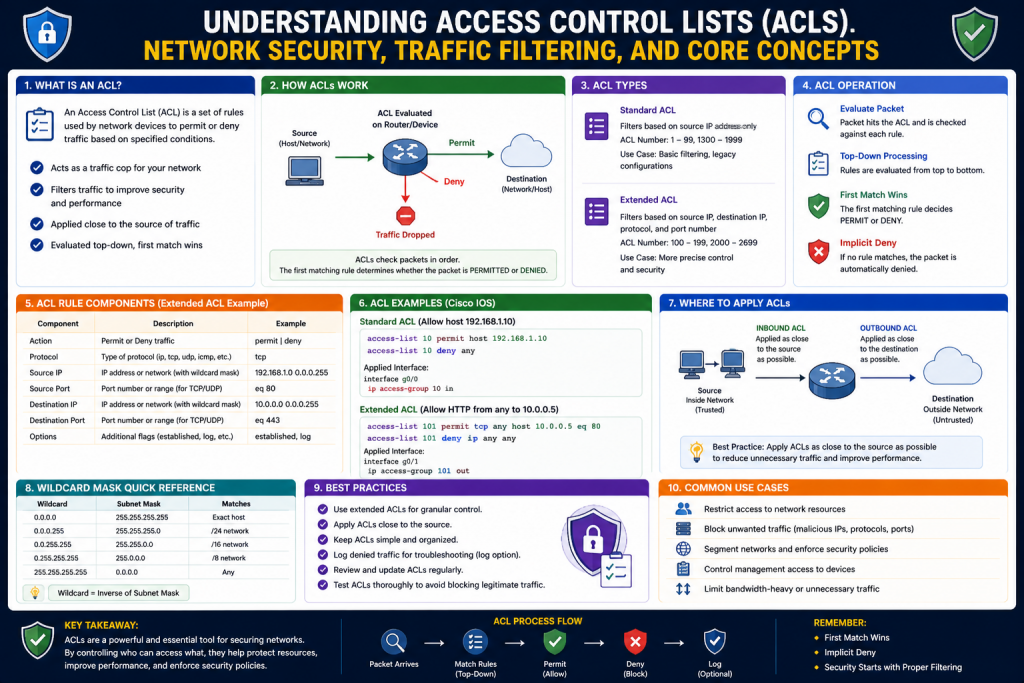
An Access Control List, commonly known as an ACL, is a set of rules used in networking to control the flow of traffic into and out of a network device. These rules are applied on devices such as routers, firewalls, and switches to determine whether specific packets of data should be allowed or denied. ACLs are a fundamental concept in networking and are widely used to enhance both security and performance.
In simple terms, an ACL acts as a filter. It examines network traffic and makes decisions based on predefined criteria such as IP addresses, protocols, and port numbers. If the traffic meets the conditions specified in the ACL, it is either permitted to pass through or blocked entirely. This ability to control traffic makes ACLs an essential tool for network administrators.
The importance of ACLs has grown significantly as networks have become more complex and interconnected. With the increasing number of devices and users accessing networks, the need for precise control over data flow has become critical. ACLs provide that control by allowing administrators to define exactly what type of traffic is acceptable.
The Role of ACLs in Network Security
Security is one of the primary reasons for implementing ACLs in a network. Without proper controls, networks are vulnerable to unauthorized access, data breaches, and various forms of cyberattacks. ACLs help mitigate these risks by restricting access to sensitive resources.
One of the key advantages of ACLs is their ability to enforce security policies at the network level. Instead of relying solely on individual devices or applications to provide protection, ACLs create a centralized mechanism for controlling access. This ensures consistency and reduces the chances of security gaps.
ACLs are often used to block traffic from unknown or untrusted sources. For example, an organization may choose to deny all incoming traffic from external networks except for specific trusted IP addresses. This approach significantly reduces the attack surface and makes it more difficult for attackers to gain access.
Another important use of ACLs is in preventing the spread of malware. By restricting certain types of traffic, such as peer-to-peer file sharing or unauthorized applications, ACLs can help limit the potential impact of malicious software. This proactive approach is essential in maintaining a secure network environment.
How ACLs Manage Network Traffic
ACLs play a crucial role in managing network traffic by determining which packets are allowed to pass through a device. This process involves inspecting each packet and comparing it against a list of rules.
When a packet arrives at a device, the ACL is checked in a sequential manner. The device starts with the first rule in the list and evaluates whether the packet matches the specified conditions. If a match is found, the corresponding action is applied immediately.
This sequential evaluation means that the order of rules is extremely important. A rule placed at the top of the list will be evaluated before those below it. As a result, administrators must carefully arrange rules to ensure the desired behavior.
In addition to controlling access, ACLs can also be used to optimize network performance. By filtering out unnecessary traffic, they reduce congestion and improve the efficiency of data transmission. This is particularly beneficial in networks with limited bandwidth or high traffic volumes.
Components of an ACL Rule
Each ACL rule is made up of several components that define the conditions under which it applies. Understanding these components is essential for creating effective ACLs.
The first component is the source IP address. This specifies where the traffic is coming from. Administrators can define rules that apply to specific devices, networks, or ranges of addresses.
The second component is the destination IP address. This indicates where the traffic is going. By controlling access to certain destinations, ACLs can protect sensitive systems and data.
Another important component is the protocol. Common protocols include TCP, UDP, and ICMP. By specifying the protocol, administrators can control the type of traffic allowed on the network.
Port numbers are also a key part of ACL rules. Ports are used to identify specific services or applications. For example, port 80 is commonly used for web traffic, while port 443 is used for secure web communication. By filtering traffic based on port numbers, ACLs can allow or block specific services.
Finally, each rule includes an action, which is either permit or deny. This determines whether the traffic is allowed to pass or is blocked.
The Importance of Rule Ordering
One of the most critical aspects of ACL configuration is the order in which rules are placed. Since ACLs are processed from top to bottom, the sequence of rules directly affects how traffic is handled.
If a packet matches a rule at the top of the list, the corresponding action is applied, and no further rules are evaluated. This means that even if there are more specific rules further down the list, they will not be considered.
For this reason, it is important to place more specific rules before more general ones. This ensures that important conditions are evaluated first and that the intended behavior is achieved.
For example, if an administrator wants to block traffic from a specific IP address but allow all other traffic, the deny rule for that IP address should be placed before the general permit rule. Otherwise, the general rule may allow the traffic before the deny rule is reached.
Proper rule ordering helps prevent conflicts and ensures that ACLs function as intended. It also makes the configuration easier to understand and maintain.
Packet Filtering Process
The process of filtering packets using an ACL involves several steps. When a packet arrives at a network device, it is first identified and analyzed. The device then compares the packet’s characteristics with the rules in the ACL.
The evaluation begins with the first rule in the list. The device checks whether the packet matches the conditions specified in that rule. If it does, the action defined in the rule is applied.
If the packet does not match the first rule, the device moves on to the next rule and repeats the process. This continues until a match is found or all rules have been evaluated.
Once a match is found, the packet is either allowed to pass or is blocked, depending on the action specified. No further rules are considered after a match is made.
This process ensures that every packet is handled according to the defined policies. It also highlights the importance of carefully designing ACL rules to avoid unintended outcomes.
Default Behavior and Implicit Deny
A key concept in ACLs is the idea of an implicit deny rule. This rule is not always visible in the configuration, but it is always present at the end of the ACL.
The implicit deny rule means that any packet that does not match any of the defined rules will be automatically blocked. This approach follows the principle of denying all traffic unless it is explicitly allowed.
This default behavior enhances security by ensuring that only authorized traffic is permitted. However, it also requires administrators to be thorough when defining rules. Any necessary traffic must be explicitly allowed, or it will be denied by default.
In some cases, administrators may choose to add an explicit rule at the end of the ACL to define the default behavior. For example, they may include a rule that allows all remaining traffic. This can make the configuration more transparent and easier to understand.
Understanding the implicit deny rule is essential for effective ACL management. It helps prevent unexpected issues and ensures that the network remains secure.
Types of Access Control Lists
There are two main types of ACLs used in networking: standard ACLs and extended ACLs. Each type has its own characteristics and use cases.
Standard ACLs are the simpler of the two. They primarily filter traffic based on the source IP address. This makes them suitable for basic access control tasks, such as allowing or denying traffic from specific networks.
Extended ACLs provide more advanced filtering capabilities. They can evaluate multiple criteria, including source and destination IP addresses, protocols, and port numbers. This allows for more precise control over network traffic.
Because of their flexibility, extended ACLs are often used in more complex environments. They enable administrators to create detailed rules that align closely with security requirements.
Choosing the right type of ACL depends on the needs of the network. In many cases, a combination of both standard and extended ACLs is used to achieve the desired level of control.
Real-World Applications of ACLs
ACLs are used in a wide range of real-world scenarios to improve network security and performance. One common application is restricting access to internal resources.
For example, an organization may want to allow only employees to access certain servers. By configuring an ACL that permits traffic from internal IP addresses and denies all others, this goal can be achieved.
Another application is controlling access to specific services. An administrator may choose to allow web traffic while blocking other types of traffic, such as file sharing or gaming applications.
ACLs are also used to prioritize traffic. In networks where certain types of communication are more important, such as voice or video calls, ACLs can be used to identify and prioritize those packets. This helps ensure a high-quality user experience.
In addition, ACLs can be used to segment networks. By controlling communication between different parts of the network, they help limit the spread of potential threats and improve overall security.
Planning and Designing ACLs
Effective use of ACLs requires careful planning and design. Before creating any rules, administrators should have a clear understanding of the network and its requirements.
This involves analyzing traffic patterns, identifying critical resources, and understanding user behavior. By gathering this information, administrators can create ACLs that meet both security and operational needs.
Documentation is an important part of this process. Keeping track of IP addresses, protocols, and commonly used services helps ensure that ACLs are accurate and effective.
Another important consideration is scalability. As networks grow and change, ACLs must be updated to reflect new requirements. Designing ACLs with flexibility in mind makes it easier to adapt to these changes.
Testing is also a critical step in the design process. Before deploying ACLs in a production environment, they should be tested in a controlled setting to ensure they function as intended.
Challenges in Using ACLs
While ACLs are a powerful tool, they are not without challenges. One of the main difficulties is managing large and complex rule sets. As the number of rules increases, it becomes more difficult to maintain and troubleshoot ACLs.
Another challenge is avoiding conflicts between rules. Overlapping or contradictory rules can lead to unexpected behavior, such as blocking legitimate traffic or allowing unauthorized access.
Performance can also be a concern. Since ACLs are processed sequentially, large rule sets can impact the speed of packet processing. This can lead to increased latency and reduced network performance.
To address these challenges, administrators should follow best practices such as keeping ACLs organized, regularly reviewing configurations, and removing unnecessary rules.
Understanding ACL Implementation in Real Environments
Implementing Access Control Lists in a real network environment goes beyond simply writing rules. It involves a structured process that ensures the ACLs align with the organization’s security policies, operational needs, and network architecture. A poorly implemented ACL can disrupt communication, block legitimate users, or even expose the network to security risks.
Before deploying ACLs, administrators must clearly define the objectives. These objectives may include restricting unauthorized access, improving network performance, enforcing compliance policies, or segmenting traffic. Each goal influences how ACLs are designed and where they are applied within the network.
ACLs can be applied on routers, firewalls, and sometimes switches. The placement of an ACL is critical because it determines how early or late traffic is filtered. Applying ACLs closer to the source of traffic can reduce unnecessary load on the network, while applying them near the destination can provide more control over access to specific resources.
Analyzing Network Traffic Before Implementation
One of the most important steps in implementing ACLs is understanding the network traffic. Without this understanding, it is difficult to create rules that are both effective and efficient.
Network administrators should analyze which devices communicate with each other, what types of applications are in use, and which protocols are most common. This analysis helps identify normal traffic patterns and distinguish them from potentially harmful or unnecessary traffic.
Traffic analysis often involves reviewing logs, monitoring bandwidth usage, and documenting IP address ranges. For example, administrators may identify that certain departments require access to specific servers, while others do not. This information is essential for creating targeted ACL rules.
Another important aspect of traffic analysis is identifying critical services. Services such as email, web access, and internal applications must remain accessible. ACLs should be designed in a way that protects these services without interrupting them.
Defining Clear Security Policies
ACL implementation should always be guided by well-defined security policies. These policies outline what types of traffic are allowed and what should be blocked.
A strong security policy typically follows the principle of least privilege. This means that only the minimum necessary access is granted, and everything else is denied by default. ACLs are an ideal tool for enforcing this principle because they allow administrators to explicitly define permitted traffic.
For example, a policy may state that only certain IP addresses are allowed to access a database server. The ACL would then include rules that permit traffic from those addresses and deny all others.
Consistency is important when defining policies. All ACLs within the network should follow the same guidelines to avoid confusion and potential security gaps. Documentation also plays a key role, as it helps administrators understand the purpose of each rule.
Prioritizing Rules from Specific to General
Rule prioritization is one of the most critical aspects of ACL implementation. Since ACLs are evaluated from top to bottom, the order of rules directly affects how traffic is handled.
Specific rules should always be placed at the top of the list. These rules target particular conditions, such as a specific IP address or application. By placing them first, administrators ensure that important traffic is handled correctly.
General rules, which apply to broader conditions, should be placed lower in the list. These rules act as a fallback for traffic that does not match any of the specific conditions.
For example, if an administrator wants to block traffic from a specific IP address but allow all other traffic, the deny rule for that IP address must appear before the general permit rule. Otherwise, the traffic may be allowed before the deny rule is reached.
Proper rule ordering not only improves security but also enhances performance by reducing the number of rules that need to be evaluated for each packet.
Standard ACL Configuration Concepts
Standard ACLs are the simplest type of ACL and are primarily used for basic traffic filtering. They evaluate traffic based only on the source IP address.
When configuring a standard ACL, administrators assign it a number or name and define the rules that determine which traffic is permitted or denied. These ACLs are typically used in situations where broad filtering is sufficient.
For example, a standard ACL might be used to allow traffic from a specific network while blocking all other sources. This type of configuration is useful for controlling access to internal resources.
Standard ACLs are usually placed close to the destination. Since they do not consider the destination IP address, placing them near the source could unintentionally block traffic that is meant for other destinations.
Despite their simplicity, standard ACLs are still very effective when used correctly. They provide a quick and efficient way to implement basic security controls.
Extended ACL Configuration Concepts
Extended ACLs offer more advanced filtering capabilities and allow administrators to define more granular rules. These ACLs can evaluate multiple parameters, including source and destination IP addresses, protocols, and port numbers.
Because of their flexibility, extended ACLs are often used in complex network environments where precise control is required. They can be used to allow or block specific applications, restrict access to certain services, and enforce detailed security policies.
For example, an extended ACL can be configured to allow web traffic from a specific network while blocking all other types of traffic. This level of control is not possible with standard ACLs.
Extended ACLs are typically placed close to the source of traffic. This helps reduce unnecessary traffic from traveling across the network, improving overall efficiency.
Configuring extended ACLs requires careful planning, as the increased complexity can make them more difficult to manage. However, the benefits they provide in terms of security and control make them an essential tool for modern networks.
Applying ACLs to Interfaces
Once an ACL is created, it must be applied to a network interface for it to take effect. This step is crucial because an ACL that is not applied to an interface will not influence traffic.
ACLs can be applied in two directions: inbound and outbound. An inbound ACL filters traffic as it enters an interface, while an outbound ACL filters traffic as it leaves.
Choosing the correct direction depends on the desired outcome. Inbound ACLs are often used to block unwanted traffic before it enters the network, while outbound ACLs can be used to control what traffic leaves the network.
The placement of ACLs on interfaces should be carefully considered. Applying an ACL in the wrong location or direction can lead to unintended consequences, such as blocking legitimate traffic or failing to stop unwanted traffic.
Testing and validation are essential after applying ACLs to ensure they are functioning as intended.
Step-by-Step ACL Configuration Process
Configuring ACLs typically follows a structured process. While the exact commands may vary depending on the device, the general steps remain consistent.
The first step is entering configuration mode on the network device. This allows administrators to make changes to the system settings.
Next, the ACL is created by defining the rules. Each rule specifies the conditions and the action to be taken. For example, a rule may permit traffic from a specific IP range or deny traffic to a certain port.
After the rules are defined, the ACL is applied to the appropriate interface. This step activates the ACL and begins filtering traffic.
Finally, the configuration is verified to ensure that the ACL is working correctly. This may involve checking the configuration, monitoring traffic, and testing connectivity.
Following a structured process helps ensure that ACLs are implemented correctly and reduces the risk of errors.
Verifying ACL Configuration
Verification is a critical step in ACL implementation. Without proper verification, it is difficult to determine whether the ACL is functioning as intended.
Administrators can use various commands and tools to verify ACL configurations. These tools provide information about the rules, their order, and how they are being applied.
One common method of verification is reviewing the ACL itself. This involves checking that all rules are correctly defined and in the proper order.
Another method is testing connectivity. By attempting to access resources from different locations, administrators can confirm whether the ACL is allowing or blocking traffic as expected.
Verification should be performed both during and after implementation. This ensures that any issues are identified and resolved quickly.
Testing ACLs in Controlled Environments
Before deploying ACLs in a live network, it is important to test them in a controlled environment. This helps prevent disruptions and ensures that the ACLs behave as expected.
Testing environments may include lab setups, virtual networks, or non-production systems. These environments allow administrators to simulate real-world scenarios without affecting actual users.
During testing, administrators should generate different types of traffic to verify that the ACL rules are working correctly. This includes both permitted and denied traffic.
Testing also helps identify potential conflicts or gaps in the rules. By addressing these issues before deployment, administrators can avoid problems in the production environment.
A thorough testing process increases confidence in the ACL configuration and reduces the risk of unexpected behavior.
Common Mistakes in ACL Implementation
There are several common mistakes that administrators should avoid when implementing ACLs. One of the most frequent errors is incorrect rule ordering. As mentioned earlier, the order of rules is critical, and mistakes in ordering can lead to unintended results.
Another common mistake is failing to account for the implicit deny rule. If necessary traffic is not explicitly permitted, it will be blocked by default.
Overly complex ACLs can also be problematic. Large and complicated rule sets are difficult to manage and increase the likelihood of errors. Keeping ACLs simple and well-organized is key to effective implementation.
Lack of documentation is another issue. Without proper documentation, it becomes difficult to understand the purpose of each rule and make updates when needed.
Finally, insufficient testing can lead to serious problems. Deploying ACLs without proper testing increases the risk of network disruptions and security vulnerabilities.
Best Practices for ACL Implementation
To ensure successful ACL implementation, administrators should follow best practices. One important practice is to plan and document all rules before applying them. This helps ensure that the ACL aligns with the network’s requirements.
Another best practice is to use descriptive names and comments for ACLs. This makes it easier to understand their purpose and simplifies troubleshooting.
Regular reviews and updates are also essential. As network requirements change, ACLs must be adjusted to reflect those changes.
Minimizing the number of rules can improve performance and make ACLs easier to manage. Administrators should remove unnecessary or redundant rules whenever possible.
Finally, monitoring and logging should be enabled to track ACL activity. This provides valuable insights into how the ACL is functioning and helps identify potential issues.
Preparing for Advanced ACL Usage
As networks become more complex, ACLs are often used in combination with other technologies such as quality of service, network address translation, and security systems. Understanding how ACLs interact with these technologies is important for advanced network design.
For example, ACLs can be used to classify traffic for prioritization in quality of service configurations. They can also be used to define which traffic is translated in network address translation processes.
Preparing for advanced usage involves gaining a deeper understanding of networking concepts and how different components work together. This knowledge allows administrators to create more sophisticated and effective ACL configurations.
Introduction to ACL Maintenance and Lifecycle Management
Access Control Lists are not a one-time configuration task. After implementation, they require continuous monitoring, regular updates, and ongoing maintenance to remain effective. Networks are dynamic environments where user behavior, applications, and security threats evolve over time. As a result, ACLs must also adapt to these changes.
Managing ACLs throughout their lifecycle ensures that they continue to align with organizational goals and security policies. Without proper maintenance, ACLs can become outdated, inefficient, or even harmful to network operations. For example, an old rule may block legitimate traffic or allow access that should no longer be permitted.
The lifecycle of an ACL includes creation, deployment, monitoring, auditing, optimization, and eventual modification or removal. Each stage plays a role in maintaining a secure and efficient network.
Importance of Monitoring ACL Activity
Monitoring is a critical component of ACL management. It provides visibility into how ACLs are functioning and whether they are effectively enforcing security policies.
By monitoring ACL activity, administrators can identify patterns in network traffic, detect unusual behavior, and verify that rules are working as intended. This visibility is essential for maintaining both security and performance.
One of the key benefits of monitoring is early detection of issues. For example, if an ACL is incorrectly blocking legitimate traffic, monitoring tools can help identify the problem before it affects a large number of users.
Monitoring also helps in identifying potential security threats. Unusual traffic patterns, repeated access attempts, or unexpected denied packets may indicate malicious activity. By analyzing this information, administrators can take proactive measures to protect the network.
Logging and Analyzing ACL Events
Logging is closely related to monitoring and provides detailed records of ACL activity. When logging is enabled, each packet that matches a rule can be recorded along with relevant information such as source address, destination address, and action taken.
These logs are valuable for troubleshooting and security analysis. They allow administrators to review past events and understand how traffic has been handled by the ACL.
Regular analysis of logs can reveal trends and anomalies. For example, a sudden increase in denied traffic from a particular source may indicate an attempted attack. Similarly, repeated access attempts to restricted resources may suggest unauthorized activity.
Log management is important because large networks can generate significant amounts of data. Administrators should implement strategies for storing, filtering, and analyzing logs to ensure they remain useful and manageable.
Tools for Testing and Troubleshooting ACLs
Testing and troubleshooting are essential for ensuring that ACLs function correctly. Various tools can be used to simulate traffic, capture packets, and analyze results.
Packet analyzers are among the most commonly used tools. They allow administrators to capture and inspect network traffic in real time. By examining packet details, administrators can determine whether ACL rules are being applied correctly.
Traffic generators are another useful tool. They allow administrators to create specific types of traffic to test how ACLs respond. This helps verify that rules are correctly permitting or denying traffic.
Command-line utilities on network devices also play a role in troubleshooting. These tools provide information about ACL configurations, rule matches, and interface statistics.
Using a combination of tools provides a comprehensive approach to testing and troubleshooting. It ensures that ACLs are thoroughly validated and any issues are quickly identified.
Identifying and Resolving Common ACL Issues
Despite careful planning, issues can still arise in ACL configurations. Identifying and resolving these issues is a key part of maintaining a healthy network.
One common issue is unintended traffic blocking. This occurs when a rule is too restrictive or incorrectly placed, preventing legitimate traffic from passing through. Troubleshooting this issue involves reviewing the rule order and conditions.
Another issue is allowing unauthorized traffic. This may happen if a rule is too broad or if a necessary deny rule is missing. Regular audits and monitoring can help detect and address this problem.
Performance issues can also occur if ACLs become too large or complex. Since each packet must be evaluated against the rules, a large number of rules can slow down processing. Simplifying the ACL and removing unnecessary rules can improve performance.
Misconfigurations are another common problem. Errors in IP addresses, port numbers, or protocols can lead to unexpected behavior. Careful review and testing are essential to prevent these issues.
Conducting Regular ACL Audits
Regular audits are an important part of ACL maintenance. An audit involves reviewing all ACL rules to ensure they are still relevant, accurate, and aligned with current policies.
During an audit, administrators should verify that each rule has a clear purpose. Rules that are no longer needed should be removed to reduce complexity and improve performance.
Audits also help identify redundant or overlapping rules. Eliminating these redundancies makes the ACL easier to manage and reduces the risk of conflicts.
In addition, audits provide an opportunity to ensure compliance with organizational and regulatory requirements. This is particularly important in industries where data security is strictly regulated.
Scheduling audits on a regular basis ensures that ACLs remain up to date and effective.
Optimizing ACL Performance
As networks grow, ACL performance becomes increasingly important. Poorly optimized ACLs can lead to delays in packet processing and reduced network efficiency.
One way to optimize performance is by minimizing the number of rules. Each additional rule increases the time required to evaluate packets. Removing unnecessary or redundant rules helps improve efficiency.
Another optimization technique is proper rule ordering. Placing frequently matched rules at the top of the list reduces the number of comparisons needed for each packet.
Grouping similar rules can also improve performance and readability. For example, rules that apply to the same network or service can be organized together.
Using more efficient rule definitions, such as summarizing IP address ranges, can further reduce complexity. This not only improves performance but also makes the ACL easier to manage.
Adapting ACLs to Changing Network Requirements
Networks are constantly evolving, and ACLs must adapt to these changes. New devices, applications, and users introduce new traffic patterns and security requirements.
When changes occur, ACLs should be reviewed and updated accordingly. This may involve adding new rules, modifying existing ones, or removing outdated entries.
Change management processes are important for ensuring that updates are made in a controlled and documented manner. This reduces the risk of errors and ensures that all changes are aligned with organizational policies.
Communication between network administrators and other teams is also essential. Understanding business needs and upcoming changes helps ensure that ACLs continue to support network operations.
Integrating ACLs with Other Security Measures
ACLs are most effective when used as part of a broader security strategy. They should be integrated with other security measures such as firewalls, intrusion detection systems, and authentication mechanisms.
For example, while ACLs can block unauthorized traffic, firewalls provide more advanced features such as stateful inspection and application-level filtering. Combining these technologies enhances overall security.
Intrusion detection and prevention systems can complement ACLs by identifying and responding to threats that bypass initial filters. Together, these systems provide multiple layers of protection.
Authentication mechanisms ensure that only authorized users can access network resources. ACLs can then be used to enforce access controls based on user roles and permissions.
This layered approach to security, often referred to as defense in depth, provides a more robust and resilient network environment.
Documentation and Change Tracking
Proper documentation is essential for effective ACL management. Each rule should be clearly documented, including its purpose, conditions, and expected behavior.
Documentation helps administrators understand the configuration and makes it easier to troubleshoot issues. It also ensures continuity when multiple team members are involved in managing the network.
Change tracking is another important aspect. Any modifications to ACLs should be recorded, including the reason for the change and the date it was made. This provides a history of changes and helps identify the cause of any issues that arise.
Using standardized naming conventions and comments within ACL configurations further improves clarity and organization.
Automating ACL Management
In large networks, manual management of ACLs can become time-consuming and error-prone. Automation can help streamline the process and improve consistency.
Automation tools can be used to generate, deploy, and update ACLs based on predefined templates and policies. This reduces the risk of human error and ensures that configurations are consistent across devices.
Automated monitoring and alerting systems can also enhance visibility. These systems can notify administrators of unusual activity or potential issues, allowing for faster response times.
While automation offers many benefits, it should be implemented carefully. Proper testing and validation are essential to ensure that automated processes function correctly.
Preparing for Future Networking Trends
As networking technologies continue to evolve, the role of ACLs is also changing. New architectures such as cloud computing, software-defined networking, and zero trust models are influencing how access control is implemented.
In cloud environments, ACLs are often used in conjunction with virtual firewalls and security groups. Understanding how ACLs function in these environments is important for modern network management.
Software-defined networking introduces new ways of managing traffic and policies. ACLs may be implemented through centralized controllers, providing greater flexibility and control.
The zero trust model emphasizes strict access controls and continuous verification. ACLs play a key role in enforcing these principles by ensuring that only authorized traffic is allowed.
Staying informed about these trends helps administrators adapt their ACL strategies and maintain effective security.
Long-Term Maintenance Strategies
Maintaining ACLs over the long term requires a proactive approach. Regular reviews, updates, and optimization are essential for ensuring continued effectiveness.
Establishing clear procedures for managing ACLs helps maintain consistency and reduces the risk of errors. These procedures should include guidelines for creating, modifying, and removing rules.
Training and knowledge sharing are also important. Ensuring that team members understand ACL concepts and best practices helps improve overall management.
Periodic testing should be conducted to verify that ACLs are functioning as expected. This includes both routine checks and testing after any changes are made.
By adopting a structured approach to maintenance, organizations can ensure that their ACLs remain effective and aligned with their goals.
Conclusion
Access Control Lists are a powerful and essential component of network security and traffic management. While their initial configuration is important, their long-term effectiveness depends on proper monitoring, troubleshooting, and maintenance.
Through continuous monitoring and logging, administrators gain valuable insights into network activity and can quickly identify potential issues. Troubleshooting tools and techniques ensure that problems are resolved efficiently, minimizing disruptions.
Regular audits and optimization help keep ACLs relevant and efficient, while proper documentation and change tracking provide clarity and accountability. Integrating ACLs with other security measures creates a layered defense that enhances overall protection.
As networks continue to evolve, ACLs must adapt to new technologies and requirements. By staying informed and following best practices, administrators can ensure that ACLs remain a reliable and effective tool for controlling network traffic.
In the end, successful ACL management is not just about controlling access but about maintaining a balance between security, performance, and usability. When implemented and maintained correctly, ACLs provide a strong foundation for a secure and efficient network environment.
Continue exploring the technologies and certification concepts that matter most to you.